Every problem in the chapter beside the book’s answer, a chapter at a time as you scroll.
Chapter 10: Further Applications of Trigonometry
376 problems · 155 figuresTry It #1 §10.1 source ↗
Solve the triangle shown in Figure 8 to the nearest tenth.
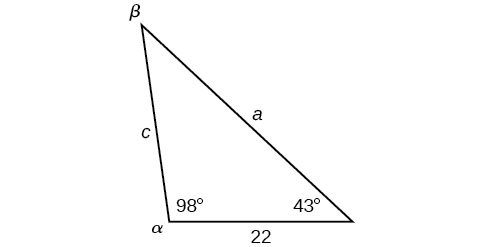 Figure 8
Answer
Try It #2 §10.1 source ↗
Answer
Solution 1
Solution 2
Try It #3 §10.1 source ↗
Answer
Try It #4 §10.1 source ↗
Answer
Try It #5 §10.1 source ↗
Answer
Try It #6 §10.1 source ↗
The diagram shown in Figure 17 represents the height of a blimp flying over a football stadium. Find the height of the blimp if the angle of elevation at the southern end zone, point A, is 70°, the angle of elevation from the northern end zone, point is 62°, and the distance between the viewing points of the two end zones is 145 yards.
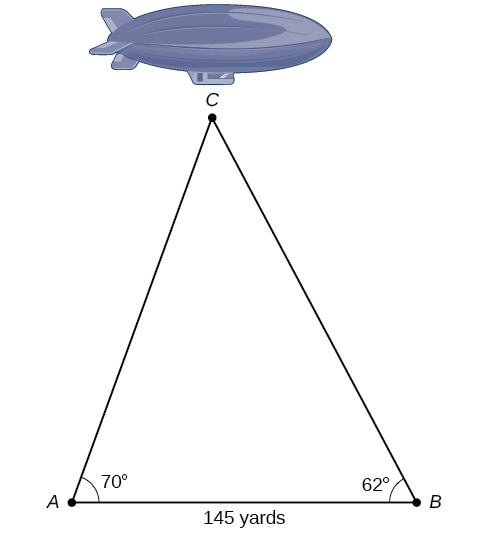
 Figure 17
Answer
10.1-1 §10.1 source ↗
Answer
10.1-3 §10.1 source ↗
Answer
10.1-5 §10.1 source ↗
Answer
10.1-7 §10.1 source ↗
For the following exercises, assume is opposite side is opposite side and is opposite side Solve each triangle, if possible. Round each answer to the nearest tenth.
Answer
10.1-9 §10.1 source ↗
For the following exercises, assume is opposite side is opposite side and is opposite side Solve each triangle, if possible. Round each answer to the nearest tenth.
Answer
10.1-11 §10.1 source ↗
For the following exercises, use the Law of Sines to solve for the missing side for each oblique triangle. Round each answer to the nearest hundredth. Assume that angle is opposite side angle is opposite side and angle is opposite side
Find side when
Answer
10.1-13 §10.1 source ↗
For the following exercises, use the Law of Sines to solve for the missing side for each oblique triangle. Round each answer to the nearest hundredth. Assume that angle is opposite side angle is opposite side and angle is opposite side
Find side when
Answer
10.1-15 §10.1 source ↗
For the following exercises, assume is opposite side is opposite side and is opposite side Determine whether there is no triangle, one triangle, or two triangles. Then solve each triangle, if possible. Round each answer to the nearest tenth.
Answer
10.1-17 §10.1 source ↗
For the following exercises, assume is opposite side is opposite side and is opposite side Determine whether there is no triangle, one triangle, or two triangles. Then solve each triangle, if possible. Round each answer to the nearest tenth.
Answer
10.1-19 §10.1 source ↗
For the following exercises, assume is opposite side is opposite side and is opposite side Determine whether there is no triangle, one triangle, or two triangles. Then solve each triangle, if possible. Round each answer to the nearest tenth.
Answer
10.1-21 §10.1 source ↗
For the following exercises, assume is opposite side is opposite side and is opposite side Determine whether there is no triangle, one triangle, or two triangles. Then solve each triangle, if possible. Round each answer to the nearest tenth.
Answer
10.1-23 §10.1 source ↗
For the following exercises, assume is opposite side is opposite side and is opposite side Determine whether there is no triangle, one triangle, or two triangles. Then solve each triangle, if possible. Round each answer to the nearest tenth.
Answer
10.1-25 §10.1 source ↗
For the following exercises, use the Law of Sines to solve, if possible, the missing side or angle for each triangle or triangles in the ambiguous case. Round each answer to the nearest tenth.
Find angle when
Answer
10.1-27 §10.1 source ↗
For the following exercises, find the area of the triangle with the given measurements. Round each answer to the nearest tenth.
Answer
10.1-29 §10.1 source ↗
For the following exercises, find the area of the triangle with the given measurements. Round each answer to the nearest tenth.
Answer
10.1-31 §10.1 source ↗
For the following exercises, find the length of side Round to the nearest tenth.
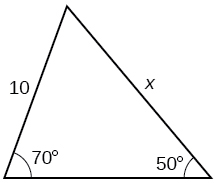
Answer
10.1-33 §10.1 source ↗
For the following exercises, find the length of side Round to the nearest tenth.
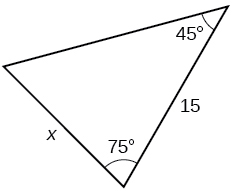
Answer
10.1-35 §10.1 source ↗
For the following exercises, find the length of side Round to the nearest tenth.
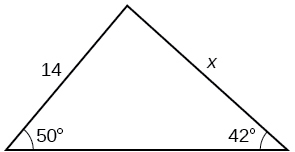
Answer
10.1-37 §10.1 source ↗
For the following exercises, find the measure of angle if possible. Round to the nearest tenth.
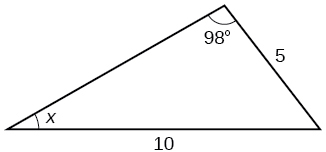
Answer
10.1-39 §10.1 source ↗
For the following exercises, find the measure of angle if possible. Round to the nearest tenth.
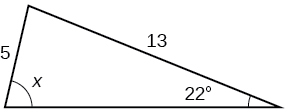
Answer
10.1-41 §10.1 source ↗
For the following exercises, find the measure of angle if possible. Round to the nearest tenth.
Notice that is an obtuse angle.
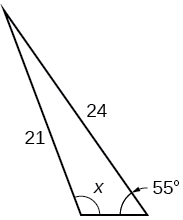
Answer
10.1-43 §10.1 source ↗
For the following exercise, solve the triangle. Round each answer to the nearest tenth.
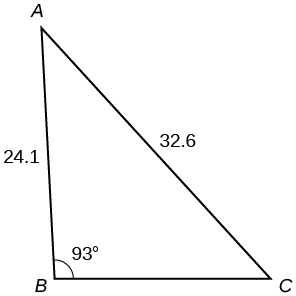
Answer
10.1-45 §10.1 source ↗
For the following exercise, solve the triangle. Round each answer to the nearest tenth.
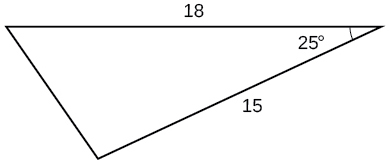
Answer
10.1-47 §10.1 source ↗
For the following exercise, solve the triangle. Round each answer to the nearest tenth.
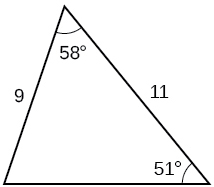
Answer
10.1-49 §10.1 source ↗
For the following exercise, solve the triangle. Round each answer to the nearest tenth.
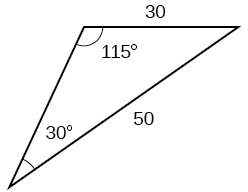
Answer
10.1-51 §10.1 source ↗
For the following exercise, solve the triangle. Round each answer to the nearest tenth.
Find the diameter of the circle in Figure 19. Round to the nearest tenth.
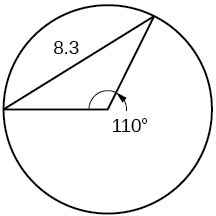 Figure 19
Answer
10.1-53 §10.1 source ↗
For the following exercise, solve the triangle. Round each answer to the nearest tenth.
Find in Figure 21. Round to the nearest tenth.
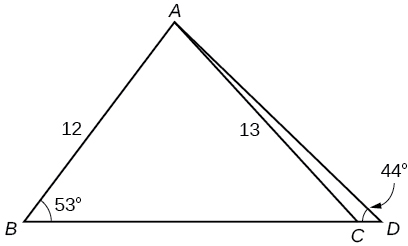 Figure 21
Answer
10.1-55 §10.1 source ↗
For the following exercise, solve the triangle. Round each answer to the nearest tenth.
Find in the parallelogram shown in Figure 23.
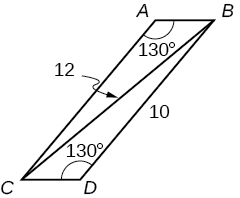 Figure 23
Answer
10.1-57 §10.1 source ↗
For the following exercise, solve the triangle. Round each answer to the nearest tenth.
Solve the triangle in Figure 25. (Hint: Draw a perpendicular from to Round each answer to the nearest tenth.
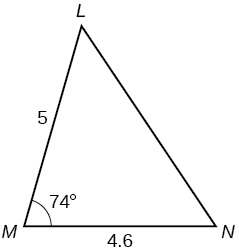 Figure 25
Answer
10.1-59 §10.1 source ↗
For the following exercise, solve the triangle. Round each answer to the nearest tenth.
A pole leans away from the sun at an angle of to the vertical, as shown in Figure 27. When the elevation of the sun is the pole casts a shadow 42 feet long on the level ground. How long is the pole? Round the answer to the nearest tenth.
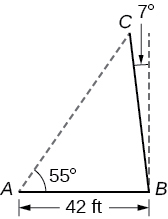 Figure 27
Answer
10.1-61 §10.1 source ↗
For the following exercise, solve the triangle. Round each answer to the nearest tenth.
Figure 29 shows a satellite orbiting Earth. The satellite passes directly over two tracking stations and which are 69 miles apart. When the satellite is on one side of the two stations, the angles of elevation at and are measured to be and respectively. How far is the satellite from station and how high is the satellite above the ground? Round answers to the nearest whole mile.
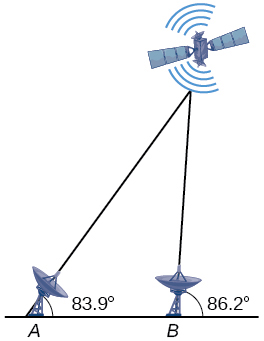
 Figure 29
Answer
10.1-63 §10.1 source ↗
For the following exercise, solve the triangle. Round each answer to the nearest tenth.
The roof of a house is at a angle. An 8-foot solar panel is to be mounted on the roof and should be angled relative to the horizontal for optimal results. (See Figure 31). How long does the vertical support holding up the back of the panel need to be? Round to the nearest tenth.
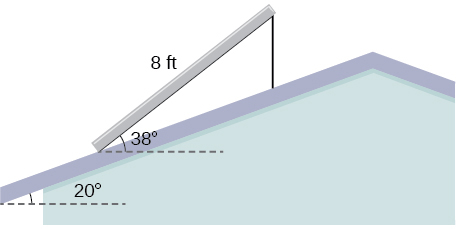 Figure 31
Answer
10.1-65 §10.1 source ↗
For the following exercise, solve the triangle. Round each answer to the nearest tenth.
A pilot is flying over a straight highway. He determines the angles of depression to two mileposts, 4.3 km apart, to be 32° and 56°, as shown in Figure 33. Find the distance of the plane from point to the nearest tenth of a kilometer.
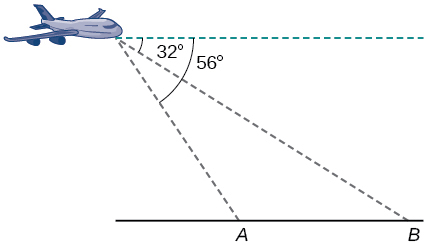
 Figure 33
Answer
10.1-67 §10.1 source ↗
For the following exercise, solve the triangle. Round each answer to the nearest tenth.
In order to estimate the height of a building, two students stand at a certain distance from the building at street level. From this point, they find the angle of elevation from the street to the top of the building to be 35°. They then move 250 feet closer to the building and find the angle of elevation to be 53°. Assuming that the street is level, estimate the height of the building to the nearest foot.
Answer
10.1-69 §10.1 source ↗
For the following exercise, solve the triangle. Round each answer to the nearest tenth.
A man and a woman standing miles apart spot a hot air balloon at the same time. If the angle of elevation from the man to the balloon is 27°, and the angle of elevation from the woman to the balloon is 41°, find the altitude of the balloon to the nearest foot.
Answer
10.1-71 §10.1 source ↗
For the following exercise, solve the triangle. Round each answer to the nearest tenth.
A street light is mounted on a pole. A 6-foot-tall man is standing on the street a short distance from the pole, casting a shadow. The angle of elevation from the tip of the man’s shadow to the top of his head of 28°. A 6-foot-tall woman is standing on the same street on the opposite side of the pole from the man. The angle of elevation from the tip of her shadow to the top of her head is 28°. If the man and woman are 20 feet apart, how far is the street light from the tip of the shadow of each person? Round the distance to the nearest tenth of a foot.
Answer
10.1-73 §10.1 source ↗
For the following exercise, solve the triangle. Round each answer to the nearest tenth.
Two streets meet at an 80° angle. At the corner, a park is being built in the shape of a triangle. Find the area of the park if, along one road, the park measures 180 feet, and along the other road, the park measures 215 feet.
Answer
10.1-75 §10.1 source ↗
For the following exercise, solve the triangle. Round each answer to the nearest tenth.
The Bermuda triangle is a region of the Atlantic Ocean that connects Bermuda, Florida, and Puerto Rico. Find the area of the Bermuda triangle if the distance from Florida to Bermuda is 1030 miles, the distance from Puerto Rico to Bermuda is 980 miles, and the angle created by the two distances is 62°.
Answer
10.1-77 §10.1 source ↗
For the following exercise, solve the triangle. Round each answer to the nearest tenth.
Naomi bought a dining table whose top is in the shape of a triangle. Find the area of the table top if two of the sides measure 4 feet and 4.5 feet, and the smaller angles measure 32° and 42°, as shown in Figure 35.
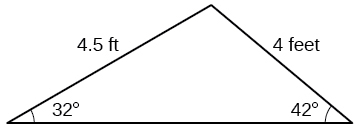 Figure 35
Answer
Try It #1 §10.2 source ↗
Answer
Try It #2 §10.2 source ↗
Answer
Try It #3 §10.2 source ↗
Answer
Try It #4 §10.2 source ↗
Answer
10.2-1 §10.2 source ↗
Answer
10.2-3 §10.2 source ↗
Answer
10.2-5 §10.2 source ↗
Answer
10.2-7 §10.2 source ↗
For the following exercises, assume is opposite side is opposite side and is opposite side If possible, solve each triangle for the unknown side. Round to the nearest tenth.
Answer
10.2-9 §10.2 source ↗
For the following exercises, assume is opposite side is opposite side and is opposite side If possible, solve each triangle for the unknown side. Round to the nearest tenth.
Answer
10.2-11 §10.2 source ↗
For the following exercises, assume is opposite side is opposite side and is opposite side If possible, solve each triangle for the unknown side. Round to the nearest tenth.
Answer
10.2-13 §10.2 source ↗
For the following exercises, assume is opposite side is opposite side and is opposite side If possible, solve each triangle for the unknown side. Round to the nearest tenth.
Answer
10.2-15 §10.2 source ↗
For the following exercises, assume is opposite side is opposite side and is opposite side If possible, solve each triangle for the unknown side. Round to the nearest tenth.
Answer
10.2-17 §10.2 source ↗
For the following exercises, use the Law of Cosines to solve for the missing angle of the oblique triangle. Round to the nearest tenth.
find angle
Answer
10.2-19 §10.2 source ↗
For the following exercises, use the Law of Cosines to solve for the missing angle of the oblique triangle. Round to the nearest tenth.
find angle
Answer
10.2-21 §10.2 source ↗
For the following exercises, solve the triangle. Round to the nearest tenth.
Answer
10.2-23 §10.2 source ↗
For the following exercises, solve the triangle. Round to the nearest tenth.
Answer
10.2-25 §10.2 source ↗
For the following exercises, solve the triangle. Round to the nearest tenth.
Answer
10.2-27 §10.2 source ↗
For the following exercises, use Heron’s formula to find the area of the triangle. Round to the nearest hundredth.
Find the area of a triangle with sides of length 18 in, 21 in, and 32 in. Round to the nearest tenth.
Answer
10.2-29 §10.2 source ↗
For the following exercises, use Heron’s formula to find the area of the triangle. Round to the nearest hundredth.
Answer
10.2-31 §10.2 source ↗
For the following exercises, use Heron’s formula to find the area of the triangle. Round to the nearest hundredth.
Answer
10.2-33 §10.2 source ↗
For the following exercises, find the length of side Round to the nearest tenth.
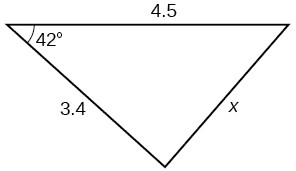
Answer
10.2-35 §10.2 source ↗
For the following exercises, find the length of side Round to the nearest tenth.
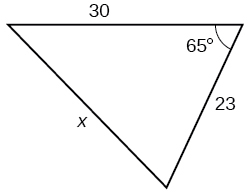
Answer
10.2-37 §10.2 source ↗
For the following exercises, find the length of side Round to the nearest tenth.
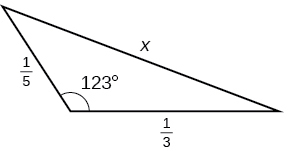
Answer
10.2-39 §10.2 source ↗
For the following exercises, find the measurement of angle
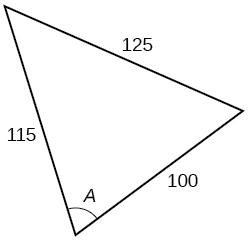
Answer
10.2-41 §10.2 source ↗
For the following exercises, find the measurement of angle
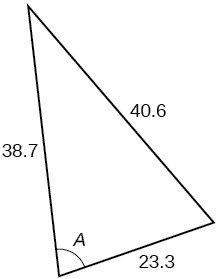
Answer
10.2-43 §10.2 source ↗
For the following exercises, solve for the unknown side. Round to the nearest tenth.
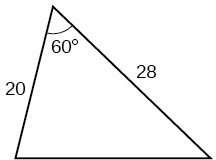
Answer
10.2-45 §10.2 source ↗
For the following exercises, solve for the unknown side. Round to the nearest tenth.
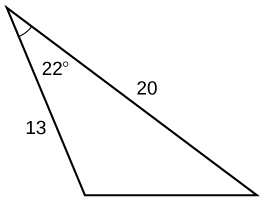
Answer
10.2-47 §10.2 source ↗
For the following exercises, find the area of the triangle. Round to the nearest hundredth.
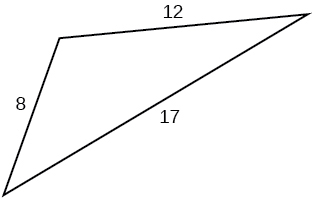
Answer
10.2-49 §10.2 source ↗
For the following exercises, find the area of the triangle. Round to the nearest hundredth.
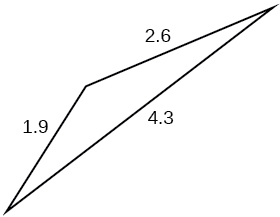
Answer
10.2-51 §10.2 source ↗
For the following exercises, find the area of the triangle. Round to the nearest hundredth.
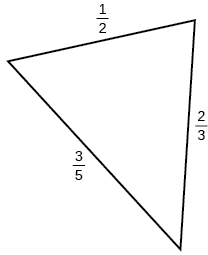
Answer
10.2-53 §10.2 source ↗
For the following exercises, find the area of the triangle. Round to the nearest hundredth.
The sides of a parallelogram are 11 feet and 17 feet. The longer diagonal is 22 feet. Find the length of the shorter diagonal.
Answer
10.2-55 §10.2 source ↗
For the following exercises, find the area of the triangle. Round to the nearest hundredth.
A regular octagon is inscribed in a circle with a radius of 8 inches. (See Figure 12.) Find the perimeter of the octagon.
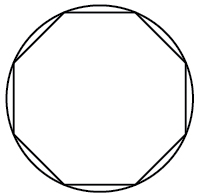 Figure 12
Answer
10.2-57 §10.2 source ↗
For the following exercises, suppose that represents the relationship of three sides of a triangle and the cosine of an angle.
Draw the triangle.
Answer
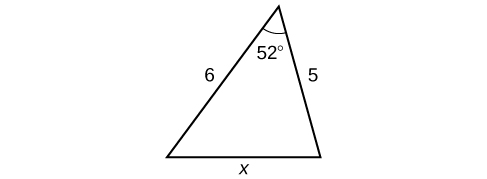
10.2-59 §10.2 source ↗
For the following exercises, find the area of the triangle.
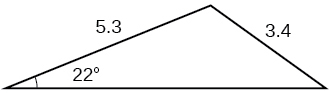
Answer
10.2-61 §10.2 source ↗
For the following exercises, find the area of the triangle.
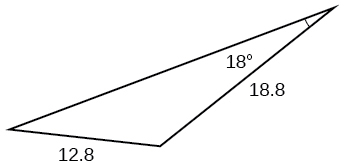
Answer
10.2-63 §10.2 source ↗
For the following exercises, find the area of the triangle.
A satellite calculates the distances and angle shown in Figure 15 (not to scale). Find the distance between the two cities. Round answers to the nearest tenth.
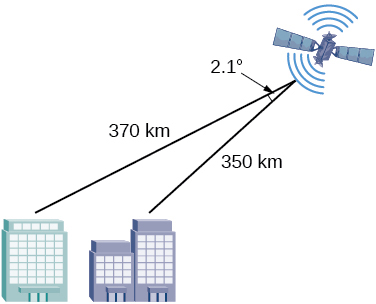
 Figure 15
Answer
10.2-65 §10.2 source ↗
For the following exercises, find the area of the triangle.
A 113-foot tower is located on a hill that is inclined 34° to the horizontal, as shown in Figure 16. A guy-wire is to be attached to the top of the tower and anchored at a point 98 feet uphill from the base of the tower. Find the length of wire needed.
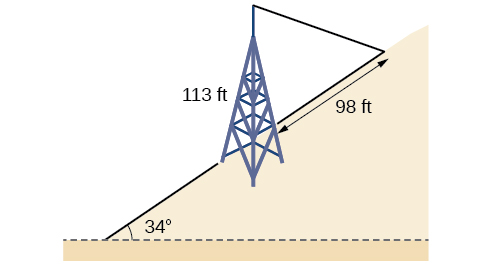
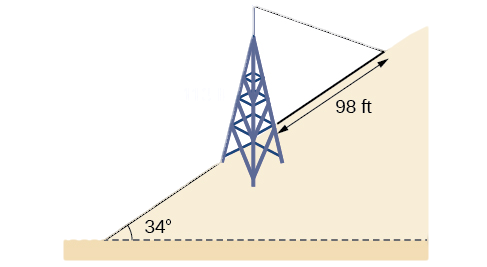 Figure 16
Answer
10.2-67 §10.2 source ↗
For the following exercises, find the area of the triangle.
The graph in Figure 17 represents two boats departing at the same time from the same dock. The first boat is traveling at 18 miles per hour at a heading of 327° and the second boat is traveling at 4 miles per hour at a heading of 60°. Find the distance between the two boats after 2 hours.
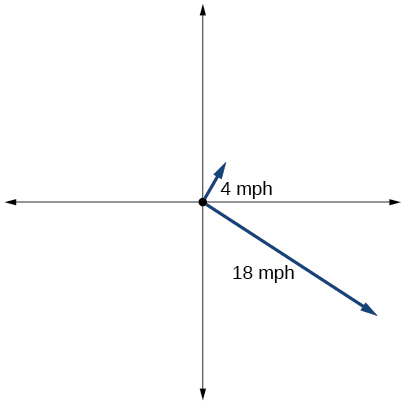 Figure 17
Answer
10.2-69 §10.2 source ↗
For the following exercises, find the area of the triangle.
A pilot flies in a straight path for 1 hour 30 min. She then makes a course correction, heading 10° to the right of her original course, and flies 2 hours in the new direction. If she maintains a constant speed of 680 miles per hour, how far is she from her starting position?
Answer
10.2-71 §10.2 source ↗
For the following exercises, find the area of the triangle.
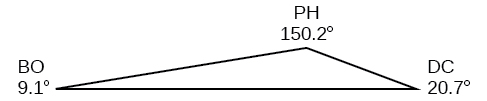
Philadelphia is 140 miles from Washington, D.C., Washington, D.C. is 442 miles from Boston, and Boston is 315 miles from Philadelphia. Draw a triangle connecting these three cities and find the angles in the triangle.
Answer
10.2-73 §10.2 source ↗
For the following exercises, find the area of the triangle.
Two airplanes take off in different directions. One travels 300 mph due west and the other travels 25° north of west at 420 mph. After 90 minutes, how far apart are they, assuming they are flying at the same altitude?
Answer
10.2-75 §10.2 source ↗
For the following exercises, find the area of the triangle.
The four sequential sides of a quadrilateral have lengths 4.5 cm, 7.9 cm, 9.4 cm, and 12.9 cm. The angle between the two smallest sides is 117°. What is the area of this quadrilateral?
Answer
10.2-77 §10.2 source ↗
For the following exercises, find the area of the triangle.
Find the area of a triangular piece of land that measures 30 feet on one side and 42 feet on another; the included angle measures 132°. Round to the nearest whole square foot.
Answer
Try It #1 §10.3 source ↗
Answer
Try It #2 §10.3 source ↗
Answer
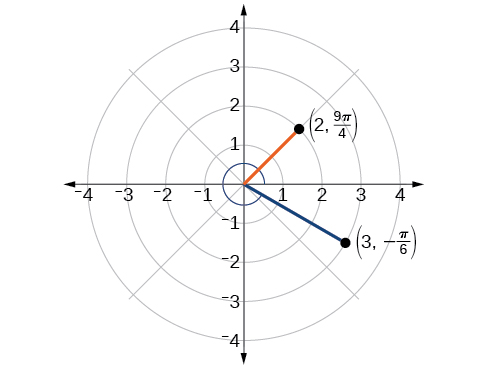
Try It #3 §10.3 source ↗
Answer
Try It #4 §10.3 source ↗
Answer
Try It #5 §10.3 source ↗
Answer
10.3-1 §10.3 source ↗
Answer
10.3-3 §10.3 source ↗
Answer
10.3-5 §10.3 source ↗
Answer
10.3-7 §10.3 source ↗
For the following exercises, convert the given polar coordinates to Cartesian coordinates. Remember to consider the quadrant in which the given point is located when determining for the point.
Answer
10.3-9 §10.3 source ↗
For the following exercises, convert the given polar coordinates to Cartesian coordinates. Remember to consider the quadrant in which the given point is located when determining for the point.
Answer
10.3-11 §10.3 source ↗
For the following exercises, convert the given Cartesian coordinates to polar coordinates with Remember to consider the quadrant in which the given point is located.
Answer
10.3-13 §10.3 source ↗
For the following exercises, convert the given Cartesian coordinates to polar coordinates with Remember to consider the quadrant in which the given point is located.
Answer
10.3-15 §10.3 source ↗
For the following exercises, convert the given Cartesian coordinates to polar coordinates with Remember to consider the quadrant in which the given point is located.
Answer
10.3-17 §10.3 source ↗
For the following exercises, convert the given Cartesian equation to a polar equation.
Answer
10.3-19 §10.3 source ↗
For the following exercises, convert the given Cartesian equation to a polar equation.
Answer
10.3-21 §10.3 source ↗
For the following exercises, convert the given Cartesian equation to a polar equation.
Answer
10.3-23 §10.3 source ↗
For the following exercises, convert the given Cartesian equation to a polar equation.
Answer
10.3-25 §10.3 source ↗
For the following exercises, convert the given Cartesian equation to a polar equation.
Answer
10.3-27 §10.3 source ↗
For the following exercises, convert the given Cartesian equation to a polar equation.
Answer
10.3-29 §10.3 source ↗
For the following exercises, convert the given polar equation to a Cartesian equation. Write in the standard form of a conic if possible, and identify the conic section represented.
Answer
10.3-31 §10.3 source ↗
For the following exercises, convert the given polar equation to a Cartesian equation. Write in the standard form of a conic if possible, and identify the conic section represented.
Answer
10.3-33 §10.3 source ↗
For the following exercises, convert the given polar equation to a Cartesian equation. Write in the standard form of a conic if possible, and identify the conic section represented.
Answer
10.3-35 §10.3 source ↗
For the following exercises, convert the given polar equation to a Cartesian equation. Write in the standard form of a conic if possible, and identify the conic section represented.
Answer
10.3-37 §10.3 source ↗
For the following exercises, convert the given polar equation to a Cartesian equation. Write in the standard form of a conic if possible, and identify the conic section represented.
Answer
10.3-39 §10.3 source ↗
For the following exercises, convert the given polar equation to a Cartesian equation. Write in the standard form of a conic if possible, and identify the conic section represented.
Answer
10.3-41 §10.3 source ↗
For the following exercises, find the polar coordinates of the point.
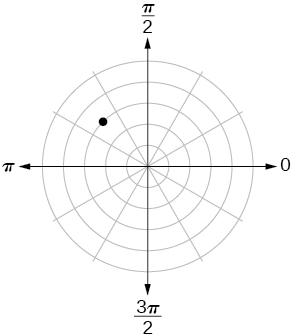
Answer
10.3-43 §10.3 source ↗
For the following exercises, find the polar coordinates of the point.
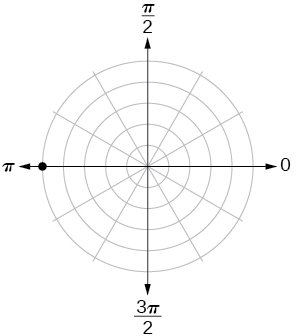
Answer
10.3-45 §10.3 source ↗
For the following exercises, plot the points.
Answer
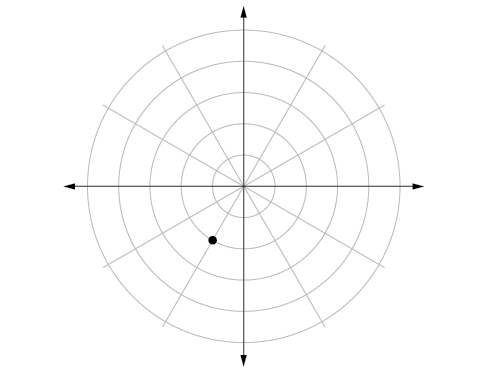
10.3-47 §10.3 source ↗
For the following exercises, plot the points.
Answer
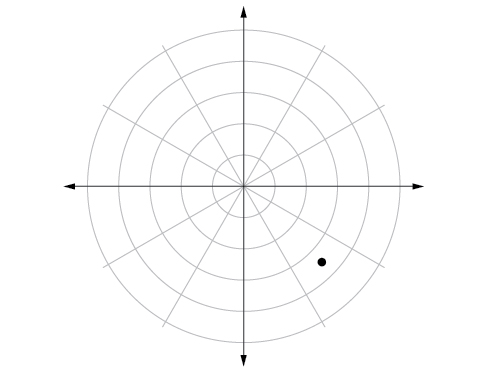
10.3-49 §10.3 source ↗
For the following exercises, plot the points.
Answer
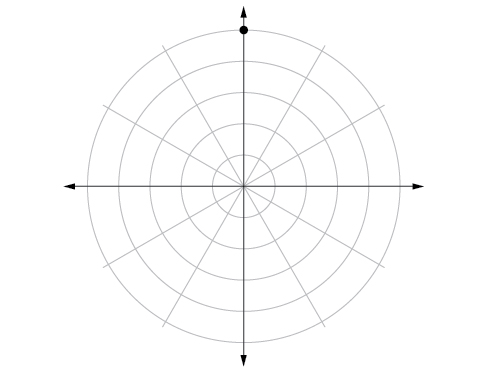
10.3-51 §10.3 source ↗
For the following exercises, plot the points.
Answer
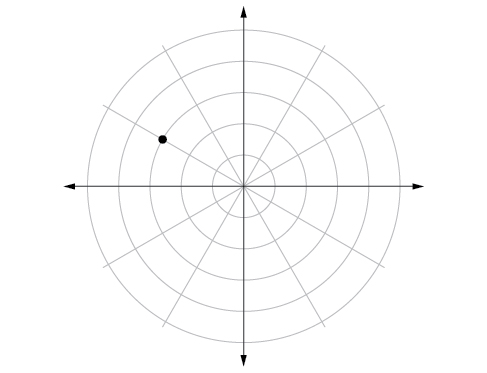
10.3-53 §10.3 source ↗
For the following exercises, plot the points.
Answer
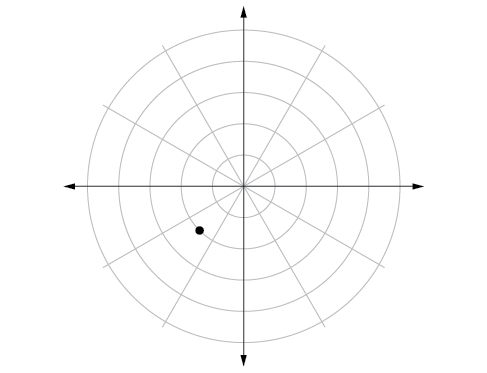
10.3-55 §10.3 source ↗
For the following exercises, convert the equation from rectangular to polar form and graph on the polar axis.
Answer
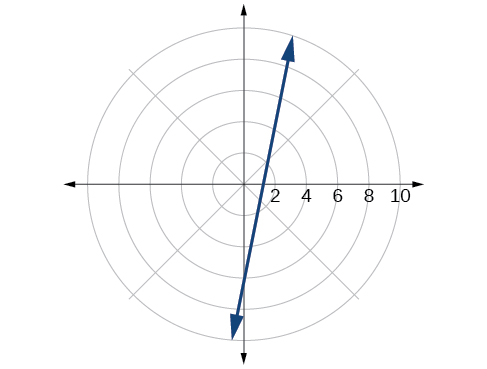
10.3-57 §10.3 source ↗
For the following exercises, convert the equation from rectangular to polar form and graph on the polar axis.
Answer
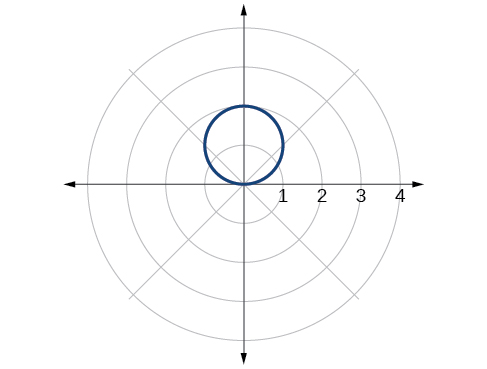
10.3-59 §10.3 source ↗
For the following exercises, convert the equation from rectangular to polar form and graph on the polar axis.
Answer
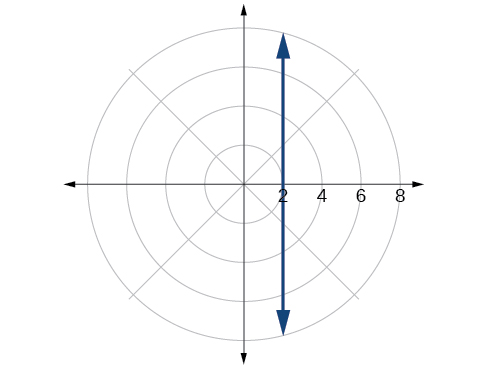
10.3-61 §10.3 source ↗
For the following exercises, convert the equation from rectangular to polar form and graph on the polar axis.
Answer
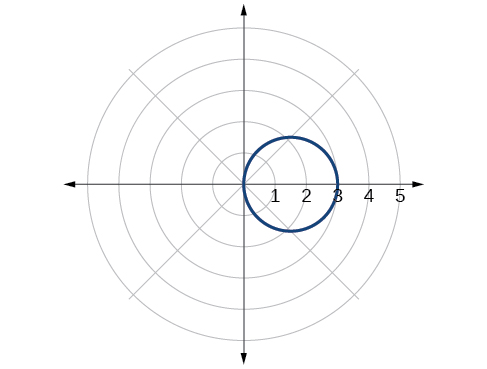
10.3-63 §10.3 source ↗
For the following exercises, convert the equation from polar to rectangular form and graph on the rectangular plane.
Answer
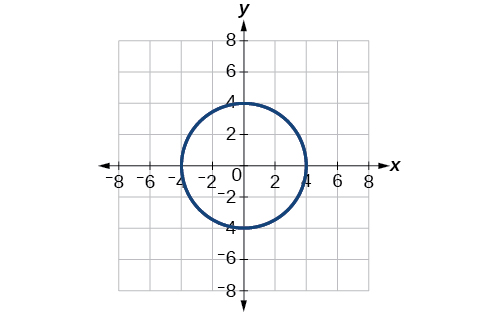
10.3-65 §10.3 source ↗
For the following exercises, convert the equation from polar to rectangular form and graph on the rectangular plane.
Answer
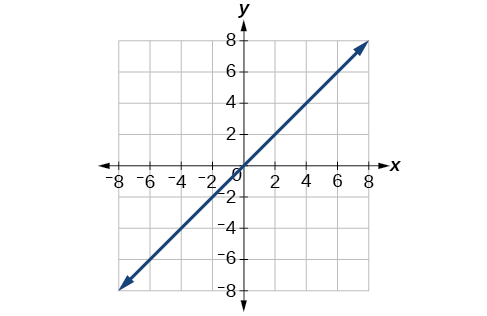
10.3-67 §10.3 source ↗
For the following exercises, convert the equation from polar to rectangular form and graph on the rectangular plane.
Answer
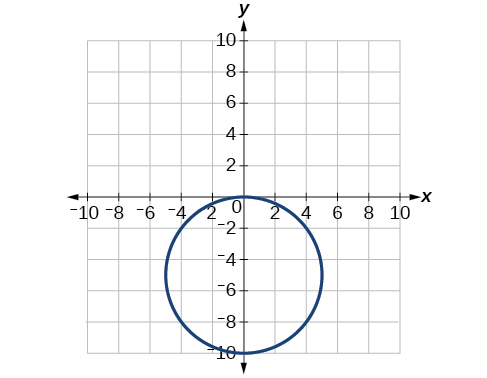
10.3-69 §10.3 source ↗
For the following exercises, convert the equation from polar to rectangular form and graph on the rectangular plane.
Use a graphing calculator to find the rectangular coordinates of Round to the nearest thousandth.
Answer
10.3-71 §10.3 source ↗
For the following exercises, convert the equation from polar to rectangular form and graph on the rectangular plane.
Use a graphing calculator to find the polar coordinates of in degrees. Round to the nearest thousandth.
Answer
10.3-73 §10.3 source ↗
For the following exercises, convert the equation from polar to rectangular form and graph on the rectangular plane.
Use a graphing calculator to find the polar coordinates of in radians. Round to the nearest hundredth.
Answer
10.3-75 §10.3 source ↗
For the following exercises, convert the equation from polar to rectangular form and graph on the rectangular plane.
Describe the graph of
Answer
10.3-77 §10.3 source ↗
For the following exercises, convert the equation from polar to rectangular form and graph on the rectangular plane.
Describe the graph of
Answer
10.3-79 §10.3 source ↗
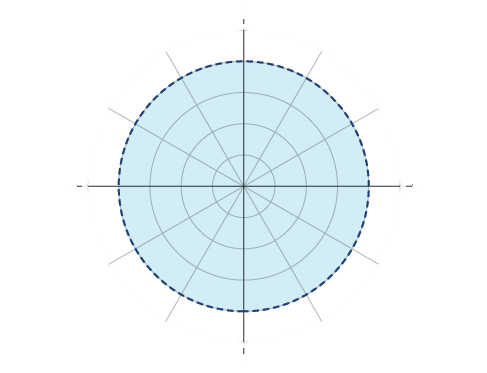
For the following exercise, graph the polar inequality.
Answer
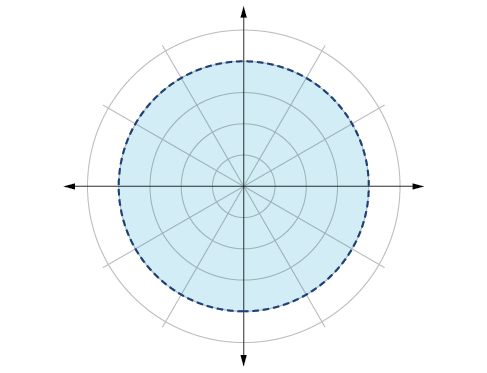
10.3-81 §10.3 source ↗
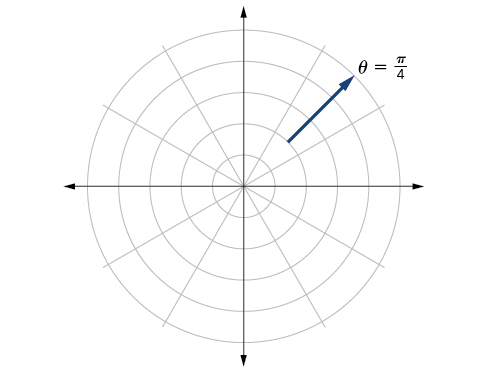
For the following exercise, graph the polar inequality.
Answer
10.3-83 §10.3 source ↗
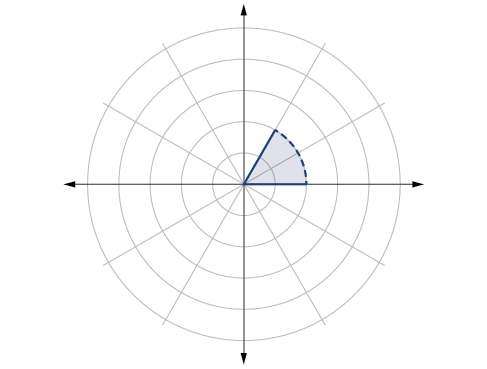
For the following exercise, graph the polar inequality.
Answer
Try It #1 §10.4 source ↗
Answer
Try It #2 §10.4 source ↗
Answer
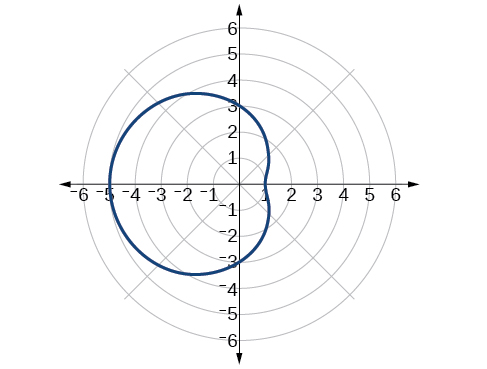
Try It #3 §10.4 source ↗
Answer
Try It #4 §10.4 source ↗
Answer
The graph is a rose curve, even
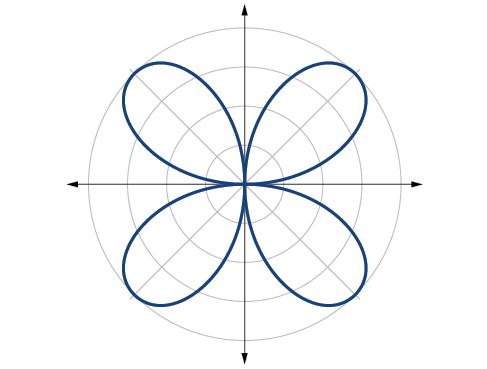
Try It #5 §10.4 source ↗
Answer
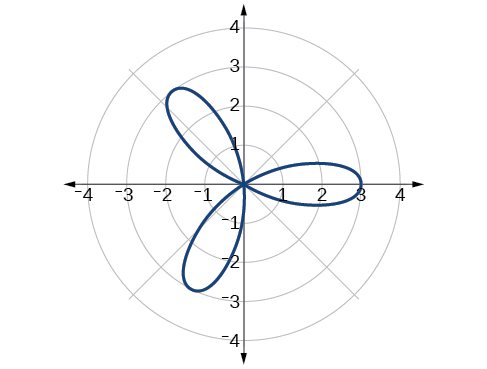
Rose curve, odd
Try It #6 §10.4 source ↗
Answer
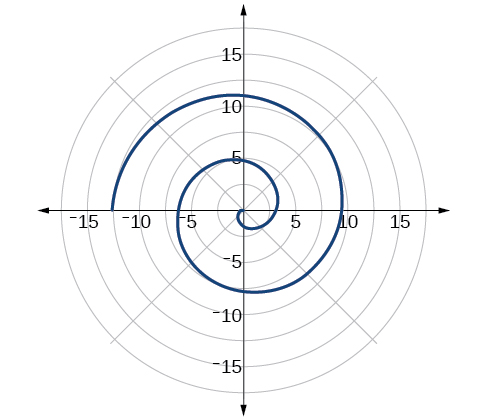
10.4-1 §10.4 source ↗
Answer
10.4-3 §10.4 source ↗
Answer
10.4-5 §10.4 source ↗
Answer
10.4-7 §10.4 source ↗
For the following exercises, test the equation for symmetry.
Answer
10.4-9 §10.4 source ↗
For the following exercises, test the equation for symmetry.
Answer
10.4-11 §10.4 source ↗
For the following exercises, test the equation for symmetry.
Answer
10.4-13 §10.4 source ↗
For the following exercises, test the equation for symmetry.
Answer
10.4-15 §10.4 source ↗
For the following exercises, test the equation for symmetry.
Answer
10.4-17 §10.4 source ↗
For the following exercises, graph the polar equation. Identify the name of the shape.
Answer
circle
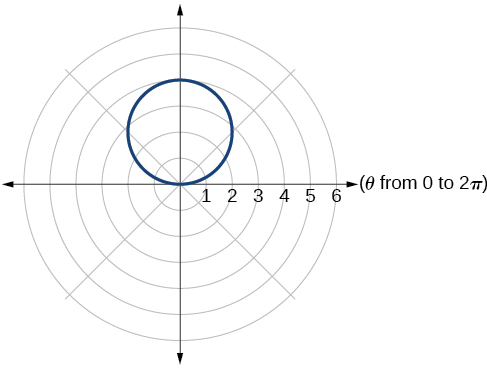
10.4-19 §10.4 source ↗
For the following exercises, graph the polar equation. Identify the name of the shape.
Answer
cardioid
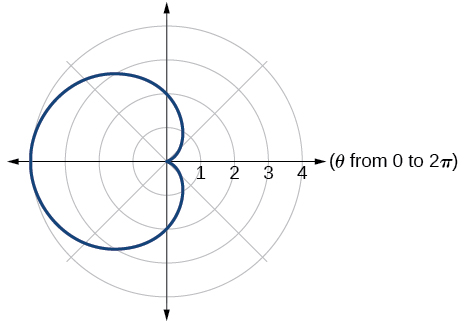
10.4-21 §10.4 source ↗
For the following exercises, graph the polar equation. Identify the name of the shape.
Answer
cardioid
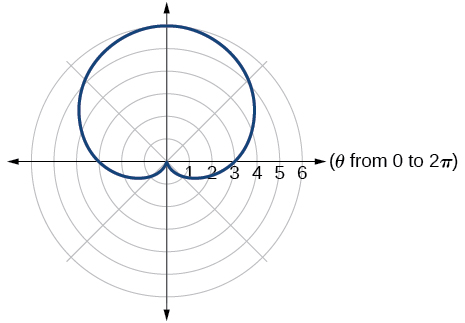
10.4-23 §10.4 source ↗
For the following exercises, graph the polar equation. Identify the name of the shape.
Answer
one-loop/dimpled limaçon
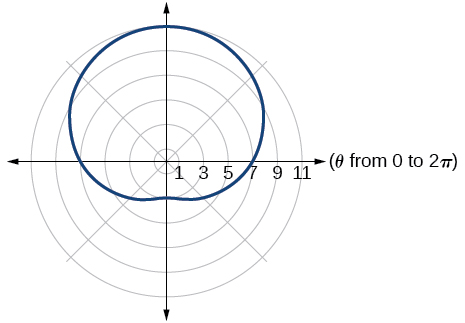
10.4-25 §10.4 source ↗
For the following exercises, graph the polar equation. Identify the name of the shape.
Answer
one-loop/dimpled limaçon
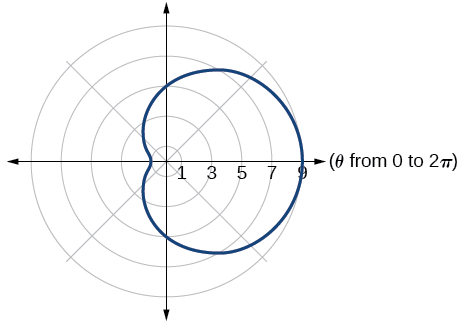
10.4-27 §10.4 source ↗
For the following exercises, graph the polar equation. Identify the name of the shape.
Answer
inner loop/two-loop limaçon
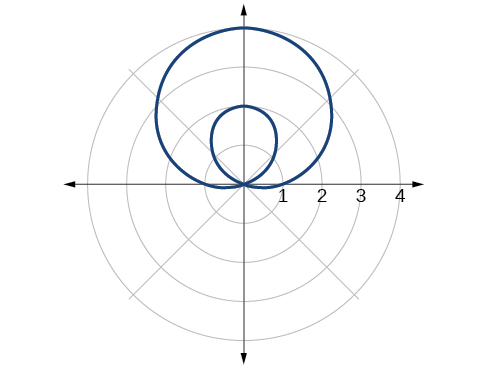
10.4-29 §10.4 source ↗
For the following exercises, graph the polar equation. Identify the name of the shape.
Answer
inner loop/two-loop limaçon
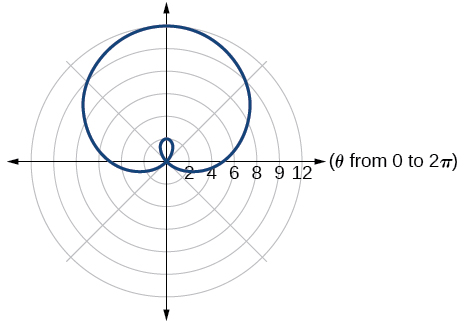
10.4-31 §10.4 source ↗
For the following exercises, graph the polar equation. Identify the name of the shape.
Answer
inner loop/two-loop limaçon
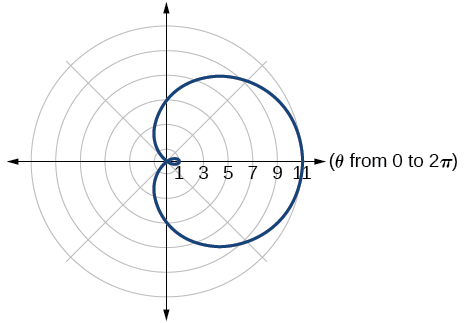
10.4-33 §10.4 source ↗
For the following exercises, graph the polar equation. Identify the name of the shape.
Answer
lemniscate
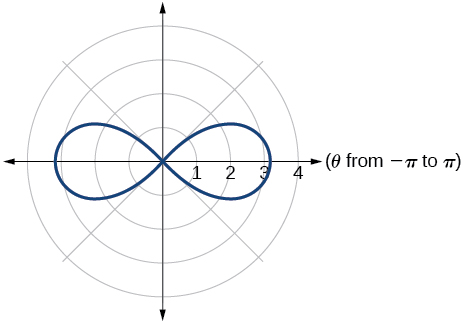
10.4-35 §10.4 source ↗
For the following exercises, graph the polar equation. Identify the name of the shape.
Answer
lemniscate
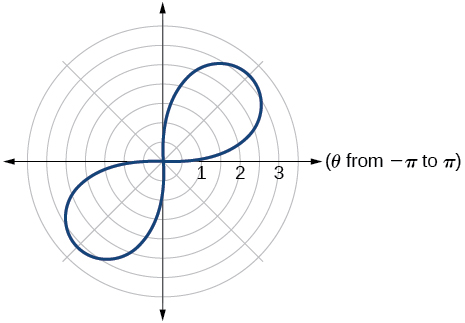
10.4-37 §10.4 source ↗
For the following exercises, graph the polar equation. Identify the name of the shape.
Answer
rose curve
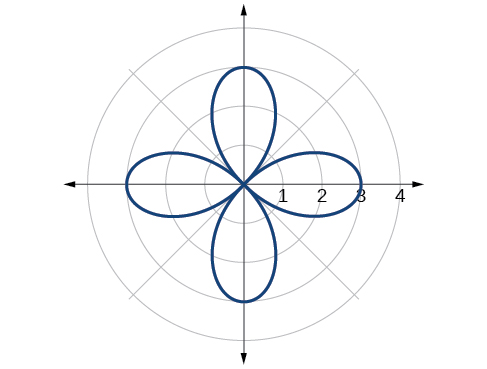
10.4-39 §10.4 source ↗
For the following exercises, graph the polar equation. Identify the name of the shape.
Answer
rose curve
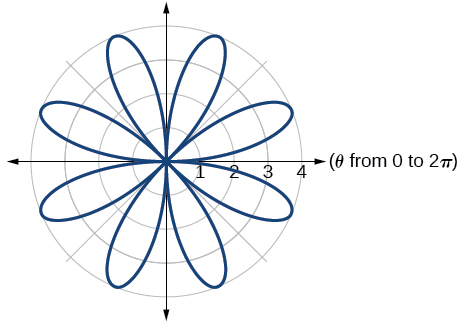
10.4-41 §10.4 source ↗
For the following exercises, graph the polar equation. Identify the name of the shape.
Answer
Archimedes’ spiral
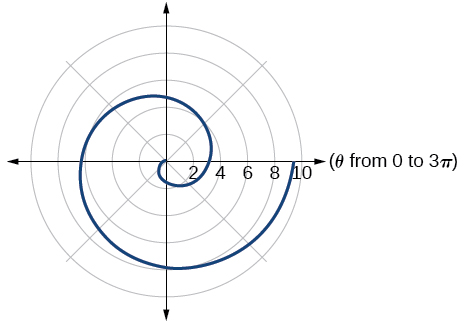
10.4-43 §10.4 source ↗
For the following exercises, graph the polar equation. Identify the name of the shape.
Answer
Archimedes’ spiral
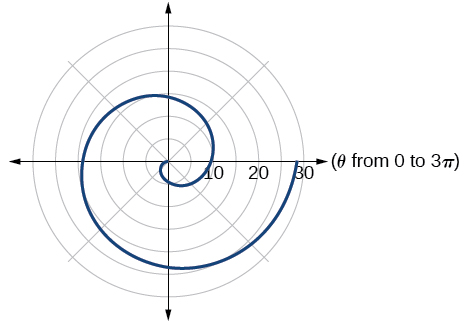
10.4-45 §10.4 source ↗
For the following exercises, use a graphing calculator to sketch the graph of the polar equation.
Answer
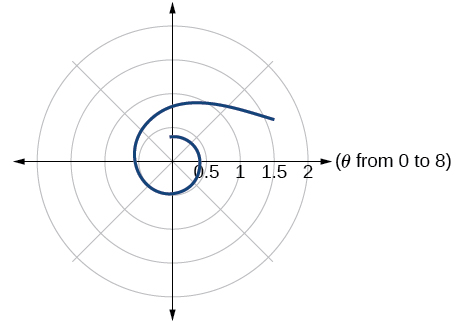
10.4-47 §10.4 source ↗
For the following exercises, use a graphing calculator to sketch the graph of the polar equation.
, a hippopede
Answer
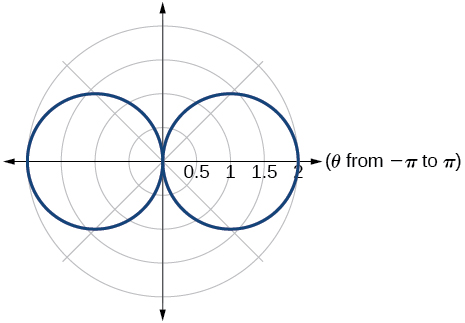
10.4-49 §10.4 source ↗
For the following exercises, use a graphing calculator to sketch the graph of the polar equation.
Answer
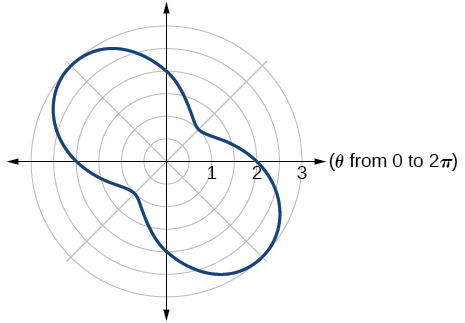
10.4-51 §10.4 source ↗
For the following exercises, use a graphing calculator to sketch the graph of the polar equation.
Answer
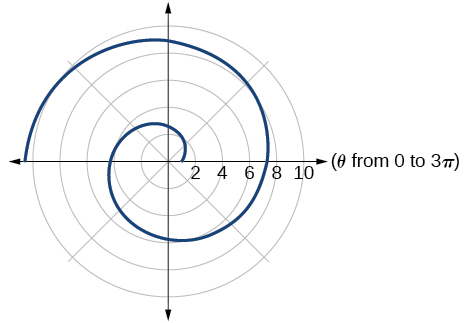
10.4-53 §10.4 source ↗
For the following exercises, use a graphing calculator to sketch the graph of the polar equation.
Answer
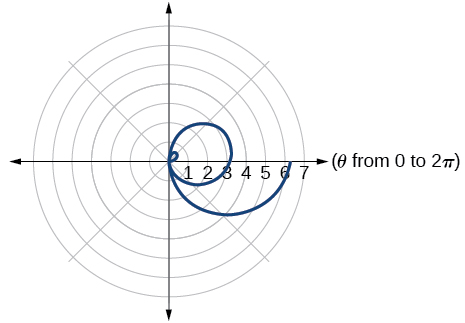
10.4-55 §10.4 source ↗
For the following exercises, use a graphing utility to graph each pair of polar equations on a domain of and then explain the differences shown in the graphs.
Answer
10.4-57 §10.4 source ↗
For the following exercises, use a graphing utility to graph each pair of polar equations on a domain of and then explain the differences shown in the graphs.
Answer
10.4-59 §10.4 source ↗
For the following exercises, use a graphing utility to graph each pair of polar equations on a domain of and then explain the differences shown in the graphs.
On a graphing utility, graph on , , , , , , and , Describe the effect of increasing the width of the domain.
Answer
10.4-61 §10.4 source ↗
For the following exercises, use a graphing utility to graph each pair of polar equations on a domain of and then explain the differences shown in the graphs.
On a graphing utility, graph each polar equation. Explain the similarities and differences you observe in the graphs.
Answer
10.4-63 §10.4 source ↗
For the following exercises, use a graphing utility to graph each pair of polar equations on a domain of and then explain the differences shown in the graphs.
On a graphing utility, graph each polar equation. Explain the similarities and differences you observe in the graphs.
Answer
10.4-65 §10.4 source ↗
For the following exercises, draw each polar equation on the same set of polar axes, and find the points of intersection.
Answer
10.4-67 §10.4 source ↗
For the following exercises, draw each polar equation on the same set of polar axes, and find the points of intersection.
Answer
10.4-69 §10.4 source ↗
For the following exercises, draw each polar equation on the same set of polar axes, and find the points of intersection.
,
Answer
10.4-71 §10.4 source ↗
For the following exercises, draw each polar equation on the same set of polar axes, and find the points of intersection.
Answer
Try It #1 §10.5 source ↗
Answer
Try It #2 §10.5 source ↗
Answer
Try It #3 §10.5 source ↗
Answer
Try It #4 §10.5 source ↗
Answer
Try It #5 §10.5 source ↗
Answer
Try It #6 §10.5 source ↗
Convert the complex number to rectangular form:
Answer
Try It #7 §10.5 source ↗
Answer
Try It #8 §10.5 source ↗
Answer
10.5-1 §10.5 source ↗
Answer
10.5-3 §10.5 source ↗
Answer
10.5-5 §10.5 source ↗
Answer
10.5-7 §10.5 source ↗
For the following exercises, find the absolute value of the given complex number.
Answer
10.5-9 §10.5 source ↗
For the following exercises, find the absolute value of the given complex number.
Answer
10.5-11 §10.5 source ↗
For the following exercises, find the absolute value of the given complex number.
Answer
10.5-13 §10.5 source ↗
For the following exercises, write the complex number in polar form.
Answer
10.5-15 §10.5 source ↗
For the following exercises, write the complex number in polar form.
Answer
10.5-17 §10.5 source ↗
For the following exercises, convert the complex number from polar to rectangular form.
Answer
10.5-19 §10.5 source ↗
For the following exercises, convert the complex number from polar to rectangular form.
Answer
10.5-21 §10.5 source ↗
For the following exercises, convert the complex number from polar to rectangular form.
Answer
10.5-23 §10.5 source ↗
For the following exercises, find in polar form.
Answer
10.5-25 §10.5 source ↗
For the following exercises, find in polar form.
Answer
10.5-27 §10.5 source ↗
For the following exercises, find in polar form.
Answer
10.5-29 §10.5 source ↗
For the following exercises, find in polar form.
Answer
10.5-31 §10.5 source ↗
For the following exercises, find in polar form.
Answer
10.5-33 §10.5 source ↗
For the following exercises, find in polar form.
Answer
10.5-35 §10.5 source ↗
For the following exercises, find the powers of each complex number in polar form.
Find when
Answer
10.5-37 §10.5 source ↗
For the following exercises, find the powers of each complex number in polar form.
Find when
Answer
10.5-39 §10.5 source ↗
For the following exercises, find the powers of each complex number in polar form.
Find when
Answer
10.5-41 §10.5 source ↗
For the following exercises, evaluate each root.
Evaluate the cube root of when
Answer
10.5-43 §10.5 source ↗
For the following exercises, evaluate each root.
Evaluate the cube root of when
Answer
10.5-45 §10.5 source ↗
For the following exercises, evaluate each root.
Evaluate the square root of when
Answer
10.5-47 §10.5 source ↗
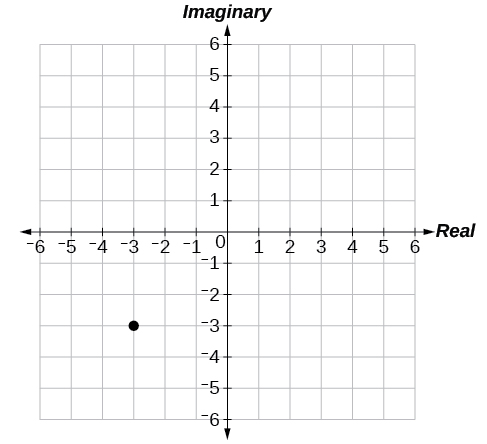
For the following exercises, plot the complex number in the complex plane.
Answer
10.5-49 §10.5 source ↗
For the following exercises, plot the complex number in the complex plane.
Answer
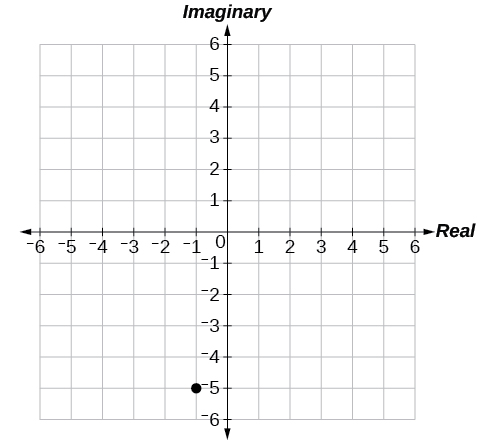
10.5-51 §10.5 source ↗
For the following exercises, plot the complex number in the complex plane.
Answer
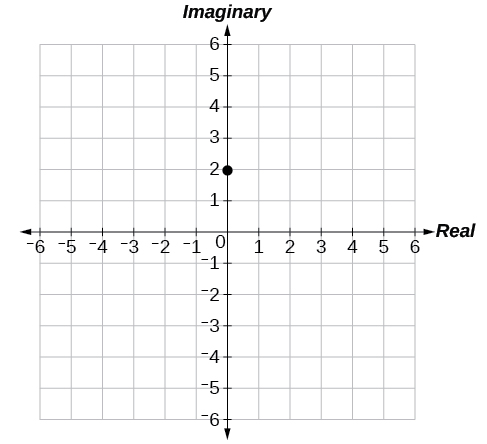
10.5-53 §10.5 source ↗
For the following exercises, plot the complex number in the complex plane.
Answer
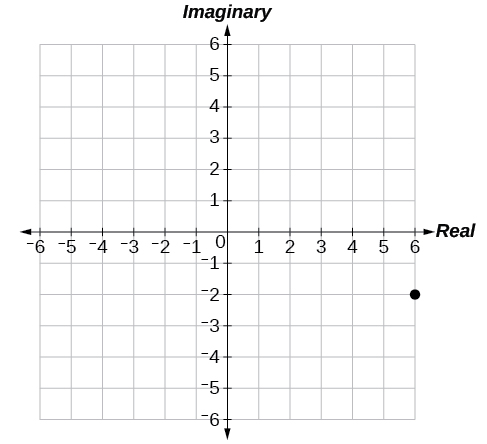
10.5-55 §10.5 source ↗
For the following exercises, plot the complex number in the complex plane.
Answer
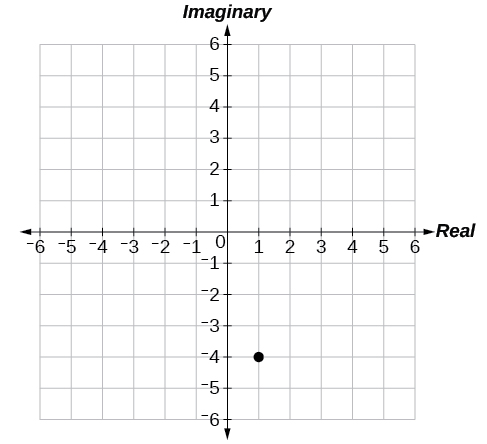
10.5-57 §10.5 source ↗
For the following exercises, find all answers rounded to the nearest hundredth.
Use the rectangular to polar feature on the graphing calculator to change to polar form.
Answer
10.5-59 §10.5 source ↗
For the following exercises, find all answers rounded to the nearest hundredth.
Use the polar to rectangular feature on the graphing calculator to change to rectangular form.
Answer
10.5-61 §10.5 source ↗
For the following exercises, find all answers rounded to the nearest hundredth.
Use the polar to rectangular feature on the graphing calculator to change to rectangular form.
Answer
Try It #1 §10.6 source ↗
Answer
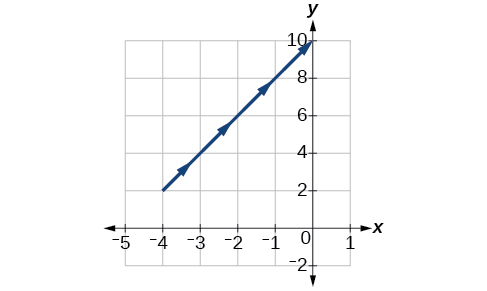
Try It #2 §10.6 source ↗
Answer
Try It #3 §10.6 source ↗
Given the equations below, eliminate the parameter and write as a rectangular equation for as a function of
Answer
Try It #4 §10.6 source ↗
Eliminate the parameter and write as a rectangular equation.
Answer
Try It #5 §10.6 source ↗
Answer
Try It #6 §10.6 source ↗
Answer
10.6-1 §10.6 source ↗
Answer
10.6-3 §10.6 source ↗
Answer
10.6-5 §10.6 source ↗
Answer
10.6-7 §10.6 source ↗
For the following exercises, eliminate the parameter to rewrite the parametric equation as a Cartesian equation.
Answer
10.6-9 §10.6 source ↗
For the following exercises, eliminate the parameter to rewrite the parametric equation as a Cartesian equation.
Answer
10.6-11 §10.6 source ↗
For the following exercises, eliminate the parameter to rewrite the parametric equation as a Cartesian equation.
Answer
10.6-13 §10.6 source ↗
For the following exercises, eliminate the parameter to rewrite the parametric equation as a Cartesian equation.
Answer
10.6-15 §10.6 source ↗
For the following exercises, eliminate the parameter to rewrite the parametric equation as a Cartesian equation.
Answer
10.6-17 §10.6 source ↗
For the following exercises, eliminate the parameter to rewrite the parametric equation as a Cartesian equation.
Answer
10.6-19 §10.6 source ↗
For the following exercises, eliminate the parameter to rewrite the parametric equation as a Cartesian equation.
Answer
10.6-21 §10.6 source ↗
For the following exercises, eliminate the parameter to rewrite the parametric equation as a Cartesian equation.
Answer
10.6-23 §10.6 source ↗
For the following exercises, eliminate the parameter to rewrite the parametric equation as a Cartesian equation.
Answer
10.6-25 §10.6 source ↗
For the following exercises, eliminate the parameter to rewrite the parametric equation as a Cartesian equation.
Answer
10.6-27 §10.6 source ↗
For the following exercises, rewrite the parametric equation as a Cartesian equation by building an table.
Answer
10.6-29 §10.6 source ↗
For the following exercises, rewrite the parametric equation as a Cartesian equation by building an table.
Answer
10.6-31 §10.6 source ↗
For the following exercises, parameterize (write parametric equations for) each Cartesian equation by setting or by setting
Answer
10.6-33 §10.6 source ↗
For the following exercises, parameterize (write parametric equations for) each Cartesian equation by setting or by setting
Answer
10.6-35 §10.6 source ↗
For the following exercises, parameterize (write parametric equations for) each Cartesian equation by using and Identify the curve.
Answer
10.6-37 §10.6 source ↗
For the following exercises, parameterize (write parametric equations for) each Cartesian equation by using and Identify the curve.
Answer
10.6-39 §10.6 source ↗
For the following exercises, parameterize (write parametric equations for) each Cartesian equation by using and Identify the curve.
Parameterize the line from to so that the line is at at and at at
Answer
10.6-41 §10.6 source ↗
For the following exercises, parameterize (write parametric equations for) each Cartesian equation by using and Identify the curve.
Parameterize the line from to so that the line is at at and at at
Answer
10.6-43 §10.6 source ↗
For the following exercises, use the table feature in the graphing calculator to determine whether the graphs intersect.
Answer
10.6-45 §10.6 source ↗
For the following exercises, use a graphing calculator to complete the table of values for each set of parametric equations.
| 1 | ||
| 2 | ||
| 3 |
Answer
| 1 | -3 | 1 |
| 2 | 0 | 7 |
| 3 | 5 | 17 |
10.6-47 §10.6 source ↗
For the following exercises, use a graphing calculator to complete the table of values for each set of parametric equations.
Find two different sets of parametric equations for
Answer
10.6-49 §10.6 source ↗
For the following exercises, use a graphing calculator to complete the table of values for each set of parametric equations.
Find two different sets of parametric equations for
Answer
Try It #1 §10.7 source ↗
Answer
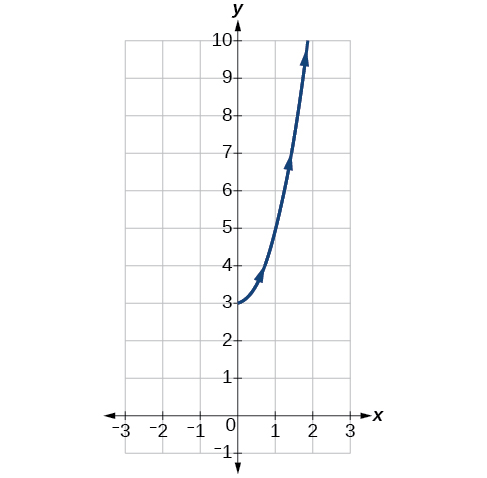
Try It #2 §10.7 source ↗
Answer
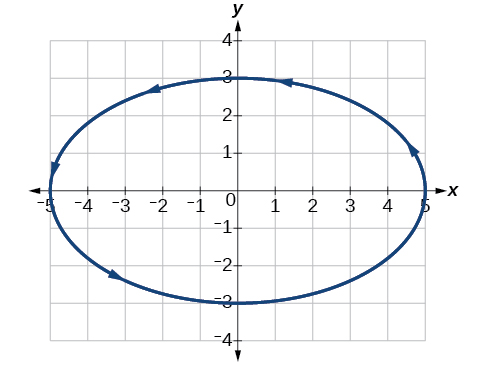
Try It #3 §10.7 source ↗
Answer
The graph of the parametric equations is in red and the graph of the rectangular equation is drawn in blue dots on top of the parametric equations.
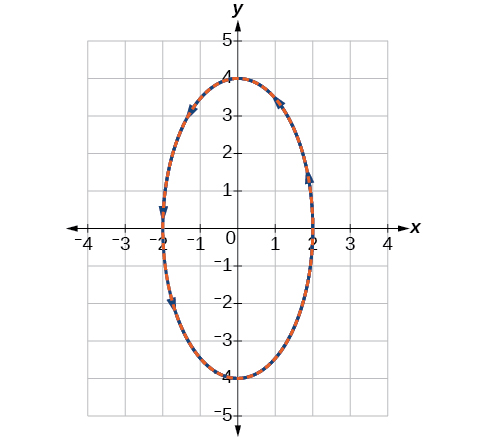
10.7-1 §10.7 source ↗
Answer
10.7-3 §10.7 source ↗
Answer
10.7-5 §10.7 source ↗
Answer
10.7-7 §10.7 source ↗
For the following exercises, graph each set of parametric equations by making a table of values. Include the orientation on the graph.
Answer
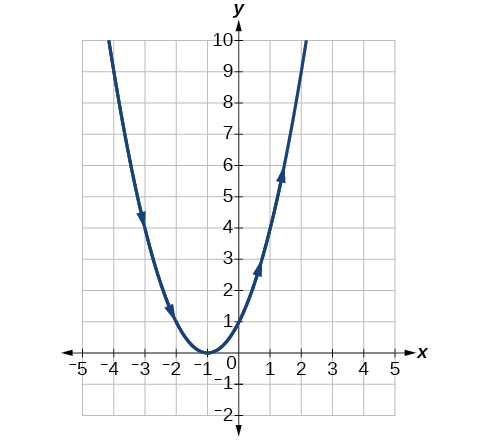
10.7-9 §10.7 source ↗
For the following exercises, graph each set of parametric equations by making a table of values. Include the orientation on the graph.
Answer
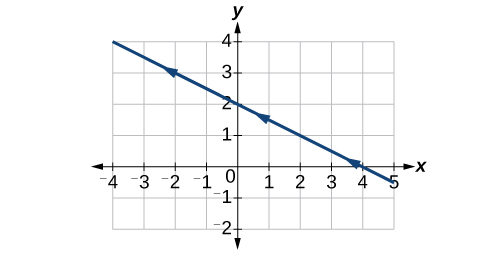
10.7-11 §10.7 source ↗
For the following exercises, graph each set of parametric equations by making a table of values. Include the orientation on the graph.
Answer
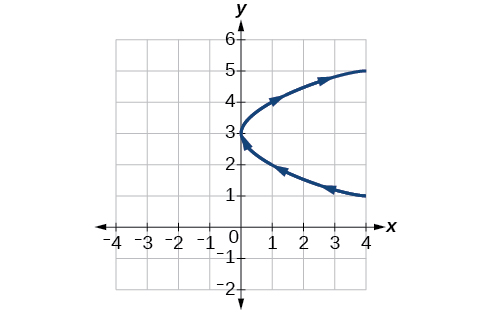
10.7-13 §10.7 source ↗
For the following exercises, sketch the curve and include the orientation.
Answer
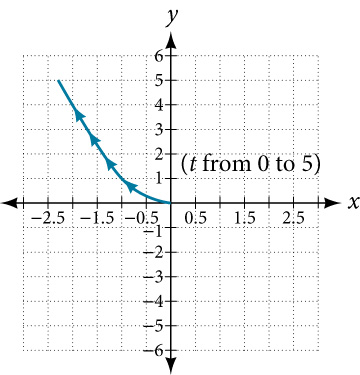
10.7-15 §10.7 source ↗
For the following exercises, sketch the curve and include the orientation.
Answer
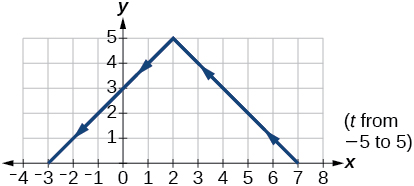
10.7-17 §10.7 source ↗
For the following exercises, sketch the curve and include the orientation.
Answer
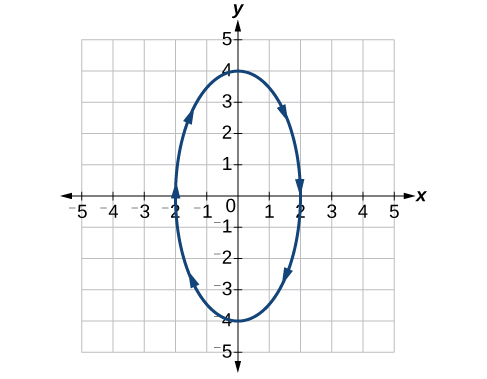
10.7-19 §10.7 source ↗
For the following exercises, sketch the curve and include the orientation.
Answer
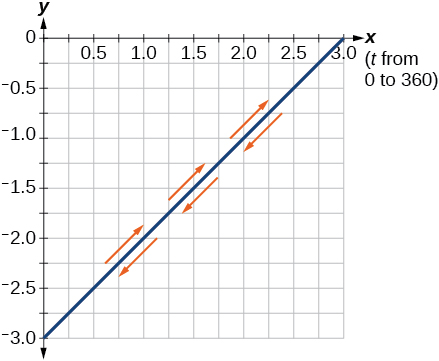
10.7-21 §10.7 source ↗
For the following exercises, sketch the curve and include the orientation.
Answer
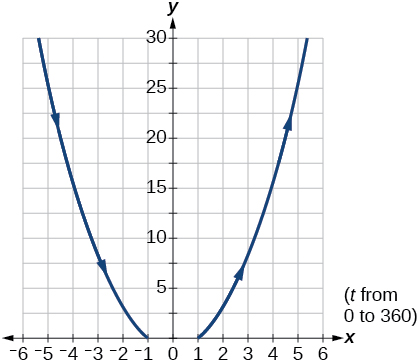
10.7-23 §10.7 source ↗
For the following exercises, graph the equation and include the orientation. Then, write the Cartesian equation.
Answer
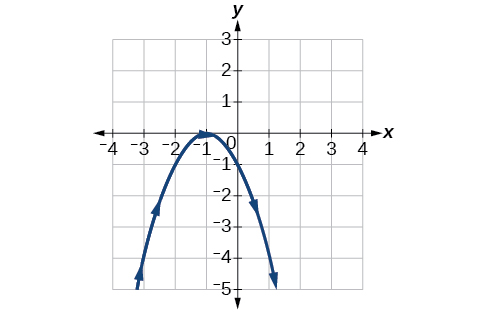
10.7-25 §10.7 source ↗
For the following exercises, graph the equation and include the orientation. Then, write the Cartesian equation.
Answer
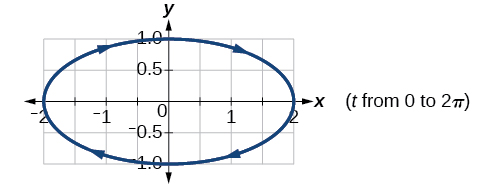
10.7-27 §10.7 source ↗
For the following exercises, graph the equation and include the orientation. Then, write the Cartesian equation.
Answer
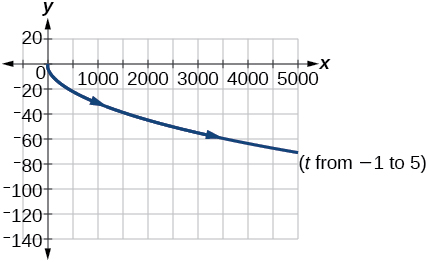
10.7-29 §10.7 source ↗
For the following exercises, graph the equation and include the orientation.
Answer
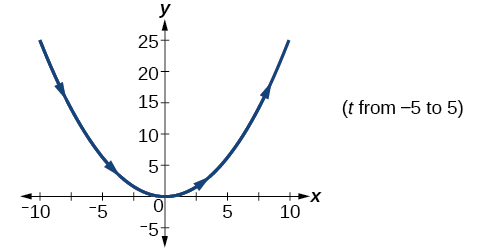
10.7-31 §10.7 source ↗
For the following exercises, graph the equation and include the orientation.
Answer
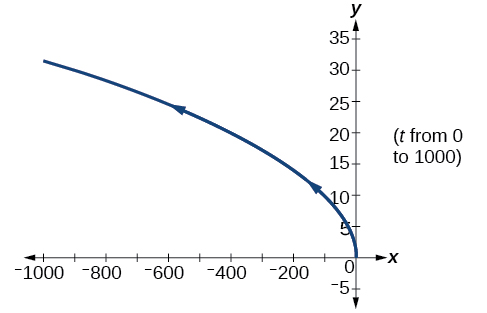
10.7-33 §10.7 source ↗
For the following exercises, graph the equation and include the orientation.
Answer
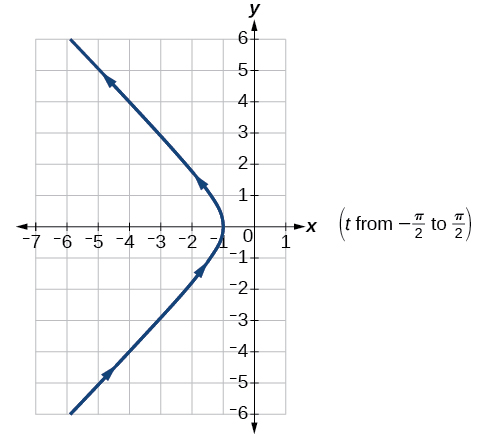
10.7-35 §10.7 source ↗
For the following exercises, use the parametric equations for integers a and b:
Graph on the domain where and , and include the orientation.
Answer
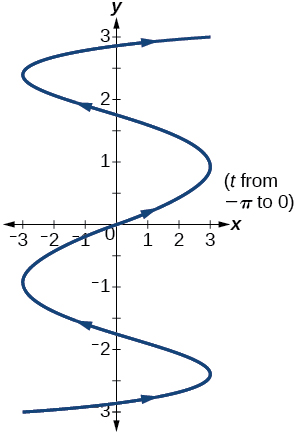
10.7-37 §10.7 source ↗
For the following exercises, use the parametric equations for integers a and b:
Graph on the domain where and , and include the orientation.
Answer
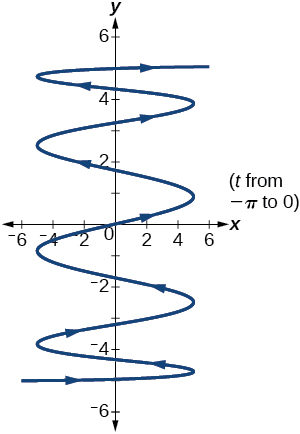
10.7-39 §10.7 source ↗
For the following exercises, use the parametric equations for integers a and b:
Describe the graph if and
Answer
10.7-41 §10.7 source ↗
For the following exercises, use the parametric equations for integers a and b:
If the parametric equations and have the graph of a horizontal parabola opening to the right, what would change the direction of the curve?
Answer
10.7-43 §10.7 source ↗
For the following exercises, describe the graph of the set of parametric equations.
and is linear
Answer
10.7-45 §10.7 source ↗
For the following exercises, describe the graph of the set of parametric equations.
Write the parametric equations of a circle with center radius 5, and a counterclockwise orientation.
Answer
10.7-47 §10.7 source ↗
For the following exercises, use a graphing utility to graph on the window by on the domain for the following values of and , and include the orientation.
Answer
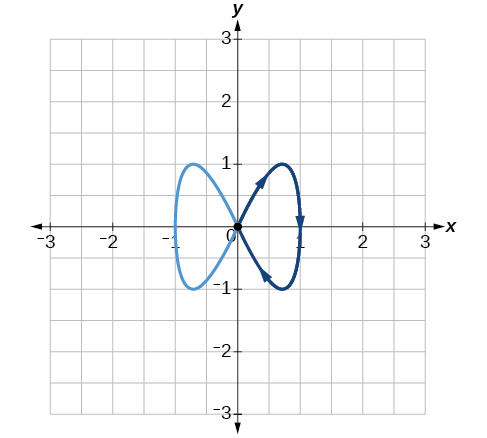
10.7-49 §10.7 source ↗
For the following exercises, use a graphing utility to graph on the window by on the domain for the following values of and , and include the orientation.
Answer
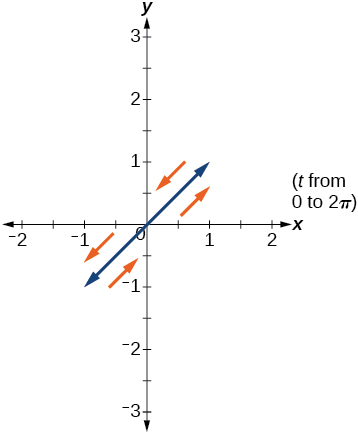
10.7-51 §10.7 source ↗
For the following exercises, use a graphing utility to graph on the window by on the domain for the following values of and , and include the orientation.
Answer
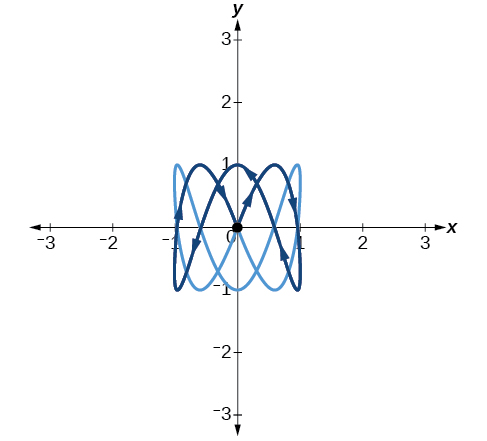
10.7-53 §10.7 source ↗
For the following exercises, look at the graphs that were created by parametric equations of the form Use the parametric mode on the graphing calculator to find the values of and to achieve each graph.
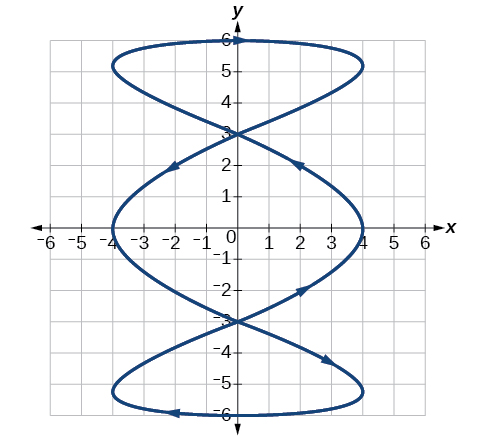
Answer
10.7-55 §10.7 source ↗
For the following exercises, look at the graphs that were created by parametric equations of the form Use the parametric mode on the graphing calculator to find the values of and to achieve each graph.
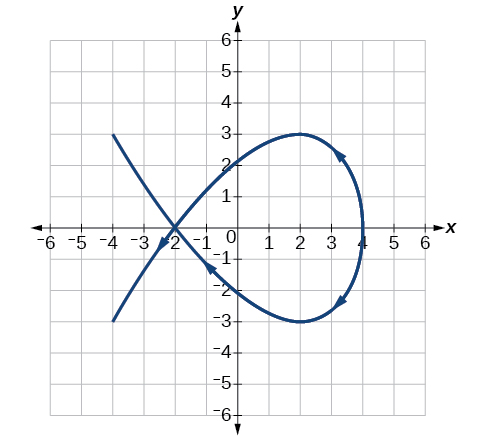
Answer
10.7-57 §10.7 source ↗
For the following exercises, use a graphing utility to graph the given parametric equations.
Graph all three sets of parametric equations on the domain
Answer
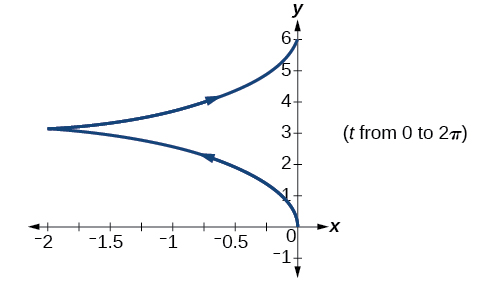
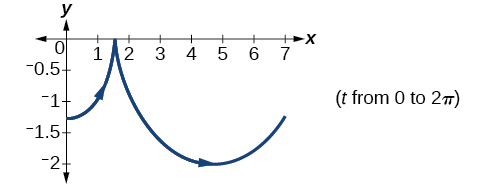
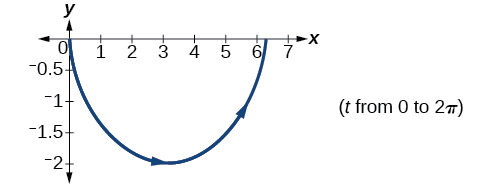
10.7-59 §10.7 source ↗
For the following exercises, use a graphing utility to graph the given parametric equations.
Graph all three sets of parametric equations on the domain
Answer
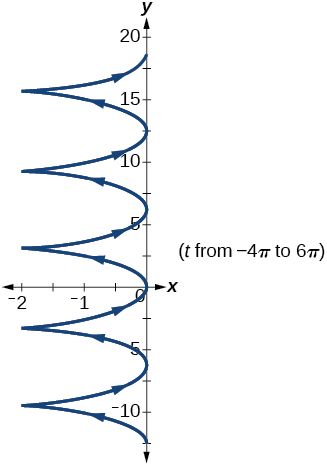
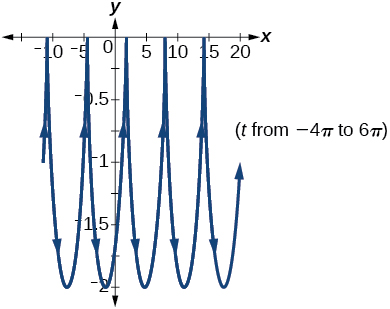
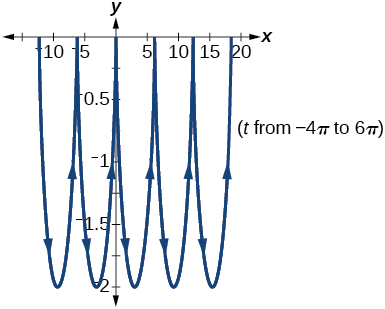
10.7-61 §10.7 source ↗
For the following exercises, use a graphing utility to graph the given parametric equations.
Explain the effect on the graph of the parametric equation when we switched and .
Answer
10.7-63 §10.7 source ↗
For the following exercises, use a graphing utility to graph the given parametric equations.
An object is thrown in the air with vertical velocity of 20 ft/s and horizontal velocity of 15 ft/s. The object’s height can be described by the equation , while the object moves horizontally with constant velocity 15 ft/s. Write parametric equations for the object’s position, and then eliminate time to write height as a function of horizontal position.
Answer
10.7-65 §10.7 source ↗
For the following exercises, use this scenario: A dart is thrown upward with an initial velocity of 64 ft/s at an angle of elevation of 52°. Consider the position of the dart at any time Neglect air resistance.
Find parametric equations that model the problem situation.
Answer
10.7-67 §10.7 source ↗
For the following exercises, use this scenario: A dart is thrown upward with an initial velocity of 64 ft/s at an angle of elevation of 52°. Consider the position of the dart at any time Neglect air resistance.
When will the dart hit the ground?
Answer
10.7-69 §10.7 source ↗
For the following exercises, use this scenario: A dart is thrown upward with an initial velocity of 64 ft/s at an angle of elevation of 52°. Consider the position of the dart at any time Neglect air resistance.
At what time will the dart reach maximum height?
Answer
10.7-71 §10.7 source ↗
For the following exercises, look at the graphs of each of the four parametric equations. Although they look unusual and beautiful, they are so common that they have names, as indicated in each exercise. Use a graphing utility to graph each on the indicated domain.
A hypocycloid: on the domain .
Answer
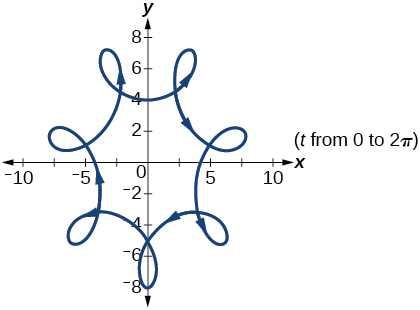
10.7-73 §10.7 source ↗
For the following exercises, look at the graphs of each of the four parametric equations. Although they look unusual and beautiful, they are so common that they have names, as indicated in each exercise. Use a graphing utility to graph each on the indicated domain.
A rose: on the domain .
Answer
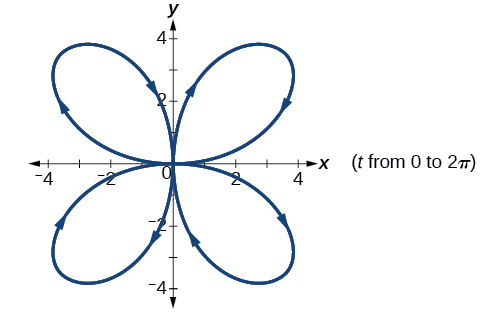
Try It #1 §10.8 source ↗
Answer
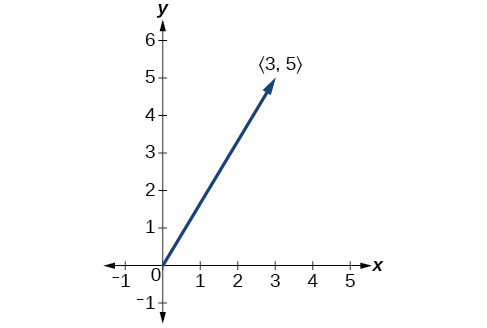
Try It #2 §10.8 source ↗
Answer
Try It #3 §10.8 source ↗
Answer
Try It #4 §10.8 source ↗
Answer
Magnitude =
10.8-1 §10.8 source ↗
Answer
10.8-3 §10.8 source ↗
Answer
10.8-5 §10.8 source ↗
Answer
10.8-7 §10.8 source ↗
Answer
10.8-9 §10.8 source ↗
For the following exercises, determine whether the two vectors and are equal, where has an initial point and a terminal point and has an initial point and a terminal point .
and
Answer
10.8-11 §10.8 source ↗
For the following exercises, determine whether the two vectors and are equal, where has an initial point and a terminal point and has an initial point and a terminal point .
and
Answer
10.8-13 §10.8 source ↗
For the following exercises, determine whether the two vectors and are equal, where has an initial point and a terminal point and has an initial point and a terminal point .
and
Answer
10.8-15 §10.8 source ↗
For the following exercises, determine whether the two vectors and are equal, where has an initial point and a terminal point and has an initial point and a terminal point .
Given initial point and terminal point write the vector in terms of and
Answer
10.8-17 §10.8 source ↗
For the following exercises, use the vectors u = i + 5j, v = −2i− 3j, and w = 4i − j.
Find 4v + 2u
Answer
10.8-19 §10.8 source ↗
For the following exercises, use the given vectors to compute u + v, u − v, and 2u − 3v.
Answer
10.8-21 §10.8 source ↗
For the following exercises, use the given vectors to compute u + v, u − v, and 2u − 3v.
Let v = 5i + 2j. Find a vector that is twice the length and points in the opposite direction as
Answer
10.8-23 §10.8 source ↗
For the following exercises, find a unit vector in the same direction as the given vector.
b = −2i + 5j
Answer
10.8-25 §10.8 source ↗
For the following exercises, find a unit vector in the same direction as the given vector.
Answer
10.8-27 §10.8 source ↗
For the following exercises, find a unit vector in the same direction as the given vector.
u = −14i + 2j
Answer
10.8-29 §10.8 source ↗
For the following exercises, find the magnitude and direction of the vector,
Answer
10.8-31 §10.8 source ↗
For the following exercises, find the magnitude and direction of the vector,
Answer
10.8-33 §10.8 source ↗
For the following exercises, find the magnitude and direction of the vector,
Given u = −i − j and v = i + 5j, calculate
Answer
10.8-35 §10.8 source ↗
For the following exercises, find the magnitude and direction of the vector,
Given u and v calculate
Answer
10.8-37 §10.8 source ↗
For the following exercises, given draw 3v and
Answer
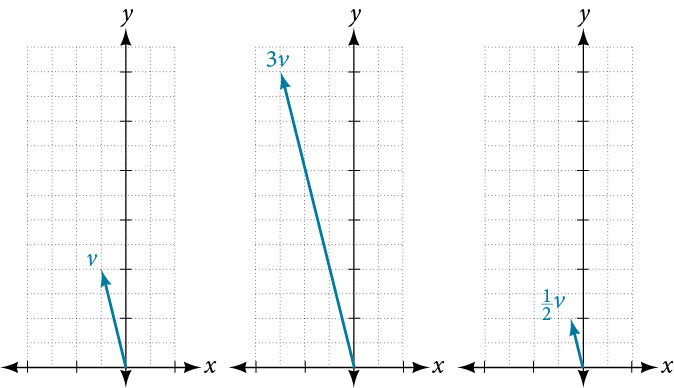
10.8-39 §10.8 source ↗
For the following exercises, use the vectors shown to sketch u + v, u − v, and 2u.
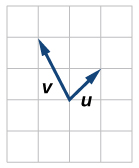
Answer
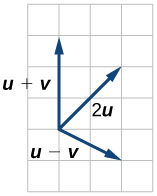
10.8-41 §10.8 source ↗
For the following exercises, use the vectors shown to sketch u + v, u − v, and 2u.
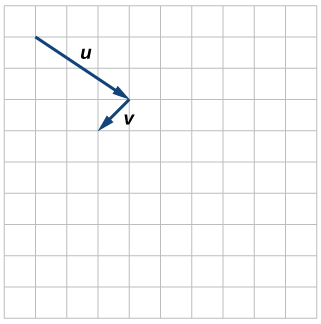
Answer
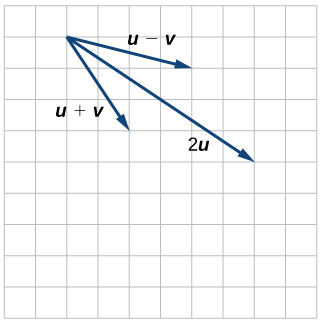
10.8-43 §10.8 source ↗
For the following exercises, use the vectors shown to sketch 2u + v.
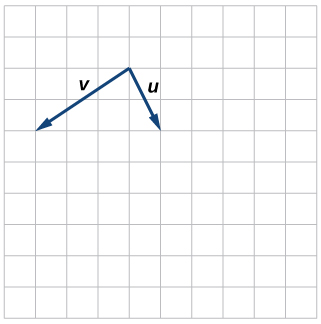
Answer
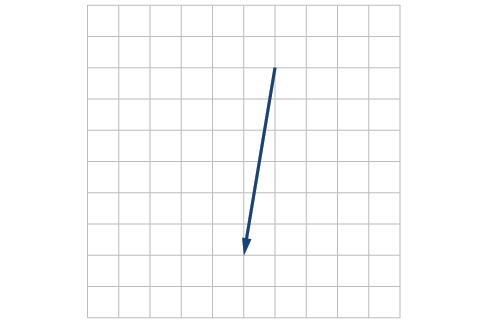
10.8-45 §10.8 source ↗
For the following exercises, use the vectors shown to sketch u − 3v.
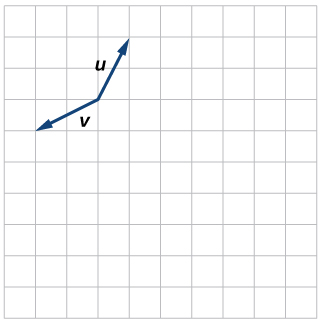
Answer
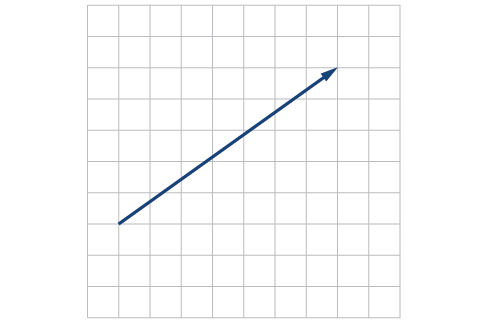
10.8-47 §10.8 source ↗
For the following exercises, write the vector shown in component form.
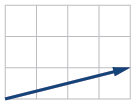
Answer
10.8-49 §10.8 source ↗
For the following exercises, write the vector shown in component form.
Given initial point and terminal point write the vector in terms of and Draw the points and the vector on the graph.
Answer
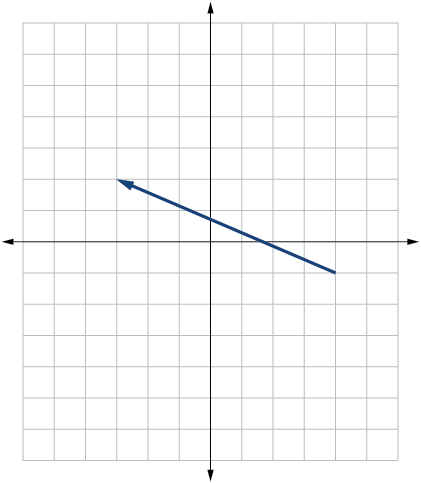
10.8-51 §10.8 source ↗
For the following exercises, use the given magnitude and direction in standard position, write the vector in component form.
Answer
10.8-53 §10.8 source ↗
For the following exercises, use the given magnitude and direction in standard position, write the vector in component form.
Answer
10.8-55 §10.8 source ↗
For the following exercises, use the given magnitude and direction in standard position, write the vector in component form.
A 60-pound box is resting on a ramp that is inclined 12°. Rounding to the nearest tenth,
ⓐ Find the magnitude of the normal (perpendicular) component of the force.
ⓑ Find the magnitude of the component of the force that is parallel to the ramp.
Answer
ⓐ 58.7
ⓑ 12.5
10.8-57 §10.8 source ↗
For the following exercises, use the given magnitude and direction in standard position, write the vector in component form.
Find the magnitude of the horizontal and vertical components of a vector with magnitude 8 pounds pointed in a direction of 27° above the horizontal. Round to the nearest hundredth.
Answer
10.8-59 §10.8 source ↗
For the following exercises, use the given magnitude and direction in standard position, write the vector in component form.
Find the magnitude of the horizontal and vertical components of a vector with magnitude 5 pounds pointed in a direction of 55° above the horizontal. Round to the nearest hundredth.
Answer
10.8-61 §10.8 source ↗
For the following exercises, use the given magnitude and direction in standard position, write the vector in component form.
A woman leaves home and walks 3 miles west, then 2 miles southwest. How far from home is she, and in what direction must she walk to head directly home?
Answer
10.8-63 §10.8 source ↗
For the following exercises, use the given magnitude and direction in standard position, write the vector in component form.
A man starts walking from home and walks 4 miles east, 2 miles southeast, 5 miles south, 4 miles southwest, and 2 miles east. How far has he walked? If he walked straight home, how far would he have to walk?
Answer
10.8-65 §10.8 source ↗
For the following exercises, use the given magnitude and direction in standard position, write the vector in component form.
A man starts walking from home and walks 3 miles at 20° north of west, then 5 miles at 10° west of south, then 4 miles at 15° north of east. If he walked straight home, how far would he have to the walk, and in what direction?
Answer
10.8-67 §10.8 source ↗
For the following exercises, use the given magnitude and direction in standard position, write the vector in component form.
An airplane is heading north at an airspeed of 600 km/hr, but there is a wind blowing from the southwest at 80 km/hr. How many degrees off course will the plane end up flying, and what is the plane’s speed relative to the ground?
Answer
10.8-69 §10.8 source ↗
For the following exercises, use the given magnitude and direction in standard position, write the vector in component form.
An airplane needs to head due north, but there is a wind blowing from the southwest at 60 km/hr. The plane flies with an airspeed of 550 km/hr. To end up flying due north, how many degrees west of north will the pilot need to fly the plane?
Answer
10.8-71 §10.8 source ↗
For the following exercises, use the given magnitude and direction in standard position, write the vector in component form.
As part of a video game, the point is rotated counterclockwise about the origin through an angle of 35°. Find the new coordinates of this point.
Answer
10.8-73 §10.8 source ↗
For the following exercises, use the given magnitude and direction in standard position, write the vector in component form.
Two children are throwing a ball back and forth straight across the back seat of a car. The ball is being thrown 10 mph relative to the car, and the car is traveling 25 mph down the road. If one child doesn't catch the ball, and it flies out the window, in what direction does the ball fly (ignoring wind resistance)?
Answer
10.8-75 §10.8 source ↗
For the following exercises, use the given magnitude and direction in standard position, write the vector in component form.
A 50-pound object rests on a ramp that is inclined 19°. Find the magnitude of the components of the force parallel to and perpendicular to (normal) the ramp to the nearest tenth of a pound.
Answer
10.8-77 §10.8 source ↗
For the following exercises, use the given magnitude and direction in standard position, write the vector in component form.
Suppose a body has a force of 10 pounds acting on it to the right, 25 pounds acting on it ─135° from the horizontal, and 5 pounds acting on it directed 150° from the horizontal. What single force is the resultant force acting on the body?
Answer
10.8-79 §10.8 source ↗
For the following exercises, use the given magnitude and direction in standard position, write the vector in component form.
Suppose a body has a force of 3 pounds acting on it to the left, 4 pounds acting on it upward, and 2 pounds acting on it 30° from the horizontal. What single force is needed to produce a state of equilibrium on the body? Draw the vector.
Answer
10.R-1 §10.R source ↗
For the following exercises, assume is opposite side is opposite side and is opposite side Solve each triangle, if possible. Round each answer to the nearest tenth.
Answer
10.R-3 §10.R source ↗
For the following exercises, assume is opposite side is opposite side and is opposite side Solve each triangle, if possible. Round each answer to the nearest tenth.
Solve the triangle.
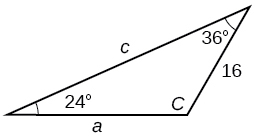
Answer
10.R-5 §10.R source ↗
For the following exercises, assume is opposite side is opposite side and is opposite side Solve each triangle, if possible. Round each answer to the nearest tenth.
A pilot is flying over a straight highway. He determines the angles of depression to two mileposts, 2.1 km apart, to be 25° and 49°, as shown in Figure 1. Find the distance of the plane from point and the elevation of the plane.
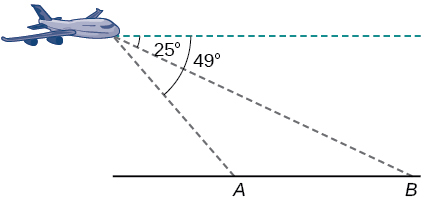
 Figure 1
Answer
10.R-7 §10.R source ↗
For the following exercises, assume is opposite side is opposite side and is opposite side Solve each triangle, if possible. Round each answer to the nearest tenth.
Solve the triangle in Figure 2, rounding to the nearest tenth.
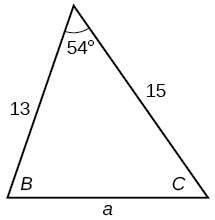 Figure 2
Answer
10.R-9 §10.R source ↗
For the following exercises, assume is opposite side is opposite side and is opposite side Solve each triangle, if possible. Round each answer to the nearest tenth.
To find the distance between two cities, a satellite calculates the distances and angle shown in Figure 3 (not to scale). Find the distance between the cities. Round answers to the nearest tenth.
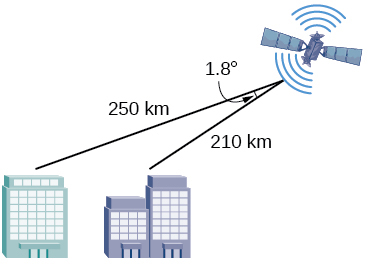
 Figure 3
Answer
10.R-11 §10.R source ↗
For the following exercises, assume is opposite side is opposite side and is opposite side Solve each triangle, if possible. Round each answer to the nearest tenth.
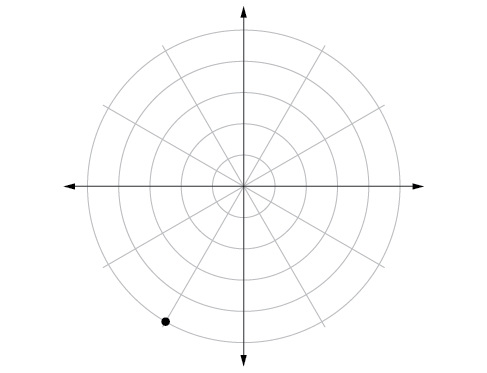
Plot the point with polar coordinates
Answer
10.R-13 §10.R source ↗
For the following exercises, assume is opposite side is opposite side and is opposite side Solve each triangle, if possible. Round each answer to the nearest tenth.
Convert to rectangular coordinates.
Answer
10.R-15 §10.R source ↗
For the following exercises, assume is opposite side is opposite side and is opposite side Solve each triangle, if possible. Round each answer to the nearest tenth.
Convert to polar coordinates.
Answer
10.R-17 §10.R source ↗
For the following exercises, convert the given Cartesian equation to a polar equation.
Answer
10.R-19 §10.R source ↗
For the following exercises, convert the given polar equation to a Cartesian equation.
Answer
10.R-21 §10.R source ↗
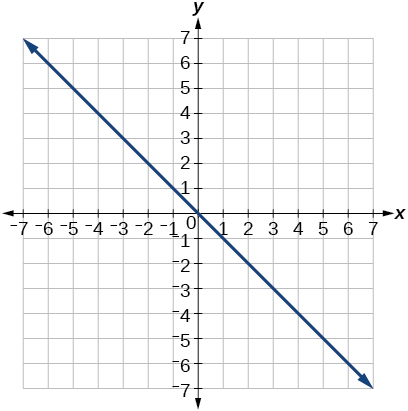
For the following exercises, convert to rectangular form and graph.
Answer
10.R-23 §10.R source ↗
For the following exercises, test each equation for symmetry.
Answer
10.R-25 §10.R source ↗
For the following exercises, test each equation for symmetry.
Sketch a graph of the polar equation Label the axis intercepts.
Answer
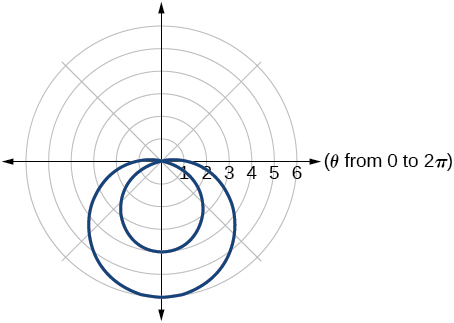
10.R-27 §10.R source ↗
For the following exercises, test each equation for symmetry.
Sketch a graph of the polar equation
Answer
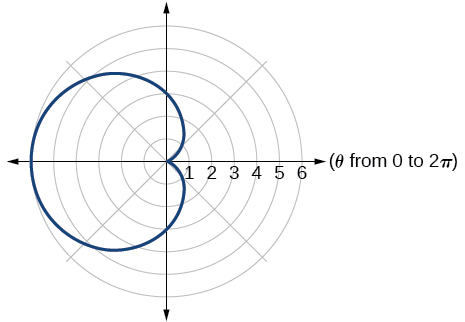
10.R-29 §10.R source ↗
For the following exercises, find the absolute value of each complex number.
Answer
10.R-31 §10.R source ↗
Write the complex number in polar form.
Answer
10.R-33 §10.R source ↗
For the following exercises, convert the complex number from polar to rectangular form.
Answer
10.R-35 §10.R source ↗
For the following exercises, find the product in polar form.
Answer
10.R-37 §10.R source ↗
For the following exercises, find the quotient in polar form.
Answer
10.R-39 §10.R source ↗
For the following exercises, find the powers of each complex number in polar form.
Find when
Answer
10.R-41 §10.R source ↗
For the following exercises, evaluate each root.
Evaluate the square root of when
Answer
10.R-43 §10.R source ↗
For the following exercises, plot the complex number in the complex plane.
Answer
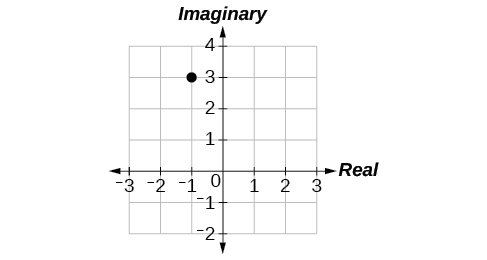
10.R-45 §10.R source ↗
For the following exercises, eliminate the parameter to rewrite the parametric equation as a Cartesian equation.
Answer
10.R-47 §10.R source ↗
For the following exercises, eliminate the parameter to rewrite the parametric equation as a Cartesian equation.
Parameterize the line from to so that the line is at at and at
Answer
10.R-49 §10.R source ↗
For the following exercises, make a table of values for each set of parametric equations, graph the equations, and include an orientation; then write the Cartesian equation.
Answer
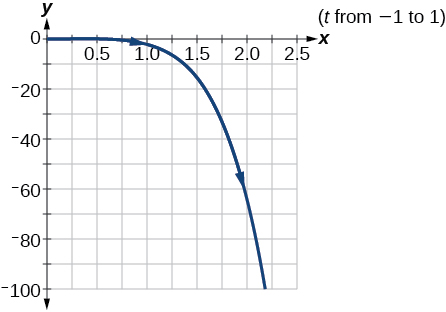
10.R-51 §10.R source ↗
For the following exercises, make a table of values for each set of parametric equations, graph the equations, and include an orientation; then write the Cartesian equation.
A ball is launched with an initial velocity of 80 feet per second at an angle of 40° to the horizontal. The ball is released at a height of 4 feet above the ground.
ⓐ Find the parametric equations to model the path of the ball.
ⓑ Where is the ball after 3 seconds?
ⓒ How long is the ball in the air?
Answer
a.
b. The ball is 14 feet high and 184 feet from where it was launched.
c. 3.3 seconds
10.R-53 §10.R source ↗
For the following exercises, determine whether the two vectors, and are equal, where has an initial point and a terminal point and has an initial point and a terminal point
and
Answer
10.R-55 §10.R source ↗
For the following exercises, use the vectors and to evaluate the expression.
2v − u + w
Answer
10.R-57 §10.R source ↗
For the following exercises, find a unit vector in the same direction as the given vector.
b = −3i − j
Answer
10.R-59 §10.R source ↗
For the following exercises, find the magnitude and direction of the vector.
Answer
10.R-61 §10.R source ↗
For the following exercises, calculate
u = i + 4j and v = 4i + 3j
Answer
10.R-63 §10.R source ↗
For the following exercises, calculate
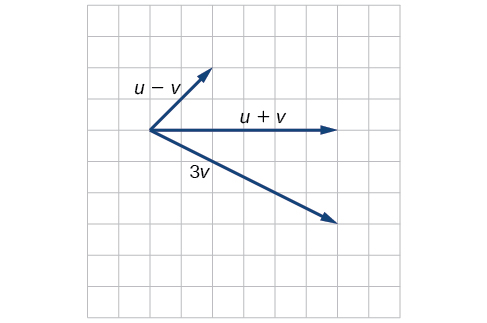
Given the vectors shown in Figure 4, sketch u + v, u − v and 3v.
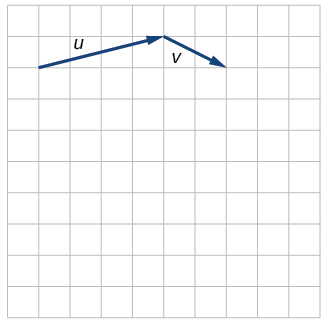 Figure 4
Answer
10.T-1 §10.T source ↗
Answer
10.T-3 §10.T source ↗
Answer
10.T-5 §10.T source ↗
Answer
10.T-7 §10.T source ↗
Answer
10.T-9 §10.T source ↗
Answer
10.T-11 §10.T source ↗
Answer
10.T-13 §10.T source ↗
Answer
10.T-15 §10.T source ↗
Given and evaluate each expression.
Answer
10.T-17 §10.T source ↗
Given and evaluate each expression.
Answer
10.T-19 §10.T source ↗
Given and evaluate each expression.
Eliminate the parameter to rewrite the following parametric equations as a Cartesian equation:
Answer
10.T-21 §10.T source ↗
Given and evaluate each expression.
Graph the set of parametric equations and find the Cartesian equation:
Answer
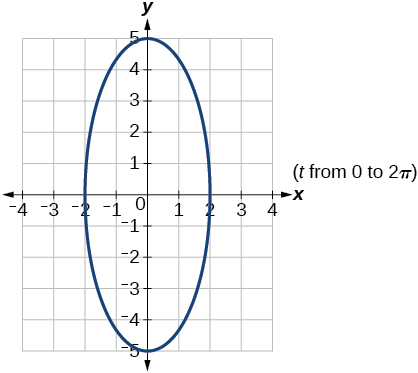
10.T-23 §10.T source ↗
For the following exercises, use the vectors u = i − 3j and v = 2i + 3j.
Find 2u − 3v.
Answer
10.T-25 §10.T source ↗
For the following exercises, use the vectors u = i − 3j and v = 2i + 3j.
Find a unit vector in the same direction as
Answer
Loading chapter 11…
Problems and answers are adapted from Algebra and Trigonometry 2e by Jay Abramson, OpenStax, and are used under the CC BY-NC-SA 4.0 licence. Access for free at https://openstax.org/books/algebra-and-trigonometry-2e/pages/1-introduction-to-prerequisites. Illustrations: Copyright Rice University, OpenStax, under CC BY-NC-SA 4.0 license. This adaptation is released under the same licence, is non-commercial, and is neither affiliated with nor endorsed by OpenStax or Rice University.