Every problem in the chapter beside the book’s answer, a chapter at a time as you scroll.

Chapter 8: Analytic Geometry

228 problems · 79 figures

Try It #3 §8.1 source ↗

What is the standard form equation of the ellipse that has vertices ( 0,±4 ) and foci ( 0,± 15 )?

Answer

x 2 + y 2 16 =1

Try It #4 §8.1 source ↗

What is the standard form equation of the ellipse that has vertices ( −3,3 ) and ( 5,3 ) and foci ( 1−2 3 ,3 ) and ( 1+2 3 ,3 )?

Answer

( x−1 ) 2 16 + ( y−3 ) 2 4 = 1

Try It #5 §8.1 source ↗

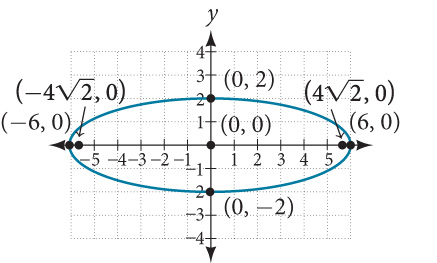
Graph the ellipse given by the equation x 2 36 + y 2 4 =1. Identify and label the center, vertices, co-vertices, and foci.

Answer

center: ( 0,0 ); vertices: ( ±6,0 ); co-vertices: ( 0,±2 ); foci: ( ±4 2 ,0 )

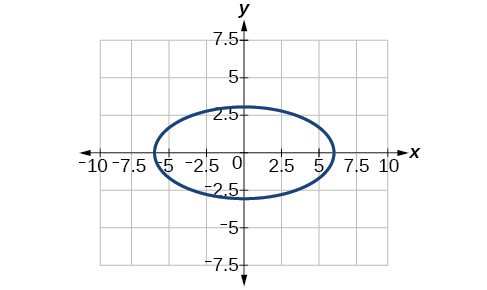
A Cartesian coordinate system shows an ellipse centered at the origin (0,0). The major axis is horizontal, with vertices at (-6, 0) and (6, 0). The minor axis is vertical, with y-intercepts at (0, 2) and (0, -2). The foci of the ellipse are located at (-4√2, 0) and (4√2, 0).

Try It #6 §8.1 source ↗

Graph the ellipse given by the equation 49 x 2 + 16 y 2 = 784. Rewrite the equation in standard form. Then identify and label the center, vertices, co-vertices, and foci.

Answer

Standard form: x 2 16 + y 2 49 = 1; center: ( 0,0 ); vertices: ( 0,±7 ); co-vertices: ( ±4,0 ); foci: ( 0,± 33 )

A coordinate plane shows an ellipse centered at (4, 2). Its major axis extends horizontally from (-2, 2) to (10, 2), and its minor axis extends vertically from (4, 2 - 2sqrt(5)) to (4, 2 + 2sqrt(5)).

Try It #7 §8.1 source ↗

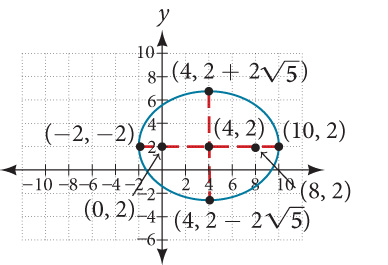
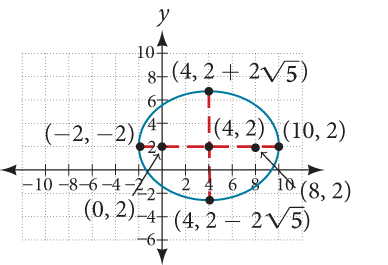
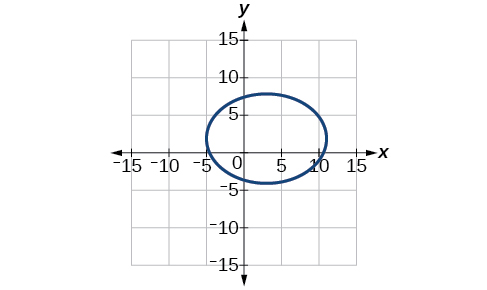
Graph the ellipse given by the equation ( x−4 ) 2 36 + ( y−2 ) 2 20 = 1. Identify and label the center, vertices, co-vertices, and foci.

Answer

Center: ( 4,2 ); vertices: ( −2,2 ) and ( 10,2 ); co-vertices: ( 4,2−2 5 ) and ( 4,2+2 5 ); foci: ( 0,2 ) and ( 8,2 )

A graph of an ellipse centered at (4, 2) on a Cartesian coordinate system. The horizontal major axis extends from (-2, 2) to (10, 2), and the vertical minor axis from (4, 2 - 2 5) to (4, 2 + 2 5). Foci are at (0, 2) and (8, 2).

Try It #8 §8.1 source ↗

Express the equation of the ellipse given in standard form. Identify the center, vertices, co-vertices, and foci of the ellipse.

4 x 2 + y 2 −24x+2y+21=0

Answer

(x−3) 2 4 + ( y+1 ) 2 16 = 1; center: ( 3,−1 ); vertices: ( 3,−5 ) and ( 3,3 ); co-vertices: ( 1,−1 ) and ( 5,−1 ); foci: ( 3,−1−2 3 ) and ( 3,−1+2 3 )

Try It #9 §8.1 source ↗

Suppose a whispering chamber is 480 feet long and 320 feet wide.

ⓐ What is the standard form of the equation of the ellipse representing the room? Hint: assume a horizontal ellipse, and let the center of the room be the point ( 0,0 ).
ⓑ If two people are standing at the foci of this room and can hear each other whisper, how far apart are the people? Round to the nearest foot.

Answer

ⓐ x 2 57,600 + y 2 25,600 = 1

ⓑ The people are standing 358 feet apart.

8.1-1 §8.1 source ↗

Define an ellipse in terms of its foci.

Answer

An ellipse is the set of all points in the plane the sum of whose distances from two fixed points, called the foci, is a constant.

8.1-3 §8.1 source ↗

What special case of the ellipse do we have when the major and minor axis are of the same length?

Answer

This special case would be a circle.

8.1-5 §8.1 source ↗

What can be said about the symmetry of the graph of an ellipse with center at the origin and foci along the y-axis?

Answer

It is symmetric about the x-axis, y-axis, and the origin.

8.1-7 §8.1 source ↗

For the following exercises, determine whether the given equations represent ellipses. If yes, write in standard form.

4 x 2 +9 y 2 =36

Answer

yes; x 2 3 2 + y 2 2 2 =1

8.1-9 §8.1 source ↗

For the following exercises, determine whether the given equations represent ellipses. If yes, write in standard form.

4 x 2 +9 y 2 =1

Answer

yes; x 2 ( 1 2 ) 2 + y 2 ( 1 3 ) 2 = 1

8.1-11 §8.1 source ↗

For the following exercises, write the equation of an ellipse in standard form, and identify the end points of the major and minor axes as well as the foci.

x 2 4 + y 2 49 =1

Answer

x 2 2 2 + y 2 7 2 = 1; Endpoints of major axis ( 0,7 ) and ( 0,−7 ). Endpoints of minor axis ( 2,0 ) and ( −2,0 ). Foci at (0,3 5 ), (0,−3 5 ).

8.1-13 §8.1 source ↗

For the following exercises, write the equation of an ellipse in standard form, and identify the end points of the major and minor axes as well as the foci.

x 2 +9 y 2 =1

Answer

x 2 ( 1 ) 2 + y 2 ( 1 3 ) 2 = 1; Endpoints of major axis ( 1,0 ) and ( −1,0 ). Endpoints of minor axis (0, 1 3 ), (0,− 1 3 ). Foci at ( 2 2 3 ,0), (− 2 2 3 ,0).

8.1-15 §8.1 source ↗

For the following exercises, write the equation of an ellipse in standard form, and identify the end points of the major and minor axes as well as the foci.

( x−2 ) 2 49 + ( y−4 ) 2 25 = 1

Answer

( x−2 ) 2 7 2 + ( y−4 ) 2 5 2 = 1; Endpoints of major axis (9,4), (−5,4). Endpoints of minor axis (2,9), (2,−1). Foci at (2+2 6 ,4), (2−2 6 ,4).

8.1-17 §8.1 source ↗

For the following exercises, write the equation of an ellipse in standard form, and identify the end points of the major and minor axes as well as the foci.

( x+5 ) 2 4 + ( y−7 ) 2 9 = 1

Answer

( x+5 ) 2 2 2 + ( y−7 ) 2 3 2 = 1; Endpoints of major axis (−5,10), (−5,4). Endpoints of minor axis (−3,7), (−7,7). Foci at (−5,7+ 5 ), (−5,7− 5 ).

8.1-19 §8.1 source ↗

For the following exercises, write the equation of an ellipse in standard form, and identify the end points of the major and minor axes as well as the foci.

4 x 2 − 8x+ 9 y 2 − 72y+ 112= 0

Answer

( x−1 ) 2 3 2 + ( y−4 ) 2 2 2 = 1; Endpoints of major axis (4,4), (−2,4). Endpoints of minor axis (1,6), (1,2). Foci at (1+ 5 ,4), (1− 5 ,4).

8.1-21 §8.1 source ↗

For the following exercises, write the equation of an ellipse in standard form, and identify the end points of the major and minor axes as well as the foci.

4 x 2 − 24x+ 36 y 2 − 360y+ 864= 0

Answer

( x−3 ) 2 ( 3 2 ) 2 + ( y−5 ) 2 ( 2 ) 2 = 1; Endpoints of major axis (3+3 2 ,5), (3−3 2 ,5). Endpoints of minor axis (3,5+ 2 ), (3,5− 2 ). Foci at (7,5), (−1,5).

8.1-23 §8.1 source ↗

For the following exercises, write the equation of an ellipse in standard form, and identify the end points of the major and minor axes as well as the foci.

4 x 2 + 40x+ 25 y 2 − 100y+ 100= 0

Answer

( x+5 ) 2 ( 5 ) 2 + ( y−2 ) 2 ( 2 ) 2 = 1; Endpoints of major axis (0,2), (−10,2). Endpoints of minor axis (−5,4), (−5,0). Foci at (−5+ 21 ,2), (−5− 21 ,2).

8.1-25 §8.1 source ↗

For the following exercises, write the equation of an ellipse in standard form, and identify the end points of the major and minor axes as well as the foci.

4 x 2 + 24x+ 25 y 2 + 200y+ 336= 0

Answer

( x+3 ) 2 ( 5 ) 2 + ( y+4 ) 2 ( 2 ) 2 = 1; Endpoints of major axis (2,−4), (−8,−4). Endpoints of minor axis (−3,−2), (−3,−6). Foci at (−3+ 21 ,−4), (−3− 21 ,−4).

8.1-27 §8.1 source ↗

For the following exercises, find the foci for the given ellipses.

( x+3 ) 2 25 + ( y+1 ) 2 36 = 1

Answer

Foci (−3,−1+ 11 ), (−3,−1− 11 )

8.1-29 §8.1 source ↗

For the following exercises, find the foci for the given ellipses.

x 2 + y 2 =1

Answer

Focus ( 0,0 )

8.1-31 §8.1 source ↗

For the following exercises, find the foci for the given ellipses.

10 x 2 + y 2 + 200x= 0

Answer

Foci (−10,30), (−10,−30)

8.1-33 §8.1 source ↗

For the following exercises, graph the given ellipses, noting center, vertices, and foci.

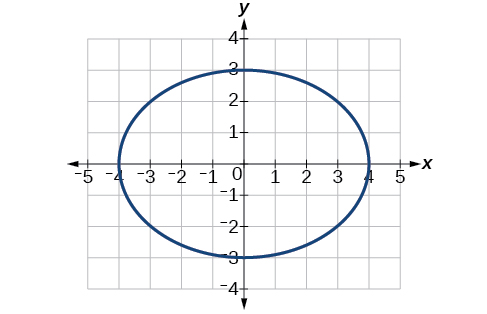
x 2 16 + y 2 9 =1

Answer

Center ( 0,0 ), Vertices (4,0), (−4,0), (0,3), (0,−3), Foci ( 7 ,0), (− 7 ,0)

A Cartesian coordinate system displays an ellipse centered at the origin, with x-axis extending from -4 to 4 and y-axis from -3 to 3.

8.1-35 §8.1 source ↗

For the following exercises, graph the given ellipses, noting center, vertices, and foci.

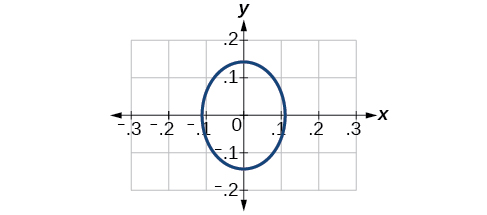
81 x 2 +49 y 2 =1

Answer

Center ( 0,0 ), Vertices ( 1 9 ,0), (− 1 9 ,0), (0, 1 7 ), (0,− 1 7 ), Foci (0, 4 2 63 ), (0,− 4 2 63 )

A graph shows an upright ellipse centered at the origin. The x-axis spans from -0.3 to 0.3, and the y-axis from -0.2 to 0.2. The ellipse's approximate x-intercepts are +/- 0.1 and y-intercepts are +/- 0.15.

8.1-37 §8.1 source ↗

For the following exercises, graph the given ellipses, noting center, vertices, and foci.

( x+3 ) 2 9 + ( y−3 ) 2 9 = 1

Answer

Center ( −3,3 ), Vertices (0,3), (−6,3), (−3,0), (−3,6), Focus ( −3,3 )

Note that this ellipse is a circle. The circle has only one focus, which coincides with the center.
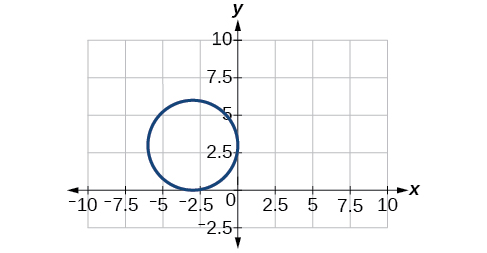
A blue circle is plotted on a Cartesian coordinate system. The x-axis ranges from -10 to 10, and the y-axis from -2.5 to 10. The circle is centered at (-2.5, 2.5) with a radius of 2.5 units.

8.1-39 §8.1 source ↗

For the following exercises, graph the given ellipses, noting center, vertices, and foci.

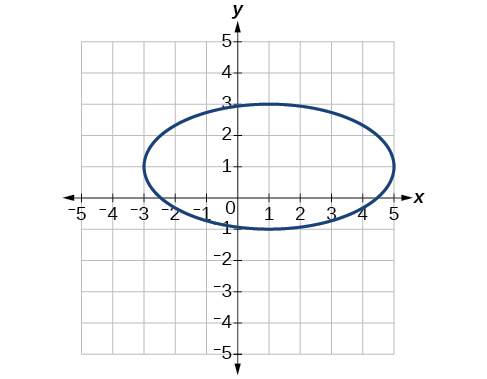
4 x 2 − 8x+ 16 y 2 − 32y− 44= 0

Answer

Center ( 1,1 ), Vertices (5,1), (−3,1), (1,3), (1,−1), Foci (1+23,1), (1-23,1)

An ellipse is displayed on a Cartesian coordinate plane with x and y axes ranging from -5 to 5. The ellipse is horizontally elongated, centered at (1,1).

8.1-41 §8.1 source ↗

For the following exercises, graph the given ellipses, noting center, vertices, and foci.

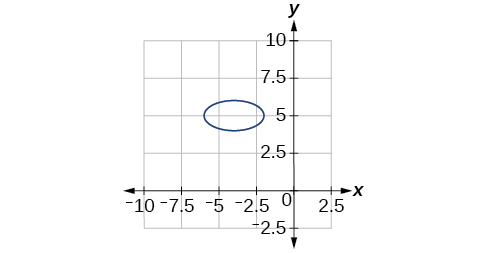
x 2 + 8x+ 4 y 2 − 40y+ 112= 0

Answer

Center ( −4,5 ), Vertices (−2,5), (−6,5), (−4,6), (−4,4), Foci (−4+ 3 ,5), (−4− 3 ,5)

An ellipse is plotted on a Cartesian coordinate system. The x-axis ranges from -10 to 2.5, with major ticks at -10, -7.5, -5, -2.5, 0, and 2.5. The y-axis ranges from -2.5 to 10, with major ticks at -2.5, 0, 2.5, 5, 7.5, and 10. The ellipse is centered approximately at (-4, 5) and is horizontally elongated, extending from about x=-6 to x=-2.5 and vertically from about y=4 to y=6.

8.1-43 §8.1 source ↗

For the following exercises, graph the given ellipses, noting center, vertices, and foci.

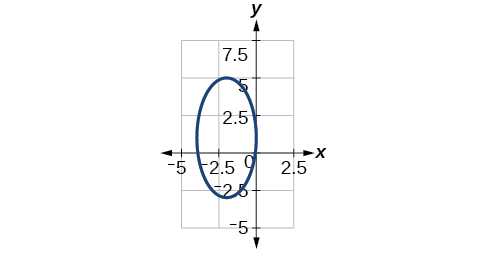
16 x 2 + 64x+ 4 y 2 − 8y+ 4= 0

Answer

Center ( −2,1 ), Vertices (0,1), (−4,1), (−2,5), (−2,−3), Foci (−2,1+2 3 ), (−2,1−2 3 )

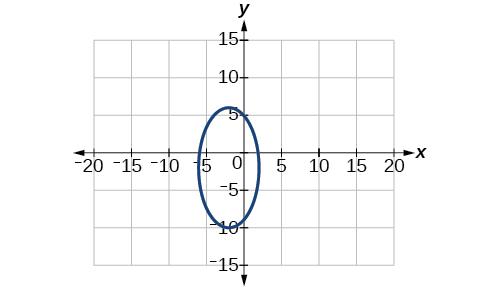
A graph displays a blue, vertically oriented ellipse centered around (-1, 2) on a Cartesian coordinate plane. The x-axis ranges from -5 to 2.5, and the y-axis from -5 to 7.5.

8.1-45 §8.1 source ↗

For the following exercises, graph the given ellipses, noting center, vertices, and foci.

4 x 2 + 16x+ 4 y 2 + 16y+ 16= 0

Answer

Center ( −2,−2 ), Vertices (0,−2), (−4,−2), (−2,0), (−2,−4), Focus ( −2,−2 )

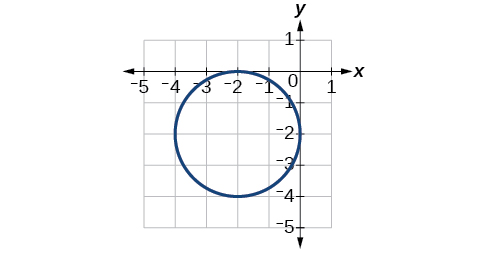
A graph displays a circle on a coordinate plane. The circle is centered at (-2, -2) and has a radius of 2, passing through points such as (-4, -2), (0, -2), (-2, 0), and (-2, -4).

8.1-47 §8.1 source ↗

For the following exercises, use the given information about the graph of each ellipse to determine its equation.

Center at the origin, symmetric with respect to the x- and y-axes, focus at (0,−2), and point on graph (5,0).

Answer

x 2 25 + y 2 29 =1

8.1-49 §8.1 source ↗

For the following exercises, use the given information about the graph of each ellipse to determine its equation.

Center ( 4,2 ) ; vertex ( 9,2 ) ; one focus: ( 4+2 6 ,2 ) .

Answer

( x−4 ) 2 25 + ( y−2 ) 2 1 = 1

8.1-51 §8.1 source ↗

For the following exercises, use the given information about the graph of each ellipse to determine its equation.

Center ( −3,4 ) ; vertex ( 1,4 ) ; one focus: ( −3+2 3 ,4 )

Answer

( x+3 ) 2 16 + ( y−4 ) 2 4 = 1

8.1-53 §8.1 source ↗

For the following exercises, given the graph of the ellipse, determine its equation.
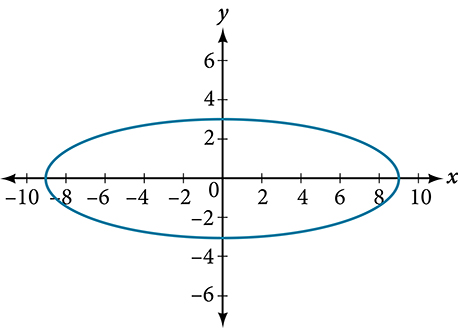
A horizontal ellipse centered at (0, 0) in the x y coordinate system with vertices at (9, 0) and (negative 9, 0) and co-vertices at (0, 3) and (0, negative 3).

Answer

x 2 81 + y 2 9 =1

8.1-55 §8.1 source ↗

For the following exercises, given the graph of the ellipse, determine its equation.
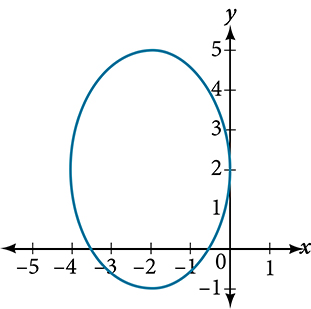
A vertical ellipse tangent to the y-axis at (0, 2) in the x y coordinate system and intersecting the x-axis midway between (negative 4, 0) and (negative 3, 0) and also (negative 1, 0) and (0, 0).

Answer

( x+2 ) 2 4 + ( y−2 ) 2 9 = 1

8.1-57 §8.1 source ↗

For the following exercises, find the area of the ellipse. The area of an ellipse is given by the formula Area=a⋅b⋅π.

( x−3 ) 2 9 + ( y−3 ) 2 16 = 1

Answer

Area = 12πsquareunits

8.1-59 §8.1 source ↗

For the following exercises, find the area of the ellipse. The area of an ellipse is given by the formula Area=a⋅b⋅π.

( x+1 ) 2 4 + ( y−2 ) 2 5 = 1

Answer

Area = 2 5 π square units.

8.1-61 §8.1 source ↗

For the following exercises, find the area of the ellipse. The area of an ellipse is given by the formula Area=a⋅b⋅π.

9 x 2 − 54x+ 9 y 2 − 54y+ 81= 0

Answer

Area = 9π square units.

8.1-63 §8.1 source ↗

For the following exercises, find the area of the ellipse. The area of an ellipse is given by the formula Area=a⋅b⋅π.

Find the equation of the ellipse that will just fit inside a box that is four times as wide as it is high. Express in terms of h, the height.

Answer

x 2 4 h 2 + y 2 1 4 h 2 = 1

8.1-65 §8.1 source ↗

For the following exercises, find the area of the ellipse. The area of an ellipse is given by the formula Area=a⋅b⋅π.

An arch has the shape of a semi-ellipse. The arch has a height of 12 feet and a span of 40 feet. Find an equation for the ellipse, and use that to find the distance from the center to a point at which the height is 6 feet. Round to the nearest hundredth.

Answer

x 2 400 + y 2 144 = 1 . Distance = 17.32 feet

8.1-67 §8.1 source ↗

For the following exercises, find the area of the ellipse. The area of an ellipse is given by the formula Area=a⋅b⋅π.

A person in a whispering gallery standing at one focus of the ellipse can whisper and be heard by a person standing at the other focus because all the sound waves that reach the ceiling are reflected to the other person. If a whispering gallery has a length of 120 feet, and the foci are located 30 feet from the center, find the height of the ceiling at the center.

Answer

Approximately 51.96 feet

Try It #1 §8.2 source ↗

Identify the vertices and foci of the hyperbola with equation x 2 9 − y 2 25 =1.

Answer

Vertices: ( ±3,0 ); Foci: ( ± 34 ,0 )

Try It #2 §8.2 source ↗

What is the standard form equation of the hyperbola that has vertices ( 0,±2 ) and foci ( 0,±2 5 )?

Answer

y 2 4 − x 2 16 =1

Try It #3 §8.2 source ↗

What is the standard form equation of the hyperbola that has vertices ( 1,−2 ) and ( 1,8 ) and foci ( 1,−10 ) and ( 1,16 )?

Answer

( y−3 ) 2 25 - ( x−1 ) 2 144 = 1

Try It #4 §8.2 source ↗

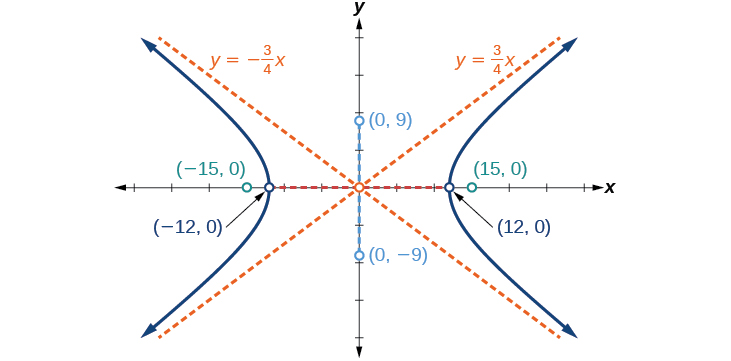
Graph the hyperbola given by the equation x 2 144 − y 2 81 = 1. Identify and label the vertices, co-vertices, foci, and asymptotes.

Answer

vertices: ( ±12,0 ); co-vertices: ( 0,±9 ); foci: ( ±15,0 ); asymptotes: y=± 3 4 x;

A hyperbola centered at the origin with vertices (±12, 0), foci (±15, 0), and asymptotes y = ±(3/4)x. Points (0, ±9) are on the conjugate axis.

Try It #5 §8.2 source ↗

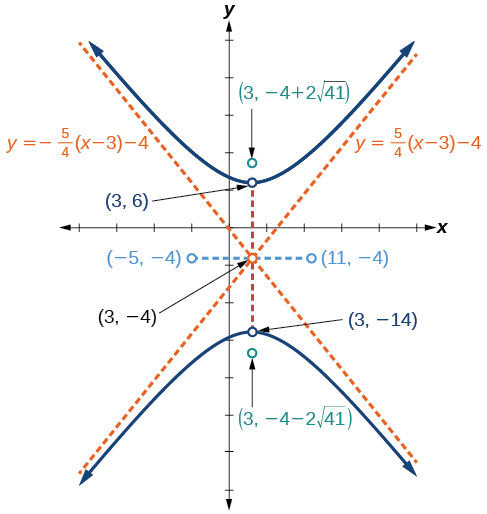
Graph the hyperbola given by the standard form of an equation ( y+4 ) 2 100 − ( x−3 ) 2 64 = 1. Identify and label the center, vertices, co-vertices, foci, and asymptotes.

Answer

center: ( 3,−4 ); vertices: ( 3,−14 ) and ( 3,6 ); co-vertices: ( −5,−4 ); and ( 11,−4 ); foci: ( 3,−4−2 41 ) and ( 3,−4+2 41 ); asymptotes: y= ± 5 4 (x−3)− 4

A graph depicts a hyperbola opening along the y-axis, centered at the point (3, -4). The upper branch has a vertex at (3, 6) and a focus at (3, -4 + 2 sqrt(41)). The lower branch has a vertex at (3, -14) and a focus at (3, -4 - 2 sqrt(41)). The asymptotes are represented by dashed orange lines with equations y = (5/4)(x-3)-4 and y = -(5/4)(x-3)-4. A horizontal dashed blue line passes through the center at y = -4, with points (-5, -4) and (11, -4) marked on it. A vertical dashed red line passes through the center at x = 3, intersecting the vertices and foci.

Try It #6 §8.2 source ↗

A design for a cooling tower project is shown in Figure 12. Find the equation of the hyperbola that models the sides of the cooling tower. Assume that the center of the hyperbola—indicated by the intersection of dashed perpendicular lines in the figure—is the origin of the coordinate plane. Round final values to four decimal places.
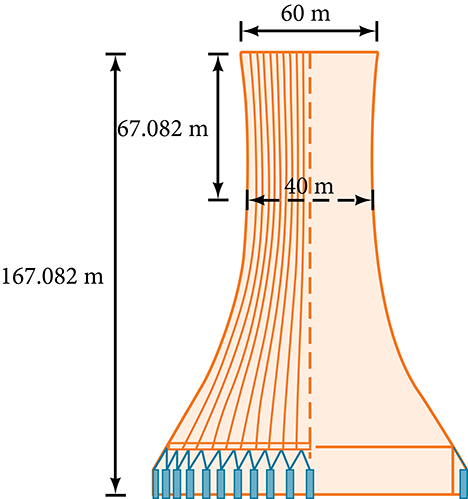
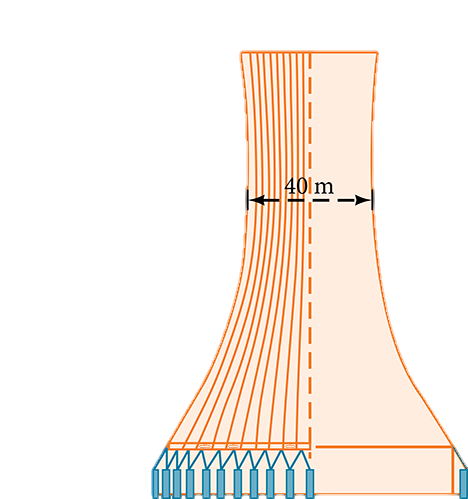
Project design for a natural draft cooling tower. The overall height is 167.082 meters. The diameter at the top is 60 meters, and at their closest, 79.6 meters from the top, the sides are 60 meters apart.Project design for a natural draft cooling tower. The overall height is 167.082 meters. The diameter at the top is 60 meters, and at their closest, 79.6 meters from the top, the sides are 60 meters apart. Figure 12

Answer

The sides of the tower can be modeled by the hyperbolic equation. x 2 400 − y 2 3600 = 1or  x 2 20 2 − y 2 60 2 = 1.

8.2-1 §8.2 source ↗

Define a hyperbola in terms of its foci.

Answer

A hyperbola is the set of points in a plane the difference of whose distances from two fixed points (foci) is a positive constant.

8.2-3 §8.2 source ↗

What must be true of the foci of a hyperbola?

Answer

The foci must lie on the transverse axis and be in the interior of the hyperbola.

8.2-5 §8.2 source ↗

Where must the center of hyperbola be relative to its foci?

Answer

The center must be the midpoint of the line segment joining the foci.

8.2-7 §8.2 source ↗

For the following exercises, determine whether the following equations represent hyperbolas. If so, write in standard form.

x 2 36 − y 2 9 =1

Answer

yes x 2 6 2 − y 2 3 2 =1

8.2-9 §8.2 source ↗

For the following exercises, determine whether the following equations represent hyperbolas. If so, write in standard form.

25 x 2 − 16 y 2 = 400

Answer

yes x 2 4 2 − y 2 5 2 =1

8.2-11 §8.2 source ↗

For the following exercises, write the equation for the hyperbola in standard form if it is not already, and identify the vertices and foci, and write equations of asymptotes.

x 2 25 − y 2 36 =1

Answer

x 2 5 2 − y 2 6 2 = 1; vertices: (5,0), (−5,0); foci: ( 61 ,0), (− 61 ,0); asymptotes: y= 6 5 x, y= − 6 5 x

8.2-13 §8.2 source ↗

For the following exercises, write the equation for the hyperbola in standard form if it is not already, and identify the vertices and foci, and write equations of asymptotes.

y 2 4 − x 2 81 =1

Answer

y 2 2 2 − x 2 9 2 = 1; vertices: (0,2), (0,−2); foci: (0, 85 ), (0,− 85 ); asymptotes: y= 2 9 x, y= − 2 9 x

8.2-15 §8.2 source ↗

For the following exercises, write the equation for the hyperbola in standard form if it is not already, and identify the vertices and foci, and write equations of asymptotes.

( x−1 ) 2 9 − ( y−2 ) 2 16 = 1

Answer

( x−1 ) 2 3 2 − ( y−2 ) 2 4 2 = 1; vertices: (4,2), (−2,2); foci: (6,2), (−4,2); asymptotes: y= 4 3 (x−1)+ 2, y= − 4 3 (x−1)+ 2

8.2-17 §8.2 source ↗

For the following exercises, write the equation for the hyperbola in standard form if it is not already, and identify the vertices and foci, and write equations of asymptotes.

( x−2 ) 2 49 − ( y+7 ) 2 49 = 1

Answer

( x−2 ) 2 7 2 − ( y+7 ) 2 7 2 = 1; vertices: (9,−7), (−5,−7); foci: (2+7 2 ,−7), (2−7 2 ,−7); asymptotes: y= x− 9, y= − x− 5

8.2-19 §8.2 source ↗

For the following exercises, write the equation for the hyperbola in standard form if it is not already, and identify the vertices and foci, and write equations of asymptotes.

− 9 x 2 − 54x+ 9 y 2 − 54y+ 81= 0

Answer

( x+3 ) 2 3 2 − ( y−3 ) 2 3 2 = 1; vertices: (0,3), (−6,3); foci: (−3+3 2 ,1), (−3−3 2 ,1); asymptotes: y=x+6,y=−x

8.2-21 §8.2 source ↗

For the following exercises, write the equation for the hyperbola in standard form if it is not already, and identify the vertices and foci, and write equations of asymptotes.

− 4 x 2 + 24x+ 16 y 2 − 128y+ 156= 0

Answer

( y−4 ) 2 2 2 − ( x−3 ) 2 4 2 = 1; vertices: (3,6), (3,2); foci: (3,4+2 5 ), (3,4−2 5 ); asymptotes: y= 1 2 (x−3)+ 4, y= − 1 2 (x−3)+ 4

8.2-23 §8.2 source ↗

For the following exercises, write the equation for the hyperbola in standard form if it is not already, and identify the vertices and foci, and write equations of asymptotes.

x 2 + 2x− 100 y 2 − 1000y+ 2401= 0

Answer

( y+5 ) 2 7 2 − ( x+1 ) 2 70 2 = 1; vertices: (−1,2), (−1,−12); foci: (−1,−5+7 101 ), (−1,−5−7 101 ); asymptotes: y= 1 10 (x+1)− 5, y= − 1 10 (x+1)− 5

8.2-25 §8.2 source ↗

For the following exercises, write the equation for the hyperbola in standard form if it is not already, and identify the vertices and foci, and write equations of asymptotes.

4 x 2 + 24x− 25 y 2 + 200y− 464= 0

Answer

( x+3 ) 2 5 2 − ( y−4 ) 2 2 2 = 1; vertices: (2,4), (−8,4); foci: (−3+ 29 ,4), (−3− 29 ,4); asymptotes: y= 2 5 (x+3)+ 4, y= − 2 5 (x+3)+ 4

8.2-27 §8.2 source ↗

For the following exercises, find the equations of the asymptotes for each hyperbola.

( x−3 ) 2 5 2 − ( y+4 ) 2 2 2 = 1

Answer

y= 2 5 (x−3)− 4, y= − 2 5 (x−3)− 4

8.2-29 §8.2 source ↗

For the following exercises, find the equations of the asymptotes for each hyperbola.

9 x 2 − 18x− 16 y 2 + 32y− 151= 0

Answer

y= 3 4 (x−1)+ 1, y= − 3 4 (x−1)+ 1

8.2-31 §8.2 source ↗

For the following exercises, sketch a graph of the hyperbola, labeling vertices and foci.

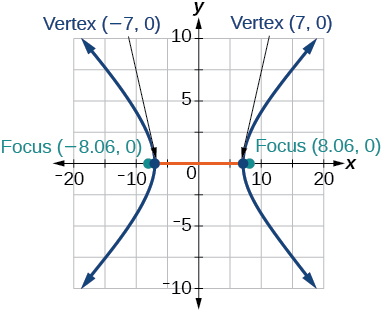
x 2 49 − y 2 16 =1

Answer

The image shows a hyperbola centered at the origin, opening to the left and right. Its vertices are labeled at (-7,0) and (7,0), while its foci are labeled at approximately (-8.06,0) and (8.06,0). The graph is set against a grid with x-axis values ranging from -20 to 20 and y-axis values from -10 to 10.

8.2-33 §8.2 source ↗

For the following exercises, sketch a graph of the hyperbola, labeling vertices and foci.

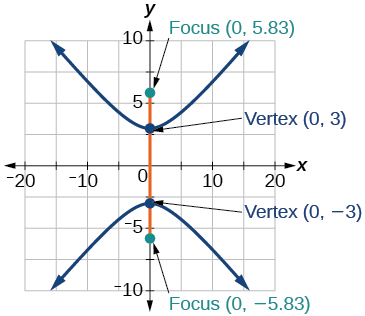
y 2 9 − x 2 25 =1

Answer

A graph shows a hyperbola centered at the origin. The transverse axis is along the y-axis. The vertices are labeled at (0, 3) and (0, -3). The foci are labeled at (0, 5.83) and (0, -5.83).

8.2-35 §8.2 source ↗

For the following exercises, sketch a graph of the hyperbola, labeling vertices and foci.

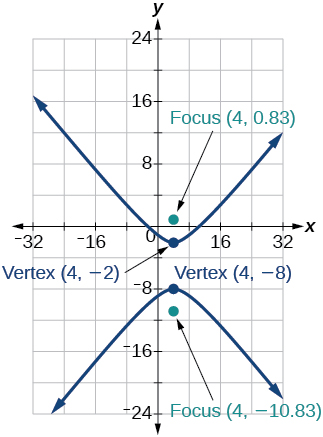
( y+5 ) 2 9 − ( x−4 ) 2 25 = 1

Answer

A graph of a vertically oriented hyperbola. Vertices are (4, -2) and (4, -8). Foci are (4, 0.83) and (4, -10.83).

8.2-37 §8.2 source ↗

For the following exercises, sketch a graph of the hyperbola, labeling vertices and foci.

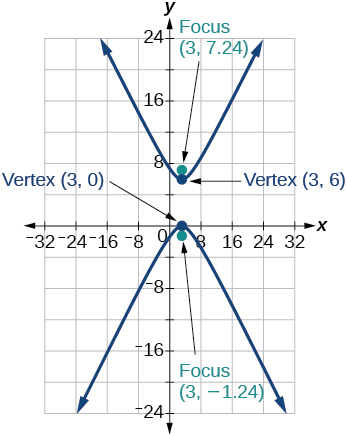
( y−3 ) 2 9 − ( x−3 ) 2 9 = 1

Answer

A hyperbola graph with vertices labeled at (3, 0) and (3, 6), and foci at (3, -1.24) and (3, 7.24). The branches open upwards and downwards along the y-axis.

8.2-39 §8.2 source ↗

For the following exercises, sketch a graph of the hyperbola, labeling vertices and foci.

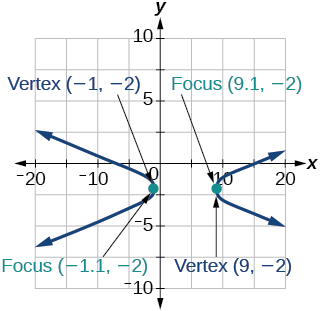
x 2 − 8x− 25 y 2 − 100y− 109= 0

Answer

A graph on a coordinate plane shows a hyperbola with its center at (4, -2). The two vertices are labeled at (-1, -2) and (9, -2). The two foci are labeled at approximately (-1.1, -2) and (9.1, -2). The hyperbola opens horizontally, with its branches extending to the left from the vertex at (-1, -2) and to the right from the vertex at (9, -2). The x-axis ranges from -20 to 20, and the y-axis ranges from -10 to 10.

8.2-41 §8.2 source ↗

For the following exercises, sketch a graph of the hyperbola, labeling vertices and foci.

64 x 2 + 128x− 9 y 2 − 72y− 656= 0

Answer

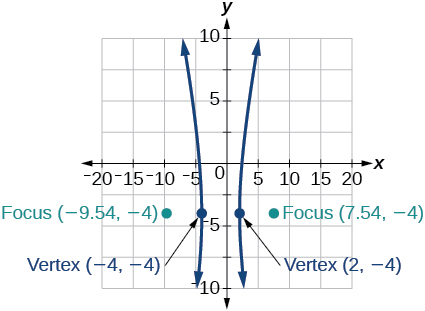
A graph shows a hyperbola on a coordinate plane. The x-axis ranges from -20 to 20 and the y-axis ranges from -10 to 10. The hyperbola has two branches opening horizontally, one to the left and one to the right. The left vertex is labeled as (-4, -4) and the right vertex is labeled as (2, -4). The left focus is labeled as (-9.54, -4) and the right focus is labeled as (7.54, -4).

8.2-43 §8.2 source ↗

For the following exercises, sketch a graph of the hyperbola, labeling vertices and foci.

− 100 x 2 + 1000x+ y 2 − 10y− 2575= 0

Answer

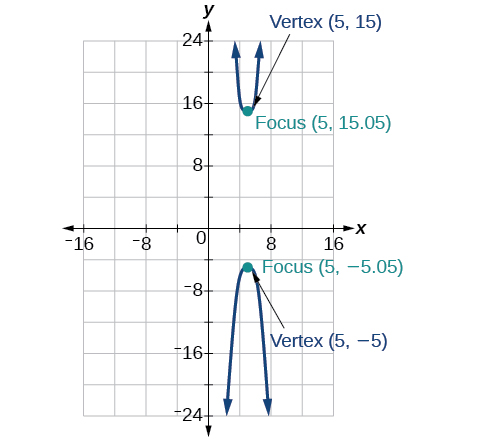
A Cartesian coordinate system displays two parabolas. The top parabola opens upwards, with its vertex marked at (5, 15) and its focus marked at (5, 15.05). The bottom parabola opens downwards, with its vertex marked at (5, -5) and its focus marked at (5, -5.05). Both parabolas share the vertical line x=5 as their axis of symmetry. The x-axis spans from -16 to 16, and the y-axis spans from -24 to 24.

8.2-45 §8.2 source ↗

For the following exercises, given information about the graph of the hyperbola, find its equation.

Vertices at ( 3,0 ) and ( −3,0 ) and one focus at ( 5,0 ).

Answer

x 2 9 − y 2 16 =1

8.2-47 §8.2 source ↗

For the following exercises, given information about the graph of the hyperbola, find its equation.

Vertices at ( 1,1 ) and ( 11,1 ) and one focus at ( 12,1 ).

Answer

( x−6 ) 2 25 − ( y−1 ) 2 11 = 1

8.2-49 §8.2 source ↗

For the following exercises, given information about the graph of the hyperbola, find its equation.

Center: ( 4,2 ); vertex: ( 9,2 ); one focus: ( 4+ 26 ,2 ).

Answer

( x−4 ) 2 25 − ( y−2 ) 2 1 = 1

8.2-51 §8.2 source ↗

For the following exercises, given the graph of the hyperbola, find its equation.
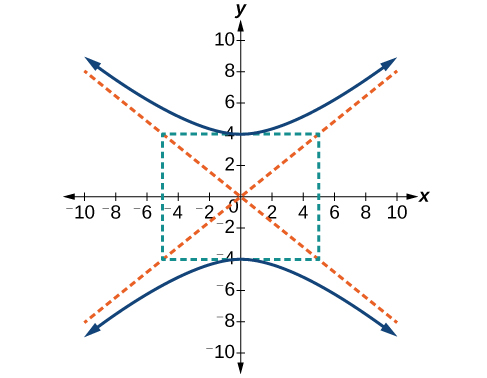
A vertical hyperbola centered at (0, 0) with vertices at (0, negative 4) and (0, 4). The slant asymptotes are shown but not labeled.

Answer

y 2 16 − x 2 25 =1

8.2-53 §8.2 source ↗

For the following exercises, given the graph of the hyperbola, find its equation.
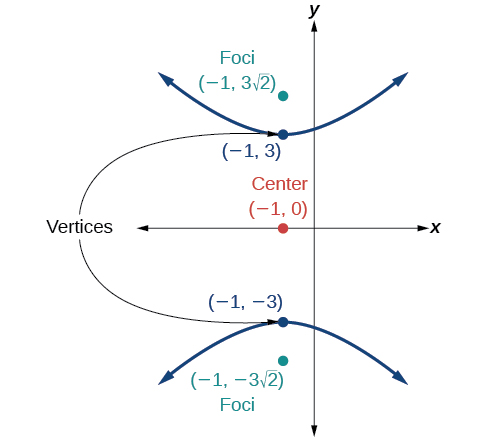
A vertical hyperbola centered at (negative 1, 0) with vertices at (negative 1, negative 3) and (negative 1, 3) and foci at (negative 1, negative 3 square root of 2) and (negative 1, 3 square root of 2).

Answer

y 2 9 − ( x+1 ) 2 9 = 1

8.2-55 §8.2 source ↗

For the following exercises, given the graph of the hyperbola, find its equation.
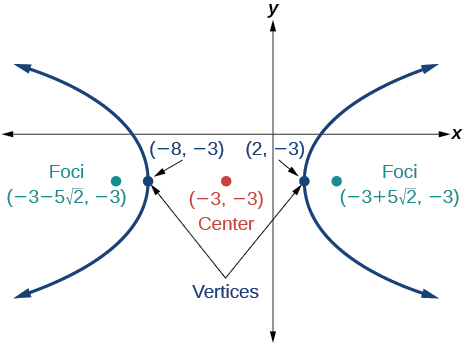
A horizontal hyperbola centered at (negative 3, negative 3) with vertices at (negative 8, negative 3) and (2, negative 3) and foci at (negative 3 minus 5 square root of 2, negative 3) and (negative 3 + 5 square root of 2, negative 3).

Answer

( x+3 ) 2 25 − ( y+3 ) 2 25 = 1

8.2-57 §8.2 source ↗

For the following exercises, express the equation for the hyperbola as two functions, with y as a function of x. Express as simply as possible. Use a graphing calculator to sketch the graph of the two functions on the same axes.

y 2 9 − x 2 1 =1

Answer

y(x)= 3 x 2 +1 , y(x)= − 3 x 2 +1

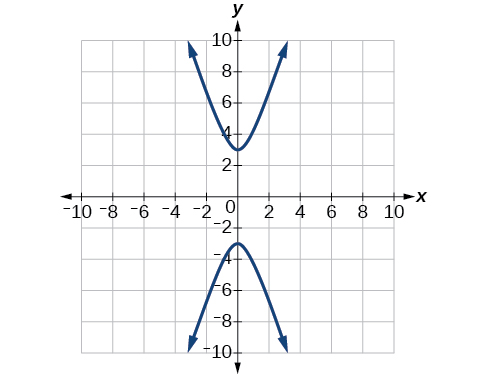
A graph showing two parabolas. The upper parabola opens upwards with its vertex at (0, 3), and the lower parabola opens downwards with its vertex at (0, -3). Both are symmetric about the y-axis.

8.2-59 §8.2 source ↗

For the following exercises, express the equation for the hyperbola as two functions, with y as a function of x. Express as simply as possible. Use a graphing calculator to sketch the graph of the two functions on the same axes.

− 4 x 2 − 16x+ y 2 − 2y− 19= 0

Answer

y(x)= 1+ 2 x 2 +4x+5 , y(x)= 1− 2 x 2 +4x+5

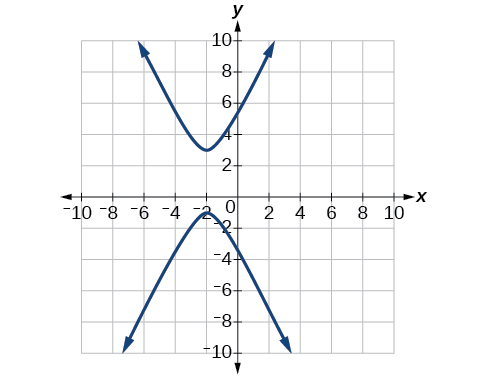
A graph on a Cartesian coordinate system with x- and y-axes ranging from -10 to 10. The graph displays two curves. The upper curve opens upwards, with its vertex at approximately (-2, 3), and extends to the upper left and upper right. The lower curve opens downwards, with its vertex at approximately (-2, -1), and extends to the lower left and lower right. Both curves appear to be parabolas, suggesting a conic section or a pair of quadratic functions.

8.2-61 §8.2 source ↗

For the following exercises, a hedge is to be constructed in the shape of a hyperbola near a fountain at the center of the yard. Find the equation of the hyperbola and sketch the graph.

The hedge will follow the asymptotes y= xand y= − x, and its closest distance to the center fountain is 5 yards.

Answer
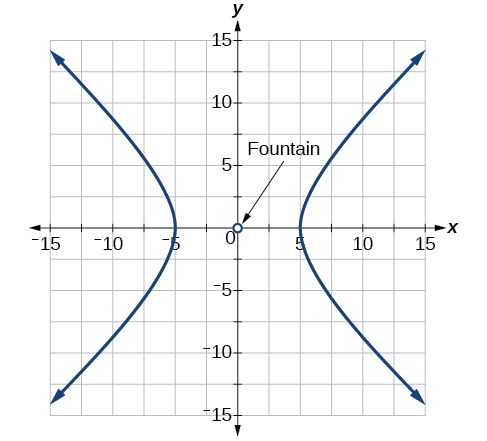
x 2 25 − y 2 25 =1

A Cartesian coordinate system with x and y axes ranging from -15 to 15. A hyperbola with horizontal branches is plotted, with its vertices at approximately x = -4 and x = 4. The origin (0,0) is marked with an open circle and labeled Fountain with an arrow pointing to it.

8.2-63 §8.2 source ↗

For the following exercises, a hedge is to be constructed in the shape of a hyperbola near a fountain at the center of the yard. Find the equation of the hyperbola and sketch the graph.

The hedge will follow the asymptotes y= 1 2 x and y=− 1 2 x, and its closest distance to the center fountain is 10 yards.

Answer
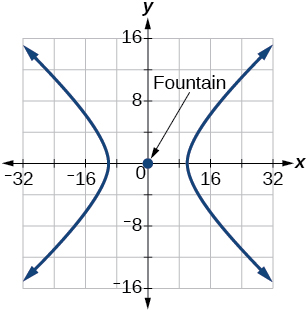
x 2 100 − y 2 25 = 1

A graph displays a hyperbola centered at the origin, labeled Fountain. The hyperbola opens horizontally, symmetric about the x-axis, with its vertices on the x-axis.

8.2-65 §8.2 source ↗

For the following exercises, a hedge is to be constructed in the shape of a hyperbola near a fountain at the center of the yard. Find the equation of the hyperbola and sketch the graph.

The hedge will follow the asymptotes y= 3 4 x and y=− 3 4 x, and its closest distance to the center fountain is 20 yards.

Answer
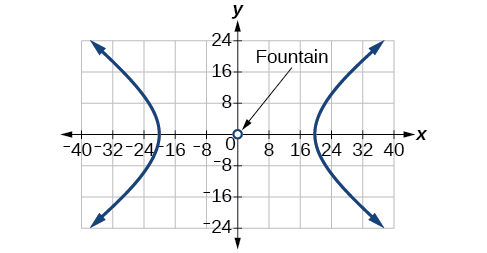
x 2 400 − y 2 225 = 1

A graph displays a hyperbola centered at the origin (0,0), labeled Fountain. The hyperbola opens horizontally, with its two branches extending outwards from approximate x-intercepts at (-20,0) and (20,0).

8.2-67 §8.2 source ↗

For the following exercises, assume an object enters our solar system and we want to graph its path on a coordinate system with the sun at the origin and the x-axis as the axis of symmetry for the object's path. Give the equation of the flight path of each object using the given information.

The object enters along a path approximated by the line y=2x−2 and passes within 0.5 au of the sun at its closest approach, so the sun is one focus of the hyperbola. It then departs the solar system along a path approximated by the line y=−2x+2.

Answer

4(x-1)2-y22= 16

8.2-69 §8.2 source ↗

For the following exercises, assume an object enters our solar system and we want to graph its path on a coordinate system with the sun at the origin and the x-axis as the axis of symmetry for the object's path. Give the equation of the flight path of each object using the given information.

The object enters along a path approximated by the line y= 1 3 x−1 and passes within 1 au of the sun at its closest approach, so the sun is one focus of the hyperbola. It then departs the solar system along a path approximated by the line y=− 1 3 x+1.

Answer

( x−h ) 2 a2 -(y-k)2 b2= (x-3)2-9y2= 4

Try It #1 §8.3 source ↗

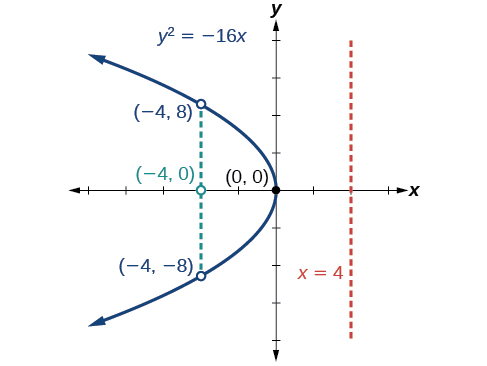
Graph y 2 =−16x. Identify and label the focus, directrix, and endpoints of the latus rectum.

Answer

Focus: ( −4,0 ); Directrix: x=4; Endpoints of the latus rectum: ( −4,±8 )

A graph displays the parabola y^2 = -16x. Its vertex is at (0, 0), the focus at (-4, 0), and the directrix is the line x = 4. Points (-4, 8) and (-4, -8) are shown on the parabola.

Try It #2 §8.3 source ↗

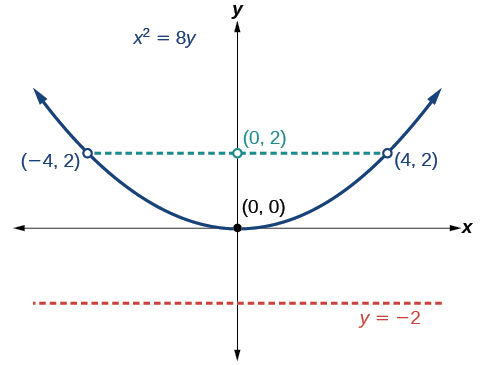
Graph x 2 =8y. Identify and label the focus, directrix, and endpoints of the latus rectum.

Answer

Focus: ( 0,2 ); Directrix: y=−2; Endpoints of the latus rectum: ( ±4,2 ).

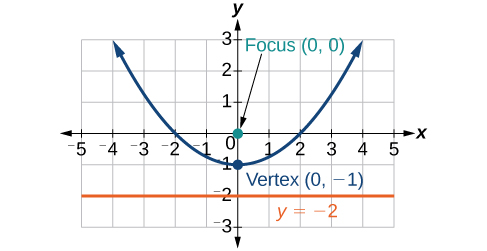
The graph of the parabola x^2=8y, centered at the origin (0,0), with its focus at (0,2) and directrix at y=-2. The points (-4,2) and (4,2) on the parabola are also indicated.

Try It #3 §8.3 source ↗

What is the equation for the parabola with focus ( 0, 7 2 ) and directrix y=− 7 2 ?

Answer

x 2 =14y.

Try It #4 §8.3 source ↗

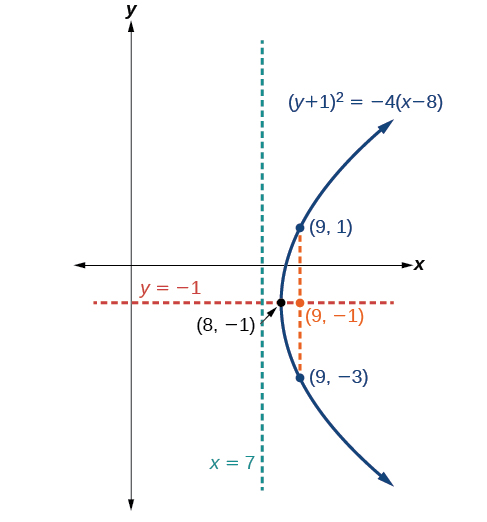
Graph ( y+1 ) 2 = 4(x−8). Identify and label the vertex, axis of symmetry, focus, directrix, and endpoints of the latus rectum.

Answer

Vertex: ( 8,−1 ); Axis of symmetry: y=−1; Focus: ( 9,−1 ); Directrix: x=7; Endpoints of the latus rectum: ( 9,−3 ) and ( 9,1 ).

Graph of the parabola (y+1)^2 = -4(x-8) opening left. Vertex (8, -1), focus (9, -1), and directrix x=7 are labeled, along with points (9, 1) and (9, -3) on the curve.

Try It #5 §8.3 source ↗

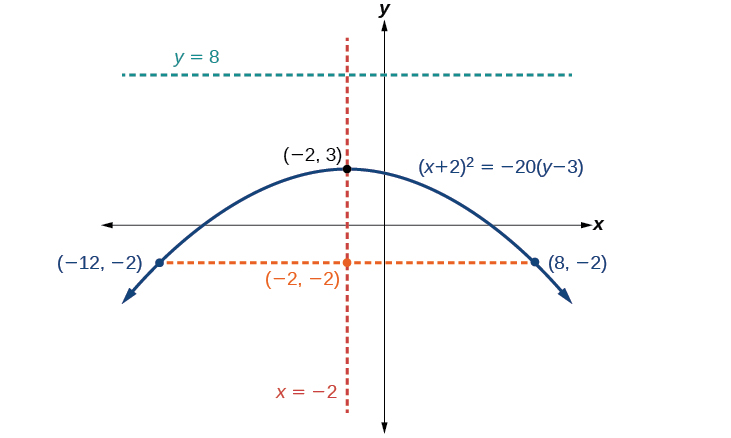
Graph ( x+2 ) 2 = −20(y−3). Identify and label the vertex, axis of symmetry, focus, directrix, and endpoints of the latus rectum.

Answer

Vertex: ( −2,3 ); Axis of symmetry: x=−2; Focus: ( −2,−2 ); Directrix: y=8; Endpoints of the latus rectum: ( −12,−2 ) and ( 8,−2 ).

A graph of a downward-opening parabola with equation (x+2)^2 = -20(y-3). Its vertex is at (-2, 3), axis of symmetry x = -2, focus at (-2, -2), and directrix y = 8.

Try It #6 §8.3 source ↗

Balcony-sized solar cookers have been designed for families living in India. The top of a dish has a diameter of 1600 mm. The sun’s rays reflect off the parabolic mirror toward the “cooker,” which is placed 320 mm from the base.

ⓐ Find an equation that models a cross-section of the solar cooker. Assume that the vertex of the parabolic mirror is the origin of the coordinate plane, and that the parabola opens to the right (i.e., has the x-axis as its axis of symmetry).

ⓑ Use the equation found in part ⓐ to find the depth of the cooker.

Answer

ⓐ y 2 =1280x

ⓑ The depth of the cooker is 500 mm

8.3-1 §8.3 source ↗

Define a parabola in terms of its focus and directrix.

Answer

A parabola is the set of points in the plane that lie equidistant from a fixed point, the focus, and a fixed line, the directrix.

8.3-3 §8.3 source ↗

If the equation of a parabola is written in standard form and p is negative and the directrix is a horizontal line, then what can we conclude about its graph?

Answer

The graph will open down.

8.3-5 §8.3 source ↗

As the graph of a parabola becomes wider, what will happen to the distance between the focus and directrix?

Answer

The distance between the focus and directrix will increase.

8.3-7 §8.3 source ↗

For the following exercises, determine whether the given equation is a parabola. If so, rewrite the equation in standard form.

y=4 x 2

Answer

yes x2=4(116)y

8.3-9 §8.3 source ↗

For the following exercises, determine whether the given equation is a parabola. If so, rewrite the equation in standard form.

( y−3 ) 2 = 8(x−2)

Answer

yes ( y−3 ) 2 = 4(2)(x−2)

8.3-11 §8.3 source ↗

For the following exercises, rewrite the given equation in standard form, and then determine the vertex (V), focus (F), and directrix (d) of the parabola.

x=8 y 2

Answer

y 2 = 1 8 x, V:(0,0); F:( 1 32 ,0); d:x= − 1 32

8.3-13 §8.3 source ↗

For the following exercises, rewrite the given equation in standard form, and then determine the vertex (V), focus (F), and directrix (d) of the parabola.

y=−4 x 2

Answer

x 2 = − 1 4 y, V:(0,0); F:(0,− 1 16 ); d:y= 1 16

8.3-15 §8.3 source ↗

For the following exercises, rewrite the given equation in standard form, and then determine the vertex (V), focus (F), and directrix (d) of the parabola.

x=36 y 2

Answer

y 2 = 1 36 x, V:(0,0); F:( 1 144 ,0); d:x= − 1 144

8.3-17 §8.3 source ↗

For the following exercises, rewrite the given equation in standard form, and then determine the vertex (V), focus (F), and directrix (d) of the parabola.

( x−1 ) 2 = 4(y−1)

Answer

( x−1 ) 2 = 4(y−1), V:(1,1); F:(1,2); d:y= 0

8.3-19 §8.3 source ↗

For the following exercises, rewrite the given equation in standard form, and then determine the vertex (V), focus (F), and directrix (d) of the parabola.

( y−4 ) 2 = 2(x+3)

Answer

( y−4 ) 2 = 2(x+3), V:(−3,4); F:(− 5 2 ,4); d:x= − 7 2

8.3-21 §8.3 source ↗

For the following exercises, rewrite the given equation in standard form, and then determine the vertex (V), focus (F), and directrix (d) of the parabola.

( x+4 ) 2 = 24(y+1)

Answer

( x+4 ) 2 = 24(y+1), V:(−4,−1); F:(−4,5); d:y= −7

8.3-23 §8.3 source ↗

For the following exercises, rewrite the given equation in standard form, and then determine the vertex (V), focus (F), and directrix (d) of the parabola.

y 2 + 12x− 6y+ 21= 0

Answer

( y−3 ) 2 = −12(x+1), V:(−1,3); F:(−4,3); d:x= 2

8.3-25 §8.3 source ↗

For the following exercises, rewrite the given equation in standard form, and then determine the vertex (V), focus (F), and directrix (d) of the parabola.

5 x 2 − 50x− 4y+ 113= 0

Answer

( x−5 ) 2 = 4 5 (y+3), V:(5,−3); F:(5,− 14 5 ); d:y= − 16 5

8.3-27 §8.3 source ↗

For the following exercises, rewrite the given equation in standard form, and then determine the vertex (V), focus (F), and directrix (d) of the parabola.

x 2 − 4x+ 2y− 6= 0

Answer

( x−2 ) 2 = −2(y−5), V:(2,5); F:(2, 9 2 ); d:y= 11 2

8.3-29 §8.3 source ↗

For the following exercises, rewrite the given equation in standard form, and then determine the vertex (V), focus (F), and directrix (d) of the parabola.

3 y 2 − 4x− 6y+ 23= 0

Answer

( y−1 ) 2 = 4 3 (x−5), V:(5,1); F:( 16 3 ,1); d:x= 14 3

8.3-31 §8.3 source ↗

For the following exercises, graph the parabola, labeling the focus and the directrix.

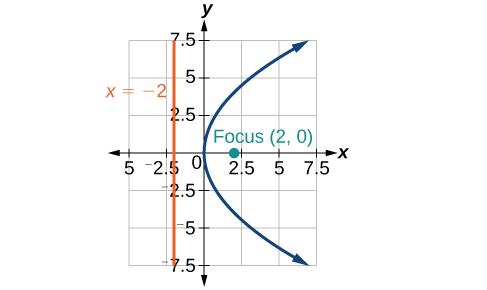
x= 1 8 y 2

Answer

A graph of a parabola shown on a coordinate plane, with its focus at (2, 0) marked by a green dot and its directrix as the vertical orange line x = -2.

8.3-33 §8.3 source ↗

For the following exercises, graph the parabola, labeling the focus and the directrix.

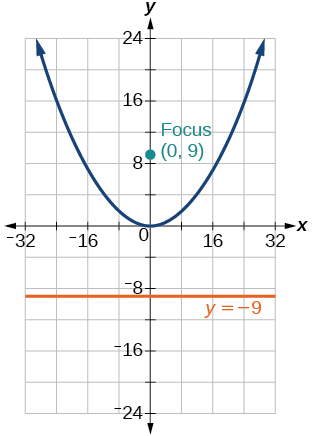
y= 1 36 x 2

Answer

A graph showing a parabola opening upwards, with its vertex at the origin (0,0). The focus is located at (0,9) and labeled Focus (0,9). The directrix is a horizontal line at y = -9, labeled y = -9. The x-axis ranges from -32 to 32, and the y-axis ranges from -24 to 24, both with tick marks every 8 units.

8.3-35 §8.3 source ↗

For the following exercises, graph the parabola, labeling the focus and the directrix.

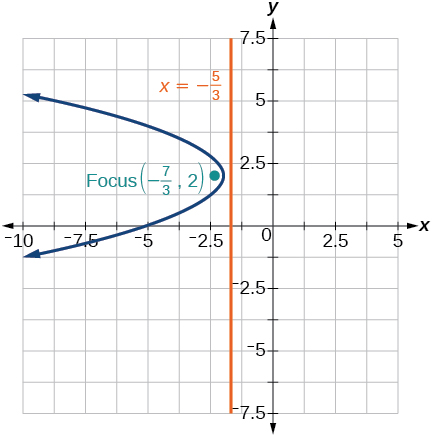
( y−2 ) 2 = − 4 3 (x+2)

Answer

A graph displays a parabola opening to the left. The focus is marked at (-7/3, 2). The directrix is a vertical line at x = -5/3. The x-axis ranges from -10 to 5, and the y-axis ranges from -7.5 to 7.5.

8.3-37 §8.3 source ↗

For the following exercises, graph the parabola, labeling the focus and the directrix.

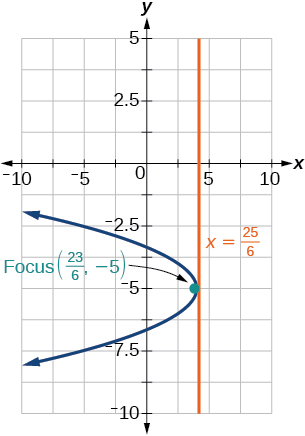
−6 ( y+5 ) 2 = 4(x−4)

Answer

A parabola opening left is graphed with its focus at (23/6, -5) and its directrix as the vertical line x = 25/6, shown on a Cartesian coordinate plane.

8.3-39 §8.3 source ↗

For the following exercises, graph the parabola, labeling the focus and the directrix.

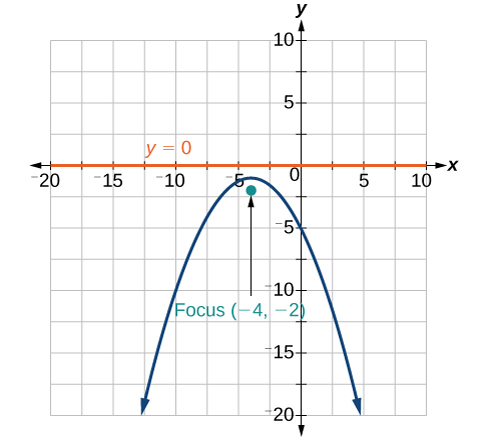
x 2 + 8x+ 4y+ 20= 0

Answer

A Cartesian coordinate system shows a parabola opening downwards. The x-axis ranges from -20 to 10 and the y-axis from -20 to 10. The directrix of the parabola is indicated by an orange horizontal line labeled y = 0, which coincides with the x-axis. The focus of the parabola is marked by a teal dot at coordinates (-4, -2) with an arrow pointing to it and labeled Focus (-4, -2). The vertex of the parabola is located at (-4, -1).

8.3-41 §8.3 source ↗

For the following exercises, graph the parabola, labeling the focus and the directrix.

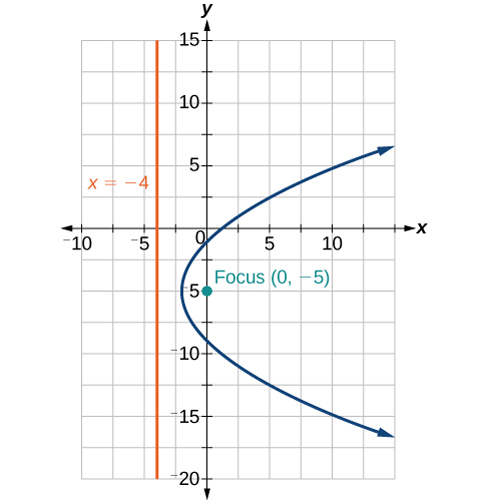
y 2 − 8x+ 10y+ 9= 0

Answer

A graph of a parabola plotted on a coordinate plane. The x-axis ranges from -10 to 15, and the y-axis ranges from -20 to 15. A blue curve represents the parabola, which opens horizontally to the right. A green dot marks the focus of the parabola at the coordinates (0, -5). An orange vertical line, labeled x = -4, represents the directrix of the parabola.

8.3-43 §8.3 source ↗

For the following exercises, graph the parabola, labeling the focus and the directrix.

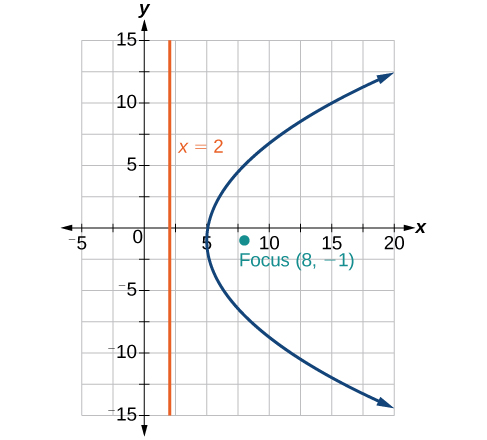
y 2 + 2y− 12x+ 61= 0

Answer

A graph displays a parabola opening to the right, with its directrix at x = 2 shown as a vertical orange line and its focus marked as a teal point at (8, -1).

8.3-45 §8.3 source ↗

For the following exercises, find the equation of the parabola given information about its graph.

Vertex is ( 0,0 ); directrix is y=4, focus is ( 0,−4 ).

Answer

x 2 =−16y

8.3-47 §8.3 source ↗

For the following exercises, find the equation of the parabola given information about its graph.

Vertex is ( 2,2 ); directrix is x=2− 2 , focus is ( 2+ 2 ,2 ).

Answer

( y−2 ) 2 = 4 2 (x−2)

8.3-49 §8.3 source ↗

For the following exercises, find the equation of the parabola given information about its graph.

Vertex is ( 2 ,− 3 ); directrix is x=2 2 , focus is ( 0,− 3 ).

Answer

( y+ 3 ) 2 = −4 2 (x− 2 )

8.3-51 §8.3 source ↗

For the following exercises, determine the equation for the parabola from its graph.
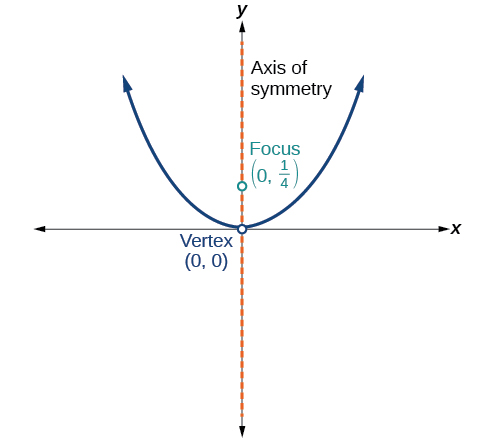
This figure shows two thumbtacks stuck in a piece of paper with a slack piece of string between them. A pencil pulls the string taught and by moving around, draws an ellipse.

Answer

x 2 =y

8.3-53 §8.3 source ↗

For the following exercises, determine the equation for the parabola from its graph.
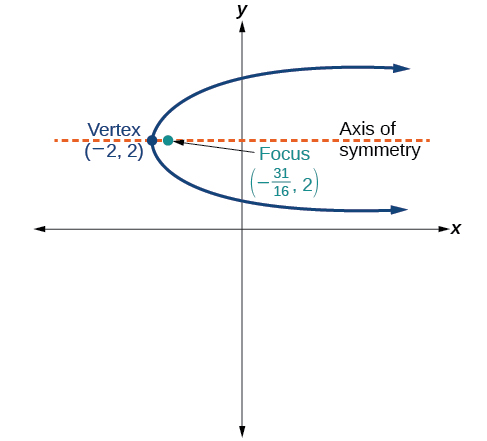
This is a horizontal parabola in the x y plane, opening to the right, with Vertex (negative 2, 2) and Focus (negative 31/16, 2). The Axis of Symmetry, a horizontal line, is shown, passing through the Vertex and the Focus.

Answer

( y−2 ) 2 = 1 4 (x+2)

8.3-55 §8.3 source ↗

For the following exercises, determine the equation for the parabola from its graph.
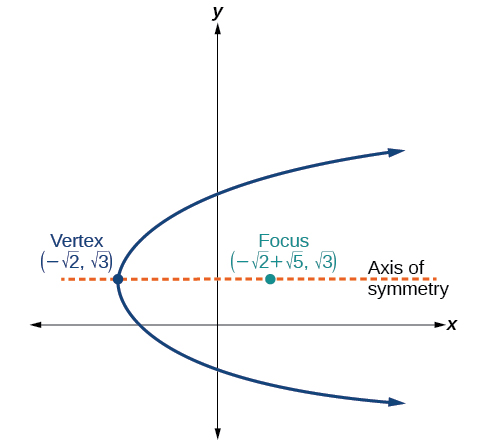
This is a horizontal parabola in the x y plane, opening to the right, with Vertex (negative square root of 2, square root of 3) and Focus (negative square root of 2 + square root of 5, square root of 3). The Axis of Symmetry, a horizontal line, is shown, passing through the Vertex and the Focus.

Answer

( y− 3 ) 2 = 4 5 (x+ 2 )

8.3-57 §8.3 source ↗

For the following exercises, the vertex and endpoints of the latus rectum of a parabola are given. Find the equation.

V( 0,0 ), Endpoints ( −2,4 ), ( −2,−4 )

Answer

y 2 =−8x

8.3-59 §8.3 source ↗

For the following exercises, the vertex and endpoints of the latus rectum of a parabola are given. Find the equation.

V( −3,−1 ), Endpoints ( 0,5 ), ( 0,−7 )

Answer

( y+1 ) 2 = 12(x+3)

8.3-61 §8.3 source ↗

For the following exercises, the vertex and endpoints of the latus rectum of a parabola are given. Find the equation.

The mirror in an automobile headlight has a parabolic cross-section with the light bulb at the focus. On a schematic, the equation of the parabola is given as x 2 =4y. At what coordinates should you place the light bulb?

Answer

( 0,1 )

8.3-63 §8.3 source ↗

For the following exercises, the vertex and endpoints of the latus rectum of a parabola are given. Find the equation.

A satellite dish is shaped like a paraboloid of revolution. This means that it can be formed by rotating a parabola around its axis of symmetry. The receiver is to be located at the focus. If the dish is 12 feet across at its opening and 4 feet deep at its center, where should the receiver be placed?

Answer

At the point 2.25 feet above the vertex.

8.3-65 §8.3 source ↗

For the following exercises, the vertex and endpoints of the latus rectum of a parabola are given. Find the equation.

The reflector in a searchlight is shaped like a paraboloid of revolution. A light source is located 1 foot from the base along the axis of symmetry. If the opening of the searchlight is 3 feet across, find the depth.

Answer

0.5625 feet

8.3-67 §8.3 source ↗

For the following exercises, the vertex and endpoints of the latus rectum of a parabola are given. Find the equation.

An arch is in the shape of a parabola. It has a span of 100 feet and a maximum height of 20 feet. Find the equation of the parabola, and determine the height of the arch 40 feet from the center.

Answer

x 2 = −125(y−20), height is 7.2 feet

8.3-69 §8.3 source ↗

For the following exercises, the vertex and endpoints of the latus rectum of a parabola are given. Find the equation.

An object is projected so as to follow a parabolic path given by y=− x 2 +96x, where x is the horizontal distance traveled in feet and y is the height. Determine the maximum height the object reaches.

Answer

2304 feet

Try It #1 §8.4 source ↗

Identify the graph of each of the following nondegenerate conic sections.

ⓐ 16 y 2 − x 2 + x− 4y− 9= 0

ⓑ 16 x 2 + 4 y 2 + 16x+ 49y− 81= 0

Answer

ⓐ hyperbola

ⓑ ellipse

Try It #2 §8.4 source ↗

Rewrite the 13 x 2 − 6 3 xy+ 7 y 2 = 16 in the x ′ y ′ system without the x ′ y ′ term.

Answer

x ′ 2 4 + y ′ 2 1 =1

Try It #3 §8.4 source ↗

Identify the conic for each of the following without rotating axes.

ⓐ x 2 − 9xy+ 3 y 2 − 12= 0

ⓑ 10 x 2 − 9xy+ 4 y 2 − 4= 0

Answer

ⓐ hyperbola

ⓑ ellipse

8.4-1 §8.4 source ↗

What effect does the xy term have on the graph of a conic section?

Answer

The xy term causes a rotation of the graph to occur.

8.4-3 §8.4 source ↗

If the equation of a conic section is written in the form A x 2 + Bxy+ C y 2 + Dx+ Ey+ F= 0, and B 2 − 4AC> 0, what can we conclude?

Answer

The conic section is a hyperbola.

8.4-5 §8.4 source ↗

For the equation A x 2 + Bxy+ C y 2 + Dx+ Ey+ F= 0, the value of θ that satisfies cot(2θ)= A−C B gives us what information?

Answer

It gives the angle of rotation of the axes in order to eliminate the xy term.

8.4-7 §8.4 source ↗

For the following exercises, determine which conic section is represented based on the given equation.

x 2 − 10x+ 4y− 10= 0

Answer

AB=0, parabola

8.4-9 §8.4 source ↗

For the following exercises, determine which conic section is represented based on the given equation.

4 x 2 − y 2 + 8x− 1= 0

Answer

AB=−4<0, hyperbola

8.4-11 §8.4 source ↗

For the following exercises, determine which conic section is represented based on the given equation.

2 x 2 + 3 y 2 − 8x− 12y+ 2= 0

Answer

AB=6>0, ellipse

8.4-13 §8.4 source ↗

For the following exercises, determine which conic section is represented based on the given equation.

3 x 2 + 6xy+ 3 y 2 − 36y− 125= 0

Answer

B 2 −4AC=0, parabola

8.4-15 §8.4 source ↗

For the following exercises, determine which conic section is represented based on the given equation.

2 x 2 + 4 3 xy+ 6 y 2 − 6x− 3= 0

Answer

B 2 −4AC=0, parabola

8.4-17 §8.4 source ↗

For the following exercises, determine which conic section is represented based on the given equation.

8 x 2 + 4 2 xy+ 4 y 2 − 10x+ 1= 0

Answer

B 2 − 4AC= − 96< 0, ellipse

8.4-19 §8.4 source ↗

For the following exercises, find a new representation of the given equation after rotating through the given angle.

4 x 2 − xy+ 4 y 2 − 2= 0, θ= 45°

Answer

7 x ′ 2 + 9 y ′ 2 − 4= 0

8.4-21 §8.4 source ↗

For the following exercises, find a new representation of the given equation after rotating through the given angle.

− 2 x 2 + 8xy+ 1= 0, θ= 45°

Answer

3 x ′ 2 + 2 x ′ y ′ − 5 y ′ 2 + 1= 0

8.4-23 §8.4 source ↗

For the following exercises, determine the angle θ that will eliminate the xy term and write the corresponding equation without the xy term.

x 2 + 3 3 xy+ 4 y 2 + y− 2= 0

Answer

θ= 60 ∘ , 11 x ′ 2 − y ′ 2 + 3 x ′ + y ′ − 4= 0

8.4-25 §8.4 source ↗

For the following exercises, determine the angle θ that will eliminate the xy term and write the corresponding equation without the xy term.

9 x 2 − 3 3 xy+ 6 y 2 + 4y− 3= 0

Answer

θ= - 30 ∘ , 21 x ′ 2 + 9 y ′ 2 + 4 x ′ − 4 3 y ′ − 6= 0

8.4-27 §8.4 source ↗

For the following exercises, determine the angle θ that will eliminate the xy term and write the corresponding equation without the xy term.

16 x 2 + 24xy+ 9 y 2 + 6x− 6y+ 2= 0

Answer

θ≈ 36.9 ∘ , 125 x ′ 2 + 6 x ′ − 42 y ′ + 10= 0

8.4-29 §8.4 source ↗

For the following exercises, determine the angle θ that will eliminate the xy term and write the corresponding equation without the xy term.

x 2 + 4xy+ y 2 − 2x+ 1= 0

Answer

θ= 45 ∘ , 3 x ′ 2 − y ′ 2 − 2 x ′ + 2 y ′ + 1= 0

8.4-31 §8.4 source ↗

For the following exercises, rotate through the given angle based on the given equation. Give the new equation and graph the original and rotated equation.

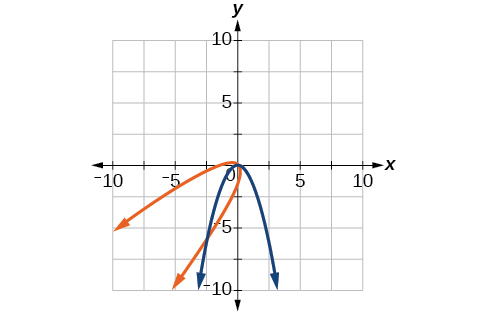
y= − x 2 , θ= − 45 ∘

Answer

2 2 ( x ′ + y ′ )= 1 2 ( x ′ − y ′ ) 2

A coordinate plane displays two parabolas with their vertices at the origin. A blue parabola opens downwards, and an orange parabola opens to the left.

8.4-33 §8.4 source ↗

For the following exercises, rotate through the given angle based on the given equation. Give the new equation and graph the original and rotated equation.

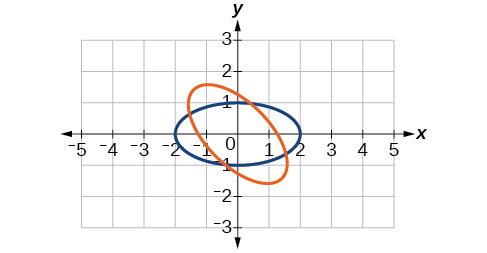
x 2 4 + y 2 1 = 1, θ= 45 ∘

Answer

( x ′ − y ′ ) 2 8 + ( x ′ + y ′ ) 2 2 = 1

A coordinate plane shows two intersecting ellipses. One is blue and appears more horizontally oriented, while the other is orange and appears more vertically oriented. Both are centered near the origin.

8.4-35 §8.4 source ↗

For the following exercises, rotate through the given angle based on the given equation. Give the new equation and graph the original and rotated equation.

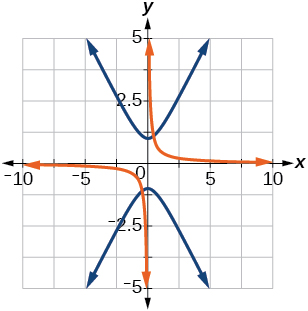
y 2 − x 2 = 1, θ= 45 ∘

Answer

( x ′ + y ′ ) 2 2 − ( x ′ − y ′ ) 2 2 = 1

A graph displays two hyperbolas centered at the origin on a Cartesian coordinate plane. One hyperbola, shown in orange, opens horizontally, while the other, in blue, opens vertically.

8.4-37 §8.4 source ↗

For the following exercises, rotate through the given angle based on the given equation. Give the new equation and graph the original and rotated equation.

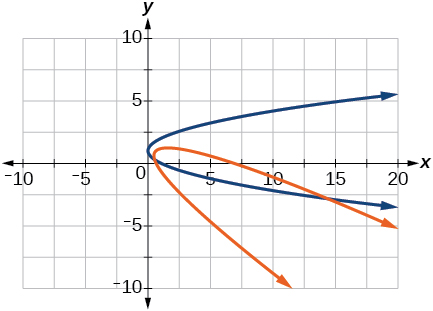
x= ( y−1 ) 2 , θ= 30 ∘

Answer

3 2 x ′ − 1 2 y ′ = ( 1 2 x ′ + 3 2 y ′ −1 ) 2

A graph displays two parabolas. The blue parabola opens to the right with its vertex at the origin (0,0). The orange parabola opens downwards with its vertex at (2,1).

8.4-39 §8.4 source ↗

For the following exercises, graph the equation relative to the x ′ y ′ system in which the equation has no x ′ y ′ term.

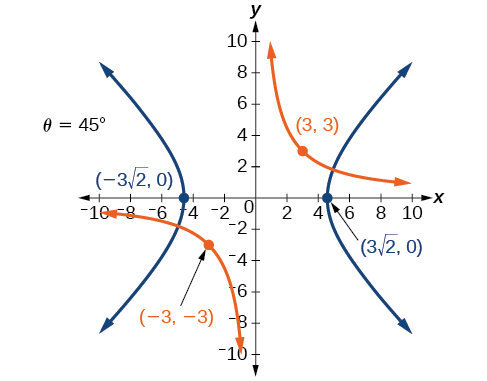
xy=9

Answer

This graph illustrates two hyperbolas rotated by 45 degrees. The blue hyperbola opens left and right, with vertices at ( 3 2 , 0) and (- 3 2 , 0). The orange hyperbola opens up and down, passing through (3, 3) and (-3, -3).

8.4-41 §8.4 source ↗

For the following exercises, graph the equation relative to the x ′ y ′ system in which the equation has no x ′ y ′ term.

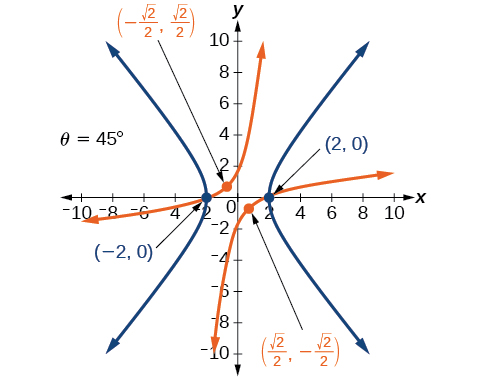
x 2 − 10xy+ y 2 − 24= 0

Answer

A graph of a hyperbola rotated by 45 degrees. The x-axis and y-axis both range from -10 to 10. The vertices of the hyperbola are at (-2, 0) and (2, 0). The foci are indicated at (negative square root of 2 over 2, square root of 2 over 2) and (square root of 2 over 2, negative square root of 2 over 2). The rotation angle is labeled as theta = 45 degrees.

8.4-43 §8.4 source ↗

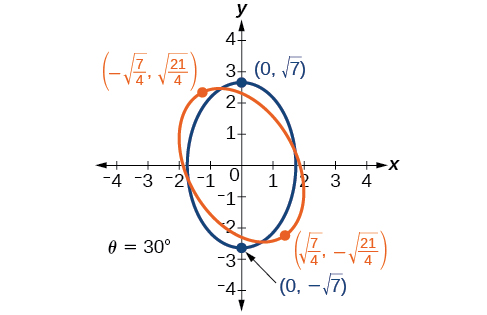
For the following exercises, graph the equation relative to the x ′ y ′ system in which the equation has no x ′ y ′ term.

6 x 2 + 2 3 xy+ 4 y 2 − 21= 0

Answer

Two ellipses are shown on a coordinate plane. The blue ellipse is centered at the origin, and the orange ellipse is rotated by 30 degrees. Their intersection points are labeled.

8.4-45 §8.4 source ↗

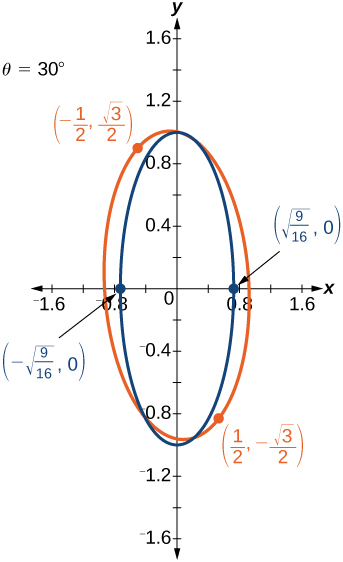
For the following exercises, graph the equation relative to the x ′ y ′ system in which the equation has no x ′ y ′ term.

21 x 2 + 2 3 xy+ 19 y 2 − 18= 0

Answer

Two ellipses on a coordinate plane. Blue ellipse is axis-aligned with x-intercepts (+/- sqrt(9/16), 0). Orange ellipse is rotated 30 degrees, with points (-1/2, sqrt(3)/2) and (1/2, -sqrt(3)/2) labeled.

8.4-47 §8.4 source ↗

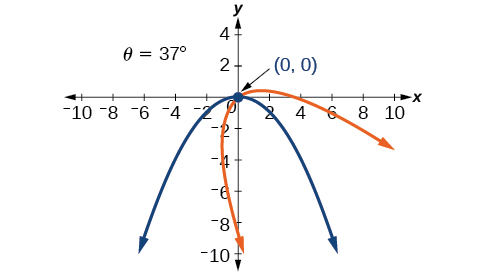
For the following exercises, graph the equation relative to the x ′ y ′ system in which the equation has no x ′ y ′ term.

16 x 2 + 24xy+ 9 y 2 − 60x+ 80y= 0

Answer

Two parabolic paths, starting at (0,0), are plotted on an x-y plane. The blue path goes downwards, and the orange path moves right and down. An angle of 37° is indicated.

8.4-49 §8.4 source ↗

For the following exercises, graph the equation relative to the x ′ y ′ system in which the equation has no x ′ y ′ term.

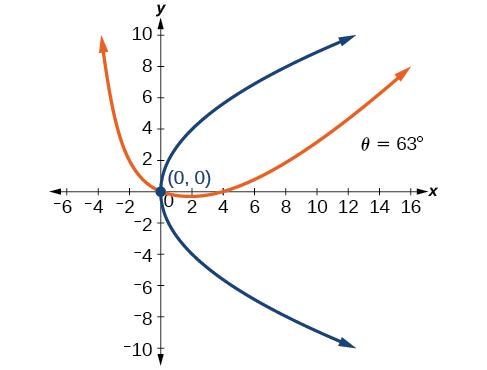
4 x 2 − 4xy+ y 2 − 8 5 x− 16 5 y= 0

Answer

A coordinate plane displays two parabolas starting at (0,0). The blue parabola opens along the positive x-axis. The orange parabola is rotated by an angle theta = 63 degrees.

8.4-51 §8.4 source ↗

For the following exercises, determine the angle of rotation in order to eliminate the xy term. Then graph the new set of axes.

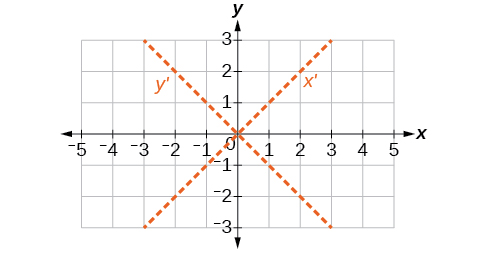
6 x 2 − 5xy+ 6 y 2 + 20x− y= 0

Answer

θ= 45 ∘

A graph on a Cartesian coordinate system shows the x-axis and y-axis, each ranging from -5 to 5. Two dashed lines are drawn, both passing through the origin. One dashed line is labeled y' and goes from top-left to bottom-right, representing the equation y = -x. The other dashed line is labeled x' and goes from bottom-left to top-right, representing the equation y = x. These dashed lines illustrate a rotation of the coordinate axes.

8.4-53 §8.4 source ↗

For the following exercises, determine the angle of rotation in order to eliminate the xy term. Then graph the new set of axes.

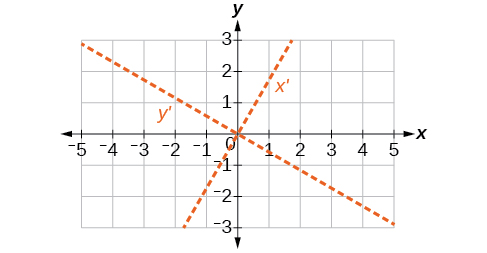
4 x 2 + 6 3 xy+ 10 y 2 + 20x− 40y= 0

Answer

θ= 60 ∘

A Cartesian coordinate system with original x and y axes and two dashed lines, x' and y', both passing through the origin. x' has a positive slope, and y' has a negative slope.

8.4-55 §8.4 source ↗

For the following exercises, determine the angle of rotation in order to eliminate the xy term. Then graph the new set of axes.

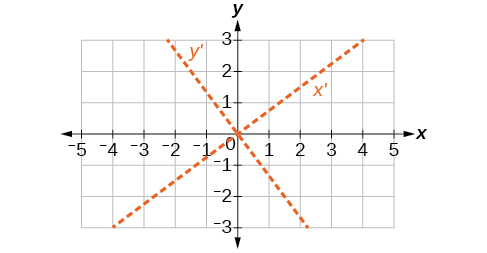
16 x 2 + 24xy+ 9 y 2 + 20x− 44y= 0

Answer

θ≈ 36.9 ∘

A graph illustrating two sets of coordinate axes, (x, y) and a rotated set (x', y'), both intersecting at the origin. The x' and y' axes are shown as dashed orange lines.

8.4-57 §8.4 source ↗

For the following exercises, determine the value of k based on the given equation.

Given 2 x 2 + kxy+ 12 y 2 + 10x− 16y+ 28= 0, find k for the graph to be an ellipse.

Answer

− 4 6 < k< 4 6

8.4-59 §8.4 source ↗

For the following exercises, determine the value of k based on the given equation.

Given k x 2 + 8xy+ 8 y 2 − 12x+ 16y+ 18= 0, find k for the graph to be a parabola.

Answer

k=2

Try It #1 §8.5 source ↗

Identify the conic with focus at the origin, the directrix, and the eccentricity for r= 2 3−cosθ .

Answer

ellipse; e= 1 3 ;x=−2

Try It #2 §8.5 source ↗

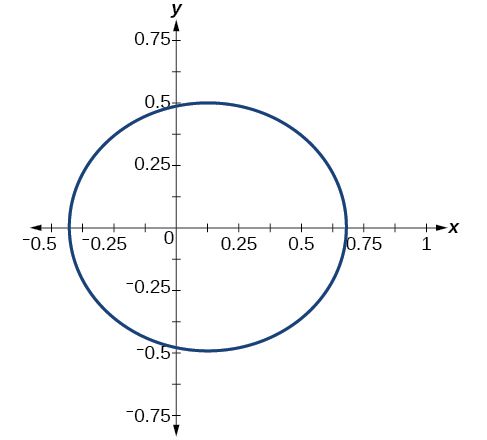
Graph r= 2 4−cosθ .

Answer

A two-dimensional Cartesian coordinate system displays a dark blue circle. The x-axis is labeled 'x' and ranges from -0.5 to 1, with tick marks every 0.25. The y-axis is labeled 'y' and ranges from -0.75 to 0.75, with tick marks every 0.25. The circle is centered at (0.25, 0) and has a radius of 0.5, extending from x = -0.25 to x = 0.75 and from y = -0.5 to y = 0.5.

Try It #3 §8.5 source ↗

Find the polar form of the conic given a focus at the origin, e=1, and directrix x=−1.

Answer

r= 1 1−cosθ

Try It #4 §8.5 source ↗

Convert the conic r= 2 1+2cosθ to rectangular form.

Answer

4− 8x+ 3 x 2 − y 2 = 0

8.5-1 §8.5 source ↗

Explain how eccentricity determines which conic section is given.

Answer

If eccentricity is less than 1, it is an ellipse. If eccentricity is equal to 1, it is a parabola. If eccentricity is greater than 1, it is a hyperbola.

8.5-3 §8.5 source ↗

If a conic section is written as a polar equation, and the denominator involves sinθ, what conclusion can be drawn about the directrix?

Answer

The directrix will be parallel to the polar axis.

8.5-5 §8.5 source ↗

What do we know about the focus/foci of a conic section if it is written as a polar equation?

Answer

One of the foci will be located at the origin.

8.5-7 §8.5 source ↗

For the following exercises, identify the conic with a focus at the origin, and then give the directrix and eccentricity.

r= 3 4−4sinθ

Answer

Parabola with e=1 and directrix 3 4 units below the pole.

8.5-9 §8.5 source ↗

For the following exercises, identify the conic with a focus at the origin, and then give the directrix and eccentricity.

r= 5 1+2sinθ

Answer

Hyperbola with e=2 and directrix 5 2 units above the pole.

8.5-11 §8.5 source ↗

For the following exercises, identify the conic with a focus at the origin, and then give the directrix and eccentricity.

r= 3 10+10cosθ

Answer

Parabola with e=1 and directrix 3 10 units to the right of the pole.

8.5-13 §8.5 source ↗

For the following exercises, identify the conic with a focus at the origin, and then give the directrix and eccentricity.

r= 4 7+2cosθ

Answer

Ellipse with e= 2 7 and directrix 2 units to the right of the pole.

8.5-15 §8.5 source ↗

For the following exercises, identify the conic with a focus at the origin, and then give the directrix and eccentricity.

r(3+5sinθ)= 11

Answer

Hyperbola with e= 5 3 and directrix 11 5 units above the pole.

8.5-17 §8.5 source ↗

For the following exercises, identify the conic with a focus at the origin, and then give the directrix and eccentricity.

r(7+8cosθ)= 7

Answer

Hyperbola with e= 8 7 and directrix 7 8 units to the right of the pole.

8.5-19 §8.5 source ↗

For the following exercises, convert the polar equation of a conic section to a rectangular equation.

r= 2 5−3sinθ

Answer

25 x 2 + 16 y 2 − 12y− 4= 0

8.5-21 §8.5 source ↗

For the following exercises, convert the polar equation of a conic section to a rectangular equation.

r= 3 2+5cosθ

Answer

21 x 2 − 4 y 2 − 30x+ 9= 0

8.5-23 §8.5 source ↗

For the following exercises, convert the polar equation of a conic section to a rectangular equation.

r= 3 8−8cosθ

Answer

64 y 2 =48x+9

8.5-25 §8.5 source ↗

For the following exercises, convert the polar equation of a conic section to a rectangular equation.

r= 5 5−11sinθ

Answer

96 y 2 − 25 x 2 + 110y+ 25= 0

8.5-27 §8.5 source ↗

For the following exercises, convert the polar equation of a conic section to a rectangular equation.

r(2−cosθ)=1

Answer

3 x 2 + 4 y 2 − 2x− 1= 0

8.5-29 §8.5 source ↗

For the following exercises, convert the polar equation of a conic section to a rectangular equation.

r= 6secθ −2+3secθ

Answer

5 x 2 + 9 y 2 − 24x− 36= 0

8.5-31 §8.5 source ↗

For the following exercises, graph the given conic section. If it is a parabola, label the vertex, focus, and directrix. If it is an ellipse, label the vertices and foci. If it is a hyperbola, label the vertices and foci.

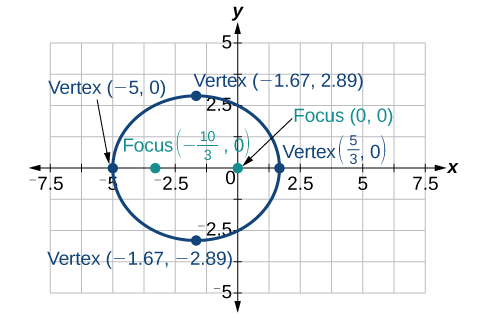
r= 5 2+cosθ

Answer

An ellipse with vertices at (-5,0), (5/3,0), (-1.67, 2.89), (-1.67, -2.89) and foci at (-10/3, 0) and (0,0) is shown on a Cartesian grid.

8.5-33 §8.5 source ↗

For the following exercises, graph the given conic section. If it is a parabola, label the vertex, focus, and directrix. If it is an ellipse, label the vertices and foci. If it is a hyperbola, label the vertices and foci.

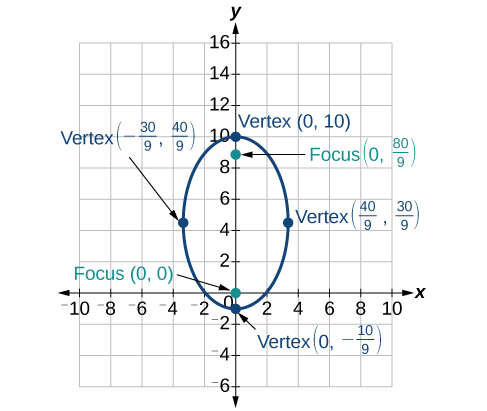
r= 10 5−4sinθ

Answer

A graph of an ellipse on a Cartesian coordinate system with its four vertices labeled as (0, 10), (0, -10/9), (-30/9, 40/9), (40/9, 30/9), and two foci at (0, 80/9) and (0, 0).

8.5-35 §8.5 source ↗

For the following exercises, graph the given conic section. If it is a parabola, label the vertex, focus, and directrix. If it is an ellipse, label the vertices and foci. If it is a hyperbola, label the vertices and foci.

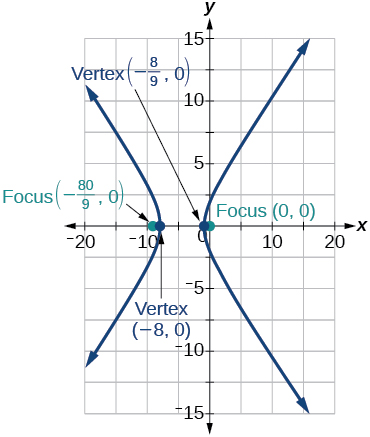
r= 8 4−5cosθ

Answer

A hyperbola graph with foci (0,0) and (-80/9,0) and vertices (-8/9,0) and (-8,0). The branches open left and right along the x-axis.

8.5-37 §8.5 source ↗

For the following exercises, graph the given conic section. If it is a parabola, label the vertex, focus, and directrix. If it is an ellipse, label the vertices and foci. If it is a hyperbola, label the vertices and foci.

r= 2 1−sinθ

Answer

A graph displays an upward-opening parabola with its vertex at (0, -1), focus at (0, 0), and directrix at y = -2. The x-axis ranges from -5 to 5, and the y-axis from -3 to 3.

8.5-39 §8.5 source ↗

For the following exercises, graph the given conic section. If it is a parabola, label the vertex, focus, and directrix. If it is an ellipse, label the vertices and foci. If it is a hyperbola, label the vertices and foci.

r(1+cosθ)=5

Answer

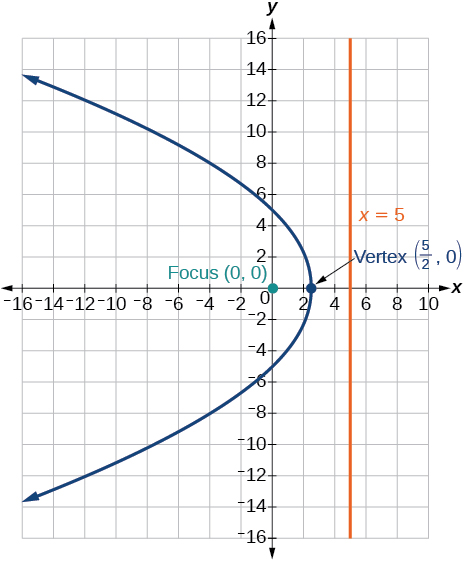
A graph of a parabola is shown on a coordinate plane. The x-axis extends from -16 to 10, and the y-axis extends from -16 to 16. The parabola opens to the left, passing through the origin of the y-axis at approximately y=4.47 and y=-4.47, and through the x-axis at 5/2 (which is 2.5). The focus of the parabola is a green dot located at the origin (0,0) and labeled Focus (0, 0). The vertex of the parabola is a blue dot located at (5/2, 0) and labeled Vertex (5/2, 0). The directrix of the parabola is a vertical orange line at x=5, labeled x = 5.

8.5-41 §8.5 source ↗

For the following exercises, graph the given conic section. If it is a parabola, label the vertex, focus, and directrix. If it is an ellipse, label the vertices and foci. If it is a hyperbola, label the vertices and foci.

r(3−2sinθ)= 6

Answer

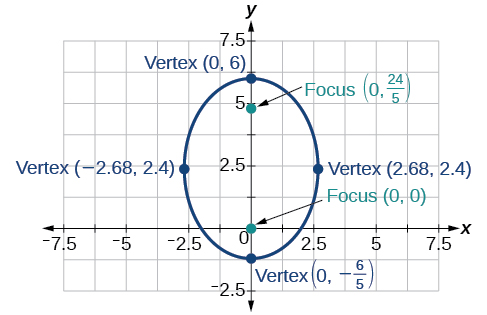
A graph displays an ellipse on a coordinate plane. The ellipse is vertically oriented. Its vertices are labeled as (0, 6), (0, -6/5), (-2.68, 2.4), and (2.68, 2.4). The foci are labeled as (0, 24/5) and (0, 0).

8.5-43 §8.5 source ↗

For the following exercises, find the polar equation of the conic with focus at the origin and the given eccentricity and directrix.

Directrix: x=4;e= 1 5

Answer

r= 4 5+cosθ

8.5-45 §8.5 source ↗

For the following exercises, find the polar equation of the conic with focus at the origin and the given eccentricity and directrix.

Directrix: y=2;e=2

Answer

r= 4 1+2sinθ

8.5-47 §8.5 source ↗

For the following exercises, find the polar equation of the conic with focus at the origin and the given eccentricity and directrix.

Directrix: x=1;e=1

Answer

r= 1 1+cosθ

8.5-49 §8.5 source ↗

For the following exercises, find the polar equation of the conic with focus at the origin and the given eccentricity and directrix.

Directrix: x=− 1 4 ;e= 7 2

Answer

r= 7 8−28cosθ

8.5-51 §8.5 source ↗

For the following exercises, find the polar equation of the conic with focus at the origin and the given eccentricity and directrix.

Directrix: y=4;e= 3 2

Answer

r= 12 2+3sinθ

8.5-53 §8.5 source ↗

For the following exercises, find the polar equation of the conic with focus at the origin and the given eccentricity and directrix.

Directrix: x=−5;e= 3 4

Answer

r= 15 4−3cosθ

8.5-55 §8.5 source ↗

For the following exercises, find the polar equation of the conic with focus at the origin and the given eccentricity and directrix.

Directrix: x=−3;e= 1 3

Answer

r= 3 3−3cosθ

8.5-57 §8.5 source ↗

Recall from Rotation of Axes that equations of conics with an xy term have rotated graphs. For the following exercises, express each equation in polar form with r as a function of θ.

x 2 +xy+ y 2 =4

Answer

r= ± 2 1+sinθcosθ

8.5-59 §8.5 source ↗

Recall from Rotation of Axes that equations of conics with an xy term have rotated graphs. For the following exercises, express each equation in polar form with r as a function of θ.

16 x 2 + 24xy+ 9 y 2 = 4

Answer

r= ± 2 4cosθ+3sinθ

8.R-1 §8.R source ↗

For the following exercises, write the equation of the ellipse in standard form. Then identify the center, vertices, and foci.

x 2 25 + y 2 64 =1

Answer

x 2 5 2 + y 2 8 2 = 1; center: ( 0,0 ); vertices: (5,0), (−5,0), (0,8), (0,−8); foci: (0, 39 ), (0,− 39 )

8.R-3 §8.R source ↗

For the following exercises, write the equation of the ellipse in standard form. Then identify the center, vertices, and foci.

9 x 2 + y 2 + 54x− 4y+ 76= 0

Answer

(x+3) 2 1 2 + (y−2) 2 3 2 = 1(−3,2); (−2,2), (−4,2), (−3,5), (−3,−1); (−3,2+2 2 ), (−3,2−2 2 )

8.R-5 §8.R source ↗

For the following exercises, graph the ellipse, noting center, vertices, and foci.

x 2 36 + y 2 9 =1

Answer

center: ( 0,0 ); vertices: (6,0), (−6,0), (0,3), (0,−3); foci: (3 3 ,0), (−3 3 ,0)

A blue ellipse is plotted on a grid. It is centered at the origin (0,0) and extends horizontally from x=-5.5 to x=5.5 and vertically from y=-3 to y=3.

8.R-7 §8.R source ↗

For the following exercises, graph the ellipse, noting center, vertices, and foci.

4 x 2 + y 2 + 16x+ 4y− 44= 0

Answer

center: ( −2,−2 ); vertices: (2,−2), (−6,−2), (−2,6), (−2,−10); foci: (−2,−2+4 3 ,), (−2,−2−4 3 )

A blue ellipse is shown on a coordinate plane with x-axis ranging from -20 to 20 and y-axis from -15 to 15. The ellipse is vertically oriented, centered at (0, -2.5), with its widest points at approximately x = -2.5 and x = 2.5, and its highest and lowest points at y = 5 and y = -10, respectively.

8.R-9 §8.R source ↗

For the following exercises, use the given information to find the equation for the ellipse.

Center at ( 0,0 ), focus at ( 3,0 ), vertex at ( −5,0 )

Answer

x 2 25 + y 2 16 =1

8.R-11 §8.R source ↗

For the following exercises, use the given information to find the equation for the ellipse.

A whispering gallery is to be constructed such that the foci are located 35 feet from the center. If the length of the gallery is to be 100 feet, what should the height of the ceiling be?

Answer

Approximately 35.71 feet

8.R-13 §8.R source ↗

For the following exercises, write the equation of the hyperbola in standard form. Then give the center, vertices, and foci.

( y+1 ) 2 16 − ( x−4 ) 2 36 = 1

Answer

( y+1 ) 2 4 2 − ( x−4 ) 2 6 2 = 1; center: ( 4,−1 ); vertices: (4,3), (4,−5); foci: (4,−1+2 13 ), (4,−1−2 13 )

8.R-15 §8.R source ↗

For the following exercises, write the equation of the hyperbola in standard form. Then give the center, vertices, and foci.

3 x 2 − y 2 − 12x− 6y− 9= 0

Answer

( x−2 ) 2 2 2 − ( y+3 ) 2 ( 2 3 ) 2 = 1; center: ( 2,−3 ); vertices: (4,−3), (0,−3); foci: (6,−3), (−2,−3)

8.R-17 §8.R source ↗

For the following exercises, graph the hyperbola, labeling vertices and foci.

( y−1 ) 2 49 − ( x+1 ) 2 4 = 1

Answer


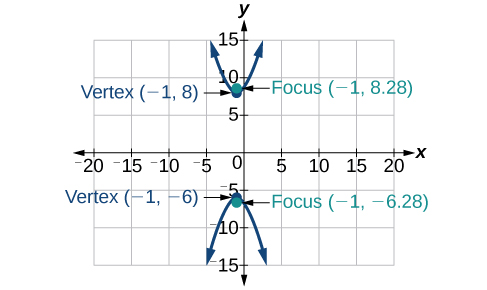
A graph displays a hyperbola centered at (-1, 1). The two vertices are at (-1, 8) and (-1, -6). The two foci are at (-1, 8.28) and (-1, -6.28).

8.R-19 §8.R source ↗

For the following exercises, graph the hyperbola, labeling vertices and foci.

2 y 2 − x 2 − 12y− 6= 0

Answer


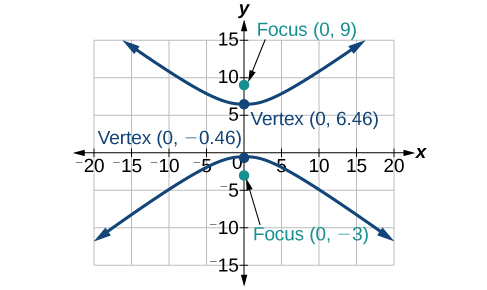
This graph illustrates a hyperbola with a vertical transverse axis, showing its two branches, vertices at (0, 6.46) and (0, -0.46), and foci at (0, 9) and (0, -3).

8.R-21 §8.R source ↗

For the following exercises, find the equation of the hyperbola.

Foci at ( 3,7 ) and ( 7,7 ), vertex at ( 6,7 )

Answer

( x−5 ) 2 1 − ( y−7 ) 2 3 = 1

8.R-23 §8.R source ↗

For the following exercises, write the equation of the parabola in standard form. Then give the vertex, focus, and directrix.

( x+2 ) 2 = 1 2 (y−1)

Answer

( x+2 ) 2 = 1 2 (y−1); vertex: ( −2,1 ); focus: ( −2, 9 8 ); directrix: y= 7 8

8.R-25 §8.R source ↗

For the following exercises, write the equation of the parabola in standard form. Then give the vertex, focus, and directrix.

x 2 + 10x− y+ 23= 0

Answer

( x+5 ) 2 = (y+2); vertex: ( −5,−2 ); focus: ( −5,− 7 4 ); directrix: y=− 9 4

8.R-27 §8.R source ↗

For the following exercises, graph the parabola, labeling vertex, focus, and directrix.

( y−1 ) 2 = 1 2 (x+3)

Answer


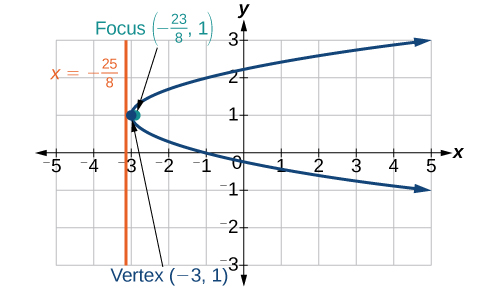
A graph on a coordinate plane displays a parabola opening to the right. The vertex of the parabola is marked at (-3, 1). The focus is labeled as the point (-23/8, 1). A vertical orange line, representing the directrix, is shown at x = -25/8. The x-axis ranges from -5 to 5, and the y-axis ranges from -3 to 3, with major grid lines at integer values.

8.R-29 §8.R source ↗

For the following exercises, graph the parabola, labeling vertex, focus, and directrix.

2 y 2 + 12y+ 6x+ 15= 0

Answer


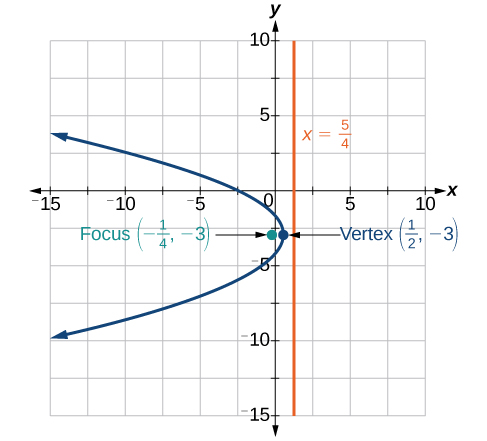
A graph displays a horizontal parabola opening left, with its vertex at (1/2, -3), focus at (-1/4, -3), and a vertical directrix line represented by x = 5/4.

8.R-31 §8.R source ↗

For the following exercises, write the equation of the parabola using the given information.

Focus at ( 2, 9 8 ); directrix is y= 7 8

Answer

( x−2 ) 2 = ( 1 2 )(y−1)

8.R-33 §8.R source ↗

For the following exercises, determine which of the conic sections is represented.

16 x 2 + 24xy+ 9 y 2 + 24x− 60y− 60= 0

Answer

B 2 −4AC=0, parabola

8.R-35 §8.R source ↗

For the following exercises, determine which of the conic sections is represented.

4 x 2 + xy+ 2 y 2 + 8x− 26y+ 9= 0

Answer

B 2 − 4AC= − 31< 0, ellipse

8.R-37 §8.R source ↗

For the following exercises, determine the angle θ that will eliminate the xy term, and write the corresponding equation without the xy term.

x 2 − xy+ y 2 − 6= 0

Answer

θ= 45 ∘ , x ′ 2 + 3 y ′ 2 − 12= 0

8.R-39 §8.R source ↗

For the following exercises, graph the equation relative to the x ′ y ′ system in which the equation has no x ′ y ′ term.

x 2 − xy+ y 2 − 2= 0

Answer

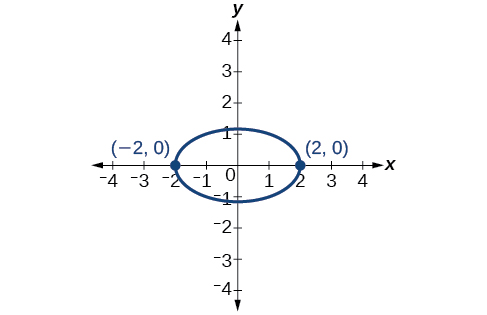
θ= 45 ∘

A graph on the Cartesian coordinate plane shows an ellipse centered at the origin (0,0). The x-axis extends from -4 to 4, and the y-axis extends from -4 to 4. The ellipse intersects the x-axis at (-2,0) and (2,0), and these points are explicitly labeled. The ellipse intersects the y-axis at (0,1) and (0,-1). The major axis of the ellipse lies along the x-axis and has a length of 4, while the minor axis lies along the y-axis and has a length of 2.

8.R-41 §8.R source ↗

For the following exercises, given the polar equation of the conic with focus at the origin, identify the eccentricity and directrix.

r= 10 1−5cosθ

Answer

Hyperbola with e=5 and directrix 2 units to the left of the pole.

8.R-43 §8.R source ↗

For the following exercises, given the polar equation of the conic with focus at the origin, identify the eccentricity and directrix.

r= 1 4+3sinθ

Answer

Ellipse with e= 3 4 and directrix 1 3 unit above the pole.

8.R-45 §8.R source ↗

For the following exercises, graph the conic given in polar form. If it is a parabola, label the vertex, focus, and directrix. If it is an ellipse or a hyperbola, label the vertices and foci.

r= 3 1−sinθ

Answer


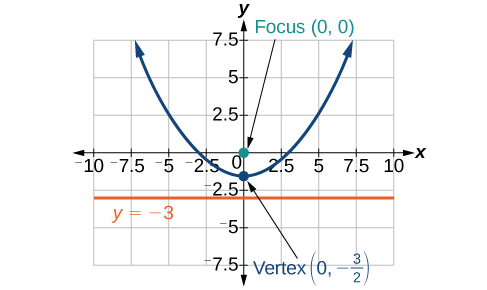
A graph illustrating a parabola opening upwards, with its focus at (0, 0), vertex at (0, -3/2), and a horizontal directrix line labeled y = -3.

8.R-47 §8.R source ↗

For the following exercises, graph the conic given in polar form. If it is a parabola, label the vertex, focus, and directrix. If it is an ellipse or a hyperbola, label the vertices and foci.

r= 10 4+5cosθ

Answer


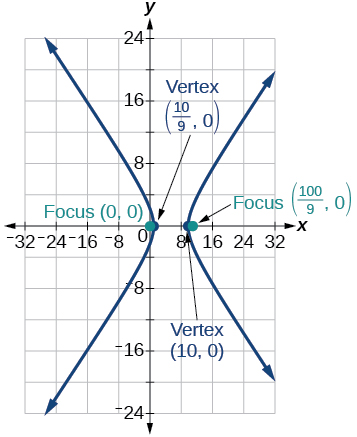
A horizontal hyperbola graph opens left and right. Its vertices are at (10/9, 0) and (10, 0), and its foci are at (0, 0) and (100/9, 0).

8.R-49 §8.R source ↗

For the following exercises, given information about the graph of a conic with focus at the origin, find the equation in polar form.

Directrix is x=3 and eccentricity e=1

Answer

r= 3 1+cos θ

8.T-1 §8.T source ↗

For the following exercises, write the equation in standard form and state the center, vertices, and foci.

x 2 9 + y 2 4 =1

Answer

x 2 3 2 + y 2 2 2 = 1; center: ( 0,0 ); vertices: (3,0), (–3,0), (0,2), (0,−2); foci: ( 5 ,0), (− 5 ,0)

8.T-3 §8.T source ↗

For the following exercises, sketch the graph, identifying the center, vertices, and foci.

( x−3 ) 2 64 + ( y−2 ) 2 36 = 1

Answer

center: ( 3,2 ); vertices: (11,2), (−5,2), (3,8), (3,−4); foci: (3+2 7 ,2), (3−2 7 ,2)

An ellipse is graphed on a Cartesian coordinate plane. The ellipse is centered at (3, 2) and extends horizontally from x = -4 to x = 10, and vertically from y = -3 to y = 7.

8.T-5 §8.T source ↗

For the following exercises, sketch the graph, identifying the center, vertices, and foci.

Write the standard form equation of an ellipse with a center at ( 1,2 ), vertex at ( 7,2 ), and focus at ( 4,2 ).

Answer

( x−1 ) 2 36 + ( y−2 ) 2 27 = 1

8.T-7 §8.T source ↗

For the following exercises, write the equation of the hyperbola in standard form, and give the center, vertices, foci, and asymptotes.

x 2 49 − y 2 81 =1

Answer

x 2 7 2 − y 2 9 2 = 1; center: ( 0,0 ); vertices (7,0), (−7,0); foci: ( 130 ,0), (− 130 ,0); asymptotes: y=± 9 7 x

8.T-9 §8.T source ↗

For the following exercises, graph the hyperbola, noting its center, vertices, and foci. State the equations of the asymptotes.

( x−3 ) 2 25 − ( y+3 ) 2 1 = 1

Answer

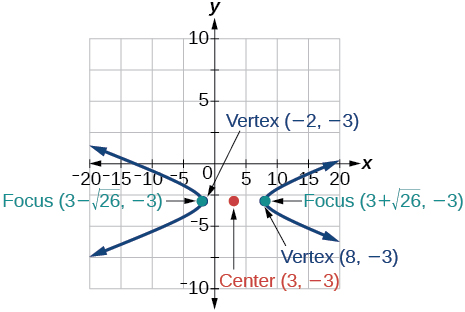
center: ( 3,−3 ); vertices: (8,−3), (−2,−3); foci: (3+ 26 ,−3), (3− 26 ,−3); asymptotes: y= ± 1 5 (x−3)− 3

A graph plots a horizontal hyperbola opening left and right. The center is at (3, -3). Vertices are at (-2, -3) and (8, -3). Foci are at (3-sqrt(26), -3) and (3+sqrt(26), -3).

8.T-11 §8.T source ↗

For the following exercises, graph the hyperbola, noting its center, vertices, and foci. State the equations of the asymptotes.

Write the standard form equation of a hyperbola with foci at ( 1,0 ) and ( 1,6 ), and a vertex at ( 1,2 ).

Answer

( y−3 ) 2 1 − ( x−1 ) 2 8 = 1

8.T-13 §8.T source ↗

For the following exercises, write the equation of the parabola in standard form, and give the vertex, focus, and equation of the directrix.

3 x 2 − 12x− y+ 11= 0

Answer

( x−2 ) 2 = 1 3 (y+1); vertex: ( 2,−1 ); focus: ( 2,− 11 12 ); directrix: y=− 13 12

8.T-15 §8.T source ↗

For the following exercises, graph the parabola, labeling the vertex, focus, and directrix.

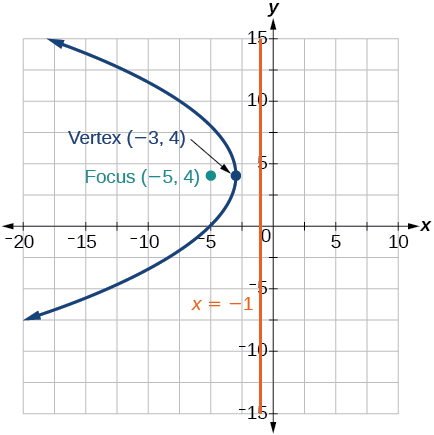
y 2 + 8x− 8y+ 40= 0

Answer


A graph displays a parabola plotted on a coordinate plane. The x-axis ranges from -20 to 10 and the y-axis from -15 to 15, with grid lines at intervals of 5. The parabola opens to the left. The vertex of the parabola is marked at (-3, 4) with a dark blue dot and labeled as Vertex (-3, 4). The focus is marked at (-5, 4) with a teal dot and labeled as Focus (-5, 4). A vertical orange line represents the directrix, which is the line x = -1, and is labeled as x = -1.

8.T-17 §8.T source ↗

For the following exercises, graph the parabola, labeling the vertex, focus, and directrix.

A searchlight is shaped like a paraboloid of revolution. If the light source is located 1.5 feet from the base along the axis of symmetry, and the depth of the searchlight is 3 feet, what should the width of the opening be?

Answer

Approximately 8.49 feet

8.T-19 §8.T source ↗

For the following exercises, determine which conic section is represented by the given equation, and then determine the angle θ that will eliminate the xy term.

x 2 + 4xy+ 4 y 2 + 6x− 8y= 0

Answer

parabola; θ≈ 63.4 ∘

8.T-21 §8.T source ↗

For the following exercises, rewrite in the x ′ y ′ system without the x ′ y ′ term, and graph the rotated graph.

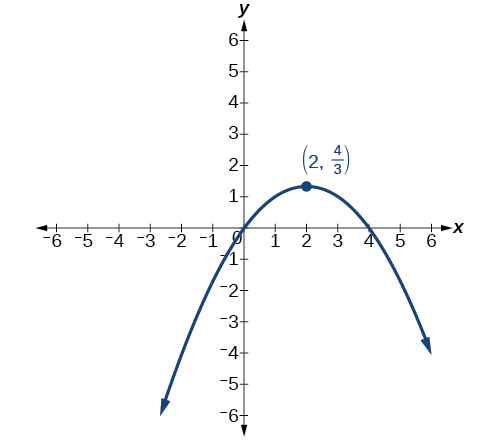
16 x 2 + 24xy+ 9 y 2 − 125x= 0

Answer

x ′ 2 − 4 x ′ + 3 y ′ = 0

A Cartesian coordinate system displays a parabola that opens downwards. The x-axis is labeled from -6 to 6, and the y-axis is labeled from -6 to 6. The parabola passes through the origin (0,0) and appears to cross the x-axis again at x=4. Its vertex is indicated by a blue dot and labeled with the coordinates (2, 4/3). The curve extends infinitely downwards on both ends, indicated by arrows.

8.T-23 §8.T source ↗

For the following exercises, identify the conic with focus at the origin, and then give the directrix and eccentricity.

r= 5 4+6cosθ

Answer

Hyperbola with e= 3 2 , and directrix 5 6 units to the right of the pole.

8.T-25 §8.T source ↗

For the following exercises, graph the given conic section. If it is a parabola, label vertex, focus, and directrix. If it is an ellipse or a hyperbola, label vertices and foci.

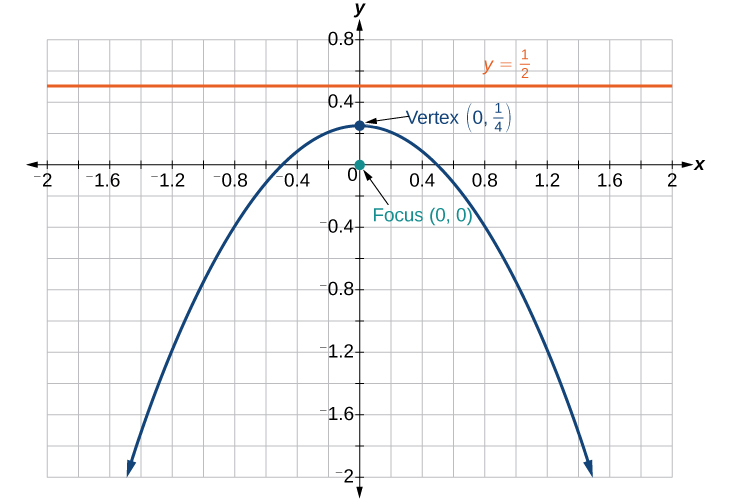
r= 2 4+4sinθ

Answer

A downward-opening parabola is graphed. Its vertex is at (0, 1/4) and its focus is at (0, 0). The directrix is the horizontal line y = 1/2, shown above the vertex.

Loading chapter 9…

Problems and answers are adapted from College Algebra with Corequisite Support 2e by Jay Abramson and Sharon North, OpenStax, and are used under the CC BY-NC-SA 4.0 licence. Access for free at https://openstax.org/books/college-algebra-corequisite-support-2e/pages/1-introduction-to-prerequisites. Illustrations: Copyright Rice University, OpenStax, under CC BY-NC-SA 4.0 license. This adaptation is released under the same licence, is non-commercial, and is neither affiliated with nor endorsed by OpenStax or Rice University.