Every problem in the chapter beside the book’s answer, a chapter at a time as you scroll.
Chapter 8: Ethics Throughout the Data Science Cycle
20 problems · 1 figure8-1 §8.1 source ↗
- a.To ensure individuals are aware of the potential risks and benefits of the research
- b.To bypass legal regulations and guidelines
- c.To collect data without the knowledge of individuals
- d.To speed up the data collection process
Answer
8-2 §8.1 source ↗
- a.Data analysts
- b.Government agencies
- c.Medical professionals
- d.Data scientists
Answer
8-3 §8.1 source ↗
- a.Maximizing collected data
- b.Minimizing informed consent
- c.Ensuring secure storage and access protocols
- d.Avoiding compliance with regulations and guidelines
Answer
8-4 §8.1 source ↗
- a.Unauthorized access to sensitive information
- b.Alteration or destruction of data
- c.Risk of legal issues
- d.All of the above
Answer
8-5 §8.1 source ↗
- a.Have strong data security policies and protocols in place
- b.Respond to data breaches in a timely manner
- c.Only use publicly available data
- d.Share data with third parties without permission
Answer
8-6 §8.1 source ↗
- a.Public datasets
- b.Private databases from unaffiliated sources
- c.Open repositories such as Kaggle.com and OpenML
- d.All of the above
Answer
8-7 §8.1 source ↗
- a.Quantitative and qualitative data only
- b.Tabular, text-based, and image-based data only
- c.Audio-based data only
- d.Quantitative, qualitative, tabular, text-based, and audio-based data
Answer
8-8 §8.1 source ↗
- a.Anyone who is directly involved in the project
- b.Shareholders and customers only
- c.Anyone who is directly involved in the project and has a legitimate need for the data
- d.Anyone with a valid email address
Answer
8-9 §8.1 source ↗
- a.Human resources
- b.Marketing
- c.Legal and compliance teams
- d.Manufacturing
Answer
8-10 §8.2 source ↗
- a.To increase the accuracy of the model by avoiding bias
- b.To avoid legal trouble
- c.To improve the interpretability of the model
- d.To focus on one group of data used in training
Answer
8-11 §8.2 source ↗
- a.Dataset 1, consisting of all the past browsing data on the platform
- b.Dataset 2, the results of an extensive survey of people from various backgrounds and demographic segments who may or may not be familiar with the new social media platform
- c.Dataset 3, the results of an internal company questionnaire
Answer
8-12 §8.2 source ↗
- a.Data points that are well-represented in the training set
- b.Data points that are rare or abnormal in comparison to the rest of the data
- c.Data points that are equally distributed among all classes
- d.Data points that are consistently labeled incorrectly
Answer
8-13 §8.2 source ↗
- a.To ensure models are not overfitting
- b.To maintain the accuracy of the model
- c.To uphold fairness and equity in the decision-making process
- d.To avoid legal consequences
Answer
8-14 §8.2 source ↗
- a.Name, address, and email address
- b.High school GPA and scores on standardized tests
- c.Sports and extracurricular activities
- d.None of the data should be anonymized
Answer
8-15 §8.2 source ↗
- a.When the individual has given consent for anonymization
- b.When the data is used for research purposes
- c.When there is a potential threat to national security
- d.When the data will be used for marketing purposes
Answer
8-16 §8.3 source ↗
- a.Identifying potential errors and biases in the data
- b.Allowing others to replicate the results
- c.Protecting the privacy and dignity of individuals
- d.All of the above
Answer
8-17 §8.3 source ↗
- a.People with visual impairments
- b.People with cognitive impairments
- c.People with auditory impairments
- d.Any person who will use the data
Answer
8-18 §8.3 source ↗
- a.Data attribution
- b.Data manipulation
- c.Data accuracy
- d.Data extraction
Answer
8-19 §8.3 source ↗
- a.Maximizing profits
- b.Manipulating data to fit a desired narrative
- c.Ensuring accessibility and inclusivity
- d.Following the latest trends in data visualization techniques
Answer
8-20 §8.3 source ↗
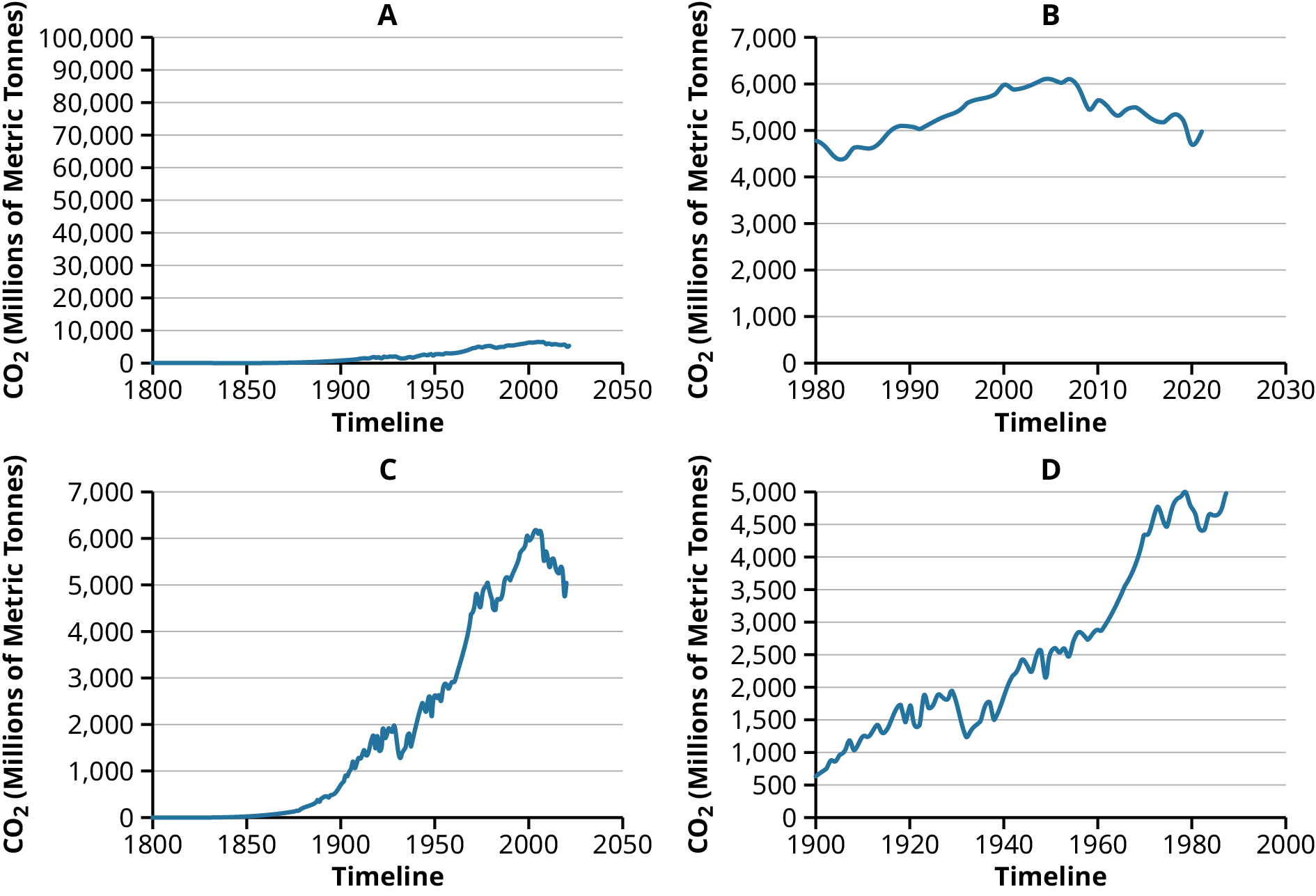 Figure 8.11 Source: Hannah Ritchie, Max Roser and Pablo Rosado (2020) - "CO₂ and Greenhouse Gas Emissions." Published online at OurWorldInData.org. Retrieved from: 'https://ourworldindata.org/co2-and-greenhouse-gas-emissions' [Online Resource]
- a.Graph A
- b.Graph B
- c.Graph C
- d.Graph D
Answer
Loading chapter 10…
Problems and answers are adapted from Principles of Data Science by Shaun V. Ault, Soohyun Nam Liao and Larry Musolino, OpenStax, and are used under the CC BY-NC-SA 4.0 licence. Access for free at https://openstax.org/books/principles-data-science/pages/1-introduction. Illustrations: Copyright Rice University, OpenStax, under CC BY-NC-SA 4.0 license. This adaptation is released under the same licence, is non-commercial, and is neither affiliated with nor endorsed by OpenStax or Rice University.