Every problem in the chapter beside the book’s answer, a chapter at a time as you scroll.

Chapter 12: Current Liabilities

20 problems · 1 figure

Multiple Choice 12.1 §12.1 source ↗

Which of the following is not considered a current liability?
  1. a.
    Accounts Payable
  2. b.
    Unearned Revenue
  3. c.
    the component of a twenty-year note payable due in year 20
  4. d.
    current portion of a noncurrent note payable

Answer

C. the component of a twenty-year note payable due in year 20

Multiple Choice 12.3 §12.1 source ↗

The following is selected financial data from Block Industries:
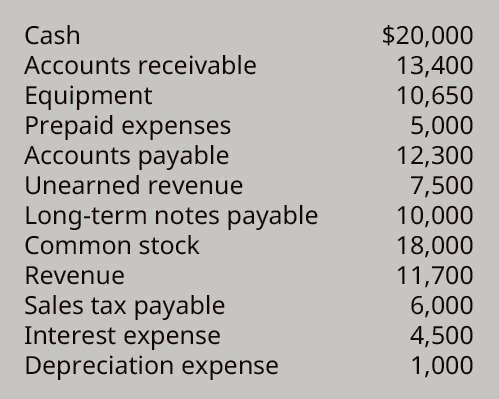
Cash $20,000, Accounts receivable 13,400, Equipment 10,650, Prepaid expenses 5,000, Accounts payable 12,300, Unearned revenue 7,500, Long-term notes payable 10,000, Common stock 18,000, Revenue 11,700, Sales tax payable 6,000, Interest expense 4,500, Depreciation expense 1,000.

How much does Block Industries have in current liabilities?

  1. a.
    $19,800
  2. b.
    $18,300
  3. c.
    $12,300
  4. d.
    $25,800

Answer

D. $25,800

Multiple Choice 12.5 §12.2 source ↗

Nido Co. has a standing agreement with a supplier for purchasing car parts. The terms of the agreement are 3/15, n/30 from the invoice date of September 1. The company makes a purchase on September 1 for $5,000 and pays the amount due on September 13. What amount does Nido Co. pay in cash on September 13?
  1. a.
    $5,000
  2. b.
    $4,850
  3. c.
    $150
  4. d.
    $4,250

Answer

B. $4,850

Multiple Choice 12.7 §12.2 source ↗

Lime Co. incurs a $4,000 note with equal principal installment payments due for the next eight years. What is the amount of the current portion of the noncurrent note payable due in the second year?
  1. a.
    $800
  2. b.
    $1,000
  3. c.
    $500
  4. d.
    nothing, since this is a noncurrent note payable

Answer

C. $500

Multiple Choice 12.9 §12.3 source ↗

Blake Department Store sells television sets with one-year warranties that cover repair and replacement of television parts. In the month of June, Blake sells forty television sets with a per unit cost of $500. If Blake estimates warranty fulfillment at 10% of sales, what would be the warranty liability reported in June?
  1. a.
    $1,000
  2. b.
    $2,000
  3. c.
    $500
  4. d.
    $20,000

Answer

B. $2,000

Multiple Choice 12.11 §12.3 source ↗

Which of the following best describes a contingent liability that is unlikely to occur?
  1. a.
    remote
  2. b.
    probable and estimable
  3. c.
    reasonably possible
  4. d.
    probable and inestimable

Answer

A. remote

Multiple Choice 12.13 §12.4 source ↗

Which of the following is not a characteristic of a short-term note payable?
  1. a.
    Payment is due in less than a year.
  2. b.
    It bears interest.
  3. c.
    It can result from an accounts payable conversion.
  4. d.
    It is reported on the balance sheet under noncurrent liabilities.

Answer

D. It is reported on the balance sheet under noncurrent liabilities.

Multiple Choice 12.15 §12.4 source ↗

Marathon Peanuts converts a $130,000 account payable into a short-term note payable, with an annual interest rate of 6%, and payable in four months. How much interest will Marathon Peanuts owe at the end of four months?
  1. a.
    $2,600
  2. b.
    $7,800
  3. c.
    $137,800
  4. d.
    $132,600

Answer

A. $2,600

Multiple Choice 12.17 §12.5 source ↗

Which of the following is considered an employer payroll tax?
  1. a.
    FICA Medicare
  2. b.
    FUTA
  3. c.
    SUTA
  4. d.
    A and B only
  5. e.
    B and C only
  6. f.
    A, B, and C

Answer

F. A, B, and C

Multiple Choice 12.19 §12.5 source ↗

An employee and employer cost-share health insurance. If the employee covers three-fourths of the cost and the employer covers the rest, what would be the employee’s responsibility if the total premium was $825?
  1. a.
    $618.75
  2. b.
    $206.25
  3. c.
    $412.50
  4. d.
    $275

Answer

A. $618.75

Question 12.1 §12.1 source ↗

Why is Accounts Payable classified as a current liability?

Answer

Accounts Payable can be set up as a line of credit between a purchaser and a supplier. The terms of the invoice usually state that payment is due within a year, or a shorter time frame. Since accounts payable amounts are due within a company’s operating cycle, this account type would be considered a current liability.

Question 12.3 §12.1 source ↗

What is the difference between a noncurrent liability and a current liability?

Answer

A noncurrent liability is due in more than one year or outside a standard company operating period. A current liability is payable within a company’s operating period, or less than a year.

Question 12.5 §12.2 source ↗

If Bergen Air Systems takes out a $100,000 loan, with eight equal principal payments due over the next eight years, how much will be accounted for as a current portion of a noncurrent note payable each year?

Answer

$12,500

Question 12.7 §12.2 source ↗

What specific accounts are recognized when a business purchases equipment on credit?

Answer

Accounts Payable and Equipment

Question 12.9 §12.3 source ↗

What are the two FASB required conditions for a contingent liability to be recognized?

Answer

The likelihood of occurrence and the measurement requirement are the FASB required conditions. A contingent liability must be recognized and disclosed if there is a probable liability determination before the preparation of financial statements has occurred, and the company can reasonably estimate the amount of loss.

Question 12.11 §12.3 source ↗

Name the four contingent liability treatments.

Answer

They are probable and estimable, probable and inestimable, reasonably possible, and remote.

Question 12.13 §12.4 source ↗

What is a key difference between a short-term note payable and a current portion of a noncurrent note payable?

Answer

A short-term notes payable does not have any long-term characteristics and is meant to be paid in full within the company’s operating period (less than a year). The current portion of a noncurrent note payable is based off of a long-term debt but is only recognized as a current liability when a portion of the long-term note payable is due. The remainder stays a long-term liability.

Question 12.15 §12.4 source ↗

What business circumstance could produce a short-term notes payable created from a loan?

Answer

A business borrows money from a bank, and the bank makes the note payable within a year, with interest. For example, this could come from a capital expenditure need or when expenses exceed revenues.

Question 12.17 §12.5 source ↗

What are examples of involuntary deductions employers are required to collect for employee and employer payroll liabilities?

Answer

Examples include FICA Social Security, FICA Medicare, Federal Unemployment Compensation Tax (FUTA), State Unemployment Compensation Tax (SUTA), federal income tax, state income tax, Additional Medicare Tax, and local income tax.

Question 12.19 §12.5 source ↗

What are FUTA and SUTA taxes? Is there any possible reduction in the FUTA tax rate? If so, what is the reduction, and how is this determined?

Answer

FUTA and SUTA are the acronyms for the Federal Unemployment Tax Act and the State Unemployment Tax Act. They are unemployment insurance systems that collect funds from employers to cover employees in case of job disruption beyond their control. The FUTA tax rate is 6% but can be reduced by paying on time to the state unemployment system. This rate can be reduced down to as low as 0.6%.

Loading chapter 13…

Problems and answers are adapted from Principles of Accounting, Volume 1: Financial Accounting by Mitchell Franklin, Patty Graybeal and Dixon Cooper, OpenStax, and are used under the CC BY-NC-SA 4.0 licence. Access for free at https://openstax.org/books/principles-financial-accounting/pages/1-why-it-matters. Illustrations: Copyright Rice University, OpenStax, under CC BY-NC-SA 4.0 license. This adaptation is released under the same licence, is non-commercial, and is neither affiliated with nor endorsed by OpenStax or Rice University.