Every problem in the chapter beside the book’s answer, a chapter at a time as you scroll.
Chapter 4: Applications of Derivatives
327 problems · 37 figuresCheckpoint 4.1 §4.1 source ↗
Answer
Checkpoint 4.2 §4.1 source ↗
Answer
Checkpoint 4.3 §4.1 source ↗
Answer
Checkpoint 4.4 §4.1 source ↗
Answer
4-1 §4.1 source ↗
For the following exercises, find the quantities for the given equation.
Find at and if
Answer
4-3 §4.1 source ↗
For the following exercises, find the quantities for the given equation.
Find at and if and
Answer
4-5 §4.1 source ↗
For the following exercises, sketch the situation if necessary and used related rates to solve for the quantities.
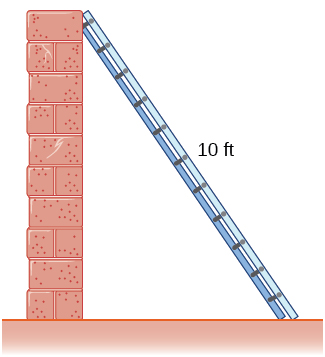
A 10-ft ladder is leaning against a wall. If the top of the ladder slides down the wall at a rate of 2 ft/sec, how fast is the bottom moving along the ground when the bottom of the ladder is 5 ft from the wall?
Answer
4-7 §4.1 source ↗
For the following exercises, sketch the situation if necessary and used related rates to solve for the quantities.
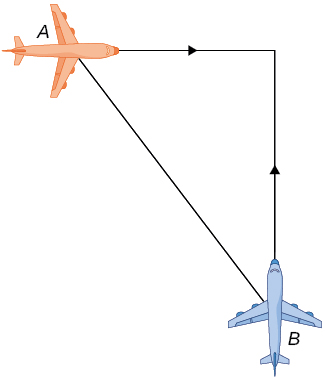
Two airplanes are flying in the air at the same height: airplane A is flying east at 250 mi/h and airplane B is flying north at If they are both heading to the same airport, located 30 miles east of airplane A and 40 miles north of airplane B, at what rate is the distance between the airplanes changing?
Answer
4-9 §4.1 source ↗
For the following exercises, sketch the situation if necessary and used related rates to solve for the quantities.
Two buses are driving along parallel freeways that are apart, one heading east and the other heading west. Assuming that each bus drives a constant find the rate at which the distance between the buses is changing when they are apart, heading toward each other.
Answer
4-11 §4.1 source ↗
For the following exercises, sketch the situation if necessary and used related rates to solve for the quantities.
Using the previous problem, what is the rate at which the tip of the shadow moves away from the person when the person is 10 ft from the pole?
Answer
4-13 §4.1 source ↗
For the following exercises, sketch the situation if necessary and used related rates to solve for the quantities.
Using the previous problem, what is the rate at which the shadow changes when the person is 10 ft from the wall, if the person is walking away from the wall at a rate of 2 ft/sec?
Answer
4-15 §4.1 source ↗
For the following exercises, sketch the situation if necessary and used related rates to solve for the quantities.
Using the previous problem, what is the rate at which the distance between you and the helicopter is changing when the helicopter has risen to a height of 60 ft in the air, assuming that, initially, it was 30 ft above you?
Answer
4-17 §4.1 source ↗
For the following exercises, draw and label diagrams to help solve the related-rates problems.
The volume of a cube decreases at a rate of 10 m3/s. Find the rate at which the side of the cube changes when the side of the cube is 2 m.
Answer
4-19 §4.1 source ↗
For the following exercises, draw and label diagrams to help solve the related-rates problems.
The radius of a sphere decreases at a rate of m/sec. Find the rate at which the surface area decreases when the radius is 10 m.
Answer
4-21 §4.1 source ↗
For the following exercises, draw and label diagrams to help solve the related-rates problems.
The radius of a sphere is increasing at a rate of 9 cm/sec. Find the radius of the sphere when the volume and the radius of the sphere are increasing at the same numerical rate.
Answer
4-23 §4.1 source ↗
For the following exercises, draw and label diagrams to help solve the related-rates problems.
A triangle has two constant sides of length 3 ft and 5 ft. The angle between these two sides is increasing at a rate of 0.1 rad/sec. Find the rate at which the area of the triangle is changing when the angle between the two sides is
Answer
4-25 §4.1 source ↗
For the following exercises, consider a right cone that is leaking water. The dimensions of the conical tank are a height of 16 ft and a radius of 5 ft.
How fast does the depth of the water change when the water is 10 ft high if the cone leaks water at a rate of 10 ft3/min?
Answer
4-27 §4.1 source ↗
For the following exercises, consider a right cone that is leaking water. The dimensions of the conical tank are a height of 16 ft and a radius of 5 ft.
If the water level is decreasing at a rate of 3 in/min when the depth of the water is 8 ft, determine the rate at which water is leaking out of the cone.
Answer
4-29 §4.1 source ↗
For the following exercises, consider a right cone that is leaking water. The dimensions of the conical tank are a height of 16 ft and a radius of 5 ft.
A vertical cylinder is leaking water but you are unable to determine at what rate. The cylinder has a height of 2 m and a radius of 2 m. Find the rate at which the water is leaking out of the cylinder if the rate at which the height is decreasing is 10 cm/min when the height is 1 m.
Answer
4-31 §4.1 source ↗
For the following exercises, consider a right cone that is leaking water. The dimensions of the conical tank are a height of 16 ft and a radius of 5 ft.
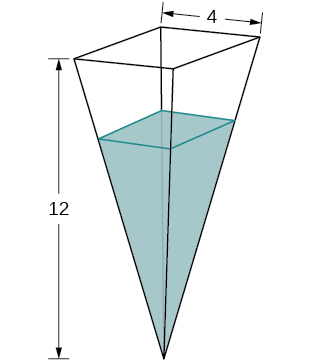
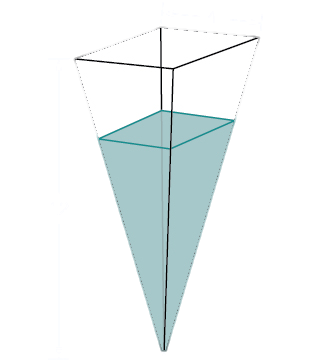
A tank is shaped like an upside-down square pyramid, with base of 4 m by 4 m and a height of 12 m (see the following figure). How fast does the height increase when the water is 2 m deep if water is being pumped in at a rate of m3/sec?
Answer
4-33 §4.1 source ↗
For the following problems, consider a pool shaped like the bottom half of a sphere, that is being filled at a rate of 25 ft3/min. The radius of the pool is 10 ft. The formula for the volume of a partial hemisphere is where is the height of the water and is the radius of the water.
Find the rate at which the depth of the water is changing when the water has a depth of 1 ft.
Answer
4-35 §4.1 source ↗
For the following problems, consider a pool shaped like the bottom half of a sphere, that is being filled at a rate of 25 ft3/min. The radius of the pool is 10 ft. The formula for the volume of a partial hemisphere is where is the height of the water and is the radius of the water.
Gravel is being unloaded from a truck and falls into a pile shaped like a cone at a rate of 10 ft3/min. The radius of the cone base is three times the height of the cone. Find the rate at which the height of the gravel changes when the pile has a height of 5 ft.
Answer
4-37 §4.1 source ↗
For the following exercises, solve the related-rates problems. Consider making a sketch that represents the situation to help you understand each problem.
You are stationary on the ground and are watching a bird fly horizontally at a rate of m/sec. The bird is located 40 m above your head. How fast does the angle of elevation change when the horizontal distance between you and the bird is 9 m?
Answer
4-39 §4.1 source ↗
For the following exercises, solve the related-rates problems. Consider making a sketch that represents the situation to help you understand each problem.
A lighthouse, L, is on an island 4 mi away from the closest point, P, on the beach (see the following image). If the lighthouse light rotates clockwise at a constant rate of 10 revolutions/min, how fast does the beam of light move across the beach 2 mi away from the closest point on the beach?
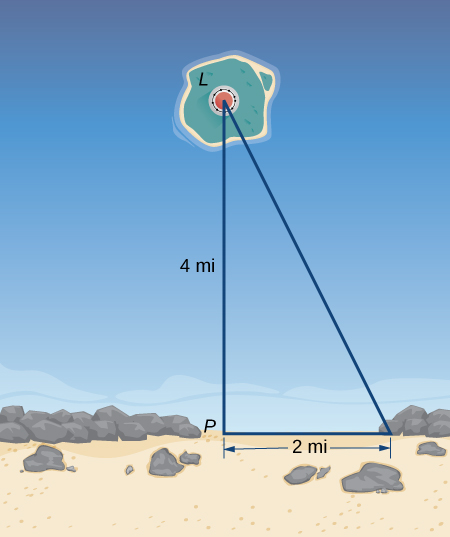
Answer
4-41 §4.1 source ↗
For the following exercises, solve the related-rates problems. Consider making a sketch that represents the situation to help you understand each problem.
You are walking to a bus stop at a right-angle corner. You move north at a rate of 2 m/sec and are 20 m south of the intersection. The bus travels west at a rate of 10 m/sec away from the intersection – you have missed the bus! What is the rate at which the angle between you and the bus is changing when you are 20 m south of the intersection and the bus is 10 m west of the intersection?
Answer
4-43 §4.1 source ↗
For the following exercises, refer to the figure of baseball diamond, which has sides of 90 ft.
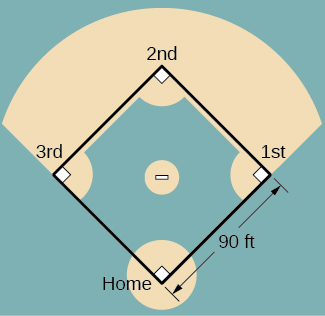
[T] A batter hits a ball toward second base at 80 ft/sec and runs toward first base at a rate of 30 ft/sec. At what rate does the distance between the ball and the batter change when the runner has covered one-third of the distance to first base? (Hint: Recall the law of cosines.)
Answer
4-45 §4.1 source ↗
For the following exercises, refer to the figure of baseball diamond, which has sides of 90 ft.
[T] Runners start at first and second base. When the baseball is hit, the runner at first base runs at a speed of 18 ft/sec toward second base and the runner at second base runs at a speed of 20 ft/sec toward third base. How fast is the distance between runners changing 1 sec after the ball is hit?
Answer
Checkpoint 4.5 §4.2 source ↗
Answer
Checkpoint 4.6 §4.2 source ↗
Answer
Checkpoint 4.7 §4.2 source ↗
Answer
Checkpoint 4.8 §4.2 source ↗
Answer
Checkpoint 4.9 §4.2 source ↗
Answer
Checkpoint 4.10 §4.2 source ↗
Answer
Checkpoint 4.11 §4.2 source ↗
Answer
4-47 §4.2 source ↗
Answer
4-49 §4.2 source ↗
Answer
4-51 §4.2 source ↗
For the following exercises, find the linear approximation to near for the function.
Answer
4-53 §4.2 source ↗
For the following exercises, find the linear approximation to near for the function.
Answer
4-55 §4.2 source ↗
For the following exercises, find the linear approximation to near for the function.
Answer
4-57 §4.2 source ↗
For the following exercises, compute the values given within 0.01 by deciding on the appropriate and and evaluating Check your answer using a calculator.
[T]
Answer
4-59 §4.2 source ↗
For the following exercises, compute the values given within 0.01 by deciding on the appropriate and and evaluating Check your answer using a calculator.
[T]
Answer
4-61 §4.2 source ↗
For the following exercises, compute the values given within 0.01 by deciding on the appropriate and and evaluating Check your answer using a calculator.
[T]
Answer
4-63 §4.2 source ↗
For the following exercises, determine the appropriate and and evaluate Calculate the numerical error in the linear approximations that follow.
[T]
Answer
4-65 §4.2 source ↗
For the following exercises, determine the appropriate and and evaluate Calculate the numerical error in the linear approximations that follow.
[T]
Answer
4-67 §4.2 source ↗
For the following exercises, determine the appropriate and and evaluate Calculate the numerical error in the linear approximations that follow.
[T]
Answer
4-69 §4.2 source ↗
For the following exercises, find the differential of the function.
Answer
4-71 §4.2 source ↗
For the following exercises, find the differential of the function.
Answer
4-73 §4.2 source ↗
For the following exercises, find the differential and evaluate for the given and
Answer
4-75 §4.2 source ↗
For the following exercises, find the differential and evaluate for the given and
Answer
4-77 §4.2 source ↗
For the following exercises, find the differential and evaluate for the given and
Answer
4-79 §4.2 source ↗
For the following exercises, find the change in volume or in surface area
if the sides of a cube change from to
Answer
4-81 §4.2 source ↗
For the following exercises, find the change in volume or in surface area
if the radius of a sphere changes from by
Answer
4-83 §4.2 source ↗
For the following exercises, find the change in volume or in surface area
if a circular cylinder of height 3 changes from to
Answer
4-85 §4.2 source ↗
For the following exercises, find the change in volume or in surface area
A pool has a rectangular base of 10 ft by 20 ft and a depth of 6 ft. What is the change in volume if you only fill it up to 5.5 ft?
Answer
Checkpoint 4.12 §4.3 source ↗
Answer
Checkpoint 4.13 §4.3 source ↗
Answer
4-91 §4.3 source ↗
Answer
4-93 §4.3 source ↗
Answer
4-95 §4.3 source ↗
Answer
4-97 §4.3 source ↗
Answer
4-99 §4.3 source ↗
Answer
4-101 §4.3 source ↗
For the following exercises, determine where the local and absolute maxima and minima occur on the graph given. Assume the graph represents the entirety of each function. For any extrema located at an endpoint, approximate the x-value.
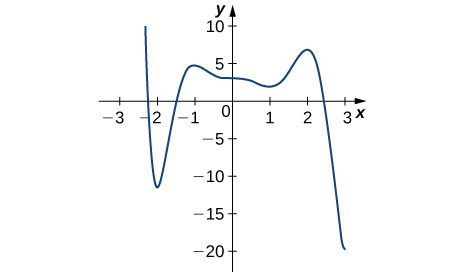
Answer
4-103 §4.3 source ↗
For the following exercises, determine where the local and absolute maxima and minima occur on the graph given. Assume the graph represents the entirety of each function. For any extrema located at an endpoint, approximate the x-value.
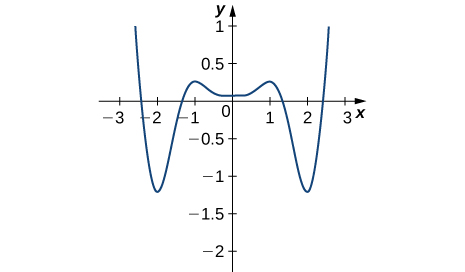
Answer
4-105 §4.3 source ↗
For the following problems, draw graphs of which is continuous, over the interval with the following properties:
Absolute minimum at and absolute maximum at
Answer
4-107 §4.3 source ↗
For the following problems, draw graphs of which is continuous, over the interval with the following properties:
Absolute maxima at and local minimum at and absolute minimum at
Answer
4-109 §4.3 source ↗
For the following exercises, find the critical numbers in the domains of the following functions.
Answer
4-111 §4.3 source ↗
For the following exercises, find the critical numbers in the domains of the following functions.
Answer
4-113 §4.3 source ↗
For the following exercises, find the critical numbers in the domains of the following functions.
Answer
4-115 §4.3 source ↗
For the following exercises, find the critical numbers in the domains of the following functions.
Answer
4-117 §4.3 source ↗
For the following exercises, find the critical numbers in the domains of the following functions.
Answer
4-119 §4.3 source ↗
For the following exercises, find the local and/or absolute extrema for the functions over the specified domain.
over
Answer
4-121 §4.3 source ↗
For the following exercises, find the local and/or absolute extrema for the functions over the specified domain.
over
Answer
4-123 §4.3 source ↗
For the following exercises, find the local and/or absolute extrema for the functions over the specified domain.
over
Answer
4-125 §4.3 source ↗
For the following exercises, find the local and/or absolute extrema for the functions over the specified domain.
over
Answer
4-127 §4.3 source ↗
For the following exercises, find the local and/or absolute extrema for the functions over the specified domain.
over
Answer
4-129 §4.3 source ↗
For the following exercises, find the local and absolute minima and maxima for the functions over
Answer
4-131 §4.3 source ↗
For the following exercises, find the local and absolute minima and maxima for the functions over
Answer
4-133 §4.3 source ↗
For the following exercises, find the local and absolute minima and maxima for the functions over
Answer
4-135 §4.3 source ↗
For the following functions, use a calculator to graph the function and to estimate the absolute and local maxima and minima. Then, solve for them explicitly.
[T]
Answer
4-137 §4.3 source ↗
For the following functions, use a calculator to graph the function and to estimate the absolute and local maxima and minima. Then, solve for them explicitly.
[T]
Answer
4-139 §4.3 source ↗
For the following functions, use a calculator to graph the function and to estimate the absolute and local maxima and minima. Then, solve for them explicitly.
[T]
Answer
4-141 §4.3 source ↗
For the following functions, use a calculator to graph the function and to estimate the absolute and local maxima and minima. Then, solve for them explicitly.
A ball is thrown into the air and its position is given by Find the height at which the ball stops ascending. How long after it is thrown does this happen?
Answer
4-143 §4.3 source ↗
For the following exercises, consider the production of gold during the California gold rush (1848–1888). The production of gold can be modeled by where is the number of years since the rush began and is ounces of gold produced (in millions). A summary of the data is shown in the following figure.
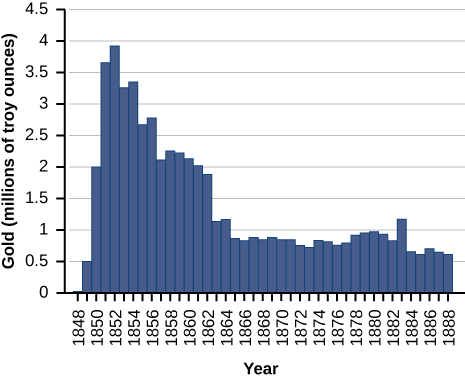
Find when the minimum (local and absolute) gold production occurred. What was the amount of gold produced during this minimum?
Answer
4-145 §4.3 source ↗
Find the critical points, maxima, and minima for the following piecewise functions.
Answer
4-147 §4.3 source ↗
For the following exercises, find the critical points of the following generic functions. Are they maxima, minima, or neither? State the necessary conditions.
given that and a is an integer.
Answer
Checkpoint 4.14 §4.4 source ↗
Answer
Checkpoint 4.15 §4.4 source ↗
Answer
4-149 §4.4 source ↗
Answer
4-151 §4.4 source ↗
Answer
4-153 §4.4 source ↗
For the following exercises, determine over what intervals (if any) the Mean Value Theorem applies. Justify your answer.
Answer
4-155 §4.4 source ↗
For the following exercises, determine over what intervals (if any) the Mean Value Theorem applies. Justify your answer.
Answer
4-157 §4.4 source ↗
For the following exercises, graph the functions on a calculator and draw the secant line that connects the endpoints. Estimate the number of points such that
[T] over
Answer
4-159 §4.4 source ↗
For the following exercises, graph the functions on a calculator and draw the secant line that connects the endpoints. Estimate the number of points such that
[T] over
Answer
4-161 §4.4 source ↗
For the following exercises, find all points predicted by the Mean Value Theorem satisfying
Answer
4-163 §4.4 source ↗
For the following exercises, find all points predicted by the Mean Value Theorem satisfying
Answer
4-165 §4.4 source ↗
For the following exercises, find all points predicted by the Mean Value Theorem satisfying
Answer
4-167 §4.4 source ↗
For the following exercises, show there is no such that Explain why the Mean Value Theorem does not apply over the interval
Answer
4-169 §4.4 source ↗
For the following exercises, show there is no such that Explain why the Mean Value Theorem does not apply over the interval
Answer
4-171 §4.4 source ↗
For the following exercises, determine whether the Mean Value Theorem applies for the functions over the given interval Justify your answer.
over
Answer
4-173 §4.4 source ↗
For the following exercises, determine whether the Mean Value Theorem applies for the functions over the given interval Justify your answer.
over
Answer
4-175 §4.4 source ↗
For the following exercises, determine whether the Mean Value Theorem applies for the functions over the given interval Justify your answer.
over
Answer
4-177 §4.4 source ↗
For the following exercises, determine whether the Mean Value Theorem applies for the functions over the given interval Justify your answer.
over
Answer
4-179 §4.4 source ↗
For the following exercises, determine whether the Mean Value Theorem applies for the functions over the given interval Justify your answer.
over
Answer
4-181 §4.4 source ↗
For the following exercises, determine whether the Mean Value Theorem applies for the functions over the given interval Justify your answer.
over
Answer
4-183 §4.4 source ↗
For the following exercises, consider the roots of the equation.
Find the conditions for exactly one root (double root) for the equation
Answer
4-185 §4.4 source ↗
For the following exercises, use a calculator to graph the function over the interval and graph the secant line from to Use the calculator to estimate all values of as guaranteed by the Mean Value Theorem. Then, find the exact value of if possible, or write the final equation and use a calculator to estimate to four digits.
[T] over
Answer
4-187 §4.4 source ↗
For the following exercises, use a calculator to graph the function over the interval and graph the secant line from to Use the calculator to estimate all values of as guaranteed by the Mean Value Theorem. Then, find the exact value of if possible, or write the final equation and use a calculator to estimate to four digits.
[T] over
Answer
4-189 §4.4 source ↗
For the following exercises, use a calculator to graph the function over the interval and graph the secant line from to Use the calculator to estimate all values of as guaranteed by the Mean Value Theorem. Then, find the exact value of if possible, or write the final equation and use a calculator to estimate to four digits.
[T] over
Answer
4-191 §4.4 source ↗
For the following exercises, use a calculator to graph the function over the interval and graph the secant line from to Use the calculator to estimate all values of as guaranteed by the Mean Value Theorem. Then, find the exact value of if possible, or write the final equation and use a calculator to estimate to four digits.
Two cars drive from one stoplight to the next, leaving at the same time and arriving at the same time. Is there ever a time when they are going the same speed? Prove or disprove.
Answer
4-193 §4.4 source ↗
For the following exercises, use a calculator to graph the function over the interval and graph the secant line from to Use the calculator to estimate all values of as guaranteed by the Mean Value Theorem. Then, find the exact value of if possible, or write the final equation and use a calculator to estimate to four digits.
Show that and have the same derivative. What can you say about
Answer
Let represent the distance of Car 1 from Stoplight 1 at time . Let represent the distance of Car 2 from Stoplight 1 at time . Then . Let represent the time that the cars arrive at Stoplight 2. Then where is the distance between the stoplights.
Define a new function . Then . By the Mean Value Theorem, there is a time such that
At time c,
So, at time c, Car 1 and Car 2 are traveling at the same speed.
Checkpoint 4.16 §4.5 source ↗
Answer
Checkpoint 4.17 §4.5 source ↗
Answer
Checkpoint 4.18 §4.5 source ↗
Answer
Checkpoint 4.19 §4.5 source ↗
Answer
4-195 §4.5 source ↗
Answer
4-197 §4.5 source ↗
Answer
4-199 §4.5 source ↗
Answer
4-201 §4.5 source ↗
For the following exercises, analyze the graphs of then list all intervals where is increasing or decreasing.
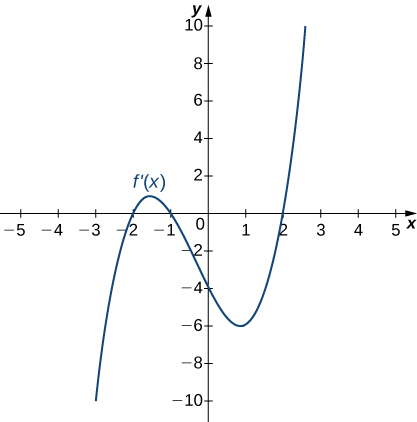
Answer
4-203 §4.5 source ↗
For the following exercises, analyze the graphs of then list all intervals where is increasing or decreasing.
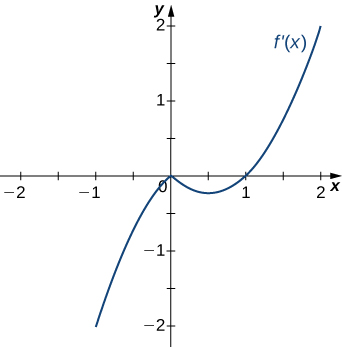
Answer
4-205 §4.5 source ↗
For the following exercises, analyze the graphs of then list all intervals where is increasing or decreasing.
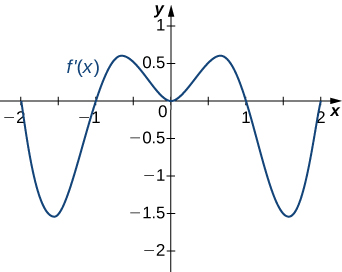
Answer
4-207 §4.5 source ↗
For the following exercises, analyze the graphs of then list all intervals where
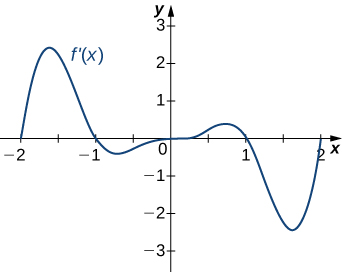
Answer
4-209 §4.5 source ↗
For the following exercises, analyze the graphs of then list all intervals where
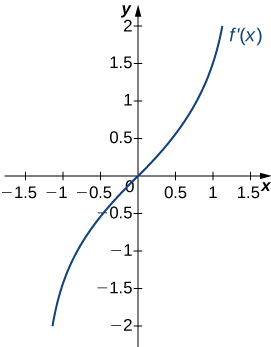
Answer
4-211 §4.5 source ↗
For the following exercises, analyze the graphs of then list all inflection points and intervals where is concave up and concave down.
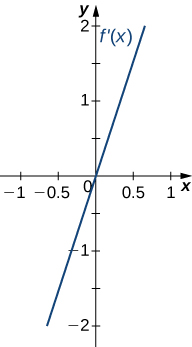
Answer
4-213 §4.5 source ↗
For the following exercises, analyze the graphs of then list all inflection points and intervals where is concave up and concave down.
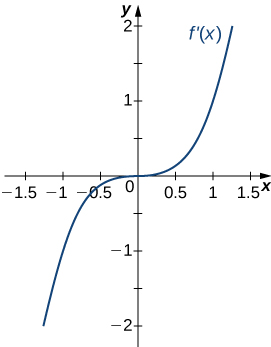
Answer
4-215 §4.5 source ↗
For the following exercises, analyze the graphs of then list all inflection points and intervals where is concave up and concave down.
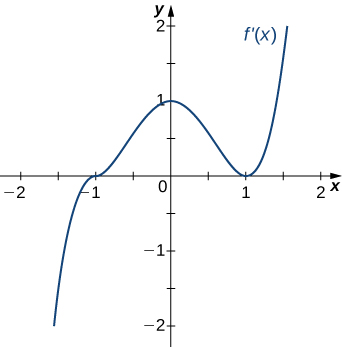
Answer
4-217 §4.5 source ↗
For the following exercises, draw a graph that satisfies the given specifications for the domain The function does not have to be continuous or differentiable.
over over for all
Answer
4-219 §4.5 source ↗
For the following exercises, draw a graph that satisfies the given specifications for the domain The function does not have to be continuous or differentiable.
There is a local maximum at local minimum at and the graph is neither concave up nor concave down.
Answer
4-221 §4.5 source ↗
For the following exercises, determine
If needed, use a calculator to graph the functions, but show your work.
over
Answer
4-223 §4.5 source ↗
For the following exercises, determine a. intervals where is concave up or concave down, and b. the inflection points of
Answer
4-225 §4.5 source ↗
For the following exercises, determine
Answer
4-227 §4.5 source ↗
For the following exercises, determine
Answer
4-229 §4.5 source ↗
For the following exercises, determine
Answer
4-231 §4.5 source ↗
For the following exercises, determine
[T] over
Answer
4-233 §4.5 source ↗
For the following exercises, determine
[T] over
Answer
4-235 §4.5 source ↗
For the following exercises, determine
[T]
Answer
4-237 §4.5 source ↗
For the following exercises, determine
over
Answer
4-239 §4.5 source ↗
For the following exercises, determine
Answer
4-241 §4.5 source ↗
For the following exercises, interpret the sentences in terms of
The population is growing more slowly. Here is the population.
Answer
4-243 §4.5 source ↗
For the following exercises, interpret the sentences in terms of
The airplane lands smoothly. Here is the plane’s altitude.
Answer
4-245 §4.5 source ↗
For the following exercises, interpret the sentences in terms of
The economy is picking up speed. Here is a measure of the economy, such as GDP.
Answer
4-247 §4.5 source ↗
For the following exercises, consider a third-degree polynomial which has the properties (not applicable to Exercises 249 and 250). Determine whether the following statements are true or false. Justify your answer.
for some
Answer
4-249 §4.5 source ↗
For the following exercises, consider a third-degree polynomial which has the properties (not applicable to Exercises 249 and 250). Determine whether the following statements are true or false. Justify your answer.
If has three roots, then it has inflection point.
Answer
Checkpoint 4.20 §4.6 source ↗
Answer
Checkpoint 4.21 §4.6 source ↗
Answer
Let Let Therefore, for all we have
Therefore,
Checkpoint 4.22 §4.6 source ↗
Answer
Let Let Then, for all we have
Checkpoint 4.23 §4.6 source ↗
Answer
Checkpoint 4.24 §4.6 source ↗
Answer
Checkpoint 4.25 §4.6 source ↗
Answer
Checkpoint 4.26 §4.6 source ↗
Answer
Checkpoint 4.27 §4.6 source ↗
Answer
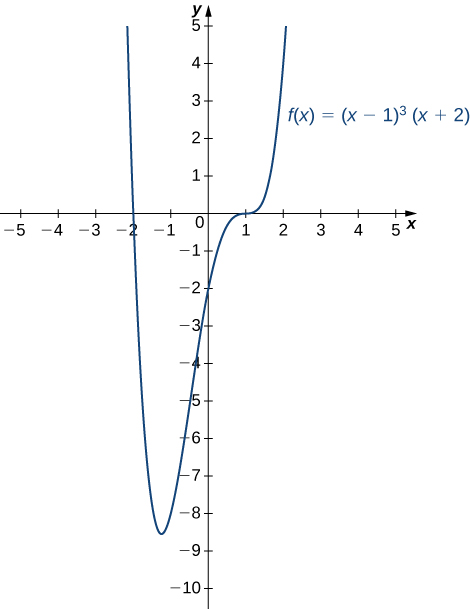
Checkpoint 4.28 §4.6 source ↗
Answer
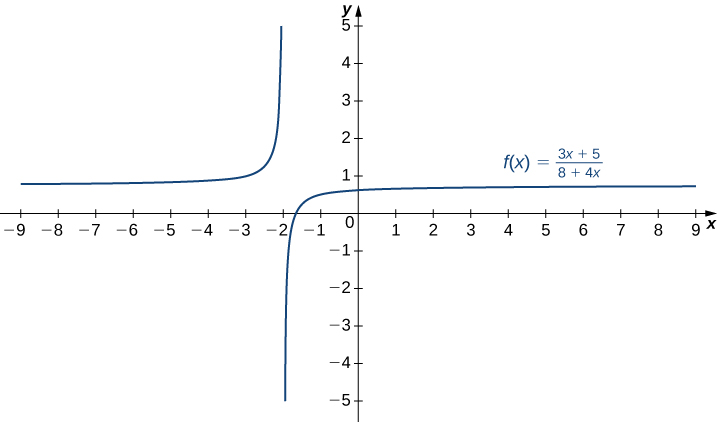
Checkpoint 4.29 §4.6 source ↗
Answer
Checkpoint 4.30 §4.6 source ↗
Answer
4-251 §4.6 source ↗
For the following exercises, examine the graphs. Identify where the vertical asymptotes are located.
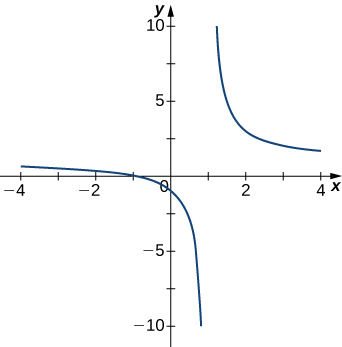
Answer
4-253 §4.6 source ↗
For the following exercises, examine the graphs. Identify where the vertical asymptotes are located.
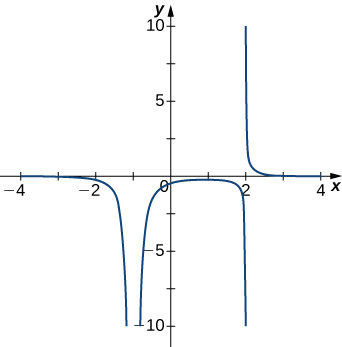
Answer
4-255 §4.6 source ↗
For the following exercises, examine the graphs. Identify where the vertical asymptotes are located.
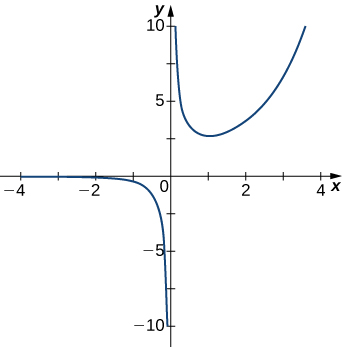
Answer
4-257 §4.6 source ↗
For the following functions determine whether there is an asymptote at Justify your answer without graphing on a calculator.
Answer
4-259 §4.6 source ↗
For the following functions determine whether there is an asymptote at Justify your answer without graphing on a calculator.
Answer
4-261 §4.6 source ↗
For the following exercises, evaluate the limit.
Answer
4-263 §4.6 source ↗
For the following exercises, evaluate the limit.
Answer
4-265 §4.6 source ↗
For the following exercises, evaluate the limit.
Answer
4-267 §4.6 source ↗
For the following exercises, evaluate the limit.
Answer
4-269 §4.6 source ↗
For the following exercises, evaluate the limit.
Answer
4-271 §4.6 source ↗
For the following exercises, find the horizontal and vertical asymptotes.
Answer
4-273 §4.6 source ↗
For the following exercises, find the horizontal and vertical asymptotes.
Answer
4-275 §4.6 source ↗
For the following exercises, find the horizontal and vertical asymptotes.
Answer
4-277 §4.6 source ↗
For the following exercises, find the horizontal and vertical asymptotes.
Answer
4-279 §4.6 source ↗
For the following exercises, find the horizontal and vertical asymptotes.
Answer
4-281 §4.6 source ↗
For the following exercises, find the horizontal and vertical asymptotes.
Answer
4-283 §4.6 source ↗
For the following exercises, find the horizontal and vertical asymptotes.
Answer
4-285 §4.6 source ↗
For the following exercises, construct a function that has the given asymptotes.
and
Answer
4-287 §4.6 source ↗
For the following exercises, construct a function that has the given asymptotes.
Answer
4-289 §4.6 source ↗
For the following exercises, graph the function on a graphing calculator on the window and estimate the horizontal asymptote or limit. Then, calculate the actual horizontal asymptote or limit.
[T]
Answer
4-291 §4.6 source ↗
For the following exercises, graph the function on a graphing calculator on the window and estimate the horizontal asymptote or limit. Then, calculate the actual horizontal asymptote or limit.
[T]
Answer
4-293 §4.6 source ↗
For the following exercises, graph the function on a graphing calculator on the window and estimate the horizontal asymptote or limit. Then, calculate the actual horizontal asymptote or limit.
[T]
Answer
4-295 §4.6 source ↗
For the following exercises, draw a graph of the functions without using a calculator. Be sure to notice all important features of the graph: local maxima and minima, inflection points, and asymptotic behavior.
Answer
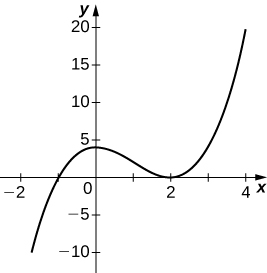
4-297 §4.6 source ↗
For the following exercises, draw a graph of the functions without using a calculator. Be sure to notice all important features of the graph: local maxima and minima, inflection points, and asymptotic behavior.
Answer
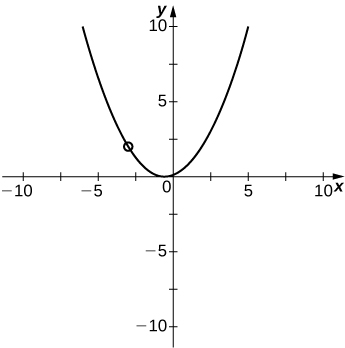
4-299 §4.6 source ↗
For the following exercises, draw a graph of the functions without using a calculator. Be sure to notice all important features of the graph: local maxima and minima, inflection points, and asymptotic behavior.
Answer
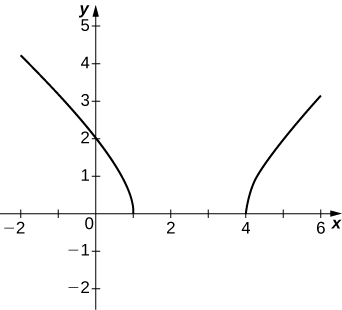
4-301 §4.6 source ↗
For the following exercises, draw a graph of the functions without using a calculator. Be sure to notice all important features of the graph: local maxima and minima, inflection points, and asymptotic behavior.
on
Answer
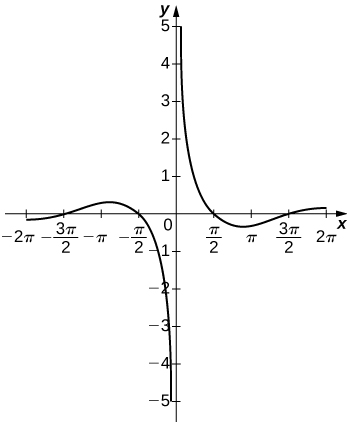
4-303 §4.6 source ↗
For the following exercises, draw a graph of the functions without using a calculator. Be sure to notice all important features of the graph: local maxima and minima, inflection points, and asymptotic behavior.
Answer
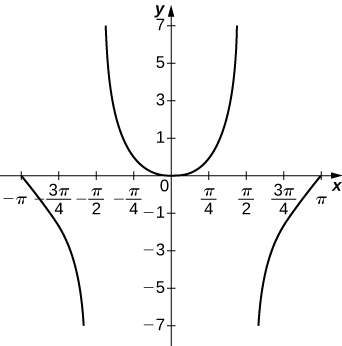
4-305 §4.6 source ↗
For the following exercises, draw a graph of the functions without using a calculator. Be sure to notice all important features of the graph: local maxima and minima, inflection points, and asymptotic behavior.
Answer
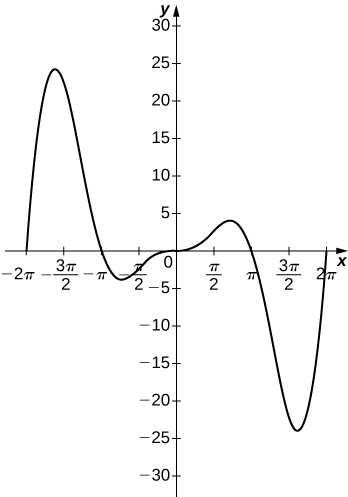
4-307 §4.6 source ↗
For the following exercises, draw a graph of the functions without using a calculator. Be sure to notice all important features of the graph: local maxima and minima, inflection points, and asymptotic behavior.
For to have an asymptote at then the polynomials and must have what relation?
Answer
4-309 §4.6 source ↗
For the following exercises, draw a graph of the functions without using a calculator. Be sure to notice all important features of the graph: local maxima and minima, inflection points, and asymptotic behavior.
Both and have asymptotes at and What is the most obvious difference between these two functions?
Answer
Checkpoint 4.31 §4.7 source ↗
Answer
Checkpoint 4.32 §4.7 source ↗
Answer
Checkpoint 4.33 §4.7 source ↗
Answer
Checkpoint 4.34 §4.7 source ↗
Answer
Checkpoint 4.35 §4.7 source ↗
Answer
Checkpoint 4.36 §4.7 source ↗
Answer
4-311 §4.7 source ↗
For the following exercises, answer by proof, counterexample, or explanation.
When you find the maximum for an optimization problem, why do you need to check the sign of the derivative around the critical points?
Answer
4-313 §4.7 source ↗
For the following exercises, answer by proof, counterexample, or explanation.
True or False. For every continuous nonlinear function, you can find the value that maximizes the function.
Answer
4-315 §4.7 source ↗
For the following exercises, set up and evaluate each optimization problem.
To carry a suitcase on an airplane, the length height of the box must be less than or equal to Assuming the base of the suitcase is square, show that the volume is What height allows you to have the largest volume?
Answer
4-317 §4.7 source ↗
For the following exercises, set up and evaluate each optimization problem.
Find the positive integer that minimizes the sum of the number and its reciprocal.
Answer
4-319 §4.7 source ↗
For the following exercises, consider the construction of a pen to enclose an area.
You have of fencing to construct a rectangular pen for cattle. What are the dimensions of the pen that maximize the area?
Answer
4-321 §4.7 source ↗
For the following exercises, consider the construction of a pen to enclose an area.
You need to construct a fence around an area of What are the dimensions of the rectangular pen to minimize the amount of material needed?
Answer
4-323 §4.7 source ↗
For the following exercises, consider the construction of a pen to enclose an area.
[T] You are moving into a new apartment and notice there is a corner where the hallway narrows from What is the length of the longest item that can be carried horizontally around the corner?
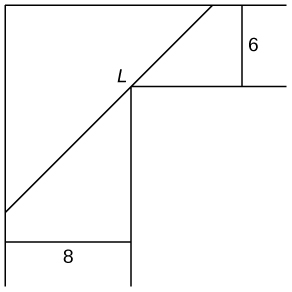
Answer
4-325 §4.7 source ↗
For the following exercises, consider the construction of a pen to enclose an area.
In the previous problem, assume the patient was nervous during the third measurement, so we only weight that value half as much as the others. What is the value that minimizes
Answer
4-327 §4.7 source ↗
For the following problems, consider a lifeguard at a circular pool with diameter He must reach someone who is drowning on the exact opposite side of the pool, at position The lifeguard swims with a speed and runs around the pool at speed
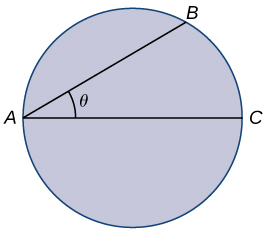
Find a function that measures the total amount of time it takes to reach the drowning person as a function of the swim angle,
Answer
4-329 §4.7 source ↗
For the following problems, consider a lifeguard at a circular pool with diameter He must reach someone who is drowning on the exact opposite side of the pool, at position The lifeguard swims with a speed and runs around the pool at speed
A truck uses gas as where represents the speed of the truck and represents the gallons of fuel per mile. Assuming and are positive, at what speed is fuel consumption minimized?
Answer
4-331 §4.7 source ↗
For the following exercises, consider a limousine that gets at speed the chauffeur costs and gas is
Find the cheapest driving speed.
Answer
4-333 §4.7 source ↗
For the following exercises, consider a pizzeria that sell pizzas for a revenue of and costs where represents the number of pizzas .
Assume that and How many pizzas sold maximizes the profit?
Answer
4-335 §4.7 source ↗
For the following exercises, consider a wire long cut into two pieces. One piece forms a circle with radius and the other forms a square of side
Choose to maximize the sum of their areas.
Answer
4-337 §4.7 source ↗
For the following exercises, consider two nonnegative numbers and such that Maximize and minimize the quantities.
Answer
4-339 §4.7 source ↗
For the following exercises, consider two nonnegative numbers and such that Maximize and minimize the quantities.
Answer
4-341 §4.7 source ↗
For the following exercises, draw the given optimization problem and solve.
Find the volume of the largest right circular cylinder that fits in a sphere of radius
Answer
4-343 §4.7 source ↗
For the following exercises, draw the given optimization problem and solve.
Find the area of the largest rectangle that fits into the triangle with sides and
Answer
4-345 §4.7 source ↗
For the following exercises, draw the given optimization problem and solve.
Find the dimensions of the closed cylinder volume that has the least amount of surface area.
Answer
4-347 §4.7 source ↗
For the following exercises, consider the points on the given graphs. Use a calculator to graph the functions.
[T] Where is the line closest to the origin?
Answer
4-349 §4.7 source ↗
For the following exercises, consider the points on the given graphs. Use a calculator to graph the functions.
[T] Where is the parabola closest to point
Answer
4-351 §4.7 source ↗
For the following exercises, write an equation that models each related-rates situation. Do not solve.
A window is composed of a semicircle placed on top of a rectangle. If you have of window-framing materials for the outer frame, what is the maximum size of the window you can create? Use to represent the radius of the semicircle.
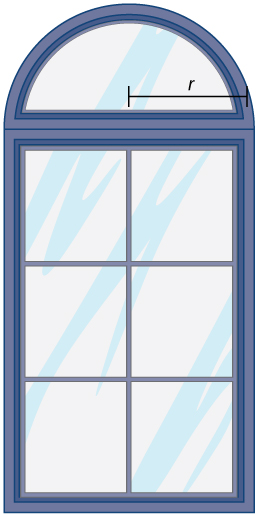
Answer
4-353 §4.7 source ↗
For the following exercises, write an equation that models each related-rates situation. Do not solve.
You are constructing a box for your cat to sleep in. The plush material for the square bottom of the box costs and the material for the sides costs You need a box with volume Find the dimensions of the box that minimize cost. Use to represent the length of the side of the box.
Answer
4-355 §4.7 source ↗
For the following exercises, write an equation that models each related-rates situation. Do not solve.
You are the manager of an apartment complex with units. When you set rent at all apartments are rented. As you increase rent by one fewer apartment is rented. Maintenance costs run for each occupied unit. What is the rent that maximizes the total amount of profit?
Answer
Checkpoint 4.37 §4.8 source ↗
Answer
Checkpoint 4.38 §4.8 source ↗
Answer
Checkpoint 4.39 §4.8 source ↗
Answer
Checkpoint 4.40 §4.8 source ↗
Answer
Checkpoint 4.41 §4.8 source ↗
Answer
Checkpoint 4.42 §4.8 source ↗
Answer
Checkpoint 4.43 §4.8 source ↗
Answer
Checkpoint 4.44 §4.8 source ↗
Answer
4-357 §4.8 source ↗
For the following exercises, evaluate the limit.
Evaluate the limit
Answer
4-359 §4.8 source ↗
For the following exercises, evaluate the limit.
Evaluate the limit .
Answer
4-361 §4.8 source ↗
For the following exercises, evaluate the limit.
Evaluate the limit .
Answer
4-363 §4.8 source ↗
For the following exercises, determine whether you can apply L’Hôpital’s rule directly. Explain why or why not. Then, indicate if there is some way you can alter the limit so you can apply L’Hôpital’s rule.
Answer
4-365 §4.8 source ↗
For the following exercises, determine whether you can apply L’Hôpital’s rule directly. Explain why or why not. Then, indicate if there is some way you can alter the limit so you can apply L’Hôpital’s rule.
Answer
4-367 §4.8 source ↗
For the following exercises, evaluate the limits with either L’Hôpital’s rule or previously learned methods.
Answer
4-369 §4.8 source ↗
For the following exercises, evaluate the limits with either L’Hôpital’s rule or previously learned methods.
Answer
4-371 §4.8 source ↗
For the following exercises, evaluate the limits with either L’Hôpital’s rule or previously learned methods.
Answer
4-373 §4.8 source ↗
For the following exercises, evaluate the limits with either L’Hôpital’s rule or previously learned methods.
Answer
4-375 §4.8 source ↗
For the following exercises, evaluate the limits with either L’Hôpital’s rule or previously learned methods.
Answer
4-377 §4.8 source ↗
For the following exercises, evaluate the limits with either L’Hôpital’s rule or previously learned methods.
Answer
4-379 §4.8 source ↗
For the following exercises, evaluate the limits with either L’Hôpital’s rule or previously learned methods.
Answer
4-381 §4.8 source ↗
For the following exercises, evaluate the limits with either L’Hôpital’s rule or previously learned methods.
Answer
4-383 §4.8 source ↗
For the following exercises, evaluate the limits with either L’Hôpital’s rule or previously learned methods.
Answer
4-385 §4.8 source ↗
For the following exercises, evaluate the limits with either L’Hôpital’s rule or previously learned methods.
Answer
4-387 §4.8 source ↗
For the following exercises, evaluate the limits with either L’Hôpital’s rule or previously learned methods.
Answer
4-389 §4.8 source ↗
For the following exercises, evaluate the limits with either L’Hôpital’s rule or previously learned methods.
Answer
4-391 §4.8 source ↗
For the following exercises, evaluate the limits with either L’Hôpital’s rule or previously learned methods.
Answer
4-393 §4.8 source ↗
For the following exercises, evaluate the limits with either L’Hôpital’s rule or previously learned methods.
Answer
4-395 §4.8 source ↗
For the following exercises, evaluate the limits with either L’Hôpital’s rule or previously learned methods.
Answer
4-397 §4.8 source ↗
For the following exercises, use a calculator to graph the function and estimate the value of the limit, then use L’Hôpital’s rule to find the limit directly.
[T]
Answer
4-399 §4.8 source ↗
For the following exercises, use a calculator to graph the function and estimate the value of the limit, then use L’Hôpital’s rule to find the limit directly.
[T]
Answer
4-401 §4.8 source ↗
For the following exercises, use a calculator to graph the function and estimate the value of the limit, then use L’Hôpital’s rule to find the limit directly.
[T]
Answer
4-403 §4.8 source ↗
For the following exercises, use a calculator to graph the function and estimate the value of the limit, then use L’Hôpital’s rule to find the limit directly.
[T]
Answer
4-405 §4.8 source ↗
For the following exercises, use a calculator to graph the function and estimate the value of the limit, then use L’Hôpital’s rule to find the limit directly.
[T]
Answer
Checkpoint 4.45 §4.9 source ↗
Answer
Checkpoint 4.46 §4.9 source ↗
Answer
Checkpoint 4.47 §4.9 source ↗
Answer
Checkpoint 4.48 §4.9 source ↗
Answer
4-407 §4.9 source ↗
For the following exercises, write Newton’s formula as for solving
Answer
4-409 §4.9 source ↗
For the following exercises, write Newton’s formula as for solving
Answer
4-411 §4.9 source ↗
For the following exercises, solve using the iteration which differs slightly from Newton’s method. Find a that works and a that fails to converge, with the exception of
with
Answer
4-413 §4.9 source ↗
For the following exercises, solve using the iteration which differs slightly from Newton’s method. Find a that works and a that fails to converge, with the exception of
What is the value of for Newton’s method?
Answer
4-415 §4.9 source ↗
For the following exercises, start at
a. and
b.
Compute and using the specified iterative method.
Answer
4-417 §4.9 source ↗
For the following exercises, start at
a. and
b.
Compute and using the specified iterative method.
Answer
4-419 §4.9 source ↗
For the following exercises, start at
a. and
b.
Compute and using the specified iterative method.
Answer
4-421 §4.9 source ↗
For the following exercises, start at
a. and
b.
Compute and using the specified iterative method.
Answer
4-423 §4.9 source ↗
For the following exercises, solve to four decimal places using Newton’s method and a computer or calculator. Choose any initial guess that is not the exact root.
Answer
4-425 §4.9 source ↗
For the following exercises, solve to four decimal places using Newton’s method and a computer or calculator. Choose any initial guess that is not the exact root.
Answer
4-427 §4.9 source ↗
For the following exercises, solve to four decimal places using Newton’s method and a computer or calculator. Choose any initial guess that is not the exact root.
choose
Answer
4-429 §4.9 source ↗
For the following exercises, solve to four decimal places using Newton’s method and a computer or calculator. Choose any initial guess that is not the exact root.
Answer
4-431 §4.9 source ↗
For the following exercises, solve to four decimal places using Newton’s method and a computer or calculator. Choose any initial guess that is not the exact root.
Answer
4-433 §4.9 source ↗
For the following exercises, use Newton’s method to find the fixed points of the function where round to three decimals.
on
Answer
4-435 §4.9 source ↗
For the following exercises, use Newton’s method to find the fixed points of the function where round to three decimals.
Answer
4-437 §4.9 source ↗
Newton’s method can be used to find maxima and minima of functions in addition to the roots. In this case apply Newton’s method to the derivative function to find its roots, instead of the original function. For the following exercises, consider the formulation of the method.
What additional restrictions are necessary on the function
Answer
4-439 §4.9 source ↗
For the following exercises, use Newton’s method to find the location of the local minima and/or maxima of the following functions; round to three decimals.
Minimum of
Answer
4-441 §4.9 source ↗
For the following exercises, use Newton’s method to find the location of the local minima and/or maxima of the following functions; round to three decimals.
Maximum of
Answer
4-443 §4.9 source ↗
For the following exercises, use Newton’s method to find the location of the local minima and/or maxima of the following functions; round to three decimals.
Maximum of
Answer
4-445 §4.9 source ↗
For the following exercises, use Newton’s method to find the location of the local minima and/or maxima of the following functions; round to three decimals.
Minimum of
Answer
4-447 §4.9 source ↗
For the following exercises, use the specified method to solve the equation. If it does not work, explain why it does not work.
Newton’s method,
Answer
4-449 §4.9 source ↗
For the following exercises, use the specified method to solve the equation. If it does not work, explain why it does not work.
Solving starting at
Answer
4-451 §4.9 source ↗
For the following exercises, use the secant method, an alternative iterative method to Newton’s method. The formula is given by
Find a root to accurate to four decimal places.
Answer
4-453 §4.9 source ↗
For the following exercises, use the secant method, an alternative iterative method to Newton’s method. The formula is given by
Find a root to accurate to four decimal places.
Answer
4-455 §4.9 source ↗
For the following exercises, use both Newton’s method and the secant method to calculate a root for the following equations. Use a calculator or computer to calculate how many iterations of each are needed to reach within three decimal places of the exact answer. For the secant method, use the first guess from Newton’s method.
Answer
4-457 §4.9 source ↗
For the following exercises, use both Newton’s method and the secant method to calculate a root for the following equations. Use a calculator or computer to calculate how many iterations of each are needed to reach within three decimal places of the exact answer. For the secant method, use the first guess from Newton’s method.
Answer
4-459 §4.9 source ↗
For the following exercises, use both Newton’s method and the secant method to calculate a root for the following equations. Use a calculator or computer to calculate how many iterations of each are needed to reach within three decimal places of the exact answer. For the secant method, use the first guess from Newton’s method.
Answer
4-461 §4.9 source ↗
In the following exercises, consider Kepler’s equation regarding planetary orbits, where is the mean anomaly, is eccentric anomaly, and measures eccentricity.
Use Newton’s method to solve for the eccentric anomaly when the mean anomaly and the eccentricity of the orbit round to three decimals.
Answer
4-463 §4.9 source ↗
The following two exercises consider a bank investment. The initial investment is After years, the investment has tripled to
Use Newton’s method to determine the interest rate if the interest was compounded continuously.
Answer
Checkpoint 4.49 §4.10 source ↗
Answer
Checkpoint 4.50 §4.10 source ↗
Answer
Checkpoint 4.51 §4.10 source ↗
Answer
Checkpoint 4.52 §4.10 source ↗
Answer
Checkpoint 4.53 §4.10 source ↗
Answer
4-465 §4.10 source ↗
For the following exercises, show that are antiderivatives of
Answer
4-467 §4.10 source ↗
For the following exercises, show that are antiderivatives of
Answer
4-469 §4.10 source ↗
For the following exercises, show that are antiderivatives of
Answer
4-471 §4.10 source ↗
For the following exercises, find the general form for the antiderivative of the function.
Answer
4-473 §4.10 source ↗
For the following exercises, find the general form for the antiderivative of the function.
Answer
4-475 §4.10 source ↗
For the following exercises, find the general form for the antiderivative of each function
Answer
4-477 §4.10 source ↗
For the following exercises, find the general form for the antiderivative of each function
Answer
4-479 §4.10 source ↗
For the following exercises, find the general form for the antiderivative of each function
Answer
4-481 §4.10 source ↗
For the following exercises, find the general form for the antiderivative of each function
Answer
4-483 §4.10 source ↗
For the following exercises, find the general form for the antiderivative of each function
Answer
4-485 §4.10 source ↗
For the following exercises, find the general form for the antiderivative of each function
Answer
4-487 §4.10 source ↗
For the following exercises, find the general form for the antiderivative of each function
Answer
4-489 §4.10 source ↗
For the following exercises, find the general form for the antiderivative of each function
Answer
4-491 §4.10 source ↗
For the following exercises, evaluate the integral.
Answer
4-493 §4.10 source ↗
For the following exercises, evaluate the integral.
Answer
4-495 §4.10 source ↗
For the following exercises, evaluate the integral.
Answer
4-497 §4.10 source ↗
For the following exercises, evaluate the integral.
Answer
4-499 §4.10 source ↗
For the following exercises, solve the initial value problem.
Answer
4-501 §4.10 source ↗
For the following exercises, solve the initial value problem.
Answer
4-503 §4.10 source ↗
For the following exercises, solve the initial value problem.
Answer
4-505 §4.10 source ↗
For the following exercises, find two possible functions given the second- or third-order derivatives.
Answer
4-507 §4.10 source ↗
For the following exercises, find two possible functions given the second- or third-order derivatives.
Answer
4-509 §4.10 source ↗
For the following exercises, find two possible functions given the second- or third-order derivatives.
A car is being driven at a rate of mph when the brakes are applied. The car decelerates at a constant rate of ft/sec2. How long before the car stops?
Answer
4-511 §4.10 source ↗
For the following exercises, find two possible functions given the second- or third-order derivatives.
You are merging onto the freeway, accelerating from rest at a constant rate of ft/sec2. How long does it take you to reach merging speed at mph?
Answer
4-513 §4.10 source ↗
For the following exercises, find two possible functions given the second- or third-order derivatives.
A car company wants to ensure its newest model can stop in sec when traveling at mph. If we assume constant deceleration, find the value of deceleration that accomplishes this.
Answer
4-515 §4.10 source ↗
For the following exercises, find the antiderivative of the function, assuming
[T]
Answer
4-517 §4.10 source ↗
For the following exercises, find the antiderivative of the function, assuming
[T]
Answer
4-519 §4.10 source ↗
For the following exercises, find the antiderivative of the function, assuming
[T]
Answer
4-521 §4.10 source ↗
For the following exercises, determine whether the statement is true or false. Either prove it is true or find a counterexample if it is false.
If is the antiderivative of then is the antiderivative of
Answer
4-523 §4.10 source ↗
For the following exercises, determine whether the statement is true or false. Either prove it is true or find a counterexample if it is false.
If is the antiderivative of then is the antiderivative of
Answer
4-525 §4.R source ↗
True or False? Justify your answer with a proof or a counterexample. Assume that is continuous and differentiable unless stated otherwise.
If and then there exists at least one point such that
Answer
4-527 §4.R source ↗
True or False? Justify your answer with a proof or a counterexample. Assume that is continuous and differentiable unless stated otherwise.
There is a function such that and (A graphical “proof” is acceptable for this answer.)
Answer
4-529 §4.R source ↗
True or False? Justify your answer with a proof or a counterexample. Assume that is continuous and differentiable unless stated otherwise.
Given the graph of determine where is increasing or decreasing.
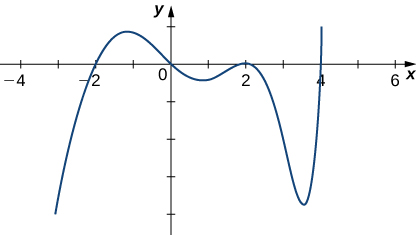
Answer
4-531 §4.R source ↗
True or False? Justify your answer with a proof or a counterexample. Assume that is continuous and differentiable unless stated otherwise.
Find the linear approximation to near
Answer
4-533 §4.R source ↗
Find the critical points and the local and absolute extrema of the following functions on the given interval.
over
Answer
4-535 §4.R source ↗
Determine over which intervals the following functions are increasing, decreasing, concave up, and concave down.
Answer
4-537 §4.R source ↗
Determine over which intervals the following functions are increasing, decreasing, concave up, and concave down.
Answer
4-539 §4.R source ↗
Evaluate the following limits.
Answer
4-541 §4.R source ↗
Evaluate the following limits.
Answer
4-543 §4.R source ↗
Use Newton’s method to find the first two iterations, given the starting point.
Answer
4-545 §4.R source ↗
Find the antiderivatives of the following functions.
Answer
4-547 §4.R source ↗
Graph the following functions by hand. Make sure to label the inflection points, critical points, zeros, and asymptotes.
Answer
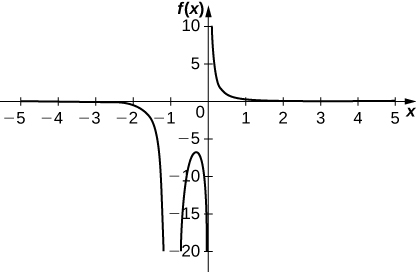
Inflection points: none; critical points: zeros: none; vertical asymptotes: horizontal asymptote:
4-549 §4.R source ↗
Graph the following functions by hand. Make sure to label the inflection points, critical points, zeros, and asymptotes.
A car is being compacted into a rectangular solid. The volume is decreasing at a rate of m3/sec. The length and width of the compactor are square, but the height is not the same length as the length and width. If the length and width walls move toward each other at a rate of m/sec, find the rate at which the height is changing when the length and width are m and the height is m.
Answer
4-551 §4.R source ↗
Graph the following functions by hand. Make sure to label the inflection points, critical points, zeros, and asymptotes.
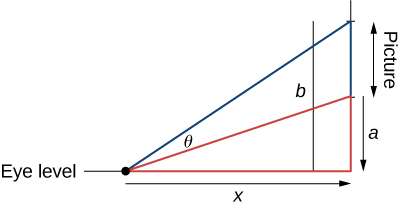
The famous Regiomontanus’ problem for angle maximization was proposed during the 15th century. A painting hangs on a wall with the bottom of the painting a distance feet above eye level, and the top feet above eye level. What distance (in feet) from the wall should the viewer stand to maximize the angle subtended by the painting,
Answer
Loading chapter 5…
Problems and answers are adapted from Calculus Volume 1 by Gilbert Strang and Edwin “Jed” Herman, OpenStax, and are used under the CC BY-NC-SA 4.0 licence. Access for free at https://openstax.org/books/calculus-volume-1/pages/1-introduction. Illustrations: Copyright Rice University, OpenStax, under CC BY-NC-SA 4.0 license. This adaptation is released under the same licence, is non-commercial, and is neither affiliated with nor endorsed by OpenStax or Rice University.