Every problem in the chapter beside the book’s answer, a chapter at a time as you scroll.
Chapter 4: Systems of ODEs
37 problems · 1 figureExercise 3.1.101 §3.1 source ↗
Find the general solution to , , .
Answer
, ,
Exercise 3.1.102 §3.1 source ↗
Solve , , , .
Answer
,
Exercise 3.1.103 §3.1 source ↗
Write as a first-order system.
Answer
, , , (here )
Exercise 3.1.104 §3.1 source ↗
Write , as a first-order system.
Answer
, , ,
Exercise 3.1.105 §3.1 source ↗
Suppose two masses on carts on frictionless surface are at displacements and as in Example 3.1.3. Suppose initial displacement is , and initial velocity is for some number . Use your intuition to solve the system, explain your reasoning.
Let us look at a second-order example. We return to the mass and spring setup, but this time we consider two masses.
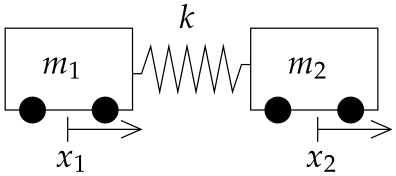
Consider one spring with constant and two masses and . Think of the masses as carts on a straight track with no friction. Let be the displacement of the first cart and be the displacement of the second cart. That is, we put the two carts somewhere with no tension on the spring, we mark the position of the first and second cart, and we call those the zero positions. Then measures how far the first cart is from its zero position, and measures how far the second cart is from its zero position. The force exerted by the spring on the first cart is as is how far the spring is stretched (or compressed) from the rest position. The force exerted on the second cart is the opposite, thus the same thing with a negative sign. Newton’s second law states that force equals mass times acceleration, that is,
Again, we cannot solve for the or variables one at a time. Where the first cart goes depends on exactly where the second cart goes and vice versa.
Answer
. Explanation of the intuition is left to reader.
Exercise 3.1.106 §3.1 source ↗
Suppose the tanks are as in Example 3.1.2 except that clean water flows in at a rate of liters per second into tank 1, and brine flows out of tank 2 and into the sewer also at a rate of liters per second. The rate of flow from tank 1 into tank 2 is still , but the rate of flow from tank 2 back into tank 1 is (assume ).
a) Draw the picture.
b) Set up the system of equations.
c) Intuitively, what happens as goes to infinity, explain.
First, we consider salt and brine tanks, but this time water flows from one to the other and back. Imagine we have two tanks, each containing volume liters of salt brine. The amount of salt in the first tank is grams, and the amount of salt in the second tank is grams. Let denote time—the independent variable. The liquid in each tank is being constantly and perfectly mixed and flows or is pumped at a rate of liters per second out of each tank into the other. See Figure 3.1.
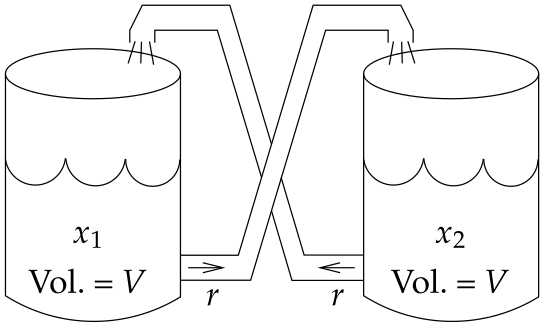
A closed system of two brine tanks.
The rate of change of , that is, , is the rate of salt entering minus the rate leaving. The density of the salt in tank 2 is , so the rate of salt entering tank 1 is times . The density of the salt in tank 1 is , so the rate of salt leaving tank 1 is times . In other words,
Similarly, to find the rate , the roles of and are reversed. All in all, the system of ODEs for this problem is
In this system, we cannot solve for or separately. We must solve for both and at once, which is intuitively clear—the amount of salt in one tank affects the amount in the other. We cannot know before we know , and vice versa.
We do not yet know how to find all the solutions, but intuitively we can at least find some solutions. Suppose we know that initially the tanks have the same amount of salt. That is, we have an initial condition such as . Then clearly the amount of salt entering and leaving each tank is the same, so the amounts are not changing. In other words, and (the constant functions) is a solution: , and , so the equations are satisfied.
Let us think about the setup a little bit more without solving it. Suppose the initial conditions are and , for two different constants and . Since no salt is coming in or out of this closed system, the total amount of salt is constant. That is, is constant, and so it equals . Intuitively, if , more salt will flow out of tank one than into it. After a long time, we then expect the amount of salt in each tank to equalize. In other words, the solutions of both and should tend towards as goes to . Once you know how to solve systems, you can check that this really is so.
A closed system of two brine tanks.
Answer
a) Left to reader. b) , . c) As goes to infinity, both and go to zero, explanation is left to reader.
Exercise 3.2.101 §3.2 source ↗
Compute determinant of
Answer
Exercise 3.2.102 §3.2 source ↗
Find such that is not invertible.
Answer
Exercise 3.2.103 §3.2 source ↗
Solve .
Answer
Exercise 3.2.104 §3.2 source ↗
Suppose are nonzero numbers. Let , .
a) Compute .
b) Compute .
Answer
a) b)
Exercise 3.3.101 §3.3 source ↗
Are and linearly independent? Justify.
Answer
Yes.
Exercise 3.3.102 §3.3 source ↗
Are , , and linearly independent? Justify.
Answer
No.
Exercise 3.3.103 §3.3 source ↗
Write , in matrix notation.
Answer
Exercise 3.3.104 §3.3 source ↗
a) Write , in matrix notation.
b) Solve and write the solution in matrix notation.
Answer
a) b)
Exercise 3.4.101 §3.4 source ↗
a) Compute eigenvalues and eigenvectors of .
b) Solve the system .
Answer
a) Eigenvalues: Eigenvectors: , ,
b)
Exercise 3.4.102 §3.4 source ↗
a) Compute eigenvalues and eigenvectors of .
b) Solve the system .
Answer
a) Eigenvalues: , Eigenvectors: ,
b)
Exercise 3.4.103 §3.4 source ↗
Solve , using the eigenvalue method.
Answer
Exercise 3.4.104 §3.4 source ↗
Solve , using the eigenvalue method.
Answer
Exercise 3.5.101 §3.5 source ↗
Describe the behavior of the following systems without solving:
a) , .
b) , .
c) , .
d) , .
e) , .
Answer
a) Two eigenvalues: so the behavior is a saddle. b) Two eigenvalues: and , so the behavior is a source. c) Two eigenvalues: , so the behavior is a center (ellipses). d) Two eigenvalues: and , so the behavior is a sink. e) Two eigenvalues: and , so the behavior is a saddle.
Exercise 3.5.102 §3.5 source ↗
Suppose that where is a 2 by 2 matrix with eigenvalues . Describe the behavior.
Answer
Spiral source.
Exercise 3.5.103 §3.5 source ↗
Take . Draw the vector field and describe the behavior. Is it one of the behaviors that we have seen before?
Answer (2 parts)
The solution does not move anywhere if . When is positive, the solution moves (with constant speed) in the positive direction. When is negative, the solution moves (with constant speed) in the negative direction. It is not one of the behaviors we saw.
Note that the matrix has a double eigenvalue 0 and the general solution is and , which agrees with the description above.
Exercise 3.6.101 §3.6 source ↗
Find the general solution to .
Answer
Exercise 3.6.102 §3.6 source ↗
Suppose there are three carts of equal mass and connected by two springs of constant (and no connections to walls). Set up the system and find its general solution.
Answer
. Solution:
Exercise 3.6.103 §3.6 source ↗
Suppose a cart of mass is attached by a spring of constant to a cart of mass , which is attached to the wall by a spring also of constant . Suppose that the initial position of the first cart is 1 meter in the positive direction from the rest position, and the second cart starts at the rest position. The carts are not moving and are let go. Find the position of the second cart as a function of time.
Answer
Exercise 3.7.101 §3.7 source ↗
Let .
a) What are the eigenvalues?
b) What is/are the defect(s) of the eigenvalue(s)?
c) Find the general solution of .
Answer
a) b) No defects. c)
Exercise 3.7.102 §3.7 source ↗
Let .
a) What are the eigenvalues?
b) What is/are the defect(s) of the eigenvalue(s)?
c) Find the general solution of .
Answer
a)
b) Eigenvalue 1 has a defect of 1
c)
Exercise 3.7.103 §3.7 source ↗
Let .
a) What are the eigenvalues?
b) What is/are the defect(s) of the eigenvalue(s)?
c) Find the general solution of .
Answer
a)
b) Eigenvalue 2 has a defect of 2
c)
Exercise 3.7.104 §3.7 source ↗
Let , where , , and are unknowns. Suppose that is a doubled eigenvalue of defect 1, and suppose that is a corresponding eigenvector. Find and show that there is only one such matrix .
Answer
Exercise 3.8.101 §3.8 source ↗
Compute where .
Answer
Exercise 3.8.102 §3.8 source ↗
Compute where .
Answer
Exercise 3.8.103 §3.8 source ↗
a) Compute where .
b) Solve for .
Answer
a) b)
Exercise 3.8.104 §3.8 source ↗
Compute the first 3 terms (up to the second degree) of the Taylor expansion of where . Write it as a single matrix. Then use it to approximate .
Answer
Exercise 3.8.105 §3.8 source ↗
For any positive integer , find a formula (or a recipe) for for the following matrices:
a)
b)
c)
Answer
a) b)
c) if is even, and if is odd.
Exercise 3.9.101 §3.9 source ↗
Find a particular solution to ,
a) using integrating factor method,
b) using eigenvector decomposition,
c) using undetermined coefficients.
Answer
The general solution is (particular solutions should agree with one of these):
,
Exercise 3.9.102 §3.9 source ↗
Find a particular solution to ,
a) using integrating factor method,
b) using eigenvector decomposition,
c) using undetermined coefficients.
Answer
The general solution is (particular solutions should agree with one of these):
,
Exercise 3.9.103 §3.9 source ↗
Solve , with initial conditions , using eigenvector decomposition.
Answer
Exercise 3.9.104 §3.9 source ↗
Solve , with initial conditions , , , using eigenvector decomposition.
Answer
Loading chapter 5…
Exercises and answers are adapted from Notes on Diffy Qs: Differential Equations for Engineers by Jiří Lebl, which is free to read and download, and are used under the CC BY-NC-SA 4.0 licence. They are taken from the book’s LaTeX source and set for the web, so they may differ slightly from the printed page. This adaptation is released under the same licence and is neither affiliated with nor endorsed by Lebl or Jiří Lebl.