Every problem in the chapter beside the book’s answer, a chapter at a time as you scroll.
Chapter 8: Unemployment
7 problems · 1 figure8-1 §8.1 source ↗
Answer
The population is divided into those “in the labor force” and those “not in the labor force.” Thus, the number of adults not in the labor force is 237.8 – 153.9 = 83.9 million. Since the labor force is divided into employed persons and unemployed persons, the number of unemployed persons is 153.9 – 139.1 = 14.8 million. Thus, the adult population has the following proportions:
• 139.1/237.8 = 58.5% employed persons
• 14.8/237.8 = 6.2% unemployed persons
• 83.9/237.8 = 35.3% persons out of the labor force
8-2 §8.1 source ↗
Answer
8-3 §8.2 source ↗
Answer
8-4 §8.2 source ↗
Whose unemployment rates are commonly higher in the U.S. economy:
a. White or non-White people?
b. The young or the middle-aged?
c. College graduates or high school graduates?
Answer
a. Non-White people
b. The young
c. High school graduates
8-5 §8.3 source ↗
Answer
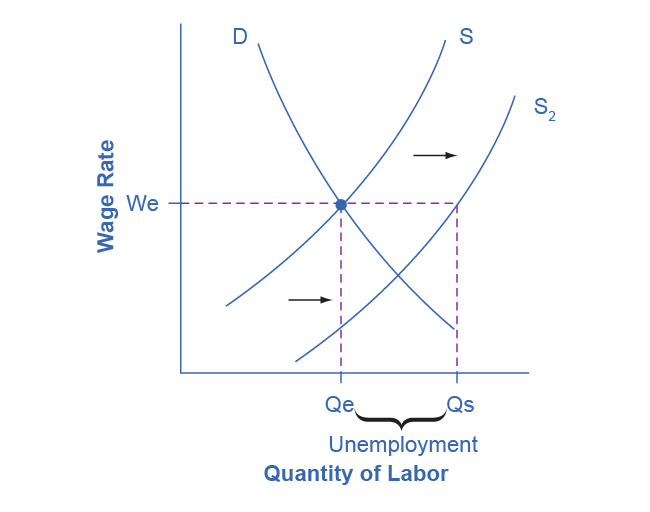
Because of the influx of women into the labor market, the supply of labor shifts to the right. Since wages are sticky downward, the increased supply of labor causes an increase in people looking for jobs (Qs), but no change in the number of jobs available (Qe). As a result, unemployment increases by the amount of the increase in the labor supply. This can be seen in the following figure.
Over time, as labor demand grows, the unemployment will decline and eventually wages will begin to increase again. But this increase in labor demand goes beyond the scope of this problem.
8-6 §8.4 source ↗
Answer
8-7 §8.4 source ↗
Answer
Loading chapter 9…
Problems and answers are adapted from Principles of Macroeconomics 3e by Steven A. Greenlaw, David Shapiro and Daniel MacDonald, OpenStax, and are used under the CC BY-NC-SA 4.0 licence. Access for free at https://openstax.org/books/principles-macroeconomics-3e/pages/1-introduction. Illustrations: Copyright Rice University, OpenStax, under CC BY-NC-SA 4.0 license. This adaptation is released under the same licence, is non-commercial, and is neither affiliated with nor endorsed by OpenStax or Rice University.