Every problem in the chapter beside the book’s answer, a chapter at a time as you scroll.

Chapter 11: Monopoly and Antitrust Policy

10 problems · 1 figure

11-1 §11.1 source ↗

Is it true that a merger between two firms that are not already in the top four by size can affect both the four-firm concentration ratio and the Herfindahl-Hirschman Index? Explain briefly.

Answer

Yes, it is true. The HHI example is easy enough: since the market shares of all firms are included in the HHI calculation, a merger between two of the firms will change the HHI. For the four-firm concentration ratio, it is quite possible that a merger between, say, the fifth and sixth largest firms in the market could create a new firm that is then ranked in the top four in the market. In this case, a merger of two firms, neither in the top four, would still change the four-firm concentration ratio.

11-2 §11.1 source ↗

Is it true that the four-firm concentration ratio puts more emphasis on one or two very large firms, while the Herfindahl-Hirschman Index puts more emphasis on all the firms in the entire market? Explain briefly.

Answer

No, it is not true. The HHI includes the market shares of all firms in its calculation, but the squaring of the market shares has the effect of making the impact of the largest firms relatively bigger than in the 4-firm or 8-firm ratio.

11-3 §11.1 source ↗

Some years ago, two intercity bus companies, Greyhound Lines, Inc. and Trailways Transportation System, wanted to merge. One possible definition of the market in this case was “the market for intercity bus service.” Another possible definition was “the market for intercity transportation, including personal cars, car rentals, passenger trains, and commuter air flights.” Which definition do you think the bus companies preferred, and why?

Answer

The bus companies wanted the broader market definition (i.e., the second definition). If the narrow definition had been used, the combined bus companies would have had a near-monopoly on the market for intercity bus service. But they had only a sliver of the market for intercity transportation when everything else was included. The merger was allowed.

11-4 §11.1 source ↗

As a result of globalization and new information and communications technology, would you expect that the definitions of markets that antitrust authorities use will become broader or narrower?

Answer

The common expectation is that the definition of markets will become broader because of greater competition from faraway places. However, this broadening doesn’t necessarily mean that antitrust authorities can relax. There is also a fear that companies with a local or national monopoly may use the new opportunities to extend their reach across national borders, and that it will be difficult for national authorities to respond.

11-5 §11.2 source ↗

Why would a firm choose to use one or more of the anticompetitive practices described in Regulating Anticompetitive Behavior?

Answer

Because outright collusion to raise profits is illegal and because existing regulations include gray areas which firms may be able to exploit.

11-6 §11.3 source ↗

Urban transit systems, especially those with rail systems, typically experience significant economies of scale in operation. Consider the transit system data in Table 11.4. Note that the quantity is in millions of riders.

Draw the demand, marginal revenue, marginal cost, and average cost curves. Do they have the normal shapes?

Table 11.4 in the book ↗
Demand: Quantity 1 2 3 4 5 6 7 8 9 10
Price 10 9 8 7 6 5 4 3 2 1
Marginal Revenue 10 8 6 4 2 0 –2 –4 –6 –8
Costs: Marginal Cost 9 6 5 3 2 3 4 5 7 10
Average Cost 9 7.5 6.7 5.8 5 4.7 4.6 4.6 4.9 5.4

Answer

Yes, all curves have normal shapes.
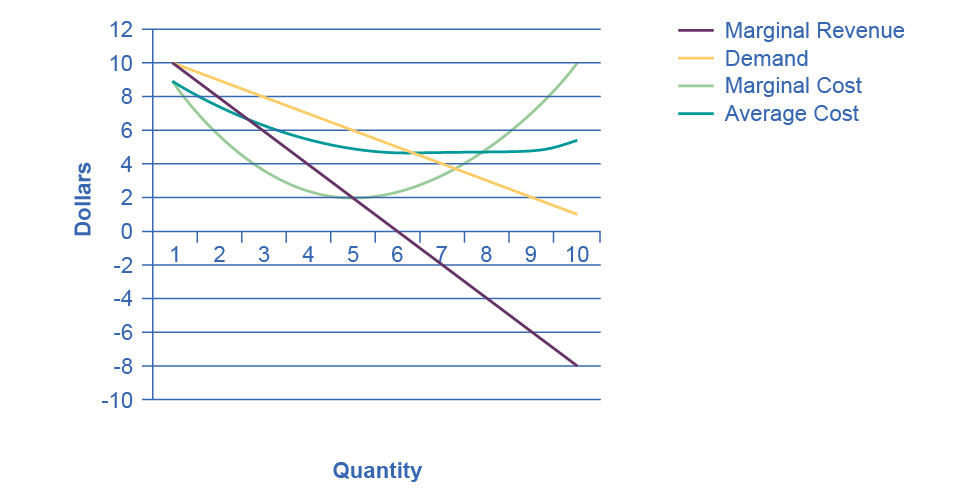
The graph shows a steep downward sloping marginal revenue curve, a downward sloping demand curve, a u-shaped marginal cost curve, and a shallow u-shaped average cost curve

11-7 §11.3 source ↗

From the graph you drew to answer Exercise 11.6, would you say this transit system is a natural monopoly? Justify.

Answer

Yes it is a natural monopoly because average costs decline over the range that satisfies the market demand. For example, at the point where the demand curve and the average cost curve meet, there are economies of scale.

11-8 §11.4 source ↗

Use the following information to answer the next three questions. In the years before wireless phones, when telephone technology required having a wire running to every home, it seemed plausible that telephone service had diminishing average costs and might require regulation like a natural monopoly. For most of the twentieth century, the national U.S. phone company was AT&T, and the company functioned as a regulated monopoly. Think about the deregulation of the U.S. telecommunications industry that has occurred over the last few decades. (This is not a research assignment, but a thought assignment based on what you have learned in this chapter.)

What real-world changes made the deregulation possible?

Answer

Improvements in technology that allowed phone calls to be made via microwave transmission, communications satellites, and other wireless technologies.

11-9 §11.4 source ↗

Use the following information to answer the next three questions. In the years before wireless phones, when telephone technology required having a wire running to every home, it seemed plausible that telephone service had diminishing average costs and might require regulation like a natural monopoly. For most of the twentieth century, the national U.S. phone company was AT&T, and the company functioned as a regulated monopoly. Think about the deregulation of the U.S. telecommunications industry that has occurred over the last few decades. (This is not a research assignment, but a thought assignment based on what you have learned in this chapter.)

What are some of the benefits of the deregulation?

Answer

More consumer choice. Cheaper phone calls, especially long distance. Better-quality phone service in many cases. Cheaper, faster, and better-quality data transmission. Spin-off technologies like free Internet-based calling and video calling.

11-10 §11.4 source ↗

Use the following information to answer the next three questions. In the years before wireless phones, when telephone technology required having a wire running to every home, it seemed plausible that telephone service had diminishing average costs and might require regulation like a natural monopoly. For most of the twentieth century, the national U.S. phone company was AT&T, and the company functioned as a regulated monopoly. Think about the deregulation of the U.S. telecommunications industry that has occurred over the last few decades. (This is not a research assignment, but a thought assignment based on what you have learned in this chapter.)

What might some of the negatives of deregulation be?

Answer

More choice can sometimes make for difficult decisions—not knowing if you got the best plan for your situation, for example. Some phone service providers are less reliable than AT&T used to be.

Loading chapter 12…

Problems and answers are adapted from Principles of Microeconomics 3e by Steven A. Greenlaw, David Shapiro and Daniel MacDonald, OpenStax, and are used under the CC BY-NC-SA 4.0 licence. Access for free at https://openstax.org/books/principles-microeconomics-3e/pages/1-introduction. Illustrations: Copyright Rice University, OpenStax, under CC BY-NC-SA 4.0 license. This adaptation is released under the same licence, is non-commercial, and is neither affiliated with nor endorsed by OpenStax or Rice University.