Every problem in the chapter beside the book’s answer, a chapter at a time as you scroll.
Chapter 19: International Trade
7 problems · 1 figure19-1 §19.1 source ↗
Answer
19-2 §19.1 source ↗
Answer
19-3 §19.1 source ↗
Answer
In answering questions like these, it is often helpful to begin by organizing the information in a table, such as in the following table. Notice that, in this case, the productivity of the countries is expressed in terms of how many workers it takes to produce a unit of a product.
| Country | One Sweater | One Bottle of wine |
|---|---|---|
| France | 1 worker | 1 worker |
| Tunisia | 2 workers | 3 workers |
In this example, France has an absolute advantage in the production of both sweaters and wine. You can tell because it takes France less labor to produce a unit of the good.
19-4 §19.2 source ↗
In Germany it takes three workers to make one television and four workers to make one video camera. In Poland it takes six workers to make one television and 12 workers to make one video camera.
a. Who has the absolute advantage in the production of televisions? Who has the absolute advantage in the production of video cameras? How can you tell?
b. Calculate the opportunity cost of producing one additional television set in Germany and in Poland. (Your calculation may involve fractions, which is fine.) Which country has a comparative advantage in the production of televisions?
c. Calculate the opportunity cost of producing one video camera in Germany and in Poland. Which country has a comparative advantage in the production of video cameras?
d. In this example, is absolute advantage the same as comparative advantage, or not?
e. In what product should Germany specialize? In what product should Poland specialize?
Answer
a. In Germany, it takes fewer workers to make either a television or a video camera. Germany has an absolute advantage in the production of both goods.
b. Producing an additional television in Germany requires three workers. Shifting those three German workers will reduce video camera production by 3/4 of a camera. Producing an additional television set in Poland requires six workers, and shifting those workers from the other good reduces output of video cameras by 6/12 of a camera, or 1/2. Thus, the opportunity cost of producing televisions is lower in Poland, so Poland has the comparative advantage in the production of televisions. Note: Do not let the fractions like 3/4 of a camera or 1/2 of a video camera bother you. If either country was to expand television production by a significant amount—that is, lots more than one unit—then we will be talking about whole cameras and not fractional ones. You can also spot this conclusion by noticing that Poland’s absolute disadvantage is relatively lower in televisions, because Poland needs twice as many workers to produce a television but three times as many to produce a video camera, so the product with the relatively lower absolute disadvantage is Poland’s comparative advantage.
c. Producing a video camera in Germany requires four workers, and shifting those four workers away from television production has an opportunity cost of 4/3 television sets. Producing a video camera in Poland requires 12 workers, and shifting those 12 workers away from television production has an opportunity cost of two television sets. Thus, the opportunity cost of producing video cameras is lower in Germany, and video cameras will be Germany’s comparative advantage.
d. In this example, absolute advantage differs from comparative advantage. Germany has the absolute advantage in the production of both goods, but Poland has a comparative advantage in the production of televisions.
e. Germany should specialize, at least to some extent, in the production of video cameras, export video cameras, and import televisions. Conversely, Poland should specialize, at least to some extent, in the production of televisions, export televisions, and import video cameras.
19-5 §19.3 source ↗
Answer
19-6 §19.3 source ↗
Table 19.15 shows how the average costs of production for semiconductors (the “chips” in computer memories) change as the quantity of semiconductors built at that factory increases.
a. Based on these data, sketch a curve with quantity produced on the horizontal axis and average cost of production on the vertical axis. How does the curve illustrate economies of scale?
b. If the equilibrium quantity of semiconductors demanded is 90,000, can this economy take full advantage of economies of scale? What about if quantity demanded is 70,000 semiconductors? 50,000 semiconductors? 30,000 semiconductors?
c. Explain how international trade could make it possible for even a small economy to take full advantage of economies of scale, while also benefiting from competition and the variety offered by several producers.
| Quantity of Semiconductors | Average Total Cost |
|---|---|
| 10,000 | $8 each |
| 20,000 | $5 each |
| 30,000 | $3 each |
| 40,000 | $2 each |
| 100,000 | $2 each |
Answer
a. Start by plotting the points on a sketch diagram and then drawing a line through them. The following figure illustrates the average costs of production of semiconductors. 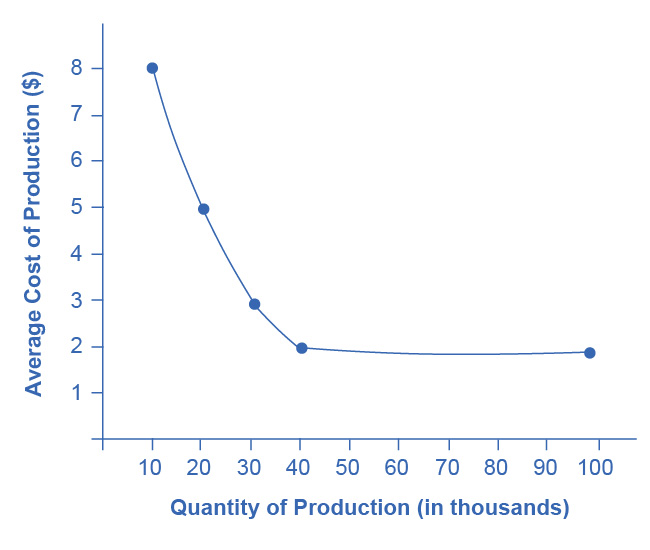
b. At any quantity demanded above 40,000, this economy can take full advantage of economies of scale; that is, it can produce at the lowest cost per unit. Indeed, if the quantity demanded was quite high, like 500,000, then there could be a number of different factories all taking full advantage of economies of scale and competing with each other. If the quantity demanded falls below 40,000, then the economy by itself, without foreign trade, cannot take full advantage of economies of scale.
c. The simplest answer to this question is that the small country could have a large enough factory to take full advantage of economies of scale, but then export most of the output. For semiconductors, countries like Taiwan and Korea have recently fit this description. Moreover, this country could also import semiconductors from other countries which also have large factories, thus getting the benefits of competition and variety. A slightly more complex answer is that the country can get these benefits of economies of scale without producing semiconductors, but simply by buying semiconductors made at low cost around the world. An economy, especially a smaller country, may well end up specializing and producing a few items on a large scale, but then trading those items for other items produced on a large scale, and thus gaining the benefits of economies of scale by trade, as well as by direct production.
19-7 §19.4 source ↗
Answer
Loading chapter 20…
Problems and answers are adapted from Principles of Microeconomics 3e by Steven A. Greenlaw, David Shapiro and Daniel MacDonald, OpenStax, and are used under the CC BY-NC-SA 4.0 licence. Access for free at https://openstax.org/books/principles-microeconomics-3e/pages/1-introduction. Illustrations: Copyright Rice University, OpenStax, under CC BY-NC-SA 4.0 license. This adaptation is released under the same licence, is non-commercial, and is neither affiliated with nor endorsed by OpenStax or Rice University.