Every problem in the chapter beside the book’s answer, a chapter at a time as you scroll.
Chapter 9: Sequences, Probability, and Counting Theory
318 problems · 21 figuresTry It #1 §9.1 source ↗
Answer
Try It #2 §9.1 source ↗
Write the first five terms of the sequence.
Answer
Try It #3 §9.1 source ↗
Write the first six terms of the sequence.
Answer
Try It #4 §9.1 source ↗
Write an explicit formula for the term of the sequence.
Answer
Try It #5 §9.1 source ↗
Write an explicit formula for the term of the sequence.
Answer
Try It #6 §9.1 source ↗
Write an explicit formula for the term of the sequence.
Answer
Try It #7 §9.1 source ↗
Write the first five terms of the sequence defined by the recursive formula.
Answer
Try It #8 §9.1 source ↗
Write the first 8 terms of the sequence defined by the recursive formula.
Answer
Try It #9 §9.1 source ↗
Answer
9.1-1 §9.1 source ↗
Answer
9.1-3 §9.1 source ↗
Answer
9.1-5 §9.1 source ↗
Answer
9.1-7 §9.1 source ↗
For the following exercises, write the first four terms of the sequence.
Answer
9.1-9 §9.1 source ↗
For the following exercises, write the first four terms of the sequence.
Answer
9.1-11 §9.1 source ↗
For the following exercises, write the first four terms of the sequence.
Answer
9.1-13 §9.1 source ↗
For the following exercises, write the first four terms of the sequence.
Answer
9.1-15 §9.1 source ↗
For the following exercises, write the first four terms of the sequence.
Answer
9.1-17 §9.1 source ↗
For the following exercises, write the first eight terms of the piecewise sequence.
Answer
9.1-19 §9.1 source ↗
For the following exercises, write the first eight terms of the piecewise sequence.
Answer
9.1-21 §9.1 source ↗
For the following exercises, write an explicit formula for each sequence.
Answer
9.1-23 §9.1 source ↗
For the following exercises, write an explicit formula for each sequence.
Answer
9.1-25 §9.1 source ↗
For the following exercises, write an explicit formula for each sequence.
Answer
9.1-27 §9.1 source ↗
For the following exercises, write the first five terms of the sequence.
Answer
9.1-29 §9.1 source ↗
For the following exercises, write the first five terms of the sequence.
Answer
9.1-31 §9.1 source ↗
For the following exercises, write the first eight terms of the sequence.
Answer
9.1-33 §9.1 source ↗
For the following exercises, write the first eight terms of the sequence.
Answer
9.1-35 §9.1 source ↗
For the following exercises, write a recursive formula for each sequence.
Answer
9.1-37 §9.1 source ↗
For the following exercises, write a recursive formula for each sequence.
Answer
9.1-39 §9.1 source ↗
For the following exercises, evaluate the factorial.
Answer
9.1-41 §9.1 source ↗
For the following exercises, evaluate the factorial.
Answer
9.1-43 §9.1 source ↗
For the following exercises, write the first four terms of the sequence.
Answer
9.1-45 §9.1 source ↗
For the following exercises, write the first four terms of the sequence.
Answer
9.1-47 §9.1 source ↗
For the following exercises, graph the first five terms of the indicated sequence
Answer
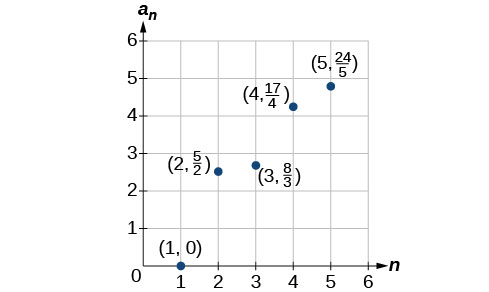
9.1-49 §9.1 source ↗
For the following exercises, graph the first five terms of the indicated sequence
Answer
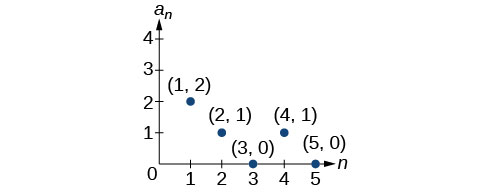
9.1-51 §9.1 source ↗
For the following exercises, graph the first five terms of the indicated sequence
Answer
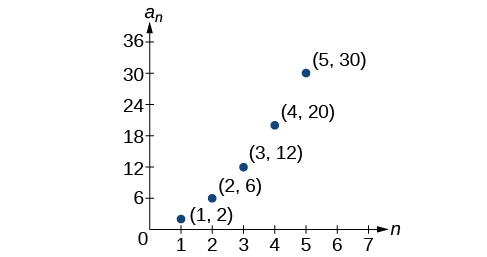
9.1-53 §9.1 source ↗
For the following exercises, write an explicit formula for the sequence using the first five points shown on the graph.
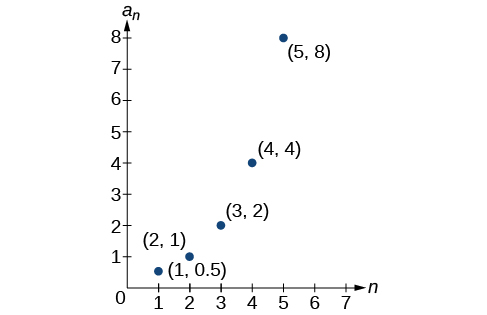
Answer
9.1-55 §9.1 source ↗
For the following exercises, write a recursive formula for the sequence using the first five points shown on the graph.
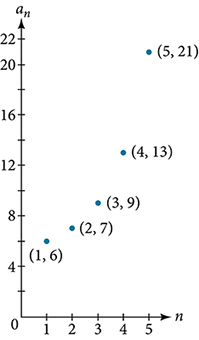
Answer
9.1-57 §9.1 source ↗
Follow these steps to evaluate a sequence defined recursively using a graphing calculator:
For the following exercises, use the steps above to find the indicated term or terms for the sequence.
Find the first five terms of the sequence , Use the >Frac feature to give fractional results.
Answer
9.1-59 §9.1 source ↗
Follow these steps to evaluate a sequence defined recursively using a graphing calculator:
For the following exercises, use the steps above to find the indicated term or terms for the sequence.
Find the first five terms of the sequence ,
Answer
9.1-61 §9.1 source ↗
Follow these steps to evaluate a sequence defined recursively using a graphing calculator:
For the following exercises, use the steps above to find the indicated term or terms for the sequence.
Find the tenth term of the sequence ,
Answer
9.1-63 §9.1 source ↗
Follow these steps to evaluate a finite sequence defined by an explicit formula. Using a TI-84, do the following.
Using a TI-83, do the following.
For the following exercises, use the steps above to find the indicated terms for the sequence. Round to the nearest thousandth when necessary.
List the first six terms of the sequence
Answer
9.1-65 §9.1 source ↗
Follow these steps to evaluate a finite sequence defined by an explicit formula. Using a TI-84, do the following.
Using a TI-83, do the following.
For the following exercises, use the steps above to find the indicated terms for the sequence. Round to the nearest thousandth when necessary.
List the first four terms of the sequence
Answer
9.1-67 §9.1 source ↗
Follow these steps to evaluate a finite sequence defined by an explicit formula. Using a TI-84, do the following.
Using a TI-83, do the following.
For the following exercises, use the steps above to find the indicated terms for the sequence. Round to the nearest thousandth when necessary.
Consider the sequence defined by Is a term in the sequence? Verify the result.
Answer
9.1-69 §9.1 source ↗
Follow these steps to evaluate a finite sequence defined by an explicit formula. Using a TI-84, do the following.
Using a TI-83, do the following.
For the following exercises, use the steps above to find the indicated terms for the sequence. Round to the nearest thousandth when necessary.
Find a recursive formula for the sequence 1, 0, −1, −1, 0, 1, 1, 0, −1, −1, 0, 1, 1, .... (Hint: find a pattern for based on the first two terms.)
Answer
9.1-71 §9.1 source ↗
Follow these steps to evaluate a finite sequence defined by an explicit formula. Using a TI-84, do the following.
Using a TI-83, do the following.
For the following exercises, use the steps above to find the indicated terms for the sequence. Round to the nearest thousandth when necessary.
Prove the conjecture made in the preceding exercise.
Answer
Try It #1 §9.2 source ↗
Is the given sequence arithmetic? If so, find the common difference.
Answer
Try It #2 §9.2 source ↗
Is the given sequence arithmetic? If so, find the common difference.
Answer
Try It #3 §9.2 source ↗
Answer
Try It #4 §9.2 source ↗
Answer
Try It #5 §9.2 source ↗
Write a recursive formula for the arithmetic sequence.
Answer
Try It #6 §9.2 source ↗
Write an explicit formula for the following arithmetic sequence.
Answer
Try It #7 §9.2 source ↗
Find the number of terms in the finite arithmetic sequence.
Answer
Try It #8 §9.2 source ↗
Answer
9.2-1 §9.2 source ↗
Answer
9.2-3 §9.2 source ↗
Answer
9.2-5 §9.2 source ↗
Answer
9.2-7 §9.2 source ↗
For the following exercises, find the common difference for the arithmetic sequence provided.
Answer
9.2-9 §9.2 source ↗
For the following exercises, determine whether the sequence is arithmetic. If so find the common difference.
Answer
9.2-11 §9.2 source ↗
For the following exercises, write the first five terms of the arithmetic sequence given the first term and common difference.
,
Answer
9.2-13 §9.2 source ↗
For the following exercises, write the first five terms of the arithmetic series given two terms.
Answer
9.2-15 §9.2 source ↗
For the following exercises, find the specified term for the arithmetic sequence given the first term and common difference.
First term is 4, common difference is 5, find the 4th term.
Answer
9.2-17 §9.2 source ↗
For the following exercises, find the specified term for the arithmetic sequence given the first term and common difference.
First term is 6, common difference is 7, find the 6th term.
Answer
9.2-19 §9.2 source ↗
For the following exercises, find the first term given two terms from an arithmetic sequence.
Find the first term or of an arithmetic sequence if and
Answer
9.2-21 §9.2 source ↗
For the following exercises, find the first term given two terms from an arithmetic sequence.
Find the first term or of an arithmetic sequence if and
Answer
9.2-23 §9.2 source ↗
For the following exercises, find the first term given two terms from an arithmetic sequence.
Find the first term or of an arithmetic sequence if and
Answer
9.2-25 §9.2 source ↗
For the following exercises, find the specified term given two terms from an arithmetic sequence.
and Find
Answer
9.2-27 §9.2 source ↗
For the following exercises, use the recursive formula to write the first five terms of the arithmetic sequence.
Answer
9.2-29 §9.2 source ↗
For the following exercises, write a recursive formula for each arithmetic sequence.
Answer
9.2-31 §9.2 source ↗
For the following exercises, write a recursive formula for each arithmetic sequence.
Answer
9.2-33 §9.2 source ↗
For the following exercises, write a recursive formula for each arithmetic sequence.
Answer
9.2-35 §9.2 source ↗
For the following exercises, write a recursive formula for each arithmetic sequence.
Answer
9.2-37 §9.2 source ↗
For the following exercises, write a recursive formula for each arithmetic sequence.
Answer
9.2-39 §9.2 source ↗
For the following exercises, write a recursive formula for the given arithmetic sequence, and then find the specified term.
Find the 14th term.
Answer
9.2-41 §9.2 source ↗
For the following exercises, use the explicit formula to write the first five terms of the arithmetic sequence.
Answer
9.2-43 §9.2 source ↗
For the following exercises, write an explicit formula for each arithmetic sequence.
Answer
9.2-45 §9.2 source ↗
For the following exercises, write an explicit formula for each arithmetic sequence.
Answer
9.2-47 §9.2 source ↗
For the following exercises, write an explicit formula for each arithmetic sequence.
Answer
9.2-49 §9.2 source ↗
For the following exercises, write an explicit formula for each arithmetic sequence.
Answer
9.2-51 §9.2 source ↗
For the following exercises, write an explicit formula for each arithmetic sequence.
Answer
9.2-53 §9.2 source ↗
For the following exercises, find the number of terms in the given finite arithmetic sequence.
Answer
9.2-55 §9.2 source ↗
For the following exercises, find the number of terms in the given finite arithmetic sequence.
Answer
9.2-57 §9.2 source ↗
For the following exercises, determine whether the graph shown represents an arithmetic sequence.
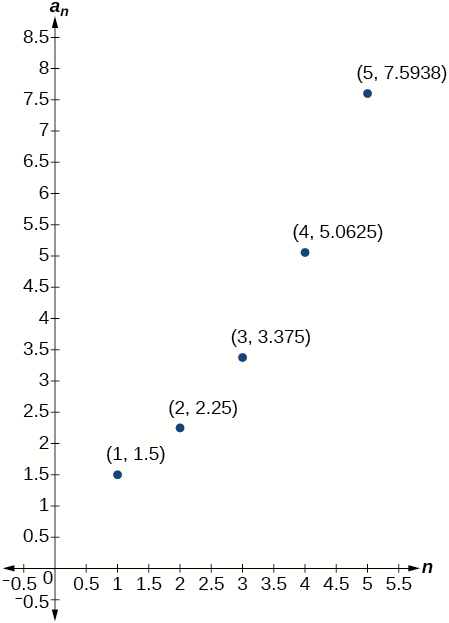
Answer
9.2-59 §9.2 source ↗
For the following exercises, use the information provided to graph the first 5 terms of the arithmetic sequence.
Answer
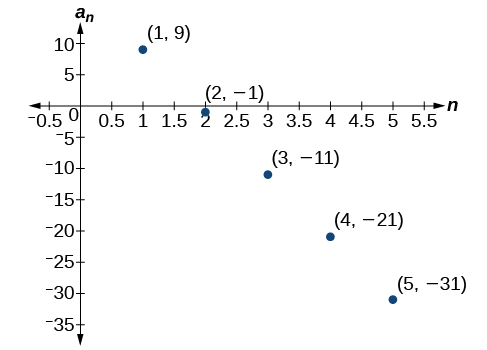
9.2-61 §9.2 source ↗
For the following exercises, follow the steps to work with the arithmetic sequence using a graphing calculator:
What are the first seven terms shown in the column with the heading
Answer
9.2-63 §9.2 source ↗
For the following exercises, follow the steps to work with the arithmetic sequence using a graphing calculator:
Press [WINDOW]. Set , , , , , and Then press [GRAPH]. Graph the sequence as it appears on the graphing calculator.
Answer
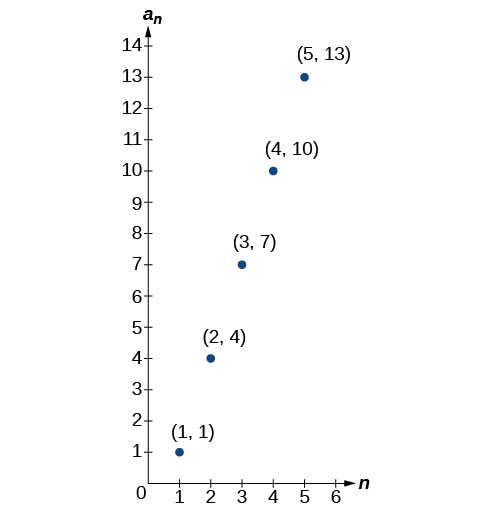
9.2-65 §9.2 source ↗
For the following exercises, follow the steps given above to work with the arithmetic sequence using a graphing calculator.
Graph the sequence as it appears on the graphing calculator. Be sure to adjust the WINDOW settings as needed.
Answer
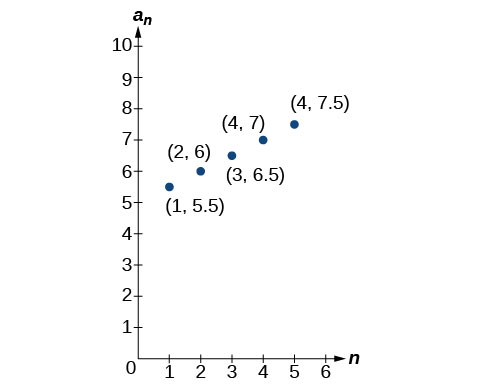
9.2-67 §9.2 source ↗
For the following exercises, follow the steps given above to work with the arithmetic sequence using a graphing calculator.
Give two examples of arithmetic sequences whose 10th terms are
Answer
9.2-69 §9.2 source ↗
For the following exercises, follow the steps given above to work with the arithmetic sequence using a graphing calculator.
Find the 11th term of the arithmetic sequence
Answer
9.2-71 §9.2 source ↗
For the following exercises, follow the steps given above to work with the arithmetic sequence using a graphing calculator.
At which term does the sequence begin to have negative values?
Answer
9.2-73 §9.2 source ↗
For the following exercises, follow the steps given above to work with the arithmetic sequence using a graphing calculator.
Write an arithmetic sequence using a recursive formula. Show the first 4 terms, and then find the 31st term.
Answer
Try It #1 §9.3 source ↗
Is the sequence geometric? If so, find the common ratio.
Answer
Try It #2 §9.3 source ↗
Is the sequence geometric? If so, find the common ratio.
Answer
Try It #3 §9.3 source ↗
Answer
Try It #4 §9.3 source ↗
Write a recursive formula for the following geometric sequence.
Answer
Try It #5 §9.3 source ↗
Answer
Try It #6 §9.3 source ↗
Write an explicit formula for the following geometric sequence.
Answer
Try It #7 §9.3 source ↗
A business starts a new website. Initially the number of hits is 293 due to the curiosity factor. The business estimates the number of hits will increase by 2.6% per week.
ⓐWrite a formula for the number of hits.
ⓑEstimate the number of hits in 5 weeks.
Answer
ⓐ
ⓑThe number of hits will be about 333.
9.3-1 §9.3 source ↗
Answer
9.3-3 §9.3 source ↗
Answer
9.3-5 §9.3 source ↗
Answer
9.3-7 §9.3 source ↗
For the following exercises, find the common ratio for the geometric sequence.
Answer
9.3-9 §9.3 source ↗
For the following exercises, determine whether the sequence is geometric. If so, find the common ratio.
Answer
9.3-11 §9.3 source ↗
For the following exercises, determine whether the sequence is geometric. If so, find the common ratio.
Answer
9.3-13 §9.3 source ↗
For the following exercises, determine whether the sequence is geometric. If so, find the common ratio.
Answer
9.3-15 §9.3 source ↗
For the following exercises, write the first five terms of the geometric sequence, given the first term and common ratio.
Answer
9.3-17 §9.3 source ↗
For the following exercises, write the first five terms of the geometric sequence, given any two terms.
Answer
9.3-19 §9.3 source ↗
For the following exercises, find the specified term for the geometric sequence, given the first term and common ratio.
The first term is 16 and the common ratio is Find the 4th term.
Answer
9.3-21 §9.3 source ↗
For the following exercises, find the specified term for the geometric sequence, given the first four terms.
Find
Answer
9.3-23 §9.3 source ↗
For the following exercises, write the first five terms of the geometric sequence.
Answer
9.3-25 §9.3 source ↗
For the following exercises, write a recursive formula for each geometric sequence.
Answer
9.3-27 §9.3 source ↗
For the following exercises, write a recursive formula for each geometric sequence.
Answer
9.3-29 §9.3 source ↗
For the following exercises, write a recursive formula for each geometric sequence.
Answer
9.3-31 §9.3 source ↗
For the following exercises, write a recursive formula for each geometric sequence.
Answer
9.3-33 §9.3 source ↗
For the following exercises, write the first five terms of the geometric sequence.
Answer
9.3-35 §9.3 source ↗
For the following exercises, write an explicit formula for each geometric sequence.
Answer
9.3-37 §9.3 source ↗
For the following exercises, write an explicit formula for each geometric sequence.
Answer
9.3-39 §9.3 source ↗
For the following exercises, write an explicit formula for each geometric sequence.
Answer
9.3-41 §9.3 source ↗
For the following exercises, write an explicit formula for each geometric sequence.
Answer
9.3-43 §9.3 source ↗
For the following exercises, find the specified term for the geometric sequence given.
Let Find
Answer
9.3-45 §9.3 source ↗
For the following exercises, find the number of terms in the given finite geometric sequence.
Answer
9.3-47 §9.3 source ↗
For the following exercises, determine whether the graph shown represents a geometric sequence.
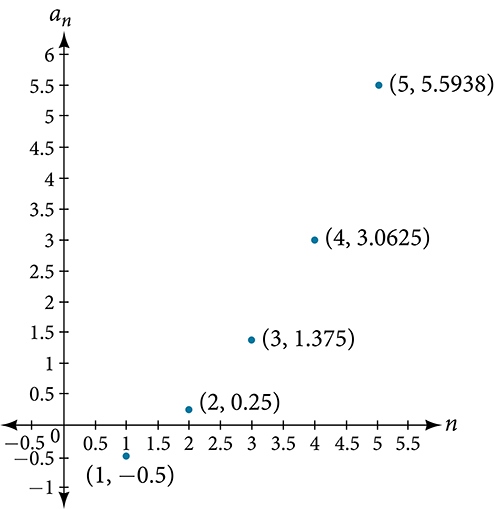
Answer
9.3-49 §9.3 source ↗
For the following exercises, use the information provided to graph the first five terms of the geometric sequence.
Answer
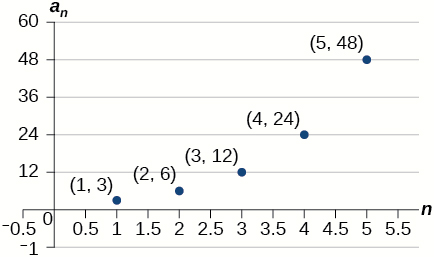
9.3-51 §9.3 source ↗
For the following exercises, use the information provided to graph the first five terms of the geometric sequence.
Use recursive formulas to give two examples of geometric sequences whose 3rd terms are
Answer
9.3-53 §9.3 source ↗
For the following exercises, use the information provided to graph the first five terms of the geometric sequence.
Find the 5th term of the geometric sequence
Answer
9.3-55 §9.3 source ↗
For the following exercises, use the information provided to graph the first five terms of the geometric sequence.
At which term does the sequence exceed
Answer
9.3-57 §9.3 source ↗
For the following exercises, use the information provided to graph the first five terms of the geometric sequence.
For which term does the geometric sequence first have a non-integer value?
Answer
9.3-59 §9.3 source ↗
For the following exercises, use the information provided to graph the first five terms of the geometric sequence.
Use the explicit formula to write a geometric sequence whose common ratio is a decimal number between 0 and 1. Show the first 4 terms, and then find the 8th term.
Answer
Try It #1 §9.4 source ↗
Answer
Try It #2 §9.4 source ↗
Use the formula to find the sum of each arithmetic series.
Answer
Try It #3 §9.4 source ↗
Use the formula to find the sum of each arithmetic series.
Answer
Try It #4 §9.4 source ↗
Use the formula to find the sum of each arithmetic series.
Answer
Try It #5 §9.4 source ↗
Answer
Try It #6 §9.4 source ↗
Use the formula to find the indicated partial sum of each geometric series.
for the series
Answer
Try It #7 §9.4 source ↗
Use the formula to find the indicated partial sum of each geometric series.
Answer
Try It #8 §9.4 source ↗
Answer
Try It #9 §9.4 source ↗
Determine whether the sum of the infinite series is defined.
Answer
Try It #10 §9.4 source ↗
Determine whether the sum of the infinite series is defined.
Answer
Try It #11 §9.4 source ↗
Determine whether the sum of the infinite series is defined.
Answer
Try It #12 §9.4 source ↗
Find the sum, if it exists.
Answer
Try It #13 §9.4 source ↗
Find the sum, if it exists.
Answer
Try It #14 §9.4 source ↗
Find the sum, if it exists.
Answer
Try It #15 §9.4 source ↗
Answer
9.4-1 §9.4 source ↗
Answer
9.4-3 §9.4 source ↗
Answer
9.4-5 §9.4 source ↗
Answer
9.4-7 §9.4 source ↗
For the following exercises, express each description of a sum using summation notation.
The sum from of to of
Answer
9.4-9 §9.4 source ↗
For the following exercises, express each description of a sum using summation notation.
The sum that results from adding the number 4 five times
Answer
9.4-11 §9.4 source ↗
For the following exercises, express each arithmetic sum using summation notation.
Answer
9.4-13 §9.4 source ↗
For the following exercises, use the formula for the sum of the first terms of each arithmetic sequence.
Answer
9.4-15 §9.4 source ↗
For the following exercises, use the formula for the sum of the first terms of each arithmetic sequence.
Answer
9.4-17 §9.4 source ↗
For the following exercises, express each geometric sum using summation notation.
Answer
9.4-19 §9.4 source ↗
For the following exercises, use the formula for the sum of the first terms of each geometric sequence, and then state the indicated sum.
Answer
9.4-21 §9.4 source ↗
For the following exercises, use the formula for the sum of the first terms of each geometric sequence, and then state the indicated sum.
Answer
9.4-23 §9.4 source ↗
For the following exercises, determine whether the infinite series has a sum. If so, write the formula for the sum. If not, state the reason.
Answer
9.4-25 §9.4 source ↗
For the following exercises, determine whether the infinite series has a sum. If so, write the formula for the sum. If not, state the reason.
Answer
9.4-27 §9.4 source ↗
For the following exercises, use the following scenario. Javier makes monthly deposits into a savings account. He opened the account with an initial deposit of $50. Each month thereafter he increased the previous deposit amount by $20.
Graph the arithmetic series showing the monthly sums of one year of Javier’s deposits.
Answer
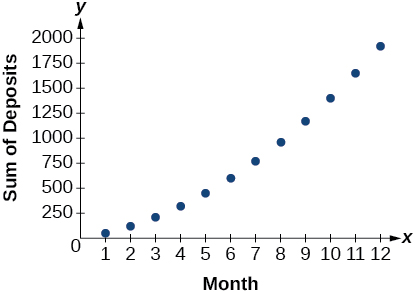
9.4-29 §9.4 source ↗
For the following exercises, use the geometric series
What number does seem to be approaching in the graph? Find the sum to explain why this makes sense.
Answer
9.4-31 §9.4 source ↗
For the following exercises, find the indicated sum.
Answer
9.4-33 §9.4 source ↗
For the following exercises, find the indicated sum.
Answer
9.4-35 §9.4 source ↗
For the following exercises, use the formula for the sum of the first terms of an arithmetic series to find the sum.
Answer
9.4-37 §9.4 source ↗
For the following exercises, use the formula for the sum of the first terms of an arithmetic series to find the sum.
Answer
9.4-39 §9.4 source ↗
For the following exercises, use the formula for the sum of the first terms of a geometric series to find the partial sum.
for the series
Answer
9.4-41 §9.4 source ↗
For the following exercises, use the formula for the sum of the first terms of a geometric series to find the partial sum.
Answer
9.4-43 §9.4 source ↗
For the following exercises, find the sum of the infinite geometric series.
Answer
9.4-45 §9.4 source ↗
For the following exercises, find the sum of the infinite geometric series.
Answer
9.4-47 §9.4 source ↗
For the following exercises, determine the value of the annuity for the indicated monthly deposit amount, the number of deposits, and the interest rate.
Deposit amount: total deposits: interest rate: compounded monthly
Answer
9.4-49 §9.4 source ↗
For the following exercises, determine the value of the annuity for the indicated monthly deposit amount, the number of deposits, and the interest rate.
Deposit amount: total deposits: interest rate: compounded semi-annually
Answer
9.4-51 §9.4 source ↗
For the following exercises, determine the value of the annuity for the indicated monthly deposit amount, the number of deposits, and the interest rate.
Write an explicit formula for such that Assume this is an arithmetic series.
Answer
9.4-53 §9.4 source ↗
For the following exercises, determine the value of the annuity for the indicated monthly deposit amount, the number of deposits, and the interest rate.
How many terms must be added before the series has a sum less than
Answer
9.4-55 §9.4 source ↗
For the following exercises, determine the value of the annuity for the indicated monthly deposit amount, the number of deposits, and the interest rate.
The sum of an infinite geometric series is five times the value of the first term. What is the common ratio of the series?
Answer
9.4-57 §9.4 source ↗
For the following exercises, determine the value of the annuity for the indicated monthly deposit amount, the number of deposits, and the interest rate.
Karl has two years to save to buy a used car when he graduates. To the nearest dollar, what would his monthly deposits need to be if he invests in an account offering a 4.2% annual interest rate that compounds monthly?
Answer
9.4-59 §9.4 source ↗
For the following exercises, determine the value of the annuity for the indicated monthly deposit amount, the number of deposits, and the interest rate.
A boulder rolled down a mountain, traveling 6 feet in the first second. Each successive second, its distance increased by 8 feet. How far did the boulder travel after 10 seconds?
Answer
9.4-61 §9.4 source ↗
For the following exercises, determine the value of the annuity for the indicated monthly deposit amount, the number of deposits, and the interest rate.
A pendulum travels a distance of 3 feet on its first swing. On each successive swing, it travels the distance of the previous swing. What is the total distance traveled by the pendulum when it stops swinging?
Answer
Try It #1 §9.5 source ↗
Answer
Try It #2 §9.5 source ↗
Answer
Try It #3 §9.5 source ↗
A family of five is having portraits taken. Use the Multiplication Principle to find the following.
How many ways can the family line up for the portrait?
Answer
Try It #4 §9.5 source ↗
A family of five is having portraits taken. Use the Multiplication Principle to find the following.
How many ways can the photographer line up 3 family members?
Answer
Try It #5 §9.5 source ↗
A family of five is having portraits taken. Use the Multiplication Principle to find the following.
How many ways can the family line up for the portrait if the parents are required to stand on each end?
Answer
Try It #6 §9.5 source ↗
A play has a cast of 7 actors preparing to make their curtain call. Use the permutation formula to find the following.
How many ways can the 7 actors line up?
Answer
Try It #7 §9.5 source ↗
A play has a cast of 7 actors preparing to make their curtain call. Use the permutation formula to find the following.
How many ways can 5 of the 7 actors be chosen to line up?
Answer
Try It #8 §9.5 source ↗
Answer
Try It #9 §9.5 source ↗
Answer
Try It #10 §9.5 source ↗
Answer
9.5-1 §9.5 source ↗
For the following exercises, assume that there are ways an event can happen, ways an event can happen, and that are non-overlapping.
Use the Addition Principle of counting to explain how many ways event can occur.
Answer
9.5-3 §9.5 source ↗
Answer the following questions.
When given two separate events, how do we know whether to apply the Addition Principle or the Multiplication Principle when calculating possible outcomes? What conjunctions may help to determine which operations to use?
Answer
9.5-5 §9.5 source ↗
Answer the following questions.
What is the term for the arrangement that selects objects from a set of objects when the order of the objects is not important? What is the formula for calculating the number of possible outcomes for this type of arrangement?
Answer
9.5-7 §9.5 source ↗
For the following exercises, determine whether to use the Addition Principle or the Multiplication Principle. Then perform the calculations.
Let the set How many ways are there to choose a positive or an odd number from
Answer
9.5-9 §9.5 source ↗
For the following exercises, determine whether to use the Addition Principle or the Multiplication Principle. Then perform the calculations.
How many ways are there to pick a paint color from 5 shades of green, 4 shades of blue, or 7 shades of yellow?
Answer
9.5-11 §9.5 source ↗
For the following exercises, determine whether to use the Addition Principle or the Multiplication Principle. Then perform the calculations.
How many outcomes are possible from tossing a coin and rolling a 6-sided die?
Answer
9.5-13 §9.5 source ↗
For the following exercises, determine whether to use the Addition Principle or the Multiplication Principle. Then perform the calculations.
How many ways are there to construct a string of 3 digits if numbers can be repeated?
Answer
9.5-15 §9.5 source ↗
For the following exercises, compute the value of the expression.
Answer
9.5-17 §9.5 source ↗
For the following exercises, compute the value of the expression.
Answer
9.5-19 §9.5 source ↗
For the following exercises, compute the value of the expression.
Answer
9.5-21 §9.5 source ↗
For the following exercises, compute the value of the expression.
Answer
9.5-23 §9.5 source ↗
For the following exercises, compute the value of the expression.
Answer
9.5-25 §9.5 source ↗
For the following exercises, find the number of subsets in each given set.
Answer
9.5-27 §9.5 source ↗
For the following exercises, find the number of subsets in each given set.
A set containing 5 distinct numbers, 4 distinct letters, and 3 distinct symbols
Answer
9.5-29 §9.5 source ↗
For the following exercises, find the number of subsets in each given set.
The set of two-digit numbers between 1 and 100 containing the digit 0
Answer
9.5-31 §9.5 source ↗
For the following exercises, find the distinct number of arrangements.
The letters in the word “academia”
Answer
9.5-33 §9.5 source ↗
For the following exercises, find the distinct number of arrangements.
The symbols in the string #,#,#,@,@,$,$,$,%,%,%,%
Answer
9.5-35 §9.5 source ↗
For the following exercises, find the distinct number of arrangements.
The set, consists of whole numbers, each being the same number of digits long. How many digits long is a number from (Hint: use the fact that a whole number cannot start with the digit 0.)
Answer
9.5-37 §9.5 source ↗
For the following exercises, find the distinct number of arrangements.
Can ever equal Explain.
Answer
9.5-39 §9.5 source ↗
For the following exercises, find the distinct number of arrangements.
How many arrangements can be made from the letters of the word “mountains” if all the vowels must form a string?
Answer
9.5-41 §9.5 source ↗
For the following exercises, find the distinct number of arrangements.
A cell phone company offers 6 different voice packages and 8 different data packages. Of those, 3 packages include both voice and data. How many ways are there to choose either voice or data, but not both?
Answer
9.5-43 §9.5 source ↗
For the following exercises, find the distinct number of arrangements.
A wholesale T-shirt company offers sizes small, medium, large, and extra-large in organic or non-organic cotton and colors white, black, gray, blue, and red. How many different T-shirts are there to choose from?
Answer
9.5-45 §9.5 source ↗
For the following exercises, find the distinct number of arrangements.
An art store has 4 brands of paint pens in 12 different colors and 3 types of ink. How many paint pens are there to choose from?
Answer
9.5-47 §9.5 source ↗
For the following exercises, find the distinct number of arrangements.
How many ways can a baseball coach arrange the order of 9 batters if there are 15 players on the team?
Answer
9.5-49 §9.5 source ↗
For the following exercises, find the distinct number of arrangements.
A motorcycle shop has 10 choppers, 6 bobbers, and 5 café racers—different types of vintage motorcycles. How many ways can the shop choose 3 choppers, 5 bobbers, and 2 café racers for a weekend showcase?
Answer
9.5-51 §9.5 source ↗
For the following exercises, find the distinct number of arrangements.
Just-For-Kicks Sneaker Company offers an online customizing service. How many ways are there to design a custom pair of Just-For-Kicks sneakers if a customer can choose from a basic shoe up to 11 customizable options?
Answer
9.5-53 §9.5 source ↗
For the following exercises, find the distinct number of arrangements.
Suni bought 20 plants to arrange along the border of her garden. How many distinct arrangements can she make if the plants are comprised of 6 tulips, 6 roses, and 8 daisies?
Answer
Try It #1 §9.6 source ↗
Find each binomial coefficient.
ⓐ
ⓑ
Answer
ⓐ35
ⓑ330
Try It #2 §9.6 source ↗
Write in expanded form.
ⓐ
ⓑ
Answer
ⓐ
ⓑ
Try It #3 §9.6 source ↗
Answer
9.6-1 §9.6 source ↗
Answer
9.6-3 §9.6 source ↗
Answer
9.6-5 §9.6 source ↗
For the following exercises, evaluate the binomial coefficient.
Answer
9.6-7 §9.6 source ↗
For the following exercises, evaluate the binomial coefficient.
Answer
9.6-9 §9.6 source ↗
For the following exercises, evaluate the binomial coefficient.
Answer
9.6-11 §9.6 source ↗
For the following exercises, evaluate the binomial coefficient.
Answer
9.6-13 §9.6 source ↗
For the following exercises, use the Binomial Theorem to expand each binomial.
Answer
9.6-15 §9.6 source ↗
For the following exercises, use the Binomial Theorem to expand each binomial.
Answer
9.6-17 §9.6 source ↗
For the following exercises, use the Binomial Theorem to expand each binomial.
Answer
9.6-19 §9.6 source ↗
For the following exercises, use the Binomial Theorem to expand each binomial.
Answer
9.6-21 §9.6 source ↗
For the following exercises, use the Binomial Theorem to expand each binomial.
Answer
9.6-23 §9.6 source ↗
For the following exercises, use the Binomial Theorem to write the first three terms of each binomial.
Answer
9.6-25 §9.6 source ↗
For the following exercises, use the Binomial Theorem to write the first three terms of each binomial.
Answer
9.6-27 §9.6 source ↗
For the following exercises, use the Binomial Theorem to write the first three terms of each binomial.
Answer
9.6-29 §9.6 source ↗
For the following exercises, use the Binomial Theorem to write the first three terms of each binomial.
Answer
9.6-31 §9.6 source ↗
For the following exercises, find the indicated term of each binomial without fully expanding the binomial.
The fourth term of
Answer
9.6-33 §9.6 source ↗
For the following exercises, find the indicated term of each binomial without fully expanding the binomial.
The eighth term of
Answer
9.6-35 §9.6 source ↗
For the following exercises, find the indicated term of each binomial without fully expanding the binomial.
The fifth term of
Answer
9.6-37 §9.6 source ↗
For the following exercises, find the indicated term of each binomial without fully expanding the binomial.
The ninth term of
Answer
9.6-39 §9.6 source ↗
For the following exercises, find the indicated term of each binomial without fully expanding the binomial.
The eighth term of
Answer
9.6-41 §9.6 source ↗
For the following exercises, use the Binomial Theorem to expand the binomial Then find and graph each indicated sum on one set of axes.
Find and graph such that is the sum of the first two terms of the expansion.
Answer
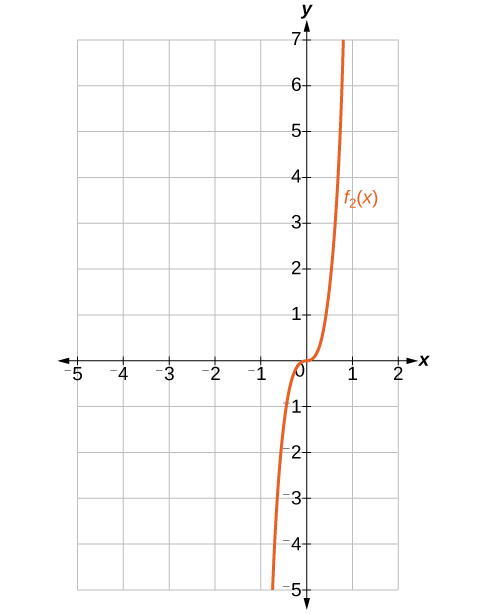
9.6-43 §9.6 source ↗
For the following exercises, use the Binomial Theorem to expand the binomial Then find and graph each indicated sum on one set of axes.
Find and graph such that is the sum of the first four terms of the expansion.
Answer
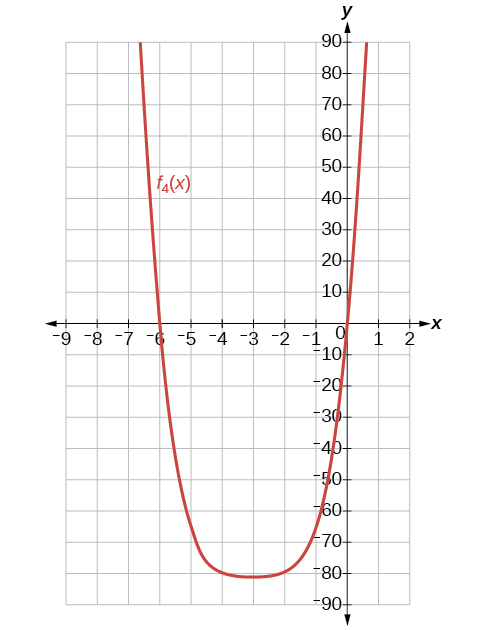
9.6-45 §9.6 source ↗
For the following exercises, use the Binomial Theorem to expand the binomial Then find and graph each indicated sum on one set of axes.
In the expansion of each term has the form , where successively takes on the value If what is the corresponding term?
Answer
9.6-47 §9.6 source ↗
For the following exercises, use the Binomial Theorem to expand the binomial Then find and graph each indicated sum on one set of axes.
Consider the expansion of What is the exponent of in the term?
Answer
9.6-49 §9.6 source ↗
For the following exercises, use the Binomial Theorem to expand the binomial Then find and graph each indicated sum on one set of axes.
Which expression cannot be expanded using the Binomial Theorem? Explain.
•
•
•
•
Answer
Try It #1 §9.7 source ↗
Answer
| Outcome | Probability |
|---|---|
| Heads | |
| Tails |
Try It #2 §9.7 source ↗
Answer
Try It #3 §9.7 source ↗
Answer
Try It #4 §9.7 source ↗
Answer
Try It #5 §9.7 source ↗
Answer
Try It #6 §9.7 source ↗
A child randomly selects 3 gumballs from a container holding 4 purple gumballs, 8 yellow gumballs, and 2 green gumballs.
ⓐFind the probability that all 3 gumballs selected are purple.
ⓑFind the probability that no yellow gumballs are selected.
ⓒFind the probability that at least 1 yellow gumball is selected.
Answer
9.7-1 §9.7 source ↗
Answer
9.7-3 §9.7 source ↗
Answer
9.7-5 §9.7 source ↗
Answer
9.7-7 §9.7 source ↗
For the following exercises, use the spinner shown in Figure 3 to find the probabilities indicated.
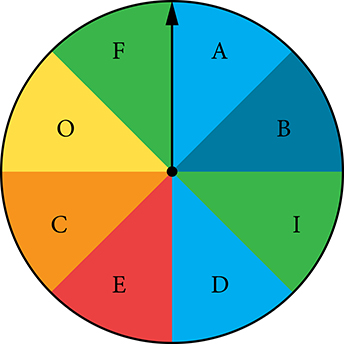 Figure 3
Landing on a vowel
Answer
9.7-9 §9.7 source ↗
For the following exercises, use the spinner shown in Figure 3 to find the probabilities indicated.
Figure 3 Landing on purple or a vowel
Answer
9.7-11 §9.7 source ↗
For the following exercises, use the spinner shown in Figure 3 to find the probabilities indicated.
Figure 3 Landing on green or blue
Answer
9.7-13 §9.7 source ↗
For the following exercises, use the spinner shown in Figure 3 to find the probabilities indicated.
Figure 3 Not landing on yellow or a consonant
Answer
9.7-15 §9.7 source ↗
For the following exercises, two coins are tossed.
Find the probability of tossing two heads.
Answer
9.7-17 §9.7 source ↗
For the following exercises, two coins are tossed.
Find the probability of tossing at least one tail.
Answer
9.7-19 §9.7 source ↗
For the following exercises, four coins are tossed.
Find the probability of tossing exactly two heads.
Answer
9.7-21 §9.7 source ↗
For the following exercises, four coins are tossed.
Find the probability of tossing four heads or four tails.
Answer
9.7-23 §9.7 source ↗
For the following exercises, four coins are tossed.
Find the probability of tossing not all tails.
Answer
9.7-25 §9.7 source ↗
For the following exercises, four coins are tossed.
Find the probability of tossing either two heads or three heads.
Answer
9.7-27 §9.7 source ↗
For the following exercises, one card is drawn from a standard deck of cards. Find the probability of drawing the following:
A two
Answer
9.7-29 §9.7 source ↗
For the following exercises, one card is drawn from a standard deck of cards. Find the probability of drawing the following:
Red six
Answer
9.7-31 §9.7 source ↗
For the following exercises, one card is drawn from a standard deck of cards. Find the probability of drawing the following:
A non-ace
Answer
9.7-33 §9.7 source ↗
For the following exercises, two dice are rolled, and the results are summed.
Construct a table showing the sample space of outcomes and sums.
Answer
| 1 | 2 | 3 | 4 | 5 | 6 | |
| 1 | (1,1) 2 | (1,2) 3 | (1,3) 4 | (1,4) 5 | (1,5) 6 | (1,6) 7 |
| 2 | (2,1) 3 | (2,2) 4 | (2,3) 5 | (2,4) 6 | (2,5) 7 | (2,6) 8 |
| 3 | (3,1) 4 | (3,2) 5 | (3,3) 6 | (3,4) 7 | (3,5) 8 | (3,6) 9 |
| 4 | (4,1) 5 | (4,2) 6 | (4,3) 7 | (4,4) 8 | (4,5) 9 | (4,6) 10 |
| 5 | (5,1) 6 | (5,2) 7 | (5,3) 8 | (5,4) 9 | (5,5) 10 | (5,6) 11 |
| 6 | (6,1) 7 | (6,2) 8 | (6,3) 9 | (6,4) 10 | (6,5) 11 | (6,6) 12 |
9.7-35 §9.7 source ↗
For the following exercises, two dice are rolled, and the results are summed.
Find the probability of rolling at least one four or a sum of
Answer
9.7-37 §9.7 source ↗
For the following exercises, two dice are rolled, and the results are summed.
Find the probability of rolling a sum greater than or equal to
Answer
9.7-39 §9.7 source ↗
For the following exercises, two dice are rolled, and the results are summed.
Find the probability of rolling a sum less than or greater than
Answer
9.7-41 §9.7 source ↗
For the following exercises, two dice are rolled, and the results are summed.
Find the probability of rolling a sum of or
Answer
9.7-43 §9.7 source ↗
For the following exercises, a coin is tossed, and a card is pulled from a standard deck. Find the probability of the following:
A head on the coin or a club
Answer
9.7-45 §9.7 source ↗
For the following exercises, a coin is tossed, and a card is pulled from a standard deck. Find the probability of the following:
A head on the coin or a face card
Answer
9.7-47 §9.7 source ↗
For the following exercises, use this scenario: a bag of M&Ms contains blue, brown, orange, yellow, red, and green M&Ms. Reaching into the bag, a person grabs 5 M&Ms.
What is the probability of getting all blue M&Ms?
Answer
9.7-49 §9.7 source ↗
For the following exercises, use this scenario: a bag of M&Ms contains blue, brown, orange, yellow, red, and green M&Ms. Reaching into the bag, a person grabs 5 M&Ms.
What is the probability of getting blue M&Ms?
Answer
9.7-51 §9.7 source ↗
Use the following scenario for the exercises that follow: In the game of Keno, a player starts by selecting numbers from the numbers to After the player makes his selections, winning numbers are randomly selected from numbers to A win occurs if the player has correctly selected or of the winning numbers. (Round all answers to the nearest hundredth of a percent.)
What is the percent chance that a player selects exactly 3 winning numbers?
Answer
9.7-53 §9.7 source ↗
Use the following scenario for the exercises that follow: In the game of Keno, a player starts by selecting numbers from the numbers to After the player makes his selections, winning numbers are randomly selected from numbers to A win occurs if the player has correctly selected or of the winning numbers. (Round all answers to the nearest hundredth of a percent.)
What is the percent chance that a player selects all 5 winning numbers?
Answer
9.7-55 §9.7 source ↗
Use the following scenario for the exercises that follow: In the game of Keno, a player starts by selecting numbers from the numbers to After the player makes his selections, winning numbers are randomly selected from numbers to A win occurs if the player has correctly selected or of the winning numbers. (Round all answers to the nearest hundredth of a percent.)
How much less is a player’s chance of selecting 3 winning numbers than the chance of selecting either 4 or 5 winning numbers?
Answer
9.7-57 §9.7 source ↗
Use this data for the exercises that follow: In 2013, there were roughly 317 million citizens in the United States, and about 40 million were elderly (aged 65 and over).2
If you meet five U.S. citizens, what is the percent chance that exactly one is elderly? (Round to the nearest tenth of a percent.)
Answer
9.7-59 §9.7 source ↗
Use this data for the exercises that follow: In 2013, there were roughly 317 million citizens in the United States, and about 40 million were elderly (aged 65 and over).2
If you meet five U.S. citizens, what is the percent chance that four are elderly? (Round to the nearest thousandth of a percent.)
Answer
9.R-1 §9.R source ↗
Answer
9.R-3 §9.R source ↗
Answer
9.R-5 §9.R source ↗
Answer
9.R-7 §9.R source ↗
Answer
9.R-9 §9.R source ↗
Answer
9.R-11 §9.R source ↗
Answer
9.R-13 §9.R source ↗
Answer
9.R-15 §9.R source ↗
Answer
9.R-17 §9.R source ↗
Answer
9.R-19 §9.R source ↗
Answer
9.R-21 §9.R source ↗
Answer
9.R-23 §9.R source ↗
Answer
9.R-25 §9.R source ↗
Answer
9.R-27 §9.R source ↗
Answer
9.R-29 §9.R source ↗
Answer
9.R-31 §9.R source ↗
Answer
9.R-33 §9.R source ↗
Answer
9.R-35 §9.R source ↗
Answer
9.R-37 §9.R source ↗
Answer
9.R-39 §9.R source ↗
Answer
9.R-41 §9.R source ↗
Answer
9.R-43 §9.R source ↗
Answer
9.R-45 §9.R source ↗
Answer
9.R-47 §9.R source ↗
For the following exercises, assume two die are rolled.
Construct a table showing the sample space.
Answer
| 1 | 2 | 3 | 4 | 5 | 6 | |
| 1 | 1,1 | 1,2 | 1,3 | 1,4 | 1,5 | 1,6 |
| 2 | 2,1 | 2,2 | 2,3 | 2,4 | 2,5 | 2,6 |
| 3 | 3,1 | 3,2 | 3,3 | 3,4 | 3,5 | 3,6 |
| 4 | 4,1 | 4,2 | 4,3 | 4,4 | 4,5 | 4,6 |
| 5 | 5,1 | 5,2 | 5,3 | 5,4 | 5,5 | 5,6 |
| 6 | 6,1 | 6,2 | 6,3 | 6,4 | 6,5 | 6,6 |
9.R-49 §9.R source ↗
For the following exercises, assume two die are rolled.
What is the probability of rolling a pair?
Answer
9.R-51 §9.R source ↗
For the following exercises, assume two die are rolled.
What is the probability that a roll doesn’t include a 2 or result in a pair?
Answer
9.R-53 §9.R source ↗
For the following exercises, assume two die are rolled.
What is the probability that a roll includes neither a 5 nor a 6?
Answer
9.R-55 §9.R source ↗
For the following exercises, use the following data: An elementary school survey found that 350 of the 500 students preferred soda to milk. Suppose 8 children from the school are attending a birthday party. (Show calculations and round to the nearest tenth of a percent.)
What is the percent chance that at least one of the children attending the party prefers milk?
Answer
9.R-57 §9.R source ↗
For the following exercises, use the following data: An elementary school survey found that 350 of the 500 students preferred soda to milk. Suppose 8 children from the school are attending a birthday party. (Show calculations and round to the nearest tenth of a percent.)
What is the percent chance that exactly 3 of the children attending the party prefer milk?
Answer
9.T-1 §9.T source ↗
Answer
9.T-3 §9.T source ↗
Answer
9.T-5 §9.T source ↗
Answer
9.T-7 §9.T source ↗
Answer
9.T-9 §9.T source ↗
Answer
9.T-11 §9.T source ↗
Answer
9.T-13 §9.T source ↗
Answer
9.T-15 §9.T source ↗
Answer
9.T-17 §9.T source ↗
Answer
9.T-19 §9.T source ↗
Answer
9.T-21 §9.T source ↗
Answer
9.T-23 §9.T source ↗
Answer
9.T-25 §9.T source ↗
For the following exercises, use the spinner in Figure 1.
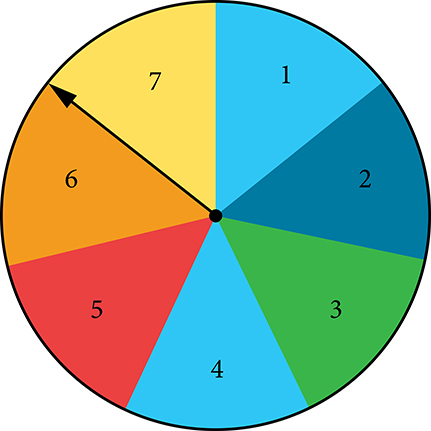 Figure 1
What is the probability of landing on an odd number?
Answer
9.T-27 §9.T source ↗
For the following exercises, use the spinner in Figure 1.
Figure 1 What is the probability of landing on blue or an odd number?
Answer
9.T-29 §9.T source ↗
For the following exercises, use the spinner in Figure 1.
Figure 1 A bowl of candy holds 16 peppermint, 14 butterscotch, and 10 strawberry flavored candies. Suppose a person grabs a handful of 7 candies. What is the percent chance that exactly 3 are butterscotch? (Show calculations and round to the nearest tenth of a percent.)
Answer
End of the book.
Problems and answers are adapted from College Algebra 2e by Jay Abramson, OpenStax, and are used under the CC BY-NC-SA 4.0 licence. Access for free at https://openstax.org/books/college-algebra-2e/pages/1-introduction-to-prerequisites. Illustrations: Copyright Rice University, OpenStax, under CC BY-NC-SA 4.0 license. This adaptation is released under the same licence, is non-commercial, and is neither affiliated with nor endorsed by OpenStax or Rice University.