Every problem in the chapter beside the book’s answer, a chapter at a time as you scroll.
Chapter 12: Introduction to Calculus
188 problems · 39 figuresTry It #1 §12.1 source ↗
For the following limit, define and
Answer
Try It #2 §12.1 source ↗
Using the graph of the function shown in Figure 8, estimate the following limits.
ⓐ
ⓑ
ⓒ
ⓓ
ⓔ
ⓕ
ⓖ
ⓗ
ⓘ
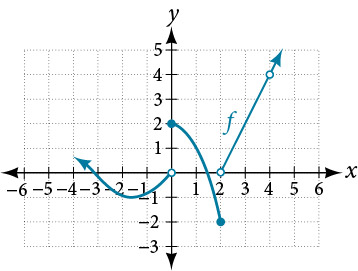 Figure 8
Answer
Try It #3 §12.1 source ↗
Numerically estimate the limit of the following function by making a table:
Answer
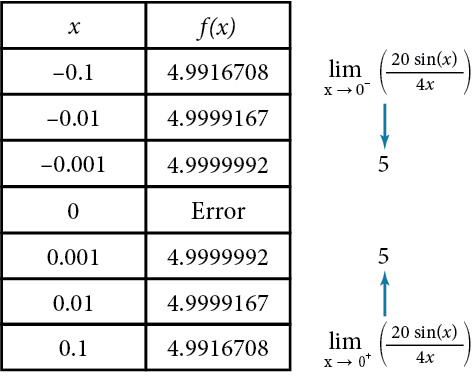
Try It #4 §12.1 source ↗
Answer
12.1-1 §12.1 source ↗
Answer
12.1-3 §12.1 source ↗
For the following exercises, estimate the functional values and the limits from the graph of the function provided in Figure 14.
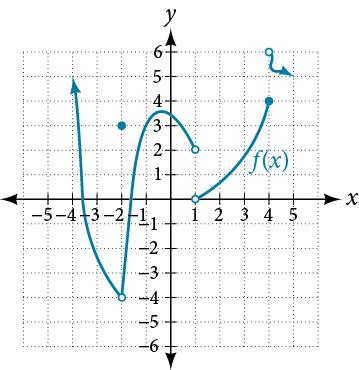 Figure 14
Answer
12.1-5 §12.1 source ↗
For the following exercises, estimate the functional values and the limits from the graph of the function provided in Figure 14.
Figure 14
Answer
12.1-7 §12.1 source ↗
For the following exercises, estimate the functional values and the limits from the graph of the function provided in Figure 14.
Figure 14
Answer
12.1-9 §12.1 source ↗
For the following exercises, estimate the functional values and the limits from the graph of the function provided in Figure 14.
Figure 14
Answer
12.1-11 §12.1 source ↗
For the following exercises, estimate the functional values and the limits from the graph of the function provided in Figure 14.
Figure 14
Answer
12.1-13 §12.1 source ↗
For the following exercises, estimate the functional values and the limits from the graph of the function provided in Figure 14.
Figure 14
Answer
12.1-15 §12.1 source ↗
For the following exercises, draw the graph of a function from the functional values and limits provided.
, , , , ,
Answer
12.1-16 §12.1 source ↗
For the following exercises, draw the graph of a function from the functional values and limits provided.
, , , ,
Answer
12.1-17 §12.1 source ↗
For the following exercises, draw the graph of a function from the functional values and limits provided.
, , , ,
Answer
12.1-18 §12.1 source ↗
For the following exercises, draw the graph of a function from the functional values and limits provided.
, , , ,
Answer
12.1-19 §12.1 source ↗
For the following exercises, draw the graph of a function from the functional values and limits provided.
, , , ,
Answer
12.1-20 §12.1 source ↗
For the following exercises, draw the graph of a function from the functional values and limits provided.
, , , ,
Answer
12.1-21 §12.1 source ↗
For the following exercises, draw the graph of a function from the functional values and limits provided.
, , , ,
Answer
12.1-23 §12.1 source ↗
For the following exercises, use a graphing calculator to determine the limit to 5 decimal places as approaches 0.
Answer
12.1-25 §12.1 source ↗
For the following exercises, use a graphing calculator to determine the limit to 5 decimal places as approaches 0.
Answer
12.1-27 §12.1 source ↗
For the following exercises, use a graphing calculator to determine the limit to 5 decimal places as approaches 0.
Based on the pattern you observed in the exercises above, make a conjecture as to the limit of
Answer
12.1-29 §12.1 source ↗
For the following exercises, use a graphing utility to find graphical evidence to determine the left- and right-hand limits of the function given as approaches If the function has a limit as approaches state it. If not, discuss why there is no limit.
Answer
12.1-31 §12.1 source ↗
For the following exercises, use numerical evidence to determine whether the limit exists at If not, describe the behavior of the graph of the function near Round answers to two decimal places.
Answer
12.1-33 §12.1 source ↗
For the following exercises, use numerical evidence to determine whether the limit exists at If not, describe the behavior of the graph of the function near Round answers to two decimal places.
Answer
12.1-35 §12.1 source ↗
For the following exercises, use numerical evidence to determine whether the limit exists at If not, describe the behavior of the graph of the function near Round answers to two decimal places.
Answer
12.1-37 §12.1 source ↗
For the following exercises, use numerical evidence to determine whether the limit exists at If not, describe the behavior of the graph of the function near Round answers to two decimal places.
Answer
12.1-39 §12.1 source ↗
For the following exercises, use a calculator to estimate the limit by preparing a table of values. If there is no limit, describe the behavior of the function as approaches the given value.
Answer
12.1-40 §12.1 source ↗
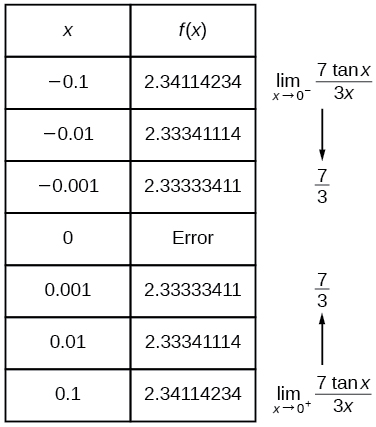
For the following exercises, use a calculator to estimate the limit by preparing a table of values. If there is no limit, describe the behavior of the function as approaches the given value.
Answer
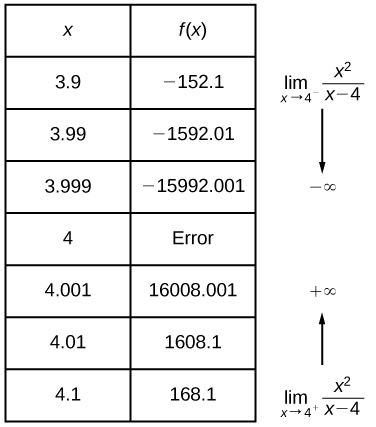
12.1-43 §12.1 source ↗
For the following exercises, use a graphing utility to find numerical or graphical evidence to determine the left and right-hand limits of the function given as approaches If the function has a limit as approaches state it. If not, discuss why there is no limit.
Answer
12.1-45 §12.1 source ↗
For the following exercises, use a graphing utility to find numerical or graphical evidence to determine the left and right-hand limits of the function given as approaches If the function has a limit as approaches state it. If not, discuss why there is no limit.
Answer
12.1-47 §12.1 source ↗
For the following exercises, use a graphing utility to find numerical or graphical evidence to determine the left and right-hand limits of the function given as approaches If the function has a limit as approaches state it. If not, discuss why there is no limit.
Answer
12.1-49 §12.1 source ↗
For the following exercises, use a graphing utility to find numerical or graphical evidence to determine the left and right-hand limits of the function given as approaches If the function has a limit as approaches state it. If not, discuss why there is no limit.
Answer
12.1-51 §12.1 source ↗
For the following exercises, use a graphing utility to find numerical or graphical evidence to determine the left and right-hand limits of the function given as approaches If the function has a limit as approaches state it. If not, discuss why there is no limit.
According to the Theory of Relativity, the mass of a particle depends on its velocity . That is
where is the mass when the particle is at rest and is the speed of light. Find the limit of the mass, as approaches
Answer
Through examination of the postulates and an understanding of relativistic physics, as Take this one step further to the solution,
Try It #1 §12.2 source ↗
Answer
Try It #2 §12.2 source ↗
Answer
Try It #3 §12.2 source ↗
Answer
Try It #4 §12.2 source ↗
Answer
Try It #5 §12.2 source ↗
Answer
Try It #6 §12.2 source ↗
Answer
Try It #7 §12.2 source ↗
Answer
Try It #8 §12.2 source ↗
Answer
Try It #9 §12.2 source ↗
Answer
12.2-1 §12.2 source ↗
Answer
12.2-3 §12.2 source ↗
Answer
12.2-5 §12.2 source ↗
For the following exercises, evaluate the limits algebraically.
Answer
12.2-7 §12.2 source ↗
For the following exercises, evaluate the limits algebraically.
Answer
12.2-9 §12.2 source ↗
For the following exercises, evaluate the limits algebraically.
Answer
12.2-11 §12.2 source ↗
For the following exercises, evaluate the limits algebraically.
Answer
12.2-13 §12.2 source ↗
For the following exercises, evaluate the limits algebraically.
Answer
12.2-15 §12.2 source ↗
For the following exercises, evaluate the limits algebraically.
Answer
12.2-17 §12.2 source ↗
For the following exercises, evaluate the limits algebraically.
Answer
12.2-19 §12.2 source ↗
For the following exercises, evaluate the limits algebraically.
Answer
12.2-21 §12.2 source ↗
For the following exercises, evaluate the limits algebraically.
Answer
12.2-23 §12.2 source ↗
For the following exercises, evaluate the limits algebraically.
Answer
12.2-25 §12.2 source ↗
For the following exercises, evaluate the limits algebraically.
Answer
12.2-27 §12.2 source ↗
For the following exercises, evaluate the limits algebraically.
Answer
12.2-29 §12.2 source ↗
For the following exercises, evaluate the limits algebraically.
Answer
12.2-31 §12.2 source ↗
For the following exercise, use the given information to evaluate the limits: .
Answer
12.2-33 §12.2 source ↗
For the following exercise, use the given information to evaluate the limits: .
Answer
12.2-35 §12.2 source ↗
For the following exercises, evaluate the following limits.
Answer
12.2-37 §12.2 source ↗
For the following exercises, evaluate the following limits.
Answer
12.2-39 §12.2 source ↗
For the following exercises, evaluate the following limits.
Answer
12.2-41 §12.2 source ↗
For the following exercises, evaluate the following limits.
Answer
12.2-43 §12.2 source ↗
For the following exercises, evaluate the following limits.
Answer
12.2-45 §12.2 source ↗
For the following exercises, find the average rate of change
Answer
12.2-47 §12.2 source ↗
For the following exercises, find the average rate of change
Answer
12.2-49 §12.2 source ↗
For the following exercises, find the average rate of change
Answer
12.2-51 §12.2 source ↗
For the following exercises, find the average rate of change
Answer
12.2-53 §12.2 source ↗
For the following exercises, find the average rate of change
Answer
12.2-55 §12.2 source ↗
For the following exercises, find the average rate of change
Find an equation that could be represented by Figure 4.
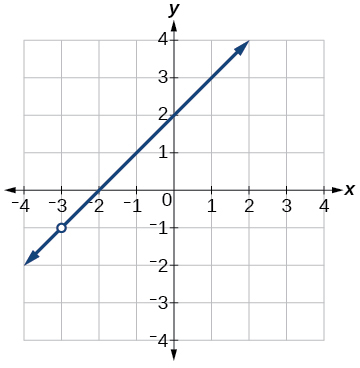 Figure 4
Answer
12.2-57 §12.2 source ↗
For the following exercises, refer to Figure 5.
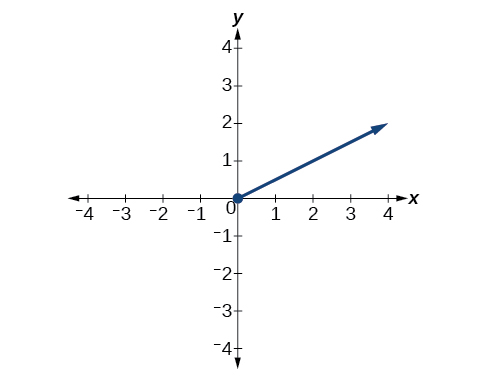 Figure 5
What is the left-hand limit of the function as approaches 0?
Answer
12.2-59 §12.2 source ↗
For the following exercises, refer to Figure 5.
Figure 5 The height of a projectile is given by Find the average rate of change of the height from second to seconds.
Answer
Try It #1 §12.3 source ↗
Identify all discontinuities for the following functions as either a jump or a removable discontinuity.
ⓐ
ⓑ
Answer
ⓐ removable discontinuity at
ⓑ jump discontinuity at
Try It #2 §12.3 source ↗
Answer
Try It #3 §12.3 source ↗
Answer
Try It #4 §12.3 source ↗
Answer
12.3-1 §12.3 source ↗
Answer
12.3-3 §12.3 source ↗
For the following exercises, determine why the function is discontinuous at a given point on the graph. State which condition fails.
Answer
12.3-5 §12.3 source ↗
For the following exercises, determine why the function is discontinuous at a given point on the graph. State which condition fails.
Answer
12.3-7 §12.3 source ↗
For the following exercises, determine why the function is discontinuous at a given point on the graph. State which condition fails.
Answer
12.3-9 §12.3 source ↗
For the following exercises, determine why the function is discontinuous at a given point on the graph. State which condition fails.
Answer
12.3-11 §12.3 source ↗
For the following exercises, determine why the function is discontinuous at a given point on the graph. State which condition fails.
Answer
12.3-13 §12.3 source ↗
For the following exercises, determine why the function is discontinuous at a given point on the graph. State which condition fails.
Answer
12.3-15 §12.3 source ↗
For the following exercises, determine why the function is discontinuous at a given point on the graph. State which condition fails.
Answer
,
Therefore, does not exist.
12.3-17 §12.3 source ↗
For the following exercises, determine why the function is discontinuous at a given point on the graph. State which condition fails.
Answer
12.3-19 §12.3 source ↗
For the following exercises, determine why the function is discontinuous at a given point on the graph. State which condition fails.
Answer
12.3-21 §12.3 source ↗
For the following exercises, determine why the function is discontinuous at a given point on the graph. State which condition fails.
Answer
12.3-23 §12.3 source ↗
For the following exercises, determine whether or not the given function is continuous everywhere. If it is continuous everywhere it is defined, state for what range it is continuous. If it is discontinuous, state where it is discontinuous.
Answer
12.3-25 §12.3 source ↗
For the following exercises, determine whether or not the given function is continuous everywhere. If it is continuous everywhere it is defined, state for what range it is continuous. If it is discontinuous, state where it is discontinuous.
Answer
12.3-27 §12.3 source ↗
For the following exercises, determine whether or not the given function is continuous everywhere. If it is continuous everywhere it is defined, state for what range it is continuous. If it is discontinuous, state where it is discontinuous.
Answer
12.3-29 §12.3 source ↗
For the following exercises, determine whether or not the given function is continuous everywhere. If it is continuous everywhere it is defined, state for what range it is continuous. If it is discontinuous, state where it is discontinuous.
Answer
12.3-31 §12.3 source ↗
For the following exercises, determine whether or not the given function is continuous everywhere. If it is continuous everywhere it is defined, state for what range it is continuous. If it is discontinuous, state where it is discontinuous.
Answer
12.3-33 §12.3 source ↗
For the following exercises, determine whether or not the given function is continuous everywhere. If it is continuous everywhere it is defined, state for what range it is continuous. If it is discontinuous, state where it is discontinuous.
Answer
12.3-35 §12.3 source ↗
For the following exercises, determine whether or not the given function is continuous everywhere. If it is continuous everywhere it is defined, state for what range it is continuous. If it is discontinuous, state where it is discontinuous.
Answer
12.3-37 §12.3 source ↗
For the following exercises, refer to Figure 15. Each square represents one square unit. For each value of determine which of the three conditions of continuity are satisfied at and which are not.
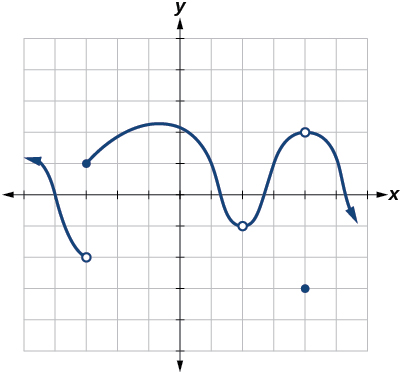 Figure 15
Answer
12.3-39 §12.3 source ↗
For the following exercises, refer to Figure 15. Each square represents one square unit. For each value of determine which of the three conditions of continuity are satisfied at and which are not.
Figure 15
Answer
12.3-41 §12.3 source ↗
For the following exercises, use a graphing utility to graph the function as in Figure 16. Set the x-axis a short distance before and after 0 to illustrate the point of discontinuity.
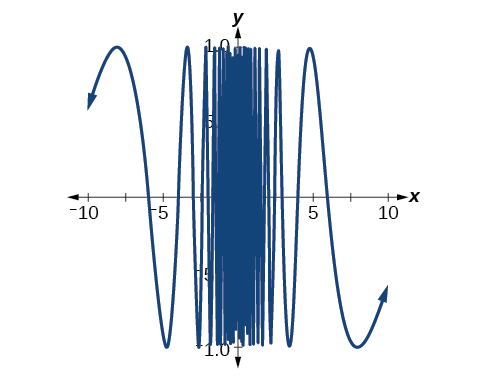 Figure 16
Evaluate
Answer
12.3-43 §12.3 source ↗
For the following exercises, use a graphing utility to graph the function as in Figure 16. Set the x-axis a short distance before and after 0 to illustrate the point of discontinuity.
Figure 16 What is the domain of
Answer
12.3-45 §12.3 source ↗
For the following exercises, consider the function shown in Figure 17.
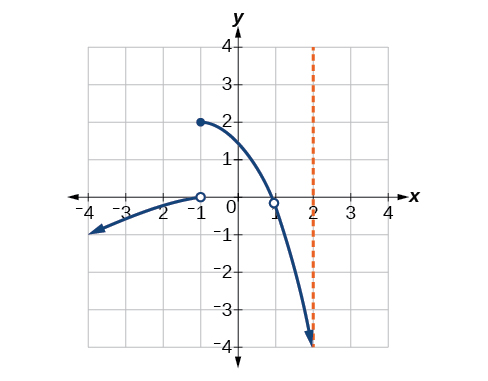 Figure 17
What condition of continuity is violated at these points?
Answer
At the limit does not exist. At does not exist.
At there appears to be a vertical asymptote, and the limit does not exist.
12.3-47 §12.3 source ↗
For the following exercises, consider the function shown in Figure 17.
Figure 17 Construct a function that passes through the origin with a constant slope of 1, with removable discontinuities at and
Answer
12.3-49 §12.3 source ↗
For the following exercises, consider the function shown in Figure 17.
Figure 17 Find the limit and determine if the following function is continuous at
Answer
Try It #1 §12.4 source ↗
Answer
Try It #2 §12.4 source ↗
Answer
Try It #3 §12.4 source ↗
Answer
Try It #4 §12.4 source ↗
Answer
Try It #5 §12.4 source ↗
Answer
Try It #6 §12.4 source ↗
Using the graph of the function shown in Figure 7, estimate: and
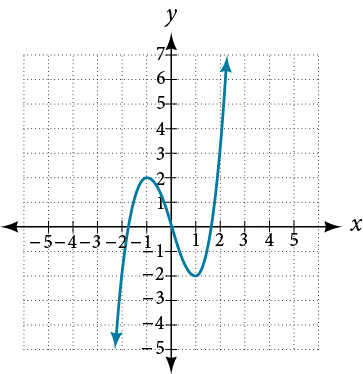 Figure 7
Answer
Try It #7 §12.4 source ↗
A runner runs along a straight east-west road. The function gives how many feet eastward of her starting point she is after seconds. Interpret each of the following as it relates to the runner.
ⓐ
ⓑ
ⓒ
ⓓ
ⓔ
Answer
ⓐ After zero seconds, she has traveled 0 feet.
ⓑ After 10 seconds, she has traveled 150 feet east.
ⓒ After 10 seconds, she is moving eastward at a rate of 15 ft/sec.
ⓓ After 20 seconds, she is moving westward at a rate of 10 ft/sec.
ⓔAfter 40 seconds, she is 100 feet westward of her starting point.
Try It #8 §12.4 source ↗
Determine where the function shown in Figure 18 is continuous and differentiable from the graph.
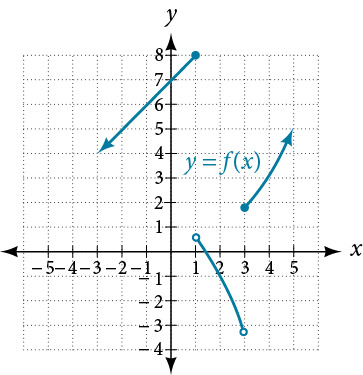 Figure 18
Answer
Try It #9 §12.4 source ↗
Answer
Try It #10 §12.4 source ↗
Answer
12.4-1 §12.4 source ↗
Answer
12.4-3 §12.4 source ↗
Answer
12.4-5 §12.4 source ↗
Answer
12.4-7 §12.4 source ↗
For the following exercises, use the definition of derivative to calculate the derivative of each function.
Answer
12.4-9 §12.4 source ↗
For the following exercises, use the definition of derivative to calculate the derivative of each function.
Answer
12.4-11 §12.4 source ↗
For the following exercises, use the definition of derivative to calculate the derivative of each function.
Answer
12.4-13 §12.4 source ↗
For the following exercises, use the definition of derivative to calculate the derivative of each function.
Answer
12.4-15 §12.4 source ↗
For the following exercises, use the definition of derivative to calculate the derivative of each function.
Answer
12.4-17 §12.4 source ↗
For the following exercises, use the definition of derivative to calculate the derivative of each function.
Answer
12.4-19 §12.4 source ↗
For the following exercises, find the average rate of change between the two points.
and
Answer
12.4-21 §12.4 source ↗
For the following exercises, find the average rate of change between the two points.
and
Answer
12.4-23 §12.4 source ↗
For the following polynomial functions, find the derivatives.
Answer
12.4-25 §12.4 source ↗
For the following polynomial functions, find the derivatives.
Answer
12.4-27 §12.4 source ↗
For the following functions, find the equation of the tangent line to the curve at the given point on the curve.
Answer
12.4-29 §12.4 source ↗
For the following exercise, find such that the given line is tangent to the graph of the function.
Answer
12.4-31 §12.4 source ↗
For the following exercises, consider the graph of the function and determine where the function is continuous/discontinuous and differentiable/not differentiable.
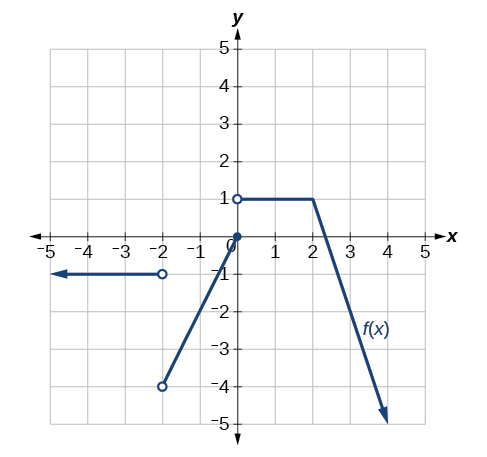
Answer
12.4-33 §12.4 source ↗
For the following exercises, consider the graph of the function and determine where the function is continuous/discontinuous and differentiable/not differentiable.
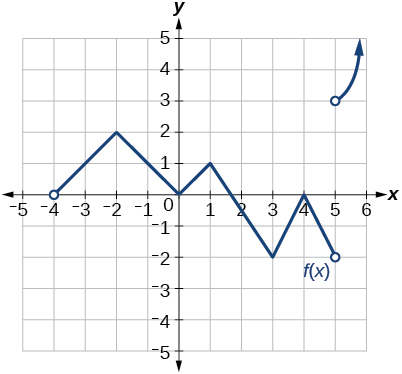
Answer
12.4-35 §12.4 source ↗
For the following exercises, use Figure 20 to estimate either the function at a given value of or the derivative at a given value of as indicated.
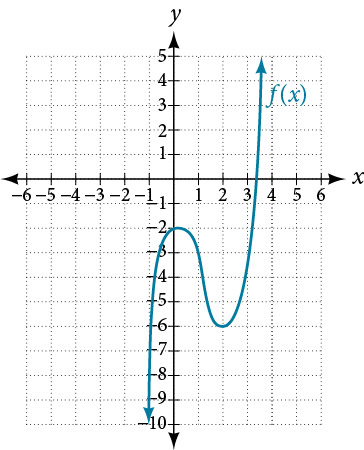 Figure 20
Answer
12.4-37 §12.4 source ↗
For the following exercises, use Figure 20 to estimate either the function at a given value of or the derivative at a given value of as indicated.
Figure 20
Answer
12.4-39 §12.4 source ↗
For the following exercises, use Figure 20 to estimate either the function at a given value of or the derivative at a given value of as indicated.
Figure 20
Answer
12.4-41 §12.4 source ↗
For the following exercises, use Figure 20 to estimate either the function at a given value of or the derivative at a given value of as indicated.
Figure 20
Answer
12.4-43 §12.4 source ↗
For the following exercises, use Figure 20 to estimate either the function at a given value of or the derivative at a given value of as indicated.
Figure 20
Answer
12.4-45 §12.4 source ↗
For the following exercises, use Figure 20 to estimate either the function at a given value of or the derivative at a given value of as indicated.
Figure 20 Numerically evaluate the derivative. Explore the behavior of the graph of around by graphing the function on the following domains: , , and . We can use the feature on our calculator that automatically sets Ymin and Ymax to the Xmin and Xmax values we preset. (On some of the commonly used graphing calculators, this feature may be called ZOOM FIT or ZOOM AUTO). By examining the corresponding range values for this viewing window, approximate how the curve changes at that is, approximate the derivative at
Answer
12.4-47 §12.4 source ↗
For the following exercises, explain the notation in words. The volume of a tank of gasoline, in gallons, minutes after noon.
Answer
12.4-49 §12.4 source ↗
For the following exercises, explain the notation in words. The volume of a tank of gasoline, in gallons, minutes after noon.
Answer
12.4-51 §12.4 source ↗
For the following exercises, explain the functions in words. The height, of a projectile after seconds is given by
Answer
12.4-53 §12.4 source ↗
For the following exercises, explain the functions in words. The height, of a projectile after seconds is given by
Answer
12.4-55 §12.4 source ↗
For the following exercises, explain the functions in words. The height, of a projectile after seconds is given by
Answer
12.4-57 §12.4 source ↗
For the following exercises, the volume of a sphere with respect to its radius is given by
Find the instantaneous rate of change of when
Answer
12.4-59 §12.4 source ↗
For the following exercises, the revenue generated by selling items is given by
Find and interpret.
Answer
12.4-61 §12.4 source ↗
For the following exercises, the cost of producing cellphones is described by the function
Find the average rate of change in the total cost as changes from
Answer
12.4-63 §12.4 source ↗
For the following exercises, the cost of producing cellphones is described by the function
Find the approximate marginal cost, when 20 cellphones have been produced, of producing the 21st cellphone.
Answer
12.4-65 §12.4 source ↗
For the following exercises, use the definition for the derivative at a point to find the derivative of the functions.
Answer
12.4-67 §12.4 source ↗
For the following exercises, use the definition for the derivative at a point to find the derivative of the functions.
Answer
12.R-1 §12.R source ↗
For the following exercises, use Figure 1.
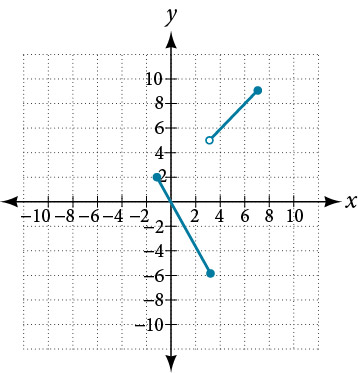 Figure 1
Answer
12.R-3 §12.R source ↗
For the following exercises, use Figure 1.
Figure 1
Answer
12.R-5 §12.R source ↗
For the following exercises, use Figure 1.
Figure 1 At what values of is the function discontinuous? What condition of continuity is violated?
Answer
12.R-7 §12.R source ↗
For the following exercises, with the use of a graphing utility, use numerical or graphical evidence to determine the left- and right-hand limits of the function given as approaches If the function has limit as approaches state it. If not, discuss why there is no limit.
Answer
12.R-9 §12.R source ↗
For the following exercises, with the use of a graphing utility, use numerical or graphical evidence to determine the left- and right-hand limits of the function given as approaches If the function has limit as approaches state it. If not, discuss why there is no limit.
Answer
12.R-11 §12.R source ↗
For the following exercises, find the limits if and
Answer
12.R-13 §12.R source ↗
For the following exercises, find the limits if and
Answer
12.R-15 §12.R source ↗
For the following exercises, find the limits if and
Answer
12.R-17 §12.R source ↗
For the following exercises, evaluate the limits using algebraic techniques.
Answer
12.R-19 §12.R source ↗
For the following exercises, evaluate the limits using algebraic techniques.
Answer
12.R-21 §12.R source ↗
For the following exercises, use numerical evidence to determine whether the limit exists at If not, describe the behavior of the graph of the function at
Answer
12.R-23 §12.R source ↗
For the following exercises, use numerical evidence to determine whether the limit exists at If not, describe the behavior of the graph of the function at
Answer
12.R-25 §12.R source ↗
For the following exercises, use numerical evidence to determine whether the limit exists at If not, describe the behavior of the graph of the function at
Answer
12.R-27 §12.R source ↗
For the following exercises, determine where the given function is continuous. Where it is not continuous, state which conditions fail, and classify any discontinuities.
Answer
12.R-29 §12.R source ↗
For the following exercises, determine where the given function is continuous. Where it is not continuous, state which conditions fail, and classify any discontinuities.
Answer
12.R-31 §12.R source ↗
For the following exercises, determine where the given function is continuous. Where it is not continuous, state which conditions fail, and classify any discontinuities.
Answer
12.R-33 §12.R source ↗
For the following exercises, find the average rate of change
Answer
12.R-35 §12.R source ↗
For the following exercises, find the average rate of change
Answer
12.R-37 §12.R source ↗
For the following exercises, find the average rate of change
Answer
12.R-39 §12.R source ↗
For the following exercises, find the derivative of the function.
Answer
12.R-41 §12.R source ↗
For the following exercises, with the aid of a graphing utility, explain why the function is not differentiable everywhere on its domain. Specify the points where the function is not differentiable.
Answer
12.T-1 §12.T source ↗
For the following exercises, use the graph of in Figure 1.
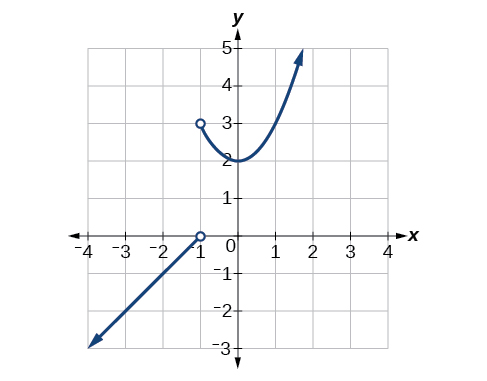 Figure 1
Answer
12.T-3 §12.T source ↗
For the following exercises, use the graph of in Figure 1.
Figure 1
Answer
12.T-5 §12.T source ↗
For the following exercises, use the graph of in Figure 1.
Figure 1
Answer
12.T-7 §12.T source ↗
For the following exercises, with the use of a graphing utility, use numerical or graphical evidence to determine the left- and right-hand limits of the function given as approaches If the function has a limit as approaches state it. If not, discuss why there is no limit
Answer
12.T-10 §12.T source ↗
For the following exercises, evaluate each limit using algebraic techniques.
Answer
12.T-12 §12.T source ↗
For the following exercises, determine whether or not the given function is continuous. If it is continuous, show why. If it is not continuous, state which conditions fail.
Answer
12.T-14 §12.T source ↗
For the following exercises, use the definition of a derivative to find the derivative of the given function at
Answer
12.T-16 §12.T source ↗
For the following exercises, use the definition of a derivative to find the derivative of the given function at
Answer
12.T-18 §12.T source ↗
For the following exercises, with the aid of a graphing utility, explain why the function is not differentiable everywhere on its domain. Specify the points where the function is not differentiable.
Answer
12.T-20 §12.T source ↗
For the following exercises, explain the notation in words when the height of a projectile in feet, is a function of time in seconds after launch and is given by the function
Answer
12.T-22 §12.T source ↗
For the following exercises, explain the notation in words when the height of a projectile in feet, is a function of time in seconds after launch and is given by the function
Answer
12.T-24 §12.T source ↗
For the following exercises, explain the notation in words when the height of a projectile in feet, is a function of time in seconds after launch and is given by the function
Answer
12.T-26 §12.T source ↗
For the following exercises, use technology to evaluate the limit.
Answer
12.T-28 §12.T source ↗
For the following exercises, use technology to evaluate the limit.
Evaluate the limit by hand.
At what value(s) of is the function below discontinuous?
Answer
12.T-29 §12.T source ↗
For the following exercises, consider the function whose graph appears in Figure 3.
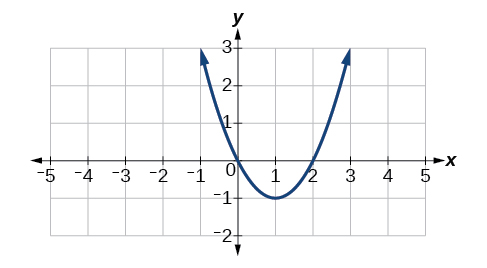 Figure 3
Find the average rate of change of the function from
Answer
12.T-30 §12.T source ↗
For the following exercises, consider the function whose graph appears in Figure 3.
Figure 3 Find all values of at which
Answer
12.T-32 §12.T source ↗
For the following exercises, consider the function whose graph appears in Figure 3.
Figure 3 Find an equation of the tangent line to the graph of the indicated point:
Answer
12.T-34 §12.T source ↗
For the following exercises, use the function .
Explore the behavior of the graph of around by graphing the function on the following domains, [0.9, 1.1], [0.99, 1.01], [0.999, 1.001], and [0.9999, 1.0001]. Use this information to determine whether the function appears to be differentiable at
Answer
12.T-36 §12.T source ↗
For the following exercises, find the derivative of each of the functions using the definition:
Answer
12.T-38 §12.T source ↗
For the following exercises, find the derivative of each of the functions using the definition:
Answer
12.T-40 §12.T source ↗
For the following exercises, find the derivative of each of the functions using the definition:
Answer
12.T-42 §12.T source ↗
For the following exercises, find the derivative of each of the functions using the definition:
Answer
End of the book.
Problems and answers are adapted from Precalculus 2e by Jay Abramson, OpenStax, and are used under the CC BY-NC-SA 4.0 licence. Access for free at https://openstax.org/books/precalculus-2e/pages/1-introduction-to-functions. Illustrations: Copyright Rice University, OpenStax, under CC BY-NC-SA 4.0 license. This adaptation is released under the same licence, is non-commercial, and is neither affiliated with nor endorsed by OpenStax or Rice University.