Every problem in the chapter beside the book’s answer, a chapter at a time as you scroll.
Chapter 3: Polynomial and Rational Functions
432 problems · 80 figuresTry It #1 §3.1 source ↗
Answer
Try It #2 §3.1 source ↗
Answer
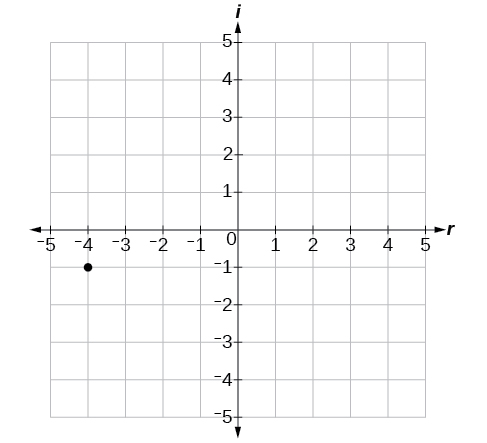
Try It #3 §3.1 source ↗
Answer
Try It #4 §3.1 source ↗
Answer
Try It #5 §3.1 source ↗
Answer
Try It #6 §3.1 source ↗
Answer
Try It #7 §3.1 source ↗
Answer
3.1-1 §3.1 source ↗
Answer
3.1-3 §3.1 source ↗
Answer
3.1-5 §3.1 source ↗
For the following exercises, evaluate the algebraic expressions.
evaluate
Answer
3.1-7 §3.1 source ↗
For the following exercises, evaluate the algebraic expressions.
evaluate
Answer
3.1-9 §3.1 source ↗
For the following exercises, evaluate the algebraic expressions.
evaluate
Answer
3.1-11 §3.1 source ↗
For the following exercises, determine the number of real and nonreal solutions for each quadratic function shown.
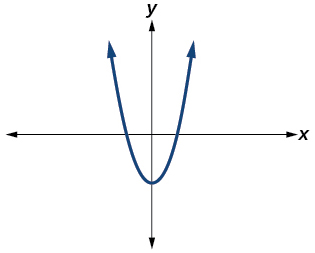
Answer
3.1-13 §3.1 source ↗
For the following exercises, plot the complex numbers on the complex plane.
Answer
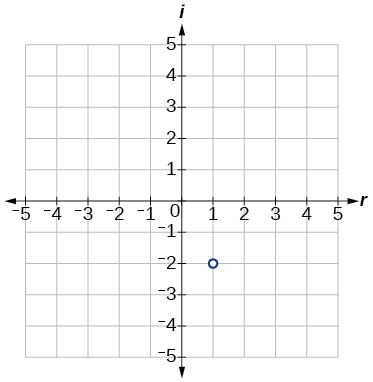
3.1-15 §3.1 source ↗
For the following exercises, plot the complex numbers on the complex plane.
Answer
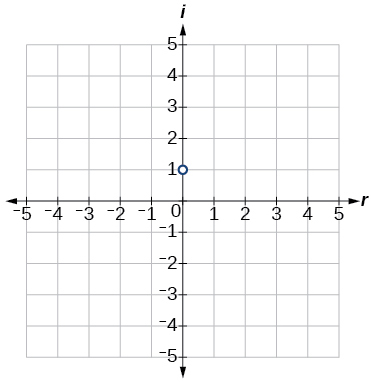
3.1-17 §3.1 source ↗
For the following exercises, perform the indicated operation and express the result as a simplified complex number.
Answer
3.1-19 §3.1 source ↗
For the following exercises, perform the indicated operation and express the result as a simplified complex number.
Answer
3.1-21 §3.1 source ↗
For the following exercises, perform the indicated operation and express the result as a simplified complex number.
Answer
3.1-23 §3.1 source ↗
For the following exercises, perform the indicated operation and express the result as a simplified complex number.
Answer
3.1-25 §3.1 source ↗
For the following exercises, perform the indicated operation and express the result as a simplified complex number.
Answer
3.1-27 §3.1 source ↗
For the following exercises, perform the indicated operation and express the result as a simplified complex number.
Answer
3.1-29 §3.1 source ↗
For the following exercises, perform the indicated operation and express the result as a simplified complex number.
Answer
3.1-31 §3.1 source ↗
For the following exercises, perform the indicated operation and express the result as a simplified complex number.
Answer
3.1-33 §3.1 source ↗
For the following exercises, perform the indicated operation and express the result as a simplified complex number.
Answer
3.1-35 §3.1 source ↗
For the following exercises, perform the indicated operation and express the result as a simplified complex number.
Answer
3.1-37 §3.1 source ↗
For the following exercises, perform the indicated operation and express the result as a simplified complex number.
Answer
3.1-39 §3.1 source ↗
For the following exercises, perform the indicated operation and express the result as a simplified complex number.
Answer
3.1-41 §3.1 source ↗
For the following exercises, perform the indicated operation and express the result as a simplified complex number.
Answer
3.1-43 §3.1 source ↗
For the following exercises, perform the indicated operation and express the result as a simplified complex number.
Answer
3.1-45 §3.1 source ↗
For the following exercises, use a calculator to help answer the questions.
Evaluate for Predict the value if
Answer
3.1-47 §3.1 source ↗
For the following exercises, use a calculator to help answer the questions.
Show that a solution of is
Answer
3.1-49 §3.1 source ↗
For the following exercises, evaluate the expressions, writing the result as a simplified complex number.
Answer
3.1-51 §3.1 source ↗
For the following exercises, evaluate the expressions, writing the result as a simplified complex number.
Answer
3.1-53 §3.1 source ↗
For the following exercises, evaluate the expressions, writing the result as a simplified complex number.
Answer
3.1-55 §3.1 source ↗
For the following exercises, evaluate the expressions, writing the result as a simplified complex number.
Answer
3.1-57 §3.1 source ↗
For the following exercises, evaluate the expressions, writing the result as a simplified complex number.
Answer
Try It #1 §3.2 source ↗
A coordinate grid has been superimposed over the quadratic path of a basketball in Figure 8. Assume that the point (–4, 7) is the highest point of the basketball’s trajectory. Find an equation for the path of the ball. Does the shooter make the basket?
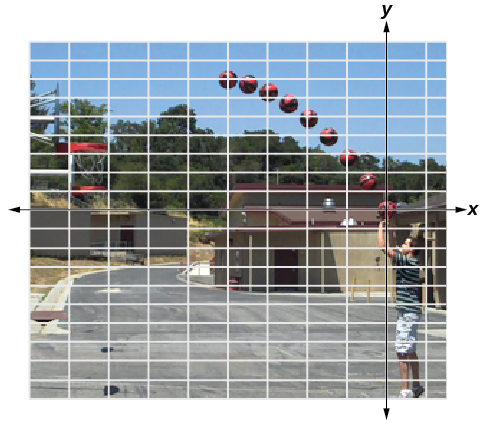 Figure 8 (credit: modification of work by Dan Meyer)
Answer
Try It #2 §3.2 source ↗
Answer
Try It #3 §3.2 source ↗
Answer
Try It #4 §3.2 source ↗
Answer
Try It #5 §3.2 source ↗
A rock is thrown upward from the top of a 112-foot high cliff overlooking the ocean at a speed of 96 feet per second. The rock’s height above ocean can be modeled by the equation
ⓐ When does the rock reach the maximum height?
ⓑ What is the maximum height of the rock?
ⓒWhen does the rock hit the ocean?
Answer
ⓐ 3 seconds
ⓑ 256 feet
ⓒ 7 seconds
3.2-1 §3.2 source ↗
Answer
3.2-3 §3.2 source ↗
Answer
3.2-5 §3.2 source ↗
Answer
3.2-7 §3.2 source ↗
For the following exercises, rewrite the quadratic functions in vertex form and give the vertex.
Answer
3.2-9 §3.2 source ↗
For the following exercises, rewrite the quadratic functions in vertex form and give the vertex.
Answer
3.2-11 §3.2 source ↗
For the following exercises, rewrite the quadratic functions in vertex form and give the vertex.
Answer
3.2-13 §3.2 source ↗
For the following exercises, rewrite the quadratic functions in vertex form and give the vertex.
Answer
3.2-15 §3.2 source ↗
For the following exercises, determine whether there is a minimum or maximum value to each quadratic function. Find the value and the axis of symmetry.
Answer
3.2-17 §3.2 source ↗
For the following exercises, determine whether there is a minimum or maximum value to each quadratic function. Find the value and the axis of symmetry.
Answer
3.2-19 §3.2 source ↗
For the following exercises, determine whether there is a minimum or maximum value to each quadratic function. Find the value and the axis of symmetry.
Answer
3.2-21 §3.2 source ↗
For the following exercises, determine the domain and range of the quadratic function.
Answer
3.2-23 §3.2 source ↗
For the following exercises, determine the domain and range of the quadratic function.
Answer
3.2-25 §3.2 source ↗
For the following exercises, determine the domain and range of the quadratic function.
Answer
3.2-27 §3.2 source ↗
For the following exercises, solve the equations over the complex numbers.
Answer
3.2-29 §3.2 source ↗
For the following exercises, solve the equations over the complex numbers.
Answer
3.2-31 §3.2 source ↗
For the following exercises, solve the equations over the complex numbers.
Answer
3.2-33 §3.2 source ↗
For the following exercises, solve the equations over the complex numbers.
Answer
3.2-35 §3.2 source ↗
For the following exercises, solve the equations over the complex numbers.
Answer
3.2-37 §3.2 source ↗
For the following exercises, solve the equations over the complex numbers.
Answer
3.2-39 §3.2 source ↗
For the following exercises, solve the equations over the complex numbers.
Answer
3.2-41 §3.2 source ↗
For the following exercises, solve the equations over the complex numbers.
Answer
3.2-43 §3.2 source ↗
For the following exercises, solve the equations over the complex numbers.
Answer
3.2-45 §3.2 source ↗
For the following exercises, use the vertex and a point on the graph to find the general form of the equation of the quadratic function.
Answer
3.2-47 §3.2 source ↗
For the following exercises, use the vertex and a point on the graph to find the general form of the equation of the quadratic function.
Answer
3.2-49 §3.2 source ↗
For the following exercises, use the vertex and a point on the graph to find the general form of the equation of the quadratic function.
Answer
3.2-51 §3.2 source ↗
For the following exercises, use the vertex and a point on the graph to find the general form of the equation of the quadratic function.
Answer
3.2-53 §3.2 source ↗
For the following exercises, sketch a graph of the quadratic function and give the vertex, axis of symmetry, and intercepts.
Answer
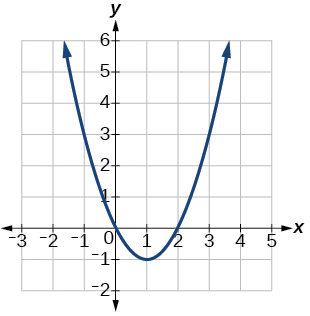
Vertex Axis of symmetry is Intercepts are
3.2-55 §3.2 source ↗
For the following exercises, sketch a graph of the quadratic function and give the vertex, axis of symmetry, and intercepts.
Answer
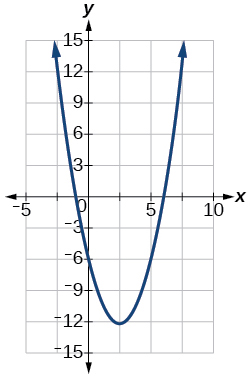
Vertex Axis of symmetry is intercepts:
3.2-57 §3.2 source ↗
For the following exercises, sketch a graph of the quadratic function and give the vertex, axis of symmetry, and intercepts.
Answer
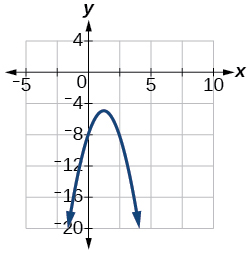
Vertex Axis of symmetry is Intercepts are
3.2-59 §3.2 source ↗
For the following exercises, write the equation for the graphed function.
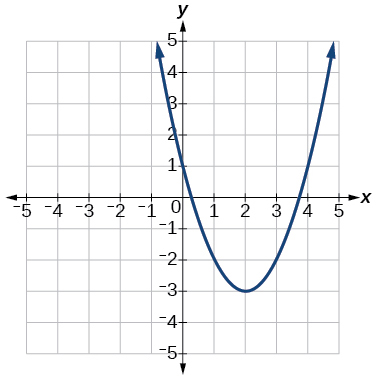
Answer
3.2-61 §3.2 source ↗
For the following exercises, write the equation for the graphed function.
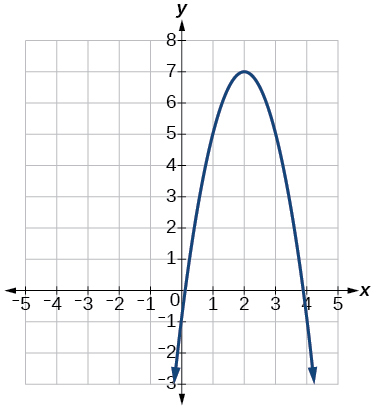
Answer
3.2-63 §3.2 source ↗
For the following exercises, write the equation for the graphed function.
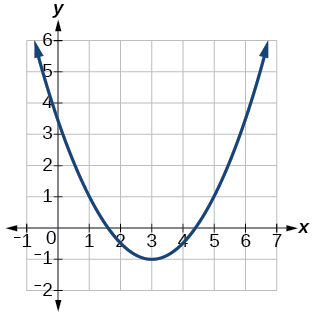
Answer
3.2-65 §3.2 source ↗
For the following exercises, use the table of values that represent points on the graph of a quadratic function. By determining the vertex and axis of symmetry, find the general form of the equation of the quadratic function.
| –2 | –1 | 0 | 1 | 2 | |
| 5 | 2 | 1 | 2 | 5 |
Answer
3.2-67 §3.2 source ↗
For the following exercises, use the table of values that represent points on the graph of a quadratic function. By determining the vertex and axis of symmetry, find the general form of the equation of the quadratic function.
| –2 | –1 | 0 | 1 | 2 | |
| –2 | 1 | 2 | 1 | –2 |
Answer
3.2-69 §3.2 source ↗
For the following exercises, use the table of values that represent points on the graph of a quadratic function. By determining the vertex and axis of symmetry, find the general form of the equation of the quadratic function.
| –2 | –1 | 0 | 1 | 2 | |
| 8 | 2 | 0 | 2 | 8 |
Answer
3.2-71 §3.2 source ↗
For the following exercises, use a calculator to find the answer.
Graph on the same set of axes and and What appears to be the effect of adding a constant?
Answer
3.2-73 §3.2 source ↗
For the following exercises, use a calculator to find the answer.
The path of an object projected at a 45 degree angle with initial velocity of 80 feet per second is given by the function where is the horizontal distance traveled and is the height in feet. Use the TRACE feature of your calculator to determine the height of the object when it has traveled 100 feet away horizontally.
Answer
3.2-75 §3.2 source ↗
For the following exercises, use the vertex of the graph of the quadratic function and the direction the graph opens to find the domain and range of the function.
Vertex opens up.
Answer
3.2-77 §3.2 source ↗
For the following exercises, use the vertex of the graph of the quadratic function and the direction the graph opens to find the domain and range of the function.
Vertex opens down.
Answer
3.2-79 §3.2 source ↗
For the following exercises, write the equation of the quadratic function that contains the given point and has the same shape as the given function.
Contains and has shape of Vertex is on the axis.
Answer
3.2-81 §3.2 source ↗
For the following exercises, write the equation of the quadratic function that contains the given point and has the same shape as the given function.
Contains and has the shape of Vertex is on the axis.
Answer
3.2-83 §3.2 source ↗
For the following exercises, write the equation of the quadratic function that contains the given point and has the same shape as the given function.
Contains and has the shape of Vertex is on the axis.
Answer
3.2-85 §3.2 source ↗
For the following exercises, write the equation of the quadratic function that contains the given point and has the same shape as the given function.
Find the dimensions of the rectangular corral producing the greatest enclosed area given 200 feet of fencing.
Answer
3.2-87 §3.2 source ↗
For the following exercises, write the equation of the quadratic function that contains the given point and has the same shape as the given function.
Find the dimensions of the rectangular corral producing the greatest enclosed area split into 3 pens of the same size given 500 feet of fencing.
Answer
3.2-89 §3.2 source ↗
For the following exercises, write the equation of the quadratic function that contains the given point and has the same shape as the given function.
Among all of the pairs of numbers whose difference is 12, find the pair with the smallest product. What is the product?
Answer
3.2-91 §3.2 source ↗
For the following exercises, write the equation of the quadratic function that contains the given point and has the same shape as the given function.
A rocket is launched in the air. Its height, in meters above sea level, as a function of time, in seconds, is given by Find the maximum height the rocket attains.
Answer
3.2-93 §3.2 source ↗
For the following exercises, write the equation of the quadratic function that contains the given point and has the same shape as the given function.
A soccer stadium holds 62,000 spectators. With a ticket price of $11, the average attendance has been 26,000. When the price dropped to $9, the average attendance rose to 31,000. Assuming that attendance is linearly related to ticket price, what ticket price would maximize revenue?
Answer
Try It #1 §3.3 source ↗
Which functions are power functions?
Answer
Try It #2 §3.3 source ↗
Answer
Try It #3 §3.3 source ↗
Answer
Try It #4 §3.3 source ↗
Describe the end behavior, and determine a possible degree of the polynomial function in Figure 8.
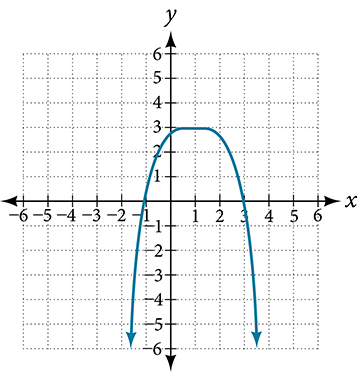 Figure 8
Answer
Try It #5 §3.3 source ↗
Answer
Try It #6 §3.3 source ↗
Answer
Try It #7 §3.3 source ↗
Answer
Try It #8 §3.3 source ↗
What can we conclude about the polynomial represented by the graph shown in Figure 14 based on its intercepts and turning points?
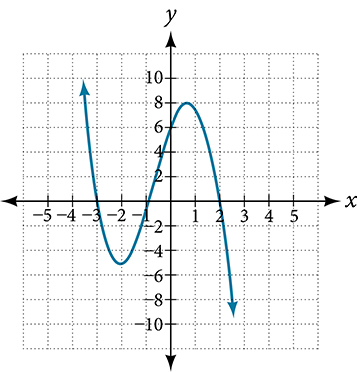 Figure 14
Answer
Try It #9 §3.3 source ↗
Answer
3.3-1 §3.3 source ↗
Answer
3.3-3 §3.3 source ↗
Answer
3.3-5 §3.3 source ↗
Answer
3.3-7 §3.3 source ↗
For the following exercises, identify the function as a power function, a polynomial function, or neither.
Answer
3.3-9 §3.3 source ↗
For the following exercises, identify the function as a power function, a polynomial function, or neither.
Answer
3.3-11 §3.3 source ↗
For the following exercises, identify the function as a power function, a polynomial function, or neither.
Answer
3.3-13 §3.3 source ↗
For the following exercises, find the degree and leading coefficient for the given polynomial.
Answer
3.3-15 §3.3 source ↗
For the following exercises, find the degree and leading coefficient for the given polynomial.
Answer
3.3-17 §3.3 source ↗
For the following exercises, determine the end behavior of the functions.
Answer
3.3-19 §3.3 source ↗
For the following exercises, determine the end behavior of the functions.
Answer
3.3-21 §3.3 source ↗
For the following exercises, determine the end behavior of the functions.
Answer
3.3-23 §3.3 source ↗
For the following exercises, determine the end behavior of the functions.
Answer
3.3-25 §3.3 source ↗
For the following exercises, find the intercepts of the functions.
Answer
3.3-27 §3.3 source ↗
For the following exercises, find the intercepts of the functions.
Answer
3.3-29 §3.3 source ↗
For the following exercises, find the intercepts of the functions.
Answer
3.3-31 §3.3 source ↗
For the following exercises, determine the least possible degree of the polynomial function shown.
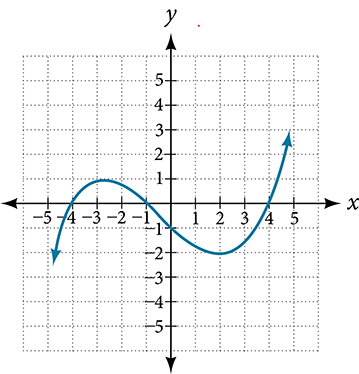
Answer
3.3-33 §3.3 source ↗
For the following exercises, determine the least possible degree of the polynomial function shown.
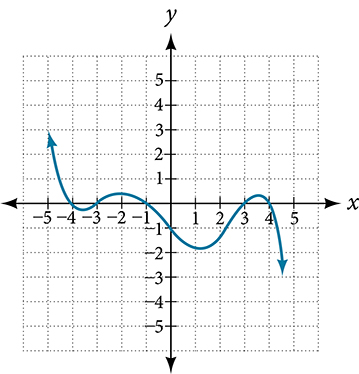
Answer
3.3-35 §3.3 source ↗
For the following exercises, determine the least possible degree of the polynomial function shown.
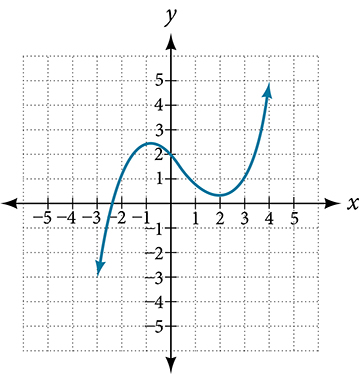
Answer
3.3-37 §3.3 source ↗
For the following exercises, determine the least possible degree of the polynomial function shown.
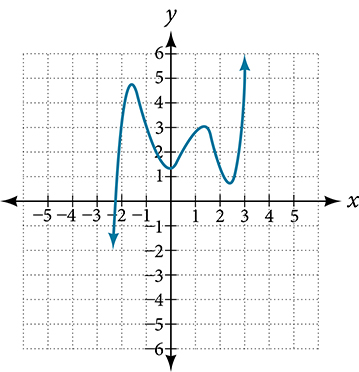
Answer
3.3-39 §3.3 source ↗
For the following exercises, determine whether the graph of the function provided is a graph of a polynomial function. If so, determine the number of turning points and the least possible degree for the function.
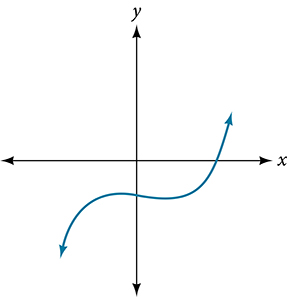
Answer
3.3-41 §3.3 source ↗
For the following exercises, determine whether the graph of the function provided is a graph of a polynomial function. If so, determine the number of turning points and the least possible degree for the function.
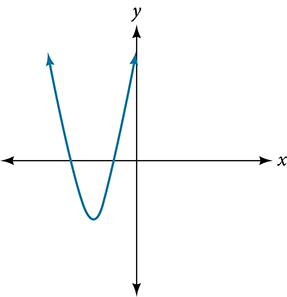
Answer
3.3-43 §3.3 source ↗
For the following exercises, determine whether the graph of the function provided is a graph of a polynomial function. If so, determine the number of turning points and the least possible degree for the function.
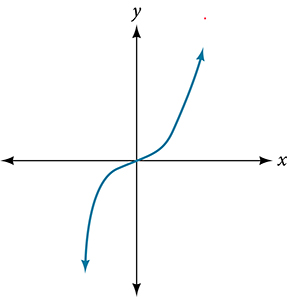
Answer
3.3-44 §3.3 source ↗
For the following exercises, determine whether the graph of the function provided is a graph of a polynomial function. If so, determine the number of turning points and the least possible degree for the function.
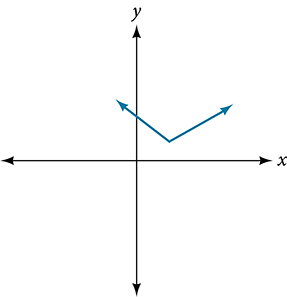
Answer
3.3-45 §3.3 source ↗
For the following exercises, determine whether the graph of the function provided is a graph of a polynomial function. If so, determine the number of turning points and the least possible degree for the function.
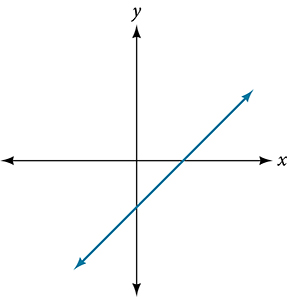
Answer
3.3-47 §3.3 source ↗
For the following exercises, make a table to confirm the end behavior of the function.
Answer
| 10 | 9,500 |
| 100 | 99,950,000 |
| –10 | 9,500 |
| –100 | 99,950,000 |
as , , as ,
3.3-49 §3.3 source ↗
For the following exercises, make a table to confirm the end behavior of the function.
Answer
| 10 | –504 |
| 100 | –941,094 |
| –10 | 1,716 |
| –100 | 1,061,106 |
as , , as ,
3.3-51 §3.3 source ↗
For the following exercises, graph the polynomial functions using a calculator. Based on the graph, determine the intercepts and the end behavior.
Answer
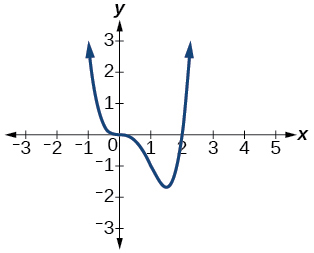
The intercept is The intercepts are As , , as ,
3.3-53 §3.3 source ↗
For the following exercises, graph the polynomial functions using a calculator. Based on the graph, determine the intercepts and the end behavior.
Answer
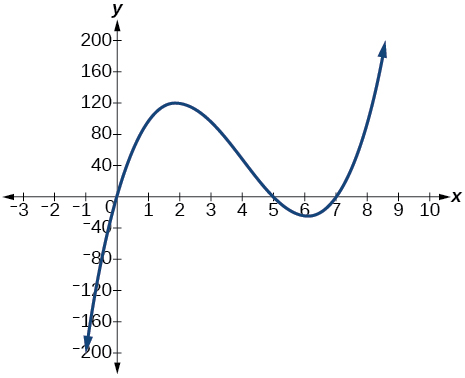
The intercept is . The intercepts are As , , as ,
3.3-55 §3.3 source ↗
For the following exercises, graph the polynomial functions using a calculator. Based on the graph, determine the intercepts and the end behavior.
Answer
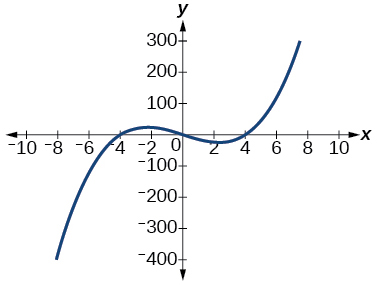
The intercept is The intercept is As , , as ,
3.3-57 §3.3 source ↗
For the following exercises, graph the polynomial functions using a calculator. Based on the graph, determine the intercepts and the end behavior.
Answer
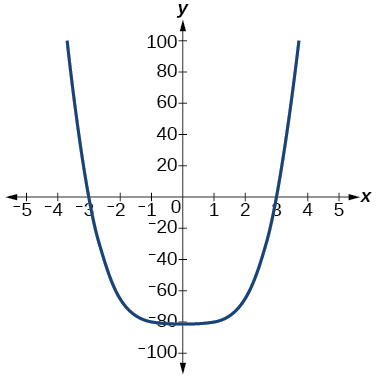
The intercept is The intercept are As , , as ,
3.3-59 §3.3 source ↗
For the following exercises, graph the polynomial functions using a calculator. Based on the graph, determine the intercepts and the end behavior.
Answer
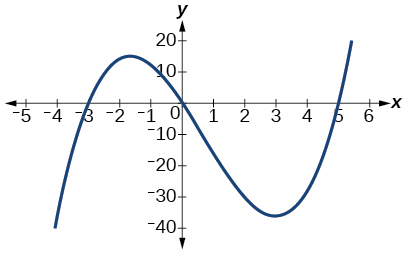
The intercept is The intercepts are As , , as ,
3.3-61 §3.3 source ↗
For the following exercises, use the information about the graph of a polynomial function to determine the function. Assume the leading coefficient is 1 or –1. There may be more than one correct answer.
The intercept is The intercepts are Degree is 2.
End behavior: ,,
Answer
3.3-63 §3.3 source ↗
For the following exercises, use the information about the graph of a polynomial function to determine the function. Assume the leading coefficient is 1 or –1. There may be more than one correct answer.
The intercept is The intercepts are Degree is 3.
End behavior: ,,,
Answer
3.3-65 §3.3 source ↗
For the following exercises, use the information about the graph of a polynomial function to determine the function. Assume the leading coefficient is 1 or –1. There may be more than one correct answer.
The intercept is There is no intercept. Degree is 4.
End behavior: ,,,
Answer
3.3-67 §3.3 source ↗
For the following exercises, use the written statements to construct a polynomial function that represents the required information.
A cube has an edge of 3 feet. The edge is increasing at the rate of 2 feet per minute. Express the volume of the cube as a function of the number of minutes elapsed.
Answer
3.3-69 §3.3 source ↗
For the following exercises, use the written statements to construct a polynomial function that represents the required information.
An open box is to be constructed by cutting out square corners of inch sides from a piece of cardboard 8 inches by 8 inches and then folding up the sides. Express the volume of the box as a function of
Answer
Try It #1 §3.4 source ↗
Answer
Try It #2 §3.4 source ↗
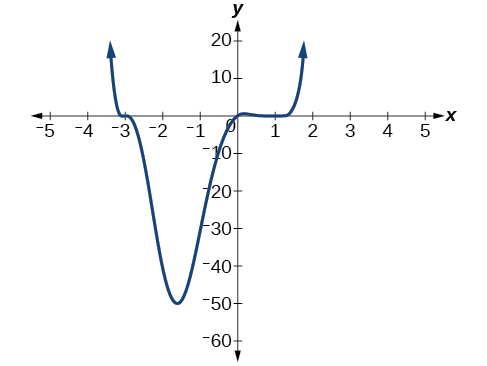
Use the graph of the function of degree 9 in Figure 10 to identify the zeros of the function and their multiplicities.
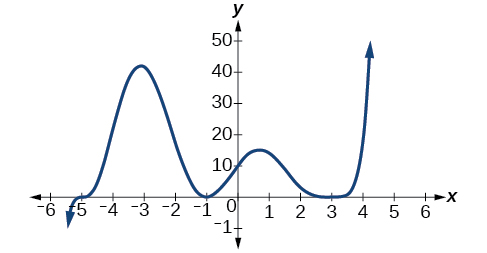 Figure 10
Answer
Try It #3 §3.4 source ↗
Answer
Try It #4 §3.4 source ↗
Answer
Try It #5 §3.4 source ↗
Given the graph shown in Figure 20, write a formula for the function shown.
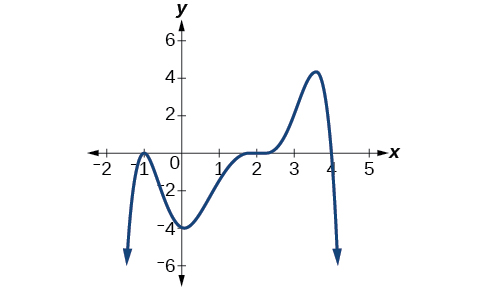 Figure 20
Answer
Try It #6 §3.4 source ↗
Answer
3.4-1 §3.4 source ↗
Answer
3.4-3 §3.4 source ↗
Answer
3.4-5 §3.4 source ↗
Answer
3.4-7 §3.4 source ↗
For the following exercises, find the or t-intercepts of the polynomial functions.
Answer
3.4-9 §3.4 source ↗
For the following exercises, find the or t-intercepts of the polynomial functions.
Answer
3.4-11 §3.4 source ↗
For the following exercises, find the or t-intercepts of the polynomial functions.
Answer
3.4-13 §3.4 source ↗
For the following exercises, find the or t-intercepts of the polynomial functions.
Answer
3.4-15 §3.4 source ↗
For the following exercises, find the or t-intercepts of the polynomial functions.
Answer
3.4-17 §3.4 source ↗
For the following exercises, find the or t-intercepts of the polynomial functions.
Answer
3.4-19 §3.4 source ↗
For the following exercises, find the or t-intercepts of the polynomial functions.
Answer
3.4-21 §3.4 source ↗
For the following exercises, find the or t-intercepts of the polynomial functions.
Answer
3.4-23 §3.4 source ↗
For the following exercises, find the or t-intercepts of the polynomial functions.
Answer
3.4-25 §3.4 source ↗
For the following exercises, use the Intermediate Value Theorem to confirm that the given polynomial has at least one zero within the given interval.
between and
Answer
3.4-27 §3.4 source ↗
For the following exercises, use the Intermediate Value Theorem to confirm that the given polynomial has at least one zero within the given interval.
between and .
Answer
3.4-29 §3.4 source ↗
For the following exercises, use the Intermediate Value Theorem to confirm that the given polynomial has at least one zero within the given interval.
between and
Answer
3.4-31 §3.4 source ↗
For the following exercises, find the zeros and give the multiplicity of each.
Answer
3.4-33 §3.4 source ↗
For the following exercises, find the zeros and give the multiplicity of each.
Answer
3.4-35 §3.4 source ↗
For the following exercises, find the zeros and give the multiplicity of each.
Answer
3.4-37 §3.4 source ↗
For the following exercises, find the zeros and give the multiplicity of each.
Answer
3.4-39 §3.4 source ↗
For the following exercises, find the zeros and give the multiplicity of each.
Answer
3.4-41 §3.4 source ↗
For the following exercises, find the zeros and give the multiplicity of each.
Answer
3.4-43 §3.4 source ↗
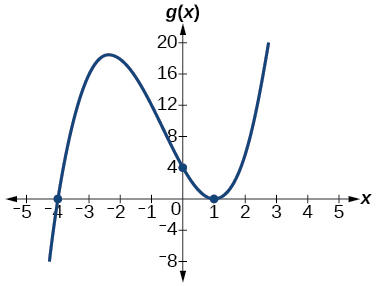
For the following exercises, graph the polynomial functions. Note and intercepts, multiplicity, and end behavior.
Answer
x-intercepts, with multiplicity 2, with multiplicity 1, intercept . As , , as , .
3.4-45 §3.4 source ↗
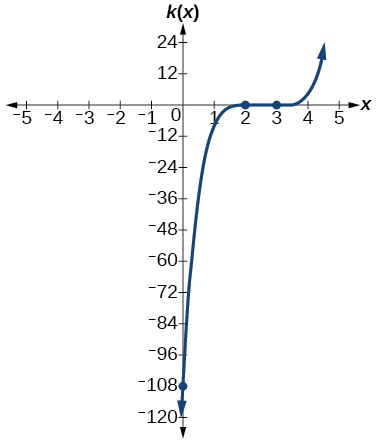
For the following exercises, graph the polynomial functions. Note and intercepts, multiplicity, and end behavior.
Answer
x-intercepts with multiplicity 3, with multiplicity 2, intercept . As , , as ,
3.4-47 §3.4 source ↗
For the following exercises, graph the polynomial functions. Note and intercepts, multiplicity, and end behavior.
Answer
x-intercepts with multiplicity 1, -intercept As , , as ,
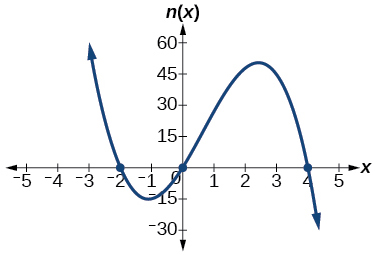
3.4-49 §3.4 source ↗
For the following exercises, use the graphs to write the formula for a polynomial function of least degree.
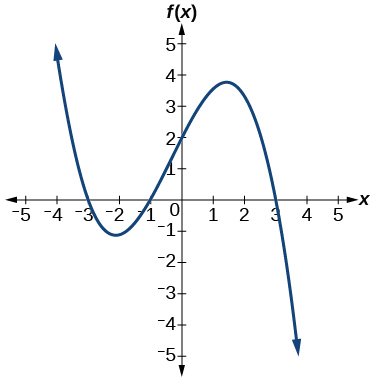
Answer
3.4-51 §3.4 source ↗
For the following exercises, use the graphs to write the formula for a polynomial function of least degree.
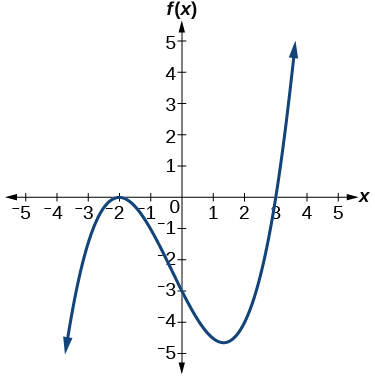
Answer
3.4-53 §3.4 source ↗
For the following exercises, use the graph to identify zeros and multiplicity.
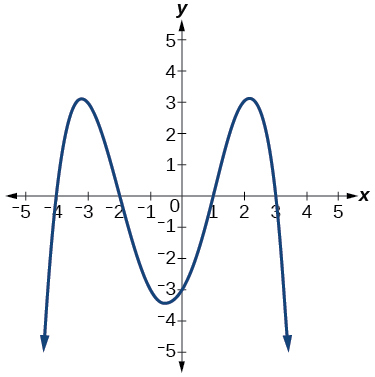
Answer
3.4-55 §3.4 source ↗
For the following exercises, use the graph to identify zeros and multiplicity.
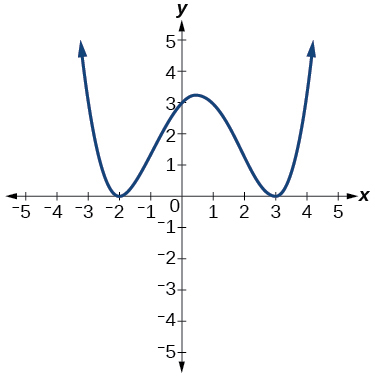
Answer
3.4-57 §3.4 source ↗
For the following exercises, use the given information about the polynomial graph to write the equation.
Degree 3. Zeros at and y-intercept at
Answer
3.4-59 §3.4 source ↗
For the following exercises, use the given information about the polynomial graph to write the equation.
Degree 5. Roots of multiplicity 2 at and , and a root of multiplicity 1 at y-intercept at
Answer
3.4-61 §3.4 source ↗
For the following exercises, use the given information about the polynomial graph to write the equation.
Degree 5. Double zero at and triple zero at Passes through the point
Answer
3.4-63 §3.4 source ↗
For the following exercises, use the given information about the polynomial graph to write the equation.
Degree 3. Zeros at and y-intercept at
Answer
3.4-65 §3.4 source ↗
For the following exercises, use the given information about the polynomial graph to write the equation.
Degree 4. Roots of multiplicity 2 at and roots of multiplicity 1 at and
y-intercept at
Answer
3.4-67 §3.4 source ↗
For the following exercises, use a calculator to approximate local minima and maxima or the global minimum and maximum.
Answer
3.4-69 §3.4 source ↗
For the following exercises, use a calculator to approximate local minima and maxima or the global minimum and maximum.
Answer
3.4-71 §3.4 source ↗
For the following exercises, use a calculator to approximate local minima and maxima or the global minimum and maximum.
Answer
3.4-73 §3.4 source ↗
For the following exercises, use the graphs to write a polynomial function of least degree.
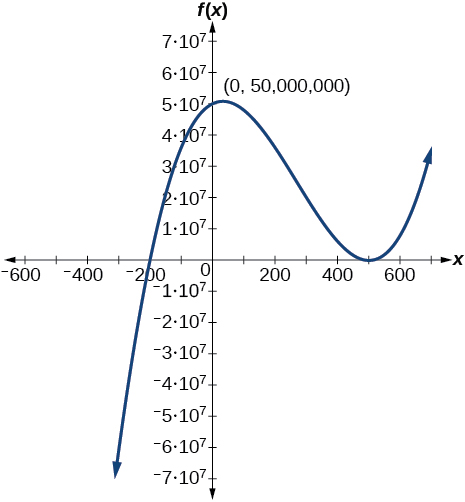
Answer
3.4-75 §3.4 source ↗
For the following exercises, write the polynomial function that models the given situation.
A rectangle has a length of 10 units and a width of 8 units. Squares of by units are cut out of each corner, and then the sides are folded up to create an open box. Express the volume of the box as a polynomial function in terms of
Answer
3.4-77 §3.4 source ↗
For the following exercises, write the polynomial function that models the given situation.
A square has sides of 12 units. Squares by units are cut out of each corner, and then the sides are folded up to create an open box. Express the volume of the box as a function in terms of
Answer
3.4-79 §3.4 source ↗
For the following exercises, write the polynomial function that models the given situation.
A right circular cone has a radius of and a height 3 units less. Express the volume of the cone as a polynomial function. The volume of a cone is for radius and height
Answer
Try It #1 §3.5 source ↗
Answer
Try It #2 §3.5 source ↗
Answer
Try It #3 §3.5 source ↗
Answer
3.5-1 §3.5 source ↗
Answer
3.5-3 §3.5 source ↗
For the following exercises, use long division to divide. Specify the quotient and the remainder.
Answer
3.5-5 §3.5 source ↗
For the following exercises, use long division to divide. Specify the quotient and the remainder.
Answer
3.5-7 §3.5 source ↗
For the following exercises, use long division to divide. Specify the quotient and the remainder.
Answer
3.5-9 §3.5 source ↗
For the following exercises, use long division to divide. Specify the quotient and the remainder.
Answer
3.5-11 §3.5 source ↗
For the following exercises, use long division to divide. Specify the quotient and the remainder.
Answer
3.5-13 §3.5 source ↗
For the following exercises, use long division to divide. Specify the quotient and the remainder.
Answer
3.5-15 §3.5 source ↗
For the following exercises, use synthetic division to find the quotient.
Answer
3.5-17 §3.5 source ↗
For the following exercises, use synthetic division to find the quotient.
Answer
3.5-19 §3.5 source ↗
For the following exercises, use synthetic division to find the quotient.
Answer
3.5-21 §3.5 source ↗
For the following exercises, use synthetic division to find the quotient.
Answer
3.5-23 §3.5 source ↗
For the following exercises, use synthetic division to find the quotient.
Answer
3.5-25 §3.5 source ↗
For the following exercises, use synthetic division to find the quotient.
Answer
3.5-27 §3.5 source ↗
For the following exercises, use synthetic division to find the quotient.
Answer
3.5-29 §3.5 source ↗
For the following exercises, use synthetic division to find the quotient.
Answer
3.5-31 §3.5 source ↗
For the following exercises, use synthetic division to find the quotient.
Answer
3.5-33 §3.5 source ↗
For the following exercises, use synthetic division to find the quotient.
Answer
3.5-35 §3.5 source ↗
For the following exercises, use synthetic division to find the quotient.
Answer
3.5-37 §3.5 source ↗
For the following exercises, use synthetic division to find the quotient.
Answer
3.5-39 §3.5 source ↗
For the following exercises, use synthetic division to determine whether the first expression is a factor of the second. If it is, indicate the factorization.
Answer
3.5-41 §3.5 source ↗
For the following exercises, use synthetic division to determine whether the first expression is a factor of the second. If it is, indicate the factorization.
Answer
3.5-43 §3.5 source ↗
For the following exercises, use synthetic division to determine whether the first expression is a factor of the second. If it is, indicate the factorization.
Answer
3.5-45 §3.5 source ↗
For the following exercises, use the graph of the third-degree polynomial and one factor to write the factored form of the polynomial suggested by the graph. The leading coefficient is one.
Factor is
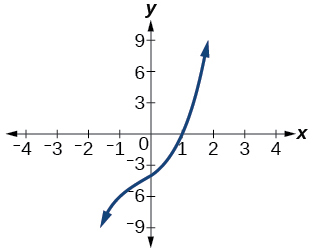
Answer
3.5-47 §3.5 source ↗
For the following exercises, use the graph of the third-degree polynomial and one factor to write the factored form of the polynomial suggested by the graph. The leading coefficient is one.
Factor is
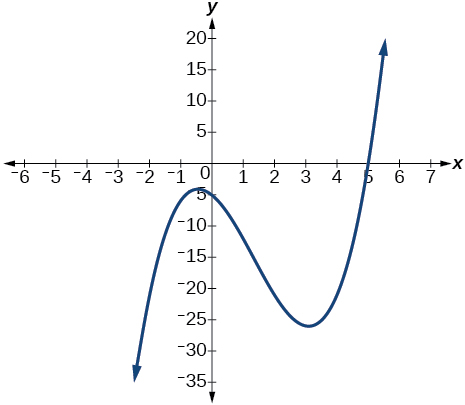
Answer
3.5-49 §3.5 source ↗
For the following exercises, use synthetic division to find the quotient and remainder.
Answer
3.5-51 §3.5 source ↗
For the following exercises, use synthetic division to find the quotient and remainder.
Answer
3.5-53 §3.5 source ↗
For the following exercises, use synthetic division to find the quotient and remainder.
Answer
3.5-55 §3.5 source ↗
For the following exercises, use a calculator with CAS to answer the questions.
Consider for ,, What do you expect the result to be if
Answer
3.5-57 §3.5 source ↗
For the following exercises, use a calculator with CAS to answer the questions.
Consider with ,, What do you expect the result to be if
Answer
3.5-59 §3.5 source ↗
For the following exercises, use synthetic division to determine the quotient involving a complex number.
Answer
3.5-61 §3.5 source ↗
For the following exercises, use synthetic division to determine the quotient involving a complex number.
Answer
3.5-63 §3.5 source ↗
For the following exercises, use synthetic division to determine the quotient involving a complex number.
Answer
3.5-65 §3.5 source ↗
For the following exercises, use the given length and area of a rectangle to express the width algebraically.
Length is area is
Answer
3.5-67 §3.5 source ↗
For the following exercises, use the given volume of a box and its length and width to express the height of the box algebraically.
Volume is length is width is
Answer
3.5-69 §3.5 source ↗
For the following exercises, use the given volume of a box and its length and width to express the height of the box algebraically.
Volume is length is width is
Answer
3.5-71 §3.5 source ↗
For the following exercises, use the given volume and radius of a cylinder to express the height of the cylinder algebraically.
Volume is radius is
Answer
3.5-73 §3.5 source ↗
For the following exercises, use the given volume and radius of a cylinder to express the height of the cylinder algebraically.
Volume is radius is
Answer
Try It #1 §3.6 source ↗
Answer
Try It #2 §3.6 source ↗
Answer
Try It #3 §3.6 source ↗
Answer
Try It #4 §3.6 source ↗
Answer
Try It #5 §3.6 source ↗
Answer
Try It #6 §3.6 source ↗
Answer
Try It #7 §3.6 source ↗
Answer
3.6-1 §3.6 source ↗
Answer
3.6-3 §3.6 source ↗
Answer
3.6-5 §3.6 source ↗
Answer
3.6-7 §3.6 source ↗
For the following exercises, use the Remainder Theorem to find the remainder.
Answer
3.6-9 §3.6 source ↗
For the following exercises, use the Remainder Theorem to find the remainder.
Answer
3.6-11 §3.6 source ↗
For the following exercises, use the Remainder Theorem to find the remainder.
Answer
3.6-13 §3.6 source ↗
For the following exercises, use the Remainder Theorem to find the remainder.
Answer
3.6-15 §3.6 source ↗
For the following exercises, use the given factor and the Factor Theorem to find all real zeros for the given polynomial function.
Answer
3.6-17 §3.6 source ↗
For the following exercises, use the given factor and the Factor Theorem to find all real zeros for the given polynomial function.
Answer
3.6-19 §3.6 source ↗
For the following exercises, use the given factor and the Factor Theorem to find all real zeros for the given polynomial function.
Answer
3.6-21 §3.6 source ↗
For the following exercises, use the given factor and the Factor Theorem to find all real zeros for the given polynomial function.
Answer
3.6-23 §3.6 source ↗
For the following exercises, use the Rational Zero Theorem to find all real zeros.
Answer
3.6-25 §3.6 source ↗
For the following exercises, use the Rational Zero Theorem to find all real zeros.
Answer
3.6-27 §3.6 source ↗
For the following exercises, use the Rational Zero Theorem to find all real zeros.
Answer
3.6-29 §3.6 source ↗
For the following exercises, use the Rational Zero Theorem to find all real zeros.
Answer
3.6-31 §3.6 source ↗
For the following exercises, use the Rational Zero Theorem to find all real zeros.
Answer
3.6-33 §3.6 source ↗
For the following exercises, use the Rational Zero Theorem to find all real zeros.
Answer
3.6-35 §3.6 source ↗
For the following exercises, use the Rational Zero Theorem to find all real zeros.
Answer
3.6-37 §3.6 source ↗
For the following exercises, use the Rational Zero Theorem to find all real zeros.
Answer
3.6-39 §3.6 source ↗
For the following exercises, use the Rational Zero Theorem to find all real zeros.
Answer
3.6-41 §3.6 source ↗
For the following exercises, find all complex solutions (real and non-real).
Answer
3.6-43 §3.6 source ↗
For the following exercises, find all complex solutions (real and non-real).
Answer
3.6-45 §3.6 source ↗
For the following exercises, find all complex solutions (real and non-real).
Answer
3.6-47 §3.6 source ↗
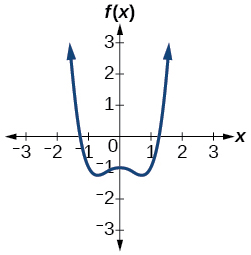
For the following exercises, use Descartes’ Rule to determine the possible number of positive and negative solutions. Then graph to confirm which of those possibilities is the actual combination.
Answer
1 positive, 1 negative
3.6-49 §3.6 source ↗
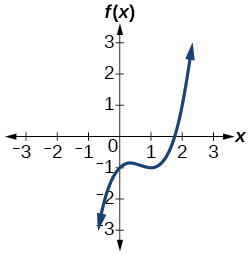
For the following exercises, use Descartes’ Rule to determine the possible number of positive and negative solutions. Then graph to confirm which of those possibilities is the actual combination.
Answer
3 or 1 positive, 0 negative
3.6-51 §3.6 source ↗
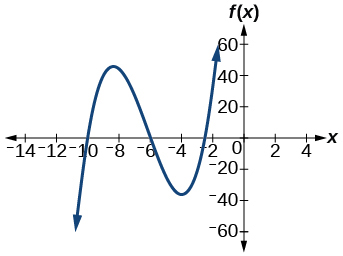
For the following exercises, use Descartes’ Rule to determine the possible number of positive and negative solutions. Then graph to confirm which of those possibilities is the actual combination.
Answer
0 positive, 3 or 1 negative
3.6-53 §3.6 source ↗
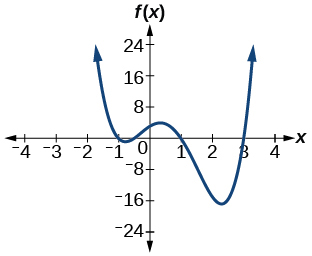
For the following exercises, use Descartes’ Rule to determine the possible number of positive and negative solutions. Then graph to confirm which of those possibilities is the actual combination.
Answer
2 or 0 positive, 2 or 0 negative
3.6-55 §3.6 source ↗
For the following exercises, use Descartes’ Rule to determine the possible number of positive and negative solutions. Then graph to confirm which of those possibilities is the actual combination.
Answer
2 or 0 positive, 2 or 0 negative
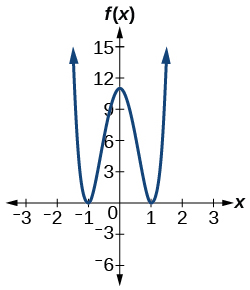
3.6-57 §3.6 source ↗
For the following exercises, list all possible rational zeros for the functions.
Answer
3.6-59 §3.6 source ↗
For the following exercises, list all possible rational zeros for the functions.
Answer
3.6-61 §3.6 source ↗
For the following exercises, use your calculator to graph the polynomial function. Based on the graph, find the rational zeros. All real solutions are rational.
Answer
3.6-63 §3.6 source ↗
For the following exercises, use your calculator to graph the polynomial function. Based on the graph, find the rational zeros. All real solutions are rational.
Answer
3.6-65 §3.6 source ↗
For the following exercises, use your calculator to graph the polynomial function. Based on the graph, find the rational zeros. All real solutions are rational.
Answer
3.6-67 §3.6 source ↗
For the following exercises, construct a polynomial function of least degree possible using the given information.
Real roots: –1, 1 (with multiplicity 2 and 1) and
Answer
3.6-69 §3.6 source ↗
For the following exercises, construct a polynomial function of least degree possible using the given information.
Real roots: , 0, and
Answer
3.6-71 §3.6 source ↗
For the following exercises, find the dimensions of the box described.
The length is twice as long as the width. The height is 2 inches greater than the width. The volume is 192 cubic inches.
Answer
3.6-73 §3.6 source ↗
For the following exercises, find the dimensions of the box described.
The length is one inch more than the width, which is one inch more than the height. The volume is 86.625 cubic inches.
Answer
3.6-75 §3.6 source ↗
For the following exercises, find the dimensions of the box described.
The length is 3 inches more than the width. The width is 2 inches more than the height. The volume is 120 cubic inches.
Answer
3.6-77 §3.6 source ↗
For the following exercises, find the dimensions of the right circular cylinder described.
The height is one less than one half the radius. The volume is cubic meters.
Answer
3.6-79 §3.6 source ↗
For the following exercises, find the dimensions of the right circular cylinder described.
The radius and height differ by two meters. The height is greater and the volume is cubic meters.
Answer
Try It #1 §3.7 source ↗
Answer
Try It #2 §3.7 source ↗
Answer
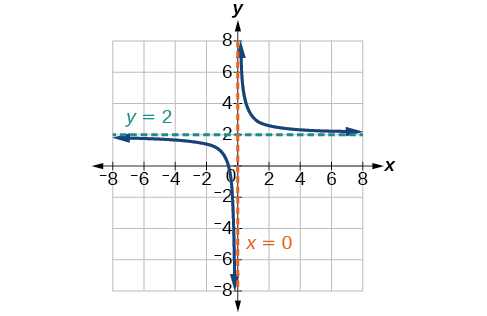
The function and the asymptotes are shifted 3 units right and 4 units down. As and as
The function is
Try It #3 §3.7 source ↗
Answer
Try It #4 §3.7 source ↗
Answer
Try It #5 §3.7 source ↗
Answer
Try It #6 §3.7 source ↗
Find the vertical and horizontal asymptotes of the function:
Answer
Try It #7 §3.7 source ↗
Answer
For the transformed reciprocal squared function, we find the rational form.
Because the numerator is the same degree as the denominator we know that as is the horizontal asymptote. Next, we set the denominator equal to zero, and find that the vertical asymptote is because as We then set the numerator equal to 0 and find the x-intercepts are at and Finally, we evaluate the function at 0 and find the y-intercept to be at
Try It #8 §3.7 source ↗
Answer
Horizontal asymptote at Vertical asymptotes at y-intercept at
x-intercepts at is a zero with multiplicity 2, and the graph bounces off the x-axis at this point. is a single zero and the graph crosses the axis at this point.
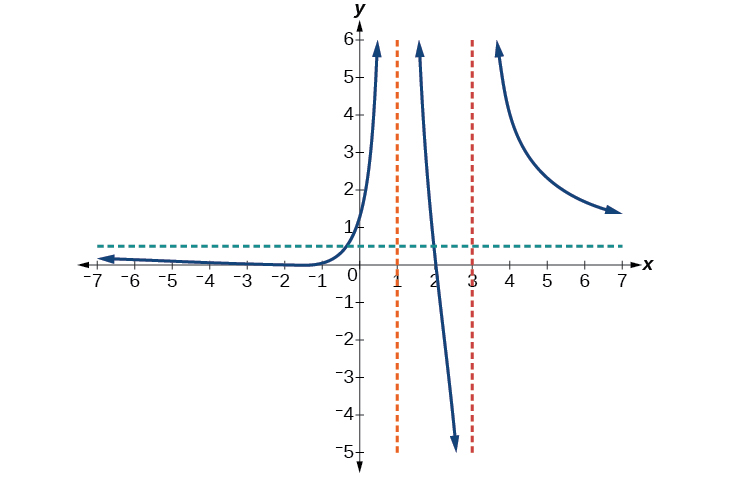
3.7-1 §3.7 source ↗
Answer
3.7-3 §3.7 source ↗
Answer
3.7-5 §3.7 source ↗
Answer
3.7-7 §3.7 source ↗
For the following exercises, find the domain of the rational functions.
Answer
3.7-9 §3.7 source ↗
For the following exercises, find the domain of the rational functions.
Answer
3.7-11 §3.7 source ↗
For the following exercises, find the domain, vertical asymptotes, and horizontal asymptotes of the functions.
Answer
3.7-13 §3.7 source ↗
For the following exercises, find the domain, vertical asymptotes, and horizontal asymptotes of the functions.
Answer
3.7-15 §3.7 source ↗
For the following exercises, find the domain, vertical asymptotes, and horizontal asymptotes of the functions.
Answer
3.7-17 §3.7 source ↗
For the following exercises, find the domain, vertical asymptotes, and horizontal asymptotes of the functions.
Answer
3.7-19 §3.7 source ↗
For the following exercises, find the domain, vertical asymptotes, and horizontal asymptotes of the functions.
Answer
3.7-21 §3.7 source ↗
For the following exercises, find the x- and y-intercepts for the functions.
Answer
3.7-23 §3.7 source ↗
For the following exercises, find the x- and y-intercepts for the functions.
Answer
3.7-25 §3.7 source ↗
For the following exercises, describe the local and end behavior of the functions.
Answer
Local behavior:
End behavior:
3.7-27 §3.7 source ↗
For the following exercises, describe the local and end behavior of the functions.
Answer
3.7-29 §3.7 source ↗
For the following exercises, describe the local and end behavior of the functions.
Answer
Local behavior: ,
End behavior:
3.7-31 §3.7 source ↗
For the following exercises, find the slant asymptote of the functions.
Answer
3.7-33 §3.7 source ↗
For the following exercises, find the slant asymptote of the functions.
Answer
3.7-35 §3.7 source ↗
For the following exercises, use the given transformation to graph the function. Note the vertical and horizontal asymptotes.
The reciprocal function shifted up two units.
Answer
3.7-37 §3.7 source ↗
For the following exercises, use the given transformation to graph the function. Note the vertical and horizontal asymptotes.
The reciprocal squared function shifted to the right 2 units.
Answer
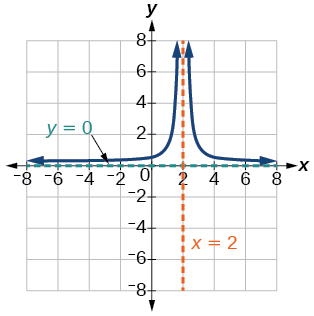
3.7-39 §3.7 source ↗
For the following exercises, find the horizontal intercepts, the vertical intercept, the vertical asymptotes, and the horizontal or slant asymptote of the functions. Use that information to sketch a graph.
Answer
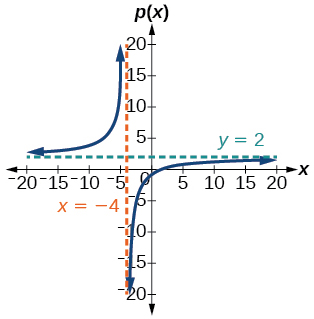
3.7-41 §3.7 source ↗
For the following exercises, find the horizontal intercepts, the vertical intercept, the vertical asymptotes, and the horizontal or slant asymptote of the functions. Use that information to sketch a graph.
Answer
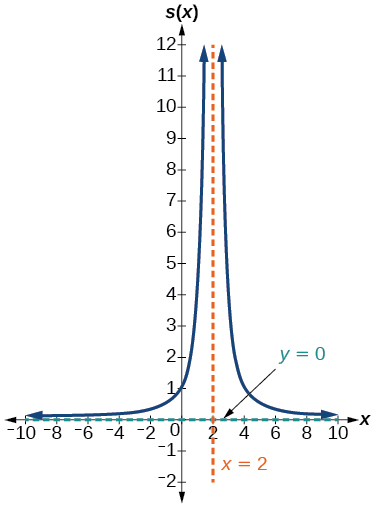
3.7-43 §3.7 source ↗
For the following exercises, find the horizontal intercepts, the vertical intercept, the vertical asymptotes, and the horizontal or slant asymptote of the functions. Use that information to sketch a graph.
Answer
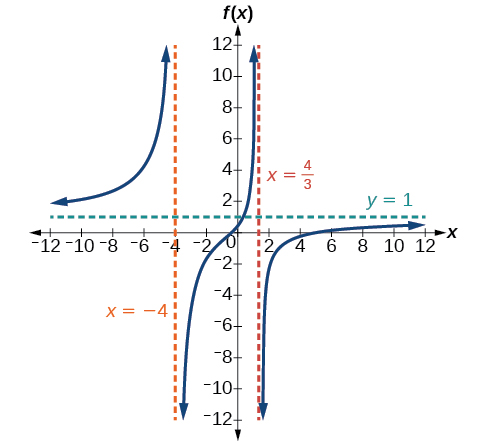
3.7-45 §3.7 source ↗
For the following exercises, find the horizontal intercepts, the vertical intercept, the vertical asymptotes, and the horizontal or slant asymptote of the functions. Use that information to sketch a graph.
Answer
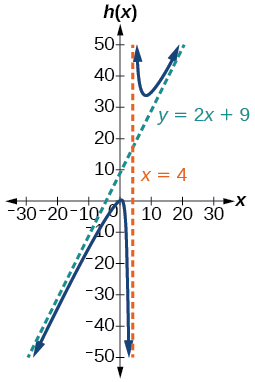
; removable discontinuity (hole) at
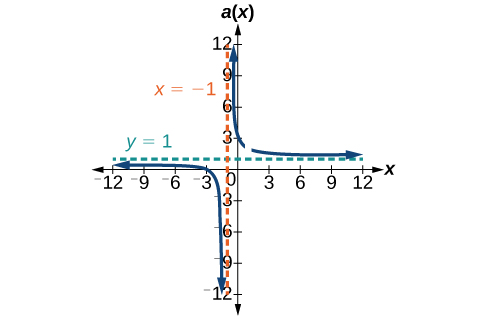
3.7-47 §3.7 source ↗
For the following exercises, find the horizontal intercepts, the vertical intercept, the vertical asymptotes, and the horizontal or slant asymptote of the functions. Use that information to sketch a graph.
Answer
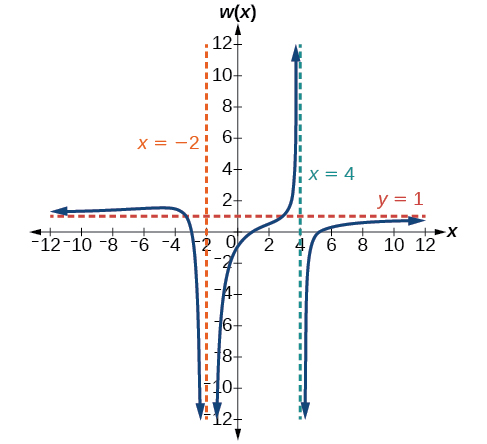
3.7-49 §3.7 source ↗
For the following exercises, find the horizontal intercepts, the vertical intercept, the vertical asymptotes, and the horizontal or slant asymptote of the functions. Use that information to sketch a graph.
Answer
3.7-51 §3.7 source ↗
For the following exercises, write an equation for a rational function with the given characteristics.
Vertical asymptotes at and x-intercepts at and y-intercept at
Answer
3.7-53 §3.7 source ↗
For the following exercises, write an equation for a rational function with the given characteristics.
Vertical asymptotes at and x-intercepts at and Horizontal asymptote at
Answer
3.7-55 §3.7 source ↗
For the following exercises, write an equation for a rational function with the given characteristics.
Vertical asymptote at Double zero at y-intercept at
Answer
3.7-57 §3.7 source ↗
For the following exercises, use the graphs to write an equation for the function.
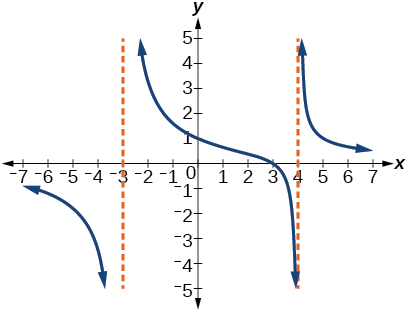
Answer
3.7-59 §3.7 source ↗
For the following exercises, use the graphs to write an equation for the function.
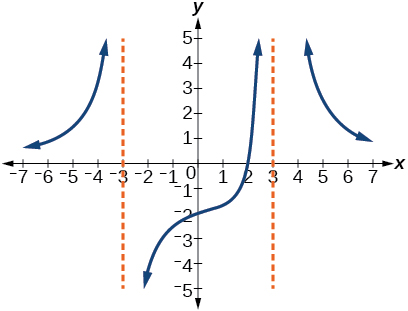
Answer
3.7-61 §3.7 source ↗
For the following exercises, use the graphs to write an equation for the function.
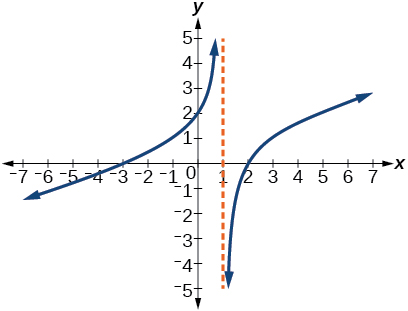
Answer
3.7-63 §3.7 source ↗
For the following exercises, use the graphs to write an equation for the function.
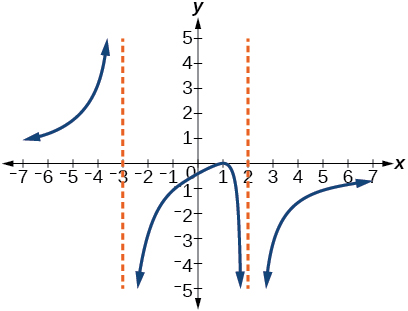
Answer
3.7-65 §3.7 source ↗
For the following exercises, make tables to show the behavior of the function near the vertical asymptote and reflecting the horizontal asymptote
Answer
| 2.01 | 2.001 | 2.0001 | 1.99 | 1.999 | |
| 100 | 1,000 | 10,000 | –100 | –1,000 |
| 10 | 100 | 1,000 | 10,000 | 100,000 | |
| .125 | .0102 | .001 | .0001 | .00001 |
Vertical asymptote Horizontal asymptote
3.7-67 §3.7 source ↗
For the following exercises, make tables to show the behavior of the function near the vertical asymptote and reflecting the horizontal asymptote
Answer
| –4.1 | –4.01 | –4.001 | –3.99 | –3.999 | |
| 82 | 802 | 8,002 | –798 | –7998 |
| 10 | 100 | 1,000 | 10,000 | 100,000 | |
| 1.4286 | 1.9331 | 1.992 | 1.9992 | 1.999992 |
Vertical asymptote Horizontal asymptote
3.7-69 §3.7 source ↗
For the following exercises, make tables to show the behavior of the function near the vertical asymptote and reflecting the horizontal asymptote
Answer
| –.9 | –.99 | –.999 | –1.1 | –1.01 | |
| 81 | 9,801 | 998,001 | 121 | 10,201 |
| 10 | 100 | 1,000 | 10,000 | 100,000 | |
| .82645 | .9803 | .998 | .9998 |
Vertical asymptote Horizontal asymptote
3.7-71 §3.7 source ↗
For the following exercises, use a calculator to graph Use the graph to solve
Answer
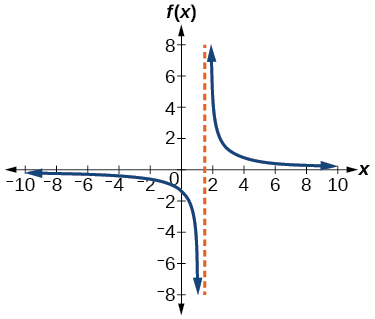
3.7-73 §3.7 source ↗
For the following exercises, use a calculator to graph Use the graph to solve
Answer
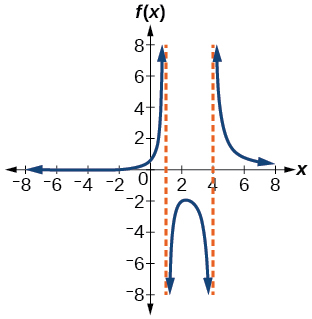
3.7-75 §3.7 source ↗
For the following exercises, identify the removable discontinuity.
Answer
3.7-77 §3.7 source ↗
For the following exercises, identify the removable discontinuity.
Answer
3.7-79 §3.7 source ↗
For the following exercises, identify the removable discontinuity.
Answer
3.7-81 §3.7 source ↗
For the following exercises, express a rational function that describes the situation.
In the refugee camp hospital, a large mixing tank currently contains 300 gallons of water, into which 8 pounds of sugar have been mixed. A tap will open, pouring 20 gallons of water per minute into the tank at the same time sugar is poured into the tank at a rate of 2 pounds per minute. Find the concentration (pounds per gallon) of sugar in the tank after minutes.
Answer
3.7-83 §3.7 source ↗
For the following exercises, use the given rational function to answer the question.
The concentration of a drug in a patient’s bloodstream hours after injection is given by Use a calculator to approximate the time when the concentration is highest.
Answer
3.7-85 §3.7 source ↗
For the following exercises, construct a rational function that will help solve the problem. Then, use a calculator to answer the question.
A rectangular box with a square base is to have a volume of 20 cubic feet. The material for the base costs 30 cents/ square foot. The material for the sides costs 10 cents/square foot. The material for the top costs 20 cents/square foot. Determine the dimensions that will yield minimum cost. Let = length of the side of the base.
Answer
3.7-87 §3.7 source ↗
For the following exercises, construct a rational function that will help solve the problem. Then, use a calculator to answer the question.
A right circular cylinder with no top has a volume of 50 cubic meters. Find the radius that will yield minimum surface area. Let = radius.
Answer
Try It #1 §3.8 source ↗
Answer
Try It #2 §3.8 source ↗
Answer
Try It #3 §3.8 source ↗
Answer
Try It #4 §3.8 source ↗
Answer
Try It #5 §3.8 source ↗
Answer
3.8-1 §3.8 source ↗
Answer
3.8-3 §3.8 source ↗
Answer
3.8-5 §3.8 source ↗
For the following exercises, find the inverse of the function on the given domain.
Answer
3.8-7 §3.8 source ↗
For the following exercises, find the inverse of the function on the given domain.
Answer
3.8-9 §3.8 source ↗
For the following exercises, find the inverse of the function on the given domain.
Answer
3.8-11 §3.8 source ↗
For the following exercises, find the inverse of the function on the given domain.
Answer
3.8-13 §3.8 source ↗
For the following exercises, find the inverse of the functions.
Answer
3.8-15 §3.8 source ↗
For the following exercises, find the inverse of the functions.
Answer
3.8-17 §3.8 source ↗
For the following exercises, find the inverse of the functions.
Answer
3.8-19 §3.8 source ↗
For the following exercises, find the inverse of the functions.
Answer
3.8-21 §3.8 source ↗
For the following exercises, find the inverse of the functions.
Answer
3.8-23 §3.8 source ↗
For the following exercises, find the inverse of the functions.
Answer
3.8-25 §3.8 source ↗
For the following exercises, find the inverse of the functions.
Answer
3.8-27 §3.8 source ↗
For the following exercises, find the inverse of the functions.
Answer
3.8-29 §3.8 source ↗
For the following exercises, find the inverse of the functions.
Answer
3.8-31 §3.8 source ↗
For the following exercises, find the inverse of the functions.
Answer
3.8-33 §3.8 source ↗
For the following exercises, find the inverse of the function and graph both the function and its inverse.
Answer
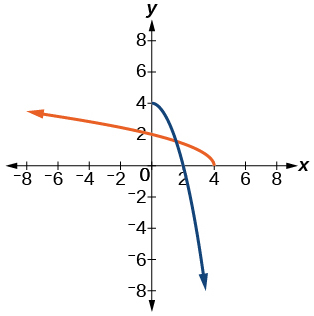
3.8-35 §3.8 source ↗
For the following exercises, find the inverse of the function and graph both the function and its inverse.
Answer
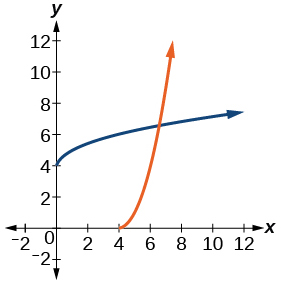
3.8-37 §3.8 source ↗
For the following exercises, find the inverse of the function and graph both the function and its inverse.
Answer
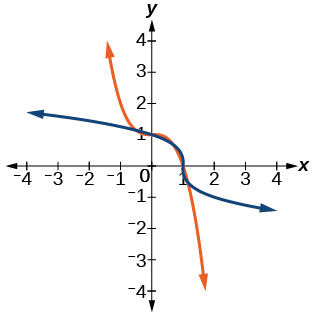
3.8-39 §3.8 source ↗
For the following exercises, find the inverse of the function and graph both the function and its inverse.
Answer
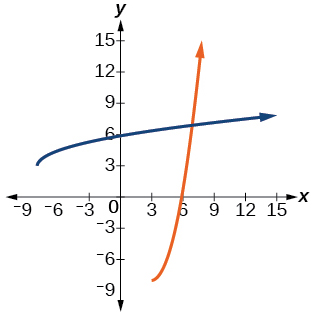
3.8-41 §3.8 source ↗
For the following exercises, find the inverse of the function and graph both the function and its inverse.
Answer
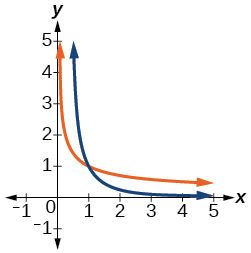
3.8-43 §3.8 source ↗
For the following exercises, use a graph to help determine the domain of the functions.
Answer
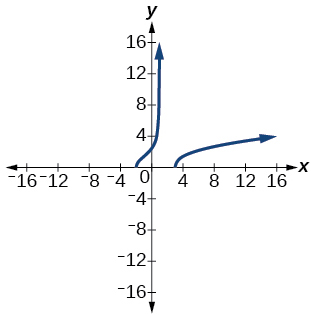
3.8-45 §3.8 source ↗
For the following exercises, use a graph to help determine the domain of the functions.
Answer
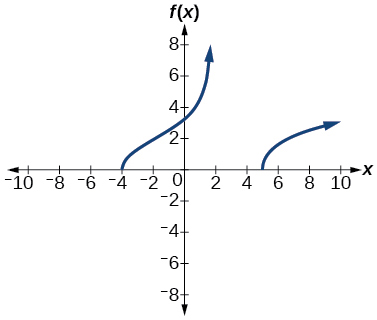
3.8-47 §3.8 source ↗
For the following exercises, use a calculator to graph the function. Then, using the graph, give three points on the graph of the inverse with y-coordinates given.
Answer
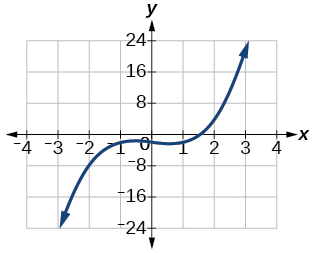
3.8-49 §3.8 source ↗
For the following exercises, use a calculator to graph the function. Then, using the graph, give three points on the graph of the inverse with y-coordinates given.
Answer
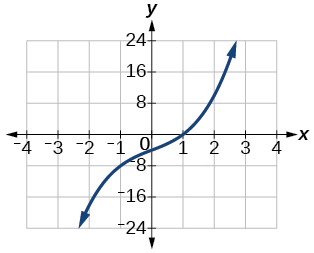
3.8-51 §3.8 source ↗
For the following exercises, use a calculator to graph the function. Then, using the graph, give three points on the graph of the inverse with y-coordinates given.
Answer
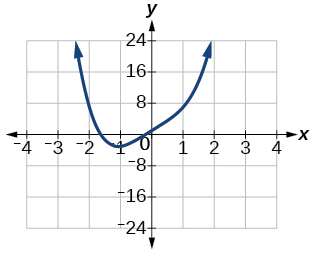
3.8-53 §3.8 source ↗
For the following exercises, find the inverse of the functions with positive real numbers.
Answer
3.8-55 §3.8 source ↗
For the following exercises, find the inverse of the functions with positive real numbers.
Answer
3.8-57 §3.8 source ↗
For the following exercises, determine the function described and then use it to answer the question.
An object dropped from a height of 200 meters has a height, in meters after seconds have lapsed, such that Express as a function of height, and find the time to reach a height of 50 meters.
Answer
3.8-59 §3.8 source ↗
For the following exercises, determine the function described and then use it to answer the question.
The volume, of a sphere in terms of its radius, is given by Express as a function of and find the radius of a sphere with volume of 200 cubic feet.
Answer
3.8-61 §3.8 source ↗
For the following exercises, determine the function described and then use it to answer the question.
A container holds 100 ml of a solution that is 25 ml acid. If ml of a solution that is 60% acid is added, the function gives the concentration, as a function of the number of ml added, Express as a function of and determine the number of mL that need to be added to have a solution that is 50% acid.
Answer
3.8-63 §3.8 source ↗
For the following exercises, determine the function described and then use it to answer the question.
The volume of a cylinder , in terms of radius, and height, is given by If a cylinder has a height of 6 meters, express the radius as a function of and find the radius of a cylinder with volume of 300 cubic meters.
Answer
3.8-65 §3.8 source ↗
For the following exercises, determine the function described and then use it to answer the question.
The volume of a right circular cone, in terms of its radius, and its height, is given by Express in terms of if the height of the cone is 12 inches and find the radius of a cone with volume of 50 cubic inches.
Answer
Try It #1 §3.9 source ↗
Answer
Try It #2 §3.9 source ↗
Answer
Try It #3 §3.9 source ↗
Answer
3.9-1 §3.9 source ↗
Answer
3.9-3 §3.9 source ↗
Answer
3.9-5 §3.9 source ↗
For the following exercises, write an equation describing the relationship of the given variables.
varies directly as the square of and when
Answer
3.9-7 §3.9 source ↗
For the following exercises, write an equation describing the relationship of the given variables.
varies directly as the cube of and when
Answer
3.9-9 §3.9 source ↗
For the following exercises, write an equation describing the relationship of the given variables.
varies directly as the fourth power of and when
Answer
3.9-11 §3.9 source ↗
For the following exercises, write an equation describing the relationship of the given variables.
varies inversely as the square of and when
Answer
3.9-13 §3.9 source ↗
For the following exercises, write an equation describing the relationship of the given variables.
varies inversely as the fourth power of and when
Answer
3.9-15 §3.9 source ↗
For the following exercises, write an equation describing the relationship of the given variables.
varies inversely as the cube root of and when
Answer
3.9-17 §3.9 source ↗
For the following exercises, write an equation describing the relationship of the given variables.
varies jointly as , , and and when , , , then
Answer
3.9-19 §3.9 source ↗
For the following exercises, write an equation describing the relationship of the given variables.
varies jointly as and the square root of and when and , then
Answer
3.9-21 §3.9 source ↗
For the following exercises, write an equation describing the relationship of the given variables.
varies jointly as and and inversely as When , , and , then
Answer
3.9-23 §3.9 source ↗
For the following exercises, write an equation describing the relationship of the given variables.
varies jointly as and and inversely as the square root of and the square of When , , and , then
Answer
3.9-25 §3.9 source ↗
For the following exercises, use the given information to find the unknown value.
varies directly as the square of . When , then . Find when .
Answer
3.9-27 §3.9 source ↗
For the following exercises, use the given information to find the unknown value.
varies directly as the square root of When , then . Find .
Answer
3.9-29 §3.9 source ↗
For the following exercises, use the given information to find the unknown value.
varies inversely with When , then . Find when .
Answer
3.9-31 §3.9 source ↗
For the following exercises, use the given information to find the unknown value.
varies inversely with the cube of When , then . Find when .
Answer
3.9-33 §3.9 source ↗
For the following exercises, use the given information to find the unknown value.
varies inversely with the cube root of When then Find when
Answer
3.9-35 §3.9 source ↗
For the following exercises, use the given information to find the unknown value.
varies jointly as When and then Find when and
Answer
3.9-37 §3.9 source ↗
For the following exercises, use the given information to find the unknown value.
varies jointly as the square of and the square root of When and then Find when and
Answer
3.9-39 §3.9 source ↗
For the following exercises, use the given information to find the unknown value.
varies jointly as the square of and the cube of and inversely as the square root of When and then Find when and
Answer
3.9-41 §3.9 source ↗
For the following exercises, use a calculator to graph the equation implied by the given variation.
varies directly with the square of and when
Answer
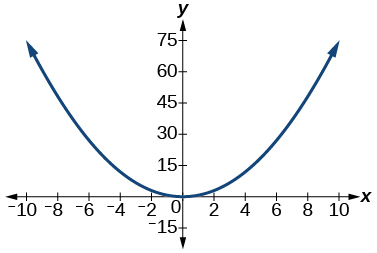
3.9-43 §3.9 source ↗
For the following exercises, use a calculator to graph the equation implied by the given variation.
varies directly as the square root of and when
Answer
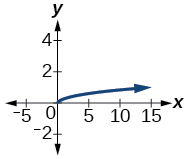
3.9-45 §3.9 source ↗
For the following exercises, use a calculator to graph the equation implied by the given variation.
varies inversely as the square of and when
Answer
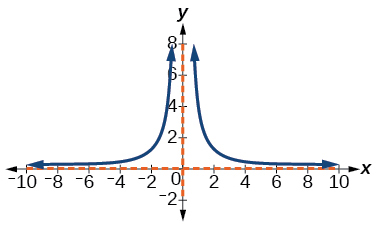
3.9-47 §3.9 source ↗
For the following exercises, use Kepler’s Law, which states that the square of the time, required for a planet to orbit the Sun varies directly with the cube of the mean distance, that the planet is from the Sun.
Use the result from the previous exercise to determine the time required for Mars to orbit the Sun if its mean distance is 142 million miles.
Answer
3.9-49 §3.9 source ↗
For the following exercises, use Kepler’s Law, which states that the square of the time, required for a planet to orbit the Sun varies directly with the cube of the mean distance, that the planet is from the Sun.
Use the result from the previous exercise to determine the time required for Venus to orbit the Sun if its mean distance is 108 million kilometers.
Answer
3.9-51 §3.9 source ↗
For the following exercises, use the given information to answer the questions.
The distance that an object falls varies directly with the square of the time, of the fall. If an object falls 16 feet in one second, how long for it to fall 144 feet?
Answer
3.9-53 §3.9 source ↗
For the following exercises, use the given information to answer the questions.
The rate of vibration of a string under constant tension varies inversely with the length of the string. If a string is 24 inches long and vibrates 128 times per second, what is the length of a string that vibrates 64 times per second?
Answer
3.9-55 §3.9 source ↗
For the following exercises, use the given information to answer the questions.
The weight of an object above the surface of the Earth varies inversely with the square of the distance from the center of the Earth. If a body weighs 50 pounds when it is 3960 miles from Earth’s center, what would it weigh it were 3970 miles from Earth’s center?
Answer
3.9-57 §3.9 source ↗
For the following exercises, use the given information to answer the questions.
The current in a circuit varies inversely with its resistance measured in ohms. When the current in a circuit is 40 amperes, the resistance is 10 ohms. Find the current if the resistance is 12 ohms.
Answer
3.9-59 §3.9 source ↗
For the following exercises, use the given information to answer the questions.
The horsepower (hp) that a shaft can safely transmit varies jointly with its speed (in revolutions per minute (rpm)) and the cube of the diameter. If the shaft of a certain material 3 inches in diameter can transmit 45 hp at 100 rpm, what must the diameter be in order to transmit 60 hp at 150 rpm?
Answer
3.R-1 §3.R source ↗
You have reached the end of Chapter 3: Polynomial and Rational Functions. Let’s review some of the Key Terms, Concepts and Equations you have learned.
Perform the indicated operation with complex numbers.
Answer
3.R-3 §3.R source ↗
You have reached the end of Chapter 3: Polynomial and Rational Functions. Let’s review some of the Key Terms, Concepts and Equations you have learned.
Perform the indicated operation with complex numbers.
Answer
3.R-5 §3.R source ↗
Solve the following equations over the complex number system.
Answer
3.R-7 §3.R source ↗
For the following exercises, write the quadratic function in standard form. Then, give the vertex and axes intercepts. Finally, graph the function.
Answer
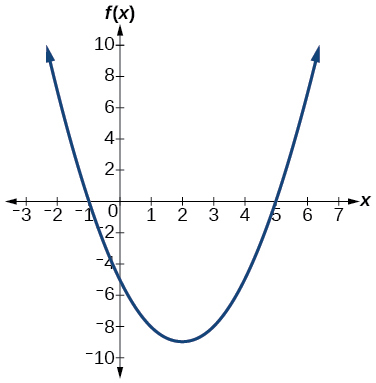
3.R-9 §3.R source ↗
For the following problems, find the equation of the quadratic function using the given information.
The vertex is and a point on the graph is
Answer
3.R-11 §3.R source ↗
Answer the following questions.
A rectangular plot of land is to be enclosed by fencing. One side is along a river and so needs no fence. If the total fencing available is 600 meters, find the dimensions of the plot to have maximum area.
Answer
3.R-13 §3.R source ↗
For the following exercises, determine if the function is a polynomial function and, if so, give the degree and leading coefficient.
Answer
3.R-15 §3.R source ↗
For the following exercises, determine if the function is a polynomial function and, if so, give the degree and leading coefficient.
Answer
3.R-17 §3.R source ↗
For the following exercises, determine end behavior of the polynomial function.
Answer
3.R-19 §3.R source ↗
For the following exercises, find all zeros of the polynomial function, noting multiplicities.
Answer
3.R-21 §3.R source ↗
For the following exercises, find all zeros of the polynomial function, noting multiplicities.
Answer
3.R-23 §3.R source ↗
For the following exercises, based on the given graph, determine the zeros of the function and note multiplicity.
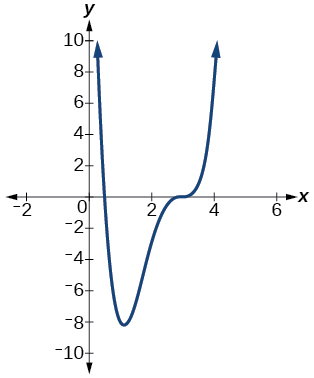
Answer
3.R-25 §3.R source ↗
For the following exercises, use long division to find the quotient and remainder.
Answer
3.R-27 §3.R source ↗
For the following exercises, use synthetic division to find the quotient. If the divisor is a factor, then write the factored form.
Answer
3.R-29 §3.R source ↗
For the following exercises, use synthetic division to find the quotient. If the divisor is a factor, then write the factored form.
Answer
3.R-31 §3.R source ↗
For the following exercises, use the Rational Zero Theorem to help you solve the polynomial equation.
Answer
3.R-33 §3.R source ↗
For the following exercises, use the Rational Zero Theorem to help you solve the polynomial equation.
Answer
3.R-35 §3.R source ↗
For the following exercises, use Descartes’ Rule of Signs to find the possible number of positive and negative solutions.
Answer
3.R-37 §3.R source ↗
For the following rational functions, find the intercepts and the vertical and horizontal asymptotes, and then use them to sketch a graph.
Answer
Intercepts , Asymptotes and
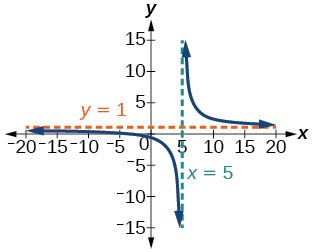
3.R-39 §3.R source ↗
For the following rational functions, find the intercepts and the vertical and horizontal asymptotes, and then use them to sketch a graph.
Answer
Intercepts (3, 0), (-3, 0), and , Asymptotes
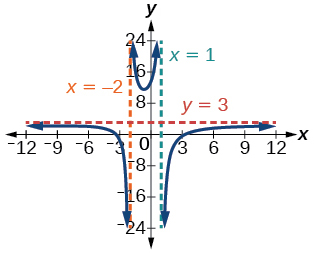
3.R-41 §3.R source ↗
For the following exercises, find the slant asymptote.
Answer
3.R-43 §3.R source ↗
For the following exercises, find the inverse of the function with the domain given.
Answer
3.R-45 §3.R source ↗
For the following exercises, find the inverse of the function with the domain given.
Answer
3.R-47 §3.R source ↗
For the following exercises, find the inverse of the function with the domain given.
Answer
3.R-49 §3.R source ↗
For the following exercises, find the unknown value.
varies directly as the square of If when find if
Answer
3.R-51 §3.R source ↗
For the following exercises, find the unknown value.
varies jointly as the cube of and as If when and find if and
Answer
3.R-53 §3.R source ↗
For the following exercises, solve the application problem.
The weight of an object above the surface of the earth varies inversely with the square of the distance from the center of the earth. If a person weighs 150 pounds when he is on the surface of the earth (3,960 miles from center), find the weight of the person if he is 20 miles above the surface.
Answer
3.T-1 §3.T source ↗
Perform the indicated operation or solve the equation.
Answer
3.T-3 §3.T source ↗
Perform the indicated operation or solve the equation.
Answer
3.T-5 §3.T source ↗
Determine the end behavior of the polynomial function.
Answer
3.T-7 §3.T source ↗
Write the quadratic function in standard form. Determine the vertex and axes intercepts and graph the function.
Answer
, vertex , intercepts
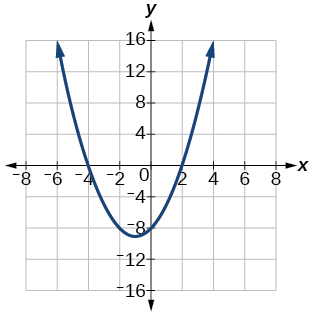
3.T-9 §3.T source ↗
Solve the following application problem.
A rectangular field is to be enclosed by fencing. In addition to the enclosing fence, another fence is to divide the field into two parts, running parallel to two sides. If 1,200 feet of fencing is available, find the maximum area that can be enclosed.
Answer
3.T-11 §3.T source ↗
Find all zeros of the following polynomial functions, noting multiplicities.
Answer
3.T-13 §3.T source ↗
Use long division to find the quotient.
Answer
3.T-15 §3.T source ↗
Use synthetic division to find the quotient. If the divisor is a factor, write the factored form.
Answer
3.T-17 §3.T source ↗
Use the Rational Zero Theorem to help you find the zeros of the polynomial functions.
Answer
3.T-19 §3.T source ↗
Use the Rational Zero Theorem to help you find the zeros of the polynomial functions.
Answer
3.T-21 §3.T source ↗
Given the following information about a polynomial function, find the function.
It has a zero of multiplicity 3 at and another zero at . It contains the point
Answer
3.T-23 §3.T source ↗
For the following rational functions, find the intercepts and horizontal and vertical asymptotes, and sketch a graph.
Answer
Intercepts , Asymptotes .
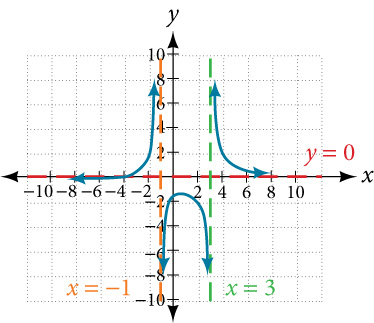
3.T-25 §3.T source ↗
Find the slant asymptote of the rational function.
Answer
3.T-27 §3.T source ↗
Find the inverse of the function.
Answer
3.T-29 §3.T source ↗
Find the unknown value.
varies inversely as the square of and when Find if
Answer
3.T-31 §3.T source ↗
Solve the following application problem.
The distance a body falls varies directly as the square of the time it falls. If an object falls 64 feet in 2 seconds, how long will it take to fall 256 feet?
Answer
Loading chapter 4…
Problems and answers are adapted from Precalculus 2e by Jay Abramson, OpenStax, and are used under the CC BY-NC-SA 4.0 licence. Access for free at https://openstax.org/books/precalculus-2e/pages/1-introduction-to-functions. Illustrations: Copyright Rice University, OpenStax, under CC BY-NC-SA 4.0 license. This adaptation is released under the same licence, is non-commercial, and is neither affiliated with nor endorsed by OpenStax or Rice University.