Every problem in the chapter beside the book’s answer, a chapter at a time as you scroll.

Chapter 12: Balanced Scorecard and Other Performance Measures

17 problems · 2 figures

Multiple Choice 12.1 §12.1 source ↗

Components of the organization that are demotivating for purposes of performance management are known as ________.
  1. a.
    business goals
  2. b.
    strategic plans
  3. c.
    uncontrollable factors
  4. d.
    incentives

Answer

C. uncontrollable factors

Multiple Choice 12.3 §12.1 source ↗

Goal congruence in well-designed performance measurement systems best explains a congruence between ________.
  1. a.
    employees and the company
  2. b.
    strategic plans and the future
  3. c.
    decisions and outcomes
  4. d.
    feedback and measurement

Answer

A. employees and the company

Multiple Choice 12.5 §12.1 source ↗

Performance measures are only useful if ________.
  1. a.
    there are both controllable and uncontrollable factors to evaluate managers
  2. b.
    manager reward systems are designed by the chief financial officer prior to implementation
  3. c.
    all of the measures used are accounting numbers
  4. d.
    there is a baseline against which to compare the measured results

Answer

A. there are both controllable and uncontrollable factors to evaluate managers

Multiple Choice 12.7 §12.2 source ↗

A good performance measurement system will align the goals of management with ________.
  1. a.
    the goals of the city manager and the mayoral staff
  2. b.
    the goals of the corporation, and both parties will benefit
  3. c.
    the priorities of the stockholders as listed at the annual meeting
  4. d.
    the investment department’s response to the annual audit

Answer

B. the goals of the corporation, and both parties will benefit

Multiple Choice 12.9 §12.2 source ↗

A good performance measurement system will include which of the following?
  1. a.
    short-term goals
  2. b.
    long-term goals
  3. c.
    short-term and long-term goals
  4. d.
    no goals at all

Answer

C. short-term and long-term goals

Multiple Choice 12.11 §12.3 source ↗

Dixon Construction Materials has collected this information:
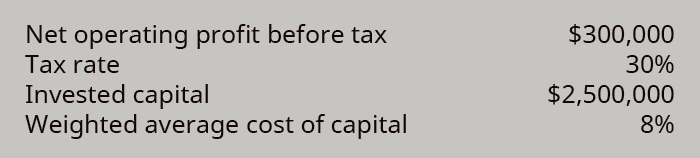
Cost of the machine $2,000,000. Income to be generated by the machine 1,000,000. Income without the new machine 7,000,000. Beginning of the year capital assets (without the machine) 12,000,000. End of the year capital assets (without the machine) 12,400,000. Tax rate 30 percent. Minimum required rate of return 15 percent. Weighted average cost of capital 9 percent. Sales revenue without the machine 18,000,000. Sales revenue with the machine 19,400,000.

Based on this information, what is the EVA for the project?

  1. a.
    $100,000
  2. b.
    $10,000
  3. c.
    $450,000
  4. d.
    ($110,000)

Answer

B. $10,000

Multiple Choice 12.13 §12.3 source ↗

Which of the following measures the profitability of a division relative to the size of its investment in capital assets?
  1. a.
    residual income (RI)
  2. b.
    sales margin
  3. c.
    return on investment (ROI)
  4. d.
    economic value added (EVA)

Answer

C. return on investment (ROI)

Multiple Choice 12.15 §12.3 source ↗

Calculate the ROI for Gardner Chemical given the following information:
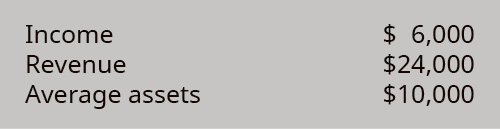
Income $6,000. Revenue $24,000. Average assets $10,000.
  1. a.
    25%
  2. b.
    24%
  3. c.
    60%
  4. d.
    40%

Answer

C. 60%

Multiple Choice 12.17 §12.4 source ↗

The metrics based on nonfinancial information are known as ________.
  1. a.
    quantitative factors
  2. b.
    qualitative factors
  3. c.
    stakeholders
  4. d.
    stockholders

Answer

B. qualitative factors

Multiple Choice 12.19 §12.4 source ↗

People affected by decisions made by a company, including investors, creditors, employees, managers, regulators, customers, suppliers, and laypeople, are known as ________.
  1. a.
    quantitative factors
  2. b.
    qualitative factors
  3. c.
    stakeholders
  4. d.
    stockholders

Answer

C. stakeholders

Question 12.1 §12.1 source ↗

Why might a manager focused solely on accounting numbers miss opportunities for future benefits?

Answer

Answers will vary. Responses may focus on the short-term view versus long-term views and include examples such as: managers focusing on only profitability might avoid spending the money for long-term assets to fuel the future; managers may miss other opportunities like funding the expense for creation of a customer database, if profitability is the focus in the short term; managers may avoid research and development costs that would be used to create the next generation of their product to achieve profitability in the short term.

Question 12.3 §12.1 source ↗

Should an organization focus on controllable or uncontrollable factors to effectively implement a successful performance measurement system? Explain your answer.

Answer

Controllable. Responses will vary based on students’ prior experiences.

Question 12.5 §12.1 source ↗

What are the four types of centers and their corresponding responsibilities?

Answer

Revenue center—the manager has control over the revenues that are generated for the corporation but not over the costs of the organization. Cost center—the manager has control over costs but not over revenues. Profit center—the manager has control over both revenues and costs. Investment center— the manager has control over revenues, costs, and capital assets.

Question 12.7 §12.2 source ↗

Compare and contrast short- and long-term goals for a company. Give an example of each, and explain why they are important for performance measurement systems.

Answer

Short-term goals include goals such as reducing costs of production by a certain percentage for the current year or increasing year-over-year sales by a certain percentage. Long-term goals may include goals such as expanding into new territories or adding new products over the next five years. A good performance measurement system will include both short- and long-term measures in order to motivate managers to make decisions that will fulfill both the corporations and their own short- and long-term goals.

Question 12.9 §12.2 source ↗

What does goal congruence mean? Provide an example with your explanation.

Answer

Answers will vary and should lead to discussions. Goal congruence means aligning the goals of the business with the personal goals of the manager. For example, when a company has a goal to significantly improve sales of a certain product, the regional sales manager will have an increased sales goal as a result.

Question 12.11 §12.3 source ↗

What is EVA and why is it superior to other performance measures?

Answer

EVA is residual income adjusted for accounting distortions. Like residual income, it encourages managers to make appropriate levels of investment. In addition, it treats items such as research and development costs as having a long-term benefit to the company.

Question 12.13 §12.4 source ↗

Describe. the history and purpose of the balanced scorecard.

Answer

Answers may vary but should include some of these ideas. The idea for using both quantitative and qualitative measures in the form of a balanced scorecard was first suggested by Art Schneiderman of Analog Devices in 1987 and was later added to by Kaplan and Norton. The resulting design incorporated various performance measures grouped under four categories: financial perspective, internal operations perspective, customer perspective, and learning and growth. These areas were chosen because the success of a company is dependent on how it performs financially, which is directly related to the company’s internal operations, how the customer perceives and interacts with the company, and the direction in which the company is headed.

Loading chapter 13…

Problems and answers are adapted from Principles of Accounting, Volume 2: Managerial Accounting by Mitchell Franklin, Patty Graybeal and Dixon Cooper, OpenStax, and are used under the CC BY-NC-SA 4.0 licence. Access for free at https://openstax.org/books/principles-managerial-accounting/pages/1-why-it-matters. Illustrations: Copyright Rice University, OpenStax, under CC BY-NC-SA 4.0 license. This adaptation is released under the same licence, is non-commercial, and is neither affiliated with nor endorsed by OpenStax or Rice University.