Every problem in the chapter beside the book’s answer, a chapter at a time as you scroll.

Chapter 4: Job Order Costing

16 problems · 1 figure

Multiple Choice 4.1 §4.1 source ↗

Which of the following product situations is better suited to job order costing than to process costing?
  1. a.
    Each product batch is exactly the same as the prior batch.
  2. b.
    The costs are easily traced to a specific product.
  3. c.
    Costs are accumulated by department.
  4. d.
    The value of work in process is based on assigning standard costs.

Answer

B. The costs are easily traced to a specific product.

Multiple Choice 4.3 §4.1 source ↗

Which of the following is a prime cost?
  1. a.
    indirect materials
  2. b.
    direct labor
  3. c.
    administrative expenses
  4. d.
    factory depreciation expenses

Answer

B. direct labor

Multiple Choice 4.5 §4.1 source ↗

During production, to what are the costs in job order costing applied?
  1. a.
    manufacturing overhead
  2. b.
    cost of goods sold
  3. c.
    each individual product
  4. d.
    each individual department

Answer

C. each individual product

Multiple Choice 4.7 §4.2 source ↗

Which document shows the cost of direct materials, direct labor, and overhead applied for each specific job?
  1. a.
    job cost sheet
  2. b.
    purchase order
  3. c.
    materials requisition form
  4. d.
    receiving document

Answer

A. job cost sheet

Multiple Choice 4.9 §4.2 source ↗

Which document lists the total direct labor used in a specific job?
  1. a.
    job cost sheet
  2. b.
    purchase order
  3. c.
    employee time ticket
  4. d.
    receiving document

Answer

A. job cost sheet

Multiple Choice 4.11 §4.4 source ↗

In a job order cost system, which account shows the overhead used by the company?
  1. a.
    work in process inventory
  2. b.
    finished goods inventory
  3. c.
    cost of goods sold
  4. d.
    manufacturing overhead

Answer

D. manufacturing overhead

Multiple Choice 4.13 §4.7 source ↗

In a job order cost system, overhead applied is debited to which account?
  1. a.
    work in process inventory
  2. b.
    finished goods inventory
  3. c.
    manufacturing overhead
  4. d.
    cost of goods sold

Answer

A. work in process inventory

Multiple Choice 4.15 §4.7 source ↗

In a job order cost system, utility expense incurred is debited to which account?
  1. a.
    work in process inventory
  2. b.
    finished goods inventory
  3. c.
    manufacturing overhead
  4. d.
    cost of goods sold

Answer

C. manufacturing overhead

Multiple Choice 4.17 §4.8 source ↗

The activity base for service industries is most likely to be ________.
  1. a.
    machine hours
  2. b.
    administrative salaries
  3. c.
    direct labor cost
  4. d.
    direct labor hours

Answer

D. direct labor hours

Question 4.1 §4.1 source ↗

A printing company manufactures notebooks of various sizes. The company manufactures 3,000 notebooks each day. Should the company use process costing or job order costing?

Answer

The company should use process costing. Since there are many similar items, process costing is a better fit than job order costing.

Question 4.3 §4.1 source ↗

Choco’s Chocolates incurs these costs for the month:
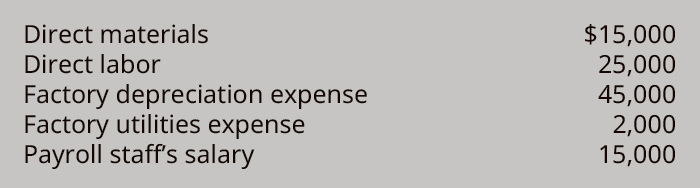
A list of costs reads “Direct materials $15,000”, “Direct labor 25,000”, “Factory depreciation expense 45,000”, “Utility expense 2000”, “Payroll staff’s salary 15,000”.

What is the conversion cost?

Answer

The conversion cost is $72,000: the sum of direct labor, factory depreciation expense, and utility expense.

Question 4.5 §4.1 source ↗

Why are product costs assigned to the product and period costs immediately expensed?

Answer

The expense recognition principle requires that expenses follow the revenue. Product costs are assigned to the product because they are associated with the revenue from the sale of the product. The cost is transferred from inventory to cost of goods sold when the item is sold. This matches the revenue from the sale with the cost of the item being sold. Period costs are expensed when incurred because they are not related to a specific product but are instead related to the time period in which revenue is earned.

Question 4.7 §4.3 source ↗

From beginning to end, place these items in the order of the flow of goods.
  1. a.
    cost of goods sold
  2. b.
    raw materials inventory
  3. c.
    finished goods inventory
  4. d.
    work in process inventory

Answer

B. raw materials inventory · D. work in process inventory · C. finished goods inventory · A. cost of goods sold

Question 4.9 §4.4 source ↗

How is the predetermined overhead rate applied?

Answer

Management uses the activity considered to be the cost driver and multiplies that rate by the activity for each specific job. The result is the amount of overhead applied to that specific job.

Question 4.11 §4.6 source ↗

Why is the manufacturing overhead account debited as expenses are recognized and then credited when overhead is applied?

Answer

Expenses normally have a debit balance, and the manufacturing overhead account is debited when expenses are incurred to recognize the incurrence. When the expenses are allocated to the asset, the work in process inventory, the expense account manufacturing overhead is credited. This is in accordance with the expense recognition principle. The timing of the expense follows the revenue, and when the costs are allocated to inventory, they become a part of the product’s cost and are recognized when the asset is sold.

Question 4.13 §4.8 source ↗

When compared to manufacturing companies, service industries do not generally use ________ as a component of product cost.

Answer

direct materials

Loading chapter 5…

Problems and answers are adapted from Principles of Accounting, Volume 2: Managerial Accounting by Mitchell Franklin, Patty Graybeal and Dixon Cooper, OpenStax, and are used under the CC BY-NC-SA 4.0 licence. Access for free at https://openstax.org/books/principles-managerial-accounting/pages/1-why-it-matters. Illustrations: Copyright Rice University, OpenStax, under CC BY-NC-SA 4.0 license. This adaptation is released under the same licence, is non-commercial, and is neither affiliated with nor endorsed by OpenStax or Rice University.