Every problem in the chapter beside the book’s answer, a chapter at a time as you scroll.

Chapter 3: Cost-Volume-Profit Analysis

18 problems · 2 figures

Multiple Choice 3.1 §3.1 source ↗

The amount of a unit’s sales price that helps to cover fixed expenses is its ________.
  1. a.
    contribution margin
  2. b.
    profit
  3. c.
    variable cost
  4. d.
    stepped cost

Answer

A. contribution margin

Multiple Choice 3.3 §3.1 source ↗

A company’s product sells for $150 and has variable costs of $60 associated with the product. What is its contribution margin ratio?
  1. a.
    10%
  2. b.
    40%
  3. c.
    60%
  4. d.
    90%

Answer

C. 60%

Multiple Choice 3.5 §3.2 source ↗

A company sells its products for $80 per unit and has per-unit variable costs of $30. What is the contribution margin per unit?
  1. a.
    $30
  2. b.
    $50
  3. c.
    $80
  4. d.
    $110

Answer

B. $50

Multiple Choice 3.7 §3.2 source ↗

Company A wants to earn $5,000 profit in the month of January. If their fixed costs are $10,000 and their product has a per-unit contribution margin of $250, how many units must they sell to reach their target income?
  1. a.
    20
  2. b.
    40
  3. c.
    60
  4. d.
    120

Answer

C. 60

Multiple Choice 3.9 §3.2 source ↗

A company has pre-tax or operating income of $120,000. If the tax rate is 40%, what is the company’s after-tax income?
  1. a.
    $300,000
  2. b.
    $240,000
  3. c.
    $48,000
  4. d.
    $72,000

Answer

D. $72,000

Multiple Choice 3.11 §3.3 source ↗

When sales price decreases and all other variables are held constant, the break-even point will ________.
  1. a.
    remain unchanged
  2. b.
    increase
  3. c.
    decrease
  4. d.
    produce a higher contribution margin

Answer

B. increase

Multiple Choice 3.13 §3.3 source ↗

When fixed costs decrease and all other variables remain unchanged, the break-even point will ________.
  1. a.
    remain unchanged
  2. b.
    increase
  3. c.
    decrease
  4. d.
    produce a lower contribution margin

Answer

C. decrease

Multiple Choice 3.15 §3.4 source ↗

If the sales mix in a multi-product environment shifts to a higher volume in low contribution margin products, the break-even point will ________.
  1. a.
    remain unchanged because all products are included in the calculation of break-even
  2. b.
    increase because the low contribution margin products have little effect on break-even
  3. c.
    increase because the per composite unit contribution margin will decrease
  4. d.
    decrease because the per composite unit contribution margin will increase

Answer

C. increase because the per composite unit contribution margin will decrease

Multiple Choice 3.17 §3.4 source ↗

Waskowski Company sells three products (A, B, and C) with a sales mix of 3:2:1. Unit sales price are shown. What is the sales price per composite unit?
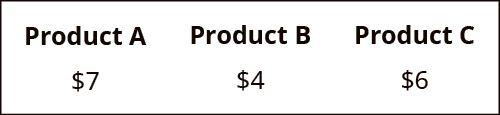
Product A $7, Product B $4, Product C $6.
  1. a.
    $17.00
  2. b.
    $25.00
  3. c.
    $35.00
  4. d.
    $20.00

Answer

C. $35.00

Multiple Choice 3.19 §3.4 source ↗

A company sells two products, Model 101 and Model 202. For every one unit of Model 101, they sell they sell two units of Model 202. Sales and cost information for the two products is shown. What is the contribution margin for a composite unit based on the sales mix?
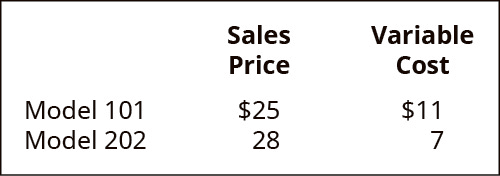
Sales Price, Variable Cost respectively: Model 101 $25, 11; Model 202 28, 7.
  1. a.
    $14
  2. b.
    $21
  3. c.
    $35
  4. d.
    $56

Answer

D. $56

Multiple Choice 3.21 §3.5 source ↗

Macom Manufacturing has total contribution margin of $61,250 and net income of $24,500 for the month of June. Marcus expects sales volume to increase by 10% in July. What are the degree of operating leverage and the expected percent change in income for Macom Manufacturing?
  1. a.
    0.4 and 10%
  2. b.
    2.5 and 10%
  3. c.
    2.5 and 25%
  4. d.
    5.0 and 50%

Answer

C. 2.5 and 25%

Multiple Choice 3.23 §3.5 source ↗

If a firm has a contribution margin of $78,090 and a net income of $13,700 for the current month, what is their degree of operating leverage?
  1. a.
    0.21
  2. b.
    1.21
  3. c.
    2.4
  4. d.
    5.7

Answer

D. 5.7

Question 3.1 §3.1 source ↗

Define and explain contribution margin on a per unit basis.

Answer

Answers will vary. Responses should include that per-unit contribution margin is the amount by which a product’s selling price exceeds it total variable cost per unit.

Question 3.3 §3.1 source ↗

Explain how a contribution margin income statement can be used to determine profitability.

Answer

Answers will vary. Responses should include that contribution income statements express total contribution margin for a given level of activity and can be useful in making decisions about product pricing and optimal levels of activity.

Question 3.5 §3.2 source ↗

What is meant by a product’s contribution margin ratio and how is this ratio useful in planning business operations?

Answer

Answers will vary. Responses should include the fact that the contribution margin ratio represents the percentage of every sales dollar available to cover fixed expenses. Businesses can use this ratio when projecting profit at various levels of sales revenue.

Question 3.7 §3.3 source ↗

After conducting a CVP analysis, most businesses will then recreate a revised or projected income statement incorporating the results of the CVP analysis. What is the benefit of taking this extra step in the analysis?

Answer

Answers will vary. Responses should include a description of how the CVP analysis information can be brought into a projected income statement that takes into account additional revenues and expenses of the business to create a “big picture” of what happens as a result of a change in cost, volume, and profit

Question 3.9 §3.4 source ↗

Explain what a sales mix is and how changes in the sales mix affect the break-even point.

Answer

Answers will vary. Responses should include the definition of sales mix as the relative proportions in which a company’s products are sold as well as a description of how products within the sales mix have unique sales prices, variable costs, and contribution margins.

Question 3.11 §3.5 source ↗

Explain margin of safety and why it is an important measurement for managers.

Answer

Answers will vary. Responses should include an explanation of how margin of safety allows the business to operate at a level where the risk of falling to or below the break-even point is low. There should also be some mention of the usefulness of the margin safety as an “alarm” for companies, such that when sales fall to the margin of safety level, action may be warranted.

Loading chapter 4…

Problems and answers are adapted from Principles of Accounting, Volume 2: Managerial Accounting by Mitchell Franklin, Patty Graybeal and Dixon Cooper, OpenStax, and are used under the CC BY-NC-SA 4.0 licence. Access for free at https://openstax.org/books/principles-managerial-accounting/pages/1-why-it-matters. Illustrations: Copyright Rice University, OpenStax, under CC BY-NC-SA 4.0 license. This adaptation is released under the same licence, is non-commercial, and is neither affiliated with nor endorsed by OpenStax or Rice University.