Every problem in the chapter beside the book’s answer, a chapter at a time as you scroll.
Chapter 14: Partial Differentiation
105 problems · 3 figures14.1.1 §14.1 source ↗
Let . Determine the equations and shapes of the cross-sections when , , , and describe the level curves. Use a three-dimensional graphing tool to graph the surface.
Answer
14.1.2 §14.1 source ↗
Let . Determine the equations and shapes of the cross-sections when , , , and describe the level curves. Use a three-dimensional graphing tool to graph the surface.
Answer
14.1.3 §14.1 source ↗
Let . Determine the equations and shapes of the cross-sections when , , , and describe the level curves. Use a three-dimensional graphing tool to graph the surface.
Answer
14.1.4 §14.1 source ↗
Let . Determine the equations and shapes of the cross-sections when , , , and describe the level curves. Use a three-dimensional graphing tool to graph the surface.
Answer
14.1.5 §14.1 source ↗
Let . Determine the equations and shapes of the cross-sections when , , , and describe the level curves. Use a three-dimensional graphing tool to graph the surface.
Answer
14.1.6 §14.1 source ↗
Find the domain of each of the following functions of two variables:
a.
b.
c.
Answer
14.2.1 §14.2 source ↗
Determine whether each limit exists. If it does, find the limit and prove that it is the limit; if it does not, explain how you know.
Answer
14.2.2 §14.2 source ↗
Determine whether each limit exists. If it does, find the limit and prove that it is the limit; if it does not, explain how you know.
Answer
14.2.3 §14.2 source ↗
Determine whether each limit exists. If it does, find the limit and prove that it is the limit; if it does not, explain how you know.
Answer
14.2.4 §14.2 source ↗
Determine whether each limit exists. If it does, find the limit and prove that it is the limit; if it does not, explain how you know.
Answer
14.2.5 §14.2 source ↗
Determine whether each limit exists. If it does, find the limit and prove that it is the limit; if it does not, explain how you know.
Answer
14.2.6 §14.2 source ↗
Determine whether each limit exists. If it does, find the limit and prove that it is the limit; if it does not, explain how you know.
Answer
14.2.7 §14.2 source ↗
Determine whether each limit exists. If it does, find the limit and prove that it is the limit; if it does not, explain how you know.
Answer
14.2.8 §14.2 source ↗
Determine whether each limit exists. If it does, find the limit and prove that it is the limit; if it does not, explain how you know.
Answer
14.2.9 §14.2 source ↗
Determine whether each limit exists. If it does, find the limit and prove that it is the limit; if it does not, explain how you know.
Answer
14.2.10 §14.2 source ↗
Determine whether each limit exists. If it does, find the limit and prove that it is the limit; if it does not, explain how you know.
Answer
14.2.11 §14.2 source ↗
Determine whether each limit exists. If it does, find the limit and prove that it is the limit; if it does not, explain how you know.
Answer
14.2.12 §14.2 source ↗
Determine whether each limit exists. If it does, find the limit and prove that it is the limit; if it does not, explain how you know.
Answer
14.3.1 §14.3 source ↗
Find and where .
Answer
14.3.2 §14.3 source ↗
Find and where .
Answer
14.3.3 §14.3 source ↗
Find and where .
Answer
14.3.4 §14.3 source ↗
Find and where .
Answer
14.3.5 §14.3 source ↗
Find and where .
Answer
14.3.6 §14.3 source ↗
Find and where .
Answer
14.3.7 §14.3 source ↗
Find and where .
Answer
14.3.8 §14.3 source ↗
Find an equation for the plane tangent to at .
Answer
14.3.9 §14.3 source ↗
Find an equation for the plane tangent to at .
Answer
14.3.10 §14.3 source ↗
Find an equation for the plane tangent to at .
Answer
14.3.11 §14.3 source ↗
Find an equation for the plane tangent to at .
Answer
14.3.12 §14.3 source ↗
Find an equation for the line normal to at .
Answer
14.3.15 §14.3 source ↗
In much the same way that we used the tangent line to approximate the value of a function from single variable calculus, we can use the tangent plane to approximate a function from multivariable calculus. Consider the tangent plane found in Exercise 11. Use this plane to approximate .
Answer
14.3.17 §14.3 source ↗
Suppose and are single variable differentiable functions. Find and for each of the following functions of two variables.
a.
b.
c.
Answer
14.4.1 §14.4 source ↗
Use the chain rule to compute for , , .
Answer
14.4.2 §14.4 source ↗
Use the chain rule to compute for , , .
Answer
14.4.3 §14.4 source ↗
Use the chain rule to compute and for , , .
Answer
14.4.4 §14.4 source ↗
Use the chain rule to compute and for , , .
Answer
14.4.5 §14.4 source ↗
Use the chain rule to compute and for .
Answer
14.4.6 §14.4 source ↗
Use the chain rule to compute and for .
Answer
14.4.7 §14.4 source ↗
Use the chain rule to compute and for .
Answer
14.4.8 §14.4 source ↗
Use the chain rule to compute and for .
Answer
14.4.9 §14.4 source ↗
Chemistry students will recognize the ideal gas law, given by which relates the Pressure, Volume, and Temperature of moles of gas. (R is the ideal gas constant). Thus, we can view pressure, volume, and temperature as variables, each one dependent on the other two.
a. If pressure of a gas is increasing at a rate of and temperature is increasing at a rate of , how fast is the volume changing?
b. If the volume of a gas is decreasing at a rate of and temperature is increasing at a rate of , how fast is the pressure changing?
c. If the pressure of a gas is decreasing at a rate of and the volume is increasing at a rate of , how fast is the temperature changing?
Answer
14.5.1 §14.5 source ↗
Find for in the direction of at the point .
Answer
14.5.2 §14.5 source ↗
Find for in the direction of at the point .
Answer
14.5.3 §14.5 source ↗
Find for in the direction 30 degrees from the positive axis at the point .
Answer
14.5.4 §14.5 source ↗
The temperature of a thin plate in the - plane is . How fast does temperature change at the point moving in a direction 30 degrees from the positive axis?
Answer
14.5.5 §14.5 source ↗
Suppose the density of a thin plate at is . Find the rate of change of the density at in a direction radians from the positive axis.
Answer
14.5.6 §14.5 source ↗
Suppose the electric potential at is . Find the rate of change of the potential at toward the origin and also in a direction at a right angle to the direction toward the origin.
Answer
14.5.7 §14.5 source ↗
A plane perpendicular to the - plane contains the point on the paraboloid . The cross-section of the paraboloid created by this plane has slope 0 at this point. Find an equation of the plane.
Answer
14.5.8 §14.5 source ↗
A plane perpendicular to the - plane contains the point on the paraboloid . The cross-section of the paraboloid created by this plane has slope 0 at this point. Find an equation of the plane.
Answer
14.5.9 §14.5 source ↗
Suppose the temperature at is given by . In what direction should you go from the point to decrease the temperature as quickly as possible? What is the rate of change of temperature in this direction?
Answer
14.5.10 §14.5 source ↗
Suppose the temperature at is given by . In what direction can you go from the point to maintain the same temperature?
Answer
14.5.11 §14.5 source ↗
Find an equation for the plane tangent to at .
Answer
14.5.12 §14.5 source ↗
Find an equation for the plane tangent to at .
Answer
14.5.13 §14.5 source ↗
Find a vector function for the line normal to at .
Answer
14.5.14 §14.5 source ↗
Find a vector function for the line normal to at .
Answer
14.5.15 §14.5 source ↗
Find a vector function for the line normal to at .
Answer
14.5.16 §14.5 source ↗
Find the directions in which the directional derivative of at the point has the value 1.
Answer
14.5.18 §14.5 source ↗
A bug is crawling on the surface of a hot plate, the temperature of which at the point units to the right of the lower left corner and units up from the lower left corner is given by .
a. If the bug is at the point , in what direction should it move to cool off the fastest? How fast will the temperature drop in this direction?
b. If the bug is at the point , in what direction should it move in order to maintain its temperature?
Answer
14.5.19 §14.5 source ↗
The elevation on a portion of a hill is given by . From the location above , in which direction will water run?
Answer
14.5.20 §14.5 source ↗
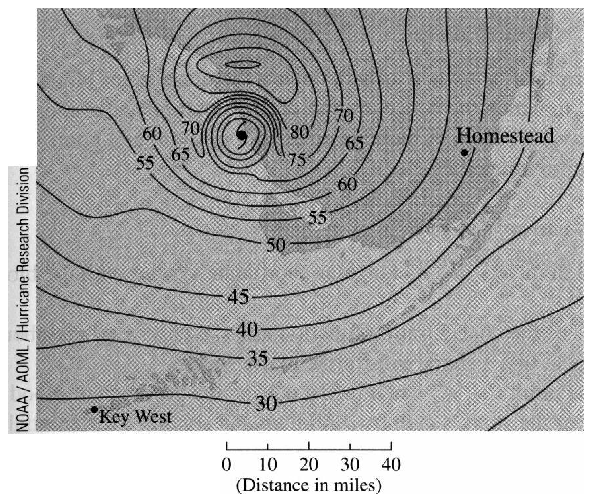
The contour map here shows wind speed in knots during Hurricane Andrew on August 24, 1992. Use it to estimate the value of the directional derivative of the wind speed at Homestead, FL, in the direction of the eye of the hurricane. Explain the meaning of your answer to a lay person.
Answer
14.5.21 §14.5 source ↗
Suppose that . Find the gradient at the point . Sketch the level curve to the graph of when , and plot both the tangent line and the gradient vector at the point . (Make your sketch large). What do you notice, geometrically?
Answer
14.6.1 §14.6 source ↗
Find all first and second partial derivatives of .
Answer
14.6.2 §14.6 source ↗
Find all first and second partial derivatives of .
Answer
14.6.3 §14.6 source ↗
Find all first and second partial derivatives of .
Answer
14.6.4 §14.6 source ↗
Find all first and second partial derivatives of .
Answer
14.6.5 §14.6 source ↗
Find all first and second partial derivatives of .
Answer
14.6.6 §14.6 source ↗
Find all first and second partial derivatives of .
Answer
14.6.7 §14.6 source ↗
Find all first and second partial derivatives of .
Answer
14.6.8 §14.6 source ↗
Find all first and second partial derivatives of with respect to and if .
Answer
14.6.9 §14.6 source ↗
Find all first and second partial derivatives of with respect to and if .
Answer
14.7.1 §14.7 source ↗
Find all local maximum and minimum points of .
Answer
14.7.2 §14.7 source ↗
Find all local maximum and minimum points of .
Answer
14.7.3 §14.7 source ↗
Find all local maximum and minimum points of .
Answer
14.7.4 §14.7 source ↗
Find all local maximum and minimum points of .
Answer
14.7.5 §14.7 source ↗
Find all local maximum and minimum points of .
Answer
14.7.6 §14.7 source ↗
Find all local maximum and minimum points of .
Answer
14.7.7 §14.7 source ↗
Find the absolute maximum and minimum points of over the region bounded by , , and .
Answer
14.7.8 §14.7 source ↗
A six-sided rectangular box is to hold cubic meter; what shape should the box be to minimize surface area?
Answer
14.7.9 §14.7 source ↗
The post office will accept packages whose combined length and girth is at most 130 inches. (Girth is the maximum distance around the package perpendicular to the length; for a rectangular box, the length is the largest of the three dimensions.) What is the largest volume that can be sent in a rectangular box?
Answer
14.7.10 §14.7 source ↗
The bottom of a rectangular box costs twice as much per unit area as the sides and top. Find the shape for a given volume that will minimize cost.
Answer
14.7.11 §14.7 source ↗
Using the methods of this section, find the shortest distance from the origin to the plane .
Answer
14.7.12 §14.7 source ↗
Using the methods of this section, find the shortest distance from the point to the plane . You may assume that ; use of Sage or similar software is recommended.
Answer
14.7.13 §14.7 source ↗
A trough is to be formed by bending up two sides of a long metal rectangle so that the cross-section of the trough is an isosceles trapezoid, as in figure 6.2.6. If the width of the metal sheet is 2 meters, how should it be bent to maximize the volume of the trough?
Answer
14.7.14 §14.7 source ↗
Given the three points , , and , is the sum of the squares of the distances from point to the three points. Find and so that this quantity is minimized.
Answer
14.7.16 §14.7 source ↗
Find the shortest distance from the point to the parabola .
Answer
14.7.17 §14.7 source ↗
Find the shortest distance from the point to the paraboloid .
Answer
14.7.19 §14.7 source ↗
Find the volume of the largest rectangular box with edges parallel to the axes that can be inscribed in the ellipsoid .
Answer
14.8.1 §14.8 source ↗
A six-sided rectangular box is to hold cubic meter; what shape should the box be to minimize surface area?
Answer
14.8.2 §14.8 source ↗
The post office will accept packages whose combined length and girth are at most 130 inches (girth is the maximum distance around the package perpendicular to the length). What is the largest volume that can be sent in a rectangular box?
Answer
14.8.3 §14.8 source ↗
The bottom of a rectangular box costs twice as much per unit area as the sides and top. Find the shape for a given volume that will minimize cost.
Answer
14.8.4 §14.8 source ↗
Using Lagrange multipliers, find the shortest distance from the point to the plane .
Answer
14.8.5 §14.8 source ↗
Find all points on the surface that are closest to the origin.
Answer
14.8.6 §14.8 source ↗
The material for the bottom of an aquarium costs half as much as the high strength glass for the four sides. Find the shape of the cheapest aquarium that holds a given volume .
Answer
14.8.7 §14.8 source ↗
The plane intersects the cylinder in an ellipse. Find the points on the ellipse closest to and farthest from the origin.
Answer
14.8.8 §14.8 source ↗
Find three positive numbers whose sum is 48 and whose product is as large as possible.
Answer
14.8.9 §14.8 source ↗
Find all points on the plane in the first octant at which has a maximum value.
Answer
14.8.10 §14.8 source ↗
Find the points on the surface that are closest to the origin.
Answer
14.8.11 §14.8 source ↗
A manufacturer makes two models of an item, standard and deluxe. It costs $40 to manufacture the standard model and $60 for the deluxe. A market research firm estimates that if the standard model is priced at dollars and the deluxe at dollars, then the manufacturer will sell of the standard items and of the deluxe each year. How should the items be priced to maximize profit?
Answer
14.8.12 §14.8 source ↗
A length of sheet metal is to be made into a water trough by bending up two sides as shown in figure 14.8.3. Find and so that the trapezoid–shaped cross section has maximum area, when the width of the metal sheet is 2 meters (that is, ).
Answer
14.8.13 §14.8 source ↗
Find the maximum and minimum values of subject to the constraint .
Answer
14.8.14 §14.8 source ↗
Find the maximum and minimum values of subject to the constraint .
Answer
14.8.15 §14.8 source ↗
Find the maximum and minimum values of when .
Answer
14.8.16 §14.8 source ↗
Find three real numbers whose sum is 9 and the sum of whose squares is a small as possible.
Answer
14.8.17 §14.8 source ↗
Find the dimensions of the closed rectangular box with maximum volume that can be inscribed in the unit sphere.
Answer
14.8.18 §14.8 source ↗
Find the isosceles triangle with perimeter 12 and maximum area.
Answer
Loading chapter 15…
Exercises and answers are adapted from Calculus: Early Transcendentals by David Guichard and friends, which is free to read and download, and are used under the CC BY-NC-SA 4.0 licence. They are taken from the book’s online edition and set for the web, so they may differ slightly from the printed page. This adaptation is released under the same licence and is neither affiliated with nor endorsed by David Guichard or Whitman College. The book was first written by David Guichard. Its chapters 1–9 modify and expand notes by Neal Koblitz of the University of Washington; it includes exercises and examples from H. Jerome Keisler’s Elementary Calculus: An Approach Using Infinitesimals, from which its chapter on differential equations is largely derived, and some exercises from the OpenStax Calculus books; and Albert Schueller, Barry Balof and Mike Wills contributed additional material.