Every problem in the chapter beside the book’s answer, a chapter at a time as you scroll.
Chapter 2: Instantaneous Rate of Change: The Derivative
41 problems · 1 figure2.1.1 §2.1 source ↗
Draw the graph of the function between and . Find the slope of the chord between the points of the circle lying over (a) and , (b) and , (c) and , (d) and . Now use the geometry of tangent lines on a circle to find (e) the exact value of the derivative . Your answers to (a)–(d) should be getting closer and closer to your answer to (e).
Answer
2.1.2 §2.1 source ↗
Use geometry to find the derivative of the function in the text for each of the following : (a) 20, (b) 24, (c) , (d) . Draw a graph of the upper semicircle, and draw the tangent line at each of these four points.
Answer
2.1.3 §2.1 source ↗
Draw the graph of the function between and . Find the slope of the chord between (a) and , (b) and , (c) and . Now use algebra to find a simple formula for the slope of the chord between and . Determine what happens when approaches 0. In your graph of , draw the straight line through the point whose slope is this limiting value of the difference quotient as approaches 0.
Answer
2.1.4 §2.1 source ↗
Find an algebraic expression for the difference quotient when . Simplify the expression as much as possible. Then determine what happens as approaches 0. That value is .
Answer
2.1.5 §2.1 source ↗
Draw the graph of between and . Find the slope of the chord between (a) and , (b) and , (c) and . Then use algebra to find a simple formula for the slope of the chord between and . (Use the expansion .) Determine what happens as approaches 0, and in your graph of draw the straight line through the point whose slope is equal to the value you just found.
Answer
2.1.6 §2.1 source ↗
Find an algebraic expression for the difference quotient when . Simplify the expression as much as possible. Then determine what happens as approaches 0. That value is .
Answer
2.2.1 §2.2 source ↗
An object is traveling in a straight line so that its position (that is, distance from some fixed point) is given by this table:
| time (seconds) | 0 | 1 | 2 | 3 |
| distance (meters) | 0 | 10 | 25 | 60 |
Find the average speed of the object during the following time intervals: , , , , , . If you had to guess the speed at just on the basis of these, what would you guess?
Answer
2.2.2 §2.2 source ↗
Let , where is the time in seconds and is the distance in meters that an object falls on a certain airless planet. Draw a graph of this function between and . Make a table of the average speed of the falling object between (a) 2 seconds and 3 seconds, (b) 2 seconds and 2.1 seconds, (c) 2 seconds and 2.01 seconds, (d) 2 seconds and 2.001 seconds. Then use algebra to find a simple formula for the average speed between time and time . (If you substitute in this formula you should again get the answers to parts (a)–(d).) Next, in your formula for average speed (which should be in simplified form) determine what happens as approaches zero. This is the instantaneous speed. Finally, in your graph of draw the straight line through the point whose slope is the instantaneous velocity you just computed; it should of course be the tangent line.
Answer
2.2.3 §2.2 source ↗
If an object is dropped from an 80-meter high window, its height above the ground at time seconds is given by the formula . (Here we are neglecting air resistance; the graph of this function was shown in figure 1.0.1.) Find the average velocity of the falling object between (a) 1 seconds and 1.1 seconds, (b) 1 seconds and 1.01 seconds, (c) 1 seconds and 1.001 seconds. Now use algebra to find a simple formula for the average velocity of the falling object between 1 seconds and seconds. Determine what happens to this average velocity as approaches 0. That is the instantaneous velocity at time second (it will be negative, because the object is falling).
Answer
2.3.1 §2.3 source ↗
Compute the limits. If a limit does not exist, explain why.
Answer
2.3.2 §2.3 source ↗
Compute the limits. If a limit does not exist, explain why.
Answer
2.3.3 §2.3 source ↗
Compute the limits. If a limit does not exist, explain why.
Answer
2.3.4 §2.3 source ↗
Compute the limits. If a limit does not exist, explain why.
Answer
2.3.5 §2.3 source ↗
Compute the limits. If a limit does not exist, explain why.
Answer
2.3.6 §2.3 source ↗
Compute the limits. If a limit does not exist, explain why.
Answer
2.3.7 §2.3 source ↗
Compute the limits. If a limit does not exist, explain why.
Answer
2.3.8 §2.3 source ↗
Compute the limits. If a limit does not exist, explain why.
Answer
2.3.9 §2.3 source ↗
Compute the limits. If a limit does not exist, explain why.
Answer
2.3.10 §2.3 source ↗
Compute the limits. If a limit does not exist, explain why.
Answer
2.3.11 §2.3 source ↗
Compute the limits. If a limit does not exist, explain why.
Answer
2.3.12 §2.3 source ↗
Compute the limits. If a limit does not exist, explain why.
Answer
2.3.13 §2.3 source ↗
Compute the limits. If a limit does not exist, explain why.
Answer
2.3.14 §2.3 source ↗
Compute the limits. If a limit does not exist, explain why.
Answer
2.3.15 §2.3 source ↗
Compute the limits. If a limit does not exist, explain why.
Answer
2.3.16 §2.3 source ↗
Compute the limits. If a limit does not exist, explain why.
(Hint: Use the fact that for any real number . You should probably use the definition of a limit here.)
Answer
2.3.18 §2.3 source ↗
Compute the limits. If a limit does not exist, explain why.
Evaluate the expressions by reference to this graph:
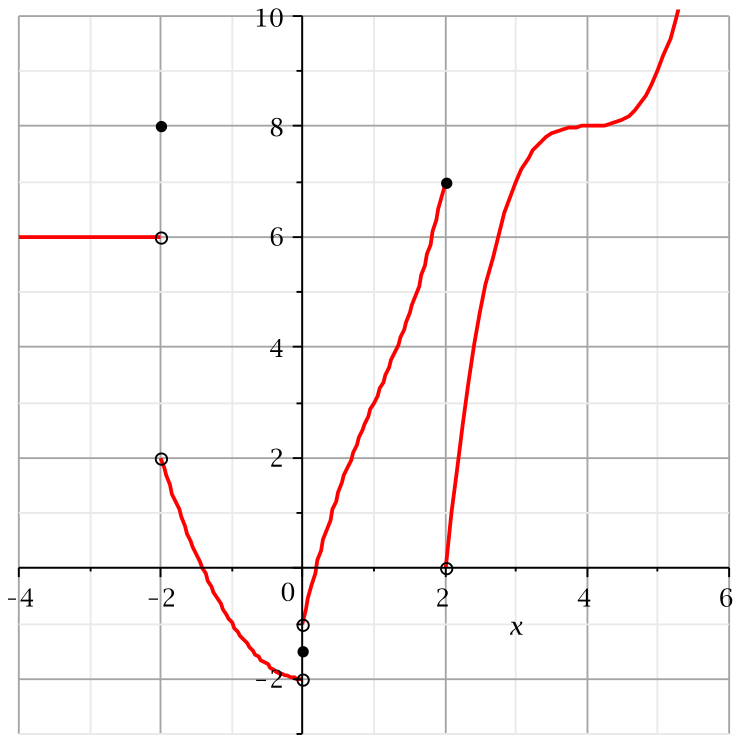
| (a) | (b) | (c) |
| (d) | (e) | (f) |
| (g) | (h) | (i) |
| (j) | (k) | (l) |
Answer
2.4.1 §2.4 source ↗
Find the derivative of .
Answer
2.4.2 §2.4 source ↗
Find the derivative of .
Answer
2.4.3 §2.4 source ↗
Find the derivative of .
Answer
2.4.4 §2.4 source ↗
Find the derivative of (where , , and are constants).
Answer
2.4.5 §2.4 source ↗
Find the derivative of .
Answer
2.4.8 §2.4 source ↗
Find the derivative of
Answer
2.4.9 §2.4 source ↗
Find the derivative of
Answer
2.4.10 §2.4 source ↗
Find an equation for the tangent line to the graph of at the point
Answer
2.4.11 §2.4 source ↗
Find a value for so that the graph of has a horizontal tangent line at .
Answer
2.5.2 §2.5 source ↗
Is a bounded function? If so, find the smallest .
Answer
2.5.3 §2.5 source ↗
Is a bounded function? If so, find the smallest .
Answer
2.5.4 §2.5 source ↗
Is a bounded function? If so, find the smallest .
Answer
2.5.5 §2.5 source ↗
Consider the function Show that it is continuous at the point . Is a continuous function?
Answer
2.5.6 §2.5 source ↗
Approximate a root of to one decimal place.
Answer
2.5.7 §2.5 source ↗
Approximate a root of to one decimal place.
Answer
Loading chapter 3…
Exercises and answers are adapted from Calculus: Early Transcendentals by David Guichard and friends, which is free to read and download, and are used under the CC BY-NC-SA 4.0 licence. They are taken from the book’s online edition and set for the web, so they may differ slightly from the printed page. This adaptation is released under the same licence and is neither affiliated with nor endorsed by David Guichard or Whitman College. The book was first written by David Guichard. Its chapters 1–9 modify and expand notes by Neal Koblitz of the University of Washington; it includes exercises and examples from H. Jerome Keisler’s Elementary Calculus: An Approach Using Infinitesimals, from which its chapter on differential equations is largely derived, and some exercises from the OpenStax Calculus books; and Albert Schueller, Barry Balof and Mike Wills contributed additional material.