Every problem in the chapter beside the book’s answer, a chapter at a time as you scroll.
Chapter 15: Multiple Integration
107 problems · 2 figures15.1.1 §15.1 source ↗
Compute .
Answer
15.1.2 §15.1 source ↗
Compute .
Answer
15.1.3 §15.1 source ↗
Compute .
Answer
15.1.4 §15.1 source ↗
Compute .
Answer
15.1.5 §15.1 source ↗
Compute .
Answer
15.1.6 §15.1 source ↗
Compute .
Answer
15.1.7 §15.1 source ↗
Compute .
Answer
15.1.8 §15.1 source ↗
Compute .
Answer
15.1.9 §15.1 source ↗
Compute: .
Answer
15.1.10 §15.1 source ↗
Compute: .
Answer
15.1.11 §15.1 source ↗
Compute:
Answer
15.1.12 §15.1 source ↗
Compute:
Answer
15.1.13 §15.1 source ↗
Compute:
Answer
15.1.14 §15.1 source ↗
Compute .
Answer
15.1.15 §15.1 source ↗
Compute .
Answer
15.1.16 §15.1 source ↗
Evaluate over the region in the first quadrant bounded by the hyperbola and the lines , , and .
Answer
15.1.17 §15.1 source ↗
Find the volume below above the region , .
Answer
15.1.18 §15.1 source ↗
Find the volume bounded by and .
Answer
15.1.19 §15.1 source ↗
Find the volume in the first octant bounded by and .
Answer
15.1.20 §15.1 source ↗
Find the volume in the first octant bounded by , , , and .
Answer
15.1.21 §15.1 source ↗
Find the volume in the first octant bounded by , , and .
Answer
15.1.22 §15.1 source ↗
Find the volume in the first octant bounded by and .
Answer
15.1.23 §15.1 source ↗
Find the volume bounded by and .
Answer
15.1.24 §15.1 source ↗
Find the volume bounded by and .
Answer
15.1.25 §15.1 source ↗
Find the volume under the surface above the triangle with vertices , , .
Answer
15.1.26 §15.1 source ↗
Find the volume enclosed by , , , .
Answer
15.1.27 §15.1 source ↗
A swimming pool is circular with a 40 meter diameter. The depth is constant along east-west lines and increases linearly from 2 meters at the south end to 7 meters at the north end. Find the volume of the pool.
Answer
15.1.28 §15.1 source ↗
Find the average value of on the rectangle with vertices , ), and .
Answer
15.1.30 §15.1 source ↗
Three cylinders of radius 1 intersect at right angles at the origin, as shown in figure 15.1.6. Find the volume contained inside all three cylinders.
Answer
15.1.32 §15.1 source ↗
Reverse the order of integration on each of the following integrals
a.
b.
c.
d.
e.
Answer
15.2.1 §15.2 source ↗
Find the volume above the - plane, under the surface , and inside .
Answer
15.2.2 §15.2 source ↗
Find the volume inside both and .
Answer
15.2.3 §15.2 source ↗
Find the volume below and above the top half of the cone .
Answer
15.2.4 §15.2 source ↗
Find the volume below , above the - plane, and inside .
Answer
15.2.5 §15.2 source ↗
Find the volume below , above the - plane, and inside .
Answer
15.2.6 §15.2 source ↗
Find the volume between and .
Answer
15.2.7 §15.2 source ↗
Find the area inside and outside .
Answer
15.2.8 §15.2 source ↗
Find the area inside both and .
Answer
15.2.9 §15.2 source ↗
Find the area inside the four-leaf rose and outside .
Answer
15.2.10 §15.2 source ↗
Find the area inside the cardioid and outside .
Answer
15.2.11 §15.2 source ↗
Find the area of one loop of the three-leaf rose .
Answer
15.2.12 §15.2 source ↗
Compute by converting to cylindrical coordinates.
Answer
15.2.13 §15.2 source ↗
Compute by converting to cylindrical coordinates.
Answer
15.2.14 §15.2 source ↗
Find the volume under above the region
Answer
15.2.15 §15.2 source ↗
Find the volume between and above the region
Answer
15.2.16 §15.2 source ↗
Find the volume inside and .
Answer
15.2.17 §15.2 source ↗
Find the volume under above .
Answer
15.2.19 §15.2 source ↗
Consider the integral , where is the unit disk centered at the origin. (This is the same shape described in a different way in exercise 13 in section 9.7.)
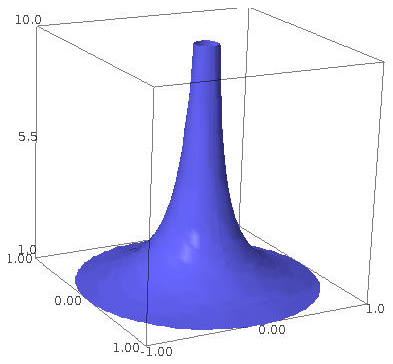
a. Why might this integral be considered improper?
b. Calculate the value of the integral of the same function over the annulus with outer radius 1 and inner radius .
c. Obtain a value for the integral on the whole disk by letting approach 0.
Answer
15.3.1 §15.3 source ↗
Find the center of mass of a two-dimensional plate that occupies the square and has density function .
Answer
15.3.2 §15.3 source ↗
Find the center of mass of a two-dimensional plate that occupies the triangle , , and has density function .
Answer
15.3.3 §15.3 source ↗
Find the center of mass of a two-dimensional plate that occupies the upper unit semicircle centered at and has density function .
Answer
15.3.4 §15.3 source ↗
Find the center of mass of a two-dimensional plate that occupies the upper unit semicircle centered at and has density function .
Answer
15.3.5 §15.3 source ↗
Find the center of mass of a two-dimensional plate that occupies the triangle formed by , , and and has density function .
Answer
15.3.6 §15.3 source ↗
Find the center of mass of a two-dimensional plate that occupies the triangle formed by , , and and has density function .
Answer
15.3.7 §15.3 source ↗
Find the center of mass of a two-dimensional plate that occupies the region enclosed by the parabolas , and has density function .
Answer
15.3.8 §15.3 source ↗
Find the centroid of the area in the first quadrant bounded by , , and . (Recall that the centroid is the center of mass when the density is 1 everywhere.)
Answer
15.3.9 §15.3 source ↗
Find the centroid of one loop (say the loop along the -axis) of the three-leaf rose . (Recall that the centroid is the center of mass when the density is 1 everywhere, and that the mass in this case is the same as the area, which was the subject of exercise 11 in section 15.2.) The computations of the integrals for the moments and are elementary but quite long; Sage can help.
Answer
15.3.10 §15.3 source ↗
Find the center of mass of a two dimensional object that occupies the region , , with density .
Answer
15.3.11 §15.3 source ↗
A two-dimensional object has shape given by and density . Set up the three integrals required to compute the center of mass.
Answer
,
.
15.3.12 §15.3 source ↗
A two-dimensional object has shape given by and density . Set up the three integrals required to compute the center of mass.
Answer
,
.
15.3.13 §15.3 source ↗
A two-dimensional object sits inside and outside , and has density everywhere. Set up the integrals required to compute the center of mass.
Answer
,
.
15.4.1 §15.4 source ↗
Find the area of the surface of a right circular cone of height and base radius .
Answer
15.4.2 §15.4 source ↗
Find the area of the portion of the plane inside the cylinder .
Answer
15.4.3 §15.4 source ↗
Find the area of the portion of the plane in the first octant.
Answer
15.4.4 §15.4 source ↗
Find the area of the upper half of the cone inside the cylinder .
Answer
15.4.5 §15.4 source ↗
Find the area of the upper half of the cone above the interior of one loop of .
Answer
15.4.6 §15.4 source ↗
Find the area of the upper hemisphere of above the interior of one loop of .
Answer
15.4.7 §15.4 source ↗
The plane cuts a triangle in the first octant provided that and are all positive. Find the area of this triangle.
Answer
15.4.8 §15.4 source ↗
Find the area of the portion of the cone lying above the plane and inside the cylinder .
Answer
15.5.1 §15.5 source ↗
Evaluate .
Answer
15.5.2 §15.5 source ↗
Evaluate .
Answer
15.5.3 §15.5 source ↗
Evaluate .
Answer
15.5.4 §15.5 source ↗
Evaluate .
Answer
15.5.5 §15.5 source ↗
Evaluate .
Answer
15.5.6 §15.5 source ↗
Evaluate .
Answer
15.5.7 §15.5 source ↗
Evaluate .
Answer
15.5.8 §15.5 source ↗
Compute .
Answer
15.5.10 §15.5 source ↗
Compute over the region in the first octant.
Answer
15.5.11 §15.5 source ↗
Find the mass of a cube with edge length 2 and density equal to the square of the distance from one corner.
Answer
15.5.12 §15.5 source ↗
Find the mass of a cube with edge length 2 and density equal to the square of the distance from one edge.
Answer
15.5.13 §15.5 source ↗
An object occupies the volume of the upper hemisphere of and has density at . Find the center of mass.
Answer
15.5.14 §15.5 source ↗
An object occupies the volume of the pyramid with corners at , , , , and and has density at . Find the center of mass.
Answer
15.6.1 §15.6 source ↗
Evaluate .
Answer
15.6.2 §15.6 source ↗
Evaluate .
Answer
15.6.3 §15.6 source ↗
Evaluate over the interior of the cylinder between and .
Answer
15.6.4 §15.6 source ↗
Evaluate over the interior of the cylinder between and .
Answer
15.6.5 §15.6 source ↗
Evaluate over the region above the - plane, inside and under .
Answer
15.6.6 §15.6 source ↗
Evaluate over the region in the first octant, inside and under .
Answer
15.6.7 §15.6 source ↗
Evaluate over the interior of .
Answer
15.6.8 §15.6 source ↗
Evaluate over the interior of .
Answer
15.6.9 §15.6 source ↗
Compute over the region inside in the first octant.
Answer
15.6.10 §15.6 source ↗
Find the mass of a right circular cone of height and base radius if the density is proportional to the distance from the base.
Answer
15.6.11 §15.6 source ↗
Find the mass of a right circular cone of height and base radius if the density is proportional to the distance from its axis of symmetry.
Answer
15.6.12 §15.6 source ↗
An object occupies the region inside the unit sphere at the origin, and has density equal to the distance from the -axis. Find the mass.
Answer
15.6.13 §15.6 source ↗
An object occupies the region inside the unit sphere at the origin, and has density equal to the square of the distance from the origin. Find the mass.
Answer
15.6.14 §15.6 source ↗
An object occupies the region between the unit sphere at the origin and a sphere of radius 2 with center at the origin, and has density equal to the distance from the origin. Find the mass.
Answer
15.6.15 §15.6 source ↗
An object occupies the region in the first octant bounded by the cones and , and the sphere , and has density proportional to the distance from the origin. Find the mass.
Answer
15.7.1 §15.7 source ↗
Complete example 15.7.1 by converting to polar coordinates and evaluating the integral.
Answer
15.7.2 §15.7 source ↗
Evaluate over the square with corners , , , and in two ways: directly, and using , .
Answer
15.7.3 §15.7 source ↗
Evaluate over the square with corners , , , and in two ways: directly, and using , .
Answer
15.7.4 §15.7 source ↗
Evaluate over the triangle with corners , , and in two ways: directly, and using , .
Answer
15.7.5 §15.7 source ↗
Evaluate over the parallelogram with corners , , , and in two ways: directly, and using , .
Answer
15.7.6 §15.7 source ↗
Evaluate over the triangle with corners , , and using , .
Answer
15.7.7 §15.7 source ↗
Evaluate over the region bounded by , , , and using , .
Answer
15.7.8 §15.7 source ↗
Evaluate over the region in the first quadrant bounded by the ellipse .
Answer
15.7.9 §15.7 source ↗
Compute the Jacobian for the substitutions , , .
Answer
15.7.10 §15.7 source ↗
Evaluate where is the solid enclosed by the ellipsoid using the transformation , , and .
Answer
Loading chapter 16…
Exercises and answers are adapted from Calculus: Early Transcendentals by David Guichard and friends, which is free to read and download, and are used under the CC BY-NC-SA 4.0 licence. They are taken from the book’s online edition and set for the web, so they may differ slightly from the printed page. This adaptation is released under the same licence and is neither affiliated with nor endorsed by David Guichard or Whitman College. The book was first written by David Guichard. Its chapters 1–9 modify and expand notes by Neal Koblitz of the University of Washington; it includes exercises and examples from H. Jerome Keisler’s Elementary Calculus: An Approach Using Infinitesimals, from which its chapter on differential equations is largely derived, and some exercises from the OpenStax Calculus books; and Albert Schueller, Barry Balof and Mike Wills contributed additional material.