Every problem in the chapter beside the book’s answer, a chapter at a time as you scroll.
Chapter 3: Techniques of Integration
244 problems · 1 figureCheckpoint 3.1 §3.1 source ↗
Answer
Checkpoint 3.2 §3.1 source ↗
Answer
Checkpoint 3.3 §3.1 source ↗
Answer
Checkpoint 3.4 §3.1 source ↗
Answer
3-1 §3.1 source ↗
In using the technique of integration by parts, you must carefully choose which expression is u. For each of the following problems, use the guidelines in this section to choose u. Do not evaluate the integrals.
Answer
3-3 §3.1 source ↗
In using the technique of integration by parts, you must carefully choose which expression is u. For each of the following problems, use the guidelines in this section to choose u. Do not evaluate the integrals.
Answer
3-5 §3.1 source ↗
In using the technique of integration by parts, you must carefully choose which expression is u. For each of the following problems, use the guidelines in this section to choose u. Do not evaluate the integrals.
Answer
3-7 §3.1 source ↗
Find the integral by using the simplest method. Not all problems require integration by parts.
(Hint: is equivalent to
Answer
3-9 §3.1 source ↗
Find the integral by using the simplest method. Not all problems require integration by parts.
Answer
3-11 §3.1 source ↗
Find the integral by using the simplest method. Not all problems require integration by parts.
Answer
3-13 §3.1 source ↗
Find the integral by using the simplest method. Not all problems require integration by parts.
Answer
3-15 §3.1 source ↗
Find the integral by using the simplest method. Not all problems require integration by parts.
Answer
3-17 §3.1 source ↗
Find the integral by using the simplest method. Not all problems require integration by parts.
Answer
3-19 §3.1 source ↗
Find the integral by using the simplest method. Not all problems require integration by parts.
Answer
3-21 §3.1 source ↗
Find the integral by using the simplest method. Not all problems require integration by parts.
Answer
3-23 §3.1 source ↗
Find the integral by using the simplest method. Not all problems require integration by parts.
Answer
3-25 §3.1 source ↗
Find the integral by using the simplest method. Not all problems require integration by parts.
Answer
3-27 §3.1 source ↗
Find the integral by using the simplest method. Not all problems require integration by parts.
Answer
3-29 §3.1 source ↗
Find the integral by using the simplest method. Not all problems require integration by parts.
Answer
3-31 §3.1 source ↗
Find the integral by using the simplest method. Not all problems require integration by parts.
Answer
3-33 §3.1 source ↗
Find the integral by using the simplest method. Not all problems require integration by parts.
Answer
3-35 §3.1 source ↗
Find the integral by using the simplest method. Not all problems require integration by parts.
Answer
3-37 §3.1 source ↗
Find the integral by using the simplest method. Not all problems require integration by parts.
Answer
3-39 §3.1 source ↗
Compute the definite integrals. Use a graphing utility to confirm your answers.
(Express the answer in exact form.)
Answer
3-41 §3.1 source ↗
Compute the definite integrals. Use a graphing utility to confirm your answers.
Answer
3-43 §3.1 source ↗
Compute the definite integrals. Use a graphing utility to confirm your answers.
(Express the answer in exact form.)
Answer
3-45 §3.1 source ↗
Compute the definite integrals. Use a graphing utility to confirm your answers.
(Express the answer in exact form.)
Answer
3-47 §3.1 source ↗
Compute the definite integrals. Use a graphing utility to confirm your answers.
Evaluate
Answer
3-49 §3.1 source ↗
Derive the following formulas using the technique of integration by parts. Assume that n is a positive integer. These formulas are called reduction formulas because the exponent in the x term has been reduced by one in each case. The second integral is simpler than the original integral.
Answer
3-51 §3.1 source ↗
Derive the following formulas using the technique of integration by parts. Assume that n is a positive integer. These formulas are called reduction formulas because the exponent in the x term has been reduced by one in each case. The second integral is simpler than the original integral.
Integrate using two methods:
a. Using parts, letting
b. Substitution, letting
Answer
3-53 §3.1 source ↗
State whether you would use integration by parts to evaluate the integral. If so, identify u and dv. If not, describe the technique used to perform the integration without actually doing the problem.
Answer
3-55 §3.1 source ↗
State whether you would use integration by parts to evaluate the integral. If so, identify u and dv. If not, describe the technique used to perform the integration without actually doing the problem.
Answer
3-57 §3.1 source ↗
State whether you would use integration by parts to evaluate the integral. If so, identify u and dv. If not, describe the technique used to perform the integration without actually doing the problem.
Answer
3-59 §3.1 source ↗
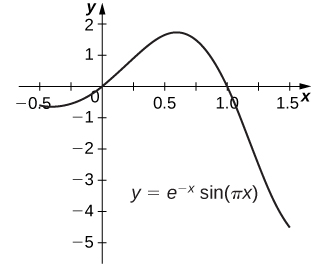
Sketch the region bounded above by the curve, the x-axis, and and find the area of the region. Provide the exact form or round answers to the number of places indicated.
(Approximate answer to five decimal places.)
Answer
The area under graph is 0.39535.
3-61 §3.1 source ↗
Find the volume generated by rotating the region bounded by the given curves about the specified line. Express the answers in exact form or approximate to the number of decimal places indicated.
about (Express the answer in exact form.)
Answer
3-63 §3.1 source ↗
Find the volume generated by rotating the region bounded by the given curves about the specified line. Express the answers in exact form or approximate to the number of decimal places indicated.
Find the area under the graph of from (Round the answer to two significant digits.)
Answer
3-65 §3.1 source ↗
Find the volume generated by rotating the region bounded by the given curves about the specified line. Express the answers in exact form or approximate to the number of decimal places indicated.
Find the area of the region enclosed by the curve and the x-axis for
(Express the answer in exact form.)
Answer
3-67 §3.1 source ↗
Find the volume generated by rotating the region bounded by the given curves about the specified line. Express the answers in exact form or approximate to the number of decimal places indicated.
Find the volume of the solid generated by revolving the region bounded by the curve and the x-axis, about the x-axis. (Express the answer in exact form.)
Answer
Checkpoint 3.5 §3.2 source ↗
Answer
Checkpoint 3.6 §3.2 source ↗
Answer
Checkpoint 3.7 §3.2 source ↗
Answer
Checkpoint 3.8 §3.2 source ↗
Answer
Checkpoint 3.9 §3.2 source ↗
Answer
Checkpoint 3.10 §3.2 source ↗
Answer
Checkpoint 3.11 §3.2 source ↗
Answer
Checkpoint 3.12 §3.2 source ↗
Answer
Checkpoint 3.13 §3.2 source ↗
Answer
3-69 §3.2 source ↗
Fill in the blank to make a true statement.
Answer
3-71 §3.2 source ↗
Use an identity to reduce the power of the trigonometric function to a trigonometric function raised to the first power.
Answer
3-73 §3.2 source ↗
Evaluate each of the following integrals by u-substitution.
Answer
3-75 §3.2 source ↗
Evaluate each of the following integrals by u-substitution.
Answer
3-77 §3.2 source ↗
Evaluate each of the following integrals by u-substitution.
Answer
3-79 §3.2 source ↗
Compute the following integrals using the guidelines for integrating powers of trigonometric functions. Use a CAS to check the solutions. (Note: Some of the problems may be done using techniques of integration learned previously.)
Answer
3-81 §3.2 source ↗
Compute the following integrals using the guidelines for integrating powers of trigonometric functions. Use a CAS to check the solutions. (Note: Some of the problems may be done using techniques of integration learned previously.)
Answer
3-83 §3.2 source ↗
Compute the following integrals using the guidelines for integrating powers of trigonometric functions. Use a CAS to check the solutions. (Note: Some of the problems may be done using techniques of integration learned previously.)
Answer
3-85 §3.2 source ↗
Compute the following integrals using the guidelines for integrating powers of trigonometric functions. Use a CAS to check the solutions. (Note: Some of the problems may be done using techniques of integration learned previously.)
Answer
3-87 §3.2 source ↗
Compute the following integrals using the guidelines for integrating powers of trigonometric functions. Use a CAS to check the solutions. (Note: Some of the problems may be done using techniques of integration learned previously.)
Answer
3-89 §3.2 source ↗
Compute the following integrals using the guidelines for integrating powers of trigonometric functions. Use a CAS to check the solutions. (Note: Some of the problems may be done using techniques of integration learned previously.)
Answer
3-91 §3.2 source ↗
Compute the following integrals using the guidelines for integrating powers of trigonometric functions. Use a CAS to check the solutions. (Note: Some of the problems may be done using techniques of integration learned previously.)
Answer
3-93 §3.2 source ↗
Compute the following integrals using the guidelines for integrating powers of trigonometric functions. Use a CAS to check the solutions. (Note: Some of the problems may be done using techniques of integration learned previously.)
Answer
3-95 §3.2 source ↗
For the following exercises, find a general formula for the integrals.
Answer
3-97 §3.2 source ↗
Use the double-angle formulas to evaluate the following integrals.
Answer
3-99 §3.2 source ↗
Use the double-angle formulas to evaluate the following integrals.
Answer
3-101 §3.2 source ↗
Use the double-angle formulas to evaluate the following integrals.
Answer
3-103 §3.2 source ↗
For the following exercises, evaluate the definite integrals. Express answers in exact form whenever possible.
Answer
3-105 §3.2 source ↗
For the following exercises, evaluate the definite integrals. Express answers in exact form whenever possible.
Answer
3-107 §3.2 source ↗
For the following exercises, evaluate the definite integrals. Express answers in exact form whenever possible.
Answer
3-109 §3.2 source ↗
For the following exercises, evaluate the definite integrals. Express answers in exact form whenever possible.
(Round this answer to three decimal places.)
Answer
3-111 §3.2 source ↗
For the following exercises, evaluate the definite integrals. Express answers in exact form whenever possible.
Answer
3-113 §3.2 source ↗
For the following exercises, evaluate the definite integrals. Express answers in exact form whenever possible.
Find the area of the region bounded by the graphs of the equations
Answer
3-115 §3.2 source ↗
For the following exercises, evaluate the definite integrals. Express answers in exact form whenever possible.
Find the average value of the function over the interval
Answer
3-117 §3.2 source ↗
For the following exercises, solve the differential equations.
Answer
3-119 §3.2 source ↗
For the following exercises, solve the differential equations.
Find the length of the curve
Answer
3-121 §3.2 source ↗
For the following exercises, use this information: The inner product of two functions f and g over is defined by Two distinct functions f and g are said to be orthogonal if
Show that are orthogonal over the interval
Answer
3-123 §3.2 source ↗
For the following exercises, use this information: The inner product of two functions f and g over is defined by Two distinct functions f and g are said to be orthogonal if
Integrate
Answer
3-125 §3.2 source ↗
For each pair of integrals, determine which one is more difficult to evaluate. Explain your reasoning.
or
Answer
Checkpoint 3.14 §3.3 source ↗
Answer
Checkpoint 3.15 §3.3 source ↗
Answer
Checkpoint 3.16 §3.3 source ↗
Answer
3-127 §3.3 source ↗
Simplify the following expressions by writing each one using a single trigonometric function.
Answer
3-129 §3.3 source ↗
Simplify the following expressions by writing each one using a single trigonometric function.
Answer
3-131 §3.3 source ↗
Use the technique of completing the square to express each trinomial as the square of a binomial or the square of a binomial plus a constant.
Answer
3-133 §3.3 source ↗
Use the technique of completing the square to express each trinomial as the square of a binomial or the square of a binomial plus a constant.
Answer
3-135 §3.3 source ↗
Integrate using the method of trigonometric substitution. Express the final answer in terms of the variable.
Answer
3-137 §3.3 source ↗
Integrate using the method of trigonometric substitution. Express the final answer in terms of the variable.
Answer
3-139 §3.3 source ↗
Integrate using the method of trigonometric substitution. Express the final answer in terms of the variable.
Answer
3-141 §3.3 source ↗
Integrate using the method of trigonometric substitution. Express the final answer in terms of the variable.
Answer
3-143 §3.3 source ↗
Integrate using the method of trigonometric substitution. Express the final answer in terms of the variable.
Answer
3-145 §3.3 source ↗
Integrate using the method of trigonometric substitution. Express the final answer in terms of the variable.
Answer
3-147 §3.3 source ↗
Integrate using the method of trigonometric substitution. Express the final answer in terms of the variable.
Answer
3-149 §3.3 source ↗
Integrate using the method of trigonometric substitution. Express the final answer in terms of the variable.
Answer
3-151 §3.3 source ↗
Integrate using the method of trigonometric substitution. Express the final answer in terms of the variable.
Answer
3-153 §3.3 source ↗
Integrate using the method of trigonometric substitution. Express the final answer in terms of the variable.
Answer
3-155 §3.3 source ↗
In the following exercises, use the substitutions or Express the final answers in terms of the variable x.
Answer
3-157 §3.3 source ↗
In the following exercises, use the substitutions or Express the final answers in terms of the variable x.
Answer
3-159 §3.3 source ↗
In the following exercises, use the substitutions or Express the final answers in terms of the variable x.
Answer
3-161 §3.3 source ↗
Use the technique of completing the square to evaluate the following integrals.
Answer
3-163 §3.3 source ↗
Use the technique of completing the square to evaluate the following integrals.
Answer
3-165 §3.3 source ↗
Use the technique of completing the square to evaluate the following integrals.
Evaluate the integral without using calculus:
Answer
3-167 §3.3 source ↗
Use the technique of completing the square to evaluate the following integrals.
Evaluate the integral using two different substitutions. First, let and evaluate using trigonometric substitution. Second, let and use trigonometric substitution. Are the answers the same?
Answer
3-169 §3.3 source ↗
Use the technique of completing the square to evaluate the following integrals.
Evaluate the integral using the form Next, evaluate the same integral using Are the results the same?
Answer
3-171 §3.3 source ↗
Use the technique of completing the square to evaluate the following integrals.
State the method of integration you would use to evaluate the integral Why did you choose this method?
Answer
3-173 §3.3 source ↗
Use the technique of completing the square to evaluate the following integrals.
Find the length of the arc of the curve over the specified interval: Round the answer to three decimal places.
Answer
3-175 §3.3 source ↗
Use the technique of completing the square to evaluate the following integrals.
The region bounded by the graph of and the x-axis between and is revolved about the x-axis. Find the volume of the solid that is generated.
Answer
3-177 §3.3 source ↗
Solve the initial-value problem for y as a function of x.
Answer
3-179 §3.3 source ↗
Solve the initial-value problem for y as a function of x.
An oil storage tank can be described as the volume generated by revolving the area bounded by about the x-axis. Find the volume of the tank (in cubic meters).
Answer
3-181 §3.3 source ↗
Solve the initial-value problem for y as a function of x.
Find the length of the curve between and
Answer
Checkpoint 3.17 §3.4 source ↗
Answer
Checkpoint 3.18 §3.4 source ↗
Answer
Checkpoint 3.19 §3.4 source ↗
Answer
Checkpoint 3.20 §3.4 source ↗
Answer
3-183 §3.4 source ↗
Express the rational function as a sum or difference of two simpler rational expressions.
Answer
3-185 §3.4 source ↗
Express the rational function as a sum or difference of two simpler rational expressions.
Answer
3-187 §3.4 source ↗
Express the rational function as a sum or difference of two simpler rational expressions.
Answer
3-189 §3.4 source ↗
Express the rational function as a sum or difference of two simpler rational expressions.
Answer
3-191 §3.4 source ↗
Express the rational function as a sum or difference of two simpler rational expressions.
Answer
3-193 §3.4 source ↗
Express the rational function as a sum or difference of two simpler rational expressions.
Answer
3-195 §3.4 source ↗
Express the rational function as a sum or difference of two simpler rational expressions.
Answer
3-197 §3.4 source ↗
Use the method of partial fractions to evaluate each of the following integrals.
Answer
3-199 §3.4 source ↗
Use the method of partial fractions to evaluate each of the following integrals.
Answer
3-201 §3.4 source ↗
Use the method of partial fractions to evaluate each of the following integrals.
Answer
3-203 §3.4 source ↗
Use the method of partial fractions to evaluate each of the following integrals.
Answer
3-205 §3.4 source ↗
Use the method of partial fractions to evaluate each of the following integrals.
Answer
3-207 §3.4 source ↗
Evaluate the following integrals, which have irreducible quadratic factors.
Answer
3-209 §3.4 source ↗
Evaluate the following integrals, which have irreducible quadratic factors.
Answer
3-211 §3.4 source ↗
Use the method of partial fractions to evaluate the following integrals.
Answer
3-213 §3.4 source ↗
Use the method of partial fractions to evaluate the following integrals.
(Hint: Use the rational root theorem.)
Answer
3-215 §3.4 source ↗
Use substitution to convert the integrals to integrals of rational functions. Then use partial fractions to evaluate the integrals.
Answer
3-217 §3.4 source ↗
Use substitution to convert the integrals to integrals of rational functions. Then use partial fractions to evaluate the integrals.
Answer
3-219 §3.4 source ↗
Use substitution to convert the integrals to integrals of rational functions. Then use partial fractions to evaluate the integrals.
Answer
3-221 §3.4 source ↗
Use substitution to convert the integrals to integrals of rational functions. Then use partial fractions to evaluate the integrals.
Answer
3-223 §3.4 source ↗
Use substitution to convert the integrals to integrals of rational functions. Then use partial fractions to evaluate the integrals.
Answer
3-225 §3.4 source ↗
Use substitution to convert the integrals to integrals of rational functions. Then use partial fractions to evaluate the integrals.
Answer
3-227 §3.4 source ↗
Use substitution to convert the integrals to integrals of rational functions. Then use partial fractions to evaluate the integrals.
Answer
3-229 §3.4 source ↗
Use the given substitution to convert the integral to an integral of a rational function, then evaluate.
Answer
3-231 §3.4 source ↗
Use the given substitution to convert the integral to an integral of a rational function, then evaluate.
Find the volume of the solid generated when the region bounded by and is revolved about the x-axis.
Answer
3-233 §3.4 source ↗
Solve the initial-value problem for x as a function of t.
Answer
3-235 §3.4 source ↗
Solve the initial-value problem for x as a function of t.
Answer
3-237 §3.4 source ↗
Solve the initial-value problem for x as a function of t.
Find the volume generated by revolving the area bounded by about the y-axis.
Answer
3-239 §3.4 source ↗
Solve the initial-value problem for x as a function of t.
Evaluate the integral
Answer
3-241 §3.4 source ↗
For the following problems, use the substitutions and
Find the area under the curve between and (Assume the dimensions are in inches.)
Answer
3-243 §3.4 source ↗
For the following problems, use the substitutions and
Evaluate
Answer
Checkpoint 3.21 §3.5 source ↗
Answer
3-245 §3.5 source ↗
Use a table of integrals to evaluate the following integrals.
Answer
3-247 §3.5 source ↗
Use a table of integrals to evaluate the following integrals.
Answer
3-249 §3.5 source ↗
Use a table of integrals to evaluate the following integrals.
Answer
3-251 §3.5 source ↗
Use a table of integrals to evaluate the following integrals.
Answer
3-253 §3.5 source ↗
Use a table of integrals to evaluate the following integrals.
Answer
3-255 §3.5 source ↗
Use a table of integrals to evaluate the following integrals.
Answer
3-257 §3.5 source ↗
Use a table of integrals to evaluate the following integrals.
Answer
3-259 §3.5 source ↗
Use a table of integrals to evaluate the following integrals.
Answer
3-261 §3.5 source ↗
Use a CAS to evaluate the following integrals. Tables can also be used to verify the answers.
[T]
Answer
3-263 §3.5 source ↗
Use a CAS to evaluate the following integrals. Tables can also be used to verify the answers.
[T]
Answer
3-265 §3.5 source ↗
Use a CAS to evaluate the following integrals. Tables can also be used to verify the answers.
[T]
Answer
3-267 §3.5 source ↗
Use a CAS to evaluate the following integrals. Tables can also be used to verify the answers.
[T]
Answer
3-269 §3.5 source ↗
Use a CAS to evaluate the following integrals. Tables can also be used to verify the answers.
[T]
Answer
3-271 §3.5 source ↗
Use a CAS to evaluate the following integrals. Tables can also be used to verify the answers.
[T]
Answer
3-273 §3.5 source ↗
Use a calculator or CAS to evaluate the following integrals.
[T]
Answer
3-275 §3.5 source ↗
Use a calculator or CAS to evaluate the following integrals.
[T]
Answer
3-277 §3.5 source ↗
Use a calculator or CAS to evaluate the following integrals.
[T]
Answer
3-279 §3.5 source ↗
Use tables to evaluate the integrals. You may need to complete the square or change variables to put the integral into a form given in the table.
Answer
3-281 §3.5 source ↗
Use tables to evaluate the integrals. You may need to complete the square or change variables to put the integral into a form given in the table.
Answer
3-283 §3.5 source ↗
Use tables to evaluate the integrals. You may need to complete the square or change variables to put the integral into a form given in the table.
Answer
3-285 §3.5 source ↗
Use tables to perform the integration.
Answer
3-287 §3.5 source ↗
Use tables to perform the integration.
Answer
3-289 §3.5 source ↗
Use tables to perform the integration.
Find the area bounded by Use a table of integrals or a CAS.
Answer
3-291 §3.5 source ↗
Use tables to perform the integration.
Use substitution and a table of integrals to find the area of the surface generated by revolving the curve about the x-axis. (Round the answer to two decimal places.)
Answer
3-293 §3.5 source ↗
Use tables to perform the integration.
[T] Use a CAS or tables to find the area of the surface generated by revolving the curve about the x-axis. (Round the answer to two decimal places.)
Answer
3-295 §3.5 source ↗
Use tables to perform the integration.
Find the length of the curve over
Answer
3-297 §3.5 source ↗
Use tables to perform the integration.
Find the average value of the function over the interval
Answer
Checkpoint 3.22 §3.6 source ↗
Answer
Checkpoint 3.23 §3.6 source ↗
Answer
Checkpoint 3.24 §3.6 source ↗
Answer
Checkpoint 3.25 §3.6 source ↗
Answer
Checkpoint 3.26 §3.6 source ↗
Answer
3-299 §3.6 source ↗
Approximate the following integrals using either the midpoint rule, trapezoidal rule, or Simpson’s rule as indicated. (Round answers to three decimal places.)
trapezoidal rule;
Answer
3-301 §3.6 source ↗
Approximate the following integrals using either the midpoint rule, trapezoidal rule, or Simpson’s rule as indicated. (Round answers to three decimal places.)
trapezoidal rule;
Answer
3-303 §3.6 source ↗
Approximate the following integrals using either the midpoint rule, trapezoidal rule, or Simpson’s rule as indicated. (Round answers to three decimal places.)
midpoint rule;
Answer
3-305 §3.6 source ↗
Approximate the following integrals using either the midpoint rule, trapezoidal rule, or Simpson’s rule as indicated. (Round answers to three decimal places.)
Use the trapezoidal rule with four subdivisions to estimate
Answer
3-307 §3.6 source ↗
Approximate the integral to three decimal places using the indicated rule.
trapezoidal rule;
Answer
3-309 §3.6 source ↗
Approximate the integral to three decimal places using the indicated rule.
trapezoidal rule;
Answer
3-311 §3.6 source ↗
Approximate the integral to three decimal places using the indicated rule.
Simpson’s rule;
Answer
3-313 §3.6 source ↗
Approximate the integral to three decimal places using the indicated rule.
Simpson’s rule;
Answer
3-315 §3.6 source ↗
Approximate the integral to three decimal places using the indicated rule.
Simpson’s rule;
Answer
3-317 §3.6 source ↗
Approximate the integral to three decimal places using the indicated rule.
Approximate using the midpoint rule with four subdivisions to four decimal places.
Answer
3-319 §3.6 source ↗
Approximate the integral to three decimal places using the indicated rule.
Use the trapezoidal rule with four subdivisions to estimate to four decimal places.
Answer
3-321 §3.6 source ↗
Approximate the integral to three decimal places using the indicated rule.
Using Simpson’s rule with four subdivisions, find
Answer
3-323 §3.6 source ↗
Approximate the integral to three decimal places using the indicated rule.
Given use the trapezoidal rule with 16 subdivisions to approximate the integral and find the absolute error.
Answer
3-325 §3.6 source ↗
Approximate the integral to three decimal places using the indicated rule.
Find an upper bound for the error in estimating using the trapezoidal rule with seven subdivisions.
Answer
3-327 §3.6 source ↗
Approximate the integral to three decimal places using the indicated rule.
Find an upper bound for the error in estimating using Simpson’s rule with steps.
Answer
3-329 §3.6 source ↗
Approximate the integral to three decimal places using the indicated rule.
Estimate the minimum number of subintervals needed to approximate the integral with an error magnitude of less than 0.0001 using the trapezoidal rule.
Answer
3-331 §3.6 source ↗
Approximate the integral to three decimal places using the indicated rule.
Estimate the minimum number of subintervals needed to approximate the integral with an error of magnitude less than 0.0001 using the trapezoidal rule.
Answer
3-333 §3.6 source ↗
Approximate the integral to three decimal places using the indicated rule.
Use Simpson’s rule with four subdivisions to approximate the area under the probability density function from to
Answer
3-335 §3.6 source ↗
Approximate the integral to three decimal places using the indicated rule.
The length of one arch of the curve is given by Estimate L using the trapezoidal rule with
Answer
3-337 §3.6 source ↗
Approximate the integral to three decimal places using the indicated rule.
Estimate the area of the surface generated by revolving the curve about the x-axis. Use the trapezoidal rule with six subdivisions.
Answer
3-339 §3.6 source ↗
Approximate the integral to three decimal places using the indicated rule.
The growth rate of a certain tree (in feet) is given by where t is time in years. Estimate the growth of the tree through the end of the second year by using Simpson’s rule, using two subintervals. (Round the answer to the nearest hundredth.)
Answer
3-341 §3.6 source ↗
Approximate the integral to three decimal places using the indicated rule.
[T] Given approximate the value of this integral using the trapezoidal rule with 16 subdivisions and determine the absolute error.
Answer
3-343 §3.6 source ↗
Approximate the integral to three decimal places using the indicated rule.
The table represents the coordinates that give the boundary of a lot. The units of measurement are meters. Use the trapezoidal rule to estimate the number of square meters of land that is in this lot.
| x | y | x | y |
|---|---|---|---|
| 0 | 125 | 600 | 95 |
| 100 | 125 | 700 | 88 |
| 200 | 120 | 800 | 75 |
| 300 | 112 | 900 | 35 |
| 400 | 90 | 1000 | 0 |
| 500 | 90 |
Answer
3-345 §3.6 source ↗
Approximate the integral to three decimal places using the indicated rule.
The “Simpson” sum is based on the area under a ____.
Answer
Checkpoint 3.27 §3.7 source ↗
Answer
Checkpoint 3.28 §3.7 source ↗
Answer
Checkpoint 3.29 §3.7 source ↗
Answer
3-347 §3.7 source ↗
Evaluate the following integrals. If the integral is not convergent, answer “divergent.”
Answer
3-349 §3.7 source ↗
Evaluate the following integrals. If the integral is not convergent, answer “divergent.”
Answer
3-351 §3.7 source ↗
Evaluate the following integrals. If the integral is not convergent, answer “divergent.”
Answer
3-353 §3.7 source ↗
Evaluate the following integrals. If the integral is not convergent, answer “divergent.”
Without integrating, determine whether the integral converges or diverges by comparing the function with
Answer
3-355 §3.7 source ↗
Determine whether the improper integrals converge or diverge. If possible, determine the value of the integrals that converge.
Answer
3-357 §3.7 source ↗
Determine whether the improper integrals converge or diverge. If possible, determine the value of the integrals that converge.
Answer
3-359 §3.7 source ↗
Determine whether the improper integrals converge or diverge. If possible, determine the value of the integrals that converge.
Answer
3-361 §3.7 source ↗
Determine whether the improper integrals converge or diverge. If possible, determine the value of the integrals that converge.
Answer
3-363 §3.7 source ↗
Determine whether the improper integrals converge or diverge. If possible, determine the value of the integrals that converge.
Answer
3-365 §3.7 source ↗
Determine whether the improper integrals converge or diverge. If possible, determine the value of the integrals that converge.
Answer
3-367 §3.7 source ↗
Determine whether the improper integrals converge or diverge. If possible, determine the value of the integrals that converge.
Answer
3-369 §3.7 source ↗
Determine whether the improper integrals converge or diverge. If possible, determine the value of the integrals that converge.
Answer
3-371 §3.7 source ↗
Determine whether the improper integrals converge or diverge. If possible, determine the value of the integrals that converge.
Answer
3-373 §3.7 source ↗
Determine the convergence of each of the following integrals by comparison with the given integral. If the integral converges, find the number to which it converges.
compare with
Answer
3-375 §3.7 source ↗
Evaluate the integrals. If the integral diverges, answer “diverges.”
Answer
3-377 §3.7 source ↗
Evaluate the integrals. If the integral diverges, answer “diverges.”
Answer
3-379 §3.7 source ↗
Evaluate the integrals. If the integral diverges, answer “diverges.”
Answer
3-381 §3.7 source ↗
Evaluate the integrals. If the integral diverges, answer “diverges.”
Answer
3-383 §3.7 source ↗
Evaluate the integrals. If the integral diverges, answer “diverges.”
Answer
3-385 §3.7 source ↗
Evaluate the improper integrals. Each of these integrals has an infinite discontinuity either at an endpoint or at an interior point of the interval.
Answer
3-387 §3.7 source ↗
Evaluate the improper integrals. Each of these integrals has an infinite discontinuity either at an endpoint or at an interior point of the interval.
Answer
3-389 §3.7 source ↗
Evaluate the improper integrals. Each of these integrals has an infinite discontinuity either at an endpoint or at an interior point of the interval.
Answer
3-391 §3.7 source ↗
Evaluate the improper integrals. Each of these integrals has an infinite discontinuity either at an endpoint or at an interior point of the interval.
Evaluate (Be careful!) (Express your answer using three decimal places.)
Answer
3-393 §3.7 source ↗
Evaluate the improper integrals. Each of these integrals has an infinite discontinuity either at an endpoint or at an interior point of the interval.
Evaluate
Answer
3-395 §3.7 source ↗
Evaluate the improper integrals. Each of these integrals has an infinite discontinuity either at an endpoint or at an interior point of the interval.
Find the area of the region bounded by the curve the x-axis, and on the left by
Answer
3-397 §3.7 source ↗
Evaluate the improper integrals. Each of these integrals has an infinite discontinuity either at an endpoint or at an interior point of the interval.
Find the area under in the first quadrant.
Answer
3-399 §3.7 source ↗
Evaluate the improper integrals. Each of these integrals has an infinite discontinuity either at an endpoint or at an interior point of the interval.
Find the volume of the solid generated by revolving about the y-axis the region under the curve in the first quadrant.
Answer
3-401 §3.7 source ↗
The Laplace transform of a continuous function over the interval is defined by (see the Student Project). This definition is used to solve some important initial-value problems in differential equations, as discussed later. The domain of F is the set of all real numbers s such that the improper integral converges. Find the Laplace transform F of each of the following functions and give the domain of F.
Answer
3-403 §3.7 source ↗
The Laplace transform of a continuous function over the interval is defined by (see the Student Project). This definition is used to solve some important initial-value problems in differential equations, as discussed later. The domain of F is the set of all real numbers s such that the improper integral converges. Find the Laplace transform F of each of the following functions and give the domain of F.
Answer
3-405 §3.7 source ↗
The Laplace transform of a continuous function over the interval is defined by (see the Student Project). This definition is used to solve some important initial-value problems in differential equations, as discussed later. The domain of F is the set of all real numbers s such that the improper integral converges. Find the Laplace transform F of each of the following functions and give the domain of F.
Use the formula for arc length to show that the circumference of the circle is
Answer
3-407 §3.7 source ↗
A non-negative function is a probability density function if it satisfies the following definition: The probability that a random variable x lies between a and b is given by
Find the probability that x is between 0 and 0.3. (Use the function defined in the preceding problem.) Use four-place decimal accuracy.
Answer
3-409 §3.R source ↗
For the following exercises, determine whether the statement is true or false. Justify your answer with a proof or a counterexample.
cannot be integrated using partial fractions.
Answer
3-411 §3.R source ↗
For the following exercises, determine whether the statement is true or false. Justify your answer with a proof or a counterexample.
Integration by parts can always yield the integral.
Answer
3-413 §3.R source ↗
For the following exercises, evaluate the integral using the specified method.
using trigonometric substitution
Answer
3-415 §3.R source ↗
For the following exercises, evaluate the integral using the specified method.
using partial fractions
Answer
3-417 §3.R source ↗
For the following exercises, evaluate the integral using the specified method.
using a table of integrals or a CAS
Answer
3-419 §3.R source ↗
For the following exercises, integrate using whatever method you choose.
Answer
3-421 §3.R source ↗
For the following exercises, integrate using whatever method you choose.
Answer
3-423 §3.R source ↗
For the following exercises, approximate the integrals using the midpoint rule, trapezoidal rule, and Simpson’s rule using four subintervals, rounding to three decimals.
[T]
Answer
3-425 §3.R source ↗
For the following exercises, approximate the integrals using the midpoint rule, trapezoidal rule, and Simpson’s rule using four subintervals, rounding to three decimals.
[T]
Answer
3-427 §3.R source ↗
For the following exercises, evaluate the integrals, if possible.
Answer
3-431 §3.R source ↗
For the following exercises, consider the gamma function given by
[T] Using your function from the previous problem, find exactly how far the Bugati Veyron traveled in the 1 min 40 sec included in the graph.
Answer
Loading chapter 4…
Problems and answers are adapted from Calculus Volume 2 by Gilbert Strang and Edwin “Jed” Herman, OpenStax, and are used under the CC BY-NC-SA 4.0 licence. Access for free at https://openstax.org/books/calculus-volume-2/pages/1-introduction. Illustrations: Copyright Rice University, OpenStax, under CC BY-NC-SA 4.0 license. This adaptation is released under the same licence, is non-commercial, and is neither affiliated with nor endorsed by OpenStax or Rice University.