Every problem in the chapter beside the book’s answer, a chapter at a time as you scroll.
Chapter 5: Sequences and Series
225 problems · 8 figuresCheckpoint 5.1 §5.1 source ↗
Answer
Checkpoint 5.2 §5.1 source ↗
Answer
Checkpoint 5.3 §5.1 source ↗
Answer
Checkpoint 5.4 §5.1 source ↗
Answer
Checkpoint 5.5 §5.1 source ↗
Answer
Checkpoint 5.6 §5.1 source ↗
Answer
5-1 §5.1 source ↗
Find the first six terms of each of the following sequences, starting with
for
Answer
5-3 §5.1 source ↗
Find the first six terms of each of the following sequences, starting with
and for
Answer
5-5 §5.1 source ↗
Find the first six terms of each of the following sequences, starting with
Find an explicit formula for where and for
Answer
5-7 §5.1 source ↗
Find the first six terms of each of the following sequences, starting with
Find a formula for the term of the arithmetic sequence whose first term is such that for
Answer
5-9 §5.1 source ↗
Find the first six terms of each of the following sequences, starting with
Find a formula for the term of the geometric sequence whose first term is such that for
Answer
5-11 §5.1 source ↗
Find the first six terms of each of the following sequences, starting with
Find an explicit formula for the term of the sequence satisfying and for
Answer
5-13 §5.1 source ↗
Find a formula for the general term of each of the following sequences.
Answer
5-15 §5.1 source ↗
Find a function that identifies the term of the following recursively defined sequences, as
and for
Answer
5-17 §5.1 source ↗
Find a function that identifies the term of the following recursively defined sequences, as
and for
Answer
5-19 §5.1 source ↗
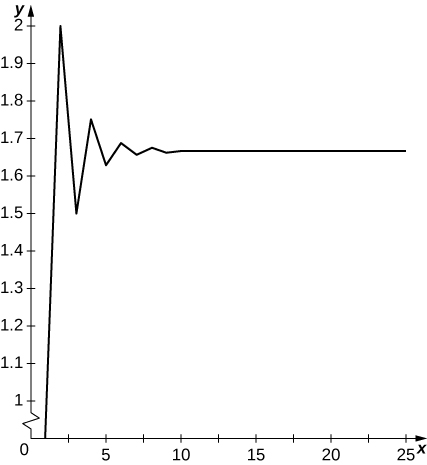
Plot the first terms of each sequence. State whether the graphical evidence suggests that the sequence converges or diverges.
[T] and for
Answer
Terms oscillate above and below and appear to converge to
5-21 §5.1 source ↗
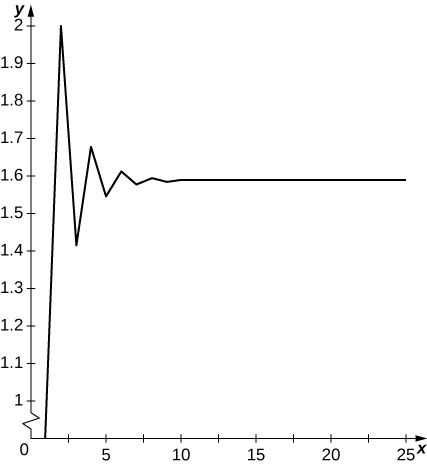
Plot the first terms of each sequence. State whether the graphical evidence suggests that the sequence converges or diverges.
[T] and for
Answer
Terms oscillate above and below and appear to converge to a limit.
5-23 §5.1 source ↗
Suppose that and for all Evaluate each of the following limits, or state that the limit does not exist, or state that there is not enough information to determine whether the limit exists.
Answer
5-25 §5.1 source ↗
Suppose that and for all Evaluate each of the following limits, or state that the limit does not exist, or state that there is not enough information to determine whether the limit exists.
Answer
5-27 §5.1 source ↗
Find the limit of each of the following sequences, using L’Hôpital’s rule when appropriate.
Answer
5-29 §5.1 source ↗
Find the limit of each of the following sequences, using L’Hôpital’s rule when appropriate.
Answer
5-31 §5.1 source ↗
For each of the following sequences, whose terms are indicated, state whether the sequence is bounded and whether it is eventually monotone, increasing, or decreasing.
Answer
5-33 §5.1 source ↗
For each of the following sequences, whose terms are indicated, state whether the sequence is bounded and whether it is eventually monotone, increasing, or decreasing.
Answer
5-35 §5.1 source ↗
For each of the following sequences, whose terms are indicated, state whether the sequence is bounded and whether it is eventually monotone, increasing, or decreasing.
Answer
5-37 §5.1 source ↗
For each of the following sequences, whose terms are indicated, state whether the sequence is bounded and whether it is eventually monotone, increasing, or decreasing.
Answer
5-39 §5.1 source ↗
For each of the following sequences, whose terms are indicated, state whether the sequence is bounded and whether it is eventually monotone, increasing, or decreasing.
Determine whether the sequence defined as follows has a limit. If it does, find the limit.
Answer
5-41 §5.1 source ↗
Use the Squeeze Theorem to find the limit of each of the following sequences.
Answer
5-43 §5.1 source ↗
Use the Squeeze Theorem to find the limit of each of the following sequences.
Answer
5-45 §5.1 source ↗
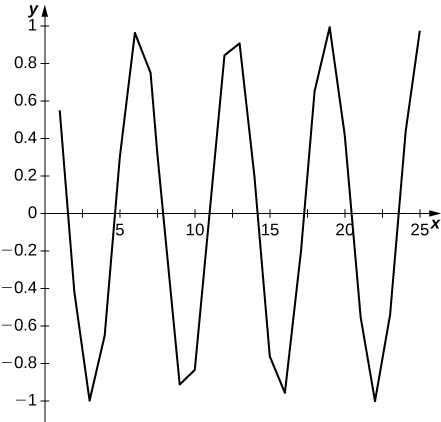
For the following sequences, plot the first terms of the sequence and state whether the graphical evidence suggests that the sequence converges or diverges.
[T]
Answer
Graph oscillates and suggests no limit.
5-47 §5.1 source ↗
Determine the limit of the sequence or show that the sequence diverges. If it converges, find its limit.
Answer
5-49 §5.1 source ↗
Determine the limit of the sequence or show that the sequence diverges. If it converges, find its limit.
Answer
5-51 §5.1 source ↗
Determine the limit of the sequence or show that the sequence diverges. If it converges, find its limit.
Answer
5-53 §5.1 source ↗
Determine the limit of the sequence or show that the sequence diverges. If it converges, find its limit.
Answer
5-55 §5.1 source ↗
Newton’s method seeks to approximate a solution that starts with an initial approximation and successively defines a sequence For the given choice of and write out the formula for If the sequence appears to converge, give an exact formula for the solution then identify the limit accurate to four decimal places and the smallest such that agrees with up to four decimal places.
[T]
Answer
5-57 §5.1 source ↗
Newton’s method seeks to approximate a solution that starts with an initial approximation and successively defines a sequence For the given choice of and write out the formula for If the sequence appears to converge, give an exact formula for the solution then identify the limit accurate to four decimal places and the smallest such that agrees with up to four decimal places.
[T]
Answer
5-59 §5.1 source ↗
Newton’s method seeks to approximate a solution that starts with an initial approximation and successively defines a sequence For the given choice of and write out the formula for If the sequence appears to converge, give an exact formula for the solution then identify the limit accurate to four decimal places and the smallest such that agrees with up to four decimal places.
[T] A lake initially contains fish. Suppose that in the absence of predators or other causes of removal, the fish population increases by each month. However, factoring in all causes, fish are lost each month.
a. Explain why the fish population after months is modeled by with
b. How many fish will be in the pond after one year?
Answer
5-61 §5.1 source ↗
Newton’s method seeks to approximate a solution that starts with an initial approximation and successively defines a sequence For the given choice of and write out the formula for If the sequence appears to converge, give an exact formula for the solution then identify the limit accurate to four decimal places and the smallest such that agrees with up to four decimal places.
[T] A student takes out a college loan of at an annual percentage rate of compounded monthly.
a. If the student makes payments of per month, how much does the student owe after months?
b. After how many months will the loan be paid off?
Answer
5-63 §5.1 source ↗
Newton’s method seeks to approximate a solution that starts with an initial approximation and successively defines a sequence For the given choice of and write out the formula for If the sequence appears to converge, give an exact formula for the solution then identify the limit accurate to four decimal places and the smallest such that agrees with up to four decimal places.
[T] The binary representation of a number between and can be defined as follows. Let if and if Let Let if and if Let and in general, and if and if Find the binary expansion of
Answer
5-65 §5.1 source ↗
For the following two exercises, assume that you have access to a computer program or Internet source that can generate a list of zeros and ones of any desired length. Pseudorandom number generators (PRNGs) play an important role in simulating random noise in physical systems by creating sequences of zeros and ones that appear like the result of flipping a coin repeatedly. One of the simplest types of PRNGs recursively defines a random-looking sequence of integers by fixing two special integers and and letting be the remainder after dividing into then creates a bit sequence of zeros and ones whose term is equal to one if is odd and equal to zero if is even. If the bits are pseudorandom, then the behavior of their average should be similar to behavior of averages of truly randomly generated bits.
[T] Starting with and using ten different starting values of compute sequences of bits up to and compare their averages to ten such sequences generated by a random bit generator.
Answer
Checkpoint 5.7 §5.2 source ↗
Answer
Checkpoint 5.8 §5.2 source ↗
Answer
Checkpoint 5.9 §5.2 source ↗
Answer
Checkpoint 5.10 §5.2 source ↗
Answer
Checkpoint 5.11 §5.2 source ↗
Answer
5-67 §5.2 source ↗
Using sigma notation, write the following expressions as infinite series.
Answer
5-69 §5.2 source ↗
Using sigma notation, write the following expressions as infinite series.
Answer
5-71 §5.2 source ↗
Compute the first four partial sums for the series having term starting with as follows.
Answer
5-73 §5.2 source ↗
Compute the first four partial sums for the series having term starting with as follows.
Answer
5-75 §5.2 source ↗
In the following exercises, compute the general term of the series with the given partial sum If the sequence of partial sums converges, find its limit
Answer
5-77 §5.2 source ↗
In the following exercises, compute the general term of the series with the given partial sum If the sequence of partial sums converges, find its limit
Answer
5-79 §5.2 source ↗
For each of the following series, use the sequence of partial sums to determine whether the series converges or diverges.
Answer
5-81 §5.2 source ↗
For each of the following series, use the sequence of partial sums to determine whether the series converges or diverges.
(Hint: Use a partial fraction decomposition like that for
Answer
The pattern is and the series converges to
5-83 §5.2 source ↗
Suppose that that that and Find the sum of the indicated series.
Answer
5-85 §5.2 source ↗
Suppose that that that and Find the sum of the indicated series.
Answer
5-87 §5.2 source ↗
State whether the given series converges and explain why.
(Hint: Rewrite using a change of index.)
Answer
5-89 §5.2 source ↗
State whether the given series converges and explain why.
Answer
5-91 §5.2 source ↗
State whether the given series converges and explain why.
Answer
5-93 §5.2 source ↗
For as follows, write the sum as a geometric series of the form State whether the series converges and if it does, find the value of
and for
Answer
5-95 §5.2 source ↗
For as follows, write the sum as a geometric series of the form State whether the series converges and if it does, find the value of
and for
Answer
5-97 §5.2 source ↗
Use the identity to express the function as a geometric series in the indicated term.
in
Answer
5-99 §5.2 source ↗
Use the identity to express the function as a geometric series in the indicated term.
in
Answer
5-101 §5.2 source ↗
Evaluate the following telescoping series or state whether the series diverges.
Answer
5-103 §5.2 source ↗
Evaluate the following telescoping series or state whether the series diverges.
Answer
5-105 §5.2 source ↗
Express the following series as a telescoping sum and evaluate its nth partial sum.
Answer
5-107 §5.2 source ↗
Express the following series as a telescoping sum and evaluate its nth partial sum.
Answer
5-109 §5.2 source ↗
A general telescoping series is one in which all but the first few terms cancel out after summing a given number of successive terms.
Let in which as Find
Answer
5-111 §5.2 source ↗
A general telescoping series is one in which all but the first few terms cancel out after summing a given number of successive terms.
Suppose that where as Find a condition on the coefficients that make this a general telescoping series.
Answer
5-113 §5.2 source ↗
A general telescoping series is one in which all but the first few terms cancel out after summing a given number of successive terms.
Evaluate
Answer
5-115 §5.2 source ↗
A general telescoping series is one in which all but the first few terms cancel out after summing a given number of successive terms.
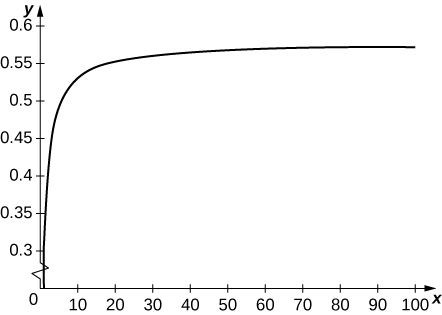
[T] Define a sequence Use the graph of to verify that is increasing. Plot for and state whether it appears that the sequence converges.
Answer
converges to is a sum of rectangles of height over the interval which lie above the graph of
5-117 §5.2 source ↗
Each of the following infinite series converges to the given multiple of or
In each case, find the minimum value of such that the partial sum of the series accurately approximates the left-hand side to the given number of decimal places, and give the desired approximate value. Up to decimals place,
[T] error
Answer
5-119 §5.2 source ↗
Each of the following infinite series converges to the given multiple of or
In each case, find the minimum value of such that the partial sum of the series accurately approximates the left-hand side to the given number of decimal places, and give the desired approximate value. Up to decimals place,
[T] error
Answer
5-121 §5.2 source ↗
Each of the following infinite series converges to the given multiple of or
In each case, find the minimum value of such that the partial sum of the series accurately approximates the left-hand side to the given number of decimal places, and give the desired approximate value. Up to decimals place,
[T] A fair coin is one that has probability of coming up heads when flipped.
a. What is the probability that a fair coin will come up tails times in a row?
b. Find the probability that a coin comes up heads for the first time on the last of an even number of coin flips.
Answer
5-123 §5.2 source ↗
Each of the following infinite series converges to the given multiple of or
In each case, find the minimum value of such that the partial sum of the series accurately approximates the left-hand side to the given number of decimal places, and give the desired approximate value. Up to decimals place,
[T] Find the probability that a fair coin will come up heads for the second time after an even number of flips.
Answer
5-125 §5.2 source ↗
Each of the following infinite series converges to the given multiple of or
In each case, find the minimum value of such that the partial sum of the series accurately approximates the left-hand side to the given number of decimal places, and give the desired approximate value. Up to decimals place,
[T] The expected number of times that a fair coin will come up heads is defined as the sum over of times the probability that the coin will come up heads exactly times in a row, or Compute the expected number of consecutive times that a fair coin will come up heads.
Answer
5-127 §5.2 source ↗
Each of the following infinite series converges to the given multiple of or
In each case, find the minimum value of such that the partial sum of the series accurately approximates the left-hand side to the given number of decimal places, and give the desired approximate value. Up to decimals place,
[T] Suppose that the amount of a drug in a patient’s system diminishes by a multiplicative factor each hour. Suppose that a new dose is administered every hours. Find an expression that gives the amount in the patient’s system after hours for each in terms of the dosage and the ratio (Hint: Write where and sum over values from the different doses administered.)
Answer
The part of the first dose after hours is the part of the second dose is and, in general, the part remaining of the dose is so
5-129 §5.2 source ↗
Each of the following infinite series converges to the given multiple of or
In each case, find the minimum value of such that the partial sum of the series accurately approximates the left-hand side to the given number of decimal places, and give the desired approximate value. Up to decimals place,
Suppose that is a sequence of numbers. Explain why the sequence of partial sums of is increasing.
Answer
5-131 §5.2 source ↗
Each of the following infinite series converges to the given multiple of or
In each case, find the minimum value of such that the partial sum of the series accurately approximates the left-hand side to the given number of decimal places, and give the desired approximate value. Up to decimals place,
[T] Suppose that and that, for given numbers and one defines and Does converge? If so, to what? (Hint: First argue that for all and is increasing.)
Answer
5-133 §5.2 source ↗
Each of the following infinite series converges to the given multiple of or
In each case, find the minimum value of such that the partial sum of the series accurately approximates the left-hand side to the given number of decimal places, and give the desired approximate value. Up to decimals place,
[T] Suppose that is a convergent series of positive terms. Explain why
Answer
5-135 §5.2 source ↗
Each of the following infinite series converges to the given multiple of or
In each case, find the minimum value of such that the partial sum of the series accurately approximates the left-hand side to the given number of decimal places, and give the desired approximate value. Up to decimals place,
[T] Find the total length of the dashed path in the following figure.
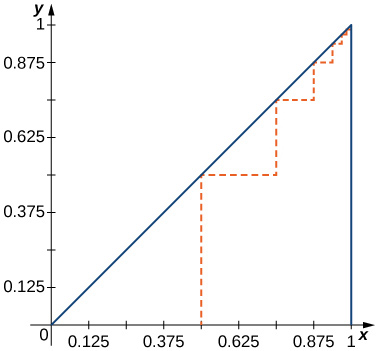
Answer
5-137 §5.2 source ↗
Each of the following infinite series converges to the given multiple of or
In each case, find the minimum value of such that the partial sum of the series accurately approximates the left-hand side to the given number of decimal places, and give the desired approximate value. Up to decimals place,
[T] The Sierpinski gasket is obtained by dividing the unit square into nine equal sub-squares, removing the middle square, then doing the same at each stage to the remaining sub-squares. The figure shows the remaining set after four iterations. Compute the total area removed after stages, and compute the length the total perimeter of the remaining set after stages.
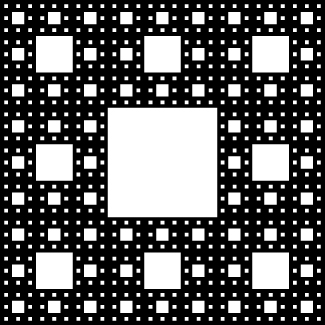
Answer
At stage one a square of area is removed, at stage one removes squares of area at stage three one removes squares of area and so on. The total removed area after stages is
as The total perimeter is
Checkpoint 5.12 §5.3 source ↗
Answer
Checkpoint 5.13 §5.3 source ↗
Answer
Checkpoint 5.14 §5.3 source ↗
Answer
Checkpoint 5.15 §5.3 source ↗
Answer
5-139 §5.3 source ↗
For each of the following series, if the divergence test applies, either state that does not exist or find If the divergence test does not apply, state why.
Answer
5-141 §5.3 source ↗
For each of the following series, if the divergence test applies, either state that does not exist or find If the divergence test does not apply, state why.
Answer
5-143 §5.3 source ↗
For each of the following series, if the divergence test applies, either state that does not exist or find If the divergence test does not apply, state why.
Answer
5-145 §5.3 source ↗
For each of the following series, if the divergence test applies, either state that does not exist or find If the divergence test does not apply, state why.
Answer
5-147 §5.3 source ↗
For each of the following series, if the divergence test applies, either state that does not exist or find If the divergence test does not apply, state why.
Answer
5-149 §5.3 source ↗
For each of the following series, if the divergence test applies, either state that does not exist or find If the divergence test does not apply, state why.
Answer
5-151 §5.3 source ↗
For each of the following series, if the divergence test applies, either state that does not exist or find If the divergence test does not apply, state why.
Answer
5-153 §5.3 source ↗
State whether the given -series converges.
Answer
5-155 §5.3 source ↗
State whether the given -series converges.
Answer
5-157 §5.3 source ↗
State whether the given -series converges.
Answer
5-159 §5.3 source ↗
Use the integral test to determine whether the following sums converge.
Answer
5-161 §5.3 source ↗
Use the integral test to determine whether the following sums converge.
Answer
5-163 §5.3 source ↗
Use the integral test to determine whether the following sums converge.
Answer
5-165 §5.3 source ↗
Express the following sums as -series and determine whether each converges.
(Hint: .)
Answer
5-167 §5.3 source ↗
Express the following sums as -series and determine whether each converges.
Answer
5-169 §5.3 source ↗
Use the estimate to find a bound for the remainder where
Answer
5-171 §5.3 source ↗
Use the estimate to find a bound for the remainder where
Answer
5-173 §5.3 source ↗
[T] Find the minimum value of such that the remainder estimate guarantees that estimates accurate to within the given error.
error
Answer
5-175 §5.3 source ↗
[T] Find the minimum value of such that the remainder estimate guarantees that estimates accurate to within the given error.
error
Answer
5-177 §5.3 source ↗
[T] Find the minimum value of such that the remainder estimate guarantees that estimates accurate to within the given error.
error
Answer
5-179 §5.3 source ↗
In the following exercises, find a value of such that is smaller than the desired error. Compute the corresponding sum and compare it to the given estimate of the infinite series.
error
Answer
5-181 §5.3 source ↗
In the following exercises, find a value of such that is smaller than the desired error. Compute the corresponding sum and compare it to the given estimate of the infinite series.
error
Answer
okay if
Estimate agrees with the sum to three decimal places.
5-183 §5.3 source ↗
In the following exercises, find a value of such that is smaller than the desired error. Compute the corresponding sum and compare it to the given estimate of the infinite series.
Find the limit as of (Hint: Compare to
Answer
5-185 §5.3 source ↗
The next few exercises are intended to give a sense of applications in which partial sums of the harmonic series arise.
In certain applications of probability, such as the so-called Watterson estimator for predicting mutation rates in population genetics, it is important to have an accurate estimate of the number Recall that is decreasing. Compute to four decimal places. (Hint: .)
Answer
5-187 §5.3 source ↗
The next few exercises are intended to give a sense of applications in which partial sums of the harmonic series arise.
[T] The simplest way to shuffle cards is to take the top card and insert it at a random place in the deck, called top random insertion, and then repeat. We will consider a deck to be randomly shuffled once enough top random insertions have been made that the card originally at the bottom has reached the top and then been randomly inserted. If the deck has cards, then the probability that the insertion will be below the card initially at the bottom (call this card is Thus the expected number of top random insertions before is no longer at the bottom is n. Once one card is below there are two places below and the probability that a randomly inserted card will fall below is The expected number of top random insertions before this happens is The two cards below are now in random order. Continuing this way, find a formula for the expected number of top random insertions needed to consider the deck to be randomly shuffled.
Answer
5-189 §5.3 source ↗
The next few exercises are intended to give a sense of applications in which partial sums of the harmonic series arise.
Show that for the remainder estimate to apply on it is sufficient that be decreasing on but need not be decreasing on
Answer
5-191 §5.3 source ↗
The next few exercises are intended to give a sense of applications in which partial sums of the harmonic series arise.
Does converge if is large enough? If so, for which
Answer
5-193 §5.3 source ↗
The next few exercises are intended to give a sense of applications in which partial sums of the harmonic series arise.
[T] A fast computer can sum one million terms per second of the divergent series Use the integral test to approximate how many seconds it will take to add up enough terms for the partial sum to exceed
Answer
Checkpoint 5.16 §5.4 source ↗
Answer
Checkpoint 5.17 §5.4 source ↗
Answer
5-195 §5.4 source ↗
Use the comparison test to determine whether the following series converge.
where
Answer
5-197 §5.4 source ↗
Use the comparison test to determine whether the following series converge.
Answer
5-199 §5.4 source ↗
Use the comparison test to determine whether the following series converge.
Answer
5-201 §5.4 source ↗
Use the comparison test to determine whether the following series converge.
Answer
5-203 §5.4 source ↗
Use the comparison test to determine whether the following series converge.
Answer
5-205 §5.4 source ↗
Use the comparison test to determine whether the following series converge.
Answer
5-207 §5.4 source ↗
Use the limit comparison test to determine whether each of the following series converges or diverges.
Answer
5-209 §5.4 source ↗
Use the limit comparison test to determine whether each of the following series converges or diverges.
Answer
5-211 §5.4 source ↗
Use the limit comparison test to determine whether each of the following series converges or diverges.
Answer
5-213 §5.4 source ↗
Use the limit comparison test to determine whether each of the following series converges or diverges.
Answer
5-215 §5.4 source ↗
Use the limit comparison test to determine whether each of the following series converges or diverges.
Answer
5-217 §5.4 source ↗
Use the limit comparison test to determine whether each of the following series converges or diverges.
Answer
5-219 §5.4 source ↗
Use the limit comparison test to determine whether each of the following series converges or diverges.
Answer
5-221 §5.4 source ↗
Use the limit comparison test to determine whether each of the following series converges or diverges.
(Hint: so
Answer
5-223 §5.4 source ↗
Use the limit comparison test to determine whether each of the following series converges or diverges.
Does converge if is large enough? If so, for which
Answer
5-225 §5.4 source ↗
Use the limit comparison test to determine whether each of the following series converges or diverges.
For which does the series converge?
Answer
5-227 §5.4 source ↗
Use the limit comparison test to determine whether each of the following series converges or diverges.
For which does the series converge?
Answer
5-229 §5.4 source ↗
Use the limit comparison test to determine whether each of the following series converges or diverges.
Does converge or diverge? Explain.
Answer
5-231 §5.4 source ↗
Use the limit comparison test to determine whether each of the following series converges or diverges.
Suppose that and and that and converge. Prove that converges and
Answer
5-233 §5.4 source ↗
Use the limit comparison test to determine whether each of the following series converges or diverges.
Does converge? (Hint: Use to compare to a
Answer
5-235 §5.4 source ↗
Use the limit comparison test to determine whether each of the following series converges or diverges.
Show that if and converges, then converges. If converges, does necessarily converge?
Answer
5-237 §5.4 source ↗
Use the limit comparison test to determine whether each of the following series converges or diverges.
Suppose that for all and that diverges. Suppose that is an arbitrary sequence of zeros and ones with infinitely many terms equal to one. Does necessarily diverge?
Answer
5-239 §5.4 source ↗
Use the limit comparison test to determine whether each of the following series converges or diverges.
Show that if and converges, then converges.
Answer
5-241 §5.4 source ↗
Use the limit comparison test to determine whether each of the following series converges or diverges.
Let be an infinite sequence of zeros and ones. What is the largest possible value of
Answer
5-243 §5.4 source ↗
Use the limit comparison test to determine whether each of the following series converges or diverges.
Explain why, if then cannot be written
Answer
5-245 §5.4 source ↗
Use the limit comparison test to determine whether each of the following series converges or diverges.
[T] Robert wants to know his body mass to arbitrary precision. He has a big balancing scale that works perfectly, an unlimited collection of weights, and nine each of and so on weights. Assuming the scale is big enough, can he do this? What does this have to do with infinite series?
Answer
5-247 §5.4 source ↗
Use the limit comparison test to determine whether each of the following series converges or diverges.
In view of the previous exercise, it may be surprising that a subseries of the harmonic series in which about one in every five terms is deleted might converge. A depleted harmonic series is a series obtained from by removing any term if a given digit, say appears in the decimal expansion of Argue that this depleted harmonic series converges by answering the following questions.
a. How many whole numbers have digits?
b. How many whole numbers do not contain as one or more of their digits?
c. What is the smallest number
d. Explain why the deleted harmonic series is bounded by
e. Show that converges.
Answer
5-249 §5.4 source ↗
Use the limit comparison test to determine whether each of the following series converges or diverges.
Suppose that a sequence of numbers has the property that and where Can you determine whether converges? (Hint: etc. Look at and use
Answer
Checkpoint 5.18 §5.5 source ↗
Answer
Checkpoint 5.19 §5.5 source ↗
Answer
Checkpoint 5.20 §5.5 source ↗
Answer
5-251 §5.5 source ↗
State whether each of the following series converges absolutely, conditionally, or not at all.
Answer
5-253 §5.5 source ↗
State whether each of the following series converges absolutely, conditionally, or not at all.
Answer
5-255 §5.5 source ↗
State whether each of the following series converges absolutely, conditionally, or not at all.
Answer
5-257 §5.5 source ↗
State whether each of the following series converges absolutely, conditionally, or not at all.
Answer
5-259 §5.5 source ↗
State whether each of the following series converges absolutely, conditionally, or not at all.
Answer
5-261 §5.5 source ↗
State whether each of the following series converges absolutely, conditionally, or not at all.
Answer
5-263 §5.5 source ↗
State whether each of the following series converges absolutely, conditionally, or not at all.
Answer
5-265 §5.5 source ↗
State whether each of the following series converges absolutely, conditionally, or not at all.
Answer
5-267 §5.5 source ↗
State whether each of the following series converges absolutely, conditionally, or not at all.
Answer
5-269 §5.5 source ↗
State whether each of the following series converges absolutely, conditionally, or not at all.
(Hint: for large
Answer
5-271 §5.5 source ↗
State whether each of the following series converges absolutely, conditionally, or not at all.
(Hint: Find common denominator then rationalize numerator.)
Answer
5-273 §5.5 source ↗
State whether each of the following series converges absolutely, conditionally, or not at all.
(Hint: Use Mean Value Theorem.)
Answer
5-275 §5.5 source ↗
State whether each of the following series converges absolutely, conditionally, or not at all.
Answer
5-277 §5.5 source ↗
State whether each of the following series converges absolutely, conditionally, or not at all.
Answer
5-279 §5.5 source ↗
State whether each of the following series converges absolutely, conditionally, or not at all.
Answer
5-281 §5.5 source ↗
In each of the following problems, use the estimate to find a value of that guarantees that the sum of the first terms of the alternating series differs from the infinite sum by at most the given error. Calculate the partial sum for this
[T] error
Answer
5-283 §5.5 source ↗
In each of the following problems, use the estimate to find a value of that guarantees that the sum of the first terms of the alternating series differs from the infinite sum by at most the given error. Calculate the partial sum for this
[T] error
Answer
5-285 §5.5 source ↗
In each of the following problems, use the estimate to find a value of that guarantees that the sum of the first terms of the alternating series differs from the infinite sum by at most the given error. Calculate the partial sum for this
[T] error
Answer
5-287 §5.5 source ↗
For the following exercises, indicate whether each of the following statements is true or false. If the statement is false, provide an example in which it is false.
If is decreasing, then converges absolutely.
Answer
5-289 §5.5 source ↗
For the following exercises, indicate whether each of the following statements is true or false. If the statement is false, provide an example in which it is false.
If is decreasing and converges then converges.
Answer
5-291 §5.5 source ↗
For the following exercises, indicate whether each of the following statements is true or false. If the statement is false, provide an example in which it is false.
Let if and if (Also, and If converges conditionally but not absolutely, then neither nor converge.
Answer
5-293 §5.5 source ↗
For the following exercises, indicate whether each of the following statements is true or false. If the statement is false, provide an example in which it is false.
Suppose that is a sequence such that converges for every possible sequence of zeros and ones. Does converge absolutely?
Answer
5-295 §5.5 source ↗
The following series do not satisfy the hypotheses of the alternating series test as stated.
In each case, state which hypothesis is not satisfied. State whether the series converges absolutely.
Answer
5-297 §5.5 source ↗
The following series do not satisfy the hypotheses of the alternating series test as stated.
In each case, state which hypothesis is not satisfied. State whether the series converges absolutely.
Answer
5-299 §5.5 source ↗
The following series do not satisfy the hypotheses of the alternating series test as stated.
In each case, state which hypothesis is not satisfied. State whether the series converges absolutely.
Suppose that converges absolutely. Show that the series consisting of the positive terms also converges.
Answer
5-301 §5.5 source ↗
The following series do not satisfy the hypotheses of the alternating series test as stated.
In each case, state which hypothesis is not satisfied. State whether the series converges absolutely.
The formula will be derived in the next chapter. Use the remainder to find a bound for the error in estimating by the fifth partial sum for and
Answer
5-303 §5.5 source ↗
The following series do not satisfy the hypotheses of the alternating series test as stated.
In each case, state which hypothesis is not satisfied. State whether the series converges absolutely.
How many terms in are needed to approximate accurate to an error of at most
Answer
5-305 §5.5 source ↗
The following series do not satisfy the hypotheses of the alternating series test as stated.
In each case, state which hypothesis is not satisfied. State whether the series converges absolutely.
Sometimes the alternating series converges to a certain fraction of an absolutely convergent series at a faster rate. Given that find Which of the series and gives a better estimation of using terms?
Answer
Let Then so
The alternating series is more accurate for terms.
5-307 §5.5 source ↗
The following alternating series converge to given multiples of Find the value of predicted by the remainder estimate such that the partial sum of the series accurately approximates the left-hand side to within the given error. Find the minimum for which the error bound holds, and give the desired approximate value in each case. Up to decimals places,
[T] error
Answer
5-309 §5.5 source ↗
The following alternating series converge to given multiples of Find the value of predicted by the remainder estimate such that the partial sum of the series accurately approximates the left-hand side to within the given error. Find the minimum for which the error bound holds, and give the desired approximate value in each case. Up to decimals places,
[T] If what is
Answer
5-311 §5.5 source ↗
The following alternating series converge to given multiples of Find the value of predicted by the remainder estimate such that the partial sum of the series accurately approximates the left-hand side to within the given error. Find the minimum for which the error bound holds, and give the desired approximate value in each case. Up to decimals places,
[T] Plot the series for and comment on its behavior
Answer
The series jumps rapidly near the endpoints. For away from the endpoints, the graph looks like
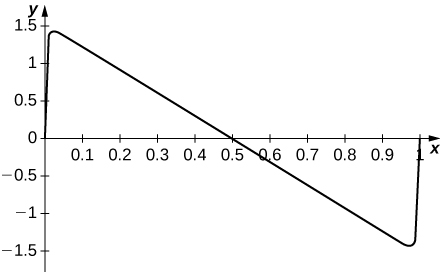
5-313 §5.5 source ↗
The following alternating series converge to given multiples of Find the value of predicted by the remainder estimate such that the partial sum of the series accurately approximates the left-hand side to within the given error. Find the minimum for which the error bound holds, and give the desired approximate value in each case. Up to decimals places,
[T] The alternating harmonic series converges because of cancellation among its terms. Its sum is known because the cancellation can be described explicitly. A random harmonic series is one of the form where is a randomly generated sequence of in which the values are equally likely to occur. Use a random number generator to produce random and plot the partial sums of your random harmonic sequence for to Compare to a plot of the first partial sums of the harmonic series.
Answer
Here is a typical result. The top curve consists of partial sums of the harmonic series. The bottom curve plots partial sums of a random harmonic series.
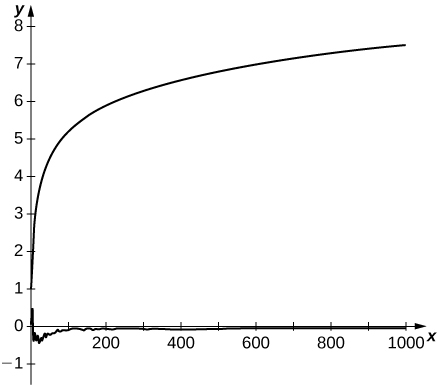
5-315 §5.5 source ↗
The following alternating series converge to given multiples of Find the value of predicted by the remainder estimate such that the partial sum of the series accurately approximates the left-hand side to within the given error. Find the minimum for which the error bound holds, and give the desired approximate value in each case. Up to decimals places,
[T] The Euler transform rewrites as For the alternating harmonic series, it takes the form Compute partial sums of until they approximate accurate to within How many terms are needed? Compare this answer to the number of terms of the alternating harmonic series are needed to estimate
Answer
Checkpoint 5.21 §5.6 source ↗
Answer
Checkpoint 5.22 §5.6 source ↗
Answer
Checkpoint 5.23 §5.6 source ↗
Answer
5-317 §5.6 source ↗
Use the ratio test to determine whether converges, where is given in the following problems. State if the ratio test is inconclusive.
Answer
5-319 §5.6 source ↗
Use the ratio test to determine whether converges, where is given in the following problems. State if the ratio test is inconclusive.
Answer
5-321 §5.6 source ↗
Use the ratio test to determine whether converges, where is given in the following problems. State if the ratio test is inconclusive.
Answer
5-323 §5.6 source ↗
Use the ratio test to determine whether converges, where is given in the following problems. State if the ratio test is inconclusive.
Answer
5-325 §5.6 source ↗
Use the ratio test to determine whether converges, where is given in the following problems. State if the ratio test is inconclusive.
Answer
5-327 §5.6 source ↗
Use the ratio test to determine whether converges, where is given in the following problems. State if the ratio test is inconclusive.
Answer
5-329 §5.6 source ↗
Use the root test to determine whether converges, where is as follows.
Answer
5-331 §5.6 source ↗
Use the root test to determine whether converges, where is as follows.
Answer
5-333 §5.6 source ↗
Use the root test to determine whether converges, where is as follows.
Answer
5-335 §5.6 source ↗
Use the root test to determine whether converges, where is as follows.
Answer
5-337 §5.6 source ↗
For this exercise, let n start at 2.
Answer
5-339 §5.6 source ↗
In the following exercises, use either the ratio test or the root test as appropriate to determine whether the series with given terms converges, or state if the test is inconclusive.
Answer
5-341 §5.6 source ↗
In the following exercises, use either the ratio test or the root test as appropriate to determine whether the series with given terms converges, or state if the test is inconclusive.
Answer
5-343 §5.6 source ↗
In the following exercises, use either the ratio test or the root test as appropriate to determine whether the series with given terms converges, or state if the test is inconclusive.
Answer
5-345 §5.6 source ↗
Use the ratio test to determine whether converges, or state if the ratio test is inconclusive.
Answer
5-347 §5.6 source ↗
Use the root and limit comparison tests to determine whether converges.
where (Hint: Find limit of
Answer
5-349 §5.6 source ↗
In the following exercises, use an appropriate test to determine whether the series converges.
Answer
5-351 §5.6 source ↗
In the following exercises, use an appropriate test to determine whether the series converges.
Answer
5-353 §5.6 source ↗
In the following exercises, use an appropriate test to determine whether the series converges.
Answer
5-355 §5.6 source ↗
In the following exercises, use an appropriate test to determine whether the series converges.
where
Answer
5-357 §5.6 source ↗
In the following exercises, use an appropriate test to determine whether the series converges.
Answer
5-359 §5.6 source ↗
In the following exercises, use an appropriate test to determine whether the series converges.
(Hint:
Answer
5-361 §5.6 source ↗
The following series converge by the ratio test. Use summation by parts, to find the sum of the given series.
where (Hint: Take and
Answer
5-363 §5.6 source ↗
The following series converge by the ratio test. Use summation by parts, to find the sum of the given series.
Answer
5-365 §5.6 source ↗
The kth term of each of the following series has a factor Find the range of for which the ratio test implies that the series converges.
Answer
5-367 §5.6 source ↗
The kth term of each of the following series has a factor Find the range of for which the ratio test implies that the series converges.
Answer
5-369 §5.6 source ↗
The kth term of each of the following series has a factor Find the range of for which the ratio test implies that the series converges.
Let For which real numbers does converge?
Answer
5-371 §5.6 source ↗
The kth term of each of the following series has a factor Find the range of for which the ratio test implies that the series converges.
Suppose that For which values of is guaranteed to converge?
Answer
5-373 §5.6 source ↗
The kth term of each of the following series has a factor Find the range of for which the ratio test implies that the series converges.
For which values of if any, does converge? (Hint:
Answer
5-375 §5.6 source ↗
The kth term of each of the following series has a factor Find the range of for which the ratio test implies that the series converges.
Let where is the greatest integer less than or equal to Determine whether converges and justify your answer.
Answer
5-377 §5.6 source ↗
The following advanced exercises use a generalized ratio test to determine convergence of some series that arise in particular applications when tests in this chapter, including the ratio and root test, are not powerful enough to determine their convergence. The test states that if then converges, while if then diverges.
Let Show that For which does the generalized ratio test imply convergence of (Hint: Write as a product of factors each smaller than
Answer
5-379 §5.R source ↗
True or False? Justify your answer with a proof or a counterexample.
If then converges.
Answer
5-381 §5.R source ↗
True or False? Justify your answer with a proof or a counterexample.
If converges, then converges.
Answer
5-383 §5.R source ↗
Is the sequence bounded, monotone, and convergent or divergent? If it is convergent, find the limit.
Answer
5-385 §5.R source ↗
Is the sequence bounded, monotone, and convergent or divergent? If it is convergent, find the limit.
Answer
5-387 §5.R source ↗
Is the sequence bounded, monotone, and convergent or divergent? If it is convergent, find the limit.
Answer
5-389 §5.R source ↗
Is the series convergent or divergent?
Answer
5-391 §5.R source ↗
Is the series convergent or divergent?
Answer
5-393 §5.R source ↗
Is the series convergent or divergent? If convergent, is it absolutely convergent?
Answer
5-395 §5.R source ↗
Is the series convergent or divergent? If convergent, is it absolutely convergent?
Answer
5-397 §5.R source ↗
Is the series convergent or divergent? If convergent, is it absolutely convergent?
Answer
5-399 §5.R source ↗
Evaluate
Answer
5-401 §5.R source ↗
The following problems consider a simple population model of the housefly, which can be exhibited by the recursive formula where is the population of houseflies at generation and is the average number of offspring per housefly who survive to the next generation. Assume a starting population
Find if and
Answer
5-403 §5.R source ↗
The following problems consider a simple population model of the housefly, which can be exhibited by the recursive formula where is the population of houseflies at generation and is the average number of offspring per housefly who survive to the next generation. Assume a starting population
If and find and
Answer
Loading chapter 6…
Problems and answers are adapted from Calculus Volume 2 by Gilbert Strang and Edwin “Jed” Herman, OpenStax, and are used under the CC BY-NC-SA 4.0 licence. Access for free at https://openstax.org/books/calculus-volume-2/pages/1-introduction. Illustrations: Copyright Rice University, OpenStax, under CC BY-NC-SA 4.0 license. This adaptation is released under the same licence, is non-commercial, and is neither affiliated with nor endorsed by OpenStax or Rice University.