Every problem in the chapter beside the book’s answer, a chapter at a time as you scroll.
Chapter 2: Vector Spaces
206 problems · 7 figuresTwo.I.1.17 §I.1 source ↗
Name the zero vector for each of these vector spaces.
The space of degree three polynomials under the natural operations.
The space of matrices.
The space .
The space of real-valued functions of one natural number variable.
Answer (4 parts)
The constant function
The constant function
Two.I.1.18 §I.1 source ↗
Find the additive inverse, in the vector space, of the vector.
In , the vector .
In the space ,
In , the space of functions of the real variable under the natural operations, the vector .
Answer (3 parts)
Two.I.1.19 §I.1 source ↗
For each, list three elements and then show it is a vector space.
The set of linear polynomials under the usual polynomial addition and scalar multiplication operations.
The set of linear polynomials , under the usual polynomial addition and scalar multiplication operations.
Hint. Use Example 1.3 as a guide. Most of the ten conditions are just verifications.
Answer (2 parts)
Three elements are: , , and . (Of course, many answers are possible.)
The verification is just like Example 1.4. We first do conditions - from Definition 1.1, having to do with addition. For closure under addition, condition (1), note that where we have that is a linear polynomial with real coefficients and so is an element of . Condition (2) is verified with: where then , while in the other order they are , and both and as these are real numbers. Condition (3) is similar: suppose then while , and the two are equal (that is, real number addition is associative so and ). For condition (4) observe that the linear polynomial has the property that and . For the last condition in this paragraph, condition (5), note that for any the additive inverse is since .
We next also check conditions (6)-(10), involving scalar multiplication. For (6), the condition that the space be closed under scalar multiplication, suppose that is a real number and is an element of , and then is an element of because it is a linear polynomial with real number coefficients. Condition (7) holds because is true from the distributive property for real number multiplication. Condition (8) is similar: . For (9) we have . Finally, condition (10) is .
Call the set . In the prior item in this exercise there was no restriction on the coefficients but here we are restricting attention to those linear polynomials where , that is, where the constant term minus twice the coefficient of the linear term is zero. Thus, three typical elements of are , , and .
For condition (1) we must show that if we add two linear polynomials that satisfy the restriction then we get a linear polynomial also satisfying the restriction: here that argument is that if then is an element of because . We can verify condition (2) with: where then , while in the other order they are , and both and as these are real numbers. (That is, this condition is not affected by the restriction and the verification is the same as the verification in the first item of this exercise). Condition (3) is also not affected by the extra restriction: suppose that then while , and the two are equal. For condition (4) observe that the linear polynomial satisfies the restriction because its constant term minus twice the coefficient of its linear term is zero, and then the verification from the first item of this question applies: has the property that and . To check condition (5), note that for any the additive inverse is since it is an element of (because we know that and multiplying both sides by gives that ), and as in the first item it acts as the additive inverse .
We must also check conditions (6)-(10), those for scalar multiplication. For (6), the condition that the space be closed under scalar multiplication, suppose that is a real number and (so that ), then is an element of because it is a linear polynomial with real number coefficients satisfying that . Condition (7) holds for the same reason that it holds in the first item of this exercise, because is true from the distributive property for real number multiplication. Condition (8) is also unchanged from the first item: . So is (9): . Finally, so is condition (10): .
Two.I.1.20 §I.1 source ↗
For each, list three elements and then show it is a vector space.
The set of matrices with real entries under the usual matrix operations.
The set of matrices with real entries where the entry is zero, under the usual matrix operations.
Answer (3 parts)
Use Example 1.4 as a guide. (Comment. Because many of the conditions are quite easy to check, sometimes a person can feel that they must have missed something. Keep in mind that easy to do, or routine, is different from not necessary to do.)
Here are three elements.
For (1), the sum of real matrices is a real matrix. For (2) we consider the sum of two matrices
and apply commutativity of real number addition
to verify that the addition of the matrices is commutative. The verification for condition (3), associativity of matrix addition, is similar to the prior verification:
while
and the two are the same entry-by-entry because real number addition is associative. For (4), the zero element of this space is the matrix of zeroes. Condition (5) holds because for any matrix the additive inverse is the matrix whose entries are the negative of ’s, the matrix .
Condition () holds because a scalar multiple of a matrix is a matrix. For condition (7) we have this.
Condition (8) goes the same way.
For (9) we have this.
Condition (10) is just as easy.
This differs from the prior item in this exercise only in that we are restricting to the set of matrices with a zero in the second row and first column. Here are three elements of .
Some of the verifications for this item are the same as for the first item in this exercise, and below we’ll just do the ones that are different.
For (1), the sum of real matrices with a zero in the entry is also a real matrix with a zero in the entry.
The verification for condition (2) given in the prior item works in this item also. The same holds for condition (3). For (4), note that the matrix of zeroes is an element of . Condition (5) holds because for any matrix the additive inverse is the matrix and so the additive inverse of a matrix with a zero in the entry is also a matrix with a zero in the entry.
Condition holds because a scalar multiple of a matrix with a zero in the entry is a matrix with a zero in the entry. Condition (7)’s verification is the same as in the prior item. So are condition (8)’s, (9)’s, and (10)’s.
Two.I.1.21 §I.1 source ↗
For each, list three elements and then show it is a vector space.
The set of three-component row vectors with their usual operations.
The set
under the operations inherited from .
Answer (2 parts)
Three elements are , , and .
We must check conditions (1)-(10) in Definition 1.1. Conditions (1)-(5) concern addition. For condition (1) recall that the sum of two three-component row vectors
is also a three-component row vector (all of the letters represent real numbers). Verification of (2) is routine
(the second equality holds because the three entries are real numbers and real number addition commutes). Condition (3)’s verification is similar.
For (4), observe that the three-component row vector is the additive identity: . To verify condition (5), assume we are given the element of the set and note that is also in the set and has the desired property: .
Conditions (6)-(10) involve scalar multiplication. To verify (6), that the space is closed under the scalar multiplication operation that was given, note that is a three-component row vector with real entries. For (7) we compute.
Condition (8) is very similar.
So is the computation for condition (9).
Condition (10) is just as routine .
Call the set . Closure of addition, condition (1), involves checking that if the summands are members of then the sum
is also a member of , which is true because it satisfies the criteria for membership in : . The verifications for conditions (2), (3), and (5) are similar to the ones in the first part of this exercise. For condition (4) note that the vector of zeroes is a member of because its first component plus its second, minus its third, and plus its fourth, totals to zero.
Condition (6), closure of scalar multiplication, is similar: where the vector is an element of ,
is also an element of because . The verification for conditions (7), (8), (9), and (10) are as in the prior item of this exercise.
Two.I.1.22 §I.1 source ↗
Show that each of these is not a vector space. (Hint. Check closure by listing two members of each set and trying some operations on them.)
Under the operations inherited from , this set
Under the operations inherited from , this set
Under the usual matrix operations,
Under the usual polynomial operations,
where is the set of reals greater than zero
Under the inherited operations,
Answer (6 parts)
In each item the set is called . For some items, there are other correct ways to show that is not a vector space.
It is not closed under addition; it fails to meet condition (1).
It is not closed under addition.
It is not closed under addition.
It is not closed under scalar multiplication.
It is empty, violating condition (4).
Two.I.1.23 §I.1 source ↗
Define addition and scalar multiplication operations to make the complex numbers a vector space over .
Answer
The usual operations and suffice. The check is easy.
Two.I.1.24 §I.1 source ↗
Is the set of rational numbers a vector space over under the usual addition and scalar multiplication operations?
Answer
No, it is not closed under scalar multiplication since, e.g., is not a rational number.
Two.I.1.25 §I.1 source ↗
Show that the set of linear combinations of the variables is a vector space under the natural addition and scalar multiplication operations.
Answer
The natural operations are and . The check that this is a vector space is easy; use Example 1.4 as a guide.
Two.I.1.26 §I.1 source ↗
Prove that this is not a vector space: the set of two-tall column vectors with real entries subject to these operations.
Answer
The ‘’ operation is not commutative (that is, condition (2) is not met); producing two members of the set witnessing this assertion is easy.
Two.I.1.27 §I.1 source ↗
Prove or disprove that is a vector space under these operations.
Answer (2 parts)
It is not a vector space.
It is not a vector space.
Two.I.1.28 §I.1 source ↗
For each, decide if it is a vector space; the intended operations are the natural ones.
The diagonal matrices
This set of matrices
This set
The set of functions
The set of functions
Answer (6 parts)
For each “yes” answer, you can just check a couple of linear combinations in the space. For each “no” answer, give a specific example of the failure of one of the conditions.
Yes. One linear combination picked out of the air is this.
The key point about the collection being a vector space is that the result is a diagonal matrix.
Yes. Here is a linear combination.
We look for the result to follow the form that the upper left and lower right entries add to make the upper right entry, and also the lower left.
No, this set is not closed under the natural addition operation. The vector of all ’s is a member of this set but when added to itself the result, the vector of all ’s, is a nonmember.
Yes.
No, is in the set but is not (that is, condition (6) fails).
Two.I.1.29 §I.1 source ↗
Prove or disprove that this is a vector space: the real-valued functions of one real variable such that .
Answer
It is a vector space. Most conditions of the definition of vector space are routine; we here check only closure. For addition, . For scalar multiplication, .
Two.I.1.30 §I.1 source ↗
Show that the set of positive reals is a vector space when we interpret ‘’ to mean the product of and (so that is ), and we interpret ‘’ as the -th power of .
Answer
We check Definition 1.1.
First, closure under ‘’ holds because the product of two positive reals is a positive real. The second condition is satisfied because real multiplication commutes. Similarly, as real multiplication associates, the third checks. For the fourth condition, observe that multiplying a number by won’t change the number. Fifth, any positive real has a reciprocal that is a positive real.
The sixth, closure under ‘’, holds because any power of a positive real is a positive real. The seventh condition is just the rule that equals the product of and . The eight condition says that . The ninth condition asserts that . The final condition says that .
Two.I.1.31 §I.1 source ↗
Is a vector space under these operations?
and
and
Answer (2 parts)
No: .
No; the same calculation as the prior answer shows a condition in the definition of a vector space that is violated. Another example of a violation of the conditions for a vector space is that .
Two.I.1.32 §I.1 source ↗
Prove or disprove that this is a vector space: the set of polynomials of degree greater than or equal to two, along with the zero polynomial.
Answer
It is not a vector space since it is not closed under addition, as is not in the set.
Two.I.1.33 §I.1 source ↗
At this point “the same” is only an intuition, but nonetheless for each vector space identify the for which the space is “the same” as .
The matrices under the usual operations
The matrices (under their usual operations)
This set of matrices
This set of matrices
Answer (4 parts)
To see that the answer is , rewrite it as
so that there are two parameters.
Two.I.1.34 §I.1 source ↗
Using to represent vector addition and for scalar multiplication, restate the definition of vector space.
Answer
A vector space (over ) consists of a set along with two operations ‘’ and ‘’ subject to these conditions. Where , (1) their vector sum is an element of . If then (2) and (3) . (4) There is a zero vector such that for all . (5) Each has an additive inverse such that . If are scalars, that is, members of ), and then (6) each scalar multiple is in . If and then (7) , and (8) , and (9) , and (10) .
Two.I.1.35 §I.1 source ↗
Prove these.
For any , if is an additive inverse of , then is an additive inverse of . So a vector is an additive inverse of any additive inverse of itself.
Vector addition left-cancels: if then implies that .
Answer (2 parts)
Let be a vector space, let , and assume that is an additive inverse of so that . Because addition is commutative, , so therefore is also the additive inverse of .
Let be a vector space and suppose . The additive inverse of is so gives that , which says that and so .
Two.I.1.36 §I.1 source ↗
The definition of vector spaces does not explicitly say that (it instead says that ). Show that it must nonetheless hold in any vector space.
Answer
Addition is commutative, so in any vector space, for any vector we have that .
Two.I.1.37 §I.1 source ↗
Prove or disprove that this is a vector space: the set of all matrices, under the usual operations.
Answer
It is not a vector space since addition of two matrices of unequal sizes is not defined, and thus the set fails to satisfy the closure condition.
Two.I.1.38 §I.1 source ↗
In a vector space every element has an additive inverse. Can some elements have two or more?
Answer
Each element of a vector space has one and only one additive inverse.
For, let be a vector space and suppose that . If are both additive inverses of then consider . On the one hand, we have that it equals . On the other hand we have that it equals . Therefore, .
Two.I.1.39 §I.1 source ↗
Prove that every point, line, or plane through the origin in is a vector space under the inherited operations.
What if it doesn’t contain the origin?
Answer (2 parts)
Every such set has the form where either or both of may be . With the inherited operations, closure of addition and scalar multiplication are easy. The other conditions are also routine.
No such set can be a vector space under the inherited operations because it does not have a zero element.
Two.I.1.40 §I.1 source ↗
Using the idea of a vector space we can easily reprove that the solution set of a homogeneous linear system has either one element or infinitely many elements. Assume that is not .
Prove that if and only if .
Prove that if and only if .
Prove that any nontrivial vector space is infinite.
Use the fact that a nonempty solution set of a homogeneous linear system is a vector space to draw the conclusion.
Answer (5 parts)
Assume that is not .
One direction of the if and only if is clear: if then . For the other way, let be a nonzero scalar. If then shows that , contrary to the assumption.
Where are scalars, holds if and only if . By the prior item, then .
A nontrivial space has a vector . Consider the set . By the prior item this set is infinite.
The solution set is either trivial, or nontrivial. In the second case, it is infinite.
Two.I.1.41 §I.1 source ↗
Is this a vector space under the natural operations: the real-valued functions of one real variable that are differentiable?
Answer
Yes. A theorem of first semester calculus says that a sum of differentiable functions is differentiable and that , and that a multiple of a differentiable function is differentiable and that .
Two.I.1.42 §I.1 source ↗
A vector space over the complex numbers has the same definition as a vector space over the reals except that scalars are drawn from instead of from . Show that each of these is a vector space over the complex numbers. (Recall how complex numbers add and multiply: and .)
The set of degree two polynomials with complex coefficients
This set
Answer (3 parts)
The check is routine. Note that ‘’ is and the zero elements are these.
Two.I.1.43 §I.1 source ↗
Name a property shared by all of the ’s but not listed as a requirement for a vector space.
Answer
Notably absent from the definition of a vector space is a distance measure.
Two.I.1.44 §I.1 source ↗
Prove that for any four vectors we can associate their sum in any way without changing the result.
This allows us to write ‘’ without ambiguity.
Prove that any two ways of associating a sum of any number of vectors give the same sum. (Hint. Use induction on the number of vectors.)
Answer (2 parts)
A small rearrangement does the trick.
Each equality above follows from the associativity of three vectors that is given as a condition in the definition of a vector space. For instance, the second ‘’ applies the rule by taking to be , taking to be , and taking to be .
The base case for induction is the three vector case. This case is one of the conditions in the definition of a vector space.
For the inductive step, assume that any two sums of three vectors, any two sums of four vectors, …, any two sums of vectors are equal no matter how we parenthesize the sums. We will show that any sum of vectors equals this one .
Any parenthesized sum has an outermost ‘’. Assume that it lies between and so the sum looks like this.
The second half involves fewer than additions, so by the inductive hypothesis we can re-parenthesize it so that it reads left to right from the inside out, and in particular, so that its outermost ‘’ occurs right before .
Apply the associativity of the sum of three things
and finish by applying the inductive hypothesis inside these outermost parenthesis.
Two.I.1.45 §I.1 source ↗
Example 1.5 gives a subset of that is not a vector space, under the obvious operations, because while it is closed under addition, it is not closed under scalar multiplication. Consider the set of vectors in the plane whose components have the same sign or are . Show that this set is closed under scalar multiplication but not addition.
Answer
Let be a member of with components and . We can abbreviate the condition that both components have the same sign or are by .
To show the set is closed under scalar multiplication, observe that the components of satisfy and so .
To show the set is not closed under addition we need only produce one example. The vector with components and , when added to the vector with components and makes a vector with mixed-sign components of and .
Two.I.2.20 §I.2 source ↗
Which of these subsets of the vector space of matrices are subspaces under the inherited operations? For each one that is a subspace, parametrize its description. For each that is not, give a condition that fails.
Answer (5 parts)
By Lemma 2.9, to see if each subset of is a subspace, we need only check if it is nonempty and closed.
Yes, we can easily check that it is nonempty and closed. This is a parametrization.
By the way, the parametrization also shows that it is a subspace, since it is given as the span of the two-matrix set, and any span is a subspace.
Yes; it is easily checked to be nonempty and closed. Alternatively, as mentioned in the prior answer, the existence of a parametrization shows that it is a subspace. For the parametrization, the condition can be rewritten as . Then we have this.
No. It is not closed under addition. For instance,
is not in the set. (This set is also not closed under scalar multiplication, for instance, it does not contain the zero matrix.)
Yes.
Two.I.2.21 §I.2 source ↗
Is this a subspace of : ? If it is then parametrize its description.
Answer
No, it is not closed. In particular, it is not closed under scalar multiplication because it does not contain the zero polynomial.
Two.I.2.22 §I.2 source ↗
Is the vector in the span of the set?
Answer
The equation
gives rise to a linear system
that has no solution, so the vector is not in the span.
Two.I.2.23 §I.2 source ↗
Decide if the vector lies in the span of the set, inside of the space.
, , in
, , in
, , in
Answer (3 parts)
Yes, solving the linear system arising from
gives and .
Yes; the linear system arising from
gives that .
No; any combination of the two given matrices has a zero in the upper right.
Two.I.2.24 §I.2 source ↗
A superhero is at the origin of a two dimensional plane. The superhero has two devices, a hoverboard that moves any distance in the direction and a magic carpet that moves any distance in the direction .
An evil villain is hiding out in the plane at the point . How many hoverboard units and magic carpet units does the superhero have to move to get to the villain?
Is there anywhere in the plane that the villain could safely hide and not be reached? If so, give one such location. If not, explain why not.
The superhero and the villain are transported to a three dimensional space where the superhero now has three devices.
Is there anywhere that the villain could safely hide? If so, give one such location and if not, explain why not.
Answer (3 parts)
This relationship
gives this system of equations.
So . Substituting gives . In the terms of the section, the vector is in the span of the set of the other two.
There is no place to hide. This Gauss’s method reduction
shows that for any there is a pair . In the terms of the section, the span of the two vectors is the entire plane.
No place to hide. Consider this system.
After reduction
it shows that for any the required , , and exist. The superhero’s devices span the plane.
Two.I.2.25 §I.2 source ↗
Which of these are members of the span in the vector space of real-valued functions of one real variable?
Answer (4 parts)
Yes; it is in that span since .
No, since has no scalar solutions that work for all . For instance, setting to be and gives the two equations and , which are not consistent with each other.
No; consider what happens on setting to be and .
Yes, .
Two.I.2.26 §I.2 source ↗
Which of these sets spans ? That is, which of these sets has the property that any three-tall vector can be expressed as a suitable linear combination of the set’s elements?
Answer (5 parts)
Yes, for any this equation
has the solution , , and .
Yes, the equation
gives rise to this
so that, given any , , and , we can compute that , , and .
No. In particular, we cannot get the vector
as a linear combination since the two given vectors both have a third component of zero.
Yes. The equation
leads to this reduction.
We have infinitely many solutions. We can, for example, set to be zero and solve for , , and in terms of , , and by the usual methods of back-substitution.
No. The equation
leads to this reduction.
This shows that not every three-tall vector can be so expressed. Only the vectors satisfying the restriction that are in the span. (To see that any such vector is indeed expressible, take and to be zero and solve for and in terms of , , and by back-substitution.)
Two.I.2.27 §I.2 source ↗
Parametrize each subspace’s description. Then express each subspace as a span.
The subset of the three-wide row vectors
This subset of
This subset of
The subset of
The subset of of quadratic polynomials such that
Answer (5 parts)
The obvious choice for the set that spans is .
One set that spans this space consists of those three matrices.
The system
gives and . So one description is this.
That shows that a set spanning this subspace consists of those two matrices.
The gives that the set equals the set . So the subspace is the span of the set .
The set can be parametrized as
and so has the spanning set .
Two.I.2.28 §I.2 source ↗
Find a set to span the given subspace of the given space. (Hint. Parametrize each.)
the -plane in
in
in
in
The set in the space
in
Answer (6 parts)
We can parametrize in this way
giving this for a spanning set.
Here is a parametrization, and the associated spanning set.
Parametrize the description as to get
Two.I.2.29 §I.2 source ↗
Is a subspace of ?
Answer
Technically, no. Subspaces of are sets of three-tall vectors, while is a set of two-tall vectors. Clearly though, is “just like” this subspace of .
Two.I.2.30 §I.2 source ↗
Decide if each is a subspace of the vector space of real-valued functions of one real variable.
The even functions . For example, two members of this set are and .
The odd functions . Two members are and .
Answer (3 parts)
Of course, the addition and scalar multiplication operations are the ones inherited from the enclosing space.
This is a subspace. It is not empty as it contains at least the two example functions given. It is closed because if are even and are scalars then we have this.
This is also a subspace; the check is similar to the prior one.
Two.I.2.31 §I.2 source ↗
Example 2.16 says that for any vector that is an element of a vector space , the set is a subspace of . (This is simply the span of the singleton set .) Must any such subspace be a proper subspace?
Answer
It can be improper. For instance, if the vector space is and then the subspace is all of .
Two.I.2.32 §I.2 source ↗
An example following the definition of a vector space shows that the solution set of a homogeneous linear system is a vector space. In the terminology of this subsection, it is a subspace of where the system has variables. What about a non-homogeneous linear system; do its solutions form a subspace (under the inherited operations)?
Answer
No, such a set is not closed. For one thing, it does not contain the zero vector.
Two.I.2.33 §I.2 source ↗
[Cleary] Give an example of each or explain why it would be impossible to do so.
A nonempty subset of that is not a subspace.
A set of two vectors in that does not span the space.
Answer (2 parts)
This nonempty subset of is not a subspace.
One reason that it is not a subspace of is that it does not contain the zero matrix. (Another reason is that it is not closed under addition, since the sum of the two is not an element of . It is also not closed under scalar multiplication.)
This set of two vectors does not span .
No linear combination of these two can give a vector whose second component is unequal to its first component.
Two.I.2.34 §I.2 source ↗
Example 2.19 shows that has infinitely many subspaces. Does every nontrivial space have infinitely many subspaces?
Answer
No. The only subspaces of are the space itself and its trivial subspace. Any subspace of that contains a nonzero member must contain the set of all of its scalar multiples . But this set is all of .
Two.I.2.35 §I.2 source ↗
Finish the proof of Lemma 2.9.
Answer
Item (1) is checked in the text.
Item (2) has five conditions. First, for closure, if and then as . Second, because the operations in are inherited from , for and , the scalar product in equals the product in , and that equals in , which equals in .
The check for the third, fourth, and fifth conditions are similar to the second condition’s check just given.
Two.I.2.36 §I.2 source ↗
Show that each vector space has only one trivial subspace.
Answer
An exercise in the prior subsection shows that every vector space has only one zero vector (that is, there is only one vector that is the additive identity element of the space). But a trivial space has only one element and that element must be this (unique) zero vector.
Two.I.2.37 §I.2 source ↗
Show that for any subset of a vector space, the span of the span equals the span . (Hint. Members of are linear combinations of members of . Members of are linear combinations of linear combinations of members of .)
Answer
As the hint suggests, the basic reason is the Linear Combination Lemma from the first chapter. For the full proof, we will show mutual containment between the two sets.
The first containment is an instance of the more general, and obvious, fact that for any subset of a vector space, .
For the other containment, that , take vectors from , namely , …, , and note that any linear combination of those
is a linear combination of elements of
and so is in . That is, simply recall that a linear combination of linear combinations (of members of ) is a linear combination (again of members of ).
Two.I.2.38 §I.2 source ↗
All of the subspaces that we’ve seen in some way use zero in their description. For example, the subspace in Example 2.3 consists of all the vectors from with a second component of zero. In contrast, the collection of vectors from with a second component of one does not form a subspace (it is not closed under scalar multiplication). Another example is Example 2.2, where the condition on the vectors is that the three components add to zero. If the condition there were that the three components add to one then it would not be a subspace (again, it would fail to be closed). However, a reliance on zero is not strictly necessary. Consider the set
under these operations.
Show that it is not a subspace of . (Hint. See Example 2.7).
Show that it is a vector space. Note that by the prior item, Lemma 2.9 can not apply.
Show that any subspace of must pass through the origin, and so any subspace of must involve zero in its description. Does the converse hold? Does any subset of that contains the origin become a subspace when given the inherited operations?
Answer (3 parts)
It is not a subspace because these are not the inherited operations. For one thing, in this space,
while this does not, of course, hold in .
We can combine the argument showing closure under addition with the argument showing closure under scalar multiplication into one single argument showing closure under linear combinations of two vectors. If are in then
(note that the definition of addition in this space is that the first components combine as , so the first component of the last vector does not say ‘’). Adding the three components of the last vector gives .
Most of the other checks of the conditions are easy (although the oddness of the operations keeps them from being routine). Commutativity of addition goes like this.
Associativity of addition has
while
and they are equal. The identity element with respect to this addition operation works this way
and the additive inverse is similar.
The conditions on scalar multiplication are also easy. For the first condition,
while
and the two are equal. The second condition compares
with
and they are equal. For the third condition,
while
and the two are equal. For scalar multiplication by we have this.
Thus all the conditions on a vector space are met by these two operations.
Remark. A way to understand this vector space is to think of it as the plane in
displaced away from the origin by along the -axis. Then addition becomes: to add two members of this space,
(such that and ) move them back by to place them in and add as usual,
and then move the result back out by along the -axis.
Scalar multiplication is similar.
For the subspace to be closed under the inherited scalar multiplication, where is a member of that subspace,
must also be a member.
The converse does not hold. Here is a subset of that contains the origin
(this subset has only two elements) but is not a subspace.
Two.I.2.39 §I.2 source ↗
We can give a justification for the convention that the sum of zero-many vectors equals the zero vector. Consider this sum of three vectors .
What is the difference between this sum of three vectors and the sum of the first two of these three?
What is the difference between the prior sum and the sum of just the first one vector?
What should be the difference between the prior sum of one vector and the sum of no vectors?
So what should be the definition of the sum of no vectors?
Answer (4 parts)
Surely, .
Taking the one-long sum and subtracting gives (.
Two.I.2.40 §I.2 source ↗
Is a space determined by its subspaces? That is, if two vector spaces have the same subspaces, must the two be equal?
Answer
Yes; any space is a subspace of itself, so each space contains the other.
Two.I.2.41 §I.2 source ↗
Give a set that is closed under scalar multiplication but not addition.
Give a set closed under addition but not scalar multiplication.
Give a set closed under neither.
Answer (3 parts)
The union of the -axis and the -axis in is one.
The set of integers, as a subset of , is one.
The subset of is one, where is any nonzero vector.
Two.I.2.42 §I.2 source ↗
Show that the span of a set of vectors does not depend on the order in which the vectors are listed in that set.
Answer
Because vector space addition is commutative, a reordering of summands leaves a linear combination unchanged.
Two.I.2.43 §I.2 source ↗
Which trivial subspace is the span of the empty set? Is it
or some other subspace?
Answer
We always consider that span in the context of an enclosing space.
Two.I.2.44 §I.2 source ↗
Show that if a vector is in the span of a set then adding that vector to the set won’t make the span any bigger. Is that also ‘only if’?
Answer
It is both ‘if’ and ‘only if’.
For ‘if’, let be a subset of a vector space and assume satisfies where are scalars and . We must show that .
Containment one way, is obvious. For the other direction, , note that if a vector is in the set on the left then it has the form where the ’s are scalars and the ’s are in . Rewrite that as and note that the result is a member of the span of .
The ‘only if’ is clearly true — adding enlarges the span to include at least .
Two.I.2.45 §I.2 source ↗
Subspaces are subsets and so we naturally consider how ‘is a subspace of’ interacts with the usual set operations.
If are subspaces of a vector space, must their intersection be a subspace? Always? Sometimes? Never?
Must the union be a subspace?
If is a subspace of some , must its set complement be a subspace?
(Hint. Try some test subspaces from Example 2.19.)
Answer (3 parts)
Always.
Assume that are subspaces of . Note that their intersection is not empty as both contain the zero vector. If and are scalars then because each vector is in and so a linear combination is in , and for the same reason. Thus the intersection is closed. Now Lemma 2.9 applies.
Sometimes (more precisely, only if or ).
To see the answer is not ‘always’, take to be , take to be the -axis, and to be the -axis. Note that
as the sum is in neither nor .
The answer is not ‘never’ because if or then clearly is a subspace.
To show that is a subspace only if one subspace contains the other, we assume that and and prove that the union is not a subspace. The assumption that is not a subset of means that there is an with . The other assumption gives a with . Consider . Note that sum is not an element of or else would be in , which it is not. Similarly the sum is not an element of . Hence the sum is not an element of , and so the union is not a subspace.
Never. As is a subspace it contains the zero vector and therefore the set that is ’s complement, , does not. Without the zero vector, the complement cannot be a vector space.
Two.I.2.46 §I.2 source ↗
Does the span of a set depend on the enclosing space? That is, if is a subspace of and is a subset of (and so also a subset of ), might the span of in differ from the span of in ?
Answer
The span of a set does not depend on the enclosing space. A linear combination of vectors from gives the same sum whether we regard the operations as those of or as those of , because the operations of are inherited from .
Two.I.2.47 §I.2 source ↗
Is the relation ‘is a subspace of’ transitive? That is, if is a subspace of and is a subspace of , must be a subspace of ?
Answer
It is; apply Lemma 2.9. (You must consider the following. Suppose is a subspace of a vector space and suppose is a subspace. From which space does inherit its operations? The answer is that it doesn’t matter — will inherit the same operations in either case.)
Two.I.2.48 §I.2 source ↗
Because ‘span of’ is an operation on sets we naturally consider how it interacts with the usual set operations.
If are subsets of a vector space, is ? Always? Sometimes? Never?
If are subsets of a vector space, is ?
If are subsets of a vector space, is ?
Is the span of the complement equal to the complement of the span?
Answer (4 parts)
Always; if then a linear combination of elements of is also a linear combination of elements of .
Sometimes (more precisely, if and only if or ).
The answer is not ‘always’ as is shown by this example from
because of this.
The answer is not ‘never’ because if either set contains the other then equality is clear. We can characterize equality as happening only when either set contains the other by assuming (implying the existence of a vector with ) and (giving a with ), noting , and showing that .
Sometimes.
Clearly because any linear combination of vectors from is a combination of vectors from and also a combination of vectors from .
Containment the other way does not always hold. For instance, in , take
so that is the -axis but is the trivial subspace.
Characterizing exactly when equality holds is tough. Clearly equality holds if either set contains the other, but that is not ‘only if’ by this example in .
Never, as the span of the complement is a subspace, while the complement of the span is not (it does not contain the zero vector).
Two.I.2.49 §I.2 source ↗
Find a structure that is closed under linear combinations, and yet is not a vector space.
Answer
For this to happen, one of the conditions giving the sensibleness of the addition and scalar multiplication operations must be violated. Consider with these operations.
The set is closed under these operations. But it is not a vector space.
Two.II.1.21 §II.1 source ↗
Decide whether each subset of is linearly dependent or linearly independent.
Answer (5 parts)
For each of these, when the subset is independent you must prove it, and when the subset is dependent you must give an example of a dependence.
It is dependent. Considering
gives this linear system.
Gauss’s Method
yields a free variable, so there are infinitely many solutions. For an example of a particular dependence we can set to be, say, . Then we get and .
It is dependent. The linear system that arises here
has infinitely many solutions. We can get a particular solution by taking to be, say, , and back-substituting to get the resulting and .
It is linearly independent. The system
has only the solution and . (We could also have gotten the answer by inspection — the second vector is obviously not a multiple of the first, and vice versa.)
It is linearly dependent. The linear system
has more unknowns than equations, and so Gauss’s Method must end with at least one variable free (there can’t be a contradictory equation because the system is homogeneous, and so has at least the solution of all zeroes). To exhibit a combination, we can do the reduction
and take, say, . Then we have that , , and .
Two.II.1.22 §II.1 source ↗
Which of these subsets of are linearly dependent and which are independent?
Answer (5 parts)
In the cases of independence, you must prove that it is independent. Otherwise, you must exhibit a dependence. (Here we give a specific dependence but others are possible.)
This set is independent. Setting up the relation gives a linear system
with only one solution: , , and .
This set is independent. We can see this by inspection, straight from the definition of linear independence. Obviously neither is a multiple of the other.
This set is linearly independent. The linear system reduces in this way
to show that there is only the solution , , and .
This set is linearly dependent. The linear system
must, after reduction, end with at least one variable free (there are more variables than equations, and there is no possibility of a contradictory equation because the system is homogeneous). We can take the free variables as parameters to describe the solution set. We can then set the parameter to a nonzero value to get a nontrivial linear relation.
Two.II.1.23 §II.1 source ↗
Determine if each set is linearly independent in the natural space.
Answer (3 parts)
The natural vector space is . Set up the equation
and consider the resulting homogeneous system.
This has the unique solution, that , . So it is linearly independent.
The natural vector space is the set of three-wide row vectors. The equation
gives rise to a linear system
with infinitely many solutions, that is, more than just the trivial solution.
So the set is linearly dependent. One dependence comes from setting , giving and .
Without having to set up a system we can see that the second element of the set is a multiple of the first (namely, times the first).
Two.II.1.24 §II.1 source ↗
Prove that each set is linearly independent in the vector space of all functions from to .
and
and
and
Answer (4 parts)
Let be the zero function , which is the additive identity in the vector space under discussion.
This set is linearly independent. Consider . Plugging in and gives a linear system
with the unique solution , .
This set is linearly independent. Consider and plug in and to get
which obviously gives , .
This set is also linearly independent. Considering and plugging in and
gives that and .
Two.II.1.25 §II.1 source ↗
Which of these subsets of the space of real-valued functions of one real variable is linearly dependent and which is linearly independent? (We have abbreviated some constant functions; e.g., in the first item, the ‘’ stands for the constant function .)
Answer (7 parts)
In each case, if the set is independent then you must prove that and if it is dependent then you must exhibit a dependence.
This set is dependent. The familiar relation shows that is satisfied by and .
This set is independent. Consider the relationship (that ‘’ is the zero function). Taking three suitable points such as , , gives a system
whose only solution is , , and .
By inspection, this set is independent. Any dependence is not possible since the cosine function is not a multiple of the identity function (we are applying Corollary 1.19).
By inspection, we spot that there is a dependence. Because , we get that is satisfied by and .
This set is dependent. The easiest way to see that is to recall the trigonometric relationship . (Remark. A person who doesn’t recall this, and tries some ’s, simply never gets a system leading to a unique solution, and never gets to conclude that the set is independent. Of course, this person might wonder if they simply never tried the right set of ’s, but a few tries will lead most people to look instead for a dependence.)
This set is dependent, because it contains the zero object in the vector space, the zero polynomial.
Two.II.1.26 §II.1 source ↗
Does the equation show that this set of functions is a linearly dependent subset of the set of all real-valued functions with domain the interval of real numbers between and ?
Answer
No, that equation is not a linear relationship. In fact this set is independent, as the system arising from taking to be , and shows.
Two.II.1.27 §II.1 source ↗
Is the -plane subset of the vector space linearly independent?
Answer
No. Here are two members of the plane where the second is a multiple of the first.
(Another reason that the answer is “no” is the the zero vector is a member of the plane and no set containing the zero vector is linearly independent.)
Two.II.1.28 §II.1 source ↗
Show that the nonzero rows of an echelon form matrix form a linearly independent set.
Answer
We have already showed this: the Linear Combination Lemma and its corollary state that in an echelon form matrix, no nonzero row is a linear combination of the others.
Two.II.1.29 §II.1 source ↗
Show that if the set is linearly independent then so is the set .
What is the relationship between the linear independence or dependence of and the independence or dependence of ?
Answer (2 parts)
Assume that is linearly independent, so that any relationship leads to the conclusion that , , and .
Consider the relationship . Rewrite it to get . Taking to be , taking to be , and taking to be we have this system.
Conclusion: the ’s are all zero, and so the set is linearly independent.
The second set is dependent
whether or not the first set is independent.
Two.II.1.30 §II.1 source ↗
Example 1.11 shows that the empty set is linearly independent.
When is a one-element set linearly independent?
How about a set with two elements?
Answer (2 parts)
A singleton set is linearly independent if and only if . For the ‘if’ direction, with , we can apply Lemma 1.5 by considering the relationship and noting that the only solution is the trivial one: . For the ‘only if’ direction, just recall that Example 1.12 shows that is linearly dependent, and so if the set is linearly independent then .
(Remark. Another answer is to say that this is the special case of Lemma 1.15 where .)
A set with two elements is linearly independent if and only if neither member is a multiple of the other (note that if one is the zero vector then it is a multiple of the other). This is an equivalent statement: a set is linearly dependent if and only if one element is a multiple of the other.
The proof is easy. A set is linearly dependent if and only if there is a relationship with either or (or both). That holds if and only if or (or both).
Two.II.1.31 §II.1 source ↗
In any vector space , the empty set is linearly independent. What about all of ?
Answer
This set is linearly dependent set because it contains the zero vector.
Two.II.1.32 §II.1 source ↗
Show that if is linearly independent then so are all of its proper subsets: , , , ,, , and . Is that ‘only if’ also?
Answer
Lemma 1.20 gives the ‘if’ half. The converse (the ‘only if’ statement) does not hold. An example is to consider the vector space and these vectors.
Two.II.1.33 §II.1 source ↗
Show that this
is a linearly independent subset of .
Show that
is in the span of by finding and giving a linear relationship.
Show that the pair is unique.
Assume that is a subset of a vector space and that is in , so that is a linear combination of vectors from . Prove that if is linearly independent then a linear combination of vectors from adding to is unique (that is, unique up to reordering and adding or taking away terms of the form ). Thus as a spanning set is minimal in this strong sense: each vector in is a combination of elements of a minimum number of times — only once.
Prove that it can happen when is not linearly independent that distinct linear combinations sum to the same vector.
Answer (4 parts)
The linear system arising from
has the unique solution and .
The linear system arising from
has the unique solution and .
Suppose that is linearly independent. Suppose that we have both and (where the vectors are members of ). Now,
can be rewritten in this way.
Possibly some of the ’s equal some of the ’s; we can combine the associated coefficients (i.e., if then can be rewritten as ). That equation is a linear relationship among distinct (after the combining is done) members of the set . We’ve assumed that is linearly independent, so all of the coefficients are zero. If is such that does not equal any then is zero. If is such that does not equal any then is zero. In the final case, we have that and so .
Therefore, the original two sums are the same, except perhaps for some or terms that we can neglect.
This set is not linearly independent:
and these two linear combinations give the same result
Thus, a linearly dependent set might have indistinct sums.
In fact, this stronger statement holds: if a set is linearly dependent then it must have the property that there are two distinct linear combinations that sum to the same vector. Briefly, where then multiplying both sides of the relationship by two gives another relationship. If the first relationship is nontrivial then the second is also.
Two.II.1.34 §II.1 source ↗
Prove that a polynomial gives rise to the zero function if and only if it is the zero polynomial. (Comment. This question is not a Linear Algebra matter but we often use the result. A polynomial gives rise to a function in the natural way: .)
Answer
In this ‘if and only if’ statement, the ‘if’ half is clear — if the polynomial is the zero polynomial then the function that arises from the action of the polynomial must be the zero function . For ‘only if’ we write . Plugging in zero gives that . Taking the derivative and plugging in zero gives that . Similarly we get that each is zero, and is the zero polynomial.
Two.II.1.35 §II.1 source ↗
Return to Section 1.2 and redefine point, line, plane, and other linear surfaces to avoid degenerate cases.
Answer
The work in this section suggests that we should define an -dimensional non-degenerate linear surface as the span of a linearly independent set of vectors.
Two.II.1.36 §II.1 source ↗
Show that any set of four vectors in is linearly dependent.
Is this true for any set of five? Any set of three?
What is the most number of elements that a linearly independent subset of can have?
Answer (3 parts)
For any , …, ,
yields a linear system
that has infinitely many solutions (Gauss’s Method leaves at least two variables free). Hence there are nontrivial linear relationships among the given members of .
Any set five vectors is a superset of a set of four vectors, and so is linearly dependent.
With three vectors from , the argument from the prior item still applies, with the slight change that Gauss’s Method now only leaves at least one variable free (but that still gives infinitely many solutions).
The prior item shows that no three-element subset of is independent. We know that there are two-element subsets of that are independent — one is
and so the answer is two.
Two.II.1.37 §II.1 source ↗
Is there a set of four vectors in such that any three form a linearly independent set?
Answer
Yes; here is one.
Two.II.1.38 §II.1 source ↗
Must every linearly dependent set have a subset that is dependent and a subset that is independent?
Answer
Yes. Fix any vector space , and let be a linearly dependent subset of . For a subset of that is dependent we can take itself. For a subset of that is independent we can take the empty set.
Two.II.1.39 §II.1 source ↗
In what is the biggest linearly independent set you can find? The smallest? The biggest linearly dependent set? The smallest? (‘Biggest’ and ‘smallest’ mean that there are no supersets or subsets with the same property.)
Answer
In the biggest linearly independent set has four vectors. There are many examples of such sets, this is one.
To see that no set with five or more vectors can be independent, set up
and note that the resulting linear system
has four equations and five unknowns, so Gauss’s Method must end with at least one variable free, so there are infinitely many solutions, and so the above linear relationship among the four-tall vectors has more solutions than just the trivial solution.
The smallest linearly independent set is the empty set.
The biggest linearly dependent set is . The smallest is .
Two.II.1.40 §II.1 source ↗
Linear independence and linear dependence are properties of sets. We can thus naturally ask how the properties of linear independence and dependence act with respect to the familiar elementary set relations and operations. In this body of this subsection we have covered the subset and superset relations. We can also consider the operations of intersection, complementation, and union.
How does linear independence relate to intersection: can an intersection of linearly independent sets be independent? Must it be?
How does linear independence relate to complementation?
Show that the union of two linearly independent sets can be linearly independent.
Show that the union of two linearly independent sets need not be linearly independent.
Answer (4 parts)
The intersection of two linearly independent sets must be linearly independent as it is a subset of the linearly independent set (as well as the linearly independent set also, of course).
The complement of a linearly independent set is linearly dependent as it contains the zero vector.
A simple example in is these two sets.
A somewhat subtler example, again in , is these two.
We must produce an example. One, in , is
since the linear dependence of is easy to see.
Two.II.1.41 §II.1 source ↗
Continued from prior exercise. What is the interaction between the property of linear independence and the operation of union?
We might conjecture that the union of linearly independent sets is linearly independent if and only if their spans have a trivial intersection . What is wrong with this argument for the ‘if’ direction of that conjecture? “If the union is linearly independent then the only solution to is the trivial one , …, . So any member of the intersection of the spans must be the zero vector because in each scalar is zero.”
Give an example showing that the conjecture is false.
Find linearly independent sets and so that the union of and is linearly independent, but the union is not linearly independent.
Characterize when the union of two linearly independent sets is linearly independent, in terms of the intersection of spans.
Answer (4 parts)
Lemma 1.5 requires that the vectors be distinct. But we could have that the union is linearly independent with some equal to some .
One example in is these two.
An example from is these sets.
The union of two linearly independent sets is linearly independent if and only if their spans of and have a trivial intersection . To prove that, assume that and are linearly independent subsets of some vector space.
For the ‘only if’ direction, assume that the intersection of the spans is trivial . Consider the set and consider the linear relationship . Subtracting gives . The left side of that equation sums to a vector in , and the right side is a vector in . Therefore, since the intersection of the spans is trivial, both sides equal the zero vector. Because is linearly independent, all of the ’s are zero. Because is linearly independent so also is linearly independent, and therefore all of the ’s are zero. Thus, the original linear relationship among members of only holds if all of the coefficients are zero. Hence, is linearly independent.
For the ‘if’ half we can make the same argument in reverse. Suppose that the union is linearly independent. Consider a linear relationship among members of and . Note that no is equal to a so that is a combination of distinct vectors, as required by Lemma 1.5. So the only solution is the trivial one , …, . Since any vector in the intersection of the spans we can write , and it must be the zero vector because each scalar is zero.
Two.II.1.42 §II.1 source ↗
For Corollary 1.17,
fill in the induction for the proof;
give an alternate proof that starts with the empty set and builds a sequence of linearly independent subsets of the given finite set until one appears with the same span as the given set.
Answer (2 parts)
We do induction on the number of vectors in the finite set .
The base case is that has no elements. In this case is linearly independent and there is nothing to check — a subset of that has the same span as is itself.
For the inductive step assume that the theorem is true for all sets of size , , …, in order to prove that it holds when has elements. If the -element set is linearly independent then the theorem is trivial, so assume that it is dependent. By Corollary 1.19 there is an that is a linear combination of other vectors in . Define and note that has the same span as by Corollary 1.3. The set has elements and so the inductive hypothesis applies to give that it has a linearly independent subset with the same span. That subset of is the desired subset of .
Here is a sketch of the argument. We have left out the induction argument details.
If the finite set is empty then there is nothing to prove. If then the empty subset will do.
Otherwise, take some nonzero vector and define . If then we are finished with this proof by noting that is linearly independent.
If not, then there is a nonzero vector (if every is in then ). Define . If then we are finished by using Theorem 1.19 to show that is linearly independent.
Repeat the last paragraph until a set with a big enough span appears. That must eventually happen because is finite, and will be reached at worst when we have used every vector from .
Two.II.1.43 §II.1 source ↗
With a some calculation we can get formulas to determine whether or not a set of vectors is linearly independent.
Show that this subset of
is linearly independent if and only if .
Show that this subset of
is linearly independent iff .
When is this subset of
linearly independent?
This is an opinion question: for a set of four vectors from , must there be a formula involving the sixteen entries that determines independence of the set? (You needn’t produce such a formula, just decide if one exists.)
Answer (4 parts)
Assuming first that ,
gives
which has a solution if and only if (we’ve assumed in this case that , and so back substitution yields a unique solution).
The case is also not hard — break it into the and subcases and note that in these cases .
Comment. An earlier exercise showed that a two-vector set is linearly dependent if and only if either vector is a scalar multiple of the other. We could also use that to make the calculation.
The equation
expresses a homogeneous linear system. We proceed by writing it in matrix form and applying Gauss’s Method.
We first reduce the matrix to upper-triangular. Assume that . With that, we can clear down the first column.
Then we get a in the second row, second column entry. (Assuming for the moment that , in order to do the row reduction step.)
Then, under the assumptions, we perform the row operation to get this.
Therefore, the original system is nonsingular if and only if the above entry is nonzero (this fraction is defined because of the assumption). It equals zero if and only if the numerator is zero.
We next worry about the assumptions. First, if but then we swap
and conclude that the system is nonsingular if and only if either or . That’s the same as asking that their product be zero:
(in going from the first line to the second we’ve applied the case assumption that by substituting for ). Since we are assuming that , we have that . With we can rewrite this to fit the form we need: in this and case, the given system is nonsingular when , as required.
The remaining cases have the same character. Do the but case and the and but case by first swapping rows and then going on as above. The , , and case is easy — a set with a zero vector is linearly dependent, and the formula comes out to equal zero.
It is linearly dependent if and only if either vector is a multiple of the other. That is, it is not independent iff
(or both) for some scalars and . Eliminating and in order to restate this condition only in terms of the given letters , , , , , , we have that it is not independent — it is dependent — iff .
Dependence or independence is a function of the indices, so there is indeed a formula (although at first glance a person might think the formula involves cases: “if the first component of the first vector is zero then …”, this guess turns out not to be correct).
Two.II.1.44 §II.1 source ↗
Prove that a set of two perpendicular nonzero vectors from is linearly independent when .
What if ? ?
Generalize to more than two vectors.
Answer (4 parts)
Recall that two vectors from are perpendicular if and only if their dot product is zero.
Assume that and are perpendicular nonzero vectors in , with . With the linear relationship , apply to both sides to conclude that . Because we have that . A similar application of shows that .
Two vectors in are perpendicular if and only if at least one of them is zero.
We define to be a trivial space, and so both and are the zero vector.
The right generalization is to look at a set of vectors that are mutually orthogonal (also called pairwise perpendicular): if then is perpendicular to . Mimicking the proof of the first item above shows that such a set of nonzero vectors is linearly independent.
Two.II.1.45 §II.1 source ↗
Consider the set of functions from the interval to .
Show that this set is a vector space under the usual operations.
Recall the formula for the sum of an infinite geometric series: for all . Why does this not express a dependence inside of the set (in the vector space that we are considering)? (Hint. Review the definition of linear combination.)
Show that the set in the prior item is linearly independent.
This shows that some vector spaces exist with linearly independent subsets that are infinite.
Answer (3 parts)
This check is routine.
The summation is infinite (has infinitely many summands). The definition of linear combination involves only finite sums.
No nontrivial finite sum of members of adds to the zero object: assume that
(any finite sum uses a highest power, here ). Multiply both sides by to conclude that each coefficient is zero, because a polynomial describes the zero function only when it is the zero polynomial.
Two.II.1.46 §II.1 source ↗
Show that, where is a subspace of , if a subset of is linearly independent in then is also linearly independent in . Is that ‘only if’?
Answer
It is both ‘if’ and ‘only if’.
Let be a subset of the subspace of the vector space . The assertion that any linear relationship among members of must be the trivial relationship , …, is a statement that holds in if and only if it holds in , because the subspace inherits its addition and scalar multiplication operations from .
Two.III.1.20 §III.1 source ↗
Decide if each is a basis for .
Answer (2 parts)
This is a basis for . To show that it spans the space we consider a generic and look for scalars such that . The resulting linear system is this.
Thus, given any triple of ’s, we can compute the ’s as , , and . Therefore each element of is a combination of the given , , and .
To prove that the set of the given three is linearly independent we can set up the equation and solve. It will give that , , and . Or, we can instead observe that the solution in the prior paragraph is unique, and cite Theorem 1.12.
This is not a basis. It does not span the space since no combination of the two will sum to the polynomial .
Two.III.1.21 §III.1 source ↗
Decide if each is a basis for .
Answer (5 parts)
By Theorem 1.12, each is a basis if and only if we can express each vector in the space in a unique way as a linear combination of the given vectors.
Yes this is a basis. The relation
gives
which has the unique solution , , and .
This is not a basis. Setting it up as in the prior item
gives a linear system whose solution
is possible if and only if the three-tall vector’s components , , and satisfy . For instance, we can find the coefficients and that work when , , and . However, there are no ’s that work for , , and . Thus this is not a basis; it does not span the space.
Yes, this is a basis. Setting up the relationship leads to this reduction
which has a unique solution for each triple of components , , and .
No, this is not a basis. The reduction
which does not have a solution for each triple , , and . Instead, the span of the given set includes only those three-tall vectors where .
Two.III.1.22 §III.1 source ↗
Represent the vector with respect to the basis.
,
,
,
Answer (3 parts)
We solve
with
and conclude that and so . Thus, the representation is this.
The relationship is easily solved by eye to give that , , , and .
Two.III.1.23 §III.1 source ↗
Represent the vector with respect to each of the two bases.
Answer
Solving
gives and .
Similarly, solving
gives this.
Two.III.1.24 §III.1 source ↗
Find a basis for , the space of all quadratic polynomials. Must any such basis contain a polynomial of each degree: degree zero, degree one, and degree two?
Answer
A natural basis is . There are bases for that do not contain any polynomials of degree one or degree zero. One is . (Every basis has at least one polynomial of degree two, though.)
Two.III.1.25 §III.1 source ↗
Find a basis for the solution set of this system.
Answer
The reduction
gives that the only condition is that . The solution set is
and so the obvious candidate for the basis is this.
We’ve shown that this spans the space, and showing it is also linearly independent is routine.
Two.III.1.26 §III.1 source ↗
Find a basis for , the space of matrices.
Answer
There are many bases. This is a natural one.
Two.III.1.27 §III.1 source ↗
Find a basis for each.
The subspace of
The space of three-wide row vectors whose first and second components add to zero
This subspace of the matrices
Answer (4 parts)
For each item, many answers are possible.
One way to proceed is to parametrize by expressing the as a combination of the other two . Then is and
suggests . This only shows that it spans, but checking that it is linearly independent is routine.
Parametrize to get , which suggests using the sequence . We’ve shown that it spans, and checking that it is linearly independent is easy.
Rewriting
suggests this for the basis.
Two.III.1.28 §III.1 source ↗
Find a basis for each space, and verify that it is a basis.
The subspace of .
This subspace of .
Answer (2 parts)
Parametrize as , , , and to get this description of as the span of a set of three vectors.
To show that this three-vector set is a basis, what remains is to verify that it is linearly independent.
From the terms we see that . From the terms we see that . The terms give that .
First parametrize the description (note that the fact that and are not mentioned in the description of does not mean they are zero or absent, it means that they are unrestricted).
That gives as the span of a three element set. We will be done if we show that the set is linearly independent.
Using the upper right entries we see that . The upper left entries give that , and the lower left entries show that .
Two.III.1.29 §III.1 source ↗
Check Example 1.6.
Answer
We will show that the second is a basis; the first is similar. We will show this straight from the definition of a basis, because this example appears before Theorem 1.12.
To see that it is linearly independent, we set up . Taking and gives this system
which shows that and .
The calculation for span is also easy; for any , we have that gives that and that , and so the span is the entire space.
Two.III.1.30 §III.1 source ↗
Find the span of each set and then find a basis for that span.
in
in
Answer (2 parts)
Asking which can be expressed as gives rise to three linear equations, describing the coefficients of , , and the constants.
Gauss’s Method with back-substitution shows, provided that , that and . Thus, with , we can compute appropriate and for any and . So the span is the entire set of linear polynomials . Parametrizing that set suggests a basis (we’ve shown that it spans; checking linear independence is easy).
With
we get this system.
Thus, the only quadratic polynomials with associated ’s are the ones such that . Hence the span is this.
Parametrizing gives , which suggests (checking that it is linearly independent is routine).
Two.III.1.31 §III.1 source ↗
Find a basis for each of these subspaces of the space of cubic polynomials.
The subspace of cubic polynomials such that
The subspace of polynomials such that and
The subspace of polynomials such that , , and
The space of polynomials such that , , , and
Answer (5 parts)
The subspace is this.
Rewriting gives this.
On breaking out the parameters, this suggests for the basis (it is easily verified).
The given subspace is the collection of cubics such that and . Gauss’s Method
gives that and that . Rewriting as suggests this for a basis . The above shows that it spans the space. Checking it is linearly independent is routine. (Comment. A worthwhile check is to verify that both polynomials in the basis have both seven and five as roots.)
Here there are three conditions on the cubics, that , that , and that . Gauss’s Method
yields the single free variable , with , , and . The parametrization is this.
Therefore, a natural candidate for the basis is . It spans the space by the work above. It is clearly linearly independent because it is a one-element set (with that single element not the zero object of the space). Thus, any cubic through the three points , , and is a multiple of this one. (Comment. As in the prior question, a worthwhile check is to verify that plugging seven, five, and three into this polynomial yields zero each time.)
This is the trivial subspace of . Thus, the basis is empty .
Remark. Alternatively, we could have derived the polynomial in the third item by multiplying out .
Two.III.1.32 §III.1 source ↗
We’ve seen that the result of reordering a basis can be another basis. Must it be?
Answer
Yes. Linear independence and span are unchanged by reordering.
Two.III.1.33 §III.1 source ↗
Can a basis contain a zero vector?
Answer
No linearly independent set contains a zero vector.
Two.III.1.34 §III.1 source ↗
Let be a basis for a vector space.
Show that is a basis when . What happens when at least one is ?
Prove that is a basis where .
Answer (2 parts)
To show that it is linearly independent, note that if then , which in turn implies that each is zero. But with that means that each is zero. Showing that it spans the space is much the same; because is a basis, and so spans the space, we can for any write , and then .
If any of the scalars are zero then the result is not a basis, because it is not linearly independent.
Showing that is linearly independent is easy. To show that it spans the space, assume that . Then, we can represent the same with respect to in this way .
Two.III.1.35 §III.1 source ↗
Find one vector that will make each into a basis for the space.
in
in
in
Answer (4 parts)
Each forms a linearly independent set if we omit . To preserve linear independence, we must expand the span of each. That is, we must determine the span of each (leaving out), and then pick a lying outside of that span. Then to finish, we must check that the result spans the entire given space. Those checks are routine.
Any vector that is not a multiple of the given one, that is, any vector that is not on the line will do here. One is .
By inspection, we notice that the vector is not in the span of the set of the two given vectors. The check that the resulting set is a basis for is routine.
For any member of the span , the coefficient of equals the constant term. So we expand the span if we add a quadratic without this property, say, . The check that the result is a basis for is easy.
Two.III.1.36 §III.1 source ↗
Consider .
Find a linear relationship among the three.
Represent them with respect to .
Check that the same linear relationship holds among the representations, as in Lemma 1.18.
Answer (3 parts)
Simple calculation gives this.
The check is straightforward.
Two.III.1.37 §III.1 source ↗
Where is a basis, show that in this equation
each of the ’s is zero. Generalize.
Answer
To show that each scalar is zero, simply subtract . The obvious generalization is that in any equation involving only the ’s, and in which each appears only once, each scalar is zero. For instance, an equation with a combination of the even-indexed basis vectors (i.e., , , etc.) on the right and the odd-indexed basis vectors on the left also gives the conclusion that all of the coefficients are zero.
Two.III.1.38 §III.1 source ↗
A basis contains some of the vectors from a vector space; can it contain them all?
Answer
No; no linearly independent set contains the zero vector.
Two.III.1.39 §III.1 source ↗
Theorem 1.12 shows that, with respect to a basis, every linear combination is unique. If a subset is not a basis, can linear combinations be not unique? If so, must they be?
Answer
Here is a subset of that is not a basis, and two different linear combinations of its elements that sum to the same vector.
Thus, when a subset is not a basis, it can be the case that its linear combinations are not unique.
But just because a subset is not a basis does not imply that its combinations must be not unique. For instance, this set
does have the property that
implies that . The idea here is that this subset fails to be a basis because it fails to span the space; the proof of the theorem establishes that linear combinations are unique if and only if the subset is linearly independent.
Two.III.1.40 §III.1 source ↗
A square matrix is symmetric if for all indices and , entry equals entry .
Find a basis for the vector space of symmetric matrices.
Find a basis for the space of symmetric matrices.
Find a basis for the space of symmetric matrices.
Answer (3 parts)
Describing the vector space as
suggests this for a basis.
Verification is easy.
This is one possible basis.
As in the prior two questions, we can form a basis from two kinds of matrices. First are the matrices with a single one on the diagonal and all other entries zero (there are of those matrices). Second are the matrices with two opposed off-diagonal entries are ones and all other entries are zeros. (That is, all entries in are zero except that and are one.)
Two.III.1.41 §III.1 source ↗
We can show that every basis for contains the same number of vectors.
Show that no linearly independent subset of contains more than three vectors.
Show that no spanning subset of contains fewer than three vectors. Hint: recall how to calculate the span of a set and show that this method cannot yield all of when we apply it to fewer than three vectors.
Answer (2 parts)
Any four vectors from are linearly related because the vector equation
gives rise to a linear system
that is homogeneous (and so has a solution) and has four unknowns but only three equations, and therefore has nontrivial solutions. (Of course, this argument applies to any subset of with four or more vectors.)
We shall do just the two-vector case. Given , …, ,
to decide which vectors
are in the span of , set up
and row reduce the resulting system.
There are two variables and but three equations, so when Gauss’s Method finishes, on the bottom row there will be some relationship of the form . Hence, vectors in the span of the two-element set must satisfy some restriction. Hence the span is not all of .
Two.III.1.42 §III.1 source ↗
One of the exercises in the Subspaces subsection shows that the set
is a vector space under these operations.
Find a basis.
Answer
We have (using these oddball operations with care)
and so a natural candidate for a basis is this.
To check linear independence we set up
(the vector on the right is the zero object in this space). That yields the linear system
with only the solution and . Checking the span is similar.
Two.III.2.16 §III.2 source ↗
Find a basis for, and the dimension of, .
Answer
One basis is , and so the dimension is three.
Two.III.2.17 §III.2 source ↗
Find a basis for, and the dimension of, the solution set of this system.
Answer
The solution set is
so a natural basis is this
(checking linear independence is easy). Thus the dimension is three.
Two.III.2.18 §III.2 source ↗
Find a basis for, and the dimension of, each space.
the set of matrices whose only nonzero entries are on the diagonal (e.g., in entry and , etc.)
Answer (3 parts)
Parametrize to get this description of the space.
That gives the space as the span of the three-vector set. To show the three vector set makes a basis we check that it is linearly independent.
The second components give that , and the third and fourth components give that and . So one basis is this.
The dimension is the number of vectors in a basis: .
The natural parametrization is this.
Checking that the five-element set is linearly independent is trivial. So this is a basis; the dimension is .
The restrictions form a two-equations, four-unknowns linear system. Parametrizing that system to express the leading variables in terms of those that are free gives , , , and .
That description shows that the space is the span of the two-element set . We will be done if we show the set is linearly independent. This relationship
gives that from the constant terms, and from the cubic terms. One basis for the space is . This is a two-dimensional space.
Two.III.2.19 §III.2 source ↗
Find a basis for, and the dimension of, , the vector space of matrices.
Answer
For this space
this is a natural basis.
The dimension is four.
Two.III.2.20 §III.2 source ↗
Find the dimension of the vector space of matrices
subject to each condition.
and
, , and
Answer (3 parts)
As in the prior exercise, the space of matrices without restriction has this basis
and so the dimension is four.
For this space
this is a natural basis.
The dimension is three.
Gauss’s Method applied to the two-equation linear system gives that and that . Thus, we have this description
and so this is a natural basis.
The dimension is two.
Two.III.2.21 §III.2 source ↗
Find the dimension of this subspace of .
Answer
We cannot simply count the parameters. That is, the answer is not . Instead, observe that we can express every member in the form
with the choice of , , and (other choices are possible). So is the set . It has dimension .
Two.III.2.22 §III.2 source ↗
Find the dimension of each.
The space of cubic polynomials such that
The space of cubic polynomials such that and
The space of cubic polynomials such that , , and
The space of cubic polynomials such that , , , and
Answer (5 parts)
The bases for these spaces are developed in the answer set of the prior subsection.
One basis is . The dimension is three.
One basis is so the dimension is two.
A basis is . The dimension is one.
This is the trivial subspace of and so the basis is empty. The dimension is zero.
Two.III.2.23 §III.2 source ↗
What is the dimension of the span of the set ? This span is a subspace of the space of all real-valued functions of one real variable.
Answer
First recall that , and so deletion of from this set leaves the span unchanged. What’s left, the set , is linearly independent (consider the relationship where is the zero function, and then take , , and to conclude that each is zero). It is therefore a basis for its span. That shows that the span is a dimension three vector space.
Two.III.2.24 §III.2 source ↗
Find the dimension of , the vector space of -tuples of complex numbers.
Answer
Here is a basis
and so the dimension is .
Two.III.2.25 §III.2 source ↗
What is the dimension of the vector space of matrices?
Answer
A basis is
and thus the dimension is .
Two.III.2.26 §III.2 source ↗
Show that this is a basis for .
(We can use the results of this subsection to simplify this job.)
Answer
In a four-dimensional space a set of four vectors is linearly independent if and only if it spans the space. The form of these vectors makes linear independence easy to show (look at the equation of fourth components, then at the equation of third components, etc.).
Two.III.2.27 §III.2 source ↗
Decide if each is a basis for .
Answer (5 parts)
By the results of this section, because has dimension , to show that a linearly independent set is a basis we need only observe that it has three members. To show a set is not a basis we need only observe that it does not have three members (in this case we don’t have to worry about linear independence).
This is a basis; it is linearly independent by inspection (the first element has no quadratic or linear term, the second has a quadratic but no linear term, and the third has a linear term) and it has three elements.
This is not a basis as it has only two elements.
This three-element set is a basis.
This is not a basis as it has four elements.
Two.III.2.28 §III.2 source ↗
Refer to Example 2.11.
Sketch a similar subspace diagram for .
Sketch one for .
Answer (2 parts)
The diagram for has four levels. The top level has the only three-dimensional subspace, itself. The next level contains the two-dimensional subspaces (not just the linear polynomials; any two-dimensional subspace, like those polynomials of the form ). Below that are the one-dimensional subspaces. Finally, of course, is the only zero-dimensional subspace, the trivial subspace.
For , the diagram has five levels, including subspaces of dimension four through zero.
Two.III.2.29 §III.2 source ↗
Where is a set, the functions form a vector space under the natural operations: the sum is the function given by and the scalar product is . What is the dimension of the space resulting for each domain?
Answer (3 parts)
One
Two
Two.III.2.30 §III.2 source ↗
(See Exercise 2.29.) Prove that this is an infinite-dimensional space: the set of all functions under the natural operations.
Answer
We need only produce an infinite linearly independent set. One is such sequence is where is
the function that has value only at .
Two.III.2.31 §III.2 source ↗
(See Exercise 2.29.) What is the dimension of the vector space of functions , under the natural operations, where the domain is the empty set?
Answer
A function is a set of ordered pairs . So there is only one function with an empty domain, namely the empty set. A vector space with only one element a trivial vector space and has dimension zero.
Two.III.2.32 §III.2 source ↗
Show that any set of four vectors in is linearly dependent.
Answer
Apply Corollary 2.10.
Two.III.2.33 §III.2 source ↗
Show that is a basis if and only if there is no plane through the origin containing all three vectors.
Answer
A plane has the form . (The first chapter also calls this a ‘-flat’, and contains a discussion of why this is equivalent to the description often taken in Calculus as the set of points subject to a condition of the form ). When the plane passes through the origin we can take the particular vector to be . Thus, in the language we have developed in this chapter, a plane through the origin is the span of a set of two vectors.
Now for the statement. Asserting that the three are not coplanar is the same as asserting that no vector lies in the span of the other two — no vector is a linear combination of the other two. That’s simply an assertion that the three-element set is linearly independent. By Corollary 2.14, that’s equivalent to an assertion that the set is a basis for (more precisely, any sequence made from the set’s elements is a basis).
Two.III.2.34 §III.2 source ↗
Prove that any subspace of a finite dimensional space is finite dimensional.
Answer
Let the space be finite dimensional and let be a subspace of .
If is not finite dimensional then it has a linearly independent set that is infinite (start with the empty set and iterate adding vectors that are not linearly dependent on the set; this process can continue for infinitely many steps or else would be finite dimensional). But any linearly independent subset of is a linearly independent subset of , contradicting Corollary 2.10
Two.III.2.35 §III.2 source ↗
Where is the finiteness of used in Theorem 2.4?
Answer
It ensures that we exhaust the ’s. That is, it justifies the first sentence of the last paragraph.
Two.III.2.36 §III.2 source ↗
Prove that if and are both three-dimensional subspaces of then is non-trivial. Generalize.
Answer
Let be a basis for and let be a basis for . Consider the concatenation of the two basis sequences. If there is a repeated element then the intersection is nontrivial. Otherwise, the set is linearly dependent as it is a six member subset of the five-dimensional space . In either case some member of is in the span of , and thus is more than just the trivial space .
Generalization: if are subspaces of a vector space of dimension and if then they have a nontrivial intersection.
Two.III.2.37 §III.2 source ↗
A basis for a space consists of elements of that space. So we are naturally led to how the property ‘is a basis’ interacts with operations and and . (Of course, a basis is actually a sequence that it is ordered, but there is a natural extension of these operations.)
Consider first how bases might be related by . Assume that are subspaces of some vector space and that . Can there exist bases for and for such that ? Must such bases exist?
For any basis for , must there be a basis for such that ?
For any basis for , must there be a basis for such that ?
For any bases for and , must be a subset of ?
Is the of bases a basis? For what space?
Is the of bases a basis? For what space?
What about the complement operation?
(Hint. Test any conjectures against some subspaces of .)
Answer (5 parts)
First, note that a set is a basis for some space if and only if it is linearly independent, because in that case it is a basis for its own span.
The answer to the question in the second paragraph is “yes” (implying “yes” answers for both questions in the first paragraph). If is a basis for then is a linearly independent subset of . Apply Corollary 2.12 to expand it to a basis for . That is the desired .
The answer to the question in the third paragraph is “no”, which implies a “no” answer to the question of the fourth paragraph. Here is an example of a basis for a superspace with no sub-basis forming a basis for a subspace: in , consider the standard basis . No sub-basis of forms a basis for the subspace of that is the line .
It is a basis (for its span) because the intersection of linearly independent sets is linearly independent (the intersection is a subset of each of the linearly independent sets).
It is not, however, a basis for the intersection of the spaces. For instance, these are bases for :
and , but is empty. All we can say is that the of the bases is a basis for a subset of the intersection of the spaces.
The of bases need not be a basis: in
is not linearly independent. A necessary and sufficient condition for a of two bases to be a basis
it is easy enough to prove (but perhaps hard to apply).
The complement of a basis cannot be a basis because it contains the zero vector.
Two.III.2.38 §III.2 source ↗
Consider how ‘dimension’ interacts with ‘subset’. Assume and are both subspaces of some vector space, and that .
Prove that .
Prove that equality of dimension holds if and only if .
Show that the prior item does not hold if they are infinite-dimensional.
Answer (3 parts)
A basis for is a linearly independent set in and so can be expanded via Corollary 2.12 to a basis for . The second basis has at least as many members as the first.
One direction is clear: if then they have the same dimension. For the converse, let be a basis for . It is a linearly independent subset of and so can be expanded to a basis for . If then this basis for has no more members than does and so equals . Since and have the same bases, they are equal.
Let be the space of finite-degree polynomials and let be the subspace of polynomials that have only even-powered terms.
Both spaces have infinite dimension but is a proper subspace.
Two.III.2.39 §III.2 source ↗
Here is an alternative proof of this section’s main result, Theorem 2.4. First is an example, then a lemma, then the theorem.
Express this vector from a as a linear combination of members of the basis.
In that combination pick a basis vector with a non-zero coefficient. Alter by exchanging for that basis vector, to get a new sequence . Check that is also a basis for .
(Exchange Lemma) Assume that is a basis for a vector space, and that for the vector the relationship has . Prove that exchanging for yields another basis for the space.
Use that, with induction, to prove Theorem 2.4.
Answer (4 parts)
Two of the basis vectors are associated with non-zero coefficients. We can for instance pick the first.
Checking that it is another basis for is routine.
Call the outcome of the exchange . We first show that is linearly independent. Any relationship among the members of , after substitution for ,
gives a linear relationship among the members of . The basis is linearly independent so the coefficient of is zero. Because we assumed that is nonzero, . Using this in equation gives that all of the other ’s are also zero. Therefore is linearly independent.
We finish by showing that has the same span as . Half of this argument, that , is easy; we can write any member of as , which is a linear combination of linear combinations of members of , and hence is in . For the half of the argument, recall that if with then we can rearrange the equation to . Now, consider any member of , substitute for its expression as a linear combination of the members of , and recognize, as in the first half of this argument, that the result is a linear combination of linear combinations of members of , and hence is in .
Fix a vector space with at least one finite basis. Choose, from among all of this space’s bases, one of minimal size. We will show that any other basis also has the same number of members, . Because has minimal size, has no fewer than vectors. We will argue that it cannot have more than vectors.
The basis spans the space and is in the space, so is a nontrivial linear combination of elements of . By the Exchange Lemma, we can swap for a vector from , resulting in a basis , where one element is and all of the other elements are ’s.
The prior paragraph forms the basis step for an induction argument. The inductive step starts with a basis (for ) containing members of and members of . We know that has at least members so there is a . Represent it as a linear combination of elements of . The key point: in that representation, at least one of the nonzero scalars must be associated with a or else that representation would be a nontrivial linear relationship among elements of the linearly independent set . Exchange for to get a new basis with one more and one fewer than the previous basis .
Repeat that until no ’s remain, so that contains . Now, cannot have more than these vectors because any that remains would be in the span of (since it is a basis) and hence would be a linear combination of the other ’s, contradicting that is linearly independent.
Two.III.2.40 §III.2 source ↗
[Sheffer] A library has books and subscribers. Each subscriber read at least one book from the library. Prove that there must exist two disjoint sets of subscribers who read exactly the same books (that is, the union of the books read by the subscribers in each set is the same).
Answer
(This answer is from a site comment by Yuzhou Gu.) For each person assign a vector , where an entry is if the person reads the book, and otherwise. Because the vectors are linear dependent, we will have a equation of the form . Then the set of such that and the set of such that are two disjoint sets with same union of read books.
Two.III.2.41 §III.2 source ↗
[Wohascum no. 47] For any vector in and any permutation of the numbers , , …, (that is, is a rearrangement of those numbers into a new order), define to be the vector whose components are , , …, and (where is the first number in the rearrangement, etc.). Now fix and let be the span of . What are the possibilities for the dimension of ?
Answer
The possibilities for the dimension of are , , , and .
To see this, first consider the case when all the coordinates of are equal.
Then for every permutation , so is just the span of , which has dimension or according to whether is or not.
Now suppose not all the coordinates of are equal; let and with be among the coordinates of . Then we can find permutations and such that
for some . Therefore,
is in . That is, , where , , …, is the standard basis for . Similarly, , …, are all in . It is easy to see that the vectors , , …, are linearly independent (that is, form a linearly independent set), so .
Finally, we can write
This shows that if then is in the span of , …, (that is, is in the span of the set of those vectors); similarly, each will be in this span, so will equal this span and . On the other hand, if then the above equation shows that and thus , so and .
Two.III.3.16 §III.3 source ↗
Transpose each.
Answer (5 parts)
Two.III.3.17 §III.3 source ↗
Decide if the vector is in the row space of the matrix.
,
,
Answer (2 parts)
Yes. To see if there are and such that , we solve
and get and . Thus the vector is in the row space.
No. The equation has no solution.
Thus, the vector is not in the row space.
Two.III.3.18 §III.3 source ↗
Decide if the vector is in the column space.
,
,
Answer (2 parts)
No. To see if there are such that
we can use Gauss’s Method on the resulting linear system.
There is no solution and so the vector is not in the column space.
Yes. From this relationship
we get a linear system that, when we apply Gauss’s Method,
yields a solution. Thus, the vector is in the column space.
Two.III.3.19 §III.3 source ↗
Decide if the vector is in the column space of the matrix.
,
,
,
Answer (3 parts)
Yes; we are asking if there are scalars and such that
which gives rise to a linear system
and Gauss’s Method produces and . That is, there is indeed such a pair of scalars and so the vector is indeed in the column space of the matrix.
No; we are asking if there are scalars and such that
and one way to proceed is to consider the resulting linear system
that is easily seen to have no solution. Another way to proceed is to note that any linear combination of the columns on the left has a second component half as big as its first component, but the vector on the right does not meet that criterion.
Yes; we can simply observe that the vector is the first column minus the second. Or, failing that, setting up the relationship among the columns
and considering the resulting linear system
gives the additional information (beyond that there is at least one solution) that there are infinitely many solutions. Parametrizing gives and , and so taking to be zero gives a particular solution of , , and (which is, of course, the observation made at the start).
Two.III.3.20 §III.3 source ↗
Find a basis for the row space of this matrix.
Answer
A routine Gaussian reduction
suggests this basis .
Another procedure, perhaps more convenient, is to swap rows first,
leading to the basis .
Two.III.3.21 §III.3 source ↗
Find the rank of each matrix.
Answer (4 parts)
This reduction
shows that the row rank, and hence the rank, is three.
Inspection of the columns shows that the others are multiples of the first (inspection of the rows shows the same thing). Thus the rank is one.
Alternatively, the reduction
shows the same thing.
This calculation
shows that the rank is two.
The rank is zero.
Two.III.3.22 §III.3 source ↗
Give a basis for the column space of this matrix. Give the matrix’s rank.
Answer
We want a basis for this span.
The most straightforward approach is to transpose those columns to rows, use Gauss’s Method to find a basis for the span of the rows, and then transpose them back to columns.
Discard the zero vector as showing that there was a redundancy among the starting vectors, to get this basis for the column space.
The matrix’s rank is the dimension of its column space, so it is three. (It is also equal to the dimension of its row space.)
Two.III.3.23 §III.3 source ↗
Find a basis for the span of each set.
Answer (4 parts)
This reduction
gives .
Transposing and reducing
and then transposing back gives this basis.
Notice first that the surrounding space is as , not . Then, taking the first polynomial to be “the same” as the row vector , etc., leads to
which yields the basis .
Here “the same” gives
leading to this basis.
Two.III.3.24 §III.3 source ↗
Give a basis for the span of each set, in the natural vector space.
Answer (2 parts)
Transpose the columns to rows, bring to echelon form (and then lose any zero rows), and transpose back to columns.
One basis for the span is this.
As in the prior part we think of those as rows, to take advantage of the work we’ve done with Gauss’s Method.
One basis for the span of that set is .
Two.III.3.25 §III.3 source ↗
Which matrices have rank zero? Rank one?
Answer
Only the zero matrices have rank of zero. The only matrices of rank one have the form
where is some nonzero row vector, and not all of the ’s are zero. (Remark. We can’t simply say that all of the rows are multiples of the first because the first row might be the zero row. Another Remark. The above also applies with ‘column’ replacing ‘row’.)
Two.III.3.26 §III.3 source ↗
Given , what choice of will cause this matrix to have the rank of one?
Answer
If then a choice of will make the second row be a multiple of the first, specifically, times the first. If and then any non- choice for will ensure that the second row is nonzero. If and and then any choice for will do, since the matrix will automatically have rank one (even with the choice of ). Finally, if and and then no choice for will suffice because the matrix is sure to have rank two.
Two.III.3.27 §III.3 source ↗
Find the column rank of this matrix.
Answer
The column rank is two. One way to see this is by inspection — the column space consists of two-tall columns and so can have a dimension of at least two, and we can easily find two columns that together form a linearly independent set (the fourth and fifth columns, for instance). Another way to see this is to recall that the column rank equals the row rank, and to perform Gauss’s Method, which leaves two nonzero rows.
Two.III.3.28 §III.3 source ↗
Show that a linear system with at least one solution has at most one solution if and only if the matrix of coefficients has rank equal to the number of its columns.
Answer
We apply Theorem 3.13. The number of columns of a matrix of coefficients of a linear system equals the number of unknowns. A linear system with at least one solution has at most one solution if and only if the space of solutions of the associated homogeneous system has dimension zero (recall: in the ‘ ’ equation , provided that such a exists, the solution is unique if and only if the vector is unique, namely ). But that means, by the theorem, that .
Two.III.3.29 §III.3 source ↗
If a matrix is , which set must be dependent, its set of rows or its set of columns?
Answer
The set of columns must be dependent because the rank of the matrix is at most five while there are nine columns.
Two.III.3.30 §III.3 source ↗
Give an example to show that, despite that they have the same dimension, the row space and column space of a matrix need not be equal. Are they ever equal?
Answer
There is little danger of their being equal since the row space is a set of row vectors while the column space is a set of columns (unless the matrix is , in which case the two spaces must be equal).
Remark. Consider
and note that the row space is the set of all multiples of while the column space consists of multiples of
so we also cannot argue that the two spaces must be simply transposes of each other.
Two.III.3.31 §III.3 source ↗
Show that the set does not have the same span as . What, by the way, is the vector space?
Answer
First, the vector space is the set of four-tuples of real numbers, under the natural operations. Although this is not the set of four-wide row vectors, the difference is slight — it is “the same” as that set. So we will treat the four-tuples like four-wide vectors.
With that, one way to see that is not in the span of the first set is to note that this reduction
and this one
yield matrices differing in rank. This means that addition of to the set of the first three four-tuples increases the rank, and hence the span, of that set. Therefore is not already in the span.
Two.III.3.32 §III.3 source ↗
Show that this set of column vectors
is a subspace of . Find a basis.
Answer
It is a subspace because it is the column space of the matrix
of coefficients. To find a basis for the column space,
we eliminate linear relationships among the three column vectors from the spanning set by transposing, reducing,
omitting the zero row, and transposing back.
Two.III.3.33 §III.3 source ↗
Show that the transpose operation is linear:
for and .
Answer
We can do this as a straightforward calculation.
Two.III.3.34 §III.3 source ↗
In this subsection we have shown that Gaussian reduction finds a basis for the row space.
Show that this basis is not unique — different reductions may yield different bases.
Produce matrices with equal row spaces but unequal numbers of rows.
Prove that two matrices have equal row spaces if and only if after Gauss-Jordan reduction they have the same nonzero rows.
Answer (3 parts)
These reductions give different bases.
An easy example is this.
This is a less simplistic example.
Comment: a matrix’s row space consists row vectors as wide as the matrix and therefore the two matrices must be the same width. However, they might have different heights. For that reason they might not be inter-reducible and might not be row equivalent. So instead of that terminology, this exercise talks about Gauss-Jordan reduction.
The first direction is easy. Assume that and have the same nonzero rows in their reduced echelon forms. Since those rows form a basis for their row spaces, they have equal row spaces.
For the other direction assume that matrices and have the same row space. They may be the same height, or one may be taller. Suppose that is at least as tall as . Get a new matrix with the same height as by filling out with zero rows. The rowspace of is the same as the rowspace of , and therefore the same as that of . As and are same-sized and their row spaces are equal, they are row equivalent. Each row equivalence class contains a unique reduced echelon form (Theorem One.III.2.6), so the reduced echelon form of equals that of . Clearly the nonzero rows of the reduced echelon form of are the same as the nonzero rows of the reduced echelon form of , and so and have the same nonzero rows in their reduced echelon form.
Two.III.3.35 §III.3 source ↗
Why is there not a problem with Remark 3.15 in the case that is bigger than ?
Answer
It cannot be bigger.
Two.III.3.36 §III.3 source ↗
Show that the row rank of an matrix is at most . Is there a better bound?
Answer
The number of rows in a maximal linearly independent set cannot exceed the number of rows. A better bound (the bound that is, in general, the best possible) is the minimum of and , because the row rank equals the column rank.
Two.III.3.37 §III.3 source ↗
Show that the rank of a matrix equals the rank of its transpose.
Answer
Because the rows of a matrix are the columns of the dimension of the row space of equals the dimension of the column space of . But the dimension of the row space of is the rank of and the dimension of the column space of is the rank of . Thus the two ranks are equal.
Two.III.3.38 §III.3 source ↗
True or false: the column space of a matrix equals the row space of its transpose.
Answer
False. The first is a set of columns while the second is a set of rows.
This example, however,
indicates that as soon as we have a formal meaning for “the same”, we can apply it here:
while
are “the same” as each other.
Two.III.3.39 §III.3 source ↗
We have seen that a row operation may change the column space. Must it?
Answer
No. Here, Gauss’s Method does not change the column space.
Two.III.3.40 §III.3 source ↗
Prove that a linear system has a solution if and only if that system’s matrix of coefficients has the same rank as its augmented matrix.
Answer
A linear system
has a solution if and only if is in the span of the set . That’s true if and only if the column rank of the augmented matrix equals the column rank of the matrix of coefficients. Since rank equals the column rank, the system has a solution if and only if the rank of its augmented matrix equals the rank of its matrix of coefficients.
Two.III.3.41 §III.3 source ↗
An matrix has full row rank if its row rank is , and it has full column rank if its column rank is .
Show that a matrix can have both full row rank and full column rank only if it is square.
Prove that the linear system with matrix of coefficients has a solution for any , …, ’s on the right side if and only if has full row rank.
Prove that a homogeneous system has a unique solution if and only if its matrix of coefficients has full column rank.
Prove that the statement “if a system with matrix of coefficients has any solution then it has a unique solution” holds if and only if has full column rank.
Answer (4 parts)
Row rank equals column rank so each is at most the minimum of the number of rows and columns. Hence both can be full only if the number of rows equals the number of columns. (Of course, the converse does not hold: a square matrix need not have full row rank or full column rank.)
If has full row rank then, no matter what the right-hand side, Gauss’s Method on the augmented matrix ends with a leading one in each row and none of those leading ones in the furthest right column (the “augmenting” column). Back substitution then gives a solution.
On the other hand, if the linear system lacks a solution for some right-hand side it can only be because Gauss’s Method leaves some row so that it has all zeroes on the left of the “augmenting” bar and has a nonzero entry on the right. Thus, if does not have a solution for some right-hand sides, then does not have full row rank because some of its rows have been eliminated.
The matrix has full column rank if and only if its columns form a linearly independent set. That’s equivalent to the existence of only the trivial linear relationship among the columns, so the only solution of the system is where each variable is .
The matrix has full column rank if and only if the set of its columns is linearly independent, and so forms a basis for its span. That’s equivalent to the existence of a unique linear representation of all vectors in that span. That proves it, since any linear representation of a vector in the span is a solution of the linear system.
Two.III.3.42 §III.3 source ↗
How would the conclusion of Lemma 3.3 change if Gauss’s Method were changed to allow multiplying a row by zero?
Answer
Instead of the row spaces being the same, the row space of would be a subspace (possibly equal to) the row space of .
Two.III.3.43 §III.3 source ↗
What is the relationship between and ? Between and ? What, if any, is the relationship between , , and ?
Answer
Clearly as Gauss’s Method allows us to multiply all rows of a matrix by . In the same way, when we have .
Addition is more interesting. The rank of a sum can be smaller than the rank of the summands.
The rank of a sum can be bigger than the rank of the summands.
But there is an upper bound (other than the size of the matrices). In general, .
To prove this, note that we can perform Gaussian elimination on in either of two ways: we can first add to and then apply the appropriate sequence of reduction steps
or we can get the same results by performing through separately on and , and then adding. The largest rank that we can end with in the second case is clearly the sum of the ranks. (The matrices above give examples of both possibilities, and , happening.)
Two.III.4.20 §III.4 source ↗
Decide if is the direct sum of each and .
,
,
,
,
Answer (6 parts)
With each of these we can apply Lemma 4.15.
Yes. The plane is the sum of this and because for any scalars and
shows that the general vector is a sum of vectors from the two parts. And, these two subspaces are (different) lines through the origin, and so have a trivial intersection.
Yes. To see that any vector in the plane is a combination of vectors from these parts, consider this relationship.
We could now simply note that the set
is a basis for the space (because it is clearly linearly independent, and has size two in ), and thus there is one and only one solution to the above equation, implying that all decompositions are unique. Alternatively, we can solve
to get that and , and so we have
as required. As with the prior answer, each of the two subspaces is a line through the origin, and their intersection is trivial.
Yes. Each vector in the plane is a sum in this way
and the intersection of the two subspaces is trivial.
No. The intersection is not trivial.
No. These are not subspaces.
Two.III.4.21 §III.4 source ↗
Show that is the direct sum of the -plane with each of these.
the -axis
the line
Answer (3 parts)
With each of these we can use Lemma 4.15.
Any vector in can be decomposed as this sum.
And, the intersection of the -plane and the -axis is the trivial subspace.
Any vector in can be decomposed as
and the intersection of the two spaces is trivial.
Two.III.4.22 §III.4 source ↗
Is the direct sum of and ?
Answer
It is. Showing that these two are subspaces is routine. To see that the space is the direct sum of these two, just note that each member of has the unique decomposition .
Two.III.4.23 §III.4 source ↗
In , the even polynomials are the members of this set
and the odd polynomials are the members of this set.
Show that these are complementary subspaces.
Answer
To show that they are subspaces is routine. We will argue they are complements with Lemma 4.15. The intersection is trivial because the only polynomial satisfying both conditions and is the zero polynomial. To see that the entire space is the sum of the subspaces , note that the polynomials , , , etc., are in and also note that the polynomials , , etc., are in . Hence any member of is a combination of members of and .
Two.III.4.24 §III.4 source ↗
Which of these subspaces of
| : the -axis, : the -axis, : the -axis, |
| : the plane , : the -plane |
can be combined to
sum to ?
direct sum to ?
Answer (3 parts)
Each of these is .
These are broken into some separate lines for readability.
| , , , |
| , , , |
| , , , , |
| , , , |
| , , , , |
| , , |
, , , ,
Two.III.4.25 §III.4 source ↗
Show that .
Answer
Clearly each is a subspace. The bases for the subspaces, when concatenated, form a basis for the whole space.
Two.III.4.26 §III.4 source ↗
What is if ?
Answer
It is .
Two.III.4.27 §III.4 source ↗
Does Example 4.5 generalize? That is, is this true or false: if a vector space has a basis then it is the direct sum of the spans of the one-dimensional subspaces ?
Answer
True by Lemma 4.8.
Two.III.4.28 §III.4 source ↗
Can be decomposed as a direct sum in two different ways? Can ?
Answer
Two distinct direct sum decompositions of are easy to find. Two such are and , and also and . (Many more are possible, for example and its trivial subspace.)
In contrast, any partition of ’s single-vector basis will give one basis with no elements and another with a single element. Thus any decomposition involves and its trivial subspace.
Two.III.4.29 §III.4 source ↗
This exercise makes the notation of writing ‘’ between sets more natural. Prove that, where are subspaces of a vector space,
and so the sum of subspaces is the subspace of all sums.
Answer
Set inclusion one way is easy: is a subset of because each is a sum of vectors from the union.
For the other inclusion, to any linear combination of vectors from the union apply commutativity of vector addition to put vectors from first, followed by vectors from , etc. Add the vectors from to get a , add the vectors from to get a , etc. The result has the desired form.
Two.III.4.30 §III.4 source ↗
(Refer to Example 4.19. This exercise shows that the requirement that pairwise intersections be trivial is genuinely stronger than the requirement only that the intersection of all of the subspaces be trivial.) Give a vector space and three subspaces , , and such that the space is the sum of the subspaces, the intersection of all three subspaces is trivial, but the pairwise intersections , , and are nontrivial.
Answer
One example is to take the space to be , and to take the subspaces to be the -plane, the -plane, and the -plane.
Two.III.4.31 §III.4 source ↗
Prove that if then is trivial whenever . This shows that the first half of the proof of Lemma 4.15 extends to the case of more than two subspaces. (Example 4.19 shows that this implication does not reverse; the other half does not extend.)
Answer
Of course, the zero vector is in all of the subspaces, so the intersection contains at least that one vector.. By the definition of direct sum the set is independent and so no nonzero vector of is a multiple of a member of , when . In particular, no nonzero vector from equals a member of .
Two.III.4.32 §III.4 source ↗
Recall that no linearly independent set contains the zero vector. Can an independent set of subspaces contain the trivial subspace?
Answer
It can contain a trivial subspace; this set of subspaces of is independent: . No nonzero vector from the trivial space is a multiple of a vector from the -axis, simply because the trivial space has no nonzero vectors to be candidates for such a multiple (and also no nonzero vector from the -axis is a multiple of the zero vector from the trivial subspace).
Two.III.4.33 §III.4 source ↗
Does every subspace have a complement?
Answer
Yes. For any subspace of a vector space we can take any basis for that subspace and extend it to a basis for the whole space. Then the complement of the original subspace has this basis .
Two.III.4.34 §III.4 source ↗
Let be subspaces of a vector space.
Assume that the set spans , and that the set spans . Can span ? Must it?
Assume that is a linearly independent subset of and that is a linearly independent subset of . Can be a linearly independent subset of ? Must it?
Answer (2 parts)
It must. We can write any member of as where and . As spans , the vector is a combination of members of . Similarly is a combination of members of .
An easy way to see that it can be linearly independent is to take each to be the empty set. On the other hand, in the space , if and and and , then their union is not independent.
Two.III.4.35 §III.4 source ↗
When we decompose a vector space as a direct sum, the dimensions of the subspaces add to the dimension of the space. The situation with a space that is given as the sum of its subspaces is not as simple. This exercise considers the two-subspace special case.
For these subspaces of find , , , and .
Suppose that and are subspaces of a vector space. Suppose that the sequence is a basis for . Finally, suppose that the prior sequence has been expanded to give a sequence that is a basis for , and a sequence that is a basis for . Prove that this sequence
is a basis for the sum .
Conclude that .
Let and be eight-dimensional subspaces of a ten-dimensional space. List all values possible for .
Answer (4 parts)
The intersection and sum are
which have dimensions one and three.
We write for the basis for , we write for the basis for , we write for the basis for , and we write for the basis under consideration.
To see that spans , observe that we can write any vector from as a linear combination of the vectors in , simply by expressing in terms of and expressing in terms of .
We finish by showing that is linearly independent. Consider
which can be rewritten in this way.
Note that the left side sums to a vector in while right side sums to a vector in , and thus both sides sum to a member of . Since the left side is a member of , it is expressible in terms of the members of , which gives the combination of ’s from the left side above as equal to a combination of ’s. But, the fact that the basis is linearly independent shows that any such combination is trivial, and in particular, the coefficients , …, from the left side above are all zero. Similarly, the coefficients of the ’s are all zero. This leaves the above equation as a linear relationship among the ’s, but is linearly independent, and therefore all of the coefficients of the ’s are also zero.
Just count the basis vectors in the prior item: , and , and , and .
We know that . Because , we know that must have dimension greater than that of , that is, must have dimension eight, nine, or ten. Substituting gives us three possibilities or or . Thus must be either eight, seven, or six. (Giving examples to show that each of these three cases is possible is easy, for instance in .)
Two.III.4.36 §III.4 source ↗
Let and for each index suppose that is a linearly independent subset of . Prove that the union of the ’s is linearly independent.
Answer
Expand each to a basis for . The concatenation of those bases is a basis for and thus its members form a linearly independent set. But the union is a subset of that linearly independent set, and thus is itself linearly independent.
Two.III.4.37 §III.4 source ↗
A matrix is symmetric if for each pair of indices and , the entry equals the entry. A matrix is antisymmetric if each entry is the negative of the entry.
Give a symmetric matrix and an antisymmetric matrix. (Remark. For the second one, be careful about the entries on the diagonal.)
What is the relationship between a square symmetric matrix and its transpose? Between a square antisymmetric matrix and its transpose?
Show that is the direct sum of the space of symmetric matrices and the space of antisymmetric matrices.
Answer (3 parts)
Two such are these.
For the antisymmetric one, entries on the diagonal must be zero.
A square symmetric matrix equals its transpose. A square antisymmetric matrix equals the negative of its transpose.
Showing that the two sets are subspaces is easy. Suppose that . To express as a sum of a symmetric and an antisymmetric matrix, we observe that
and note the first summand is symmetric while the second is antisymmetric. Thus is the sum of the two subspaces. To show that the sum is direct, assume a matrix is both symmetric and antisymmetric . Then and so all of ’s entries are zeroes.
Two.III.4.38 §III.4 source ↗
Let be subspaces of a vector space. Prove that . Does the inclusion reverse?
Answer
Assume that . Then where and . Note that and, as a subspace is closed under addition, . Thus .
This example proves that the inclusion may be strict: in take to be the -axis, take to be the -axis, and take to be the line . Then and are trivial and so their sum is trivial. But is all of so is the -axis.
Two.III.4.39 §III.4 source ↗
The example of the -axis and the -axis in shows that does not imply that . Can and happen?
Answer
It happens when at least one of is trivial. But that is the only way it can happen.
To prove this, assume that both are non-trivial, select nonzero vectors from each, and consider . This sum is not in because would imply that is in , which violates the assumption of the independence of the subspaces. Similarly, is not in . Thus there is an element of that is not in .
Two.III.4.40 §III.4 source ↗
Consider Corollary 4.13. Does it work both ways — that is, supposing that , is if and only if ?
Answer
Yes. The left-to-right implication is Corollary 4.13. For the other direction, assume that . Let be bases for . As is the sum of the subspaces, we can write any as and expressing each as a combination of vectors from the associated basis shows that the concatenation spans . Now, that concatenation has members, and so it is a spanning set of size . The concatenation is therefore a basis for . Thus is the direct sum.
Two.III.4.41 §III.4 source ↗
We know that if then there is a basis for that splits into a basis for and a basis for . Can we make the stronger statement that every basis for splits into a basis for and a basis for ?
Answer
No. The standard basis for does not split into bases for the complementary subspaces the line and the line .
Two.III.4.42 §III.4 source ↗
We can ask about the algebra of the ‘’ operation.
Is it commutative; is ?
Is it associative; is ?
Let be a subspace of some vector space. Show that .
Must there be an identity element, a subspace such that for all subspaces ?
Does left-cancellation hold: if then ? Right cancellation?
Answer (5 parts)
Yes, for all subspaces because each side is the span of .
This one is similar to the prior one — each side of that equation is the span of .
Because this is an equality between sets, we can show that it holds by mutual inclusion. Clearly . For just recall that every subset is closed under addition so any sum of the form is in .
In each vector space, the identity element with respect to subspace addition is the trivial subspace.
Neither of left or right cancellation needs to hold. For an example, in take to be the -plane, take to be the -axis, and take to be the -axis.
1 Topic: Fields source ↗
Check that the real numbers form a field.
Answer
Going through the five conditions shows that they are all familiar from elementary mathematics.
2 Topic: Fields source ↗
Prove that these are fields.
The rational numbers
The complex numbers
Answer
As with the prior question, going through the five conditions shows that for both of these structures, the properties are familiar.
3 Topic: Fields source ↗
Give an example that shows that the integer number system is not a field.
Answer
The integers fail condition (5). For instance, there is no multiplicative inverse for — while is an integer, is not.
4 Topic: Fields source ↗
Check that the set is a field under the operations listed above,
Answer
We can do these checks by listing all of the possibilities. For instance, to verify the first half of condition (2) we must check that the structure is closed under addition and that addition is commutative , we can check both of these for all possible pairs and because there are only four such pairs. Similarly, for associativity, there are only eight triples , , , and so the check is not too long. (There are other ways to do the checks; in particular, you may recognize these operations as arithmetic modulo . But an exhaustive check is not onerous)
5 Topic: Fields source ↗
Give suitable operations to make the set a field.
Answer
These will do.
As in the prior item, we could verify that they satisfy the conditions by listing all of the cases.
1 Topic: Crystals source ↗
How many fundamental regions are there in one face of a speck of salt? (With a ruler, we can estimate that face is a square that is cm on a side.)
Answer
Each fundamental unit is cm, so there are about such units. That gives , so there are something like (three hundred million) regions.
2 Topic: Crystals source ↗
In the graphite picture, imagine that we are interested in a point Å ngstroms over and Å ngstroms up from the origin.
Express that point in terms of the basis given for graphite.
How many hexagonal shapes away is this point from the origin?
Express that point in terms of a second basis, where the first basis vector is the same, but the second is perpendicular to the first (going up the plane) and of the same length.
Answer (3 parts)
We solve
to get and .
Here is the point located in the lattice. In the picture on the left, superimposed on the unit cell are the two basis vectors and , and a box showing the offset of . The picture on the right shows where that appears inside of the crystal lattice, taking as the origin the lower left corner of the hexagon in the lower left.
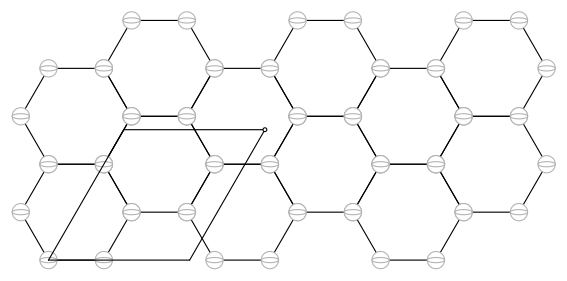
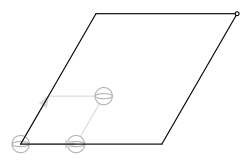
So this point is two columns of hexagons over and one hexagon up.
This second basis
makes the computation easier
(we get and ), but it doesn’t seem to have to do much with the physical structure that we are studying.
3 Topic: Crystals source ↗
Give the locations of the atoms in the diamond cube both in terms of the basis, and in Å ngstroms.
Answer
In terms of the basis the locations of the corner atoms are , , …, . The locations of the face atoms are , , , , , and . The locations of the atoms a quarter of the way down from the top are and . The atoms a quarter of the way up from the bottom are at and . Converting to Å ngstroms is easy.
4 Topic: Crystals source ↗
This illustrates how we could compute the dimensions of a unit cell from the shape in which a substance crystallizes ([Ebbing], p. 462).
Recall that there are atoms in a mole (this is Avogadro’s number). From that, and the fact that platinum has a mass of grams per mole, calculate the mass of each atom.
Platinum crystallizes in a face-centered cubic lattice with atoms at each lattice point, that is, it looks like the middle picture given above for the diamond crystal. Find the number of platinum’s per unit cell (hint: sum the fractions of platinum’s that are inside of a single cell).
From that, find the mass of a unit cell.
Platinum crystal has a density of grams per cubic centimeter. From this, and the mass of a unit cell, calculate the volume of a unit cell.
Find the length of each edge.
Describe a natural three-dimensional basis.
Answer (6 parts)
Each platinum atom in the middle of each face is split between two cubes, so that is atoms so far. Each atom at a corner is split among eight cubes, so that makes an additional atom, so the total is .
cubic centimeters
centimeters.
1 Topic: Voting Paradoxes source ↗
Here is a reasonable way in which a voter could have a cyclic preference. Suppose that this voter ranks each candidate on each of three criteria.
Draw up a table with the rows labeled ‘Democrat’, ‘Republican’, and ‘Third’, and the columns labeled ‘character’, ‘experience’, and ‘policies’. Inside each column, rank some candidate as most preferred, rank another as in the middle, and rank the remaining one as least preferred.
In this ranking, is the Democrat preferred to the Republican in (at least) two out of three criteria, or vice versa? Is the Republican preferred to the Third?
Does the table that was just constructed have a cyclic preference order? If not, make one that does.
So it is possible for a voter to have a cyclic preference among candidates. The paradox described above, however, is that even if each voter has a straight-line preference list, a cyclic preference can still arise for the entire group.
Answer
This example yields a non-rational preference order for a single voter.
| character | experience | policies | |
| Democrat | most | middle | least |
| Republican | middle | least | most |
| Third | least | most | middle |
The Democrat is better than the Republican for character and experience. The Republican wins over the Third for character and policies. And, the Third beats the Democrat for experience and policies.
2 Topic: Voting Paradoxes source ↗
Compute the values in the table of decompositions.
Answer
First, compare the decomposition that was covered in the Topic
with the decomposition of the opposite voter.
Obviously, the second is the negative of the first, and so , , and . This principle holds for any pair of opposite voters, and so we need only do the computation for a voter from the second row, and a voter from the third row. For a positive spin voter in the second row,
gives , , and . For a positive spin voter in the third row,
gives , , and .
3 Topic: Voting Paradoxes source ↗
Perform the cancellations of opposite preference orders for the Political Science class’s mock election. Are all the remaining preferences from the left three rows of the table or from the right?
Answer
The mock election corresponds to the table on page in the way shown in the first table, and after cancellation the result is the second table.
| positive spin | negative spin | ||||
|
| ||||
|
| ||||
|
|
| positive spin | negative spin | ||||
|
| ||||
|
| ||||
|
|
All three come from the same side of the table (the left), as the result from this Topic says must happen. Now we can tally, using the canceled numbers

to get the same outcome.
4 Topic: Voting Paradoxes source ↗
The necessary condition that a voting paradox can happen only if all three preference lists remaining after cancellation have the same spin is not also sufficient.
Give an example of a vote where there is a majority cycle and addition of one more voter with the same spin causes the cycle to go away.
Can the opposite happen; can addition of one voter with a “wrong” spin cause a cycle to appear?
Give a condition that is both necessary and sufficient to get a majority cycle.
Answer (3 parts)
A trivial example starts with the zero-voter election, which has a trivial majority cycle, and adds any one voter. A more interesting example takes the Political Science mock election and adds two voters (to satisfy the “addition of one more voter” criteria in the question we can add them one at a time). The new voters have positive spin, which is the spin of the votes remaining after cancellation in the original mock election. This is the resulting table of voters and next to it is the result of cancellation.
| positive spin | negative spin | ||||
|
| ||||
|
| ||||
|
|
| positive spin | negative spin | ||||
|
| ||||
|
| ||||
|
|
This is the election using the canceled numbers.

The majority cycle has indeed disappeared.
Reverse the prior exercise. That is, add a voter to the result of the prior exercise that cancels the one who made the cycle disappear.
One such condition is that, after cancellation, all three be nonnegative or all three be nonpositive, and: and and . That follows from this diagram.

5 Topic: Voting Paradoxes source ↗
A one-voter election cannot have a majority cycle because of the requirement that we’ve imposed that the voter’s list must be rational.
Show that a two-voter election may have a majority cycle. (We consider the group preference a majority cycle if all three group totals are nonnegative or if all three are nonpositive—that is, we allow some zero’s in the group preference.)
Show that for any number of voters greater than one, there is an election involving that many voters that results in a majority cycle.
Answer (2 parts)
A two-voter election can have a majority cycle in two ways. First, the two voters could be opposites, resulting after cancellation in the trivial election (with the majority cycle of all zeroes). Second, the two voters could have the same spin but come from different rows, as here.

There are two cases. An even number of voters can split half and half into opposites, e.g., half the voters are and half are . Then cancellation gives the trivial election. If the number of voters is greater than one and odd (of the form with ) then using the cycle diagram from the proof,

we can take and and . Because , this is a majority cycle.
6 Topic: Voting Paradoxes source ↗
Let be a subspace of . Prove that the set of vectors that are perpendicular to each vector in is also subspace of . Does this hold if is not a subspace?
Answer
It is nonempty because it contains the zero vector. To see that it is closed under linear combinations of two of its members, suppose that and are in and consider . For any ,
and so .
As to whether it holds if is a subset but not a subspace, the answer is yes.
1 Topic: Dimensional Analysis source ↗
[de Mestre] Consider a projectile, launched with initial velocity , at an angle . To study its motion we may guess that these are the relevant quantities.
| quantity |
| ||
| horizontal position | |||
| vertical position | |||
| initial speed | |||
| angle of launch | |||
| acceleration due to gravity | |||
| time |
Show that is a complete set of dimensionless products. (Hint. One way to go is to find the appropriate free variables in the linear system that arises but there is a shortcut that uses the properties of a basis.)
These two equations of motion for projectiles are familiar: and . Manipulate each to rewrite it as a relationship among the dimensionless products of the prior item.
Answer (2 parts)
Assuming that this
equals gives rise to this linear system
(there is no restriction on ). The natural parametrization uses the free variables to give and . The resulting description of the solution set
gives as a complete set of dimensionless products (recall that “complete” in this context does not mean that there are no other dimensionless products; it simply means that the set is a basis). This is, however, not the set of dimensionless products that the question asks for.
There are two ways to proceed. The first is to fiddle with the choice of parameters, hoping to hit on the right set. For that, we can do the prior paragraph in reverse. Converting the given dimensionless products , , , and into vectors gives this description (note the ?’s where the parameters will go).
The is already in place. Examining the rows shows that we can also put in place , , and .
The second way to proceed, following the hint, is to note that the given set is of size four in a four-dimensional vector space and so we need only show that it is linearly independent. That is easily done by inspection, by considering the sixth, first, second, and fourth components of the vectors.
The first equation can be rewritten
so that Buckingham’s function is . The second equation can be rewritten
and Buckingham’s function here is .
2 Topic: Dimensional Analysis source ↗
[Einstein] conjectured that the infrared characteristic frequencies of a solid might be determined by the same forces between atoms as determine the solid’s ordinary elastic behavior. The relevant quantities are these.
| quantity |
| ||
| characteristic frequency | |||
| compressibility | |||
| number of atoms per cubic cm | |||
| mass of an atom |
Show that there is one dimensionless product. Conclude that, in any complete relationship among quantities with these dimensional formulas, is a constant times . This conclusion played an important role in the early study of quantum phenomena.
Answer
Consider
which gives these relations among the powers.
This is the solution space (because we wish to express as a function of the other quantities, we take as the parameter).
Thus, is the dimensionless combination, and we have that equals times a constant (the function is constant since it has no arguments).
3 Topic: Dimensional Analysis source ↗
[Giordano, Wells, Wilde] The torque produced by an engine has dimensional formula . We may first guess that it depends on the engine’s rotation rate (with dimensional formula ), and the volume of air displaced (with dimensional formula ).
Try to find a complete set of dimensionless products. What goes wrong?
Adjust the guess by adding the density of the air (with dimensional formula ). Now find a complete set of dimensionless products.
Answer (2 parts)
Setting
gives this
which implies that . That is, among quantities with these dimensional formulas, the only dimensionless product is the trivial one.
Setting
gives this.
Taking as parameter to express the torque gives this description of the solution set.
Denoting the torque by , the rotation rate by , the volume of air by , and the density of air by we have that , and so the torque is times a constant.
4 Topic: Dimensional Analysis source ↗
[Tilley] Dominoes falling make a wave. We may conjecture that the wave speed depends on the spacing between the dominoes, the height of each domino, and the acceleration due to gravity .
Find the dimensional formula for each of the four quantities.
Show that is a complete set of dimensionless products.
Show that if is fixed then the propagation speed is proportional to the square root of .
Answer (3 parts)
These are the dimensional formulas.
| quantity |
| ||
| speed of the wave | |||
| separation of the dominoes | |||
| height of the dominoes | |||
| acceleration due to gravity |
The relationship
gives this linear system.
Taking and as parameters, we can describe the solution set in this way.
That gives as a complete set.
Buckingham’s Theorem says that and so, since is a constant, if is fixed then is proportional to .
5 Topic: Dimensional Analysis source ↗
Prove that the dimensionless products form a vector space under the operation of multiplying two such products and the operation of raising such the product to the power of the scalar. (The vector arrows are a precaution against confusion.) That is, prove that, for any particular homogeneous system, this set of products of powers of , …,
is a vector space under:
and
(assume that all variables represent real numbers).
Answer
Checking the conditions in the definition of a vector space is routine.
6 Topic: Dimensional Analysis source ↗
The advice about apples and oranges is not right. Consider the familiar equations for a circle and .
Check that and have different dimensional formulas.
Produce an equation that is not dimensionally homogeneous (i.e., it adds apples and oranges) but is nonetheless true of any circle.
The prior item asks for an equation that is complete but not dimensionally homogeneous. Produce an equation that is dimensionally homogeneous but not complete.
(Just because the old saying isn’t strictly right doesn’t keep it from being a useful strategy. Dimensional homogeneity is often used to check the plausibility of equations used in models. For an argument that any complete equation can easily be made dimensionally homogeneous, see [Bridgman], Chapter I, especially page 15.)
Answer (3 parts)
The dimensional formula of the circumference is , that is, . The dimensional formula of the area is .
One is .
One example is this formula relating the the length of arc subtended by an angle to the radius and the angle measure in radians: . Both terms in that formula have dimensional formula . The relationship holds for some unit systems (inches and radians, for instance) but not for all unit systems (inches and degrees, for instance).
Loading chapter 3…
Exercises and answers are adapted from Linear Algebra by Jim Hefferon, which is free to read and download, and are used under the CC BY-SA 2.5 licence. They are taken from the book’s LaTeX source and set for the web, so they may differ slightly from the printed page. This adaptation is released under the same licence and is neither affiliated with nor endorsed by Jim Hefferon.