Every problem in the chapter beside the book’s answer, a chapter at a time as you scroll.
Chapter 4: Determinants
145 problems · 11 figuresFour.I.1.1 §I.1 source ↗
Evaluate the determinant of each.
Answer (3 parts)
Four.I.1.2 §I.1 source ↗
Evaluate the determinant of each.
Answer (3 parts)
Four.I.1.3 §I.1 source ↗
Verify that the determinant of an upper-triangular matrix is the product down the diagonal.
Do lower-triangular matrices work the same way?
Answer
For the first, apply the formula in this section, note that any term with a , , or is zero, and simplify. Lower-triangular matrices work the same way.
Four.I.1.4 §I.1 source ↗
Use the determinant to decide if each is singular or nonsingular.
Answer (3 parts)
Nonsingular, the determinant is .
Nonsingular, the determinant is .
Singular, the determinant is .
Four.I.1.5 §I.1 source ↗
Singular or nonsingular? Use the determinant to decide.
Answer (3 parts)
Nonsingular, the determinant is .
Singular, the determinant is .
Singular, the determinant is .
Four.I.1.6 §I.1 source ↗
Each pair of matrices differ by one row operation. Use this operation to compare with .
,
,
,
Answer (3 parts)
via
via
via
Four.I.1.7 §I.1 source ↗
Find the determinant of this matrix by following the plan: perform Gauss’s Method and look for the determinant to remain unchanged on a row combination, to change sign on a row swap, to rescale on the rescaling of a row, and such that the determinant of the echelon form matrix is the product down its diagonal.
Answer
Gauss’s Method does this.
The echelon form matrix has a product down the diagonal of . In the course of Gauss’s Method no rows got rescaled but there was a row swap, so to get the determinant we change the sign, giving .
Four.I.1.8 §I.1 source ↗
Show this.
Answer
Using the formula for the determinant of a matrix we expand the left side
and by distributing we expand the right side.
Now we can just check that the two are equal. (Remark. This is the case of Vandermonde’s determinant which arises in applications).
Four.I.1.9 §I.1 source ↗
Which real numbers make this matrix singular?
Answer
This equation
has roots and .
Four.I.1.10 §I.1 source ↗
Do the Gaussian reduction to check the formula for matrices stated in the preamble to this section.
is nonsingular iff
Answer
We first reduce the matrix to echelon form. To begin, assume that and that .
This step finishes the calculation.
Now assuming that and , the original matrix is nonsingular if and only if the entry above is nonzero. That is, under the assumptions, the original matrix is nonsingular if and only if , as required.
We finish by running down what happens if the assumptions that were taken for convenience in the prior paragraph do not hold. First, if but then we can swap
and conclude that the matrix is nonsingular if and only if either or . The condition ‘ or ’ is equivalent to the condition ‘’. Multiplying out and using the case assumption that to substitute for gives this.
Since , we have that the matrix is nonsingular if and only if . Therefore, in this and case, the matrix is nonsingular when .
The remaining cases are routine. Do the but case and the and but case by first swapping rows and then going on as above. The , , and case is easy — that matrix is singular since the columns form a linearly dependent set, and the determinant comes out to be zero.
Four.I.1.11 §I.1 source ↗
Show that the equation of a line in through and is given by this determinant.
Answer
Figuring the determinant and doing some algebra gives this.
Note that this is the equation of a line (in particular, in contains the familiar expression for the slope), and note that and satisfy it.
Four.I.1.12 §I.1 source ↗
Many people have learned this mnemonic for the determinant of a matrix: copy the first two columns to the right side of the matrix, then take the products down the forward diagonals and add them together, and then take the products on the backward diagonals and subtract them. That is, first write
and then calculate this.
Check that this agrees with the formula given in the preamble to this section.
Does it extend to other-sized determinants?
Answer (2 parts)
The comparison with the formula given in the preamble to this section is easy.
While it holds for matrices
it does not hold for matrices. An example is that this matrix is singular because the second and third rows are equal
but following the scheme of the mnemonic does not give zero.
Four.I.1.13 §I.1 source ↗
The cross product of the vectors
is the vector computed as this determinant.
Note that the first row’s entries are vectors, the vectors from the standard basis for . Show that the cross product of two vectors is perpendicular to each vector.
Answer
The determinant is . To check perpendicularity, we check that the dot product with the first vector is zero
and the dot product with the second vector is also zero.
Four.I.1.14 §I.1 source ↗
Prove that each statement holds for matrices.
The determinant of a product is the product of the determinants .
If is invertible then the determinant of the inverse is the inverse of the determinant .
Matrices and are similar if there is a nonsingular matrix such that . (We shall look at this relationship in Chapter Five.) Show that similar matrices have the same determinant.
Answer (3 parts)
Plug and chug: the determinant of the product is this
while the product of the determinants is this.
Verification that they are equal is easy.
Use the prior item.
That similar matrices have the same determinant is immediate from the above two: .
Four.I.1.15 §I.1 source ↗
Prove that the area of this region in the plane
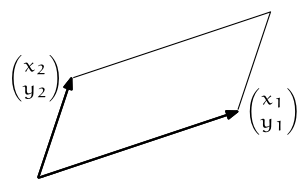
is equal to the value of this determinant.
Compare with this.
Answer
One way is to count these areas
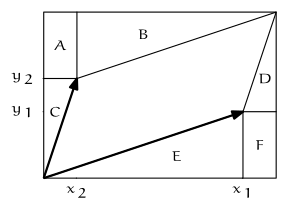
by taking the area of the entire rectangle and subtracting the area of the upper-left rectangle, the upper-middle triangle, the upper-right triangle, the lower-left triangle, the lower-middle triangle, and the lower-right rectangle . Simplification gives the determinant formula.
This determinant is the negative of the one above; the formula distinguishes whether the second column is counterclockwise from the first.
Four.I.1.16 §I.1 source ↗
Prove that for matrices, the determinant of a matrix equals the determinant of its transpose. Does that also hold for matrices?
Answer
The computation for matrices, using the formula quoted in the preamble, is easy. It does also hold for matrices; the computation is routine.
Four.I.1.17 §I.1 source ↗
Is the determinant function linear — is ?
Answer
No. We illustrate with the determinant. Recall that constants come out one row at a time.
This contradicts linearity (here we didn’t need , i.e., we can take to be the matrix of zeros).
Four.I.1.18 §I.1 source ↗
Show that if is then for any scalar .
Answer
Bring out the ’s one row at a time.
Four.I.1.19 §I.1 source ↗
Which real numbers make
singular? Explain geometrically.
Answer
There are no real numbers that make the matrix singular because the determinant of the matrix is never , it equals for all . Geometrically, with respect to the standard basis, this matrix represents a rotation of the plane through an angle of . Each such map is one-to-one — for one thing, it is invertible.
Four.I.1.20 §I.1 source ↗
[Am. Math. Mon., Apr. 1955] If a third order determinant has elements , , …, , what is the maximum value it may have?
Answer
This is how the answer was given in the cited source. Let be the sum of the three positive terms of the determinant and the sum of the three negative terms. The maximum value of is
The minimum value of consistent with is
Any change in would result in lowering that sum by more than . Therefore the maximum value for the determinant and one form for the determinant is
Four.I.2.9 §I.2 source ↗
Find each determinant by performing one row operation.
Answer (2 parts)
Do to get echelon form, and then multiply down the diagonal. The determinant is .
Swapping the second and third rows brings the system to echelon form (and changes the sign of the determinant). Multiplying down the diagonal gives , so the determinant of the given matrix is .
Four.I.2.10 §I.2 source ↗
Use Gauss’s Method to find each determinant.
Answer (2 parts)
Four.I.2.11 §I.2 source ↗
Use Gauss’s Method to find each.
Answer (2 parts)
;
Four.I.2.12 §I.2 source ↗
For which values of does this system have a unique solution?
Answer
When is the determinant not zero?
Obviously, gives nonsingularity and hence a nonzero determinant. If then we get echelon form with a combination.
Multiplying down the diagonal gives . Thus the matrix has a nonzero determinant, and so the system has a unique solution, if and only if .
Four.I.2.13 §I.2 source ↗
Express each of these in terms of .
Answer (3 parts)
Condition (2) of the definition of determinants applies via the swap .
Condition (3) applies.
Four.I.2.14 §I.2 source ↗
Find the determinant of a diagonal matrix.
Answer
A diagonal matrix is in echelon form, so the determinant is the product down the diagonal.
Four.I.2.15 §I.2 source ↗
Describe the solution set of a homogeneous linear system if the determinant of the matrix of coefficients is nonzero.
Answer
It is the trivial subspace.
Four.I.2.16 §I.2 source ↗
Show that this determinant is zero.
Answer
Adding the second row to the first gives a matrix whose first row is times its third row.
Four.I.2.17 §I.2 source ↗
Find the , , and matrices with entry given by .
Find the determinant of the square matrix with entry .
Answer (2 parts)
, ,
The determinant in the case is . In every other case the second row is the negative of the first, and so matrix is singular and the determinant is zero.
Four.I.2.18 §I.2 source ↗
Find the , , and matrices with entry given by .
Find the determinant of the square matrix with entry .
Answer (2 parts)
, ,
The and cases yield these.
And matrices with are singular, e.g.,
because twice the second row minus the first row equals the third row. Checking this is routine.
Four.I.2.19 §I.2 source ↗
Show that determinant functions are not linear by giving a case where .
Answer
This one
is easy to check.
By the way, this also gives an example where scalar multiplication is not preserved .
Four.I.2.20 §I.2 source ↗
The second condition in the definition, that row swaps change the sign of a determinant, is somewhat annoying. It means we have to keep track of the number of swaps, to compute how the sign alternates. Can we get rid of it? Can we replace it with the condition that row swaps leave the determinant unchanged? (If so then we would need new , , and formulas, but that would be a minor matter.)
Answer
No, we cannot replace it. Remark 2.2 shows that the four conditions after the replacement would conflict — no function satisfies all four.
Four.I.2.21 §I.2 source ↗
Prove that the determinant of any triangular matrix, upper or lower, is the product down its diagonal.
Answer
A upper-triangular matrix is in echelon form.
A lower-triangular matrix is either singular or nonsingular. If it is singular then it has a zero on its diagonal and so its determinant (namely, zero) is indeed the product down its diagonal. If it is nonsingular then it has no zeroes on its diagonal, and we can reduce it by Gauss’s Method to echelon form without changing the diagonal.
Four.I.2.22 §I.2 source ↗
Refer to the definition of elementary matrices in the Mechanics of Matrix Multiplication subsection.
What is the determinant of each kind of elementary matrix?
Prove that if is any elementary matrix then for any appropriately sized .
(This question doesn’t involve determinants.) Prove that if is singular then a product is also singular.
Show that .
Show that if is nonsingular then .
Answer (5 parts)
The properties in the definition of determinant show that , , and .
The three cases are easy to check by recalling the action of left multiplication by each type of matrix.
If is invertible then the associative property of matrix multiplication shows that is invertible. So if is not invertible then neither is .
If is singular then apply the prior answer: and . If is not singular then we can write it as a product of elementary matrices .
Four.I.2.23 §I.2 source ↗
Prove that the determinant of a product is the product of the determinants in this way. Fix the matrix and consider the function given by .
Check that satisfies condition (1) in the definition of a determinant function.
Check condition (2).
Check condition (3).
Check condition (4).
Conclude the determinant of a product is the product of the determinants.
Answer (5 parts)
We must show that if
then . We will be done if we show that combining rows first and then multiplying to get gives the same result as multiplying first to get and then combining (because the determinant is unaffected by the combination so we’ll then have , and hence ). That argument runs: after adding times row of to row of , the entry is , which is the entry of .
We need only show that swapping and then multiplying to get gives the same result as multiplying by and then swapping (because, as the determinant changes sign on the row swap, we’ll then have , and so ). That argument runs just like the prior one.
Not surprisingly by now, we need only show that multiplying a row by a scalar and then computing gives the same result as first computing and then multiplying the row by (as the determinant is rescaled by the multiplication, we’ll have , so ). The argument runs just as above.
Clear.
Because we’ve shown that is a determinant and that determinant functions (if they exist) are unique, we have that so .
Four.I.2.24 §I.2 source ↗
A submatrix of a given matrix is one that we get by deleting some of the rows and columns of . Thus, the first matrix here is a submatrix of the second.
Prove that for any square matrix, the rank of the matrix is if and only if is the largest integer such that there is an submatrix with a nonzero determinant.
Answer
We will first argue that a rank matrix has a submatrix with nonzero determinant. A rank matrix has a linearly independent set of rows. A matrix made from those rows will have row rank and thus has column rank . Conclusion: from those rows we can extract a linearly independent set of columns, and so the original matrix has a submatrix of rank .
We finish by showing that if is the largest such integer then the rank of the matrix is . We need only show, by the maximality of , that if a matrix has a submatrix of nonzero determinant then the rank of the matrix is at least . Consider such a submatrix. Its rows are parts of the rows of the original matrix, clearly the set of whole rows is linearly independent. Thus the row rank of the original matrix is at least , and the row rank of a matrix equals its rank.
Four.I.2.25 §I.2 source ↗
Prove that a matrix with rational entries has a rational determinant.
Answer
A matrix with only rational entries reduces with Gauss’s Method to an echelon form matrix using only rational arithmetic. Thus the entries on the diagonal must be rationals, and so the product down the diagonal is rational.
Four.I.2.26 §I.2 source ↗
[Am. Math. Mon., Feb. 1953] Find the element of likeness in (a) simplifying a fraction, (b) powdering the nose, (c) building new steps on the church, (d) keeping emeritus professors on campus, (e) putting , , in the determinant
Answer
This is how the answer was given in the cited source. The value of the determinant is independent of the values , , . Hence operation (e) does not change the value of the determinant but merely changes its appearance. Thus the element of likeness in (a), (b), (c), (d), and (e) is only that the appearance of the principle entity is changed. The same element appears in (f) changing the name-label of a rose, (g) writing a decimal integer in the scale of , (h) gilding the lily, (i) whitewashing a politician, and (j) granting an honorary degree.
Four.I.3.18 §I.3 source ↗
For this matrix, find the term associated with each -permutation.
That is, fill in the rest of this table.
| permutation | ||||||
| term |
Answer
Call the matrix .
| permutation | ||||||
| term |
Four.I.3.19 §I.3 source ↗
For each -permutation find .
Answer
We can swap each to the identity matrix. If the number of swaps is even then it’s determinant is , while if the number of swaps is odd then the determinant is
| permutation | ||||||
| number of swaps | ||||||
Remark. In that table we simply swapped until we found a number that brought us back to ‘’. But is a different number of swaps possible? If one person found swaps and another found that would be OK, since both give a determinant of . But if we can swap in two different ways and one of them is even and one is odd then that would be a problem. The next section shows that a mix of even and odd is not possible.
Four.I.3.20 §I.3 source ↗
This determinant is by the formula. Compute it with the permutation expansion.
Answer
Four.I.3.21 §I.3 source ↗
This determinant is because the first two rows add to the third. Compute the determinant using the permutation expansion.
Answer
Four.I.3.22 §I.3 source ↗
Compute the determinant by using the permutation expansion.
Answer (2 parts)
This matrix is singular.
This matrix is nonsingular.
Four.I.3.23 §I.3 source ↗
Compute these both with Gauss’s Method and the permutation expansion formula.
Answer (2 parts)
Gauss’s Method gives this
and permutation expansion gives this.
Gauss’s Method gives this
and the permutation expansion gives this.
Four.I.3.24 §I.3 source ↗
Use the permutation expansion formula to derive the formula for determinants.
Answer
Following Example 3.6 gives this.
Four.I.3.25 §I.3 source ↗
List all of the -permutations.
Answer
This is all of the permutations where
the ones where
the ones where
and the ones where .
Four.I.3.26 §I.3 source ↗
A permutation, regarded as a function from the set to itself, is one-to-one and onto. Therefore, each permutation has an inverse.
Find the inverse of each -permutation.
Find the inverse of each -permutation.
Answer (3 parts)
Each of these is easy to check.
| permutation | ||
| inverse |
| permutation | ||||||
| inverse |
Four.I.3.27 §I.3 source ↗
Prove that is multilinear if and only if for all and , this holds.
Answer
For the ‘if’ half, the first condition of Definition 3.2 follows from taking and the second condition follows from taking .
The ‘only if’ half also routine. From the first condition of Definition 3.2 gives and the second condition, applied twice, gives the result.
Four.I.3.28 §I.3 source ↗
How would determinants change if we changed property (4) of the definition to read that ?
Answer
They would all double.
Four.I.3.29 §I.3 source ↗
Verify the second and third statements in Corollary 3.16.
Answer
For the second statement, given a matrix, transpose it, swap rows, and transpose back. The result is swapped columns, and the determinant changes by a factor of . The third statement is similar: given a matrix, transpose it, apply multilinearity to what are now rows, and then transpose back the resulting matrices.
Four.I.3.30 §I.3 source ↗
Show that if an matrix has a nonzero determinant then we can express any column vector as a linear combination of the columns of the matrix.
Answer
An matrix with a nonzero determinant has rank so its columns form a basis for .
Four.I.3.31 §I.3 source ↗
[Strang 80] True or false: a matrix whose entries are only zeros or ones has a determinant equal to zero, one, or negative one.
Answer
False.
Four.I.3.32 §I.3 source ↗
Show that there are terms in the permutation expansion formula of a matrix.
How many are sure to be zero if the entry is zero?
Answer (2 parts)
For the column index of the entry in the first row there are five choices. Then, for the column index of the entry in the second row there are four choices. Continuing, we get . (See also the next question.)
Once we choose the second column in the first row, we can choose the other entries in ways.
Four.I.3.33 §I.3 source ↗
How many -permutations are there?
Answer
Four.I.3.34 §I.3 source ↗
Show that the inverse of a permutation matrix is its transpose.
Answer
[Schmidt] We will show that ; the argument is similar. The entry of is the sum of terms of the form where the entries of are denoted with ’s, that is, . Thus the entry of is the sum . But is usually , and so is usually . The only time is nonzero is when it is , but then there are no other such that is nonzero ( is the only row with a in column ). In other words,
and this is exactly the formula for the entries of the identity matrix.
Four.I.3.35 §I.3 source ↗
A matrix is skew-symmetric if , as in this matrix.
Show that skew-symmetric matrices with nonzero determinants exist only for even .
Answer
In the exponent must be even.
Four.I.3.36 §I.3 source ↗
What is the smallest number of zeros, and the placement of those zeros, needed to ensure that a matrix has a determinant of zero?
Answer
Showing that no placement of three zeros suffices is routine. Four zeroes does suffice; put them all in the same row or column.
Four.I.3.37 §I.3 source ↗
If we have data points and want to find a polynomial passing through those points then we can plug in the points to get an equation/ unknown linear system. The matrix of coefficients for that system is the Vandermonde matrix. Prove that the determinant of the transpose of that matrix of coefficients
equals the product, over all indices with , of terms of the form . (This shows that the determinant is zero, and the linear system has no solution, if and only if the ’s in the data are not distinct.)
Answer
The case shows what to do. The row combination operations of and give this.
Then the row combination operation of gives the desired result.
Four.I.3.38 §I.3 source ↗
We can divide a matrix into blocks, as here,
which shows four blocks, the square and ones in the upper left and lower right, and the zero blocks in the upper right and lower left. Show that if a matrix is such that we can partition it as
where and are square, and and are all zeroes, then .
Answer
Let be , let be , and let be . Apply the permutation expansion formula
Because the upper right of is all zeroes, if a has at least one of among its first column numbers then the term arising from is (e.g., if then is ). So the above formula reduces to a sum over all permutations with two halves: first rearrange and after that comes a permutation of . To see this gives , distribute.
Four.I.3.39 §I.3 source ↗
Prove that for any matrix there are at most distinct reals such that the matrix has determinant zero (we shall use this result in Chapter Five).
Answer
The case shows what happens.
Each term in the permutation expansion has three factors drawn from entries in the matrix (e.g., and ), and so the determinant is expressible as a polynomial in of degree . Such a polynomial has at most roots.
In general, the permutation expansion shows that the determinant is a sum of terms, each with factors, giving a polynomial of degree . A polynomial of degree has at most roots.
Four.I.3.40 §I.3 source ↗
[Math. Mag., Jan. 1963, Q307] The nine positive digits can be arranged into arrays in ways. Find the sum of the determinants of these arrays.
Answer
This is how the answer was given in the cited source. When two rows of a determinant are interchanged, the sign of the determinant is changed. When the rows of a three-by-three determinant are permuted, positive and negative determinants equal in absolute value are obtained. Hence the determinants fall into groups, each of which sums to zero.
Four.I.3.41 §I.3 source ↗
[Math. Mag., Jan. 1963, Q237] Show that
Answer
This is how the answer was given in the cited source. When the elements of any column are subtracted from the elements of each of the other two, the elements in two of the columns of the derived determinant are proportional, so the determinant vanishes. That is,
Four.I.3.42 §I.3 source ↗
[Am. Math. Mon., Jan. 1949] Let be the sum of the integer elements of a magic square of order three and let be the value of the square considered as a determinant. Show that is an integer.
Answer
This is how the answer was given in the cited source. Let
have magic sum . Then
and . Hence, adding rows and columns,
Four.I.3.43 §I.3 source ↗
[Am. Math. Mon., Jun. 1931] Show that the determinant of the elements in the upper left corner of the Pascal triangle
has the value unity.
Answer
This is how the answer was given in the cited source. Denote by the determinant in question and by the element in the -th row and -th column. Then from the law of formation of the elements we have
Subtract each row of from the row following it, beginning the process with the last pair of rows. After the subtractions the above equality shows that the element is replaced by the element , and all the elements in the first column, except , become zeroes. Now subtract each column from the one following it, beginning with the last pair. After this process the element is replaced by , as shown in the above relation. The result of the two operations is to replace by , and to reduce each element in the first row and in the first column to zero. Hence and consequently
Four.I.4.12 §I.4 source ↗
Give the permutation expansion of a general matrix and its transpose.
Answer
This is the permutation expansion of the determinant of a matrix
and the permutation expansion of the determinant of its transpose.
As with the expansions described in the subsection, the permutation matrices from corresponding terms are transposes (although this is disguised by the fact that each is self-transpose).
Four.I.4.13 §I.4 source ↗
This problem appears also in the prior subsection.
Find the inverse of each -permutation.
Find the inverse of each -permutation.
Answer (3 parts)
Each of these is easy to check.
| permutation | ||
| inverse |
| permutation | ||||||
| inverse |
Four.I.4.14 §I.4 source ↗
Find the signum of each -permutation.
Find the signum of each -permutation.
Answer (2 parts)
,
, , , , ,
Four.I.4.15 §I.4 source ↗
Find the only nonzero term in the permutation expansion of this matrix.
Compute that determinant by finding the signum of the associated permutation.
Answer
To get a nonzero term in the permutation expansion we must use the entry and the entry. Having fixed on those two we must also use the entry and the entry. The signum of is because from
the two row swaps and will produce the identity matrix.
Four.I.4.16 §I.4 source ↗
[Strang 80] What is the signum of the -permutation ?
Answer
The pattern is this.
| … | |||||||
| … |
So to find the signum of , we subtract one and look at the remainder on division by four. If the remainder is or then the signum is , otherwise it is . For , the number is divisible by four, so leaves a remainder of on division by four (more properly said, a remainder or ), and so the signum is . The case has a signum of , the case has a signum of and the case has a signum of .
Four.I.4.17 §I.4 source ↗
Prove these.
Every permutation has an inverse.
Every permutation is the inverse of another.
Answer (3 parts)
We can view permutations as maps that are one-to-one and onto. Any one-one and onto map has an inverse.
If it always takes an odd number of swaps to get from to the identity, then it always takes an odd number of swaps to get from the identity to (any swap is reversible).
This is the first question again.
Four.I.4.18 §I.4 source ↗
Prove that the matrix of the permutation inverse is the transpose of the matrix of the permutation , for any permutation .
Answer
If then . The result now follows on the observation that has a in entry if and only if , and has a in entry if and only if ,
Four.I.4.19 §I.4 source ↗
Show that a permutation matrix with inversions can be row swapped to the identity in steps. Contrast this with Corollary 4.5.
Answer
This does not say that is the least number of swaps to produce an identity, nor does it say that is the most. It instead says that there is a way to swap to the identity in exactly steps.
Let be the first row that is inverted with respect to a prior row and let be the first row giving that inversion. We have this interval of rows.
Swap.
The second matrix has one fewer inversion because there is one fewer inversion in the interval ( vs. ) and inversions involving rows outside the interval are not affected.
Proceed in this way, at each step reducing the number of inversions by one with each row swap. When no inversions remain the result is the identity.
The contrast with Corollary 4.5 is that the statement of this exercise is a ‘there exists’ statement: there exists a way to swap to the identity in exactly steps. But the corollary is a ‘for all’ statement: for all ways to swap to the identity, the parity (evenness or oddness) is the same.
Four.I.4.20 §I.4 source ↗
For any permutation let be the integer defined in this way.
(This is the product, over all indices and with , of terms of the given form.)
Compute the value of on all -permutations.
Compute the value of on all -permutations.
Prove that is not .
Prove this.
Many authors give this formula as the definition of the signum function.
Answer (4 parts)
First, is the product of the single factor and so . Second, is the product of the single factor and so .
| permutation | ||||||
It is a product of nonzero terms.
Note that is negative if and only if and are in an inversion of their usual order.
Four.II.1.8 §II.1 source ↗
Is
inside of the box formed by these three?
Answer
Solving
gives the unique solution , and . Because , the vector is not in the box.
Four.II.1.9 §II.1 source ↗
Find the volume of the region defined by the vectors.
Answer (4 parts)
For each, find the determinant and take the absolute value.
Four.II.1.10 §II.1 source ↗
In this picture the rectangle on the left is defined by the points and . Apply the matrix to get the rectangle on the right, defined by and . Why doesn’t this contradict Theorem 1.5?
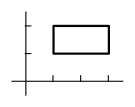 | 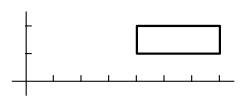 | |
| area is | determinant is | area is |
Answer
We have drawn that picture to mislead. The picture on the left is not the box formed by two vectors. If we slide it to the origin then it becomes the box formed by this sequence.
Then the image under the action of the matrix is the box formed by this sequence.
which has an area of .
Four.II.1.11 §II.1 source ↗
Find the volume of this region.
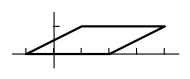
Answer
Move the parallelepiped to start at the origin, so that it becomes the box formed by
and now the absolute value of this determinant is easily computed as .
Four.II.1.12 §II.1 source ↗
Suppose that . By what factor do these change volumes?
Answer (3 parts)
Four.II.1.13 §II.1 source ↗
Consider the linear transformation of represented with respect to the standard bases by this matrix.
Compute the determinant of the matrix. Does the transformation preserve orientation or reverse it?
Find the size of the box defined by these vectors. What is its orientation?
Find the images under of the vectors in the prior item and find the size of the box that they define. What is the orientation?
Answer (3 parts)
Gauss’s Method
gives the determinant as . The sign is positive so the transformation preserves orientation.
The size of the box is the value of this determinant.
The orientation is positive.
Since this transformation is represented by the given matrix with respect to the standard bases, and with respect to the standard basis the vectors represent themselves, to find the image of the vectors under the transformation just multiply them, from the left, by the matrix.
Then compute the size of the resulting box.
The starting box is positively oriented, the transformation preserves orientations (since the determinant of the matrix is positive), and the ending box is also positively oriented.
Four.II.1.14 §II.1 source ↗
By what factor does each transformation change the size of boxes?
Answer (4 parts)
Express each transformation with respect to the standard bases and find the determinant.
Four.II.1.15 §II.1 source ↗
What is the area of the image of the rectangle under the action of this matrix?
Answer
The starting area is and the matrix changes sizes by . Thus the area of the image is .
Four.II.1.16 §II.1 source ↗
If changes volumes by a factor of and changes volumes by a factor of then by what factor will their composition changes volumes?
Answer
By a factor of .
Four.II.1.17 §II.1 source ↗
In what way does the definition of a box differ from the definition of a span?
Answer
For a box we take a sequence of vectors (as described in the remark, the order of the vectors matters), while for a span we take a set of vectors. Also, for a box subset of there must be vectors; of course for a span there can be any number of vectors. Finally, for a box the coefficients , …, are in the interval , while for a span the coefficients are free to range over all of .
Four.II.1.18 §II.1 source ↗
Does ? ?
Answer
Yes to both. For instance, the first is .
Four.II.1.19 §II.1 source ↗
Show that there are no matrices and satisfying these.
Answer
Because and these two matrices have different determinants.
Four.II.1.20 §II.1 source ↗
Suppose that and that . Find .
Assume that . Prove that .
Answer (2 parts)
If it is defined then it is .
.
Four.II.1.21 §II.1 source ↗
Let be the matrix representing (with respect to the standard bases) the map that rotates plane vectors counterclockwise through radians. By what factor does change sizes?
Answer
Four.II.1.22 §II.1 source ↗
Must a transformation that preserves areas also preserve lengths?
Answer
No, for instance the determinant of
is so it preserves areas, but the vector has length .
Four.II.1.23 §II.1 source ↗
What is the volume of a parallelepiped in bounded by a linearly dependent set?
Answer
It is zero.
Four.II.1.24 §II.1 source ↗
Find the area of the triangle in with endpoints , , and . (This asks for area, not volume. The triangle defines a plane; what is the area of the triangle in that plane?)
Answer
Two of the three sides of the triangle are formed by these vectors.
One way to find the area of this triangle is to find half the volume of the parallelogram formed by those two vectors and a length-one vector orthogonal to those two. To find the family of vectors orthogonal to those two we can start with the two relations
and solve the system
to get this solution set.
Here is a length one solution.
Thus the area of the triangle is half of the absolute value of this determinant.
Half of the absolute value is .
Four.II.1.25 §II.1 source ↗
An alternate proof of Theorem 1.5 uses the definition of determinant functions.
Note that the vectors forming make a linearly dependent set if and only if , and check that the result holds in this case.
For the case, to show that for all transformations, consider the function given by . Show that has the first property of a determinant.
Show that has the remaining three properties of a determinant function.
Conclude that .
Answer (4 parts)
Because the image of a linearly dependent set is linearly dependent, if the vectors forming make a linearly dependent set, so that , then the vectors forming make a linearly dependent set, so that , and in this case the equation holds.
We must check that if then . We can do this by checking that combining rows first and then multiplying to get gives the same result as multiplying first to get and then combining (because the determinant is unaffected by the combining rows so we’ll then have that and hence that ). This check runs: after adding times row of to row of , the entry is , which is the entry of .
For the second property, we need only check that swapping and then multiplying to get gives the same result as multiplying by first and then swapping (because, as the determinant changes sign on the row swap, we’ll then have , and so ). This check runs just like the one for the first property.
For the third property, we need only show that performing and then computing gives the same result as first computing and then performing the scalar multiplication (as the determinant is rescaled by , we’ll have and so ). Here too, the argument runs just as above.
The fourth property, that if is then the result is , is obvious.
Determinant functions are unique, so , and so .
Four.II.1.26 §II.1 source ↗
Give a non-identity matrix with the property that . Show that if then . Does the converse hold?
Answer
Any permutation matrix has the property that the transpose of the matrix is its inverse.
For the implication, we know that . Then .
The converse does not hold; here is an example.
Four.II.1.27 §II.1 source ↗
The algebraic property of determinants that factoring a scalar out of a single row will multiply the determinant by that scalar shows that where is , the determinant of is times the determinant of . Explain this geometrically, that is, using Theorem 1.5. (The observation that increasing the linear size of a three-dimensional object by a factor of will increase its volume by a factor of while only increasing its surface area by an amount proportional to a factor of is the Square-cube law [Wikipedia, Square-cube Law].)
Answer
Where the sides of the box are times longer, the box has times as many cubic units of volume.
Four.II.1.28 §II.1 source ↗
We say that matrices and are similar if there is a nonsingular matrix such that (we will study this relation in Chapter Five). Show that similar matrices have the same determinant.
Answer
If then .
Four.II.1.29 §II.1 source ↗
We usually represent vectors in with respect to the standard basis so vectors in the first quadrant have both coordinates positive.
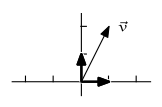
Moving counterclockwise around the origin, we cycle through four regions:
Using this basis
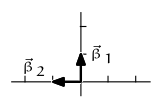
gives the same counterclockwise cycle. We say these two bases have the same orientation.
Why do they give the same cycle?
What other configurations of unit vectors on the axes give the same cycle?
Find the determinants of the matrices formed from those (ordered) bases.
What other counterclockwise cycles are possible, and what are the associated determinants?
What happens in ?
What happens in ?
A fascinating general-audience discussion of orientations is in [Gardner].
Answer (6 parts)
The new basis is the old basis rotated by .
,
In each case the determinant is (we say that these bases have positive orientation).
Because only one sign can change at a time, the only other cycle possible is
Here each associated determinant is (we say that such bases have a negative orientation).
There is one positively oriented basis and one negatively oriented basis .
There are bases ( half-axis choices are possible for the first unit vector, for the second, and for the last). Half are positively oriented like the standard basis on the left below, and half are negatively oriented like the one on the right
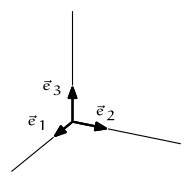
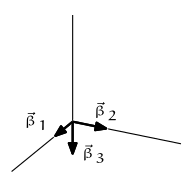
In positive orientation is sometimes called ‘right hand orientation’ because if a person places their right hand with their fingers curling from to then the thumb will point with .
Four.II.1.30 §II.1 source ↗
This question uses material from the optional Determinant Functions Exist subsection. Prove Theorem 1.5 by using the permutation expansion formula for the determinant.
Answer
We will compare with to show that the second differs from the first by a factor of . We represent the ’s with respect to the standard bases
and then we represent the map application with matrix-vector multiplication
where is column of . Then equals .
As in the derivation of the permutation expansion formula, we apply multilinearity, first splitting along the sum in the first argument
and then splitting each of those summands along the sums in the second arguments, etc. We end with, as in the derivation of the permutation expansion, summand determinants, each of the form . Factor out each of the ’s .
As in the permutation expansion derivation, whenever two of the indices in , …, are equal then the determinant has two equal arguments, and evaluates to . So we need only consider the cases where , …, form a permutation of the numbers , …, . We thus have
Swap the columns in to get the matrix back, which changes the sign by a factor of , and then factor out the determinant of .
As in the proof that the determinant of a matrix equals the determinant of its transpose, we commute the ’s to list them by ascending row number instead of by ascending column number (and we substitute for ).
Four.II.1.31 §II.1 source ↗
Show that this gives the equation of a line in through and .
[Petersen] Prove that the area of a triangle with vertices , , and is
[Math. Mag., Jan. 1973] Prove that the area of a triangle with vertices at , , and whose coordinates are integers has an area of or for some positive integer .
Answer (3 parts)
An algebraic check is easy.
simplifies to the familiar form
(the case is easily handled).
For geometric insight, this picture shows that the box formed by the three vectors. Note that all three vectors end in the plane. Below the two vectors on the right is the line through and .
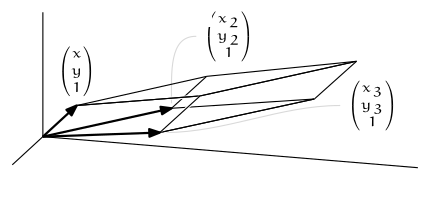
The box will have a nonzero volume unless the triangle formed by the ends of the three is degenerate. That only happens (assuming that ) if lies on the line through the other two.
This is how the answer was given in the cited source. We find the altitude through of a triangle with vertices and in the usual way from the normal form of the above:
Another step shows the area of the triangle to be
This exposition reveals the modus operandi more clearly than the usual proof of showing a collection of terms to be identical with the determinant.
This is how the answer was given in the cited source. Let
then the area of the triangle is . Now if the coordinates are all integers, then is an integer.
Four.III.1.10 §III.1 source ↗
Find the cofactor.
Answer (3 parts)
Four.III.1.11 §III.1 source ↗
Find the adjoint to this matrix.
Answer
Four.III.1.12 §III.1 source ↗
This determinant is . Compute that by expanding on the first row.
Answer
The formula for matrices gives .
Four.III.1.13 §III.1 source ↗
Find the determinant by expanding
on the first row
on the second row
on the third column.
Answer (3 parts)
Four.III.1.14 §III.1 source ↗
Find the adjoint of the matrix in Example 1.5.
Answer
This is .
Four.III.1.15 §III.1 source ↗
Find the matrix adjoint to each.
Answer (4 parts)
This is the adjoint.
The minors are .
The minors are .
Four.III.1.16 §III.1 source ↗
Find the inverse of each matrix in the prior question with Theorem 1.8.
Answer (4 parts)
The matrix has a zero determinant, and so has no inverse.
Four.III.1.17 §III.1 source ↗
Find the matrix adjoint to this one.
Answer
Four.III.1.18 §III.1 source ↗
Expand across the first row to derive the formula for the determinant of a matrix.
Answer
The determinant
expanded on the first row gives (note the two minors).
Four.III.1.19 §III.1 source ↗
Expand across the first row to derive the formula for the determinant of a matrix.
Answer
The determinant of
is this.
Four.III.1.20 §III.1 source ↗
Give a formula for the adjoint of a matrix.
Use it to derive the formula for the inverse.
Answer (2 parts)
Four.III.1.21 §III.1 source ↗
Can we compute a determinant by expanding down the diagonal?
Answer
No. Here is a determinant whose value
doesn’t equal the result of expanding down the diagonal.
Four.III.1.22 §III.1 source ↗
Give a formula for the adjoint of a diagonal matrix.
Answer
Consider this diagonal matrix.
If then the minor is an matrix with only nonzero entries, because we have deleted both and . Thus, at least one row or column of the minor is all zeroes, and so the cofactor is zero. If then the minor is the diagonal matrix with entries , …, , , …, . Its determinant is obviously times the product of those.
By the way, Theorem 1.8 provides a slicker way to derive this conclusion.
Four.III.1.23 §III.1 source ↗
Prove that the transpose of the adjoint is the adjoint of the transpose.
Answer
Just note that if then the cofactor equals the cofactor because and because the minors are the transposes of each other (and the determinant of a transpose equals the determinant of the matrix).
Four.III.1.24 §III.1 source ↗
Prove or disprove: .
Answer
It is false; here is an example.
Four.III.1.25 §III.1 source ↗
A square matrix is upper triangular if each entry is zero in the part above the diagonal, that is, when .
Must the adjoint of an upper triangular matrix be upper triangular? Lower triangular?
Prove that the inverse of a upper triangular matrix is upper triangular, if an inverse exists.
Answer (2 parts)
An example
suggests the right answer.
The result is indeed upper triangular.
This check is detailed but not hard. The entries in the upper triangle of the adjoint are where . We need to verify that the cofactor is zero if . With , row and column of ,
when deleted, leave an upper triangular minor, because entry of the minor is either entry of (this happens if and ; in this case implies that the entry is zero) or it is entry of (this happens if and ; in this case, implies that , which implies that the entry is zero), or it is entry of (this last case happens when and ; obviously here implies that and so the entry is zero). Thus the determinant of the minor is the product down the diagonal. Observe that the entry of is the entry of the minor (it doesn’t get deleted because the relation is strict). But this entry is zero because is upper triangular and . Therefore the cofactor is zero, and the adjoint is upper triangular. (The lower triangular case is similar.)
This is immediate from the prior part, by Theorem 1.8.
Four.III.1.26 §III.1 source ↗
This question requires material from the optional Determinants Exist subsection. Prove Theorem 1.4 by using the permutation expansion.
Answer
We will show that each determinant can be expanded along row . The argument for column is similar.
Each term in the permutation expansion contains one and only one entry from each row. As in Example 1.1, factor out each row entry to get , where each is a sum of terms not containing any elements of row . We will show that is the cofactor.
Consider the case first:
where the sum is over all -permutations such that . To show that is the minor , we need only show that if is an -permutation such that and is an -permutation with , …, then . But that’s true because and have the same number of inversions.
Back to the general case. Swap adjacent rows until the -th is last and swap adjacent columns until the -th is last. Observe that the determinant of the -th minor is not affected by these adjacent swaps because inversions are preserved (since the minor has the -th row and -th column omitted). On the other hand, the sign of and changes plus times. Thus .
Four.III.1.27 §III.1 source ↗
Prove that the determinant of a matrix equals the determinant of its transpose using Laplace’s expansion and induction on the size of the matrix.
Answer
This is obvious for the base case.
For the inductive case, assume that the determinant of a matrix equals the determinant of its transpose for all , …, matrices. Expanding on row gives and expanding on column gives Since the signs are the same in the two summations. Since the minor of is the transpose of the minor of , the inductive hypothesis gives .
Four.III.1.28 §III.1 source ↗
Show that
where is the -th term of , the Fibonacci sequence, and the determinant is of order . [Am. Math. Mon., Jun. 1949]
Answer
This is how the answer was given in the cited source. Denoting the above determinant by , it is seen that , . It remains to show that . In subtract the -th column from the -th, the -th from the -th, …, the first from the third, obtaining
By expanding this determinant with reference to the first row, there results the desired relation.
1 Topic: Cramer’s Rule source ↗
Use Cramer’s Rule to solve each for each of the variables.
Answer (2 parts)
Solve for the variables separately.
,
2 Topic: Cramer’s Rule source ↗
Use Cramer’s Rule to solve this system for .
Answer
3 Topic: Cramer’s Rule source ↗
Prove Cramer’s Rule.
Answer
Determinants are unchanged by combinations, including column combinations, so . Use the operation of taking times the first column and adding it to the -th column, etc., to see this is equal to . In turn, that is equal to , as required.
4 Topic: Cramer’s Rule source ↗
Here is an alternative proof of Cramer’s Rule that doesn’t overtly contain any geometry. Write for the identity matrix with column replaced by the vector of unknowns , …, .
Observe that .
Take the determinant of both sides.
Answer (2 parts)
Here is the case of a system with .
The determinant function is multiplicative . The Laplace expansion shows that , and solving for gives Cramer’s Rule.
5 Topic: Cramer’s Rule source ↗
Suppose that a linear system has as many equations as unknowns, that all of its coefficients and constants are integers, and that its matrix of coefficients has determinant . Prove that the entries in the solution are all integers. (Remark. This is often used to invent linear systems for exercises.)
Answer
Because the determinant of is nonzero, Cramer’s Rule applies and shows that . Since is a matrix of integers, its determinant is an integer.
6 Topic: Cramer’s Rule source ↗
Use Cramer’s Rule to give a formula for the solution of a two equations/two unknowns linear system.
Answer
The solution of
is
provided of course that the denominators are not zero.
7 Topic: Cramer’s Rule source ↗
Can Cramer’s Rule tell the difference between a system with no solutions and one with infinitely many?
Answer
Of course, singular systems have equal to zero, but we can characterize the infinitely many solutions case is by the fact that all of the are zero as well.
8 Topic: Cramer’s Rule source ↗
The first picture in this Topic (the one that doesn’t use determinants) shows a unique solution case. Produce a similar picture for the case of infinitely many solutions, and the case of no solutions.
Answer
We can consider the two nonsingular cases together with this system
where of course yields infinitely many solutions, and any other value for yields no solutions. The corresponding vector equation
gives a picture of two overlapping vectors. Both lie on the line . In the case the vector on the right side also lies on the line but in any other case it does not.
1 Topic: Speed of Calculating Determinants source ↗
To get an idea of what happens for typical matrices we can use the ability of computer systems to generate random numbers (of course, these are only pseudo-random in that they come from an algorithm but they pass a number of reasonable statistical tests for randomness).
Fill a array with random numbers say, in the range ). See if it is singular. Repeat that experiment a few times. Are singular matrices frequent or rare in this sense?
Time your computer algebra system at finding the determinant of ten arrays of random numbers. Find the average time per array. Repeat the prior item for arrays, arrays, … arrays, and compare to the numbers given above. (Notice that, when an array is singular, we can sometimes decide that quickly, for instance if the first row equals the second. In the light of your answer to the first part, do you expect that singular systems play a large role in your average?)
Graph the input size versus the average time.
Answer
Your timing will depend in part on the computer algebra system that you use, and in part on the power of the computer on which you do the calculation. But you should get a curve that is similar to the one shown.
2 Topic: Speed of Calculating Determinants source ↗
Compute the determinant of each of these by hand using the two methods discussed above.
Count the number of multiplications and divisions used in each case, for each of the methods.
Answer (4 parts)
The number of operations depends on exactly how we do the operations.
The determinant is . To row reduce takes a single row combination with two multiplications ( times plus , and times plus ) and the product down the diagonal takes one more multiplication. The permutation expansion takes two multiplications ( times and times ).
The determinant is . Counting the operations is routine.
The determinant is .
3 Topic: Speed of Calculating Determinants source ↗
The use by the timing routine of do_matrix has a bug. That routine does two things, generate a random matrix and then do gauss_method on it, and the timing number returned is for the combination. Produce code that times only the gauss_method routine.
Answer
You should build the matrix once and then time it being reduced many times. Note that gauss_method, as written, changes the input matrix, so be careful not to loop using the output of that routine or all the loops but the first will be on an echelon form matrix.
4 Topic: Speed of Calculating Determinants source ↗
What array can you invent that takes your computer the longest time to reduce? The shortest?
Answer
The identity matrix typically does not take long to reduce. For matrices that are slow, in Python you can try ones with numbers that are quite large. (Some computer algebra system also have the ability to generate special matrices; try some of those.)
5 Topic: Speed of Calculating Determinants source ↗
Some computer language specifications requires that arrays be stored “by column,” that is, the entire first column is stored contiguously, then the second column, etc. Does the code fragment given take advantage of this, or can it be rewritten to make it faster, by taking advantage of the fact that computer fetches are faster from contiguous locations?
Answer
No, the above code handles the numbers by row.
1 Topic: Chiò’s Method source ↗
Use Chiò’s Method to find each determinant.
Answer (2 parts)
Chiò’s matrix is
and its determinant is
Start with
and then the next step
with determinant . The determinant of the original matrix is thus
2 Topic: Chiò’s Method source ↗
What if is zero?
Answer
The same construction as was used for the case above shows that in place of we can select any nonzero entry . Entry of Chiò’s matrix is the value of this determinant
where and .
3 Topic: Chiò’s Method source ↗
The Rule of Sarrus is a mnemonic that many people learn for the determinant formula. To the right of the matrix, copy the first two columns.
Then the determinant is the sum of the three upper-left to lower-right diagonals minus the three lower-left to upper-right diagonals . Count the operations involved in Sarrus’s formula and in Chiò’s.
Answer
Sarrus’s formula uses multiplications and additions (including the subtractions in with the additions). Chiò’s formula uses two multiplications and an addition (which is actually a subtraction) for each of the four determinants, and another two multiplications and an addition for the Chió’s determinant, as well as a final division by . That’s eleven multiplication/divisions and five addition/subtractions. So Chiò is the winner.
4 Topic: Chiò’s Method source ↗
Prove Chiò’s formula.
Answer
Consider an matrix.
Rescale every row but the first by .
That rescales the determinant by a factor of .
Next perform the row operation on each row . These row operations don’t change the determinant.
The result is a matrix whose first row is unchanged, whose first column is all zeros (except for the entry of ), and whose remaining entries are these.
The determinant of this matrix is times the determinant of .
Denote by the minor of the matrix , that is, the submatrix consisting of the last rows and columns. The Laplace expansion down the first column of gives that its determinant is .
If then setting equal the two expressions for and canceling gives .
1 Topic: Projective Geometry source ↗
What is the equation of this point?
Answer
From the dot product
we get that the equation is .
2 Topic: Projective Geometry source ↗
Find the line incident on these points in the projective plane.
Find the point incident on both of these projective lines.
Answer (2 parts)
This determinant
shows that the line is .
3 Topic: Projective Geometry source ↗
Find the formula for the line incident on two projective points. Find the formula for the point incident on two projective lines.
Answer
The line incident on
comes from this determinant equation.
The equation for the point incident on two lines is the same.
4 Topic: Projective Geometry source ↗
Prove that the definition of incidence is independent of the choice of the representatives of and . That is, if , , , and , , are two triples of homogeneous coordinates for , and , , , and , , are two triples of homogeneous coordinates for , prove that if and only if .
Answer
If , , , and , , are two triples of homogeneous coordinates for then the two column vectors are in proportion, that is, lie on the same line through the origin. Similarly, the two row vectors are in proportion.
Then multiplying gives the answer .
5 Topic: Projective Geometry source ↗
Give a drawing to show that central projection does not preserve circles, that a circle may project to an ellipse. Can a (non-circular) ellipse project to a circle?
Answer
The picture of the solar eclipse — unless the image plane is exactly perpendicular to the line from the sun through the pinhole — shows the circle of the sun projecting to an image that is an ellipse. (Another example is that in many pictures in this Topic, we’ve shown the circle that is the sphere’s equator as an ellipse, that is, a viewer of the drawing sees a circle as an ellipse.)
The solar eclipse picture also shows the converse. If we picture the projection as going from left to right through the pinhole then the ellipse projects through to a circle .
6 Topic: Projective Geometry source ↗
Give the formula for the correspondence between the non-equatorial part of the antipodal modal of the projective plane, and the plane .
Answer
A spot on the unit sphere
is non-equatorial if and only if . In that case it corresponds to this point on the plane
since that is intersection of the line containing the vector and the plane.
7 Topic: Projective Geometry source ↗
(Pappus’s Theorem) Assume that , , and are collinear and that , , and are collinear. Consider these three points: (i) the intersection of the lines and , (ii) the intersection of the lines and , and (iii) the intersection of and .
Draw a (Euclidean) picture.
Apply the lemma used in Desargue’s Theorem to get simple homogeneous coordinate vectors for the ’s and .
Find the resulting homogeneous coordinate vectors for ’s (these must each involve a parameter as, e.g., could be anywhere on the line).
Find the resulting homogeneous coordinate vectors for . (Hint: it involves two parameters.)
Find the resulting homogeneous coordinate vectors for . (It also involves two parameters.)
Show that the product of the three parameters is .
Verify that is on the line.
Answer (7 parts)
Other pictures are possible, but this is one.
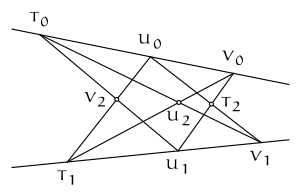
The intersections , , and are labeled so that on each line is a , a , and a .
The lemma used in Desargue’s Theorem gives a basis with respect to which the points have these homogeneous coordinate vectors.
First, any on
has homogeneous coordinate vectors of this form
( is a parameter; it depends on where on the line the point is, but any point on that line has a homogeneous coordinate vector of this form for some ). Similarly, is on
and so has this homogeneous coordinate vector.
Also similarly, is incident on
and has this homogeneous coordinate vector.
Because is we have this.
Substituting for in the first equation
shows that has this two-parameter homogeneous coordinate vector.
Since is the intersection
and substituting for in the first equation
gives that has this two-parameter homogeneous coordinate vector.
Because is on the line its homogeneous coordinate vector has the form
but a previous part of this question established that ’s homogeneous coordinate vectors have the form
and so this a homogeneous coordinate vector for .
By () and (), there is a relationship among the three parameters: .
The homogeneous coordinate vector of can be written in this way.
Now, the line consists of the points whose homogeneous coordinates have this form.
Taking and shows that the homogeneous coordinate vectors of have this form.
1 Topic: Computer Graphics source ↗
Calculate the product in ().
Answer
Straightforward calculation gives this for the product.
2 Topic: Computer Graphics source ↗
Find the matrix that reflects about the line .
Answer
Working in , let the matrix be . We get these two.
(For the second one, the starting vector is on the line through the origin that is perpendicular to .) We have this.
Solving gives
and so for homogeneous coordinates the matrix is this.
3 Topic: Computer Graphics source ↗
Find the matrix that reflects about the line .
Answer
Move all points over by , reflect about the line using the prior exercise, and them move them back.
4 Topic: Computer Graphics source ↗
Rotation and translation are rigid operations. What is the matrix for a rotation followed by a translation?
Answer
5 Topic: Computer Graphics source ↗
The homogeneous coordinates extend to manipulations of three dimensional space in the obvious way: every coordinate is a set of four-tall nonzero vectors that are related by being scalar multiples of each other. Give the matrix to do rotation about the axis, and the matrix for rotation about the axis.
Answer
Here are the two matrices.
Loading chapter 5…
Exercises and answers are adapted from Linear Algebra by Jim Hefferon, which is free to read and download, and are used under the CC BY-SA 2.5 licence. They are taken from the book’s LaTeX source and set for the web, so they may differ slightly from the printed page. This adaptation is released under the same licence and is neither affiliated with nor endorsed by Jim Hefferon.