Every problem in the chapter beside the book’s answer, a chapter at a time as you scroll.
Chapter 3: Maps Between Spaces
365 problems · 29 figuresThree.I.1.12 §I.1 source ↗
Verify, using Example 1.4 as a model, that the two correspondences given before the definition are isomorphisms.
Example 1.1
Example 1.2
Answer (2 parts)
Call the map .
It is one-to-one because if sends two members of the domain to the same image, that is, if , then the definition of gives that
and since column vectors are equal only if they have equal components, we have that and that . Thus, if maps two row vectors from the domain to the same column vector then the two row vectors are equal: .
To show that is onto we must show that any member of the codomain is the image under of some row vector. That’s easy;
is .
The computation for preservation of addition is this.
The computation for preservation of scalar multiplication is similar.
Denote the map from Example 1.2 by . To show that it is one-to-one, assume that . Then by the definition of the function,
and so and and . Thus , and consequently is one-to-one.
The function is onto because there is a polynomial sent to
by , namely, .
As for structure, this shows that preserves addition
and this shows
that it preserves scalar multiplication.
Three.I.1.13 §I.1 source ↗
For the map given by
Find the image of each of these elements of the domain.
Show that this map is an isomorphism.
Answer (5 parts)
These are the images.
To prove that is one-to-one, assume that it maps two linear polynomials to the same image . Then
and so, since column vectors are equal only when their components are equal, and . That shows that the two linear polynomials are equal, and so is one-to-one.
To show that is onto, note that this member of the codomain
is the image of this member of the domain .
To check that preserves structure, we can use item (2) of Lemma 1.11.
Three.I.1.14 §I.1 source ↗
Show that the natural map from Example 1.5 is an isomorphism.
Answer
To verify it is one-to-one, assume that . Then by the definition of . Members of are equal only when they have the same coefficients, so this implies that and and . Therefore implies that , and so is one-to-one.
To verify that it is onto, consider an arbitrary member of the codomain and observe that it is indeed the image of a member of the domain, namely, it is . (For instance, .)
The computation checking that preserves addition is this.
The check that preserves scalar multiplication is this.
Three.I.1.15 §I.1 source ↗
Show that the map given by is an isomorphism.
Answer
To see that the map is one-to-one suppose that , aiming to conclude that . That is, . Then and because quadratic polynomials are equal only if they have have the same quadratic terms, the same constant terms, and the same linear terms we conclude that , that , and from that, . Therefore and the function is one-to-one.
To see that the map is onto, we suppose that we are given a member of the codomain and we find a member of the domain that maps to it. Let the member of the codomain be . Observe that where then . Thus is onto.
To see that the map is a homomorphism we show that it respects linear combinations of two elements. By Lemma 1.11 this will show that the map preserves the operations.
Three.I.1.16 §I.1 source ↗
Verify that this map is an isomorphism: given by
Answer
We first verify that is one-to-one. To do this we will show that implies that . So assume that
which gives
from which we conclude that (by the upper-left entries), (by the lower-left entries), (by the lower-right entries), and with this last we get (by the upper right). Therefore .
Next we will show that the map is onto, that every member of the codomain is the image of some four-tall member of the domain. So, given
observe that it is the image of this domain vector.
To finish we verify that the map preserves linear combinations. By Lemma 1.11 this will show that the map preserves the operations.
Three.I.1.17 §I.1 source ↗
Decide whether each map is an isomorphism. If it is an isomorphism then prove it and if it isn’t then state a condition that it fails to satisfy.
given by
given by
given by
given by
Answer (4 parts)
No; this map is not one-to-one. In particular, the matrix of all zeroes is mapped to the same image as the matrix of all ones.
Yes, this is an isomorphism.
It is one-to-one:
gives that , and that , and that , and that .
It is onto, since this shows
that any four-tall vector is the image of a matrix.
Finally, it preserves combinations
and so item (2) of Lemma 1.11 shows that it preserves structure.
Yes, it is an isomorphism.
To show that it is one-to-one, we suppose that two members of the domain have the same image under .
This gives, by the definition of , that and then the fact that polynomials are equal only when their coefficients are equal gives a set of linear equations
that has only the solution , , , and .
To show that is onto, we note that is the image under of this matrix.
We can check that preserves structure by using item (2) of Lemma 1.11.
No, this map does not preserve structure. For instance, it does not send the matrix of all zeroes to the zero polynomial.
Three.I.1.18 §I.1 source ↗
Show that the map given by is one-to-one and onto. Is it an isomorphism?
Answer
It is one-to-one and onto, a correspondence, because it has an inverse (namely, ). However, it is not an isomorphism. For instance, .
Three.I.1.19 §I.1 source ↗
Refer to Example 1.1. Produce two more isomorphisms (of course, you must also verify that they satisfy the conditions in the definition of isomorphism).
Answer
Many maps are possible. Here are two.
The verifications are straightforward adaptations of the others above.
Three.I.1.20 §I.1 source ↗
Refer to Example 1.2. Produce two more isomorphisms (and verify that they satisfy the conditions).
Answer
Here are two.
Verification is straightforward (for the second, to show that it is onto, note that
is the image of ).
Three.I.1.21 §I.1 source ↗
Show that, although is not itself a subspace of , it is isomorphic to the -plane subspace of .
Answer
The space is not a subspace of because it is not a subset of . The two-tall vectors in are not members of .
The natural isomorphism (called the injection map) is this.
This map is one-to-one because
which in turn implies that and , and therefore the initial two two-tall vectors are equal.
Because
this map is onto the -plane.
To show that this map preserves structure, we will use item (2) of Lemma 1.11 and show
that it preserves combinations of two vectors.
Three.I.1.22 §I.1 source ↗
Find two isomorphisms between and .
Answer
Here are two:
Verification that each is an isomorphism is easy.
Three.I.1.23 §I.1 source ↗
For what is isomorphic to ?
Answer
When is the product , here is an isomorphism.
Checking that this is an isomorphism is easy.
Three.I.1.24 §I.1 source ↗
For what is isomorphic to ?
Answer
If then . (If we take and to be trivial vector spaces, then the relationship extends one dimension lower.) The natural isomorphism between them is this.
Checking that it is an isomorphism is straightforward.
Three.I.1.25 §I.1 source ↗
Prove that the map in Example 1.9, from to given by , is a vector space isomorphism.
Answer
This is the map, expanded.
This map is a correspondence because it has an inverse, the map .
To finish checking that it is an isomorphism we apply item (2) of Lemma 1.11 and show that it preserves linear combinations of two polynomials. Briefly, equals this
which equals .
Three.I.1.26 §I.1 source ↗
Why, in Lemma 1.10, must there be a ? That is, why must be nonempty?
Answer
No vector space has the empty set underlying it. We can take to be the zero vector.
Three.I.1.27 §I.1 source ↗
Are any two trivial spaces isomorphic?
Answer
Yes; where the two spaces are and , the map sending to is clearly one-to-one and onto, and also preserves what little structure there is.
Three.I.1.28 §I.1 source ↗
In the proof of Lemma 1.11, what about the zero-summands case (that is, if is zero)?
Answer
A linear combination of vectors adds to the zero vector and so Lemma 1.10 shows that the three statements are equivalent in this case.
Three.I.1.29 §I.1 source ↗
Show that any isomorphism has the form for some nonzero real number .
Answer
Consider the basis for and let be . For any we have that and so ’s action is multiplication by . Note that or else the map is not one-to-one. (Incidentally, any such map is an isomorphism, as is easy to check.)
Three.I.1.30 §I.1 source ↗
These prove that isomorphism is an equivalence relation.
Show that the identity map is an isomorphism. Thus, any vector space is isomorphic to itself.
Show that if is an isomorphism then so is its inverse . Thus, if is isomorphic to then also is isomorphic to .
Show that a composition of isomorphisms is an isomorphism: if is an isomorphism and is an isomorphism then so also is . Thus, if is isomorphic to and is isomorphic to , then also is isomorphic to .
Answer (4 parts)
In each item, following item (2) of Lemma 1.11, we show that the map preserves structure by showing that the it preserves linear combinations of two members of the domain.
The identity map is clearly one-to-one and onto. For linear combinations the check is easy.
The inverse of a correspondence is also a correspondence (as stated in the appendix), so we need only check that the inverse preserves linear combinations. Assume that (so ) and assume that .
The composition of two correspondences is a correspondence (as stated in the appendix), so we need only check that the composition map preserves linear combinations.
Three.I.1.31 §I.1 source ↗
Suppose that preserves structure. Show that is one-to-one if and only if the unique member of mapped by to is .
Answer
One direction is easy: by definition, if is one-to-one then for any at most one has , and so in particular, at most one member of is mapped to . The proof of Lemma 1.10 does not use the fact that the map is a correspondence and therefore shows that any structure-preserving map sends to .
For the other direction, assume that the only member of that is mapped to is . To show that is one-to-one assume that . Then and so . Consequently , so , and so is one-to-one.
Three.I.1.32 §I.1 source ↗
Suppose that is an isomorphism. Prove that the set is linearly dependent if and only if the set of images is linearly dependent.
Answer
We will prove something stronger — not only is the existence of a dependence preserved by isomorphism, but each instance of a dependence is preserved, that is,
The direction of this statement holds by item (3) of Lemma 1.11. The direction holds by regrouping
and applying the fact that is one-to-one, and so for the two vectors and to be mapped to the same image by , they must be equal.
Three.I.1.33 §I.1 source ↗
Show that each type of map from Example 1.8 is an automorphism.
Dilation by a nonzero scalar .
Rotation through an angle .
Reflection over a line through the origin.
Hint. For the second and third items, polar coordinates are useful.
Answer (3 parts)
This map is one-to-one because if then by definition of the map, and so , as is nonzero. This map is onto as any is the image of (again, note that is nonzero). (Another way to see that this map is a correspondence is to observe that it has an inverse: the inverse of is .)
To finish, note that this map preserves linear combinations
and therefore is an isomorphism.
As in the prior item, we can show that the map is a correspondence by noting that it has an inverse, .
That the map preserves structure is geometrically easy to see. For instance, adding two vectors and then rotating them has the same effect as rotating first and then adding. For an algebraic argument, consider polar coordinates: the map sends the vector with endpoint to the vector with endpoint . Then the familiar trigonometric formulas and show how to express the map’s action in the usual rectangular coordinate system.
Now the calculation for preservation of addition is routine.
The calculation for preservation of scalar multiplication is similar.
This map is a correspondence because it has an inverse (namely, itself).
As in the last item, that the reflection map preserves structure is geometrically easy to see: adding vectors and then reflecting gives the same result as reflecting first and then adding, for instance. For an algebraic proof, suppose that the line has slope (the case of a line with undefined slope can be done as a separate, but easy, case). We can follow the hint and use polar coordinates: where the line forms an angle of with the -axis, the action of is to send the vector with endpoint to the one with endpoint .
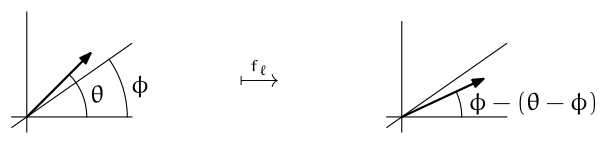
To convert to rectangular coordinates, we will use some trigonometric formulas, as we did in the prior item. First observe that and can be determined from the slope of the line. This picture
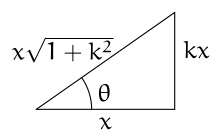
gives that and . Now,
and thus the first component of the image vector is this.
A similar calculation shows that the second component of the image vector is this.
With this algebraic description of the action of
checking that it preserves structure is routine.
Three.I.1.34 §I.1 source ↗
Produce an automorphism of other than the identity map, and other than a shift map .
Answer
First, the map doesn’t count because it is a version of . Here is a correct answer (many others are also correct): . Verification that this is an isomorphism is straightforward.
Three.I.1.35 §I.1 source ↗
Show that a function is an automorphism if and only if it has the form for some .
Let be an automorphism of such that . Find .
Show that a function is an automorphism if and only if it has the form
for some with . Hint. Exercises in prior subsections have shown that
if and only if .
Let be an automorphism of with
Find
Answer (4 parts)
For the ‘only if’ half, let to be an isomorphism. Consider the basis . Designate by . Then for any we have that , and so ’s action is multiplication by . To finish this half, just note that or else would not be one-to-one.
For the ‘if’ half we only have to check that such a map is an isomorphism when . To check that it is one-to-one, assume that so that and divide by the nonzero factor to conclude that . To check that it is onto, note that any is the image of (again, ). Finally, to check that such a map preserves combinations of two members of the domain, we have this.
By the prior item, ’s action is . Thus .
For the ‘only if’ half, assume that is an automorphism. Consider the standard basis for . Let
Then the action of on any vector is determined by by its action on the two basis vectors.
To finish this half, note that if , that is, if is a multiple of , then is not one-to-one.
For ‘if’ we must check that the map is an isomorphism, under the condition that . The structure-preservation check is easy; we will here show that is a correspondence. For the argument that the map is one-to-one, assume this.
Then, because , the resulting system
has a unique solution, namely the trivial one and (this follows from the hint).
The argument that this map is onto is closely related — this system
has a solution for any and if and only if this set
spans , i.e., if and only if this set is a basis (because it is a two-element subset of ), i.e., if and only if .
Three.I.1.36 §I.1 source ↗
Refer to Lemma 1.10 and Lemma 1.11. Find two more things preserved by isomorphism.
Answer
There are many answers; two are linear independence and subspaces.
First we show that if a set is linearly independent then its image is also linearly independent. Consider a linear relationship among members of the image set.
Because this map is an isomorphism, it is one-to-one. So maps only one vector from the domain to the zero vector in the range, that is, equals the zero vector (in the domain, of course). But, if is linearly independent then all of the ’s are zero, and so is linearly independent also. (Remark. There is a small point about this argument that is worth mention. In a set, repeats collapse, that is, strictly speaking, this is a one-element set: , because the things listed as in it are the same thing. Observe, however, the use of the subscript in the above argument. In moving from the domain set to the image set , there is no collapsing, because the image set does not have repeats, because the isomorphism is one-to-one.)
To show that if is an isomorphism and if is a subspace of the domain then the set of image vectors is a subspace of , we need only show that it is closed under linear combinations of two of its members (it is nonempty because it contains the image of the zero vector). We have
and is a member of because of the closure of a subspace under combinations. Hence the combination of and is a member of .
Three.I.1.37 §I.1 source ↗
We show that isomorphisms can be tailored to fit in that, sometimes, given vectors in the domain and in the range we can produce an isomorphism associating those vectors.
Let be a basis for so that any has a unique representation as , which we denote in this way.
Show that the operation is a function from to (this entails showing that with every domain vector there is an associated image vector in , and further, that with every domain vector there is at most one associated image vector).
Show that this function is one-to-one and onto.
Show that it preserves structure.
Produce an isomorphism from to that fits these specifications.
Answer (4 parts)
The association
is a function if every member of the domain is associated with at least one member of the codomain, and if every member of the domain is associated with at most one member of the codomain. The first condition holds because the basis spans the domain — every can be written as at least one linear combination of ’s. The second condition holds because the basis is linearly independent — every member of the domain can be written as at most one linear combination of the ’s.
For the one-to-one argument, if , that is, if then
and so and and , which gives the conclusion that . Therefore this map is one-to-one.
For onto, we can just note that
equals , and so any member of the codomain is the image of some member of the domain .
This map respects addition and scalar multiplication because it respects combinations of two members of the domain (that is, we are using item (2) of Lemma 1.11): where and , we have this.
Use any basis for whose first two members are and , say .
Three.I.1.38 §I.1 source ↗
Prove that a space is -dimensional if and only if it is isomorphic to . Hint. Fix a basis for the space and consider the map sending a vector over to its representation with respect to .
Answer
See the next subsection.
Three.I.1.39 §I.1 source ↗
(Requires the subsection on Combining Subspaces, which is optional.) Let and be vector spaces. Define a new vector space, consisting of the set along with these operations.
This is a vector space, the external direct sum of and .
Check that it is a vector space.
Find a basis for, and the dimension of, the external direct sum .
What is the relationship among , , and ?
Suppose that and are subspaces of a vector space such that (in this case we say that is the internal direct sum of and ). Show that the map given by
is an isomorphism. Thus if the internal direct sum is defined then the internal and external direct sums are isomorphic.
Answer (4 parts)
Most of the conditions in the definition of a vector space are routine. We here sketch the verification of part (1) of that definition.
For closure of , note that because and are closed, we have that and and so . Commutativity of addition in follows from commutativity of addition in and .
The check for associativity of addition is similar. The zero element is and the additive inverse of is .
The checks for the second part of the definition of a vector space are also straightforward.
This is a basis
because there is one and only one way to represent any member of with respect to this set; here is an example.
The dimension of this space is five.
We have as this is a basis.
We know that if then each can be written as in one and only one way. This is just what we need to prove that the given function an isomorphism.
First, to show that is one-to-one we can show that if , that is, if then and . But the statement ‘each is such a sum in only one way’ is exactly what is needed to make this conclusion. Similarly, the argument that is onto is completed by the statement that ‘each is such a sum in at least one way’.
This map also preserves linear combinations
and so it is an isomorphism.
Three.I.2.10 §I.2 source ↗
Decide if the spaces are isomorphic.
,
,
,
,
,
Answer (6 parts)
Each pair of spaces is isomorphic if and only if the two have the same dimension. We can, when there is an isomorphism, state a map, but it isn’t strictly necessary.
No, they have different dimensions.
No, they have different dimensions.
Yes, they have the same dimension. One isomorphism is this.
Yes, they have the same dimension. This is an isomorphism.
Yes, both have dimension .
Three.I.2.11 §I.2 source ↗
Which of these spaces are isomorphic to each other?
Answer (6 parts)
Just find the dimension of each space, for instance by finding a basis, and then spaces with the same dimension are isomorphic. This lists the dimension of each space.
Three.I.2.12 §I.2 source ↗
Consider the isomorphism where . Find the image of each of these elements of the domain.
;
;
Answer (3 parts)
Three.I.2.13 §I.2 source ↗
For which is the space isomorphic to ?
the plane subset of
the vector space of linear combinations of three letters
Answer (6 parts)
For each, the simplest thing is to find the dimension of the space by finding a basis. For each basis given below, We will omit the verification that it is a basis.
It is isomorphic to . One basis for is so the space has dimension .
It is isomorphic to since one basis for the space is .
It is isomorphic to . One basis has these six matrices.
It is a plane so it is isomorphic to . For a more extensive answer, parametrizing the plane gives this vector description
and so it has a basis consisting of those two vectors.
It is isomorphic to . One basis is the set of linear combinations , that is, .
Three.I.2.14 §I.2 source ↗
Show that if then .
Answer
They have different dimensions.
Three.I.2.15 §I.2 source ↗
Is ?
Answer
Yes, both are -dimensional.
Three.I.2.16 §I.2 source ↗
Are any two planes through the origin in isomorphic?
Answer
Yes, any two (nondegenerate) planes are both two-dimensional vector spaces.
Three.I.2.17 §I.2 source ↗
Find a set of equivalence class representatives other than the set of ’s.
Answer
There are many answers, one is the set of (taking to be the trivial vector space).
Three.I.2.18 §I.2 source ↗
True or false: between any -dimensional space and there is exactly one isomorphism.
Answer
False (except when ). For instance, if is an isomorphism then multiplying by any nonzero scalar, gives another, different, isomorphism. (Between trivial spaces the isomorphisms are unique; the only map possible is .)
Three.I.2.19 §I.2 source ↗
Can a vector space be isomorphic to one of its proper subspaces?
Answer
No. A proper subspace has a strictly lower dimension than it’s superspace; if is a proper subspace of then any linearly independent subset of must have fewer than members or else that set would be a basis for , and wouldn’t be proper.
Three.I.2.20 §I.2 source ↗
This subsection shows that for any isomorphism, the inverse map is also an isomorphism. This subsection also shows that for a fixed basis of an -dimensional vector space , the map is an isomorphism. Find the inverse of this map.
Answer
Where , the inverse is this.
Three.I.2.21 §I.2 source ↗
Prove these facts about matrices.
The row space of a matrix is isomorphic to the column space of its transpose.
The row space of a matrix is isomorphic to its column space.
Answer
All three spaces have dimension equal to the rank of the matrix.
Three.I.2.22 §I.2 source ↗
Show that the function from Theorem 2.3 is well-defined.
Answer
We must show that if then . So suppose that . Each vector in a vector space (here, the domain space) has a unique representation as a linear combination of basis vectors, so we can conclude that , …, . Thus,
and so the function is well-defined.
Three.I.2.23 §I.2 source ↗
Is the proof of Theorem 2.3 valid when ?
Answer
Yes, because a zero-dimensional space is a trivial space.
Three.I.2.24 §I.2 source ↗
For each, decide if it is a set of isomorphism class representatives.
Answer (3 parts)
No, this collection has no spaces of odd dimension.
Yes, because .
No, for instance, .
Three.I.2.25 §I.2 source ↗
Let be a correspondence between vector spaces and (that is, a map that is one-to-one and onto). Show that the spaces and are isomorphic via if and only if there are bases and such that corresponding vectors have the same coordinates: .
Answer
One direction is easy: if the two are isomorphic via then for any basis , the set is also a basis (this is shown in Lemma 2.4). The check that corresponding vectors have the same coordinates: is routine.
For the other half, assume that there are bases such that corresponding vectors have the same coordinates with respect to those bases. Because is a correspondence, to show that it is an isomorphism, we need only show that it preserves structure. Because , the map preserves structure if and only if representations preserve addition: and scalar multiplication: The addition calculation is this: , and the scalar multiplication calculation is similar.
Three.I.2.26 §I.2 source ↗
Consider the isomorphism .
Vectors in a real space are orthogonal if and only if their dot product is zero. Give a definition of orthogonality for polynomials.
The derivative of a member of is in . Give a definition of the derivative of a vector in .
Answer (2 parts)
Pulling the definition back from to gives that is orthogonal to if and only if .
A natural definition is this.
Three.I.2.27 §I.2 source ↗
Does every correspondence between bases, when extended to the spaces, give an isomorphism? That is, suppose that is a vector space with basis and that is a correspondence such that is basis for . Must sending to be an isomorphism?
Answer
Yes.
First, is well-defined because every member of has one and only one representation as a linear combination of elements of .
Second we must show that is one-to-one and onto. It is one-to-one because every member of has only one representation as a linear combination of elements of , since is a basis. And is onto because every member of has at least one representation as a linear combination of members of .
Finally, preservation of structure is routine to check. For instance, here is the preservation of addition calculation.
(The second equality is the definition of .) Preservation of scalar multiplication is similar.
Three.I.2.28 §I.2 source ↗
(Requires the subsection on Combining Subspaces, which is optional.) Suppose that and that is isomorphic to the space under the map . Show that .
Answer
Because and is one-to-one we have that . To finish, count the dimensions: , as required.
Three.I.2.29 §I.2 source ↗
Show that this is not a well-defined function from the rational numbers to the integers: with each fraction, associate the value of its numerator.
Answer
Rational numbers have many representations, e.g., , and the numerators can vary among representations.
Three.II.1.18 §II.1 source ↗
Decide if each is linear.
Answer (4 parts)
Yes. The verification is straightforward.
Yes. The verification is easy.
No. An example of an addition that is not respected is this.
Yes. The verification is straightforward.
Three.II.1.19 §II.1 source ↗
Decide if each map is linear.
Answer (5 parts)
For each, we must either check that the map preserves linear combinations or give an example of a linear combination that is not.
Yes. The check that it preserves combinations is routine.
No. For instance, not preserved is multiplication by the scalar .
Yes. This is the check that it preserves combinations of two members of the domain.
No. An example of a combination that is not preserved is that doing it one way gives this
while the other way gives this.
Three.II.1.20 §II.1 source ↗
Show that these are homomorphisms. Are they inverse to each other?
given by maps to
given by maps to
Answer
The check that each is a homomorphisms is routine. Here is the check for the differentiation map.
(An alternate proof is to simply note that this is a property of differentiation that is familiar from calculus.)
These two maps are not inverses as this composition does not act as the identity map on this element of the domain.
Three.II.1.21 §II.1 source ↗
Is (perpendicular) projection from to the -plane a homomorphism? Projection to the -plane? To the -axis? The -axis? The -axis? Projection to the origin?
Answer
Each of these projections is a homomorphism. Projection to the -plane and to the -plane are these maps.
Projection to the -axis, to the -axis, and to the -axis are these maps.
And projection to the origin is this map.
Verification that each is a homomorphism is straightforward. (The last one, of course, is the zero transformation on .)
Three.II.1.22 §II.1 source ↗
Verify that each map is a homomorphism.
given by
given by
Answer (2 parts)
This verifies that the map preserves linear combinations. By Lemma 1.7 that suffices to show that it is a homomorphism.
It preserves linear combinations.
Three.II.1.23 §II.1 source ↗
Show that, while the maps from Example 1.3 preserve linear operations, they are not isomorphisms.
Answer
The first is not onto; for instance, there is no polynomial that is sent the constant polynomial . The second is not one-to-one; both of these members of the domain
map to the same member of the codomain, .
Three.II.1.24 §II.1 source ↗
Is an identity map a linear transformation?
Answer
Yes; in any space .
Three.II.1.25 §II.1 source ↗
Stating that a function is ‘linear’ is different than stating that its graph is a line.
The function given by has a graph that is a line. Show that it is not a linear function.
The function given by
does not have a graph that is a line. Show that it is a linear function.
Answer (2 parts)
This map does not preserve structure since , while .
The check is routine.
Three.II.1.26 §II.1 source ↗
Part of the definition of a linear function is that it respects addition. Does a linear function respect subtraction?
Answer
Yes. Where is linear, .
Three.II.1.27 §II.1 source ↗
Assume that is a linear transformation of and that is a basis of . Prove each statement.
If for each basis vector then is the zero map.
If for each basis vector then is the identity map.
If there is a scalar such that for each basis vector then for all vectors in .
Answer (3 parts)
Let be represented with respect to the basis as . Then .
This argument is similar to the prior one. Let be represented with respect to the basis as . Then .
As above, only .
Three.II.1.28 §II.1 source ↗
Consider the vector space where vector addition and scalar multiplication are not the ones inherited from but rather are these: is the product of and , and is the -th power of . (This was shown to be a vector space in an earlier exercise.) Verify that the natural logarithm map is a homomorphism between these two spaces. Is it an isomorphism?
Answer
That it is a homomorphism follows from the familiar rules that the logarithm of a product is the sum of the logarithms and that the logarithm of a power is the multiple of the logarithm . This map is an isomorphism because it has an inverse, namely, the exponential map, so it is a correspondence, and therefore it is an isomorphism.
Three.II.1.29 §II.1 source ↗
Consider this transformation of the plane .
Find the image under this map of this ellipse.
Answer
Where and , the image set is
the unit circle in the -plane.
Three.II.1.30 §II.1 source ↗
Imagine a rope wound around the earth’s equator so that it fits snugly (suppose that the earth is a sphere). How much extra rope must we add so that around the entire world the rope will now be six feet off the ground?
Answer
The circumference function is linear. Thus we have . Observe that it takes the same amount of extra rope to raise the circle from tightly wound around a basketball to six feet above that basketball as it does to raise it from tightly wound around the earth to six feet above the earth.
Three.II.1.31 §II.1 source ↗
Verify that this map
is linear. Generalize.
Answer
Verifying that it is linear is routine.
The natural guess at a generalization is that for any fixed the map is linear. This statement is true. It follows from properties of the dot product we have seen earlier: and . (The natural guess at a generalization of this generalization, that the map from to whose action consists of taking the dot product of its argument with a fixed vector is linear, is also true.)
Three.II.1.32 §II.1 source ↗
Show that every homomorphism from to acts via multiplication by a scalar. Conclude that every nontrivial linear transformation of is an isomorphism. Is that true for transformations of ? ?
Answer
Let be linear. A linear map is determined by its action on a basis, so fix the basis for . For any we have that and so acts on any argument by multiplying it by the constant . If is not zero then the map is a correspondence — its inverse is division by — so any nontrivial transformation of is an isomorphism.
This projection map is an example that shows that not every transformation of acts via multiplication by a constant when , including when .
Three.II.1.33 §II.1 source ↗
Show that for any scalars this map is a homomorphism.
Answer
Where and are scalars, we have this.
Three.II.1.34 §II.1 source ↗
Consider the space of polynomials .
Show that for each , the -th derivative operator is a linear transformation of that space.
Conclude that for any scalars this map is a linear transformation of that space.
Answer (2 parts)
Each power of the derivative operator is linear because of these rules familiar from calculus.
Any linear combination of linear maps is also a linear map. Thus, the given map is a linear transformation of .
Three.II.1.35 §II.1 source ↗
Lemma 1.17 shows that a sum of linear functions is linear and that a scalar multiple of a linear function is linear. Show also that a composition of linear functions is linear.
Answer
(This argument has already appeared, as part of the proof that isomorphism is an equivalence.) Let and be linear. The composition preserves linear combinations
where and scalars
Three.II.1.36 §II.1 source ↗
Where is linear, suppose that , …, for some vectors , …, from .
If the set of ’s is independent, must the set of ’s also be independent?
If the set of ’s is independent, must the set of ’s also be independent?
If the set of ’s spans , must the set of ’s span ?
If the set of ’s spans , must the set of ’s span ?
Answer (4 parts)
Yes. The set of ’s cannot be linearly independent if the set of ’s is linearly dependent because any nontrivial relationship in the domain would give a nontrivial relationship in the range .
Not necessarily. For instance, the transformation of given by
sends this linearly independent set in the domain to a linearly dependent image.
Not necessarily. An example is the projection map
and this set that does not span the domain but maps to a set that does span the codomain.
Not necessarily. For instance, the injection map sends the standard basis for the domain to a set that does not span the codomain. (Remark. However, the set of ’s does span the range. A proof is easy.)
Three.II.1.37 §II.1 source ↗
Generalize Example 1.16 by proving that for every appropriate domain and codomain the matrix transpose map is linear. What are the appropriate domains and codomains?
Answer
Recall that the entry in row and column of the transpose of is the entry from row and column of . Now, the check is routine. Start with the transpose of the combination.
Combine and take the transpose.
Then bring out the scalars, and un-transpose.
The domain is while the codomain is .
Three.II.1.38 §II.1 source ↗
Where , by definition the line segment connecting them is the set . Show that the image, under a homomorphism , of the segment between and is the segment between and .
A subset of is convex if, for any two points in that set, the line segment joining them lies entirely in that set. (The inside of a sphere is convex while the skin of a sphere is not.) Prove that linear maps from to preserve the property of set convexity.
Answer (2 parts)
For any homomorphism we have
which is the line segment from to .
We must show that if a subset of the domain is convex then its image, as a subset of the range, is also convex. Suppose that is convex and consider its image . To show is convex we must show that for any two of its members, and , the line segment connecting them
is a subset of .
Fix any member of that line segment. Because the endpoints of are in the image of , there are members of that map to them, say and . Now, where is the scalar that we fixed in the first sentence of this paragraph, observe that Thus, any member of is a member of , and so is convex.
Three.II.1.39 §II.1 source ↗
Let be a homomorphism.
Show that the image under of a line in is a (possibly degenerate) line in .
What happens to a -dimensional linear surface?
Answer (2 parts)
For , the line through with direction is the set . The image under of that line is the line through with direction . If is the zero vector then this line is degenerate.
A -dimensional linear surface in maps to a -dimensional linear surface in (possibly it is degenerate). The proof is just like that the one for the line.
Three.II.1.40 §II.1 source ↗
Prove that the restriction of a homomorphism to a subspace of its domain is another homomorphism.
Answer
Suppose that is a homomorphism and suppose that is a subspace of . Consider the map defined by . (The only difference between and is the difference in domain.) Then this new map is linear: .
Three.II.1.41 §II.1 source ↗
Assume that is linear.
Show that the range space of this map is a subspace of the codomain .
Show that the null space of this map is a subspace of the domain .
Show that if is a subspace of the domain then its image is a subspace of the codomain . This generalizes the first item.
Generalize the second item.
Answer (5 parts)
This will appear as a lemma in the next subsection.
The range is nonempty because is nonempty. To finish we need to show that it is closed under combinations. A combination of range vectors has the form, where ,
which is itself in the range as is a member of domain . Therefore the range is a subspace.
The null space is nonempty since it contains , as maps to . It is closed under linear combinations because, where are elements of the inverse image , for
and so is also in the inverse image of .
This image of nonempty because is nonempty. For closure under combinations, where ,
which is itself in as is in . Thus this set is a subspace.
The natural generalization is that the inverse image of a subspace of is a subspace.
Suppose that is a subspace of . Note that so that the set is not empty. To show that this set is closed under combinations, let be elements of such that , …, and note that
so a linear combination of elements of is also in .
Three.II.1.42 §II.1 source ↗
Consider the set of isomorphisms from a vector space to itself. Is this a subspace of the space of homomorphisms from the space to itself?
Answer
No; the set of isomorphisms does not contain the zero map (unless the space is trivial).
Three.II.1.43 §II.1 source ↗
Does Theorem 1.9 need that is a basis? That is, can we still get a well-defined and unique homomorphism if we drop either the condition that the set of ’s be linearly independent, or the condition that it span the domain?
Answer
If doesn’t span the space then the map needn’t be unique. For instance, if we try to define a map from to itself by specifying only that maps to itself, then there is more than one homomorphism possible; both the identity map and the projection map onto the first component fit this condition.
If we drop the condition that is linearly independent then we risk an inconsistent specification (i.e, there could be no such map). An example is if we consider , and try to define a map from to itself that sends to itself, and sends both and to . No homomorphism can satisfy these three conditions.
Three.II.1.44 §II.1 source ↗
Let be a vector space and assume that the maps are linear.
Define a map whose component functions are the given linear ones.
Show that is linear.
Does the converse hold — is any linear map from to made up of two linear component maps to ?
Generalize.
Answer (3 parts)
Briefly, the check of linearity is this.
Yes. Let and be the projections
onto the two axes. Now, where and we have the desired component functions.
They are linear because they are the composition of linear functions, and the fact that the composition of linear functions is linear was part of the proof that isomorphism is an equivalence relation (alternatively, the check that they are linear is straightforward).
In general, a map from a vector space to an is linear if and only if each of the component functions is linear. The verification is as in the prior item.
Three.II.2.21 §II.2 source ↗
Let be given by . Which of these are in the null space? Which are in the range space?
Answer (6 parts)
First, to answer whether a polynomial is in the null space, we have to consider it as a member of the domain . To answer whether it is in the range space, we consider it as a member of the codomain . That is, for , the question of whether it is in the range space is sensible but the question of whether it is in the null space is not because it is not even in the domain.
The polynomial is not in the null space because is not the zero polynomial in . The polynomial is in the range space because is mapped by to .
The answer to both questions is, “Yes, because .” The polynomial is in the null space because it is mapped by to the zero polynomial in . The polynomial is in the range space because it is the image, under , of .
The polynomial is not in the null space because is not the zero polynomial in . The polynomial is not in the range space because there is no member of the domain that when multiplied by gives the constant polynomial .
The polynomial is not in the null space because . The polynomial is in the range space because it is the image of .
The polynomial is not in the null space because . The polynomial is not in the range space because of the constant term.
Three.II.2.22 §II.2 source ↗
Find the range space and the rank of each homomorphism.
given by
given by
Answer (2 parts)
The range of is all of the codomain because given
it is the image under of the domain vector . So the rank of is .
The range is the plane. Any
is the image under of this domain vector.
So the rank of the map is .
Three.II.2.23 §II.2 source ↗
Find the range space and rank of each map.
given by
given by
given by
the zero map
Answer (4 parts)
The range space is
and so the rank is one.
The range space
is all of (we can get any real number by taking to be and taking to be the desired number). Thus, the rank is one.
The range space is . The rank is two.
The range space is the trivial subspace of so the rank is zero.
Three.II.2.24 §II.2 source ↗
For each linear map in the prior exercise, find the null space and nullity.
Answer (4 parts)
The null space is
and so the nullity is one.
The null space is this.
Thus the nullity is three.
The null space
is a dimension space, so the nullity is two.
Every vector in the domain is mapped to the zero vector so the nullspace is .
Three.II.2.25 §II.2 source ↗
Find the nullity of each map below.
of rank five
of rank one
, an onto map
, onto
Answer (5 parts)
For each, use the result that the rank plus the nullity equals the dimension of the domain.
Three.II.2.26 §II.2 source ↗
What is the null space of the differentiation transformation ? What is the null space of the second derivative, as a transformation of ? The -th derivative?
Answer
Because
we have this.
In the same way,
for .
Three.II.2.27 §II.2 source ↗
For the map given by
find the range space, rank, null space, and nullity.
Answer
To see that the range space is all of note that for any this system has a solution.
(In fact, because there is a free variable, , it has infinitely many solutions.) Thus the rank, the dimension of the range space, is .
Since the rank plus the nullity equals the dimension of the domain, we know that the nullity is . Finding the null space verifies that:
the nullspace is this set
which is one-dimensional.
Three.II.2.28 §II.2 source ↗
Example 2.7 restates the first condition in the definition of homomorphism as ‘the shadow of a sum is the sum of the shadows’. Restate the second condition in the same style.
Answer
The shadow of a scalar multiple is the scalar multiple of the shadow.
Three.II.2.29 §II.2 source ↗
For the homomorphism given by find these.
Answer (3 parts)
Setting gives and and , so the null space is .
Setting gives that , and , and . Taking as a parameter, and renaming it gives this set description .
This set is empty because the range of includes only those polynomials with a term.
Three.II.2.30 §II.2 source ↗
For the map given by
sketch these inverse image sets: , , and .
Answer
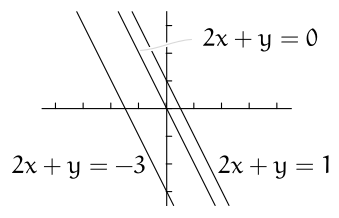
All inverse images are lines with slope .
Three.II.2.31 §II.2 source ↗
Each of these transformations of is one-to-one. For each, find the inverse.
Answer (6 parts)
These are the inverses.
For instance, for the second one, the map given in the question sends and then the inverse above sends . So this map is actually self-inverse.
Three.II.2.32 §II.2 source ↗
Describe the null space and range space of a transformation given by .
Answer
For any vector space , the null space
is trivial, while the range space
is all of , because every vector is twice some other vector, specifically, it is twice . (Thus, this transformation is actually an automorphism.)
Three.II.2.33 §II.2 source ↗
List all pairs that are possible for linear maps from to .
Answer
Because the rank plus the nullity equals the dimension of the domain (here, five), and the rank is at most three, the possible pairs are: , , , and . Coming up with linear maps that show that each pair is indeed possible is easy.
Three.II.2.34 §II.2 source ↗
Does the differentiation map have an inverse?
Answer
No (unless is trivial), because the two polynomials and have the same derivative; a map must be one-to-one to have an inverse.
Three.II.2.35 §II.2 source ↗
Find the nullity of this map .
Answer
The null space is this.
Thus the nullity is .
Three.II.2.36 §II.2 source ↗
Prove that a homomorphism is onto if and only if its rank equals the dimension of its codomain.
Conclude that a homomorphism between vector spaces with the same dimension is one-to-one if and only if it is onto.
Answer (2 parts)
One direction is obvious: if the homomorphism is onto then its range is the codomain and so its rank equals the dimension of its codomain. For the other direction assume that the map’s rank equals the dimension of the codomain. Then the map’s range is a subspace of the codomain, and has dimension equal to the dimension of the codomain. Therefore, the map’s range must equal the codomain, and the map is onto. (The ‘therefore’ is because there is a linearly independent subset of the range that is of size equal to the dimension of the codomain, but any such linearly independent subset of the codomain must be a basis for the codomain, and so the range equals the codomain.)
By Theorem 2.20, a homomorphism is one-to-one if and only if its nullity is zero. Because rank plus nullity equals the dimension of the domain, it follows that a homomorphism is one-to-one if and only if its rank equals the dimension of its domain. But this domain and codomain have the same dimension, so the map is one-to-one if and only if it is onto.
Three.II.2.37 §II.2 source ↗
Show that a linear map is one-to-one if and only if it preserves linear independence.
Answer
We are proving that is one-to-one if and only if for every linearly independent subset of the subset of is linearly independent.
One half is easy — by Theorem 2.20, if is not one-to-one then its null space is nontrivial, that is, it contains more than just the zero vector. So where is in that null space, the singleton set is independent while its image is not.
For the other half, assume that is one-to-one and so by Theorem 2.20 has a trivial null space. Then for any , the relation
implies the relation . Hence, if a subset of is independent then so is its image in .
Remark. The statement is that a linear map is one-to-one if and only if it preserves independence for all sets (that is, if a set is independent then its image is also independent). A map that is not one-to-one may well preserve some independent sets. One example is this map from to .
Linear independence is preserved for this set
and (in a somewhat more tricky example) also for this set
(recall that in a set, repeated elements do not appear twice). However, there are sets whose independence is not preserved under this map
and so not all sets have independence preserved.
Three.II.2.38 §II.2 source ↗
Corollary 2.17 says that for there to be an onto homomorphism from a vector space to a vector space , it is necessary that the dimension of be less than or equal to the dimension of . Prove that this condition is also sufficient; use Theorem 1.9 to show that if the dimension of is less than or equal to the dimension of , then there is a homomorphism from to that is onto.
Answer
(We use the notation from Theorem 1.9.) Fix a basis for and a basis for . If the dimension of is less than or equal to the dimension of then the theorem gives a linear map from to determined in this way.
We need only to verify that this map is onto.
We can write any member of as a linear combination of basis elements . This vector is the image, under the map described above, of . Thus the map is onto.
Three.II.2.39 §II.2 source ↗
Recall that the null space is a subset of the domain and the range space is a subset of the codomain. Are they necessarily distinct? Is there a homomorphism that has a nontrivial intersection of its null space and its range space?
Answer
Yes. For the transformation of given by
we have this.
Remark. We will see more of this in the fifth chapter.
Three.II.2.40 §II.2 source ↗
Prove that the image of a span equals the span of the images. That is, where is linear, prove that if is a subset of then equals . This generalizes Lemma 2.1 since it shows that if is any subspace of then its image is a subspace of , because the span of the set is .
Answer
This is a simple calculation.
Three.II.2.41 §II.2 source ↗
Prove that for any linear map and any , the set has the form
(if is not onto and is not in the range of then this set is empty since its third condition cannot be satisfied). Such a set is a coset of and we denote it as .
Consider the map given by
for some scalars , , , and . Prove that is linear.
Conclude from the prior two items that for any linear system of the form
we can write the solution set (the vectors are members of )
where is a particular solution of that linear system (if there is no particular solution then the above set is empty).
Show that this map is linear
for any scalars , …, . Extend the conclusion made in the prior item.
Show that the -th derivative map is a linear transformation of for each . Prove that this map is a linear transformation of the space
for any scalars , …, . Draw a conclusion as above.
Answer (5 parts)
We will show the sets are equal by mutual inclusion. For the direction, just note that equals , and so any member of the first set is a member of the second. For the direction, consider . Because is linear, implies that . We can write as , and then we have that , as desired, because .
This check is routine.
This is immediate.
For the linearity check, briefly, where are scalars and have components and , we have this.
The appropriate conclusion is that .
Each power of the derivative is linear because of the rules
from calculus. Thus the given map is a linear transformation of the space because any linear combination of linear maps is also a linear map by Lemma 1.17. The appropriate conclusion is , where the associated homogeneous differential equation has a constant of .
Three.II.2.42 §II.2 source ↗
Prove that for any transformation that is rank one, the map given by composing the operator with itself satisfies for some real number .
Answer
Because the rank of is one, the range space of is a one-dimensional set. Taking as a basis (for some appropriate ), we have that for every , the image is a multiple of this basis vector — associated with each there is a scalar such that . Apply to both sides of that equation and take to be
to get the desired conclusion.
Three.II.2.43 §II.2 source ↗
Let be a homomorphism, but not the zero homomorphism. Prove that if is a basis for the null space and if is not in the null space then is a basis for the entire domain .
Answer
By assumption, is not the zero map and so a vector exists that is not in the null space. Note that is a basis for , because it is a size-one linearly independent subset of . Consequently is onto, as for any we have for some scalar , and so .
Thus the rank of is one. Because the nullity is , the dimension of the domain of , the vector space , is . We can finish by showing is linearly independent, as it is a size subset of a dimension space. Because is linearly independent we need only show that is not a linear combination of the other vectors. But would give and applying to both sides would give a contradiction.
Three.II.2.44 §II.2 source ↗
Show that for any space of dimension , the dual space
is isomorphic to . It is often denoted . Conclude that .
Answer
Fix a basis for . We shall prove that this map
is an isomorphism from to .
To see that is one-to-one, assume that and are members of such that . Then
and consequently, , etc. But a homomorphism is determined by its action on a basis, so , and therefore is one-to-one.
To see that is onto, consider
for . This function from to
is linear and maps it to the given vector in , so is onto.
The map also preserves structure: where
we have
so .
Three.II.2.45 §II.2 source ↗
Show that any linear map is the sum of maps of rank one.
Answer
Let be linear and fix a basis for . Consider these maps from to
for any . Clearly is the sum of the ’s. We need only check that each is linear: where we have .
Three.II.2.46 §II.2 source ↗
Is ‘is homomorphic to’ an equivalence relation? (Hint: the difficulty is to decide on an appropriate meaning for the quoted phrase.)
Answer
Either yes (trivially) or no (nearly trivially).
If we take ‘is homomorphic to’ to mean there is a homomorphism from into (but not necessarily onto) , then every space is homomorphic to every other space as a zero map always exists.
If we take ‘is homomorphic to’ to mean there is an onto homomorphism from to then the relation is not an equivalence. For instance, there is an onto homomorphism from to (projection is one) but no homomorphism from onto by Corollary 2.17, so the relation is not reflexive.
Three.II.2.47 §II.2 source ↗
Show that the range spaces and null spaces of powers of linear maps form descending
and ascending
chains. Also show that if is such that then all following range spaces are equal: . Similarly, if then .
Answer
That they form the chains is obvious. For the rest, we show here that implies that . Induction then applies.
Assume that . Then is the same map, with the same domain, as . Thus it has the same range: .
Three.III.1.13 §III.1 source ↗
Multiply the matrix
by each vector, or state “not defined.”
Answer (3 parts)
Not defined.
Three.III.1.14 §III.1 source ↗
Multiply this matrix by each vector or state “not defined.”
Answer (3 parts)
This is not defined.
This is defined.
Not defined.
Three.III.1.15 §III.1 source ↗
Perform, if possible, each matrix-vector multiplication.
Answer (3 parts)
Not defined.
Three.III.1.16 §III.1 source ↗
This matrix equation expresses a linear system. Solve it.
Answer
Matrix-vector multiplication gives rise to a linear system.
Gaussian reduction shows that , , and .
Three.III.1.17 §III.1 source ↗
For a homomorphism from to that sends
where does go?
Answer
Here are two ways to get the answer.
First, obviously , and so we can apply the general property of preservation of combinations to get .
The other way uses the computation scheme developed in this subsection. Because we know where these elements of the space go, we consider this basis for the domain. Arbitrarily, we can take as a basis for the codomain. With those choices, we have that
and, as
the matrix-vector multiplication calculation gives this.
Thus, , as above.
Three.III.1.18 §III.1 source ↗
Let be the linear transformation with this action.
What is its effect on the general vector with entries and ?
Answer
Fix this natural basis for .
The representation of the map with respect to is this.
Since the general vector is represented with respect to by itself, and similarly every matrix is represented with respect to by itself, we have this for the effect of the map.
Three.III.1.19 §III.1 source ↗
Assume that is determined by this action.
Using the standard bases, find
the matrix representing this map;
a general formula for .
Answer (3 parts)
Again, as recalled in the subsection, with respect to , a column vector represents itself.
To represent with respect to take the images of the basis vectors from the domain, and represent them with respect to the basis for the codomain. The first is this
while the second is this.
Adjoin these to make the matrix.
For any in the domain ,
and so
is the desired representation.
Three.III.1.20 §III.1 source ↗
Represent the homomorphism given by this formula and with respect to these bases.
Answer
The action of the map on the domain’s basis vectors is this.
Represent those with respect to the codomain’s basis.
Concatenate them together into a matrix.
Three.III.1.21 §III.1 source ↗
Let be the derivative transformation.
Represent with respect to where .
Represent with respect to where .
Answer (2 parts)
We must first find the image of each vector from the domain’s basis, and then represent that image with respect to the codomain’s basis.
Those representations are then adjoined to make the matrix representing the map.
Proceeding as in the prior item, we represent the images of the domain’s basis vectors
and adjoin to make the matrix.
Three.III.1.22 §III.1 source ↗
Represent each linear map with respect to each pair of bases.
with respect to where , given by
with respect to where , given by
with respect to where and , given by
with respect to where and , given by
with respect to where , given by
Answer (6 parts)
For each, we must find the image of each of the domain’s basis vectors, represent each image with respect to the codomain’s basis, and then adjoin those representations to get the matrix.
The basis vectors from the domain have these images
and these images are represented with respect to the codomain’s basis in this way.
The matrix
has rows and columns.
Once the images under this map of the domain’s basis vectors are determined
then they can be represented with respect to the codomain’s basis
and put together to make the matrix.
The images of the basis vectors of the domain are
and they are represented with respect to the codomain’s basis as
so the matrix is
(this is an matrix).
The images of the domain’s basis vectors are
and they are represented in the codomain as
and so the matrix is this.
The images of the basis vectors from the domain are , and , and , and , etc. The representations are here.
The resulting matrix
is Pascal’s triangle (recall that is the number of ways to choose things, without order and without repetition, from a set of size ).
Three.III.1.23 §III.1 source ↗
Represent the identity map on any nontrivial space with respect to , where is any basis.
Answer
Where the space is -dimensional,
is the identity matrix.
Three.III.1.24 §III.1 source ↗
Represent, with respect to the natural basis, the transpose transformation on the space of matrices.
Answer
Taking this as the natural basis
the transpose map acts in this way
so that representing the images with respect to the codomain’s basis and adjoining those column vectors together gives this.
Three.III.1.25 §III.1 source ↗
Assume that is a basis for a vector space. Represent with respect to the transformation that is determined by each.
, , ,
, , ,
, , ,
Answer (3 parts)
With respect to the basis of the codomain, the images of the members of the basis of the domain are represented as
and consequently, the matrix representing the transformation is this.
Three.III.1.26 §III.1 source ↗
Example 1.10 shows how to represent the rotation transformation of the plane with respect to the standard basis. Express these other transformations also with respect to the standard basis.
the dilation map , which multiplies all vectors by the same scalar
the reflection map , which reflects all all vectors across a line through the origin
Answer (2 parts)
The picture of is this.
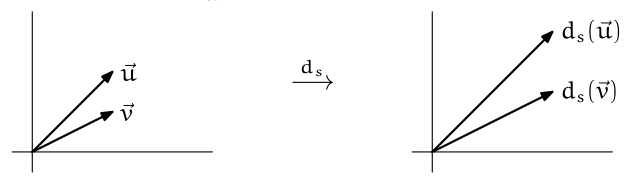
This map’s effect on the vectors in the standard basis for the domain is
and those images are represented with respect to the codomain’s basis (again, the standard basis) by themselves.
Thus the representation of the dilation map is this.
The picture of is this.
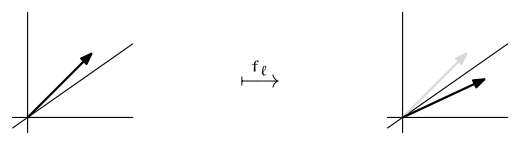
Some calculation (see Exercise I.1.33) shows that when the line has slope
(the case of a line with undefined slope is separate but easy) and so the matrix representing reflection is this.
Three.III.1.27 §III.1 source ↗
Consider a linear transformation of determined by these two.
Represent this transformation with respect to the standard bases.
Where does the transformation send this vector?
Represent this transformation with respect to these bases.
Using from the prior item, represent the transformation with respect to .
Answer (5 parts)
Call the map .
To represent this map with respect to the standard bases, we must find, and then represent, the images of the vectors and from the domain’s basis. The image of is given.
One way to find the image of is by eye — we can see this.
A more systematic way to find the image of is to use the given information to represent the transformation, and then use that representation to determine the image. Taking this for a basis,
the given information says this.
As
we have that
and consequently we know that (since, with respect to the standard basis, this vector is represented by itself). Therefore, this is the representation of with respect to .
To use the matrix developed in the prior item, note that
and so we have this is the representation, with respect to the codomain’s basis, of the image of the given vector.
Because the codomain’s basis is the standard one, and so vectors in the codomain are represented by themselves, we have this.
We first find the image of each member of , and then represent those images with respect to . For the first step, we can use the matrix developed earlier.
Actually, for the second member of there is no need to apply the matrix because the problem statement gives its image.
Now representing those images with respect to is routine.
Thus, the matrix is this.
We know the images of the members of the domain’s basis from the prior item.
We can compute the representation of those images with respect to the codomain’s basis.
Thus this is the matrix.
Three.III.1.28 §III.1 source ↗
Suppose that is one-to-one so that by Theorem 2.20, for any basis the image is a basis for . (If is onto then .)
Represent the map with respect to .
For a member of the domain, where the representation of has components , …, , represent the image vector with respect to the image basis .
Answer (2 parts)
The images of the members of the domain’s basis are
and those images are represented with respect to the codomain’s basis in this way.
Hence, the matrix is the identity.
Using the matrix in the prior item, the representation is this.
Three.III.1.29 §III.1 source ↗
Give a formula for the product of a matrix and , the column vector that is all zeroes except for a single one in the -th position.
Answer
The product
gives the -th column of the matrix.
Three.III.1.30 §III.1 source ↗
For each vector space of functions of one real variable, represent the derivative transformation with respect to .
,
,
,
Answer (3 parts)
The images of the basis vectors for the domain are and . Representing those with respect to the codomain’s basis (again, ) and adjoining the representations gives this matrix.
The images of the vectors in the domain’s basis are and . Representing with respect to the codomain’s basis and adjoining gives this matrix.
The images of the members of the domain’s basis are , , , and . Representing these images with respect to and adjoining gives this matrix.
Three.III.1.31 §III.1 source ↗
Find the range of the linear transformation of represented with respect to the standard bases by each matrix.
a matrix of the form
Answer (3 parts)
It is the set of vectors of the codomain represented with respect to the codomain’s basis in this way.
As the codomain’s basis is , and so each vector is represented by itself, the range of this transformation is the -axis.
It is the set of vectors of the codomain represented in this way.
With respect to vectors represent themselves so this range is the axis.
The set of vectors represented with respect to as
is the line , provided either or is not zero, and is the set consisting of just the origin if both are zero.
Three.III.1.32 §III.1 source ↗
Can one matrix represent two different linear maps? That is, can ?
Answer
Yes, for two reasons.
First, the two maps and need not have the same domain and codomain. For instance,
represents a map with respect to the standard bases that sends
and also represents a with respect to and that acts in this way.
The second reason is that, even if the domain and codomain of and coincide, different bases produce different maps. An example is the identity matrix
which represents the identity map on with respect to . However, with respect to for the domain but the basis for the codomain, the same matrix represents the map that swaps the first and second components
(that is, reflection about the line ).
Three.III.1.33 §III.1 source ↗
Prove Theorem 1.5.
Answer
We mimic Example 1.1, just replacing the numbers with letters.
Write as and as . By definition of representation of a map with respect to bases, the assumption that
means that . And, by the definition of the representation of a vector with respect to a basis, the assumption that
means that . Substituting gives
and so is represented as required.
Three.III.1.34 §III.1 source ↗
Example 1.10 shows how to represent rotation of all vectors in the plane through an angle about the origin, with respect to the standard bases.
Rotation of all vectors in three-space through an angle about the -axis is a transformation of . Represent it with respect to the standard bases. Arrange the rotation so that to someone whose feet are at the origin and whose head is at , the movement appears clockwise.
Repeat the prior item, only rotate about the -axis instead. (Put the person’s head at .)
Repeat, about the -axis.
Extend the prior item to . (Hint: we can restate ‘rotate about the -axis’ as ‘rotate parallel to the -plane’.)
Answer (4 parts)
The picture is this.
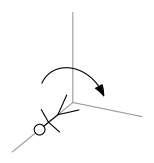
The images of the vectors from the domain’s basis
are represented with respect to the codomain’s basis (again, ) by themselves, so adjoining the representations to make the matrix gives this.
The picture is similar to the one in the prior answer. The images of the vectors from the domain’s basis
are represented with respect to the codomain’s basis by themselves, so this is the matrix.
To a person standing up, with the vertical -axis, a rotation of the -plane that is clockwise proceeds from the positive -axis to the positive -axis. That is, it rotates opposite to the direction in Example 1.10. The images of the vectors from the domain’s basis
are represented with respect to by themselves, so the matrix is this.
Three.III.1.35 §III.1 source ↗
(Schur’s Triangularization Lemma)
Let be a subspace of and fix bases . What is the relationship between the representation of a vector from with respect to and the representation of that vector (viewed as a member of ) with respect to ?
What about maps?
Fix a basis for and observe that the spans
form a strictly increasing chain of subspaces. Show that for any linear map there is a chain of subspaces of such that
for each .
Conclude that for every linear map there are bases so the matrix representing with respect to is upper-triangular (that is, each entry with is zero).
Is an upper-triangular representation unique?
Answer (5 parts)
Write the basis as and then write as the extension . If
so that then
because .
We must first decide what the question means. Compare with its restriction to the subspace . The range space of the restriction is a subspace of , so fix a basis for this range space and extend it to a basis for . We want the relationship between these two.
The answer falls right out of the prior item: if
then the extension is represented in this way.
Take to be the span of .
Apply the answer from the second item to the third item.
No. For instance , projection onto the axis, is represented by these two upper-triangular matrices
where .
Three.III.2.12 §III.2 source ↗
For each matrix, state the dimension of the domain and codomain of any map that the matrix represents.
Answer (5 parts)
domain: , codomain:
domain: , codomain:
domain: , codomain:
domain: , codomain:
domain: , codomain:
Three.III.2.13 §III.2 source ↗
Consider a linear map represented with respect to some bases by the matrix. Decide if that map is nonsingular.
Answer (5 parts)
For each we just have to decide if the matrix is nonsingular, perhaps by doing Gauss’s Method. (In truth, we can do each of these by eye.)
This matrix is nonsingular, since the second row is not a multiple of the first, so the map is nonsingular.
The matrix is singular so the map is singular.
Nonsingular.
Nonsingular.
Three.III.2.14 §III.2 source ↗
Let be the linear map defined by this matrix on the domain and codomain with respect to the given bases.
What is the image under of the vector ?
Answer
With respect to the vector’s representation is this.
Using the matrix-vector product we can compute
From that representation we can compute .
Three.III.2.15 §III.2 source ↗
Decide if each vector lies in the range of the map from to represented with respect to the standard bases by the matrix.
,
,
Answer (3 parts)
As described in the subsection, with respect to the standard bases, representations are transparent, and so, for instance, the first matrix describes this map.
So, for this first one, we are asking whether there are scalars such that
that is, whether the vector is in the column space of the matrix.
Yes. We can get this conclusion by setting up the resulting linear system and applying Gauss’s Method, as usual. Another way to get it is to note by inspection of the equation of columns that taking , and , and will do. Still a third way to get this conclusion is to note that the rank of the matrix is two, which equals the dimension of the codomain, and so the map is onto — the range is all of and in particular includes the given vector.
No; note that all of the columns in the matrix have a second component that is twice the first, while the vector does not. Alternatively, the column space of the matrix is
(which is the fact already noted, but we got it by calculation rather than inspiration), and the given vector is not in this set.
Three.III.2.16 §III.2 source ↗
Consider this matrix, representing a transformation of with respect to the bases.
To what vector in the codomain is the first member of mapped?
The second member?
Where is a general vector from the domain (a vector with components and ) mapped? That is, what transformation of is represented with respect to by this matrix?
Answer (3 parts)
The first member of the basis
maps to
which is this member of the codomain.
The second member of the basis maps
to this member of the codomain.
Because the map that the matrix represents is the identity map on the basis, it must be the identity on all members of the domain. We can come to the same conclusion in another way by considering
which maps to
which represents this member of .
Three.III.2.17 §III.2 source ↗
Consider a homomorphism represented with respect to the standard bases by this matrix.
Find the image under of each vector.
Answer (4 parts)
Since, with respect to the standard basis , a matrix is represented by itself, we just need to do the matrix-vector multiplication.
Three.III.2.18 §III.2 source ↗
What transformation of is represented with respect to and by this matrix?
Answer
A general member of the domain, represented with respect to the domain’s basis as
maps to
and so the linear map represented by the matrix with respect to these bases
is projection onto the first component.
Three.III.2.19 §III.2 source ↗
Decide whether is in the range of the map from to represented with respect to and by this matrix.
Answer
Denote the given basis of by . Application of the linear map is represented by matrix-vector multiplication. Thus the first vector in maps to the element of represented with respect to by
and that element is . Calculate the other two images of basis vectors in the same way.
So the range of is the span of three polynomials , , and . We can thus decide if is in the range of the map by looking for scalars , , and such that
and obviously , , and suffice. Thus is in the range, since it is the image of this vector.
Comment. A slicker argument is to note that the matrix is nonsingular, so it has rank , so the range has dimension , and since the codomain has dimension the map is onto. Thus every polynomial is the image of some vector and in particular is the image of a vector in the domain.
Three.III.2.20 §III.2 source ↗
Find the map that this matrix represents with respect to .
Answer
Where we can find by eye, where is the general vector, with entries and .
Thus the representation of general vector with respect to is this.
Compute the effect of the map with matrix-vector multiplication.
Finish by converting back to the standard vector representation.
Three.III.2.21 §III.2 source ↗
Example 2.11 gives a matrix that is singular and is therefore associated with maps that are singular. We cannot state the action of the associated map on domain elements , because do not know the domain or codomain or the starting and ending bases and . But we can compute what happens to the representations .
Find the set of column vectors representing the members of the null space of any map represented by this matrix.
Find the nullity of any such map .
Find the set of column vectors representing the members of the range space of any map represented by the matrix.
Find the rank of any such map .
Check that rank plus nullity equals the dimension of the domain.
Answer (6 parts)
Let the matrix be , and suppose that it represents with respect to bases and . Because has two columns, the domain is two-dimensional. Because has two rows, the codomain is two-dimensional. The action of on a representation of a general member of the domain is this.
No matter what is the codomain’s basis , the only representation of the zero vector is
and so the set of representations of members of the null space is this.
The nullity is . The representation map and its inverse are isomorphisms and so preserve the dimension of subspaces. The subspace of that is in the prior item is one-dimensional. Therefore, the image of that subspace under the inverse of the representation map — the null space of , is also one-dimensional.
The set of representations of members of the range space is this.
Of course, Theorem 2.4 gives that the rank of the map equals the rank of the matrix, which is one. Alternatively, the same argument that we used above for the null space gives here that the dimension of the range space is one.
One plus one equals two.
Three.III.2.22 §III.2 source ↗
Take each matrix to represent with respect to the standard bases. For each (i) state and . Then set up an augmented matrix with the given matrix on the left and a vector representing a range space element on the right (e.g., if the codomain is then in the right-hand column put the three entries , , and ). Perform Gauss-Jordan reduction. Use that to (ii) find and (and state whether the underlying map is onto), and (iii) find and (and state whether the underlying map is one-to-one).
Answer (3 parts)
(i) Where (with respect to the standard bases) the dimension of the domain space is the number of columns, , and the dimension of the codomain space is the number of rows, .
For the rest, we consider this matrix-vector equation.
We solve for and .
(ii) For all
in equation () the system has a solution, by the calculation. So the range space is all of the codomain . The map’s rank is the dimension of the range, . The map is onto because the range space is all of the codomain.
(iii) Again by the calculation, to find the nullspace, setting in equation () gives that . The null space is the trivial subspace of the domain.
The nullity is the dimension of that null space, . The map is one-to-one because the null space is trivial.
(i) The dimension of the domain space is the number of matrix columns, , and the dimension of the codomain space is the number of rows, .
The calculation is this.
(ii) There are codomain triples
for which the system does not have a solution, specifically the system only has a solution if .
The map’s rank is the range’s dimension, . The map is not onto because the range space is not all of the codomain.
(iii) Setting in the calculation gives infinitely many solutions. Parametrizing using the free variable leads to this description of the nullspace.
The nullity is the dimension of that null space, . The map is not one-to-one because the null space is not trivial.
(i) The domain has dimension while the codomain has dimension . Here is the calculation.
(ii) The range is this subspace of the codomain.
The rank is . The map is not onto.
(iii) The null space is the trivial subspace of the domain.
The nullity is . The map is one-to-one.
Three.III.2.23 §III.2 source ↗
Use the method from the prior exercise on this matrix.
Answer
Here is the Gauss-Jordan reduction.
(i) The dimensions are . (ii) The range space is the set containing all of the members of the codomain for which this system has a solution.
The rank is 2. Because the rank is less than the dimension of the codomain, the map is not onto.
(iii) The null space is the set of members of the domain that map to , , and .
The nullity is . Because the nullity is not the map is not one-to-one.
Three.III.2.24 §III.2 source ↗
Verify that the map represented by this matrix is an isomorphism.
Answer
For any map represented by this matrix, the domain and codomain are each of dimension . To show that the map is an isomorphism, we must show it is both onto and one-to-one. For that we don’t need to augment the matrix with , , and ; this calculation
gives that for each codomain vector there is one and only one associated domain vector.
Three.III.2.25 §III.2 source ↗
This is an alternative proof of Lemma 2.9. Given an matrix , fix a domain and codomain of appropriate dimension , and bases for those spaces, and consider the map represented by the matrix.
Show that is onto if and only if there is at least one associated by with each .
Show that is one-to-one if and only if there is at most one associated by with each .
Consider the linear system . Show that is nonsingular if and only if there is exactly one solution for each .
Answer (3 parts)
The defined map is onto if and only if for every there is a such that . Since for every vector there is exactly one representation, converting to representations gives that is onto if and only if for every representation there is a representation such that .
This is just like the prior part.
As described at the start of this subsection, by definition the map defined by the matrix associates this domain vector with this codomain vector .
Fix and consider the linear system defined by the above equation.
(Again, here the are fixed and the are unknowns.) Now, is nonsingular if and only if for all , …, this system has a solution and the solution is unique. By the first two parts of this exercise this is true if and only if the map is onto and one-to-one. This in turn is true if and only if is an isomorphism.
Three.III.2.26 §III.2 source ↗
Because the rank of a matrix equals the rank of any map it represents, if one matrix represents two different maps (where ) then the dimension of the range space of equals the dimension of the range space of . Must these equal-dimensional range spaces actually be the same?
Answer
No, the range spaces may differ. Example 2.3 shows this.
Three.III.2.27 §III.2 source ↗
Let be an -dimensional space with bases and . Consider a map that sends, for , the column vector representing with respect to to the column vector representing with respect to . Show that map is a linear transformation of .
Answer
Recall that the representation map
is an isomorphism. Thus, its inverse map is also an isomorphism. The desired transformation of is then this composition.
Because a composition of isomorphisms is also an isomorphism, this map is an isomorphism.
Three.III.2.28 §III.2 source ↗
Example 2.3 shows that changing the pair of bases can change the map that a matrix represents, even though the domain and codomain remain the same. Could the map ever not change? Is there a matrix , vector spaces and , and associated pairs of bases and (with or or both) such that the map represented by with respect to equals the map represented by with respect to ?
Answer
Yes. Consider
representing a map from to . With respect to the standard bases this matrix represents the identity map. With respect to
this matrix again represents the identity. In fact, as long as the starting and ending bases are equal — as long as — then the map represented by is the identity.
Three.III.2.29 §III.2 source ↗
A square matrix is a diagonal matrix if it is all zeroes except possibly for the entries on its upper-left to lower-right diagonal — its entry, its entry, etc. Show that a linear map is an isomorphism if there are bases such that, with respect to those bases, the map is represented by a diagonal matrix with no zeroes on the diagonal.
Answer
This is immediate from Lemma 2.9.
Three.III.2.30 §III.2 source ↗
Describe geometrically the action on of the map represented with respect to the standard bases by this matrix.
Do the same for these.
Answer
The first map
stretches vectors by a factor of three in the direction and by a factor of two in the direction. The second map
projects vectors onto the axis. The third
interchanges first and second components (that is, it is a reflection about the line ). The last
stretches vectors parallel to the axis, by an amount equal to three times their distance from that axis (this is a skew.)
Three.III.2.31 §III.2 source ↗
The fact that for any linear map the rank plus the nullity equals the dimension of the domain shows that a necessary condition for the existence of a homomorphism between two spaces, onto the second space, is that there be no gain in dimension. That is, where is onto, the dimension of must be less than or equal to the dimension of .
Show that this (strong) converse holds: no gain in dimension implies that there is a homomorphism and, further, any matrix with the correct size and correct rank represents such a map.
Are there bases for such that this matrix
represents a map from to whose range is the plane subspace of ?
Answer (2 parts)
This is immediate from Theorem 2.4.
Yes. This is immediate from the prior item.
To give a specific example, we can start with as the basis for the domain, and then we require a basis for the codomain . The matrix gives the action of the map as this
and there is no harm in finding a basis so that
that is, so that the map represented by with respect to is projection down onto the plane. The second condition gives that the third member of is . The first condition gives that the first member of plus twice the second equals , and so this basis will do.
Three.III.2.32 §III.2 source ↗
Let be an -dimensional space and suppose that . Fix a basis for and consider the map given by the dot product.
Show that this map is linear.
Show that for any linear map there is an such that .
In the prior item we fixed the basis and varied the to get all possible linear maps. Can we get all possible linear maps by fixing an and varying the basis?
Answer (3 parts)
Recall that the representation map is linear (it is actually an isomorphism, but we do not need that it is one-to-one or onto here). Considering the column vector to be a matrix gives that the map from to that takes a column vector to its dot product with is linear (this is a matrix-vector product and so Theorem 2.2 applies). Thus the map under consideration is linear because it is the composition of two linear maps.
Any linear map is represented by some matrix
(the matrix has columns because is -dimensional and it has only one row because is one-dimensional). Then taking to be the column vector that is the transpose of this matrix
has the desired action.
No. If has any nonzero entries then cannot be the zero map (and if is the zero vector then can only be the zero map).
Three.III.2.33 §III.2 source ↗
Let be vector spaces with bases .
Suppose that is represented with respect to by the matrix . Give the matrix representing the scalar multiple (where ) with respect to by expressing it in terms of .
Suppose that are represented with respect to by and . Give the matrix representing with respect to by expressing it in terms of and .
Suppose that is represented with respect to by and is represented with respect to by . Give the matrix representing with respect to by expressing it in terms of and .
Answer
See the following section.
Three.IV.1.8 §IV.1 source ↗
Perform the indicated operations, if defined, or state “not defined.”
Answer (5 parts)
Not defined.
Three.IV.1.9 §IV.1 source ↗
Give the matrix representing the zero map from to , with respect to the standard bases.
Answer
The bases don’t matter. The only thing that matters is getting the dimensions right.
Three.IV.1.10 §IV.1 source ↗
Prove Theorem 1.4.
Prove that matrix addition represents addition of linear maps.
Prove that matrix scalar multiplication represents scalar multiplication of linear maps.
Answer (3 parts)
Represent the domain vector and the maps with respect to bases in the usual way.
The representation of
regroups
to the entry-by-entry sum of the representation of and the representation of .
The representation of
is the entry-by-entry multiple of and the representation of .
Three.IV.1.11 §IV.1 source ↗
Prove each, assuming that the operations are defined, where , , and are matrices, where is the zero matrix, and where and are scalars.
Matrix addition is commutative .
Matrix addition is associative .
The zero matrix is an additive identity .
Matrices have an additive inverse .
Answer (9 parts)
First, each of these properties is easy to check in an entry-by-entry way. For example, writing
then, by definition we have
and
and the two are equal since their entries are equal . That is, each of these is easy to check by using Definition 1.3 alone.
However, each property is also easy to understand in terms of the represented maps, by applying Theorem 1.4 as well as the definition.
The two maps and are equal because , as addition is commutative in any vector space. Because the maps are the same, they must have the same representative.
As with the prior answer, except that here we apply that vector space addition is associative.
As before, except that here we note that .
Apply that .
Apply that .
Apply the prior two items with and .
Apply that .
Apply that .
Three.IV.1.12 §IV.1 source ↗
Fix domain and codomain spaces. In general, one matrix can represent many different maps with respect to different bases. However, prove that a zero matrix represents only a zero map. Are there other such matrices?
Answer
For any with bases , the (appropriately-sized) zero matrix represents this map.
This is the zero map.
There are no other matrices that represent only one map. For, suppose that is not the zero matrix. Then it has a nonzero entry; assume that . With respect to bases , it represents sending
and with respect to it also represents sending
(the notation means to double all of the members of D). These maps are easily seen to be unequal.
Three.IV.1.13 §IV.1 source ↗
Let and be vector spaces of dimensions and . Show that the space of linear maps from to is isomorphic to .
Answer
Fix bases and for and , and consider associating each linear map with the matrix representing that map . From the prior section we know that (under fixed bases) the matrices correspond to linear maps, so the representation map is one-to-one and onto. That it preserves linear operations is Theorem 1.4.
Three.IV.1.14 §IV.1 source ↗
Show that it follows from the prior question that for any six transformations there are scalars such that not every equals but is the zero map. (Hint: the six is slightly misleading.)
Answer
Fix bases and represent the transformations with matrices. The space of matrices has dimension four, and hence any six-element set is linearly dependent. By the prior exercise that extends to a dependence of maps. (The misleading part is only that there are six transformations, not five, so that we have more than we need to give the existence of the dependence.)
Three.IV.1.15 §IV.1 source ↗
The trace of a square matrix is the sum of the entries on the main diagonal (the entry plus the entry, etc.; we will see the significance of the trace in Chapter Five). Show that . Is there a similar result for scalar multiplication?
Answer
That the trace of a sum is the sum of the traces holds because both and are the sum of with , etc. For scalar multiplication we have ; the proof is easy. Thus the trace map is a homomorphism from to .
Three.IV.1.16 §IV.1 source ↗
Recall that the transpose of a matrix is another matrix, whose entry is the entry of . Verify these identities.
Answer (2 parts)
The entry of is . That is also the entry of .
The entry of is , which is also the entry of .
Three.IV.1.17 §IV.1 source ↗
A square matrix is symmetric if each entry equals the entry, that is, if the matrix equals its transpose.
Prove that for any square , the matrix is symmetric. Does every symmetric matrix have this form?
Prove that the set of symmetric matrices is a subspace of .
Answer (2 parts)
For , the entry is and the entry of is . The two are equal and thus is symmetric.
Every symmetric matrix does have that form, since we can write .
The set of symmetric matrices is nonempty as it contains the zero matrix. Clearly a scalar multiple of a symmetric matrix is symmetric. A sum of two symmetric matrices is symmetric because (since and ). Thus the subset is nonempty and closed under the inherited operations, and so it is a subspace.
Three.IV.1.18 §IV.1 source ↗
How does matrix rank interact with scalar multiplication — can a scalar product of a rank matrix have rank less than ? Greater?
How does matrix rank interact with matrix addition — can a sum of rank matrices have rank less than ? Greater?
Answer (2 parts)
Scalar multiplication leaves the rank of a matrix unchanged except that multiplication by zero leaves the matrix with rank zero. (This follows from the first theorem of the book, that multiplying a row by a nonzero scalar doesn’t change the solution set of the associated linear system.)
A sum of rank matrices can have rank less than . For instance, for any matrix , the sum has rank zero.
A sum of rank matrices can have rank greater than . Here are rank one matrices that sum to a rank two matrix.
Three.IV.2.14 §IV.2 source ↗
Compute, or state “not defined”.
Answer (4 parts)
Not defined.
Three.IV.2.15 §IV.2 source ↗
Where
compute or state “not defined.”
Answer (4 parts)
Three.IV.2.16 §IV.2 source ↗
Which products are defined?
times
times
times
times
Answer (4 parts)
Yes.
Yes.
No.
No.
Three.IV.2.17 §IV.2 source ↗
Give the size of the product or state “not defined”.
a matrix times a matrix
a matrix times a matrix
a matrix times a matrix
a matrix times a matrix
Answer (4 parts)
Not defined.
Three.IV.2.18 §IV.2 source ↗
Find the system of equations resulting from starting with
and making this change of variable (i.e., substitution).
Answer
We have
which, after expanding and regrouping about the ’s yields this.
We can express the starting system and the system used for the substitutions in matrix language, as
and
and with this, the substitution is .
Three.IV.2.19 §IV.2 source ↗
Consider the two linear functions and given as here.
Use these bases for the spaces.
Give the formula for the composition map derived directly from the above definition.
Represent and with respect to the appropriate bases.
Represent the map computed in the first part with respect to the appropriate bases.
Check that the product of the two matrices from the second part is the matrix from the third part.
Answer (4 parts)
Following the definitions gives this.
Because
we get this representation for .
Similarly, because
this is the representation of .
The action of on the domain basis is this.
We have this.
The matrix multiplication is routine, just take care with the order.
Three.IV.2.20 §IV.2 source ↗
As Definition 2.3 points out, the matrix product operation generalizes the dot product. Is the dot product of a row vector and a column vector the same as their matrix-multiplicative product?
Answer
Technically, no. The dot product operation yields a scalar while the matrix product yields a matrix. However, we usually will ignore the distinction.
Three.IV.2.21 §IV.2 source ↗
Represent the derivative map on with respect to where is the natural basis . Show that the product of this matrix with itself is defined; what map does it represent?
Answer
The action of on is , , , … and so this is its matrix representation.
The product of this matrix with itself is defined because the matrix is square.
The map so represented is the composition
which is the second derivative operation.
Three.IV.2.22 §IV.2 source ↗
[Cleary] Match each type of matrix with all these descriptions that could fit, say ‘None’ if it applies: (i) can be multiplied by its transpose to make a matrix, (ii) can represent a linear map from to that is not onto, (iii) can represent an isomorphism from to .
a matrix whose rank is
a matrix that is nonsingular
a matrix that is singular
an column vector
Answer (4 parts)
ii
iii
None
None, or (i) if we include multiplication from the left.
Three.IV.2.23 §IV.2 source ↗
Matrix multiplication is associative, . But computing them may take different times. Let be , be , and be . How many multiplications does take? ?
Answer
The matrix is , and each entry takes multiplications, for a total of . The matrix is and each entry needs multiplications, so that is . Overall there are .
For the other calculation, the matrix is and each entry takes products, for a total of . Then is and each entry uses products, for a total of . Overall here, there are products.
Three.IV.2.24 §IV.2 source ↗
Show that composition of linear transformations on is commutative. Is this true for any one-dimensional space?
Answer
It is true for all one-dimensional spaces. Let and be transformations of a one-dimensional space. We must show that for all vectors. Fix a basis for the space and then the transformations are represented by matrices.
Therefore, the compositions can be represented as and .
These two matrices are equal and so the compositions have the same effect on each vector in the space.
Three.IV.2.25 §IV.2 source ↗
Why is matrix multiplication not defined as entry-wise multiplication? That would be easier, and commutative too.
Answer
It would not represent linear map composition; Theorem 2.7 would fail.
Three.IV.2.26 §IV.2 source ↗
Prove that and for positive integers .
Prove that for any positive integer and scalar .
Answer
Each follows easily from the associated map fact. For instance, applications of the transformation , following applications, is simply applications.
Three.IV.2.27 §IV.2 source ↗
How does matrix multiplication interact with scalar multiplication: is ? Is ?
How does matrix multiplication interact with linear combinations: is ? Is ?
Answer (3 parts)
Although we can do these by going through the indices, they are best understood in terms of the represented maps. That is, fix spaces and bases so that the matrices represent linear maps .
Yes; we have both and (the second equality holds because of the linearity of ).
Both answers are yes. First, and both send to ; the calculation is as in the prior item (using the linearity of for the first one). For the other, and both send to .
Three.IV.2.28 §IV.2 source ↗
We can ask how the matrix product operation interacts with the transpose operation.
Show that .
A square matrix is symmetric if each entry equals the entry, that is, if the matrix equals its own transpose. Show that the matrices and are symmetric.
Answer (3 parts)
We have not seen a map interpretation of the transpose operation, so we will verify these by considering the entries.
The entry of is the entry of , which is the dot product of the -th row of and the -th column of . The entry of is the dot product of the -th row of and the -th column of , which is the dot product of the -th column of and the -th row of . Dot product is commutative and so these two are equal.
By the prior item each equals its transpose, e.g., .
Three.IV.2.29 §IV.2 source ↗
Rotation of vectors in about an axis is a linear map. Show that linear maps do not commute by showing geometrically that rotations do not commute.
Answer
Consider rotating all vectors radians counterclockwise about the and axes (counterclockwise in the sense that a person whose head is at or and whose feet are at the origin sees, when looking toward the origin, the rotation as counterclockwise).
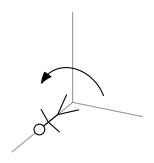
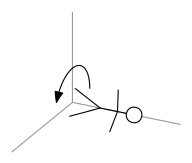
Rotating first and then is different than rotating first and then . In particular, so , while so , and hence the maps do not commute.
Three.IV.2.30 §IV.2 source ↗
In the proof of Theorem 2.12 we used some maps. What are the domains and codomains?
Answer
It doesn’t matter (as long as the spaces have the appropriate dimensions).
For associativity, suppose that is , that is , and that is . We can take any dimensional space, any dimensional space, any dimensional space, and any dimensional space — for instance, , , , and will do. We can take any bases , , , and , for those spaces. Then, with respect to the matrix represents a linear map , with respect to the matrix represents a , and with respect to the matrix represents an . We can use those maps in the proof.
The second half is similar, except that we add and and so we must take them to represent maps with the same domain and codomain.
Three.IV.2.31 §IV.2 source ↗
How does matrix rank interact with matrix multiplication?
Can the product of rank matrices have rank less than ? Greater?
Show that the rank of the product of two matrices is less than or equal to the minimum of the rank of each factor.
Answer (2 parts)
The product of rank matrices can have rank less than or equal to but not greater than .
To see that the rank can fall, consider the maps projecting onto the axes. Each is rank one but their composition , which is the zero map, is rank zero. That translates over to matrices representing those maps in this way.
To prove that the product of rank matrices cannot have rank greater than , we can apply the map result that the image of a linearly dependent set is linearly dependent. That is, if and both have rank then a set in the range of size larger than is the image under of a set in of size larger than and so is linearly dependent (since the rank of is ). Now, the image of a linearly dependent set is dependent, so any set of size larger than in the range is dependent. (By the way, observe that the rank of was not mentioned. See the next part.)
Fix spaces and bases and consider the associated linear maps and . Recall that the dimension of the image of a map (the map’s rank) is less than or equal to the dimension of the domain, and consider the arrow diagram.
First, the image of must have dimension less than or equal to the dimension of , by the prior sentence. On the other hand, is a subset of the domain of , and thus its image has dimension less than or equal the dimension of the domain of . Combining those two, the rank of a composition is less than or equal to the minimum of the two ranks.
The matrix fact follows immediately.
Three.IV.2.32 §IV.2 source ↗
Is ‘commutes with’ an equivalence relation among matrices?
Answer
The ‘commutes with’ relation is reflexive and symmetric. However, it is not transitive: for instance, with
commutes with and commutes with , but does not commute with .
Three.IV.2.33 §IV.2 source ↗
(We will use this exercise in the Matrix Inverses exercises.) Here is another property of matrix multiplication that might be puzzling at first sight.
Prove that the composition of the projections onto the and axes is the zero map despite that neither one is itself the zero map.
Prove that the composition of the derivatives is the zero map despite that neither is the zero map.
Give a matrix equation representing the first fact.
Give a matrix equation representing the second.
When two things multiply to give zero despite that neither is zero we say that each is a zero divisor.
Answer (4 parts)
Either of these.
The composition is the fifth derivative map on the space of fourth-degree polynomials.
With respect to the natural bases,
and their product (in either order) is the zero matrix.
Where ,
and their product (in either order) is the zero matrix.
Three.IV.2.34 §IV.2 source ↗
Show that, for square matrices, need not equal .
Answer
Note that , so a reasonable try is to look at matrices that do not commute so that and don’t cancel: with
we have the desired inequality.
Three.IV.2.35 §IV.2 source ↗
Represent the identity transformation with respect to for any basis . This is the identity matrix . Show that this matrix plays the role in matrix multiplication that the number plays in real number multiplication: (for all matrices for which the product is defined).
Answer
Because the identity map acts on the basis as , …, , the representation is this.
The second part of the question is obvious from Theorem 2.7.
Three.IV.2.36 §IV.2 source ↗
Prove that for any matrix there are scalars that are not all such that the combination is the zero matrix (where is the identity matrix, with ’s in its and entries and zeroes elsewhere; see Exercise 2.35).
Let be a polynomial . If is a square matrix we define to be the matrix (where is the appropriately-sized identity matrix). Prove that for any square matrix there is a polynomial such that is the zero matrix.
The minimal polynomial of a square matrix is the polynomial of least degree, and with leading coefficient , such that is the zero matrix. Find the minimal polynomial of this matrix.
(This is the representation with respect to , the standard basis, of a rotation through radians counterclockwise.)
Answer (3 parts)
The vector space has dimension four. The set has five elements and thus is linearly dependent.
Where is , generalizing the argument from the prior item shows that there is such a polynomial of degree or less, since is a -member subset of the -dimensional space .
First compute the powers
(observe that rotating by three times results in a rotation by , which is indeed what represents). Then set equal to the zero matrix
to get this linear system.
Apply Gaussian reduction.
Setting , , and to zero makes and also come out to be zero so no degree one or degree zero polynomial will do. Setting and to zero (and to one) gives a linear system
with solution and . Conclusion: the polynomial is minimal for the matrix .
Three.IV.2.37 §IV.2 source ↗
The infinite-dimensional space of all finite-degree polynomials gives a memorable example of the non-commutativity of linear maps. Let be the usual derivative and let be the shift map.
Show that the two maps don’t commute ; in fact, not only is not the zero map, it is the identity map.
Answer
The check is routine:
while
so that under the map we have .
Three.IV.2.38 §IV.2 source ↗
Recall the notation for the sum of the sequence of numbers .
In this notation, the entry of the product of and is this.
Using this notation,
reprove that matrix multiplication is associative;
reprove Theorem 2.7.
Answer (2 parts)
Tracing through the remark at the end of the subsection gives that the entry of is this
(the first equality comes from using the distributive law to multiply through the ’s, the second equality is the associative law for real numbers, the third is the commutative law for reals, and the fourth equality follows on using the distributive law to factor the ’s out), which is the entry of .
The -th component of is
and so the -th component of is this
(the first equality holds by using the distributive law to multiply the ’s through, the second equality represents the use of associativity of reals, the third follows by commutativity of reals, and the fourth comes from using the distributive law to factor the ’s out).
Three.IV.3.24 §IV.3 source ↗
Predict the result of each product with a permutation matrix and then check by multiplying it out.
Answer (3 parts)
Acting from the left, the matrix swaps the first and second rows.
Acting from the right, swaps the first and second columns.
From the left, swaps the second and third rows.
Three.IV.3.25 §IV.3 source ↗
Predict the result of each multiplication by an elementary reduction matrix, and then check by multiplying it out.
Answer (5 parts)
The second matrix has its first row multiplied by .
The second matrix has its second row multiplied by .
The second matrix undergoes the combination operation of replacing the second row with times the first row added to the second.
The first matrix undergoes the column operation of: replace the second column by times the first column plus the second.
The first matrix has its columns swapped.
Three.IV.3.26 §IV.3 source ↗
Predict the result of each multiplication by a diagonal matrix, and then check by multiplying it out.
Answer (2 parts)
The second matrix has its first row multiplied by and its second row multiplied by .
The second matrix has its first row multiplied by and its second row multiplied by .
Three.IV.3.27 §IV.3 source ↗
Produce each.
a matrix that, acting from the left, swaps rows one and two
a matrix that, acting from the right, swaps column one and two
Answer (2 parts)
This matrix swaps row one and row three.
This matrix swaps column one and two.
Three.IV.3.28 §IV.3 source ↗
Show how to use matrix multiplication to bring this matrix to echelon form.
Answer
Multiply by , then by , and then by , paying attention to the right-to-left order.
Three.IV.3.29 §IV.3 source ↗
Find the product of this matrix with its transpose.
Answer
The product is the identity matrix (recall that ). An explanation is that the given matrix represents, with respect to the standard bases, a rotation in of radians while the transpose represents a rotation of radians. The two cancel.
Three.IV.3.30 §IV.3 source ↗
The need to take linear combinations of rows and columns in tables of numbers arises often in practice. For instance, this is a map of part of Vermont and New York.
In part because of Lake Champlain, there are no roads directly connecting some pairs of towns. For instance, there is no way to go from Winooski to Grand Isle without going through Colchester. (To simplify the graph many other roads and towns have been omitted. From top to bottom of this map is about forty miles.)
The adjacency matrix of a map is the square matrix whose entry is the number of roads from city to city (all entries are ). Produce the adjacency matrix of this map, taking the cities in alphabetical order.
A matrix is symmetric if it equals its transpose. Show that an adjacency matrix is symmetric. (These are all two-way streets. Vermont doesn’t have many one-way streets.)
What is the significance of the square of the adjacency matrix? The cube?
Answer (3 parts)
The adjacency matrix is this (e.g, the first row shows that there is only one connection including Burlington, the road to Winooski).
Because these are two-way roads, any road connecting city to city gives a connection between city and city .
The square of the adjacency matrix tells how cities are connected by trips involving two roads.
Three.IV.3.31 §IV.3 source ↗
Remark. As with the prior exercise, this illustrates that in practice we often want to compute linear combinations of rows and columns in a context where we really aren’t interested in any associated linear maps. The table below gives the number of hours of each type done by each worker and the associated pay rates. Use matrices to compute the wages due.
| regular | overtime | |
| Alan | 40 | 12 |
| Betty | 35 | 6 |
| Catherine | 40 | 18 |
| Donald | 28 | 0 |
| wage | |
| regular | |
| overtime |
Answer
The pay due each person appears in the matrix product of the two arrays.
Three.IV.3.32 §IV.3 source ↗
Express this nonsingular matrix as a product of elementary reduction matrices.
Answer
The Gauss-Jordan reduction is routine.
Thus we know elementary reduction matrices such that . Move the matrices to the other side, paying attention to order. For instance, first multiply both sides from the left by to get , which simplifies to , etc.
Taking the inverse of an elementary reduction matrix is easy. For instance, to undo adding times row to row , you should take times row and add it to row . With that, Lemma 3.20 says that .
Three.IV.3.33 §IV.3 source ↗
Express
as the product of two elementary reduction matrices.
Answer
One way to produce this matrix from the identity is to use the column operations of first multiplying the second column by three, and then adding the negative of the resulting second column to the first.
In contrast with row operations, column operations are written from left to right, so this matrix product expresses doing the above two operations.
Remark. Alternatively, we could get the required matrix with row operations. Starting with the identity, first adding the negative of the first row to the second, and then multiplying the second row by three will work. Because we write successive row operations as matrix products from right to left, doing these two row operations is expressed with: the same matrix product.
Three.IV.3.34 §IV.3 source ↗
Prove that the diagonal matrices form a subspace of . What is its dimension?
Answer
The set of diagonal matrices is nonempty as the zero matrix is diagonal. Clearly it is closed under scalar multiples and sums. Therefore it is a subspace. The dimension is ; here is a basis.
Three.IV.3.35 §IV.3 source ↗
Does the identity matrix represent the identity map if the bases are unequal?
Answer
No. In , with respect to the unequal bases and , the identity transformation is represented by this matrix.
Three.IV.3.36 §IV.3 source ↗
Show that every multiple of the identity commutes with every square matrix. Are there other matrices that commute with all square matrices?
Answer
For any scalar and square matrix we have .
There are no other such matrices; here is an argument for matrices that is easily extended to . If a matrix commutes with all others then it commutes with this unit matrix.
From this we first conclude that the upper left entry must equal its lower right entry . We also conclude that the lower left entry is zero. The argument for the upper right entry is similar.
Three.IV.3.37 §IV.3 source ↗
Prove or disprove: nonsingular matrices commute.
Answer
It is false; these two don’t commute.
Three.IV.3.38 §IV.3 source ↗
Show that the product of a permutation matrix and its transpose is an identity matrix.
Answer
A permutation matrix has a single one in each row and column, and all its other entries are zeroes. Fix such a matrix. Suppose that the -th row has its one in its -th column. Then no other row has its one in the -th column; every other row has a zero in the -th column. Thus the dot product of the -th row and any other row is zero.
The -th row of the product is made up of the dot products of the -th row of the matrix and the columns of the transpose. By the last paragraph, all such dot products are zero except for the -th one, which is one.
Three.IV.3.39 §IV.3 source ↗
Show that if the first and second rows of are equal then so are the first and second rows of . Generalize.
Answer
The generalization is to go from the first and second rows to the -th and -th rows. Row of is made up of the dot products of row of and the columns of . Thus if rows and of are equal then so are rows and of .
Three.IV.3.40 §IV.3 source ↗
Describe the product of two diagonal matrices.
Answer
If the product of two diagonal matrices is defined — if both are — then the product of the diagonals is the diagonal of the products: where are equal-sized diagonal matrices, is all zeros except each that entry is .
Three.IV.3.41 §IV.3 source ↗
Show that if has a row of zeros then (if defined) has a row of zeros. Does the analogous thing happen with columns?
Answer
The -th row of is made up o f the dot products of the -th row of with the columns of . The dot product of a zero row with a column is zero.
It does happen with columns, if stated correctly: if has a column of zeros then (if defined) has a column of zeros. The proof is easy.
Three.IV.3.42 §IV.3 source ↗
Show that the set of unit matrices forms a basis for .
Answer
Perhaps the easiest way is to show that each matrix is a linear combination of unit matrices in one and only one way:
has the unique solution , , etc.
Three.IV.3.43 §IV.3 source ↗
Find the formula for the -th power of this matrix.
Answer
Call that matrix . We have
In general,
where is the -th Fibonacci number and , , which we verify by induction, based on this equation.
Three.IV.3.44 §IV.3 source ↗
The trace of a square matrix is the sum of the entries on its diagonal (its significance appears in Chapter Five). Show that .
Answer
Chapter Five gives a less computational reason — the trace of a matrix is the second coefficient in its characteristic polynomial — but for now we can use indices. We have
while
and the two are equal.
Three.IV.3.45 §IV.3 source ↗
A square matrix is upper triangular if its only nonzero entries lie above, or on, the diagonal. Show that the product of two upper triangular matrices is upper triangular. Does this hold for lower triangular also?
Answer
A matrix is upper triangular if and only if its entry is zero whenever . Thus, if are upper triangular then and are zero when . An entry in the product is zero unless at least some of the terms are nonzero, that is, unless for at least some of the summands both and . Of course, if this cannot happen and so the product of two upper triangular matrices is upper triangular. (A similar argument works for lower triangular matrices.)
Three.IV.3.46 §IV.3 source ↗
A square matrix is a Markov matrix if each entry is between zero and one and the sum along each row is one. Prove that a product of Markov matrices is Markov.
Answer
The sum along the -th row of the product is this.
Three.IV.3.47 §IV.3 source ↗
Give an example of two matrices of the same rank and size with squares of differing rank.
Answer
Fix a basis . Matrices representing the maps that send
and
will do. For instance, if for we use the standard basis then the two above give these matrices.
Notice that has rank while has rank .
Three.IV.3.48 §IV.3 source ↗
Matrix multiplication is performed often on computers. Researchers trying to understand its performance, and improve on it, count the number of operations that it takes.
Definition 2.3 gives . How many real number multiplications are in that expression? Using it, how many do we need for the product of a matrix and a matrix?
Matrix multiplication is associative, so in computing we can expect to get the same answer no matter where we put the parentheses. The cost in number of multiplications, however, varies. Find the association requiring the fewest real number multiplications to compute the matrix product of a matrix, a matrix, a matrix, and a matrix. Use the same formula as in the prior part.
(Very hard.) Find a way to multiply two matrices using only seven multiplications instead of the eight suggested by the prior approach.
Answer (3 parts)
Each entry takes multiplications and there are entries. Thus there are multiplications.
Let be , let be , let be , let be . Then
| this association | uses this many multiplications |
shows which is cheapest.
This is an improvement by S. Winograd of a formula due to V. Strassen: let and then
where , and , and , and . This takes seven multiplications and fifteen additions (save the intermediate results).
Three.IV.3.49 §IV.3 source ↗
[Putnam, 1990, A-5] If and are square matrices of the same size such that , does it follow that ?
Answer
This is how the answer was given in the cited source. No, it does not. Let and represent, with respect to the standard bases, these transformations of .
Observe that
Three.IV.3.50 §IV.3 source ↗
[Am. Math. Mon., Dec. 1966] Demonstrate these four assertions to get an alternate proof that column rank equals row rank.
iff .
iff .
.
.
Answer (5 parts)
This is how the answer was given in the cited source.
Obvious.
If then where . Hence by (a).
The converse is obvious.
By (b), ,…, are linearly independent iff ,…, are linearly independent.
We have
Thus also and so .
Three.IV.3.51 §IV.3 source ↗
[Ackerson] Prove (where is an matrix and so defines a transformation of any -dimensional space with respect to where is a basis) that . Conclude
iff ;
iff ;
iff and ;
iff ;
(Requires the Direct Sum subsection, which is optional.) iff .
Answer
This is how the answer was given in the cited source. Let be a basis for ( might be ). Let be such that . Note is linearly independent, and extend to a basis for : where .
Now take . Write
and so
But , so and we now know
spans .
To see is linearly independent, write
and, since we get a contradiction unless it is (clearly it is in , but is a basis for ).
Hence .
Three.IV.4.12 §IV.4 source ↗
Supply the intermediate steps in Example 4.9.
Answer
Here is one way to proceed. Follow
with
and read the answer off of the right side.
Three.IV.4.13 §IV.4 source ↗
Use Corollary 4.11 to decide if each matrix has an inverse.
Answer (3 parts)
Yes, it has an inverse: .
Yes.
No.
Three.IV.4.14 §IV.4 source ↗
For each invertible matrix in the prior problem, use Corollary 4.11 to find its inverse.
Answer (3 parts)
The prior question shows that no inverse exists.
Three.IV.4.15 §IV.4 source ↗
Find the inverse, if it exists, by using the Gauss-Jordan Method. Check the answers for the matrices with Corollary 4.11.
Answer (6 parts)
The reduction is routine.
This answer agrees with the answer from the check.
This reduction is easy.
The check agrees.
Trying the Gauss-Jordan reduction
shows that the left side won’t reduce to the identity, so no inverse exists. The check agrees.
This produces an inverse.
This is one way to do the reduction.
There is no inverse.
As a check, note that the third column of the starting matrix is times the second, and so it is indeed singular and therefore has no inverse.
Three.IV.4.16 §IV.4 source ↗
What matrix has this one for its inverse?
Answer
We can use Corollary 4.11.
Three.IV.4.17 §IV.4 source ↗
How does the inverse operation interact with scalar multiplication and addition of matrices?
What is the inverse of ?
Is ?
Answer (2 parts)
The proof that the inverse is (provided, of course, that the matrix is invertible) is easy.
No. For one thing, the fact that has an inverse doesn’t imply that has an inverse or that has an inverse. Neither of these matrices is invertible but their sum is.
Another point is that just because and each has an inverse doesn’t mean has an inverse; here is an example.
Still a third point is that, even if the two matrices have inverses, and the sum has an inverse, doesn’t imply that the equation holds:
but
and does not equal .
Three.IV.4.18 §IV.4 source ↗
Is ?
Answer
Yes: .
Three.IV.4.19 §IV.4 source ↗
Is invertible?
Answer
Yes, the inverse of is .
Three.IV.4.20 §IV.4 source ↗
For each real number let be represented with respect to the standard bases by this matrix.
Show that . Show also that .
Answer
One way to check that the first is true is with the angle sum formulas from trigonometry.
Checking the second equation in this way is similar.
Of course, the equations can be not just checked but also understood by recalling that is the map that rotates vectors about the origin through an angle of radians.
Three.IV.4.21 §IV.4 source ↗
Do the calculations for the proof of Corollary 4.11.
Answer
There are two cases. For the first case we assume that is nonzero. Then
shows that the matrix is invertible (in this case) if and only if . To find the inverse, we finish with the Jordan half of the reduction.
The other case is the case. We swap to get into the position.
This matrix is nonsingular if and only if both and are nonzero (which, under the case assumption that , holds if and only if ). To find the inverse we do the Jordan half.
(Note that this is what is required, since gives that ).
Three.IV.4.22 §IV.4 source ↗
Show that this matrix
has infinitely many right inverses. Show also that it has no left inverse.
Answer
With a matrix, in looking for a matrix such that the combination acts as the identity we need to be . Setting up the equation
and solving the resulting linear system
gives infinitely many solutions.
Thus has infinitely many right inverses.
As for left inverses, the equation
gives rise to a linear system with nine equations and four unknowns.
This system is inconsistent (the first equation conflicts with the third, as do the seventh and ninth) and so there is no left inverse.
Three.IV.4.23 §IV.4 source ↗
In the review of inverses example, starting this subsection, how many left inverses has ?
Answer
With respect to the standard bases we have
and setting up the equation to find the matrix inverse
gives rise to a linear system.
There are infinitely many solutions in to this system because two of these variables are entirely unrestricted
and so there are infinitely many solutions to the matrix equation.
With the bases still fixed at , for instance taking and gives a matrix representing this map.
The check that is the identity map on is easy.
Three.IV.4.24 §IV.4 source ↗
If a matrix has infinitely many right-inverses, can it have infinitely many left-inverses? Must it have?
Answer
By Lemma 4.2 it cannot have infinitely many left inverses, because a matrix with both left and right inverses has only one of each (and that one of each is one of both — the left and right inverse matrices are equal).
Three.IV.4.25 §IV.4 source ↗
Assume that is linear. One of these is true, the other is false. Which is which?
If is a left inverse of then must be linear.
If is a right inverse of then must be linear.
Answer (2 parts)
True, It must be linear, as the proof from Theorem II.2.20 shows.
False. It may be linear, but it need not be. Consider the projection map described at the start of this subsection. Define in this way.
It is a right inverse of because does this.
It is not linear because it does not map the zero vector to the zero vector.
Three.IV.4.26 §IV.4 source ↗
Assume that is invertible and that is the zero matrix. Show that is a zero matrix.
Answer
The associativity of matrix multiplication gives and also .
Three.IV.4.27 §IV.4 source ↗
Prove that if is invertible then the inverse commutes with a matrix if and only if itself commutes with that matrix .
Answer
Multiply both sides of the first equation by .
Three.IV.4.28 §IV.4 source ↗
Show that if is square and if is the zero matrix then . Generalize.
Answer
Checking that when is multiplied on both sides by that expression (assuming that is the zero matrix) then the result is the identity matrix is easy. The obvious generalization is that if is the zero matrix then ; the check again is easy.
Three.IV.4.29 §IV.4 source ↗
Let be diagonal. Describe , , … , etc. Describe , , … , etc. Define appropriately.
Answer
The powers of the matrix are formed by taking the powers of the diagonal entries. That is, is all zeros except for diagonal entries of , , etc. This suggests defining to be the identity matrix.
Three.IV.4.30 §IV.4 source ↗
Prove that any matrix row-equivalent to an invertible matrix is also invertible.
Answer
Assume that is row equivalent to and that is invertible. Because they are row-equivalent, there is a sequence of row steps to reduce one to the other. We can do that reduction with matrices, for instance, can change by row operations to as . This equation gives as a product of invertible matrices and by Lemma 4.4 then, is also invertible.
Three.IV.4.31 §IV.4 source ↗
The first question below appeared as Exercise 2.31.
Show that the rank of the product of two matrices is less than or equal to the minimum of the rank of each.
Show that if and are square then if and only if .
Answer (2 parts)
See the answer to Exercise 2.31.
We will show that both conditions are equivalent to the condition that the two matrices be nonsingular.
As and are square and their product is defined, they are equal-sized, say . Consider the half. By the prior item the rank of is less than or equal to the minimum of the rank of and the rank of . But the rank of is , so the rank of and the rank of must each be . Hence each is nonsingular.
The same argument shows that implies that each is nonsingular.
Three.IV.4.32 §IV.4 source ↗
Show that the inverse of a permutation matrix is its transpose.
Answer
Inverses are unique, so we need only show that it works. The check appears above as Exercise 3.38.
Three.IV.4.33 §IV.4 source ↗
Show that .
A square matrix is symmetric if each entry equals the entry (that is, if the matrix equals its transpose). Show that the matrices and are symmetric.
Show that the inverse of the transpose is the transpose of the inverse.
Show that the inverse of a symmetric matrix is symmetric.
Answer (4 parts)
See the answer for Exercise 2.28.
See the answer for Exercise 2.28.
Apply the first part to to get .
Apply the prior item with , as is symmetric.
Three.IV.4.34 §IV.4 source ↗
Prove that the composition of the projections is the zero map despite that neither is the zero map.
Prove that the composition of the derivatives is the zero map despite that neither map is the zero map.
Give matrix equations representing each of the prior two items.
When two things multiply to give zero despite that neither is zero, each is said to be a zero divisor. Prove that no zero divisor is invertible.
Answer
For the answer to the items making up the first half, see Exercise 2.33. For the proof in the second half, assume that is a zero divisor so there is a nonzero matrix with (or else ; this case is similar), If is invertible then but also , contradicting that is nonzero.
Three.IV.4.35 §IV.4 source ↗
In the algebra of real numbers, quadratic equations have at most two solutions. Matrix algebra is different. Show that the matrix equation has more than two solutions.
Answer
There are infinitely many matrices that square to the identity. Here are four.
Two more are
and here is another
(in this last one the pattern involves Pythagorean triples, numbers such that ). Remark: see also https://en.wikipedia.org/wiki/Square_root_of_a_2_by_2_matrix.
Three.IV.4.36 §IV.4 source ↗
Is the relation ‘is a two-sided inverse of’ transitive? Reflexive? Symmetric?
Answer
It is not reflexive since, for instance,
is not a two-sided inverse of itself. The same example shows that it is not transitive. That matrix has this two-sided inverse
and while is a two-sided inverse of and is a two-sided inverse of , we know that is not a two-sided inverse of . However, the relation is symmetric: if is a two-sided inverse of then and therefore is also a two-sided inverse of .
Three.IV.4.37 §IV.4 source ↗
[Am. Math. Mon., Nov. 1951] Prove: if the sum of the elements of each row of a square matrix is , then the sum of the elements in each row of the inverse matrix is .
Answer
This is how the answer was given in the cited source. Let be , non-singular, with the stated property. Let be its inverse. Then for ,
( is singular if ).
Three.V.1.7 §V.1 source ↗
In , where
find the change of basis matrices from to and from to . Multiply the two.
Answer
For the matrix to change bases from to we need that and that . Of course, the representation of a vector in with respect to the standard basis is easy.
Concatenating those two together to make the columns of the change of basis matrix gives this.
For the change of basis matrix in the other direction we can calculate and (this job is routine) or we can take the inverse of the above matrix. Because of the formula for the inverse of a matrix, this is easy.
Three.V.1.8 §V.1 source ↗
Which of these matrices could be used to change bases?
Answer (6 parts)
If the matrix is nonsingular then it can be a change of basis matrix. For all of these matrices we can check that by eye.
This is nonsingular since the second row is not a multiple of the first.
This is nonsingular.
This matrix is singular, since to be nonsingular a matrix must be square.
This matrix is singular since twice the first row plus the second row equals the third row.
Nonsingular.
Three.V.1.9 §V.1 source ↗
Find the change of basis matrix for .
,
,
,
,
Answer (5 parts)
Concatenate and to make the change of basis matrix .
Three.V.1.10 §V.1 source ↗
Find the change of basis matrix for each .
Answer (5 parts)
The vectors , , and make the change of basis matrix .
E.g., for the first column of the first matrix, .
Three.V.1.11 §V.1 source ↗
For the bases in Exercise 1.9, find the change of basis matrix in the other direction, from to .
Answer (5 parts)
One way to go is to find and , and then concatenate them into the columns of the desired change of basis matrix. Another way is to find the inverse of the matrices that answer Exercise 1.9.
Three.V.1.12 §V.1 source ↗
Decide if each changes bases on . To what basis is changed?
Answer (5 parts)
A matrix changes bases if and only if it is nonsingular.
This matrix is nonsingular and so changes bases. Finding to what basis is changed means finding such that
and by the definition of how a matrix represents a linear map, we have this.
Where
we can either solve the system
or else just spot the answer (thinking of the proof of Lemma 1.5).
Yes, this matrix is nonsingular and so changes bases. To calculate , we proceed as above with
to solve
and get this.
No, this matrix does not change bases because it is singular.
Yes, this matrix changes bases because it is nonsingular. The calculation of the changed-to basis is as above.
Three.V.1.13 §V.1 source ↗
For each space find the matrix changing a vector representation with respect to to one with respect to .
, ,
, ,
, ,
Answer (3 parts)
Start by computing the effect of the identity function on each element of the starting basis . Obviously this is the effect.
Now represent the three outputs with respect to the ending basis.
Concatenate them into a basis.
One way to find this is to take the inverse of the prior matrix, since it converts bases in the other direction. Alternatively, we can compute these three
and put them in a matrix.
Representing , , and with respect to the ending basis gives this.
Put them together.
Three.V.1.14 §V.1 source ↗
Find bases such that this matrix represents the identity map with respect to those bases.
Answer
This question has many different solutions. One way to proceed is to make up any basis for any space, and then compute the appropriate (necessarily for the same space, of course). Another, easier, way to proceed is to fix the codomain as and the codomain basis as . This way (recall that the representation of any vector with respect to the standard basis is just the vector itself), we have this.
Three.V.1.15 §V.1 source ↗
Consider the vector space of real-valued functions with basis . Show that is also a basis for this space. Find the change of basis matrix in each direction.
Answer
Checking that is a basis is routine. Call the natural basis . To compute the change of basis matrix we must find and , that is, we need such that these equations hold.
Obviously this is the answer.
For the change of basis matrix in the other direction we could look for and by solving these.
An easier method is to find the inverse of the matrix found above.
Three.V.1.16 §V.1 source ↗
Where does this matrix
send the standard basis for ? Any other bases? Hint. Consider the inverse.
Answer
We start by taking the inverse of the matrix, that is, by deciding what is the inverse to the map of interest.
This is more tractable than the representation the other way because this matrix is the concatenation of these two column vectors
and representations with respect to are transparent.
This pictures the action of the map that transforms to (it is, again, the inverse of the map that is the answer to this question). The line lies at an angle to the axis.
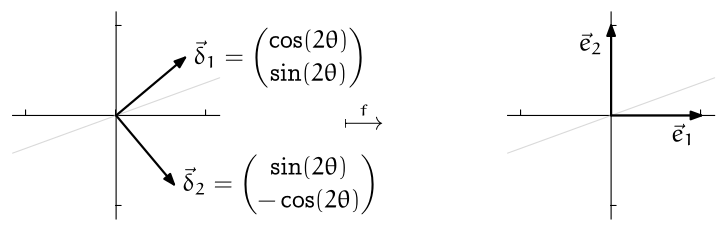
This map reflects vectors over that line. Since reflections are self-inverse, the answer to the question is: the original map reflects about the line through the origin with angle of elevation . (Of course, it does this to any basis.)
Three.V.1.17 §V.1 source ↗
What is the change of basis matrix with respect to ?
Answer
The appropriately-sized identity matrix.
Three.V.1.18 §V.1 source ↗
Prove that a matrix changes bases if and only if it is invertible.
Answer
Each is true if and only if the matrix is nonsingular.
Three.V.1.19 §V.1 source ↗
Finish the proof of Lemma 1.5.
Answer
What remains is to show that left multiplication by a reduction matrix represents a change from another basis to .
Application of a row-multiplication matrix translates a representation with respect to the basis to one with respect to , as here.
Apply a row-swap matrix to translates a representation with respect to the basis to one with respect to . Finally, applying a row-combination matrix changes a representation with respect to to one with respect to .
(As in the part of the proof in the body of this subsection, the various conditions on the row operations, e.g., that the scalar is nonzero, assure that these are all bases.)
Three.V.1.20 §V.1 source ↗
Let be an nonsingular matrix. What basis of does change to the standard basis?
Answer
Taking as a change of basis matrix , its columns are
and, because representations with respect to the standard basis are transparent, we have this.
That is, the basis is the one composed of the columns of .
Three.V.1.21 §V.1 source ↗
In with basis we have this representation.
Find a basis giving this different representation for the same polynomial.
State and prove that we can change any nonzero vector representation to any other.
Hint. The proof of Lemma 1.5 is constructive — it not only says the bases change, it shows how they change.
Answer (2 parts)
We can change the starting vector representation to the ending one through a sequence of row operations. The proof tells us what how the bases change. We start by swapping the first and second rows of the representation with respect to to get a representation with respect to a new basis .
We next add times the third row of the vector representation to the fourth row.
(The third element of is the third element of minus times the fourth element of .) Now we can finish by doubling the third row.
Here are three different approaches to stating such a result. The first is the assertion: where is a vector space with basis and is nonzero, for any nonzero column vector (whose number of components equals the dimension of ) there is a change of basis matrix such that . The second possible statement: for any (-dimensional) vector space and any nonzero vector , where are nonzero, there are bases such that and . The third is: for any nonzero member of any vector space (of dimension ) and any nonzero column vector (with components) there is a basis such that is represented with respect to that basis by that column vector.
The first and second statements follow easily from the third. The first follows because the third statement gives a basis such that and then is the desired . The second follows from the third because it is just a doubled application of it.
A way to prove the third is as in the answer to the first part of this question. Here is a sketch. Represent with respect to any basis with a column vector . This column vector must have a nonzero component because is a nonzero vector. Use that component in a sequence of row operations to convert to . (We could fill out this sketch as an induction argument on the dimension of .)
Three.V.1.22 §V.1 source ↗
Let be vector spaces, and let be bases for and be bases for . Where is linear, find a formula relating to .
Answer
This is the topic of the next subsection.
Three.V.1.23 §V.1 source ↗
Show that the columns of an change of basis matrix form a basis for . Do all bases appear in that way: can the vectors from any basis make the columns of a change of basis matrix?
Answer
A change of basis matrix is nonsingular and thus has rank equal to the number of its columns. Therefore its set of columns is a linearly independent subset of size in and it is thus a basis. The answer to the second half is also ‘yes’; all implications in the prior sentence reverse (that is, all of the ‘if … then …’ parts of the prior sentence convert to ‘if and only if’ parts).
Three.V.1.24 §V.1 source ↗
Find a matrix having this effect.
That is, find a that left-multiplies the starting vector to yield the ending vector. Is there a matrix having these two effects?
Give a necessary and sufficient condition for there to be a matrix such that and .
Answer (4 parts)
In response to the first half of the question, there are infinitely many such matrices. One of them represents with respect to the transformation of with this action.
The problem of specifying two distinct input/output pairs is a bit trickier. The fact that matrices have a linear action precludes some possibilities.
Yes, there is such a matrix. These conditions
can be solved
to give this matrix.
No, because
no linear action can produce this effect.
A sufficient condition is that be linearly independent, but that’s not a necessary condition. A necessary and sufficient condition is that any linear dependences among the starting vectors appear also among the ending vectors. That is,
The proof of this condition is routine.
Three.V.2.11 §V.2 source ↗
Decide if these are matrix equivalent.
,
,
,
Answer (3 parts)
Yes, each has rank two.
Yes, they have the same rank.
No, they have different ranks.
Three.V.2.12 §V.2 source ↗
Which of these are matrix equivalent to each other?
Answer (6 parts)
Group the matrices into classes characterized by the condition that all matrices in the same class are the same size and the same rank.
, rank
, rank
, rank
, rank
, rank
Three.V.2.13 §V.2 source ↗
Find the canonical representative of the matrix equivalence class of each matrix.
Answer (3 parts)
We need only compute the rank of each.
Three.V.2.14 §V.2 source ↗
Suppose that, with respect to
the transformation is represented by this matrix.
Use change of basis matrices to represent with respect to each pair.
,
,
Answer (3 parts)
Recall the diagram and the formula.
These two
show that
and similarly these two
give the other nonsingular matrix.
Then the answer is this.
Although not strictly necessary, a check is reassuring. Arbitrarily fixing
we have that
and so is this.
Doing the calculation with respect to starts with
and then checks that this is the same result.
These two
show that
and these two
show this.
With those, the conversion goes in this way.
As in the prior item, a check provides some confidence that we did this calculation without mistakes. We can for instance, fix the vector
(this is arbitrary, taken from thin air). Now we have
and so is this vector.
With respect to we first calculate
and, sure enough, that is the same result for .
Three.V.2.15 §V.2 source ↗
What sizes are and in the equation ?
Answer
Where and are , the matrix is while is .
Three.V.2.16 §V.2 source ↗
Consider the spaces and , with these bases.
We will find and to convert the representation of a map with respect to to one with respect to
Draw the appropriate arrow diagram.
Compute and .
Answer (2 parts)
This is the arrow diagram.
The diagram gives where and (remembering that the operation done first is written on the right).
We want and . For we do these calculations (done here by eye).
These calculations give .
This is the answer.
Three.V.2.17 §V.2 source ↗
Find the change of basis matrices and that will convert the representation of a with respect to to one with respect to .
Answer
This is the arrow diagram.
Where and the equation is .
These are the calculations for (done by eye).
So we get this.
These calculations give .
Concatenate them to make the other matrix.
Three.V.2.18 §V.2 source ↗
Find the and to express via as a block partial identity matrix.
Answer
Gauss’s Method gives this.
Column operations complete the job of reaching the canonical form for matrix equivalence.
Then these are the two matrices.
Three.V.2.19 §V.2 source ↗
Use Theorem 2.7 to show that a square matrix is nonsingular if and only if it is equivalent to an identity matrix.
Answer
Any matrix is nonsingular if and only if it has rank , that is, by Theorem 2.7, if and only if it is matrix equivalent to the matrix whose diagonal is all ones.
Three.V.2.20 §V.2 source ↗
Show that, where is a nonsingular square matrix, if and are nonsingular square matrices such that then .
Answer
If then , so , and so .
Three.V.2.21 §V.2 source ↗
Why does Theorem 2.7 not show that every matrix is diagonalizable (see Example 2.3)?
Answer
By the definition following Example 2.3, a matrix is diagonalizable if it represents a transformation with the property that there is some basis such that is a diagonal matrix — the starting and ending bases must be equal. But Theorem 2.7 says only that there are and such that we can change to a representation and get a diagonal matrix. We have no reason to suspect that we could pick the two and so that they are equal.
Three.V.2.22 §V.2 source ↗
Must matrix equivalent matrices have matrix equivalent transposes?
Answer
Yes. Row rank equals column rank, so the rank of the transpose equals the rank of the matrix. Same-sized matrices with equal ranks are matrix equivalent.
Three.V.2.23 §V.2 source ↗
What happens in Theorem 2.7 if ?
Answer
Only a zero matrix has rank zero.
Three.V.2.24 §V.2 source ↗
Show that matrix equivalence is an equivalence relation.
Answer
For reflexivity, to show that any matrix is matrix equivalent to itself, take and to be identity matrices. For symmetry, if then (inverses exist because and are nonsingular). Finally, for transitivity, assume that and that . Then substitution gives . A product of nonsingular matrices is nonsingular (we’ve shown that the product of invertible matrices is invertible; in fact, we’ve shown how to calculate the inverse) and so is therefore matrix equivalent to .
Three.V.2.25 §V.2 source ↗
Show that a zero matrix is alone in its matrix equivalence class. Are there other matrices like that?
Answer
By Theorem 2.7, a zero matrix is alone in its class because it is the only of rank zero. No other matrix is alone in its class; any nonzero scalar product of a matrix has the same rank as that matrix.
Three.V.2.26 §V.2 source ↗
What are the matrix equivalence classes of matrices of transformations on ? ?
Answer
There are two matrix equivalence classes of matrices — those of rank zero and those of rank one. The matrices fall into four matrix equivalence classes.
Three.V.2.27 §V.2 source ↗
How many matrix equivalence classes are there?
Answer
For matrices there are classes for each possible rank: where is the minimum of and there are classes for the matrices of rank , , …, . That’s classes. (Of course, totaling over all sizes of matrices we get infinitely many classes.)
Three.V.2.28 §V.2 source ↗
Are matrix equivalence classes closed under scalar multiplication? Addition?
Answer
They are closed under nonzero scalar multiplication since a nonzero scalar multiple of a matrix has the same rank as does the matrix. They are not closed under addition, for instance, has rank zero.
Three.V.2.29 §V.2 source ↗
Let represented by with respect to .
Find in this specific case.
Describe in the general case where .
Answer (3 parts)
Here is the picture.
There are two ways to move from the lower left to the lower right. The first is direct, using . The second moves up, then over, then down, using (remember that they get written right-to-left, so the “up” matrix is on the right, in order to have that when applied to a the matrix applied first is ). We write for ; of the two we choose this one because it is easier to calculate. So we have .
We have
and
and thus the answer is this.
As a quick check, we can take a vector at random
giving
while the calculation with respect to
yields the same result.
As in the first item of this question
so, writing for the matrix whose columns are the basis vectors, we have that .
Three.V.2.30 §V.2 source ↗
Let have bases and and suppose that has the basis . Where , find the formula that computes from .
Repeat the prior question with one basis for and two bases for .
Answer (2 parts)
The adapted form of the arrow diagram is this.
Since there is no need to change bases in (or we can say that the change of basis matrix is the identity), we have where .
Here, this is the arrow diagram.
We have that where .
Three.V.2.31 §V.2 source ↗
If two matrices are matrix equivalent and invertible, must their inverses be matrix equivalent?
If two matrices have matrix equivalent inverses, must the two be matrix equivalent?
If two matrices are square and matrix equivalent, must their squares be matrix equivalent?
If two matrices are square and have matrix equivalent squares, must they be matrix equivalent?
Answer (4 parts)
Here is the arrow diagram, and a version of that diagram for inverse functions.
Yes, the inverses of the matrices represent the inverses of the maps. That is, we can move from the lower right to the lower left by moving up, then left, then down. In other words, where (and invertible) and are invertible then .
Yes; this is the prior part repeated in different terms.
No, we need another assumption: if represents with respect to the same starting as ending bases , for some then represents . As a specific example, these two matrices are both rank one and so they are matrix equivalent
but the squares are not matrix equivalent — the square of the first has rank one while the square of the second has rank zero.
No. These two are not matrix equivalent but have matrix equivalent squares.
Three.V.2.32 §V.2 source ↗
Square matrices are similar if they represent the same transformation, but each with respect to the same ending as starting basis. That is, is similar to .
Give a definition of matrix similarity like that of Definition 2.4.
Prove that similar matrices are matrix equivalent.
Show that similarity is an equivalence relation.
Show that if is similar to then is similar to , the cubes are similar, etc.
Prove that there are matrix equivalent matrices that are not similar.
Answer (5 parts)
The arrow diagram suggests the definition.
Call matrices similar if there is a nonsingular matrix such that .
Take to be and take to be .
This is as in Exercise 2.24. Reflexivity is obvious: . Symmetry is also easy: implies that (multiply the first equation from the right by and from the left by ). For transitivity, assume that and that . Then and we are finished on noting that is an invertible matrix with inverse .
Assume . For squares, . Higher powers follow by induction.
These two are matrix equivalent but their squares are not matrix equivalent.
By the prior item, matrix similarity and matrix equivalence are thus different.
Three.VI.1.6 §VI.1 source ↗
Project the first vector orthogonally into the line spanned by the second vector.
,
,
,
,
Answer (4 parts)
Three.VI.1.7 §VI.1 source ↗
Project the vector orthogonally into the line.
, the line
Answer (2 parts)
Writing the line as
gives this projection.
Three.VI.1.8 §VI.1 source ↗
Although pictures guided our development of Definition 1.1, we are not restricted to spaces that we can draw. In project this vector into this line.
Answer
Three.VI.1.9 §VI.1 source ↗
Definition 1.1 uses two vectors and . Consider the transformation of resulting from fixing
and projecting into the line that is the span of . Apply it to these vectors.
Show that in general the projection transformation is this.
Express the action of this transformation with a matrix.
Answer (3 parts)
In general the projection is this.
The appropriate matrix is this.
Three.VI.1.10 §VI.1 source ↗
Example 1.4 suggests that projection breaks into two parts, and , that are non-interacting. Recall that the two are orthogonal. Show that any two nonzero orthogonal vectors make up a linearly independent set.
Answer
Suppose that and are nonzero and orthogonal. Consider the linear relationship . Take the dot product of both sides of the equation with to get that
is equal to . With the assumption that is nonzero, this gives that is zero. Showing that is zero is similar.
Three.VI.1.11 §VI.1 source ↗
What is the orthogonal projection of into a line if is a member of that line?
Show that if is not a member of the line then the set is linearly independent.
Answer (2 parts)
If the vector is in the line then the orthogonal projection is . To verify this by calculation, note that since is in the line we have that for some scalar .
(Remark. If we assume that is nonzero then we can simplify the above by taking to be .)
Write for the projection . Note that, by the assumption that is not in the line, both and are nonzero. Note also that if is zero then we are actually considering the one-element set , and with nonzero, this set is necessarily linearly independent. Therefore, we are left considering the case that is nonzero.
Setting up a linear relationship
leads to the equation . Because isn’t in the line, the scalars and must both be zero. We handled the case above, so the remaining case is that , and this gives that also. Hence the set is linearly independent.
Three.VI.1.12 §VI.1 source ↗
Definition 1.1 requires that be nonzero. Why? What is the right definition of the orthogonal projection of a vector into the (degenerate) line spanned by the zero vector?
Answer
If is the zero vector then the expression
contains a division by zero, and so is undefined. As for the right definition, for the projection to lie in the span of the zero vector, it must be defined to be .
Three.VI.1.13 §VI.1 source ↗
Are all vectors the projection of some other vector into some line?
Answer
Any vector in is the projection of some other into a line, provided that the dimension is greater than one. (Clearly, any vector is the projection of itself into a line containing itself; the question is to produce some vector other than that projects to .)
Suppose that with . If then we consider the line and if we take to be any (non-degenerate) line at all (actually, we needn’t distinguish between these two cases — see the prior exercise). Let be the components of ; since , there are at least two. If some is zero then the vector is perpendicular to . If none of the components is zero then the vector whose components are is perpendicular to . In either case, observe that does not equal , and that is the projection of into .
We can dispose of the remaining and cases. The dimension case is the trivial vector space, here there is only one vector and so it cannot be expressed as the projection of a different vector. In the dimension case there is only one (non-degenerate) line, and every vector is in it, hence every vector is the projection only of itself.
Three.VI.1.14 §VI.1 source ↗
Show that the projection of into the line spanned by has length equal to the absolute value of the number divided by the length of the vector .
Answer
The proof is a calculation. Recall that for any vector , the length is determined by . So this is the square of the length.
Three.VI.1.15 §VI.1 source ↗
Find the formula for the distance from a point to a line.
Answer
Because the projection of into the line spanned by is this,
the distance squared from the point to the line is this.
Three.VI.1.16 §VI.1 source ↗
Find the scalar such that the point is a minimum distance from the point by using Calculus (i.e., consider the distance function, set the first derivative equal to zero, and solve). Generalize to .
Answer
Because square root is a strictly increasing function, we can minimize instead of the square root of . The derivative is . Setting it equal to zero gives the only critical point.
Now the second derivative with respect to
is strictly positive (as long as neither nor is zero, in which case the question is trivial) and so the critical point is a minimum.
The generalization to is straightforward. Consider , take the derivative, etc.
Three.VI.1.17 §VI.1 source ↗
Let be the orthogonal projection of onto a line . Show that is the point in the line closest to .
Answer
Suppose . Because this is orthogonal projection, the two vectors and are at a right angle. The Triangle Inequality applies and the hypotenuse is therefore at least as long as .
Three.VI.1.18 §VI.1 source ↗
Prove that the orthogonal projection of a vector into a line has length less than or equal to that of the vector.
Answer
For any vector , the length squared is given by . So this is the square of the projection’s length.
Thus the length is , the absolute value of divided by the length of . The Cauchy-Schwarz inequality, , gives that .
Three.VI.1.19 §VI.1 source ↗
Show that the definition of orthogonal projection into a line does not depend on the spanning vector: if is a nonzero multiple of then equals .
Answer
Write for , and calculate: .
Three.VI.1.20 §VI.1 source ↗
Consider the function mapping the plane to itself that takes a vector to its projection into the line . These two each show that the map is linear, the first one in a way that is coordinate-bound (that is, it fixes a basis and then computes) and the second in a way that is more conceptual.
Produce a matrix that describes the function’s action.
Show that we can obtain this map by first rotating everything in the plane radians clockwise, then projecting into the -axis, and then rotating radians counterclockwise.
Answer (2 parts)
Fixing
as the vector whose span is the line, the formula gives this action,
which is the effect of this matrix.
Rotating the entire plane radians clockwise brings the line to lie on the -axis. Now projecting and then rotating back has the desired effect.
Three.VI.1.21 §VI.1 source ↗
For let be the projection of into the line spanned by , let be the projection of into the line spanned by , let be the projection of into the line spanned by , etc., back and forth between the spans of and . That is, is the projection of into the span of if is even, and into the span of if is odd. Must that sequence of vectors eventually settle down — must there be a sufficiently large such that equals and equals ? If so, what is the earliest such ?
Answer
The sequence need not settle down. With
the projections are these.
This sequence doesn’t repeat.
Three.VI.2.10 §VI.2 source ↗
Normalize the lengths of these vectors.
Answer (3 parts)
Three.VI.2.11 §VI.2 source ↗
Perform Gram-Schmidt on this basis for .
Check that the resulting vectors are orthogonal.
Answer
Call the given basis . First, . For the other, .
To check that they are orthogonal, just note that their dot product is zero.
Three.VI.2.12 §VI.2 source ↗
Perform the Gram-Schmidt process on this basis for .
Answer
Call the given basis . First, .
Next, .
For the third, this is the formula
and here is the calculation.
Three.VI.2.13 §VI.2 source ↗
Perform Gram-Schmidt on each of these bases for .
Then turn those orthogonal bases into orthonormal bases.
Answer (4 parts)
This is the corresponding orthonormal basis.
Here is the orthonormal basis.
This is the associated orthonormal basis.
Three.VI.2.14 §VI.2 source ↗
Perform the Gram-Schmidt process on each of these bases for .
Then turn those orthogonal bases into orthonormal bases.
Answer (2 parts)
The first basis vector is unchanged.
The second one comes from this calculation.
For the third the arithmetic is uglier but it is a straightforward calculation.
This is the orthonormal basis.
The first basis vector is what was given.
The second is here.
Here is the third.
Here is the associated orthonormal basis.
Three.VI.2.15 §VI.2 source ↗
Find an orthonormal basis for this subspace of : the plane .
Answer
We can parametrize the given space can in this way.
So we take the basis
apply the Gram-Schmidt process to get this first basis vector
and this second one.
and then normalize.
Three.VI.2.16 §VI.2 source ↗
Find an orthonormal basis for this subspace of .
Answer
Reducing the linear system
and parametrizing gives this description of the subspace.
So we take the basis,
go through the Gram-Schmidt process with the first
and second basis vectors
and finish by normalizing.
Three.VI.2.17 §VI.2 source ↗
Show that any linearly independent subset of can be orthogonalized without changing its span.
Answer
A linearly independent subset of is a basis for its own span. Apply Theorem 2.7.
Remark. Here’s why the phrase ‘linearly independent’ is in the question. Dropping the phrase would require us to worry about two things. The first thing to worry about is that when we do the Gram-Schmidt process on a linearly dependent set then we get some zero vectors. For instance, with
we would get this.
This first thing is not so bad because the zero vector is by definition orthogonal to every other vector, so we could accept this situation as yielding an orthogonal set (although it of course can’t be normalized), or we just could modify the Gram-Schmidt procedure to throw out any zero vectors. The second thing to worry about if we drop the phrase ‘linearly independent’ from the question is that the set might be infinite. Of course, any subspace of the finite-dimensional must also be finite-dimensional so only finitely many of its members are linearly independent, but nonetheless, a “process” that examines the vectors in an infinite set one at a time would at least require some more elaboration in this question. A linearly independent subset of is automatically finite — in fact, of size or less — so the ‘linearly independent’ phrase obviates these concerns.
Three.VI.2.18 §VI.2 source ↗
What happens if we try to apply the Gram-Schmidt process to a finite set that is not a basis?
Answer
If that set is not linearly independent, then we get a zero vector. Otherwise (if our set is linearly independent but does not span the space), we are doing Gram-Schmidt on a set that is a basis for a subspace and so we get an orthogonal basis for a subspace.
Three.VI.2.19 §VI.2 source ↗
What happens if we apply the Gram-Schmidt process to a basis that is already orthogonal?
Answer
The process leaves the basis unchanged.
Three.VI.2.20 §VI.2 source ↗
Let be a set of mutually orthogonal vectors in .
Prove that for any in the space, the vector is orthogonal to each of , …, .
Illustrate the prior item in by using as , using as , and taking to have components , , and .
Show that is the vector in the span of the set of ’s that is closest to . Hint. To the illustration done for the prior part, add a vector and apply the Pythagorean Theorem to the resulting triangle.
Answer (3 parts)
The argument is as in the case of the proof of Theorem 2.7. The dot product
can be written as the sum of terms of the form with , and the term . The first kind of term equals zero because the ’s are mutually orthogonal. The other term is zero because this projection is orthogonal (that is, the projection definition makes it zero: equals, after all of the cancellation is done, zero).
The vector is in black and the vector is in gray.
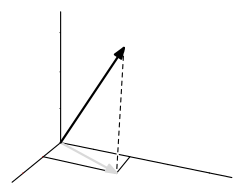
The vector lies on the dotted line connecting the black vector to the gray one, that is, it is orthogonal to the -plane.
We get this diagram by following the hint.
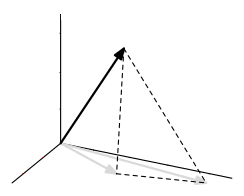
The dashed triangle has a right angle where the gray vector meets the vertical dashed line ; this is what first item of this question proved. The Pythagorean theorem then gives that the hypotenuse — the segment from to any other vector — is longer than the vertical dashed line.
More formally, writing as , consider any other vector in the span . Note that
and that (because the first item shows the is orthogonal to each and so it is orthogonal to this linear combination of the ’s). Now apply the Pythagorean Theorem (i.e., the Triangle Inequality).
Three.VI.2.21 §VI.2 source ↗
Find a nonzero vector in that is orthogonal to both of these.
Answer
One way to proceed is to find a third vector so that the three together make a basis for , e.g.,
(the second vector is not dependent on the third because it has a nonzero second component, and the first is not dependent on the second and third because of its nonzero third component), and then apply the Gram-Schmidt process. The first element of the new basis is this.
And this is the second element.
Here is the final element.
The result is orthogonal to both and . It is therefore orthogonal to every vector in the span of the set , including the two vectors given in the question.
Three.VI.2.22 §VI.2 source ↗
One advantage of orthogonal bases is that they simplify finding the representation of a vector with respect to that basis.
For this vector and this non-orthogonal basis for
first represent the vector with respect to the basis. Then project the vector into the span of each basis vector and .
With this orthogonal basis for
represent the same vector with respect to the basis. Then project the vector into the span of each basis vector. Note that the coefficients in the representation and the projection are the same.
Let be an orthogonal basis for some subspace of . Prove that for any in the subspace, the -th component of the representation is the scalar coefficient from .
Prove that .
Answer (4 parts)
We can do the representation by eye.
The two projections are also easy.
As above, we can do the representation by eye
and the two projections are easy.
Note the recurrence of the and the .
Represent with respect to the basis
so that . To determine , take the dot product of both sides with .
Solving for yields the desired coefficient.
This is a restatement of the prior item.
Three.VI.2.23 §VI.2 source ↗
Bessel’s Inequality. Consider these orthonormal sets
along with the vector whose components are , , , and .
Find the coefficient for the projection of into the span of the vector in . Check that .
Find the coefficients and for the projection of into the spans of the two vectors in . Check that .
Find , , and associated with the vectors in , and , , , and for the vectors in . Check that and that .
Show that this holds in general: where is an orthonormal set and is coefficient of the projection of a vector from the space then . Hint. One way is to look at the inequality and expand the ’s.
Answer (5 parts)
First, .
,
, , ,
For the proof, we will do only the case because the completely general case is messier but no more enlightening. We follow the hint (recall that for any vector we have ).
(The two mixed terms in the third part of the third line are zero because and are orthogonal.) The result now follows on gathering like terms and on recognizing that and because these vectors are members of an orthonormal set.
Three.VI.2.24 §VI.2 source ↗
Prove or disprove: every vector in is in some orthogonal basis.
Answer
It is true, except for the zero vector. Every vector in except the zero vector is in a basis, and that basis can be orthogonalized.
Three.VI.2.25 §VI.2 source ↗
Show that the columns of an matrix form an orthonormal set if and only if the inverse of the matrix is its transpose. Produce such a matrix.
Answer
The case gives the idea. The set
is orthonormal if and only if these nine conditions all hold
(the three conditions in the lower left are redundant but nonetheless correct). Those, in turn, hold if and only if
as required.
This is an example, the inverse of this matrix is its transpose.
Three.VI.2.26 §VI.2 source ↗
Does the proof of Theorem 2.2 fail to consider the possibility that the set of vectors is empty (i.e., that )?
Answer
If the set is empty then the summation on the left side is the linear combination of the empty set of vectors, which by definition adds to the zero vector. In the second sentence, there is not such , so the ‘if … then …’ implication is vacuously true.
Three.VI.2.27 §VI.2 source ↗
Theorem 2.7 describes a change of basis from any basis to one that is orthogonal . Consider the change of basis matrix .
Prove that the matrix changing bases in the direction opposite to that of the theorem has an upper triangular shape — all of its entries below the main diagonal are zeros.
Prove that the inverse of an upper triangular matrix is also upper triangular (if the matrix is invertible, that is). This shows that the matrix changing bases in the direction described in the theorem is upper triangular.
Answer (2 parts)
Part of the induction argument proving Theorem 2.7 checks that is in the span of . (The case in the proof illustrates.) Thus, in the change of basis matrix , the -th column has components through that are zero.
One way to see this is to recall the computational procedure that we use to find the inverse. We write the matrix, write the identity matrix next to it, and then we do Gauss-Jordan reduction. If the matrix starts out upper triangular then the Gauss-Jordan reduction involves only the Jordan half and these steps, when performed on the identity, will result in an upper triangular inverse matrix.
Three.VI.2.28 §VI.2 source ↗
Complete the induction argument in the proof of Theorem 2.7.
Answer
For the inductive step, we assume that for all in , these three conditions are true of each : (i) each is nonzero, (ii) each is a linear combination of the vectors , and (iii) each is orthogonal to all of the ’s prior to it (that is, with ). With those inductive hypotheses, consider .
By the inductive assumption (ii) we can expand each into a linear combination of
The fractions are scalars so this is a linear combination of linear combinations of . It is therefore just a linear combination of . Now, (i) it cannot sum to the zero vector because the equation would then describe a nontrivial linear relationship among the ’s that are given as members of a basis (the relationship is nontrivial because the coefficient of is ). Also, (ii) the equation gives as a combination of . Finally, for (iii), consider ; as in the case, the dot product of with can be rewritten to give two kinds of terms, (which is zero because the projection is orthogonal) and with and (which is zero because by the hypothesis (iii) the vectors and are orthogonal).
Three.VI.3.10 §VI.3 source ↗
Project the vectors into along .
Answer (3 parts)
When bases for the subspaces
are concatenated
and the given vector is represented
then the answer comes from retaining the part and dropping the part.
When the bases
are concatenated, and the vector is represented,
then retaining only the part gives this answer.
With these bases
the representation with respect to the concatenation is this.
and so the projection is this.
Three.VI.3.11 §VI.3 source ↗
Find .
Answer (8 parts)
As in Example 3.5, we can simplify the calculation by just finding the space of vectors perpendicular to all the the vectors in ’s basis.
Parametrizing to get
gives that
Parametrizing the one-equation linear system gives this description.
As in the answer to the prior part, we can describe as a span
and then is the set of vectors perpendicular to the one vector in this basis.
Parametrizing the linear requirement in the description of gives this basis.
Now, is the set of vectors perpendicular to (the one vector in) .
(By the way, this answer checks with the first item in this question.)
Every vector in the space is perpendicular to the zero vector so .
The appropriate description and basis for are routine.
Then
and so .
The description of is easy to find by parametrizing.
Finding here just requires solving a linear system with two equations
and parametrizing.
Here, is one-dimensional
and as a result, is two-dimensional.
Three.VI.3.12 §VI.3 source ↗
Find the orthogonal projection of the vector into the subspace.
Answer
Where
straightforward, although tedious, calculation gives this.
When applied to the vector we get the projection.
Three.VI.3.13 §VI.3 source ↗
With the same subspace as in the prior problem, find the orthogonal projection of this vector.
Answer
Using the matrix calculation from the prior answer, this
shows the vector is in the subspace .
Three.VI.3.14 §VI.3 source ↗
Let be the orthogonal projection of onto a subspace . Show that is the point in the subspace closest to .
Answer
Suppose . Because this is orthogonal projection, the two vectors and are at a right angle. The Triangle Inequality applies and the hypotenuse is therefore at least as long as .
Three.VI.3.15 §VI.3 source ↗
This subsection shows how to project orthogonally in two ways, the method of Example 3.2 and 3.3, and the method of Theorem 3.8. To compare them, consider the plane specified by in .
Find a basis for .
Find and a basis for .
Represent this vector with respect to the concatenation of the two bases from the prior item.
Find the orthogonal projection of into by keeping only the part from the prior item.
Check that against the result from applying Theorem 3.8.
Answer (5 parts)
Parametrizing the equation leads to this basis for .
Because is three-dimensional and is two-dimensional, the complement must be a line. Anyway, the calculation as in Example 3.5
gives this basis for .
The matrix of the projection
when applied to the vector, yields the expected result.
Three.VI.3.16 §VI.3 source ↗
We have three ways to find the orthogonal projection of a vector into a line, the Definition 1.1 way from the first subsection of this section, the Example 3.2 and 3.3 way of representing the vector with respect to a basis for the space and then keeping the part, and the way of Theorem 3.8. For these cases, do all three ways.
Answer (2 parts)
Parametrizing gives this.
For the first way, we take the vector spanning the line to be
and the Definition 1.1 formula gives this.
For the second way, we fix
and so (as in Example 3.5 and 3.6, we can just find the vectors perpendicular to all of the members of the basis)
and representing the vector with respect to the concatenation gives this.
Keeping the part yields the answer.
The third part is also a simple calculation (there is a matrix in the middle, and the inverse of it is also )
which of course gives the same answer.
Parametrization gives this.
With that, the formula for the first way gives this.
To proceed by the second method we find ,
find the representation of the given vector with respect to the concatenation of the bases and
and retain only the part.
Finally, for the third method, the matrix calculation
followed by matrix-vector multiplication
gives the answer.
Three.VI.3.17 §VI.3 source ↗
Check that the operation of Definition 3.1 is well-defined. That is, in Example 3.2 and 3.3, doesn’t the answer depend on the choice of bases?
Answer
No, a decomposition of vectors into and does not depend on the bases chosen for the subspaces, as we showed in the Direct Sum subsection.
Three.VI.3.18 §VI.3 source ↗
What is the orthogonal projection into the trivial subspace?
Answer
The orthogonal projection of a vector into a subspace is a member of that subspace. Since a trivial subspace has only one member, , the projection of any vector must equal .
Three.VI.3.19 §VI.3 source ↗
What is the projection of into along if ?
Answer
The projection into along of a is . Decomposing gives and , and dropping the part but retaining the part results in a projection of .
Three.VI.3.20 §VI.3 source ↗
Show that if is a subspace with orthonormal basis then the orthogonal projection of into is this.
Answer
The proof of Lemma 3.7 shows that each vector is the sum of its orthogonal projections into the lines spanned by the basis vectors.
Since the basis is orthonormal, the bottom of each fraction has .
Three.VI.3.21 §VI.3 source ↗
Prove that the map is the projection into along if and only if the map is the projection into along . (Recall the definition of the difference of two maps: .)
Answer
If then every vector decomposes uniquely as . For all the map gives if and only if , as required.
Three.VI.3.22 §VI.3 source ↗
Show that if a vector is perpendicular to every vector in a set then it is perpendicular to every vector in the span of that set.
Answer
Let be perpendicular to every . Then .
Three.VI.3.23 §VI.3 source ↗
True or false: the intersection of a subspace and its orthogonal complement is trivial.
Answer
True; the only vector orthogonal to itself is the zero vector.
Three.VI.3.24 §VI.3 source ↗
Show that the dimensions of orthogonal complements add to the dimension of the entire space.
Answer
This is immediate from the statement in Lemma 3.7 that the space is the direct sum of the two.
Three.VI.3.25 §VI.3 source ↗
Suppose that are such that for all complements , the projections of and into along are equal. Must equal ? (If so, what if we relax the condition to: all orthogonal projections of the two are equal?)
Answer
The two must be equal, even only under the seemingly weaker condition that they yield the same result on all orthogonal projections. Consider the subspace spanned by the set . Since each is in , the orthogonal projection of into is and the orthogonal projection of into is . For their projections into to be equal, they must be equal.
Three.VI.3.26 §VI.3 source ↗
Let be subspaces of . The perp operator acts on subspaces; we can ask how it interacts with other such operations.
Show that two perps cancel: .
Prove that implies that .
Show that .
Answer (3 parts)
We will show that the sets are mutually inclusive, and . For the first, if then by the definition of the perp operation, is perpendicular to every , and therefore (again by the definition of the perp operation) . For the other direction, consider . Lemma 3.7’s proof shows that and that we can give an orthogonal basis for the space such that the first half is a basis for and the second half is a basis for . The proof also checks that each vector in the space is the sum of its orthogonal projections into the lines spanned by these basis vectors.
Because , it is perpendicular to every vector in , and so the projections in the second half are all zero. Thus , which is a linear combination of vectors from , and so . (Remark. Here is a slicker way to do the second half: write the space both as and as . Because the first half showed that and the prior sentence shows that the dimension of the two subspaces and are equal, we can conclude that equals .)
Because , any that is perpendicular to every vector in is also perpendicular to every vector in . But that sentence simply says that .
We will again show that the sets are equal by mutual inclusion. The first direction is easy; any perpendicular to every vector in is perpendicular to every vector of the form (that is, every vector in ) and every vector of the form (every vector in ), and so . The second direction is also routine; any vector is perpendicular to any vector of the form because .
Three.VI.3.27 §VI.3 source ↗
The material in this subsection allows us to express a geometric relationship that we have not yet seen between the range space and the null space of a linear map.
Represent given by
with respect to the standard bases and show that
is a member of the perp of the null space. Prove that is equal to the span of this vector.
Generalize that to apply to any .
Represent
with respect to the standard bases and show that
are both members of the perp of the null space. Prove that is the span of these two. (Hint. See the third item of Exercise 3.26.)
Generalize that to apply to any .
In [Strang 93] this is called the Fundamental Theorem of Linear Algebra
Answer (4 parts)
The representation of
is this.
By the definition of
and this second description exactly says this.
The generalization is that for any there is a vector so that
and . We can prove this by, as in the prior item, representing with respect to the standard bases and taking to be the column vector gotten by transposing the one row of that matrix representation.
Of course,
and so the null space is this set.
That description makes clear that
and since is a subspace of , the span of the two vectors is a subspace of the perp of the null space. To see that this containment is an equality, take
in the third item of Exercise 3.26, as suggested in the hint.
As above, generalizing from the specific case is easy: for any the matrix representing the map with respect to the standard bases describes the action
and the description of the null space gives that on transposing the rows of
we have . ([Strang 93] describes this space as the transpose of the row space of .)
Three.VI.3.28 §VI.3 source ↗
Define a projection to be a linear transformation with the property that repeating the projection does nothing more than does the projection alone: for all .
Show that orthogonal projection into a line has that property.
Show that projection along a subspace has that property.
Show that for any such there is a basis for such that
where is the rank of .
Conclude that every projection is a projection along a subspace.
Also conclude that every projection has a representation
in block partial-identity form.
Answer (5 parts)
First note that if a vector is already in the line then the orthogonal projection gives itself. One way to verify this is to apply the formula for projection into the line spanned by a vector , namely . Taking the line as (the case is separate but easy) gives , which simplifies to , as required.
Now, that answers the question because after once projecting into the line, the result is in that line. The prior paragraph says that projecting into the same line again will have no effect.
The argument here is similar to the one in the prior item. With , the projection of is . Now repeating the projection will give , as required, because the decomposition of a member of into the sum of a member of and a member of is . Thus, projecting twice into along has the same effect as projecting once.
As suggested by the prior items, the condition gives that leaves vectors in the range space unchanged, and hints that we should take , …, to be basis vectors for the range, that is, that we should take the range space of for (so that ). As for the complement, we write for the null space of and we will show that .
To show this, we can show that their intersection is trivial and that they sum to the entire space . For the first, if a vector is in the range space then there is a with , and the condition on gives that , while if that same vector is also in the null space then and so the intersection of the range space and null space is trivial. For the second, to write an arbitrary as the sum of a vector from the range space and a vector from the null space, the fact that the condition can be rewritten as suggests taking .
To finish we taking a basis for where is a basis for the range space and is a basis for the null space .
Every projection (as defined in this exercise) is a projection into its range space and along its null space.
This also follows immediately from the third item.
Three.VI.3.29 §VI.3 source ↗
A square matrix is symmetric if each entry equals the entry (i.e., if the matrix equals its transpose). Show that the projection matrix is symmetric. [Strang 80] Hint. Find properties of transposes by looking in the index under ‘transpose’.
Answer
For any matrix we have that , and for any two matrices , we have that (provided, of course, that the inverse and product are defined). Applying these two gives that the matrix equals its transpose.
2 Topic: Line of Best Fit source ↗
Use least-squares to judge if the coin in this experiment is fair.
| flips | 8 | 16 | 24 | 32 | 40 |
| heads | 4 | 9 | 13 | 17 | 20 |
Answer
As with the first example discussed above, we are trying to find a best to “solve” this system.
Projecting into the linear subspace gives this
so the slope of the line of best fit is approximately .
3 Topic: Line of Best Fit source ↗
For the men’s mile record, rather than give each of the many records and its exact date, we’ve “smoothed” the data somewhat by taking a periodic sample. Do the longer calculation and compare the conclusions.
Answer
With this input
(the dates have been rounded to months, e.g., for a September record, the decimal was used), Maple responded with an intercept of and a slope of .
4 Topic: Line of Best Fit source ↗
Find the line of best fit for the men’s meter run. How does the slope compare with that for the men’s mile? (The distances are close; a mile is about meters.)
Answer
With this input (the years are zeroed at )
(the dates have been rounded to months, e.g., for a September record, the decimal was used), Maple gives an intercept of and a slope of . The slope given in the body of this Topic for the men’s mile is quite close to this.
5 Topic: Line of Best Fit source ↗
Find the line of best fit for the records for women’s mile.
Answer
With this input (the years are zeroed at )
(the dates have been rounded to months, e.g., for a September record, the decimal was used), MAPLE gave an intercept of and a slope of .
6 Topic: Line of Best Fit source ↗
Do the lines of best fit for the men’s and women’s miles cross?
Answer
These are the equations of the lines for men’s and women’s mile (the vertical intercept term of the equation for the women’s mile has been adjusted from the answer above, to zero it at the year , because that’s how the men’s mile equation was done).
Obviously the lines cross. A computer program is the easiest way to do the arithmetic: MuPAD gives and ( seconds is minutes and seconds). Remark. Of course all of this projection is highly dubious — for one thing, the equation for the women is influenced by the quite slow early times — but it is nonetheless fun.
7 Topic: Line of Best Fit source ↗
(This illustrates that there are data sets for which a linear model is not right, and that the line of best fit doesn’t in that case have any predictive value.) In a highway restaurant a trucker told me that his boss often sends him by a roundabout route, using more gas but paying lower bridge tolls. He said that New York State calibrates the toll for each bridge across the Hudson, playing off the extra gas to get there from New York City against a lower crossing cost, to encourage people to go upstate. This table, from [Cost Of Tolls] and [Google Maps], lists for each toll crossing of the Hudson River, the distance to drive from Times Square in miles and the cost in US dollars for a passenger car (if a crossings has a one-way toll then it shows half that number).
| Crossing | Distance | Toll | ||||||||||||||||||||||||||||||
|
Find the line of best fit and graph the data to show that the driver was practicing on my credulity.
Answer
Sage gives the line of best fit as .
sage: dist = [2, 7, 8, 16, 27, 47, 67, 82, 102, 120]
sage: toll = [6, 6, 6, 6.5, 2.5, 1, 1, 1, 1, 1]
sage: var('a,b,t')
(a, b, t)
sage: model(t) = a*t+b
sage: data = zip(dist,toll)
sage: fit = find_fit(data, model, solution_dict=True)
sage: model.subs(fit)
t |--> -0.0508568169130319*t + 5.630955848442933
sage: p = plot(model.subs(fit), (t,0,120))+points(data,size=25,color='red')
sage: p.save('bridges.pdf')But the graph shows that the equation has little predictive value.
Apparently a better model is that (with only one intermediate exception) crossings in the city cost roughly the same as each other, and crossings upstate cost the same as each other.
8 Topic: Line of Best Fit source ↗
When the space shuttle Challenger exploded in 1986, one of the criticisms made of NASA’s decision to launch was in the way they did the analysis of number of O-ring failures versus temperature (O-ring failure caused the explosion). Four O-ring failures would be fatal. NASA had data from previous flights.
| temp F | 53 | 75 | 57 | 58 | 63 | 70 | 70 | 66 | 67 | 67 | 67 |
| failures | 3 | 2 | 1 | 1 | 1 | 1 | 1 | 0 | 0 | 0 | 0 |
| 68 | 69 | 70 | 70 | 72 | 73 | 75 | 76 | 76 | 78 | 79 | 80 | 81 |
| 0 | 0 | 0 | 0 | 0 | 0 | 0 | 0 | 0 | 0 | 0 | 0 | 0 |
The temperature that day was forecast to be .
NASA based the decision to launch partially on a chart showing only the flights that had at least one O-ring failure. Find the line that best fits these seven flights. On the basis of this data, predict the number of O-ring failures when the temperature is , and when the number of failures will exceed four.
Find the line that best fits all 24 flights. On the basis of this extra data, predict the number of O-ring failures when the temperature is , and when the number of failures will exceed four.
Which do you think is the more accurate method of predicting? (An excellent discussion is in [Dalal, et. al.].)
Answer (2 parts)
A computer algebra system like MAPLE or MuPAD will give an intercept of and a slope of Plugging into the equation yields a predicted number of O-ring failures of (rounded to two places). Plugging in and solving gives a temperature of F.
On the basis of this information
MAPLE gives the intercept and the slope . Here, plugging into the equation predicts O-ring failures (rounded to two places). Plugging in failures gives a temperature of F.
9 Topic: Line of Best Fit source ↗
This table lists the average distance from the sun to each of the first seven planets, using Earth’s average as a unit.
| Mercury | Venus | Earth | Mars | Jupiter | Saturn | Uranus |
Plot the number of the planet (Mercury is , etc.) versus the distance. Note that it does not look like a line, and so finding the line of best fit is not fruitful.
It does, however look like an exponential curve. Therefore, plot the number of the planet versus the logarithm of the distance. Does this look like a line?
The asteroid belt between Mars and Jupiter is what is left of a planet that broke apart. Renumber so that Jupiter is , Saturn is , and Uranus is , and plot against the log again. Does this look better?
Use least squares on that data to predict the location of Neptune.
Repeat to predict where Pluto is.
Is the formula accurate for Neptune and Pluto?
This method was used to help discover Neptune (although the second item is misleading about the history; actually, the discovery of Neptune in position prompted people to look for the “missing planet” in position ). See [Gardner, 1970]
Answer (6 parts)
The plot is nonlinear.
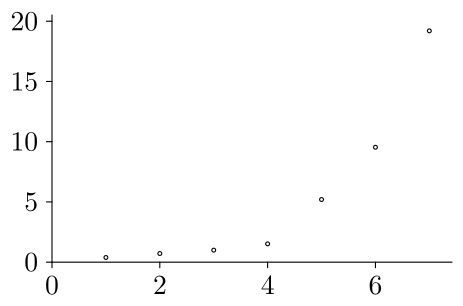
Here is the plot.
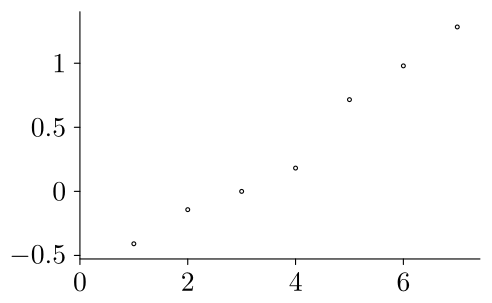
There is perhaps a jog up between planet and planet .
This plot seems even more linear.
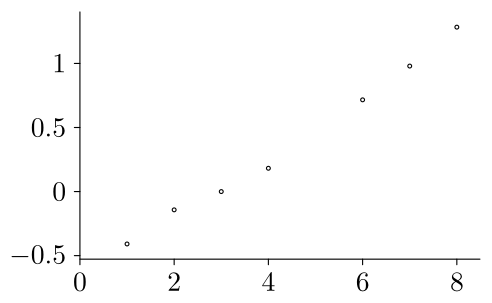
With this input
MuPAD gives that the intercept is and the slope is .
Plugging into the equation from the prior item gives that the log of the distance is , so the expected distance is . The actual distance is about .
Plugging into the same equation gives that the log of the distance is , so the expected distance is . The actual distance is about .
10 Topic: Line of Best Fit source ↗
Suppose that is a subspace of for some and suppose that is not an element of . Let the orthogonal projection of into be the vector . Show that is the element of that is closest to .
Answer
For any , the vectors and are orthogonal. So the Triangle Inequality applies to the triangle with those vectors as sides, and with as hypoteneuse. Therefore is at least as long as .
1 Topic: Geometry of Linear Maps source ↗
Use the decomposition to find the combination of dilations, flips, skews, and projections that produces the map represented with respect to the standard bases by this matrix.
Answer
This Gaussian reduction
gives the reduced echelon form of the matrix. Now the two column operations of taking times the first column and adding it to the second, and then of swapping columns two and three produce this partial identity.
All of that translates into matrix terms as: where
and
the given matrix factors as .
2 Topic: Geometry of Linear Maps source ↗
What combination of dilations, flips, skews, and projections produces a rotation counterclockwise by radians?
Answer
We will first represent the map with a matrix , perform the row operations and, if needed, column operations to reduce it to a partial-identity matrix. We will then translate that into a factorization . Substituting into the general matrix
gives this representation.
Gauss’s Method is routine.
That translates to a matrix equation in this way.
Taking inverses to solve for yields this factorization.
3 Topic: Geometry of Linear Maps source ↗
If a map is nonsingular then to get from its representation to the identity matrix we do not need any column operations, so that in the matrix is the identity. An example of a nonsingular map is the transformation that rotates vectors clockwise by radians.
Find the matrix representing this map with respect to the standard bases.
Use Gauss-Jordan to reduce to the identity, without column operations.
Translate that to a matrix equation .
Solve the matrix equation for .
Describe as a combination of dilations, flips, skews, and projections (the identity is a trivial projection).
Answer (5 parts)
Recall that rotation counterclockwise by radians is represented with respect to the standard basis in this way.
A clockwise angle is the negative of a counterclockwise one.
This Gauss-Jordan reduction
produces the identity matrix. Thus we do not need column-swapping operations to end with a partial-identity.
In matrix multiplication the reduction is
(note that composition of the Gaussian operations is from right to left).
Taking inverses
gives the desired factorization of . The partial identity is .
Reading the composition from right to left (and ignoring the identity matrices as trivial) gives that has the same effect as first performing this skew
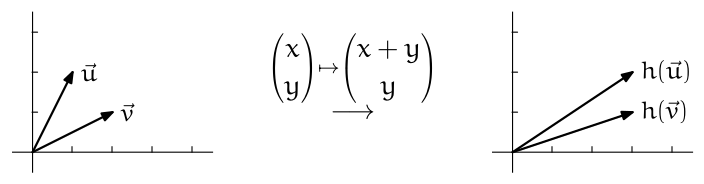
followed by a dilation that multiplies all first components by (this is a shrink in that is less than ) and all second components by , followed by another skew.
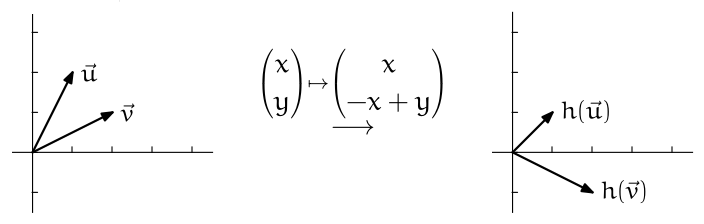
For an example we start with the unit vector whose angle with the -axis is and apply the components of in turn.
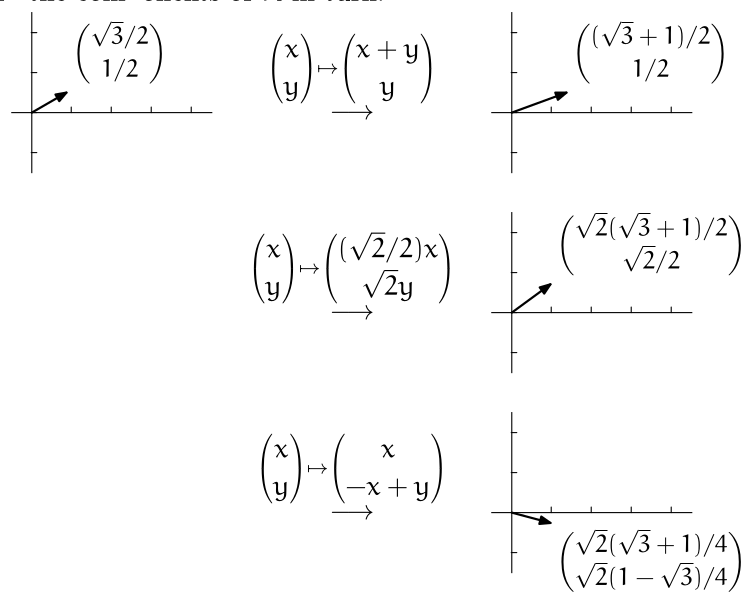
We can easily verify that the resulting vector has unit length and forms an angle with the -axis of , which is indeed a rotation clockwise of radians since .
4 Topic: Geometry of Linear Maps source ↗
Show that any linear transformation of is a map that multiplies by a scalar .
Answer
Represent it with respect to the standard bases . That produces a matrix. The only entry is the scalar .
5 Topic: Geometry of Linear Maps source ↗
Show that linear maps preserve the linear structures of a space.
Show that for any linear map from to , the image of any line is a line. The image may be a degenerate line, that is, a single point.
Show that the image of any linear surface is a linear surface. This generalizes the result that under a linear map the image of a subspace is a subspace.
Linear maps preserve other linear ideas. Show that linear maps preserve “betweeness”: if the point is between and then the image of is between the image of and the image of .
Answer (3 parts)
A line is a subset of of the form . The image of a point on that line is , and the set of such vectors, as ranges over the reals, is a line (albeit, degenerate if ).
This is an obvious extension of the prior argument.
If the point is between the points and then the line from to has in it. That is, there is a such that (where is the endpoint of , etc.). Now, as in the argument of the first item, linearity shows that .
6 Topic: Geometry of Linear Maps source ↗
Use a picture like the one that appears in the discussion of the Chain Rule to answer: if a function has an inverse, what’s the relationship between how the function — locally, approximately — dilates space, and how its inverse dilates space (assuming, of course, that it has an inverse)?
Answer
The two are inverse. For instance, for a fixed , if (with ) then .
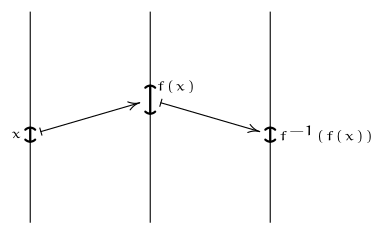
7 Topic: Geometry of Linear Maps source ↗
Show that any permutation, any reordering, of the numbers , …, , the map
can be done with a composition of maps, each of which only swaps a single pair of coordinates. Hint: you can use induction on . (Remark: in the fourth chapter we will show this and we will also show that the parity of the number of swaps used is determined by . That is, although a particular permutation could be expressed in two different ways with two different numbers of swaps, either both ways use an even number of swaps, or both use an odd number.)
Answer
We can show this by induction on the number of components in the vector. In the base case the only permutation is the trivial one, and the map
is expressible as a composition of swaps — as zero swaps. For the inductive step we assume that the map induced by any permutation of fewer than numbers can be expressed with swaps only, and we consider the map induced by a permutation of numbers.
Consider the number such that . The map
will, when followed by the swap of the -th and -th components, give the map . Now, the inductive hypothesis gives that is achievable as a composition of swaps.
1 Topic: Magic Squares source ↗
Let be a magic square with magic number .
Prove that the sum of ’s entries is .
Prove that .
Prove that is the average of the entries in its row, its column, and in each diagonal.
Prove that is the median of ’s entries.
Answer (4 parts)
The sum of the entries of is the sum of the sums of the three rows.
The constraints on entries of involving the center entry make this system.
Adding those four equations counts each matrix entry once and only once, except that we count the center entry four times. Thus the left side sums to while the right sums to . So .
The second row adds to so , giving that . The same goes for the column and the diagonals.
By the prior exercise either both and are equal to or else one is greater while one is smaller. Thus is the median of the set . The same reasoning applied to the second column shows that Thus is the median of the set . Extending to the two diagonals shows it is the median of the set of all entries.
2 Topic: Magic Squares source ↗
Solve the system , , , , , and .
Answer
For any we have this.
The unique solution is .
3 Topic: Magic Squares source ↗
Show that .
Answer
By the prior exercise the only member is .
4 Topic: Magic Squares source ↗
Let the trace function be . Define also the sum down the other diagonal .
Show that the two functions are linear.
Show that the function given by is linear.
Generalize the prior item.
Answer (3 parts)
Where we have where all numbers are real, so the trace preserves linear combinations. The argument for is similar.
It preserves linear combinations: where all numbers are real, .
Where are linear then so is given by . The proof just follows the proof of the prior item.
5 Topic: Magic Squares source ↗
A square matrix is semimagic if the rows and columns add to the same value, that is, if we drop the condition on the diagonals.
Show that the set of semimagic squares is a subspace of .
Show that the set of semimagic squares with magic number is also a subspace of .
Answer (2 parts)
The sum of two semimagic squares is semimagic, as is a scalar multiple of a semimagic square.
As with the prior item, a linear combination of two semimagic squares with magic number zero is also such a matrix.
1 Topic: Markov Chains source ↗
These questions refer to the coin-flipping game.
Check the computations in the table at the end of the first paragraph.
Consider the second row of the vector table. Note that this row has alternating ’s. Must be when is odd? Prove that it must be, or produce a counterexample.
Perform a computational experiment to estimate the chance that the player ends at five dollars, starting with one dollar, two dollars, and four dollars.
Answer (3 parts)
With this file coin.m
# Octave function for Markov coin game. p is chance of going down.
function w = coin(p,v)
q = 1-p;
A=[1,p,0,0,0,0;
0,0,p,0,0,0;
0,q,0,p,0,0;
0,0,q,0,p,0;
0,0,0,q,0,0;
0,0,0,0,q,1];
w = A * v;
endfunctionThis Octave session produced the output given here.
octave:1> v0=[0;0;0;1;0;0]
v0 =
0
0
0
1
0
0
octave:2> p=.5
p = 0.50000
octave:3> v1=coin(p,v0)
v1 =
0.00000
0.00000
0.50000
0.00000
0.50000
0.00000
octave:4> v2=coin(p,v1)
v2 =
0.00000
0.25000
0.00000
0.50000
0.00000
0.25000This continued for too many steps to list here.
octave:26> v24=coin(p,v23)
v24 =
0.39600
0.00276
0.00000
0.00447
0.00000
0.59676Using these formulas
and these initial conditions
we will prove by induction that when is odd then and when is even then . Note first that this is true in the base case by the initial conditions. For the inductive step, suppose that it is true in the , , …, cases and consider the case. If is odd then the two
follow from the inductive hypothesis that since is even. The case where is even is similar.
We can use, say, . This Octave session
octave:1> B=[1,.5,0,0,0,0;
> 0,0,.5,0,0,0;
> 0,.5,0,.5,0,0;
> 0,0,.5,0,.5,0;
> 0,0,0,.5,0,0;
> 0,0,0,0,.5,1];
octave:2> B100=B**100
B100 =
1.00000 0.80000 0.60000 0.40000 0.20000 0.00000
0.00000 0.00000 0.00000 0.00000 0.00000 0.00000
0.00000 0.00000 0.00000 0.00000 0.00000 0.00000
0.00000 0.00000 0.00000 0.00000 0.00000 0.00000
0.00000 0.00000 0.00000 0.00000 0.00000 0.00000
0.00000 0.20000 0.40000 0.60000 0.80000 1.00000
octave:3> B100*[0;1;0;0;0;0]
octave:4> B100*[0;1;0;0;0;0]
octave:5> B100*[0;0;0;1;0;0]
octave:6> B100*[0;1;0;0;0;0]yields these outputs.
2 Topic: Markov Chains source ↗
[Feller] We consider throws of a die, and say the system is in state if the largest number yet appearing on the die was .
Give the transition matrix.
Start the system in state , and run it for five throws. What is the vector at the end?
Answer (2 parts)
From these equations
We get this transition matrix.
This is the Octave session, with outputs edited out and condensed into the table at the end.
octave:1> F=[1/6, 0, 0, 0, 0, 0;
> 1/6, 2/6, 0, 0, 0, 0;
> 1/6, 1/6, 3/6, 0, 0, 0;
> 1/6, 1/6, 1/6, 4/6, 0, 0;
> 1/6, 1/6, 1/6, 1/6, 5/6, 0;
> 1/6, 1/6, 1/6, 1/6, 1/6, 6/6];
octave:2> v0=[1;0;0;0;0;0]
octave:3> v1=F*v0
octave:4> v2=F*v1
octave:5> v3=F*v2
octave:6> v4=F*v3
octave:7> v5=F*v4These are the results.
3 Topic: Markov Chains source ↗
[Kelton] There has been much interest in whether industries in the United States are moving from the Northeast and North Central regions to the South and West, motivated by the warmer climate, by lower wages, and by less unionization. Here is the transition matrix for large firms in Electric and Electronic Equipment.
| NE | NC | S | W | Z | ||||||
|
For example, a firm in the Northeast region will be in the West region next year with probability . (The Z entry is a “birth-death” state. For instance, with probability a large Electric and Electronic Equipment firm from the Northeast will move out of this system next year: go out of business, move abroad, or move to another category of firm. There is a probability that a firm in the National Census of Manufacturers will move into Electronics, or be created, or move in from abroad, into the Northeast. Finally, with probability a firm out of the categories will stay out, according to this research.)
Does the Markov model assumption of lack of history seem justified?
Assume that the initial distribution is even, except that the value at is . Compute the vectors for through .
Suppose that the initial distribution is this.
| NE | NC | S | W | Z |
Calculate the distributions for through .
Find the distribution for and . Has the system settled down to an equilibrium?
Answer (4 parts)
It does seem reasonable that, while the firm’s present location should strongly influence where it is next time (for instance, whether it stays), any locations in the prior stages should have little influence. That is, while a company may move or stay because of where it is, it is unlikely to move or stay because of where it was.
This is the Octave session, slightly edited, with the outputs put together in a table at the end.
octave:1> M=[.787,0,0,.111,.102;
> 0,.966,.034,0,0;
> 0,.063,.937,0,0;
> 0,0,.074,.612,.314;
> .021,.009,.005,.010,.954]
M =
0.78700 0.00000 0.00000 0.11100 0.10200
0.00000 0.96600 0.03400 0.00000 0.00000
0.00000 0.06300 0.93700 0.00000 0.00000
0.00000 0.00000 0.07400 0.61200 0.31400
0.02100 0.00900 0.00500 0.01000 0.95400
octave:2> v0=[.025;.025;.025;.025;.900]
octave:3> v1=M*v0
octave:4> v2=M*v1
octave:5> v3=M*v2
octave:6> v4=M*v3This table summarizes.
This is a continuation of the Octave session from the prior item.
octave:7> p0=[.0000;.6522;.3478;.0000;.0000]
octave:8> p1=M*p0
octave:9> p2=M*p1
octave:10> p3=M*p2
octave:11> p4=M*p3This summarizes the output.
This is more of the same Octave session.
octave:12> M50=M**50
M50 =
0.03992 0.33666 0.20318 0.02198 0.37332
0.00000 0.65162 0.34838 0.00000 0.00000
0.00000 0.64553 0.35447 0.00000 0.00000
0.03384 0.38235 0.22511 0.01864 0.31652
0.04003 0.33316 0.20029 0.02204 0.37437
octave:13> p50=M50*p0
p50 =
0.29024
0.54615
0.54430
0.32766
0.28695
octave:14> p51=M*p50
p51 =
0.29406
0.54609
0.54442
0.33091
0.29076This is close to a steady state.
4 Topic: Markov Chains source ↗
[Wickens] Here is a model of some kinds of learning The learner starts in an undecided state . Eventually the learner has to decide to do either response (that is, end in state ) or response (ending in ). However, the learner doesn’t jump right from undecided to sure that is the correct thing to do (or ). Instead, the learner spends some time in a “tentative-” state, or a “tentative-” state, trying the response out (denoted here and ). Imagine that once the learner has decided, it is final, so once in or , the learner stays there. For the other state changes, we can posit transitions with probability in either direction.
Construct the transition matrix.
Take and take the initial vector to be at . Run this for five steps. What is the chance of ending up at ?
Do the same for .
Graph versus the chance of ending at . Is there a threshold value for , above which the learner is almost sure not to take longer than five steps?
Answer (4 parts)
This is the relevant system of equations.
Thus we have this.
This is the Octave code, with the output removed.
octave:1> T=[.5,.25,.25,0,0;
> .25,.5,0,0,0;
> .25,0,.5,0,0;
> 0,.25,0,1,0;
> 0,0,.25,0,1]
T =
0.50000 0.25000 0.25000 0.00000 0.00000
0.25000 0.50000 0.00000 0.00000 0.00000
0.25000 0.00000 0.50000 0.00000 0.00000
0.00000 0.25000 0.00000 1.00000 0.00000
0.00000 0.00000 0.25000 0.00000 1.00000
octave:2> p0=[1;0;0;0;0]
octave:3> p1=T*p0
octave:4> p2=T*p1
octave:5> p3=T*p2
octave:6> p4=T*p3
octave:7> p5=T*p4Here is the output. The probability of ending at is about .
With this file as learn.m
# Octave script file for learning model.
function w = learn(p)
T = [1-2*p,p, p, 0, 0;
p, 1-2*p,0, 0, 0;
p, 0, 1-2*p,0, 0;
0, p, 0, 1, 0;
0, 0, p, 0, 1];
T5 = T**5;
p5 = T5*[1;0;0;0;0];
w = p5(4);
endfunctionissuing the command octave:1> learn(.20) yields ans = 0.17664.
This Octave session
octave:1> x=(.01:.01:.50)';
octave:2> y=(.01:.01:.50)';
octave:3> for i=.01:.01:.50
> y(100*i)=learn(i);
> endfor
octave:4> z=[x, y];
octave:5> gplot zyields this plot. There is no threshold value — no probability above which the curve rises sharply.
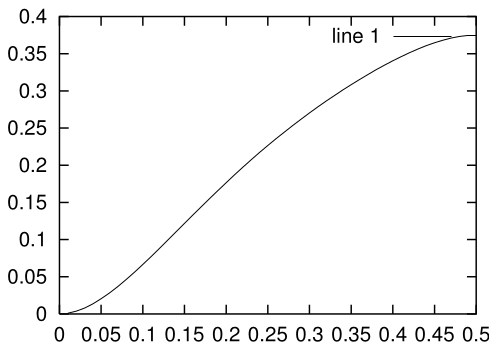
5 Topic: Markov Chains source ↗
A certain town is in a certain country (this is a hypothetical problem). Each year ten percent of the town dwellers move to other parts of the country. Each year one percent of the people from elsewhere move to the town. Assume that there are two states , living in town, and , living elsewhere.
Construct the transition matrix.
Starting with an initial distribution and , get the results for the first ten years.
Do the same for .
Are the two outcomes alike or different?
Answer (4 parts)
From these equations
we get this matrix.
This is the result from Octave.
| 1 | 2 | 3 | 4 | 5 | |
| 6 | 7 | 8 | 9 | 10 |
This is the result.
| 1 | 2 | 3 | 4 | 5 | |
| 6 | 7 | 8 | 9 | 10 |
Although the probability vectors start apart, they end only apart. So they are alike.
6 Topic: Markov Chains source ↗
For the World Series application, use a computer to generate the seven vectors for and .
What is the chance of the National League team winning it all, even though they have only a probability of or of winning any one game?
Graph the probability against the chance that the American League team wins it all. Is there a threshold value — a above which the better team is essentially ensured of winning?
Answer (3 parts)
These are the vectors, and the vectors.
|
|
We can adapt the script from the end of this Topic.
# Octave script file to compute chance of World Series outcomes.
function w = markov(p,v)
q = 1-p;
A=[0,0,0,0,0,0, 0,0,0,0,0,0, 0,0,0,0,0,0, 0,0,0,0,0,0; # 0-0
p,0,0,0,0,0, 0,0,0,0,0,0, 0,0,0,0,0,0, 0,0,0,0,0,0; # 1-0
q,0,0,0,0,0, 0,0,0,0,0,0, 0,0,0,0,0,0, 0,0,0,0,0,0; # 0-1_
0,p,0,0,0,0, 0,0,0,0,0,0, 0,0,0,0,0,0, 0,0,0,0,0,0; # 2-0
0,q,p,0,0,0, 0,0,0,0,0,0, 0,0,0,0,0,0, 0,0,0,0,0,0; # 1-1
0,0,q,0,0,0, 0,0,0,0,0,0, 0,0,0,0,0,0, 0,0,0,0,0,0; # 0-2__
0,0,0,p,0,0, 0,0,0,0,0,0, 0,0,0,0,0,0, 0,0,0,0,0,0; # 3-0
0,0,0,q,p,0, 0,0,0,0,0,0, 0,0,0,0,0,0, 0,0,0,0,0,0; # 2-1
0,0,0,0,q,p, 0,0,0,0,0,0, 0,0,0,0,0,0, 0,0,0,0,0,0; # 1-2_
0,0,0,0,0,q, 0,0,0,0,0,0, 0,0,0,0,0,0, 0,0,0,0,0,0; # 0-3
0,0,0,0,0,0, p,0,0,0,1,0, 0,0,0,0,0,0, 0,0,0,0,0,0; # 4-0
0,0,0,0,0,0, q,p,0,0,0,0, 0,0,0,0,0,0, 0,0,0,0,0,0; # 3-1__
0,0,0,0,0,0, 0,q,p,0,0,0, 0,0,0,0,0,0, 0,0,0,0,0,0; # 2-2
0,0,0,0,0,0, 0,0,q,p,0,0, 0,0,0,0,0,0, 0,0,0,0,0,0; # 1-3
0,0,0,0,0,0, 0,0,0,q,0,0, 0,0,1,0,0,0, 0,0,0,0,0,0; # 0-4_
0,0,0,0,0,0, 0,0,0,0,0,p, 0,0,0,1,0,0, 0,0,0,0,0,0; # 4-1
0,0,0,0,0,0, 0,0,0,0,0,q, p,0,0,0,0,0, 0,0,0,0,0,0; # 3-2
0,0,0,0,0,0, 0,0,0,0,0,0, q,p,0,0,0,0, 0,0,0,0,0,0; # 2-3__
0,0,0,0,0,0, 0,0,0,0,0,0, 0,q,0,0,0,0, 1,0,0,0,0,0; # 1-4
0,0,0,0,0,0, 0,0,0,0,0,0, 0,0,0,0,p,0, 0,1,0,0,0,0; # 4-2
0,0,0,0,0,0, 0,0,0,0,0,0, 0,0,0,0,q,p, 0,0,0,0,0,0; # 3-3_
0,0,0,0,0,0, 0,0,0,0,0,0, 0,0,0,0,0,q, 0,0,0,1,0,0; # 2-4
0,0,0,0,0,0, 0,0,0,0,0,0, 0,0,0,0,0,0, 0,0,p,0,1,0; # 4-3
0,0,0,0,0,0, 0,0,0,0,0,0, 0,0,0,0,0,0, 0,0,q,0,0,1]; # 3-4
v7 = (A**7) * v;
w = v7(11)+v7(16)+v7(20)+v7(23)
endfunctionWhen the American League has a probability of winning each game then their probability of winning the series is . When their probability of winning any one game is then their probability of winning the series is .
From this Octave session and its graph
octave:1> v0=[1;0;0;0;0;0;0;0;0;0;0;0;0;0;0;0;0;0;0;0;0;0;0;0];
octave:2> x=(.01:.01:.99)';
octave:3> y=(.01:.01:.99)';
octave:4> for i=.01:.01:.99
> y(100*i)=markov(i,v0);
> endfor
octave:5> z=[x, y];
octave:6> gplot zby eye we judge that if then the team is close to assured of the series.
7 Topic: Markov Chains source ↗
Above we define a transition matrix to have each entry nonnegative and each column sum to .
Check that the three transition matrices shown in this Topic meet these two conditions. Must any transition matrix do so?
Observe that if and then is a transition matrix from to . Show that a power of a transition matrix is also a transition matrix.
Generalize the prior item by proving that the product of two appropriately-sized transition matrices is a transition matrix.
Answer (3 parts)
They must satisfy this condition because the total probability of a state transition (including back to the same state) is .
See the answer to the third item.
We will do the case; bigger-sized cases are just notational problems. This product
has these two column sums
and
as required.
1 Topic: Orthonormal Matrices source ↗
Decide if each of these is an orthonormal matrix.
Answer (3 parts)
Yes.
No, the columns do not have length one.
Yes.
2 Topic: Orthonormal Matrices source ↗
Write down the formula for each of these distance-preserving maps.
the map that rotates radians, and then translates by
the map that reflects about the line
the map that reflects about and translates over and up
Answer (4 parts)
Some of these are nonlinear, because they involve a nontrivial translation.
The line makes an angle of with the -axis. Thus and .
3 Topic: Orthonormal Matrices source ↗
The proof that a map that is distance-preserving and sends the zero vector to itself incidentally shows that such a map is one-to-one and onto (the point in the domain determined by , , and corresponds to the point in the codomain determined by those three). Therefore any distance-preserving map has an inverse. Show that the inverse is also distance-preserving.
Prove that congruence is an equivalence relation between plane figures.
Answer (2 parts)
Let be distance-preserving and consider . Any two points in the codomain can be written as and . Because is distance-preserving, the distance from to equals the distance from to . But this is exactly what is required for to be distance-preserving.
Any plane figure is congruent to itself via the identity map , which is obviously distance-preserving. If is congruent to (via some ) then is congruent to via , which is distance-preserving by the prior item. Finally, if is congruent to (via some ) and is congruent to (via some ) then is congruent to via , which is easily checked to be distance-preserving.
4 Topic: Orthonormal Matrices source ↗
In practice the matrix for the distance-preserving linear transformation and the translation are often combined into one. Check that these two computations yield the same first two components.
(These are homogeneous coordinates; see the Topic on Projective Geometry).
Answer
The first two components of each are and .
5 Topic: Orthonormal Matrices source ↗
Verify that the properties described in the second paragraph of this Topic as invariant under distance-preserving maps are indeed so.
Give two more properties that are of interest in Euclidean geometry from your experience in studying that subject that are also invariant under distance-preserving maps.
Give a property that is not of interest in Euclidean geometry and is not invariant under distance-preserving maps.
Answer (3 parts)
The Pythagorean Theorem gives that three points are collinear if and only if (for some ordering of them into , , and ), . Of course, where is distance-preserving, this holds if and only if , which, again by Pythagoras, is true if and only if , , and are collinear.
The argument for betweeness is similar (above, is between and ).
If the figure is a triangle then it is the union of three line segments , , and . The prior two paragraphs together show that the property of being a line segment is invariant. So is the union of three line segments, and so is a triangle.
A circle centered at and of radius is the set of all points such that . Applying the distance-preserving map gives that the image is the set of all subject to the condition that . Since , the set is also a circle, with center and radius .
Here are two that are easy to verify: (i) the property of being a right triangle, and (ii) the property of two lines being parallel.
One that was mentioned in the section is the ‘sense’ of a figure. A triangle whose vertices read clockwise as , , may, under a distance-preserving map, be sent to a triangle read , , counterclockwise.
Loading chapter 4…
Exercises and answers are adapted from Linear Algebra by Jim Hefferon, which is free to read and download, and are used under the CC BY-SA 2.5 licence. They are taken from the book’s LaTeX source and set for the web, so they may differ slightly from the printed page. This adaptation is released under the same licence and is neither affiliated with nor endorsed by Jim Hefferon.