Every problem in the chapter beside the book’s answer, a chapter at a time as you scroll.
Chapter 1: The Nature of Light
55 problems · 8 figuresCheck Your Understanding 1.1 §1.1 source ↗
| Medium | n |
|---|---|
| Gases at , 1 atm | |
| Air | 1.000293 |
| Carbon dioxide | 1.00045 |
| Hydrogen | 1.000139 |
| Oxygen | 1.000271 |
| Liquids at | |
| Benzene | 1.501 |
| Carbon disulfide | 1.628 |
| Carbon tetrachloride | 1.461 |
| Ethanol | 1.361 |
| Glycerine | 1.473 |
| Water, fresh | 1.333 |
| Solids at | |
| Diamond | 2.419 |
| Fluorite | 1.434 |
| Glass, crown | 1.52 |
| Glass, flint | 1.66 |
| Ice (at | 1.309 |
| Polystyrene | 1.49 |
| Plexiglas | 1.51 |
| Quartz, crystalline | 1.544 |
| Quartz, fused | 1.458 |
| Sodium chloride | 1.544 |
| Zircon | 1.923 |
Answer
Check Your Understanding 1.2 §1.3 source ↗
| Medium | n |
|---|---|
| Gases at , 1 atm | |
| Air | 1.000293 |
| Carbon dioxide | 1.00045 |
| Hydrogen | 1.000139 |
| Oxygen | 1.000271 |
| Liquids at | |
| Benzene | 1.501 |
| Carbon disulfide | 1.628 |
| Carbon tetrachloride | 1.461 |
| Ethanol | 1.361 |
| Glycerine | 1.473 |
| Water, fresh | 1.333 |
| Solids at | |
| Diamond | 2.419 |
| Fluorite | 1.434 |
| Glass, crown | 1.52 |
| Glass, flint | 1.66 |
| Ice (at | 1.309 |
| Polystyrene | 1.49 |
| Plexiglas | 1.51 |
| Quartz, crystalline | 1.544 |
| Quartz, fused | 1.458 |
| Sodium chloride | 1.544 |
| Zircon | 1.923 |
Answer
Check Your Understanding 1.3 §1.4 source ↗
Answer
Check Your Understanding 1.4 §1.5 source ↗
Answer
Check Your Understanding 1.5 §1.6 source ↗
Answer
Check Your Understanding 1.6 §1.7 source ↗
Answer
Check Your Understanding 1.7 §1.7 source ↗
Answer
1-1 §1.1 source ↗
Answer
1-3 §1.1 source ↗
Answer
1-5 §1.2 source ↗
Answer
1-7 §1.3 source ↗
Answer
1-9 §1.3 source ↗
Answer
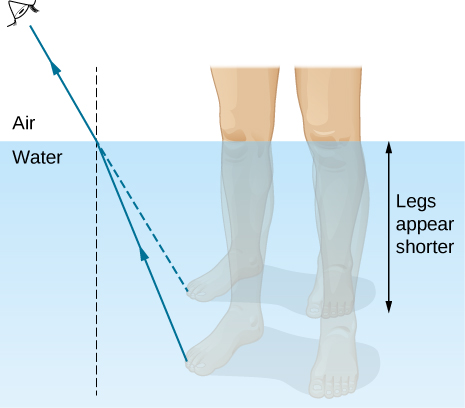
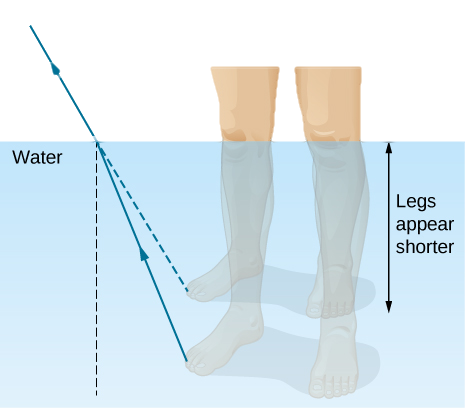
A ray from a leg emerges from water after refraction. The observer in air perceives an apparent location for the source, as if a ray traveled in a straight line. See the dashed ray below.
1-11 §1.4 source ↗
Answer
1-13 §1.4 source ↗
Answer
1-15 §1.5 source ↗
Answer
1-17 §1.6 source ↗
Answer
1-19 §1.7 source ↗
Answer
1-21 §1.7 source ↗
Answer
1-23 §1.7 source ↗
Answer
1-25 §1.7 source ↗
Answer
1-27 §1.1 source ↗
Answer
1-29 §1.1 source ↗
| Medium | n |
|---|---|
| Gases at , 1 atm | |
| Air | 1.000293 |
| Carbon dioxide | 1.00045 |
| Hydrogen | 1.000139 |
| Oxygen | 1.000271 |
| Liquids at | |
| Benzene | 1.501 |
| Carbon disulfide | 1.628 |
| Carbon tetrachloride | 1.461 |
| Ethanol | 1.361 |
| Glycerine | 1.473 |
| Water, fresh | 1.333 |
| Solids at | |
| Diamond | 2.419 |
| Fluorite | 1.434 |
| Glass, crown | 1.52 |
| Glass, flint | 1.66 |
| Ice (at | 1.309 |
| Polystyrene | 1.49 |
| Plexiglas | 1.51 |
| Quartz, crystalline | 1.544 |
| Quartz, fused | 1.458 |
| Sodium chloride | 1.544 |
| Zircon | 1.923 |
Answer
1-31 §1.1 source ↗
Answer
1-33 §1.1 source ↗
Answer
1-35 §1.2 source ↗
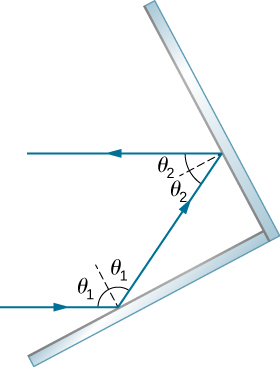
Show that when light reflects from two mirrors that meet each other at a right angle, the outgoing ray is parallel to the incoming ray, as illustrated below.
Answer
1-37 §1.2 source ↗
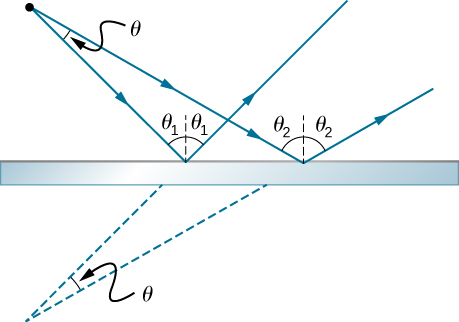
A flat mirror is neither converging nor diverging. To prove this, consider two rays originating from the same point and diverging at an angle (see below). Show that after striking a plane mirror, the angle between their directions remains
Answer
1-39 §1.3 source ↗
Unless otherwise specified, for the following problems, the indices of refraction of glass and water should be taken to be 1.50 and 1.333, respectively.
A light beam in air is incident on the surface of a pond, making an angle of with respect to the surface. What are the angles of reflection and refraction?
Answer
1-41 §1.3 source ↗
Unless otherwise specified, for the following problems, the indices of refraction of glass and water should be taken to be 1.50 and 1.333, respectively.
A pencil flashlight submerged in water sends a light beam toward the surface at an angle of incidence of . What is the angle of refraction in air?
Answer
1-43 §1.3 source ↗
Unless otherwise specified, for the following problems, the indices of refraction of glass and water should be taken to be 1.50 and 1.333, respectively.
The path of a light beam in air goes from an angle of incidence of to an angle of refraction of when it enters a rectangular block of plastic. What is the index of refraction of the plastic?
Answer
1-45 §1.3 source ↗
Unless otherwise specified, for the following problems, the indices of refraction of glass and water should be taken to be 1.50 and 1.333, respectively.
(a) Using information in the preceding problem, find the height of the instructor’s head above the water, noting that you will first have to calculate the angle of incidence. (b) Find the apparent depth of the diver’s head below water as seen by the instructor.
Answer
1-47 §1.4 source ↗
Answer
1-49 §1.4 source ↗
Answer
1-51 §1.4 source ↗
| Medium | n |
|---|---|
| Gases at , 1 atm | |
| Air | 1.000293 |
| Carbon dioxide | 1.00045 |
| Hydrogen | 1.000139 |
| Oxygen | 1.000271 |
| Liquids at | |
| Benzene | 1.501 |
| Carbon disulfide | 1.628 |
| Carbon tetrachloride | 1.461 |
| Ethanol | 1.361 |
| Glycerine | 1.473 |
| Water, fresh | 1.333 |
| Solids at | |
| Diamond | 2.419 |
| Fluorite | 1.434 |
| Glass, crown | 1.52 |
| Glass, flint | 1.66 |
| Ice (at | 1.309 |
| Polystyrene | 1.49 |
| Plexiglas | 1.51 |
| Quartz, crystalline | 1.544 |
| Quartz, fused | 1.458 |
| Sodium chloride | 1.544 |
| Zircon | 1.923 |
Answer
1-53 §1.4 source ↗
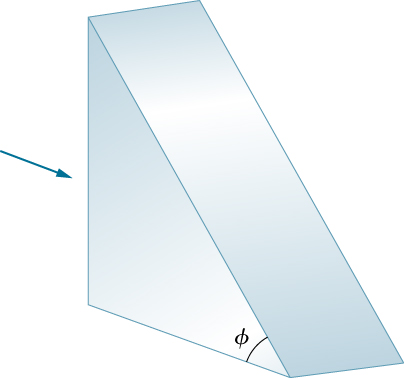
Light rays fall normally on the vertical surface of the glass prism shown below. (a) What is the largest value for such that the ray is totally reflected at the slanted face? (b) Repeat the calculation of part (a) if the prism is immersed in water.
Answer
1-55 §1.5 source ↗
Answer
1-57 §1.5 source ↗
Answer
1-59 §1.5 source ↗
Answer
1-61 §1.5 source ↗
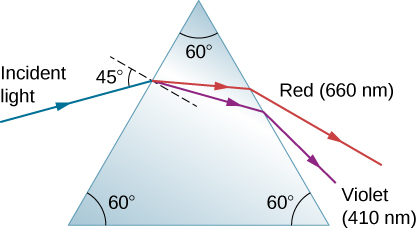
A narrow beam of white light enters a prism made of crown glass at a incident angle, as shown below. At what angles, and , do the red (660 nm) and violet (410 nm) components of the light emerge from the prism?
Answer
1-63 §1.7 source ↗
Answer
1-65 §1.7 source ↗
Answer
1-67 §1.7 source ↗
Answer
1-69 §1.7 source ↗
Answer
1-71 §1.7 source ↗
Answer
1-73 §1.7 source ↗
Answer
1-75 §1.7 source ↗
Answer
1-77 §1.AP source ↗
Answer
1-79 §1.AP source ↗
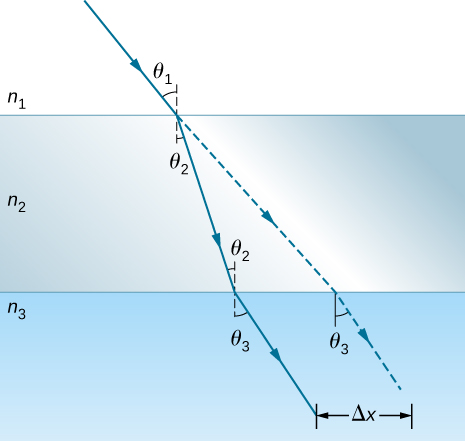
Shown below is a ray of light going from air through crown glass into water, such as going into a fish tank. Calculate the amount the ray is displaced by the glass given that the incident angle is and the glass is 1.00 cm thick.
Answer
1-81 §1.AP source ↗
Answer
1-83 §1.AP source ↗
Answer
1-85 §1.AP source ↗
Answer
1-87 §1.AP source ↗
Answer
1-89 §1.AP source ↗
Answer
1-91 §1.CP source ↗
Answer
1-93 §1.CP source ↗
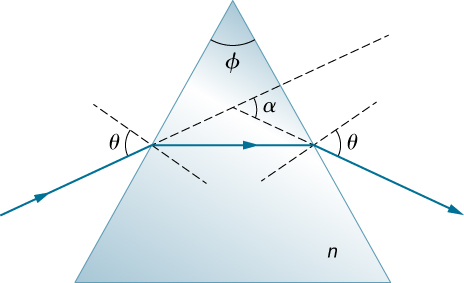
A light ray falls on the left face of a prism (see below) at the angle of incidence for which the emerging beam has an angle of refraction at the right face. Show that the index of refraction n of the glass prism is given by
where is the vertex angle of the prism and is the angle through which the beam has been deviated. If and the base angles of the prism are each what is n?
Answer
1-95 §1.CP source ↗
Answer
Loading chapter 2…
Problems and answers are adapted from University Physics Volume 3 by Samuel J. Ling, Jeff Sanny and William Moebs, OpenStax, and are used under the CC BY-NC-SA 4.0 licence. Access for free at https://openstax.org/books/university-physics-volume-3/pages/1-introduction. Illustrations: Copyright Rice University, OpenStax, under CC BY-NC-SA 4.0 license. This adaptation is released under the same licence, is non-commercial, and is neither affiliated with nor endorsed by OpenStax or Rice University.