Every problem in the chapter beside the book’s answer, a chapter at a time as you scroll.

Chapter 4: Diffraction

68 problems · 4 figures

Check Your Understanding 4.1 §4.1 source ↗

Suppose the slit width in Example 4.1 is increased to 1.8×10⁻⁶m. What are the new angular positions for the first, second, and third minima? Would a fourth minimum exist?

Answer

17.8°, 37.7°, 66.4°; no

Check Your Understanding 4.2 §4.2 source ↗

For the experiment in Example 4.2, at what angle from the center is the third maximum and what is its intensity relative to the central maximum?

Answer

74.3°, 0.0083I0

Check Your Understanding 4.3 §4.3 source ↗

For the experiment in Example 4.4, show that m=20 is also a missing order.

Answer

From dsinθ=mλ, the interference maximum occurs at 2.87° for m=20. From Equation 4.1, this is also the angle for the second diffraction minimum. (Note: Both equations use the index m but they refer to separate phenomena.)

Check Your Understanding 4.4 §4.4 source ↗

If the line spacing of a diffraction grating d is not precisely known, we can use a light source with a well-determined wavelength to measure it. Suppose the first-order constructive fringe of the Hβ emission line of hydrogen (λ=656.3nm) is measured at 11.36° using a spectrometer with a diffraction grating. What is the line spacing of this grating?

Answer

3.332×10⁻⁶m or 300 lines per millimeter

Check Your Understanding 4.5 §4.5 source ↗

What was the angular resolution of the Arecibo telescope shown in Figure 4.20 when operated at 21-cm wavelength? How did it compare to the resolution of the Hubble Telescope?
Figure 4.20 in the book ↗
A 305-m-diameter paraboloid at Arecibo in Puerto Rico was lined with reflective material, making it into a radio telescope. It was the largest curved focusing dish in the world. Although D for Arecibo was much larger than for the Hubble Telescope, it detects radiation of a much longer wavelength and its diffraction limit was significantly poorer than Hubble’s. The Arecibo telescope was still very useful, because important information is carried by radio waves that is not carried by visible light. It collapsed in 2020 and there are currently no plans to rebuild it. (credit: Jeff Hitchcock)

Answer

8.4×10⁻⁴rad, 3000 times broader than the Hubble Telescope

Check Your Understanding 4.6 §4.6 source ↗

For the experiment described in Example 4.7, what are the two other angles where interference maxima may be observed? What limits the number of maxima?

Answer

38.4° and 68.8°; Between θ=0°→90°, orders 1, 2, and 3, are all that exist.

4-1 §4.1 source ↗

As the width of the slit producing a single-slit diffraction pattern is reduced, how will the diffraction pattern produced change?

Answer

The diffraction pattern becomes wider.

4-3 §4.1 source ↗

If you and a friend are on opposite sides of a hill, you can communicate with walkie-talkies but not with flashlights. Explain.

Answer

Walkie-talkies use radio waves whose wavelengths are comparable to the size of the hill and are thus able to diffract around the hill. Visible wavelengths of the flashlight travel as rays at this size scale.

4-5 §4.1 source ↗

In our study of diffraction by a single slit, we assume that the length of the slit is much larger than the width. What happens to the diffraction pattern if these two dimensions were comparable?

Answer

The diffraction pattern becomes two-dimensional, with main fringes, which are now spots, running in perpendicular directions and fainter spots in intermediate directions.

4-7 §4.2 source ↗

In Equation 4.4, the parameter β looks like an angle but is not an angle that you can measure with a protractor in the physical world. Explain what β represents.

Answer

The parameter β=ϕ/2 is the arc angle shown in the phasor diagram in Figure 4.7. The phase difference between the first and last Huygens wavelet across the single slit is 2β and is related to the curvature of the arc that forms the resultant phasor that determines the light intensity.
Figure 4.7 in the book ↗
(a) Phasor diagram corresponding to the angular position θ in the single-slit diffraction pattern. The phase difference between the wavelets from the first and last sources is ϕ= (2π/λ)asinθ. (b) The geometry of the phasor diagram.

4-9 §4.5 source ↗

Is higher resolution obtained in a microscope with red or blue light? Explain your answer.

Answer

blue; The shorter wavelength of blue light results in a smaller angle for diffraction limit.

4-11 §4.5 source ↗

The distance between atoms in a molecule is about 10−8cm. Can visible light be used to “see” molecules?

Answer

No, these distances are three orders of magnitude smaller than the wavelength of visible light, so visible light makes a poor probe for atoms.

4-13 §4.6 source ↗

Crystal lattices can be examined with X-rays but not UV. Why?

Answer

UV wavelengths are much larger than lattice spacings in crystals such that there is no diffraction. The Bragg equation implies a value for sin⁡θ greater than unity, which has no solution.

4-15 §4.7 source ↗

If a hologram is recorded using monochromatic light at one wavelength but its image is viewed at another wavelength, say 10% shorter, what will you see? What if it is viewed using light of exactly half the original wavelength?

Answer

Image will appear at slightly different location and/or size when viewed using 10% shorter wavelength but at exactly half the wavelength, a higher-order interference reconstructs the original image, different color.

4-17 §4.1 source ↗

(a) At what angle is the first minimum for 550-nm light falling on a single slit of width 1.00μm ? (b) Will there be a second minimum?

Answer

a. 33.4°; b. no

4-19 §4.1 source ↗

(a) How wide is a single slit that produces its first minimum for 633-nm light at an angle of 28.0° ? (b) At what angle will the second minimum be?

Answer

a. 1.35×10⁻⁶m; b. 69.9°

4-21 §4.1 source ↗

Find the wavelength of light that has its third minimum at an angle of 48.6° when it falls on a single slit of width 3.00μm.

Answer

750 nm

4-23 §4.1 source ↗

Consider a single-slit diffraction pattern for λ=589nm, projected on a screen that is 1.00 m from a slit of width 0.25 mm. How far from the center of the pattern are the centers of the first and second dark fringes?

Answer

2.4 mm, 4.7 mm

4-25 §4.1 source ↗

(a) What is the minimum width of a single slit (in multiples of λ) that will produce a first minimum for a wavelength λ ? (b) What is its minimum width if it produces 50 minima? (c) 1000 minima?

Answer

a. 1.00λ; b. 50.0λ; c. 1000λ

4-27 §4.1 source ↗

If the separation between the first and the second minima of a single-slit diffraction pattern is 6.0 mm, what is the distance between the screen and the slit? The light wavelength is 500 nm and the slit width is 0.16 mm.

Answer

1.92 m

4-29 §4.1 source ↗

An aircraft maintenance technician walks past a tall hangar door that acts like a single slit for sound entering the hangar. Outside the door, on a line perpendicular to the opening in the door, a jet engine makes a 600-Hz sound. At what angle with the door will the technician observe the first minimum in sound intensity if the vertical opening is 0.800 m wide and the speed of sound is 340 m/s?

Answer

45.1 °

4-31 §4.2 source ↗

A single slit of width 0.1 mm is illuminated by a mercury light of wavelength 576 nm. Find the intensity at a 10° angle to the axis in terms of the intensity of the central maximum.

Answer

I/ I 0 = 2.2× 10 −5

4-33 §4.2 source ↗

Consider the single-slit diffraction pattern for λ=600nm, a=0.025mm, and x=2.0m. Find the intensity in terms of Io at θ=0.5°, 1.0°, 1.5°, 3.0°, and 10.0°.

Answer

0.63 I 0 , 0.11 I 0 , 0.0067 I 0 , 0.0062 I 0 , 0.00088 I 0

4-35 §4.3 source ↗

A double slit produces a diffraction pattern that is a combination of single- and double-slit interference. Find the ratio of the width of the slits to the separation between them, if the first minimum of the single-slit pattern falls on the fifth maximum of the double-slit pattern. (This will greatly reduce the intensity of the fifth maximum.)

Answer

0.200

4-37 §4.3 source ↗

Light of wavelength 500 nm falls normally on 50 slits that are 2.5×10⁻³mm wide and spaced 5.0×10⁻³mm apart. How many interference fringes lie in the central peak of the diffraction pattern?

Answer

3

4-39 §4.3 source ↗

When a monochromatic light of wavelength 430 nm incident on a double slit of slit separation 5μm, there are 11 interference fringes in its central maximum. How many interference fringes will be in the central maximum of a light of the same wavelength and slit widths, but a new slit separation of 4μm?

Answer

9

4-41 §4.4 source ↗

A diffraction grating has 2000 lines per centimeter. At what angle will the first-order maximum be for 520-nm-wavelength green light?

Answer

5.97 °

4-43 §4.4 source ↗

How many lines per centimeter are there on a diffraction grating that gives a first-order maximum for 470-nm blue light at an angle of 25.0° ?

Answer

8.99 × 10 3

4-45 §4.4 source ↗

Calculate the wavelength of light that has its second-order maximum at 45.0° when falling on a diffraction grating that has 5000 lines per centimeter.

Answer

707 nm

4-47 §4.4 source ↗

(a) What do the four angles in the preceding problem become if a 5000-line per centimeter diffraction grating is used? (b) Using this grating, what would the angles be for the second-order maxima? (c) Discuss the relationship between integral reductions in lines per centimeter and the new angles of various order maxima.

Answer

a. 11.8°, 12.5°, 14.1°, 19.2°; b. 24.2°, 25.7°, 29.1°, 41.0°; c. Decreasing the number of lines per centimeter by a factor of x means that the angle for the x-order maximum is the same as the original angle for the first-order maximum.

4-49 §4.4 source ↗

An opal such as that shown in Figure 4.15 acts like a reflection grating with rows separated by about 8μm. If the opal is illuminated normally, (a) at what angle will red light be seen and (b) at what angle will blue light be seen?
Figure 4.15 in the book ↗
(a) This Australian opal and (b) butterfly wings have rows of reflectors that act like reflection gratings, reflecting different colors at different angles. (credit a: modification of work by "Opals-On-Black"/Flickr; credit b: modification of work by “whologwhy”/Flickr)

Answer

a. using λ= 700nm,θ= 5.0°; b. using λ= 460nm,θ= 3.3°

4-51 §4.4 source ↗

(a) Find the maximum number of lines per centimeter a diffraction grating can have and produce a maximum for the smallest wavelength of visible light. (b) Would such a grating be useful for ultraviolet spectra? (c) For infrared spectra?

Answer

a. 26,300 lines/cm; b. yes; c. no

4-53 §4.4 source ↗

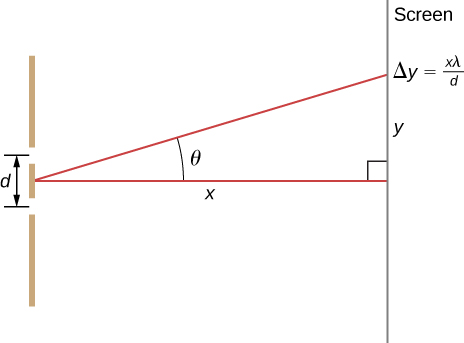
The analysis shown below also applies to diffraction gratings with lines separated by a distance d. What is the distance between fringes produced by a diffraction grating having 125 lines per centimeter for 600-nm light, if the screen is 1.50 m away? (Hint: The distance between adjacent fringes is Δy=xλ/d, assuming the slit separation d is comparable to λ.)

Figure shows two vertical lines, grating on the left and screen on the right separated by a line of length x, perpendicular to them both. There are two slits in the grating, a distance d apart. A line at an angle theta to x meets the screen at point delta y equal to x lambda by d.

Answer

1.13 × 10 −2 m

4-55 §4.5 source ↗

Assuming the angular resolution found for the Hubble Telescope in Example 4.6, what is the smallest detail that could be observed on the moon?
Example 4.6 Calculating Diffraction Limits of the Hubble Space Telescope in the book ↗

Answer

107 m

4-57 §4.5 source ↗

(a) What is the minimum angular spread of a 633-nm wavelength He-Ne laser beam that is originally 1.00 mm in diameter? (b) If this laser is aimed at a mountain cliff 15.0 km away, how big will the illuminated spot be? (c) How big a spot would be illuminated on the moon, neglecting atmospheric effects? (This might be done to hit a corner reflector to measure the round-trip time and, hence, distance.)

Answer

a. 7.72×10⁻⁴rad; b. 23.2 m; c. 590 km

4-59 §4.5 source ↗

The limit to the eye’s acuity is actually related to diffraction by the pupil. (a) What is the angle between two just-resolvable points of light for a 3.00-mm-diameter pupil, assuming an average wavelength of 550 nm? (b) Take your result to be the practical limit for the eye. What is the greatest possible distance a car can be from you if you can resolve its two headlights, given they are 1.30 m apart? (c) What is the distance between two just-resolvable points held at an arm’s length (0.800 m) from your eye? (d) How does your answer to (c) compare to details you normally observe in everyday circumstances?

Answer

a. 2.24×10⁻⁴rad; b. 5.81 km; c. 0.179 mm; d. can resolve details 0.2 mm apart at arm’s length

4-61 §4.5 source ↗

Find the radius of a star’s image on the retina of an eye if its pupil is open to 0.65 cm and the distance from the pupil to the retina is 2.8 cm. Assume λ=550nm.

Answer

2.9 μ m

4-63 §4.5 source ↗

A spy satellite orbits Earth at a height of 180 km. What is the minimum diameter of the objective lens in a telescope that must be used to resolve columns of troops marching 2.0 m apart? Assume λ=550nm.

Answer

6.0 cm

4-65 §4.5 source ↗

The headlights of a car are 1.3 m apart. What is the maximum distance at which the eye can resolve these two headlights? Take the pupil diameter to be 0.40 cm.

Answer

7.71 km

4-67 §4.5 source ↗

Suppose you are looking down at a highway from a jetliner flying at an altitude of 6.0 km. How far apart must two cars be if you are able to distinguish them? Assume that λ=550nm and that the diameter of your pupils is 4.0 mm.

Answer

1.0 m

4-69 §4.5 source ↗

The characters of a stadium scoreboard are formed with closely spaced lightbulbs that radiate primarily yellow light. (Use λ=600nm.) How closely must the bulbs be spaced so that an observer 80 m away sees a display of continuous lines rather than the individual bulbs? Assume that the pupil of the observer’s eye has a diameter of 5.0 mm.

Answer

1.2 cm or closer

4-71 §4.5 source ↗

A camera uses a lens with aperture 2.0 cm. What is the angular resolution of a photograph taken at 700 nm wavelength? Can it resolve the millimeter markings of a ruler placed 35 m away?

Answer

no

4-73 §4.6 source ↗

A first-order Bragg reflection maximum is observed when a monochromatic X-ray of a crystal whose atoms form planes separated by 0.112 nm at a 32.3° angle to a reflecting plane. What is the wavelength of this X-ray?

Answer

0.120 nm

4-75 §4.6 source ↗

The structure of the NaCl crystal forms reflecting planes 0.541 nm apart. What is the smallest angle, measured from these planes, at which X-ray diffraction can be observed, if X-rays of wavelength 0.085 nm are used?

Answer

4.51 °

4-77 §4.6 source ↗

Calcite crystals contain scattering planes separated by 0.30 nm. What is the angular separation between first and second-order diffraction maxima when X-rays of 0.130 nm wavelength are used?

Answer

13.2 °

4-79 §4.AP source ↗

White light falls on two narrow slits separated by 0.40 mm. The interference pattern is observed on a screen 3.0 m away. (a) What is the separation between the first maxima for red light (λ=700nm) and violet light (λ=400nm)? (b) At what point nearest the central maximum will a maximum for yellow light (λ=600nm) coincide with a maximum for violet light? Identify the order for each maximum.

Answer

a. 2.2 mm; b. 0.172°, second-order yellow and third-order violet coincide

4-81 §4.AP source ↗

Quasars, or quasi-stellar radio sources, are astronomical objects discovered in 1960. They are distant but strong emitters of radio waves with angular size so small, they were originally unresolved, the same as stars. The quasar 3C405 is actually two discrete radio sources that subtend an angle of 82 arcsec. If this object is studied using radio emissions at a frequency of 410 MHz, what is the minimum diameter of a radio telescope that can resolve the two sources?

Answer

2.2 km

4-83 §4.AP source ↗

A microwave of an unknown wavelength is incident on a single slit of width 6 cm. The angular width of the central peak is found to be 25°. Find the wavelength.

Answer

1.3 cm

4-85 §4.AP source ↗

A light ray of wavelength 461.9 nm emerges from a 2-mm circular aperture of a krypton ion laser. Due to diffraction, the beam expands as it moves out. How large is the central bright spot at (a) 1 m, (b) 1 km, (c) 1000 km, and (d) at the surface of the moon at a distance of 400,000 km from Earth.

Answer

a. 0.28 mm; b. 0.28 m; c. 280 m; d. 113 km

4-87 §4.AP source ↗

How far apart must two objects be on the moon to be resolvable by the 8.1-m-diameter Gemini North telescope at Mauna Kea, Hawaii, if only the diffraction effects of the telescope aperture limit the resolution? Assume 550 nm for the wavelength of light and 400,000 km for the distance to the moon.

Answer

33 m

4-89 §4.AP source ↗

Monochromatic light of wavelength 530 nm passes through a horizontal single slit of width 1.5μm in an opaque plate. A screen of dimensions 2.0m×2.0m is 1.2 m away from the slit. (a) Which way is the diffraction pattern spread out on the screen? (b) What are the angles of the minima with respect to the center? (c) What are the angles of the maxima? (d) How wide is the central bright fringe on the screen? (e) How wide is the next bright fringe on the screen?

Answer

a. vertically; b. ±20°, ±44°; c. 0, ±31°, ±60°; d. 89 cm; e. 71 cm

4-91 §4.AP source ↗

A source of light having two wavelengths 550 nm and 600 nm of equal intensity is incident on a slit of width 1.8μm. Find the separation of the m=1 bright spots of the two wavelengths on a screen 30.0 cm away.

Answer

0.98 cm

4-93 §4.AP source ↗

A single slit of width 3.0μm is illuminated by a sodium yellow light of wavelength 589 nm. Find the intensity at a 15° angle to the axis in terms of the intensity of the central maximum.

Answer

I / I 0 = 0.041

4-95 §4.AP source ↗

A diffraction grating produces a second maximum that is 89.7 cm from the central maximum on a screen 2.0 m away. If the grating has 6000 lines per centimeter, what is the wavelength of the light that produces the diffraction pattern?

Answer

340 nm

4-97 §4.AP source ↗

A diffraction grating with 2000 lines per centimeter is used to measure the wavelengths emitted by a hydrogen gas discharge tube. (a) At what angles will you find the maxima of the two first-order blue lines of wavelengths 410 and 434 nm? (b) The maxima of two other first-order lines are found at θ1=0.097rad and θ2=0.132rad. What are the wavelengths of these lines?

Answer

a. 0.082 rad and 0.087 rad; b. 480 nm and 660 nm

4-99 §4.AP source ↗

How many complete orders of the visible spectrum (400nm<λ<700nm) can be produced with a diffraction grating that contains 5000 lines per centimeter?

Answer

two orders

4-101 §4.AP source ↗

On a bright clear day, you are at the top of a mountain and looking at a city 12 km away. There are two tall towers 20.0 m apart in the city. Can your eye resolve the two towers if the diameter of the pupil is 4.0 mm? If not, what should be the minimum magnification power of the telescope needed to resolve the two towers? In your calculations use 550 nm for the wavelength of the light.

Answer

yes and N/A

4-103 §4.AP source ↗

Calculate the wavelength of light that produces its first minimum at an angle of 36.9° when falling on a single slit of width 1.00μm.

Answer

600 nm

4-105 §4.AP source ↗

As an example of diffraction by apertures of everyday dimensions, consider a doorway of width 1.0 m. (a) What is the angular position of the first minimum in the diffraction pattern of 600-nm light? (b) Repeat this calculation for a musical note of frequency 440 Hz (A above middle C). Take the speed of sound to be 343 m/s.

Answer

a. 3.4×10⁻⁵°; b. 51°

4-107 §4.AP source ↗

How far would you place a screen from the slit of the previous problem so that the second minimum is a distance of 2.5 mm from the center of the diffraction pattern?

Answer

0.63 m

4-109 §4.AP source ↗

Suppose that the central peak of a single-slit diffraction pattern is so wide that the first minima can be assumed to occur at angular positions of ±90°. For this case, what is the ratio of the slit width to the wavelength of the light?

Answer

1

4-111 §4.AP source ↗

Determine the intensities of three interference peaks other than the central peak in the central maximum of the diffraction, if possible, when a light of wavelength 500 nm is incident normally on a double slit of width 1000 nm and separation 1500 nm. Use the intensity of the central spot to be 1mW/cm2.

Answer

0.17 mW/cm2 for m=1 only, no higher orders

4-113 §4.AP source ↗

Structures on a bird feather act like a reflection grating having 8000 lines per centimeter. What is the angle of the first-order maximum for 600-nm light?

Answer

28.7 °

4-115 §4.AP source ↗

(a) What visible wavelength has its fourth-order maximum at an angle of 25.0° when projected on a 25,000-line per centimeter diffraction grating? (b) What is unreasonable about this result? (c) Which assumptions are unreasonable or inconsistent?

Answer

a. 42.3 nm; b. This wavelength is not in the visible spectrum. c. The number of slits in this diffraction grating is too large. Etching in integrated circuits can be done to a resolution of 50 nm, so slit separations of 400 nm are at the limit of what we can do today. This line spacing is too small to produce diffraction of light.

4-117 §4.AP source ↗

An amateur astronomer wants to build a telescope with a diffraction limit that will allow him to see if there are people on the moons of Jupiter. (a) What diameter mirror is needed to be able to see 1.00-m detail on a Jovian moon at a distance of 7.50×10⁸km from Earth? The wavelength of light averages 600 nm. (b) What is unreasonable about this result? (c) Which assumptions are unreasonable or inconsistent?

Answer

a. 549 km; b. This is an unreasonably large telescope. c. Unreasonable to assume diffraction limit for optical telescopes unless in space due to atmospheric effects.

4-119 §4.CP source ↗

(a) Assume that the maxima are halfway between the minima of a single-slit diffraction pattern. The use the diameter and circumference of the phasor diagram, as described in Intensity in Single-Slit Diffraction, to determine the intensities of the third and fourth maxima in terms of the intensity of the central maximum. (b) Do the same calculation, using Equation 4.4.

Answer

a. I= 0.00500I0, 0.00335I0; b. I= 0.00500I0, 0.00335I0

4-121 §4.CP source ↗

What is the maximum number of lines per centimeter a diffraction grating can have and produce a complete first-order spectrum for visible light?

Answer

12,800

4-123 §4.CP source ↗

A He-Ne laser beam is reflected from the surface of a CD onto a wall. The brightest spot is the reflected beam at an angle equal to the angle of incidence. However, fringes are also observed. If the wall is 1.50 m from the CD, and the first fringe is 0.600 m from the central maximum, what is the spacing of grooves on the CD?

Answer

1.58 × 10 −6 m

Loading chapter 5…

Problems and answers are adapted from University Physics Volume 3 by Samuel J. Ling, Jeff Sanny and William Moebs, OpenStax, and are used under the CC BY-NC-SA 4.0 licence. Access for free at https://openstax.org/books/university-physics-volume-3/pages/1-introduction. Illustrations: Copyright Rice University, OpenStax, under CC BY-NC-SA 4.0 license. This adaptation is released under the same licence, is non-commercial, and is neither affiliated with nor endorsed by OpenStax or Rice University.