Every problem in the chapter beside the book’s answer, a chapter at a time as you scroll.

Chapter 2: Geometric Optics and Image Formation

76 problems · 17 figures

2-1 §2.1 source ↗

What are the differences between real and virtual images? How can you tell (by looking) whether an image formed by a single lens or mirror is real or virtual?

Answer

Virtual image cannot be projected on a screen. You cannot distinguish a real image from a virtual image simply by judging from the image perceived with your eye.

2-3 §2.1 source ↗

Can you photograph a virtual image?

Answer

Yes, you can photograph a virtual image. For example, if you photograph your reflection from a plane mirror, you get a photograph of a virtual image. The camera focuses the light that enters its lens to form an image; whether the source of the light is a real object or a reflection from mirror (i.e., a virtual image) does not matter.

2-5 §2.1 source ↗

Is it necessary to project a real image onto a screen to see it?

Answer

No, you can see the real image the same way you can see the virtual image. The retina of your eye effectively serves as a screen.

2-7 §2.1 source ↗

If you wish to see your entire body in a flat mirror (from head to toe), how tall should the mirror be? Does its size depend upon your distance away from the mirror? Provide a sketch.

Answer

The mirror should be half your size and its top edge should be at the level of your eyes. The size does not depend on your distance from the mirror.

2-9 §2.2 source ↗

Under what circumstances will an image be located at the focal point of a spherical lens or mirror?

Answer

when the object is at infinity; see the mirror equation

2-11 §2.2 source ↗

Can an image be larger than the object even though its magnification is negative? Explain.

Answer

Yes, negative magnification simply means that the image is upside down; this does not prevent the image from being larger than the object. For instance, for a concave mirror, if distance to the object is larger than one focal distance but smaller than two focal distances the image will be inverted and magnified.

2-13 §2.3 source ↗

Use a ruler and a protractor to find the image by refraction in the following cases. Assume an air-glass interface. Use a refractive index of 1 for air and of 1.5 for glass. (Hint: Use Snell’s law at the interface.)

(a) A point object located on the axis of a concave interface located at a point within the focal length from the vertex.

(b) A point object located on the axis of a concave interface located at a point farther than the focal length from the vertex.

(c) A point object located on the axis of a convex interface located at a point within the focal length from the vertex.

(d) A point object located on the axis of a convex interface located at a point farther than the focal length from the vertex.

(e) Repeat (a)–(d) for a point object off the axis.

Answer

answers may vary

2-15 §2.4 source ↗

When you focus a camera, you adjust the distance of the lens from the film. If the camera lens acts like a thin lens, why can it not be a fixed distance from the film for both near and distant objects?

Answer

The focal length of the lens is fixed, so the image distance changes as a function of object distance.

2-17 §2.4 source ↗

Will the focal length of a lens change when it is submerged in water? Explain.

Answer

Yes, the focal length will change. The lens maker’s equation shows that the focal length depends on the index of refraction of the medium surrounding the lens. Because the index of refraction of water differs from that of air, the focal length of the lens will change when submerged in water.

2-19 §2.5 source ↗

When laser light is shone into a relaxed normal-vision eye to repair a tear by spot-welding the retina to the back of the eye, the rays entering the eye must be parallel. Why?

Answer

A relaxed, normal-vision eye will focus parallel rays of light onto the retina.

2-21 §2.5 source ↗

It has become common to replace the cataract-clouded lens of the eye with an internal lens. This intraocular lens can be chosen so that the person has perfect distant vision. Will the person be able to read without glasses? If the person was nearsighted, is the power of the intraocular lens greater or less than the removed lens?

Answer

A person with an internal lens will need glasses to read because their muscles cannot distort the lens as they do with biological lenses, so they cannot focus on near objects. To correct nearsightedness, the power of the intraocular lens must be less than that of the removed lens.

2-23 §2.8 source ↗

Geometric optics describes the interaction of light with macroscopic objects. Why, then, is it correct to use geometric optics to analyze a microscope’s image?

Answer

Microscopes create images of macroscopic size, so geometric optics applies.

2-25 §2.8 source ↗

If you want your microscope or telescope to project a real image onto a screen, how would you change the placement of the eyepiece relative to the objective?

Answer

The eyepiece would be moved slightly farther from the objective so that the image formed by the objective falls just beyond the focal length of the eyepiece.

2-27 §2.1 source ↗

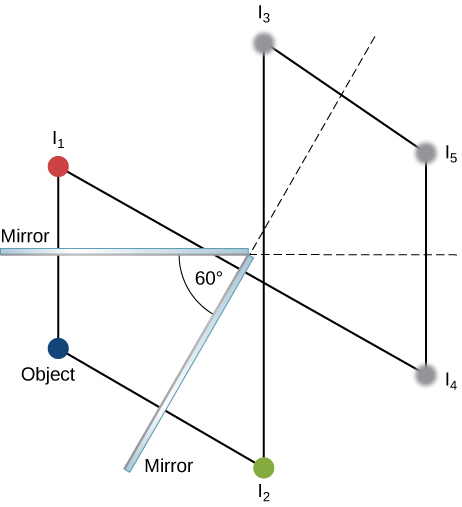
Consider a pair of flat mirrors that are positioned so that they form an angle of 60°. An object is placed on the bisector between the mirrors. Construct a ray diagram as in Figure 2.4 to show how many images are formed.
Figure 2.4 in the book ↗
Two mirrors can produce multiple images. (a) Three images of a plastic head are visible in the two mirrors at a right angle. (b) A single object reflecting from two mirrors at a right angle can produce three images, as shown by the green, purple, and red images.

Answer

Figure shows cross sections of two mirrors placed at an angle of 60 degrees to each other. Six small circles labeled object, I1, I2, I3, I4 and I5 are shown. The object is on the bisector between the mirrors. Line 1 intersects mirror 1 perpendicularly connecting the object to I1 on the other side of the mirror. Line 2 intersects the mirror 2 perpendicularly connecting the object to I2 on the other side of the mirror. Lines parallel to these respectively connect I2 to I3 and I1 to I4. Lines parallel to these respectively connect I4 to I5 and I3 to I5.

2-29 §2.2 source ↗

The following figure shows a light bulb between two spherical mirrors. One mirror produces a beam of light with parallel rays; the other keeps light from escaping without being put into the beam. Where is the filament of the light in relation to the focal point or radius of curvature of each mirror?
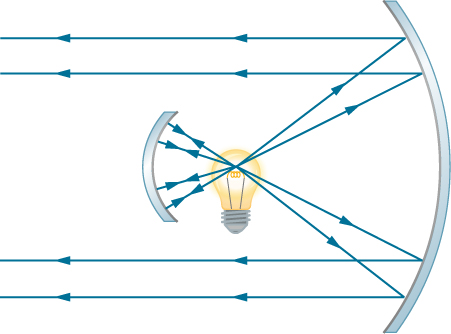
A light bulb is shown in the centre, with a small concave mirror to its left and a bigger one to its right. The light rays originating from the bulb that hit the smaller mirror are reflected back to the bulb. Light rays from the bulb that hit the bigger mirror are reflected. These reflected rays are parallel and travel towards the left.

Answer

It is in the focal point of the big mirror and at the center of curvature of the small mirror.

2-31 §2.2 source ↗

Some telephoto cameras use a mirror rather than a lens. What radius of curvature mirror is needed to replace a 800 mm-focal length telephoto lens?

Answer

f= R 2 ⇒R= + 1.60m

2-33 §2.2 source ↗

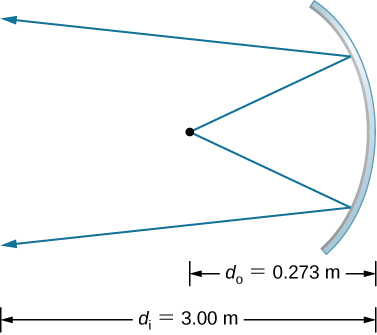
Electric room heaters use a concave mirror to reflect infrared (IR) radiation from hot coils. Note that IR radiation follows the same law of reflection as visible light. Given that the mirror has a radius of curvature of 50.0 cm and produces an image of the coils 3.00 m away from the mirror, where are the coils?

Answer

d o = 27.3 cm

2-35 §2.2 source ↗

What is the focal length of a makeup mirror that produces a magnification of 1.50 when a person’s face is 12.0 cm away? Explicitly show how you follow the steps in the Spherical Mirrors.

Answer

Step 1: Image formation by a mirror is involved.
Step 2: Draw the problem set up when possible.
Step 3: Find f.
Step 4: Given: m= 1.50, do= 0.120m.
Step 5: No ray tracing is needed.
Step 6: Using the mirror equation, Equation 2.3, m= dido, di= –mdo= –(1.50)(0.120m)= –0.180m. Then,
f= (1do+1di)−1= (1–0.180m+10.120M)–1= 0.360m.
Step 7: The image is virtual because the image distance is negative. The focal length is positive, so the mirror is concave.

2-37 §2.2 source ↗

An object 1.50 cm high is held 3.00 cm from a person’s cornea, and its reflected image is measured to be 0.167 cm high. (a) What is the magnification? (b) Where is the image? (c) Find the radius of curvature of the convex mirror formed by the cornea. (Note that this technique is used by optometrists to measure the curvature of the cornea for contact lens fitting. The instrument used is called a keratometer, or curve measurer.)

Answer

a. for a convex mirror di< 0⇒m> 0.m= + 0.111; b. di=−0.334cm (behind the cornea);
c. f= −0.376cm, so thatR= −0.752cm

2-39 §2.2 source ↗

Show that, for a flat mirror, hi=ho, given that the image is the same distance behind the mirror as the distance of the object from the mirror.

Answer

m= h i h o = − d i d o = − − d o d o = d o d o = 1⇒ h i = h o

2-41 §2.2 source ↗

Referring to the electric room heater considered in Exercise 2.33 and Exercise 2.34, calculate the intensity of IR radiation in W/m2 projected by the concave mirror on a person 3.00 m away. Assume that the heating element radiates 1500 W and has an area of 100cm2, and that half of the radiated power is reflected and focused by the mirror.

Answer

Figure shows the cross section of a concave mirror. Two rays originating from a point strike the mirror and are reflected. The distance of the point from the mirror is labeled d subscript o = 0.273 m and d subscript i = 3.00 m.


m=−11.0A′=0.110m2I=6.82kW/m2

2-43 §2.2 source ↗

Two parallel mirrors are facing each other and are separated by a distance of 3 cm. A point object is placed between the mirrors 1 cm from one of the mirrors. Find the coordinates of all the images.

Answer

x 2 m = − x 2 m − 1 , ( m = 1 , 2 , 3 , ... ) , x 2 m + 1 = b − x 2 m , ( m = 0 , 1 , 2 , ... ) , with x 0 = a .

2-45 §2.3 source ↗

An object is located in air 30 cm from the vertex of a convex surface made of glass with a radius of curvature 80 cm. Where does the image by refraction form and what is its magnification?

Answer

d i = −55cm; m= + 1.8

2-47 §2.3 source ↗

An object is located in water 30 cm from the vertex of a convex surface made of Plexiglas with a radius of curvature of 80 cm. Where does the image form by refraction and what is its magnification? nwater=4/3 and nPlexiglas= 1.65.

Answer

d i = −41cm,m= 1.4

2-49 §2.3 source ↗

Derive the spherical interface equation for refraction at a concave surface. (Hint: Follow the derivation in the text for the convex surface.)

Answer

proof

2-51 §2.4 source ↗

A certain slide projector has a 100 mm-focal length lens. (a) How far away is the screen if a slide is placed 103 mm from the lens and produces a sharp image? (b) If the slide is 24.0 by 36.0 mm, what are the dimensions of the image? Explicitly show how you follow the steps in the Lenses.

Answer

a. 1di+ 1do= 1f⇒di= 3.43m;
b. m=−33.33, so that (2.40×10⁻²m)(33.33)=80.0cm, and(3.60×10⁻²m)(33.33)=1.20m⇒0.800m×1.20m or80.0cm×120cm

2-53 §2.4 source ↗

A camera with a 50.0-mm focal length lens is being used to photograph a person standing 3.00 m away. (a) How far from the lens must the film be? (b) If the film is 36.0 mm high, what fraction of a 1.75-m-tall person will fit on it? (c) Discuss how reasonable this seems, based on your experience in taking or posing for photographs.

Answer

a. 1do+1di=1fdi=5.08cm;
b. m= −1.695×10⁻², so the maximum height is 0.036m1.695×10−2= 2.12m⇒100%;
c. This seems quite reasonable, since at 3.00 m it is possible to get a full length picture of a person.

2-55 §2.4 source ↗

Suppose your 50.0 mm-focal length camera lens is 51.0 mm away from the film in the camera. (a) How far away is an object that is in focus? (b) What is the height of the object if its image is 2.00 cm high?

Answer

a. 1do+ 1di= 1f⇒do= 2.55m;
b. hiho= −dido⇒ho= 1.00m

2-57 §2.4 source ↗

The magnification of a book held 7.50 cm from a 10.0 cm-focal length lens is 4.00. (a) Find the magnification for the book when it is held 8.50 cm from the magnifier. (b) Repeat for the book held 9.50 cm from the magnifier. (c) Comment on how magnification changes as the object distance increases as in these two calculations.

Answer

a. Using 1do+1di=1f, di=−56.67cm. Then we can determine the magnification, m=6.67. b. di=−190cm and m=+20.0; c. The magnification m increases rapidly as you increase the object distance toward the focal length.

2-59 §2.4 source ↗

A camera with a 100 mm-focal length lens is used to photograph the sun. What is the height of the image of the sun on the film, given the sun is 1.40×10⁶km in diameter and is 1.50×10⁸km away?

Answer

1 d o + 1 d i = 1 f d i = 1 ( 1 / f ) − ( 1 / d o ) d i d o = 6.667 × 10 −13 = h i h o h i = −0.933 mm

2-61 §2.4 source ↗

An object of height 3.0 cm is placed 5.0 cm in front of a converging lens of focal length 20 cm and observed from the other side. Where and how large is the image?

Answer

di=−6.7cm
hi=4.0cm

2-63 §2.4 source ↗

An object of height 3.0 cm is placed at 25 cm in front of a diverging lens of focal length 20 cm. Behind the diverging lens, there is a converging lens of focal length 20 cm. The distance between the lenses is 5.0 cm. Find the location and size of the final image.

Answer

83 cm to the right of the converging lens, m= −2.3, hi= 6.9cm

2-65 §2.5 source ↗

Unless otherwise stated, the lens-to-retina distance is 2.00 cm.

What is the power of the eye when viewing an object 50.0 cm away?

Answer

P = 52.0 D

2-67 §2.5 source ↗

Unless otherwise stated, the lens-to-retina distance is 2.00 cm.

The print in many books averages 3.50 mm in height. How high is the image of the print on the retina when the book is held 30.0 cm from the eye?

Answer

h i h o = − d i d o ⇒ h i = − h o ( d i d o )= −(3.50mm)( 2.00 cm 30.0 cm )= −0.233mm

2-69 §2.5 source ↗

Unless otherwise stated, the lens-to-retina distance is 2.00 cm.

People who do very detailed work close up, such as jewelers, often can see objects clearly at much closer distance than the normal 25 cm. (a) What is the power of the eyes of a woman who can see an object clearly at a distance of only 8.00 cm? (b) What is the image size of a 1.00-mm object, such as lettering inside a ring, held at this distance? (c) What would the size of the image be if the object were held at the normal 25.0 cm distance?

Answer

a. P=+62.5D;
b. hiho= −dido⇒hi= −0.250mm;
c. hi= −0.0800mm

2-71 §2.5 source ↗

Unless otherwise stated, the lens-to-retina distance is 2.00 cm.

What is the near point of a person whose eyes have an accommodated power of 53.5 D?

Answer

P= 1 d o + 1 d i ⇒ d o = 28.6cm

2-73 §2.5 source ↗

Unless otherwise stated, the lens-to-retina distance is 2.00 cm.

The power for normal close vision is 54.0 D. In a vision-correction procedure, the power of a patient’s eye is increased by 3.00 D. Assuming that this produces normal close vision, what was the patient’s near point before the procedure?

Answer

Originally, the close vision was 51.0 D. Therefore, P= 1do+ 1di⇒do= 1.00m

2-75 §2.5 source ↗

Unless otherwise stated, the lens-to-retina distance is 2.00 cm.

The power for normal distant vision is 50.0 D. A severely myopic patient has a far point of 5.00 cm. By how many diopters should the power of his eye be reduced in laser vision correction to obtain normal distant vision for him?

Answer

originally, P=70.0D; because the power for normal distant vision is 50.0 D, the power should be decreased by 20.0 D

2-77 §2.5 source ↗

Unless otherwise stated, the lens-to-retina distance is 2.00 cm.

The power of a physician’s eyes is 53.0 D while examining a patient. How far from her eyes is the object that is being examined?

Answer

P= 1 d o + 1 d i ⇒ d o = 0.333m

2-79 §2.5 source ↗

Unless otherwise stated, the lens-to-retina distance is 2.00 cm.

The far point of a myopic administrator is 50.0 cm. (a) What is the relaxed power of his eyes? (b) If he has the normal 8.00% ability to accommodate, what is the closest object he can see clearly?

Answer

a. P=52.0D;
b. P′=56.16D1do+1di=P⇒do=16.2cm

2-81 §2.5 source ↗

Unless otherwise stated, the lens-to-retina distance is 2.00 cm.

Repeat the previous problem for eyeglasses held 1.50 cm from the eyes.

Answer

We need di=−18.5cm when do=∞, so
P=−5.41D

2-83 §2.5 source ↗

Unless otherwise stated, the lens-to-retina distance is 2.00 cm.

Repeat the previous problem for glasses that are 1.75 cm from the eyes.

Answer

Let x = far point
⇒P=1−(x−0.0175m)+1∞⇒−xP+(0.0175m)P=1⇒x=26.8cm

2-85 §2.7 source ↗

If the image formed on the retina subtends an angle of 30° and the object subtends an angle of 5°, what is the magnification of the image?

Answer

M = 6 ×

2-87 §2.7 source ↗

How far should you hold a 2.1 cm-focal length magnifying glass from an object to obtain a magnification of 10×? Assume you place your eye 5.0 cm from the magnifying glass.

Answer

M=(25cmL)(1+L−ℓf) 1do+1–13.1=12.1 do=1.81cm

2-89 §2.7 source ↗

You view a mountain with a magnifying glass of focal length f=10cm. What is the magnification?

Answer

M = 2.5 ×

2-91 §2.7 source ↗

A magnifying glass forms an image 10 cm on the opposite side of the lens from the object, which is 10 cm away. What is the magnification of this lens for a person with a normal near point if their eye is 12 cm from the image?

Answer

M = −2.1 ×

2-93 §2.7 source ↗

For a normal, relaxed eye, a magnifying glass produces an angular magnification of 4.0. What is the largest magnification possible with this magnifying glass?

Answer

M = 25 cm f M max = 5

2-95 §2.7 source ↗

A magnifying glass produces an angular magnification of 4.5 when used by a young person with a near point of 18 cm. What is the maximum angular magnification obtained by an older person with a near point of 45 cm?

Answer

M max young = 1 + 18 cm f ⇒ f = 18 cm M max young − 1 M max old = 9.8 ×

2-97 §2.8 source ↗

(a) What magnification is produced by a 0.150 cm-focal length microscope objective that is 0.155 cm from the object being viewed? (b) What is the overall magnification if an 8× eyepiece (one that produces an angular magnification of 8.00) is used?

Answer

a. 1do+1di=1f⇒di=4.65cm⇒m=−30.0;
b. Mnet=−240

2-99 §2.8 source ↗

An amoeba is 0.305 cm away from the 0.300 cm-focal length objective lens of a microscope. (a) Where is the image formed by the objective lens? (b) What is this image’s magnification? (c) An eyepiece with a 2.00-cm focal length is placed 20.0 cm from the objective. Where is the final image? (d) What angular magnification is produced by the eyepiece? (e) What is the overall magnification? (See Figure 2.39.)
Figure 2.39 in the book ↗
A compound microscope is composed of two lenses: an objective and an eyepiece. The objective forms the first image, which is larger than the object. This first image is inside the focal length of the eyepiece and serves as the object for the eyepiece. The eyepiece forms final image that is further magnified.

Answer

a. 1doobj+ 1diobj= 1fobj⇒diobj= 18.3cm behind the objective lens;
b. mobj=−60.0;
c. doeye=1.70cmdieye=−11.3cm
in front of the eyepiece; d. Meye=13.5;
e. Mnet=−810

2-101 §2.8 source ↗

Unless otherwise stated, the lens-to-retina distance is 2.00 cm.

What is the angular magnification of a telescope that has a 100 cm-focal length objective and a 2.50 cm-focal length eyepiece?

Answer

M = −40.0

2-103 §2.8 source ↗

Unless otherwise stated, the lens-to-retina distance is 2.00 cm.

A large reflecting telescope has an objective mirror with a 10.0-m radius of curvature. What angular magnification does it produce when a 3.00 m-focal length eyepiece is used?

Answer

f obj = R 2 , M= −1.67

2-105 §2.8 source ↗

Unless otherwise stated, the lens-to-retina distance is 2.00 cm.

A 7.5× binocular produces an angular magnification of −7.50, acting like a telescope. (Mirrors are used to make the image upright.) If the binoculars have objective lenses with a 75.0-cm focal length, what is the focal length of the eyepiece lenses?

Answer

M= − f obj f eye , f eye = + 10.0cm

2-107 §2.8 source ↗

Unless otherwise stated, the lens-to-retina distance is 2.00 cm.

Trace rays to find which way the given ray will emerge after refraction through the thin lens in the following figure. Assume thin-lens approximation. (Hint: Pick a point P on the given ray in each case. Treat that point as an object. Now, find its image Q. Use the rule: All rays on the other side of the lens will either go through Q or appear to be coming from Q.)
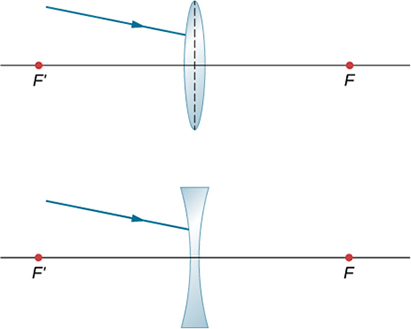
Figure a shows a ray not parallel to the optical axis striking a bi-convex lens. Figure a shows a ray not parallel to the optical axis striking a bi-concave lens.

Answer

Answers will vary.

2-109 §2.8 source ↗

Unless otherwise stated, the lens-to-retina distance is 2.00 cm.

A concave mirror of radius of curvature 10 cm is placed 30 cm from a thin convex lens of focal length 15 cm. Find the location and magnification of a small bulb sitting 50 cm from the lens by using the algebraic method.

Answer

12 cm to the left of the mirror, m=3/5

2-111 §2.8 source ↗

Unless otherwise stated, the lens-to-retina distance is 2.00 cm.

An object of height 3 cm is placed at a distance of 25 cm in front of a converging lens of focal length 20 cm, to be referred to as the first lens. Behind the lens there is another converging lens of focal length 20 cm placed 10 cm from the first lens. There is a concave mirror of focal length 15 cm placed 50 cm from the second lens. Find the location, orientation, and size of the final image.

Answer

27 cm in front of the mirror, m= 0.6, hi= 1.76cm, orientation upright

2-113 §2.8 source ↗

Unless otherwise stated, the lens-to-retina distance is 2.00 cm.

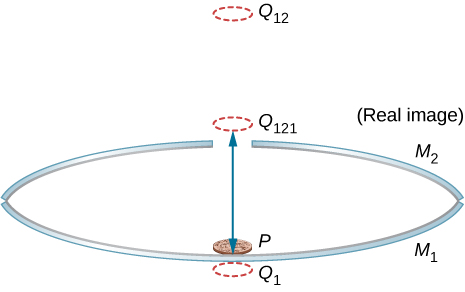
Two concave mirrors are placed facing each other. One of them has a small hole in the middle. A penny is placed on the bottom mirror (see the following figure). When you look from the side, a real image of the penny is observed above the hole. Explain how that could happen.
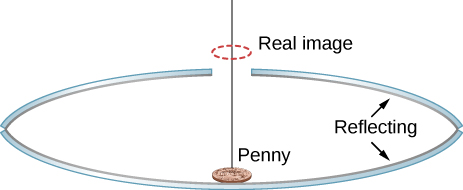
Figure shows the side view of two concave mirrors placed one on top of the other, facing each other. The top one has a small hole in the middle. A penny is placed on the bottom mirror. An image of the penny is shown above the top mirror, just above the hole.

Answer

The following figure shows three successive images beginning with the image Q1 in mirror M1. Q1 is the image in mirror M1, whose image in mirror M2 is Q12 whose image in mirror M1 is the real image Q121.

Figure shows the side view of two concave mirrors, M1 and M2 placed one on top of the other, facing each other. The top, M2, one has a small hole in the middle. A penny is placed on the bottom mirror. An image of the penny labeled Q subscript 1 is shown below M1. Another image of the penny, labeled Q subscript 121 is shown above the top mirror. This is labeled real image.

2-115 §2.8 source ↗

Unless otherwise stated, the lens-to-retina distance is 2.00 cm.

Parallel rays from a faraway source strike a converging lens of focal length 20 cm at an angle of 15 degrees with the horizontal direction. Find the vertical position of the real image observed on a screen in the focal plane.

Answer

5.4 cm from the axis

2-117 §2.8 source ↗

Unless otherwise stated, the lens-to-retina distance is 2.00 cm.

A light bulb is placed 10 cm from a plane mirror, which faces a convex mirror of radius of curvature 8 cm. The plane mirror is located at a distance of 30 cm from the vertex of the convex mirror. Find the location of two images in the convex mirror. Are there other images? If so, where are they located?

Answer

Let the vertex of the concave mirror be the origin of the coordinate system. Image 1 is at −10/3 cm (−3.3 cm), image 2 is at −40/11 cm (−3.6 cm). These serve as objects for subsequent images, which are at −310/83 cm (−3.7 cm), −9340/2501 cm (−3.7 cm), −140,720/37,681 cm (−3.7 cm). All remaining images are at approximately −3.7 cm.

2-119 §2.8 source ↗

Unless otherwise stated, the lens-to-retina distance is 2.00 cm.

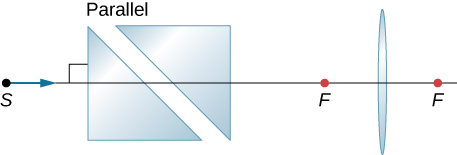
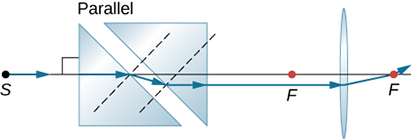
Copy and trace to find how a horizontal ray from S comes out after the lens. Use nglass=1.5 for the prism material.

Figure shows two prisms with their bases parallel to each other at an angle of 45 degrees to the horizontal. To the right of this is a bi-convex lens. A ray along the optical axis enters this set up from the left.

Answer

Figure shows two prisms with their bases parallel to each other at an angle of 45 degrees to the horizontal. To the right of this is a bi-convex lens. A ray along the optical axis enters this set up from the left, deviates between the two prisms and travels parallel to the optical axis, slightly below it. It enters the lens and deviates to pass through its focal point on the other side.

2-121 §2.8 source ↗

Unless otherwise stated, the lens-to-retina distance is 2.00 cm.

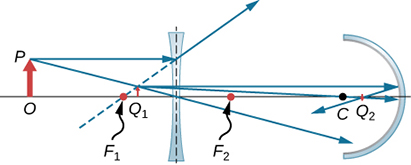
Copy and draw rays to figure out the final image.
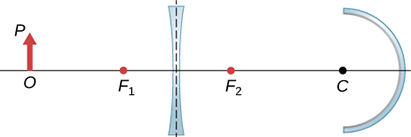
Figure shows from left to right: an object with base O on the axis and tip P. A bi-concave lens with focal point F1 and F2 on the left and right respectively and a concave mirror with centre of curvature C.

Answer

Figure shows from left to right: an object with base O on the axis and tip P. A bi-concave lens with focal point F1 and F2 on the left and right respectively and a concave mirror with center of curvature C. Two rays originate from P and diverge through the bi-concave lens. Their back extensions converge between F1 and the lens to form image Q1. Two rays originating from the tip of Q1 strike the mirror, are reflected and converge at Q2 between C and the mirror.

2-123 §2.8 source ↗

Unless otherwise stated, the lens-to-retina distance is 2.00 cm.

A diverging lens has a focal length of 20 cm. What is the power of the lens in diopters?

Answer

−5 D

2-125 §2.8 source ↗

Unless otherwise stated, the lens-to-retina distance is 2.00 cm.

What will be the angular magnification of a convex lens with the focal length 2.5 cm?

Answer

11

2-127 §2.AP source ↗

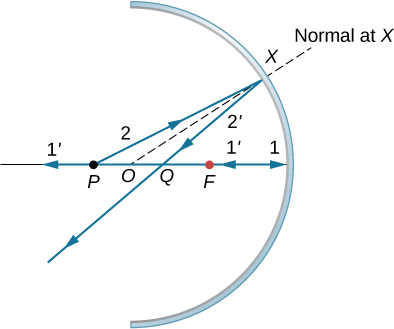
Use a ruler and a protractor to draw rays to find images in the following cases.

(a) A point object located on the axis of a concave mirror located at a point within the focal length from the vertex.
(b) A point object located on the axis of a concave mirror located at a point farther than the focal length from the vertex.
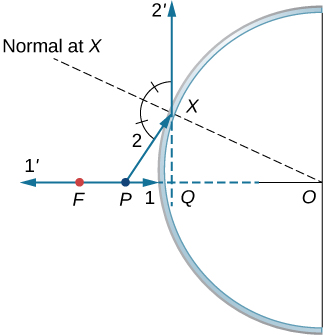
(c) A point object located on the axis of a convex mirror located at a point within the focal length from the vertex.
(d) A point object located on the axis of a convex mirror located at a point farther than the focal length from the vertex.
(e) Repeat (a)–(d) for a point object off the axis.

Answer

a.
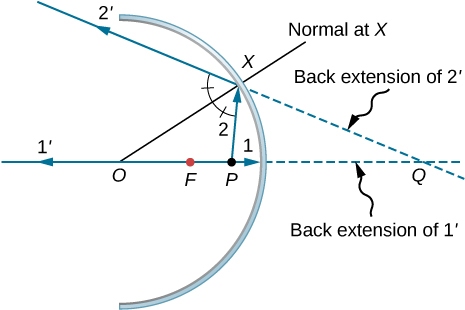
Figure shows the cross section of a concave mirror with centre of curvature O and focal point F. Point P lies on the axis between point F and the mirror. Ray 1 originates from point P, travels along the axis and hits the mirror. The reflected ray 1 prime travels back along the axis. Ray 2 originates from P and hits the mirror at point X. The reflected ray is labeled 2 prime. Line OX, labeled normal at X, bisects the angle formed by PX and ray 2 prime. The back extensions of 1 prime and 2 prime intersect at point Q.


b.

Figure shows the cross section of a concave mirror with points P, O, Q and F lying on the optical axis. Point P is furthest from the mirror. Ray 1 originates from P, travels along the axis and hits the mirror. The reflected ray 1 prime travels back along the axis. Ray 2 originates from P and hits the mirror at point X. The reflected ray 2 prime intersects the axis at point Q, which lies between points P and F. OX, labeled normal at X, bisects the angle PXQ.


c.

Figure shows a convex mirror with point P lying between point F and the mirror on the optical axis. Ray 1 originates from P, travels along the axis and hits the mirror. The reflected ray 1 prime travels back along the axis. Ray 2 originates from P and hits the mirror at point X. The angle formed by reflected ray 2 prime and PX is bisected by OX, the normal at X. The back extensions of 1 prime and 2 prime intersect at point Q, just behind the mirror.


d. similar to the previous picture but with point P outside the focal length; e. Repeat (a)–(d) for a point object off the axis. For a point object placed off axis in front of a concave mirror corresponding to parts (a) and (b), the case for convex mirror left as exercises.
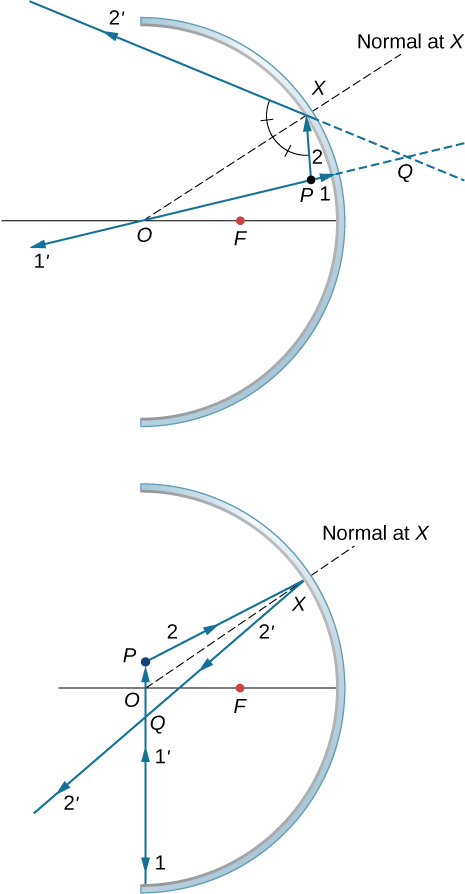
Figure a shows the cross section of a concave mirror. Point P lies above the axis, closer to the mirror than focal point F. Ray 1 originates from P and hits the mirror. Reflected ray 1 prime travels back along the same line as ray 1 and intersects the optical axis at point O. Ray 2 originates from point P and hits the mirror at point X. The reflected ray is labeled 2 prime. The back extensions of 1 prime and 2 prime intersect at point Q behind the mirror. The angle formed by rays 2 and 2 prime is bisected by OX, the normal at X. Figure b shows the cross section of a concave mirror. Point P lies above the axis, further away from the mirror than point F. Ray 1 originates from P and hits the mirror. Reflected ray 1 prime travels back along the same line as ray 1 and intersects the optical axis at point O. Ray 2 originates from point P and hits the mirror at point X. The reflected ray is labeled 2 prime. Rays 1 prime and 2 prime intersect at point Q in front of the mirror. The angle formed by rays 2 and 2 prime is bisected by OX, the normal at X.

2-129 §2.AP source ↗

A 3 cm tall object is placed 5 cm in front of a convex mirror of radius of curvature 20 cm. Where is the image formed? How tall is the image? What is the orientation of the image?

Answer

di= −10/3cm, hi= 2cm, upright

2-131 §2.AP source ↗

Derive the following equation for a convex mirror:

1VO− 1VI= −1VF,

where VO is the distance to the object O from vertex V, VI the distance to the image I from V, and VF is the distance to the focal point F from V. (Hint: use two sets of similar triangles.)

Answer

proof

2-133 §2.AP source ↗

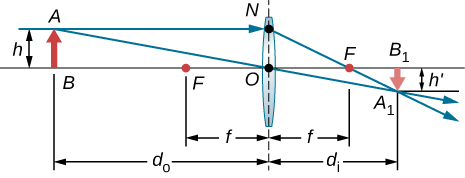
Use another ray-tracing diagram for the same situation as given in the previous problem to derive the thin-lens equation, 1do+1di=1f.

Answer

Figure shows a bi-convex lens, an object placed at point A on the optical axis and an inverted image formed at point B1 on the axis behind the lens. The top of the object is a distance h from the origin. Three rays originate from the top of the object, strike the lens and converge on the other side at the top of the inverted image. It passes the focal point in front of the lens and is parallel to the optical axis behind the lens.


Triangles BAO and B1A1O are similar triangles. Thus, A1B1AB=dido.Triangles NOF and B1A1F are similar triangles. Thus, NOf= A1B1di−f. Noting that NO=AB gives ABf= A1B1di−f or ABA1B1= fdi−f. Inverting this gives A1B1AB= di−ff. Equating the two expressions for the ratio A1B1AB gives dido=di−ff. Dividing through by di gives 1do=1f−1di or 1do+1di=1f.

2-135 §2.AP source ↗

Find the focal length of a thin plano-convex lens. The front surface of this lens is flat, and the rear surface has a radius of curvature of R2=−35cm. Assume that the index of refraction of the lens is 1.5.

Answer

70 cm

2-137 §2.AP source ↗

A nearsighted man cannot see objects clearly beyond 20 cm from his eyes. How close must he stand to a mirror in order to see what he is doing when he shaves?

Answer

The plane mirror has an infinite focal point, so that di=−do. The total apparent distance of the man in the mirror will be his actual distance, plus the apparent image distance, or do+ (−di)= 2do. If this distance must be less than 20 cm, he should stand at do=10cm.

2-139 §2.AP source ↗

Repeat the previous problem for glasses that are 2.20 cm from the eyes.

Answer

Here we want do= 25cm− 2.20cm= 0.228m. If x= near point, di= −(x−0.0220m). Thus, P= 1do+ 1di= 10.228m–1x−0.0220m. Using P=0.75D gives x=0.297m, so the near point is 29.7 cm.

2-141 §2.AP source ↗

Unreasonable Results A boy has a near point of 50 cm and a far point of 500 cm. Will a −4.00 D lens correct his far point to infinity?

Answer

Assuming a lens at 2.00 cm from the boy’s eye, the image distance must be di= −(500cm−2.00cm)= −498cm. For an infinite-distance object, the required power is P= 1di= −0.200D. Therefore, the −4.00D lens will correct the nearsightedness.

2-143 §2.AP source ↗

Let objective and eyepiece of a compound microscope have focal lengths of 2.5 cm and 10 cm, respectively and be separated by 12 cm. A 70-μm object is placed 6.0 cm from the objective. How large is the virtual image formed by the objective-eyepiece system?

Answer

87 μm

2-145 §2.AP source ↗

The objective and the eyepiece of a microscope have the focal lengths 3 cm and 10 cm respectively. Decide about the distance between the objective and the eyepiece if we need a 10× magnification from the objective/eyepiece compound system.

Answer

Use, Mnet= −diobj(feye+25cm)fobjfeye. The image distance for the objective is diobj= −Mnetfobjfeyefeye+25cm. Using fobj= 3.0cm, feye= 10cm, andM= −10 gives diobj=8.6cm. We want this image to be at the focal point of the eyepiece so that the eyepiece forms an image at infinity for comfortable viewing. Thus, the distance d between the lenses should be d= feye+ diobj= 10cm+ 8.6cm= 19cm.

2-147 §2.AP source ↗

A near-sighted person has afar point of 80 cm. (a) What kind of corrective lens will the person need assuming the distance to the contact lens from the eye is zero? (b) What would be the power of the contact lens needed?

Answer

a. focal length of the corrective lens fc=−80cm; b. −1.25 D

2-149 §2.AP source ↗

Two stars that are 109km apart are viewed by a telescope and found to be separated by an angle of 10−5radians. If the eyepiece of the telescope has a focal length of 1.5 cm and the objective has a focal length of 3 meters, how far away are the stars from the observer?

Answer

2 × 10 16 km

2-151 §2.AP source ↗

An unknown planet at a distance of 1012m from Earth is observed by a telescope that has a focal length of the eyepiece of 1 cm and a focal length of the objective of 1 m. If the far away planet is seen to subtend an angle of 10−5radian at the eyepiece, what is the size of the planet?

Answer

10 5 m

Loading chapter 3…

Problems and answers are adapted from University Physics Volume 3 by Samuel J. Ling, Jeff Sanny and William Moebs, OpenStax, and are used under the CC BY-NC-SA 4.0 licence. Access for free at https://openstax.org/books/university-physics-volume-3/pages/1-introduction. Illustrations: Copyright Rice University, OpenStax, under CC BY-NC-SA 4.0 license. This adaptation is released under the same licence, is non-commercial, and is neither affiliated with nor endorsed by OpenStax or Rice University.