Every problem in the chapter beside the book’s answer, a chapter at a time as you scroll.

Chapter 7: Quantum Mechanics

57 problems · 2 figures

Check Your Understanding 7.1 §7.1 source ↗

If a=3+4i, what is the product a*a?

Answer

(3+4i)(3−4i)= 9− 16 i 2 = 25

Check Your Understanding 7.2 §7.1 source ↗

Suppose that a particle with energy E is moving along the x-axis and is confined in the region between 0 and L. One possible wave function is

ψ(x,t)={Ae−iEt/ℏsinπxL,when0≤x≤L0,otherwise.

Determine the normalization constant.

Answer

A = 2 / L

Check Your Understanding 7.3 §7.1 source ↗

For the particle in the above example, find the probability of locating it between positions 0 and L/4

Answer

(1/2−1/π)/2= 9%

Check Your Understanding 7.4 §7.2 source ↗

A sodium atom makes a transition from the first excited state to the ground state, emitting a 589.0-nm photon with energy 2.105 eV. If the lifetime of this excited state is 1.6×10⁻⁸s, what is the uncertainty in energy of this excited state? What is the width of the corresponding spectral line?

Answer

4.1×10⁻⁸eV; 1.1×10⁻⁵nm

Check Your Understanding 7.5 §7.3 source ↗

A particle with mass m is moving along the x-axis in a potential given by the potential energy function U(x)= 0.5mω2x2. Compute the product Ψ(x,t)*U(x)Ψ(x,t). Express your answer in terms of the time-independent wave function, ψ(x).

Answer

0.5 m ω 2 x 2 ψ ( x ) * ψ ( x )

Check Your Understanding 7.6 §7.3 source ↗

Which of the following wave functions is a valid wave-function solution for Schrӧdinger’s equation?
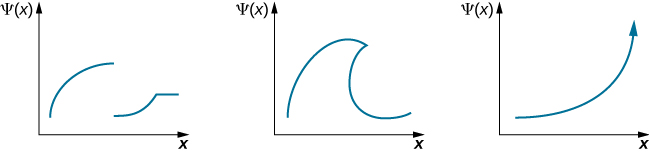
Three graphs of Psi of x versus x are shown. The first rises then drops discontinuously to a lower value, rises again and then has a constant value. The second function looks like a breaking wave, with a crest overtaking the base. The third increases exponentially to infinity.

Answer

None. The first function has a discontinuity; the second function is double-valued; and the third function diverges so is not normalizable.

Check Your Understanding 7.7 §7.4 source ↗

(a) Consider an infinite square well with wall boundaries x=0 and x=L. What is the probability of finding a quantum particle in its ground state somewhere between x=0 and x=L/4? (b) Repeat question (a) for a classical particle.

Answer

a. 9.1%; b. 25%

Check Your Understanding 7.8 §7.5 source ↗

The vibrational frequency of the hydrogen iodide HI diatomic molecule is 6.69×10 13Hz. (a) What is the force constant of the molecular bond between the hydrogen and the iodine atoms? (b) What is the energy of the emitted photon when this molecule makes a transition between adjacent vibrational energy levels?

Answer

a. 295 N/m; b. 0.277 eV

Check Your Understanding 7.9 §7.5 source ↗

Find the expectation value of the position for a particle in the ground state of a harmonic oscillator using symmetry.

Answer

〈 x 〉 = 0

Check Your Understanding 7.10 §7.6 source ↗

A proton with kinetic energy 1.00 eV is incident on a square potential barrier with height 10.00 eV. If the proton is to have the same transmission probability as an electron of the same energy, what must the width of the barrier be relative to the barrier width encountered by an electron?

Answer

L proton / L electron = m e / m p = 2.3%

7-1 §7.1 source ↗

What is the physical unit of a wave function, Ψ(x,t)? What is the physical unit of the square of this wave function?

Answer

1/L, where L=length; 1/L, where L=length

7-3 §7.1 source ↗

What kind of physical quantity does a wave function of an electron represent?

Answer

The wave function does not correspond directly to any measured quantity. It is a tool for predicting the values of physical quantities.

7-5 §7.1 source ↗

What is the meaning of the expression “expectation value?” Explain.

Answer

The average value of the physical quantity for a large number of particles with the same wave function.

7-7 §7.2 source ↗

Can the de Broglie wavelength of a particle be known precisely? Can the position of a particle be known precisely?

Answer

Yes, if its position is completely unknown. Yes, if its momentum is completely unknown.

7-9 §7.2 source ↗

Can we measure both the position and momentum of a particle with complete precision?

Answer

No. According to the uncertainty principle, if the uncertainty on the particle’s position is small, the uncertainty on its momentum is large. Similarly, if the uncertainty on the particle’s position is large, the uncertainty on its momentum is small.

7-11 §7.3 source ↗

If a quantum particle is in a stationary state, does it mean that it does not move?

Answer

No, it means that predictions about the particle (expressed in terms of probabilities) are time-independent.

7-13 §7.3 source ↗

Suppose a wave function is discontinuous at some point. Can this function represent a quantum state of some physical particle? Why? Why not?

Answer

No, because the probability of the particle existing in a narrow (infinitesimally small) interval at the discontinuity is undefined.

7-15 §7.4 source ↗

Is it possible that when we measure the energy of a quantum particle in a box, the measurement may return a smaller value than the ground state energy? What is the highest value of the energy that we can measure for this particle?

Answer

No. For an infinite square well, the spacing between energy levels increases with the quantum number n. The smallest energy measured corresponds to the transition from n = 2 to 1, which is three times the ground state energy. The largest energy measured corresponds to a transition from n=∞ to 1, which is infinity. (Note: Even particles with extremely large energies remain bound to an infinite square well—they can never “escape”)

7-17 §7.5 source ↗

Is it possible to measure energy of 0.75ℏω for a quantum harmonic oscillator? Why? Why not? Explain.

Answer

No. This energy corresponds to n=0.25, but n must be an integer.

7-19 §7.5 source ↗

If a classical harmonic oscillator can be at rest, why can the quantum harmonic oscillator never be at rest? Does this violate Bohr’s correspondence principle?

Answer

Because the smallest allowed value of the quantum number n for a simple harmonic oscillator is 0. No, because quantum mechanics and classical mechanics agree only in the limit of large n.

7-21 §7.5 source ↗

Can we simultaneously measure position and energy of a quantum oscillator? Why? Why not?

Answer

Yes, within the constraints of the uncertainty principle. If the oscillating particle is localized, the momentum and therefore energy of the oscillator are distributed.

7-23 §7.6 source ↗

What decreases the tunneling probability most: doubling the barrier width or halving the kinetic energy of the incident particle?

Answer

doubling the barrier width

7-25 §7.6 source ↗

Can a quantum particle ‘escape’ from an infinite potential well like that in a box? Why? Why not?

Answer

No, the restoring force on the particle at the walls of an infinite square well is infinity.

7-27 §7.1 source ↗

Compute |Ψ(x,t)| 2 for the function Ψ(x,t)= ψ(x)sinω t, where ω is a real constant.

Answer

| ψ ( x ) | 2 sin 2 ω t

7-29 §7.1 source ↗

Which one of the following functions, and why, qualifies to be a wave function of a particle that can move along the entire real axis? (a) ψ(x)=Ae−x 2;
(b) ψ(x)=Ae−x; (c) ψ(x)=Atanx;
(d) ψ(x)= A(sinx)/x; (e) ψ(x)=Ae−|x|.

Answer

(a), (d), and (e) can be normalized

7-31 §7.1 source ↗

A wave function of a particle with mass m is given by

ψ ( x ) = { A cos α x , − π 2 α ≤ x ≤ + π 2 α , 0 , otherwise,

where α= 1.00×10¹⁰/m. (a) Find the normalization constant. (b) Find the probability that the particle can be found on the interval 0≤x≤0.5×10⁻¹⁰m. (c) Find the particle’s average position. (d) Find its average momentum. (e) Find its average kinetic energy.

Answer

a. A=2α/π; b. probability= 29.3%; c. 〈x〉=0; d. 〈p〉=0; e. 〈K〉=α2ℏ2/2m

7-33 §7.2 source ↗

A gas of helium atoms at 273 K is in a cubical container with 25.0 cm on a side. (a) What is the minimum uncertainty in momentum components of helium atoms? (b) What is the minimum uncertainty in velocity components? (c) Find the ratio of the uncertainties in (b) to the mean speed of an atom in each direction.

Answer

a. Δp≥2.11×10⁻³⁴N·s; b. Δv≥6.31×10⁻⁸m; c. Δv/kBT/mα= 5.94×10⁻¹¹

7-35 §7.2 source ↗

Some unstable elementary particle has a rest energy of 80.41 GeV and an uncertainty in rest energy of 2.06 GeV. Estimate the lifetime of this particle.

Answer

Δ τ ≥ 1.6 × 10 −25 s

7-37 §7.2 source ↗

Measurements indicate that an atom remains in an excited state for an average time of 50.0 ns before making a transition to the ground state with the simultaneous emission of a 2.1-eV photon. (a) Estimate the uncertainty in the frequency of the photon. (b) What fraction of the photon’s average frequency is this?

Answer

a. Δf≥1.59MHz; b. Δω/ω0= 3.135×10⁻⁹

7-39 §7.3 source ↗

Combine Equation 7.17 and Equation 7.18 to show k2=ω2c2.

Answer

Carrying out the derivatives yields k2=ω2c2.

7-41 §7.3 source ↗

Show that Ψ(x,t)= Asin(kx−ωt) and Ψ(x,t)= Acos(kx−ωt) do not obey Schrӧdinger’s time-dependent equation.

Answer

Carrying out the derivatives (as above) for the sine function gives a cosine on the right side the equation, so the equality fails. The same occurs for the cosine solution.

7-43 §7.3 source ↗

A particle with mass m is described by the following wave function: ψ(x)= Acoskx+ Bsinkx, where A, B, and k are constants. Assuming that the particle is free, show that this function is the solution of the stationary Schrӧdinger equation for this particle and find the energy that the particle has in this state.

Answer

E = ℏ 2 k 2 / 2 m

7-45 §7.3 source ↗

Find the expectation value of the square of the momentum squared for the particle in the state, Ψ(x,t)= Aei(kx−ωt). What conclusion can you draw from your solution?

Answer

ℏ 2k 2; The particle has definite momentum and therefore definite momentum squared.

7-47 §7.4 source ↗

Assume that an electron in an atom can be treated as if it were confined to a box of width 2.0 Å. What is the ground state energy of the electron? Compare your result to the ground state kinetic energy of the hydrogen atom in the Bohr’s model of the hydrogen atom.

Answer

9.4 eV, 64%

7-49 §7.4 source ↗

An electron confined to a box has the ground state energy of 2.5 eV. What is the width of the box?

Answer

0.38 nm

7-51 §7.4 source ↗

What is the ground state energy (in eV) of an α-particle confined to a one-dimensional box the size of the uranium nucleus that has a radius of approximately 15.0 fm?

Answer

1.82 MeV

7-53 §7.4 source ↗

An electron confined to a box of width 0.15 nm by infinite potential energy barriers emits a photon when it makes a transition from the first excited state to the ground state. Find the wavelength of the emitted photon.

Answer

24.7 nm

7-55 §7.4 source ↗

Suppose an electron confined to a box emits photons. The longest wavelength that is registered is 500.0 nm. What is the width of the box?

Answer

6.03 Å

7-57 §7.4 source ↗

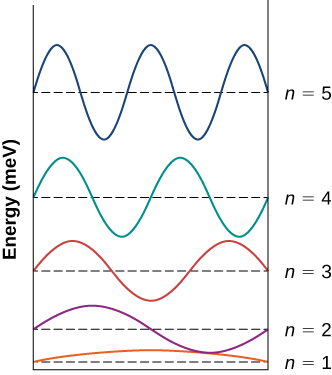
An electron is confined to a box of width 0.25 nm. (a) Draw an energy-level diagram representing the first five states of the electron. (b) Calculate the wavelengths of the emitted photons when the electron makes transitions between the fourth and the second excited states, between the second excited state and the ground state, and between the third and the second excited states.

Answer

a.

The wave functions for the n=1 through n=5 states of the electron in an infinite square well are shown. Each function is displaced vertically by its energy, measured in m e V. The n=1 state is the first half wave of the sine function. The n=2 function is the first full wave of the sine function. The n=3 function is the first one and a half waves of the sine function. The n=4 function is the first two waves of the sine function. The n=5 function is the first two and a half waves of the sine function.

;
b. λ5→3= 12.9nm,λ3→1= 25.8nm,λ4→3= 29.4nm

7-59 §7.5 source ↗

Show that the two lowest energy states of the simple harmonic oscillator, ψ0(x) and ψ1(x) from Equation 7.57, satisfy Equation 7.55.

Answer

proof

7-61 §7.5 source ↗

When a quantum harmonic oscillator makes a transition from the (n+1) state to the n state and emits a 450-nm photon, what is its frequency?

Answer

6.662 × 10 14 Hz

7-63 §7.5 source ↗

A particle with mass 0.030 kg oscillates back-and-forth on a spring with frequency 4.0 Hz. At the equilibrium position, it has a speed of 0.60 m/s. If the particle is in a state of definite energy, find its energy quantum number.

Answer

n≈ 2.037× 10 30

7-65 §7.5 source ↗

Determine the expectation value of the potential energy for a quantum harmonic oscillator in the ground state. Use this to calculate the expectation value of the kinetic energy.

Answer

〈x〉= 0.5mω2〈x 2〉= ℏω/4; 〈K〉= 〈E〉− 〈U〉= ℏω/4

7-67 §7.5 source ↗

Estimate the ground state energy of the quantum harmonic oscillator by Heisenberg’s uncertainty principle. Start by assuming that the product of the uncertainties Δx and Δp is at its minimum. Write Δp in terms of Δx and assume that for the ground state x≈Δx and p≈Δp, then write the ground state energy in terms of x. Finally, find the value of x that minimizes the energy and find the minimum of the energy.

Answer

proof

7-69 §7.6 source ↗

Show that the wave function in (a) Equation 7.68 satisfies Equation 7.61, and (b) Equation 7.69 satisfies Equation 7.63.

Answer

A complex function of the form, Aeiϕ, satisfies Schrӧdinger’s time-independent equation. The operators for kinetic and total energy are linear, so any linear combination of such wave functions is also a valid solution to Schrӧdinger’s equation. Therefore, we conclude that Equation 7.68 satisfies Equation 7.61, and Equation 7.69 satisfies Equation 7.63.

7-71 §7.6 source ↗

A 5.0-eV electron impacts on a barrier of with 0.60 nm. Find the probability of the electron to tunnel through the barrier if the barrier height is (a) 7.0 eV; (b) 9.0 eV; and (c) 13.0 eV.

Answer

a. 0.00055 or 0.055%; b. 0.000018; c. 1.1×10⁻⁷

7-73 §7.6 source ↗

A quantum particle with initial kinetic energy 32.0 eV encounters a square barrier with height 41.0 eV and width 0.25 nm. Find probability that the particle tunnels through this barrier if the particle is (a) an electron and, (b) a proton.

Answer

a. 0.13%; b. close to 0%

7-75 §7.6 source ↗

A muon, a quantum particle with a mass approximately 200 times that of an electron, is incident on a potential barrier of height 10.0 eV. The kinetic energy of the impacting muon is 5.5 eV and only about 0.10% of the squared amplitude of its incoming wave function filters through the barrier. What is the barrier’s width?

Answer

0.38 nm

7-77 §7.AP source ↗

Show that if the uncertainty in the position of a particle is on the order of its de Broglie’s wavelength, then the uncertainty in its momentum is on the order of the value of its momentum.

Answer

proof

7-79 §7.AP source ↗

A particle of mass m is confined to a box of width L. If the particle is in the first excited state, what are the probabilities of finding the particle in a region of width 0.020 L around the given point x: (a) x=0.25L; (b) x=0.40L; (c) x=0.75L; and (d) x=0.90L.

Answer

a. 4.0 %; b. 1.4 %; c. 4.0%; d. 1.4%

7-81 §7.AP source ↗

A 0.20-kg billiard ball bounces back and forth without losing its energy between the cushions of a 1.5 m long table. (a) If the ball is in its ground state, how many years does it need to get from one cushion to the other? You may compare this time interval to the age of the universe. (b) How much energy is required to make the ball go from its ground state to its first excited state? Compare it with the kinetic energy of the ball moving at 2.0 m/s.

Answer

a. t= mL2/h= 2.15×1026years; b. E1= 1.46×10−66J,K= 0.4J

7-83 §7.AP source ↗

Consider an infinite square well with wall boundaries x=0 and x=L. Show that the function ψ(x)=Asinkx is the solution to the stationary Schrӧdinger equation for the particle in a box only if k=2mE/ℏ. Explain why this is an acceptable wave function only if k is an integer multiple of π/L.

Answer

proof

7-85 §7.AP source ↗

Atoms in a crystal lattice vibrate in simple harmonic motion. Assuming a lattice atom has a mass of 9.4×10⁻²⁶kg, what is the force constant of the lattice if a lattice atom makes a transition from the ground state to first excited state when it absorbs a 525-µm photon?

Answer

1.2 N/m

7-87 §7.AP source ↗

An electron with kinetic energy 2.0 MeV encounters a potential energy barrier of height 16.0 MeV and width 2.00 nm. What is the probability that the electron emerges on the other side of the barrier?

Answer

0

7-89 §7.CP source ↗

An electron in a long, organic molecule used in a dye laser behaves approximately like a quantum particle in a box with width 4.18 nm. Find the emitted photon when the electron makes a transition from the first excited state to the ground state and from the second excited state to the first excited state.

Answer

19.2 µ m; 11.5 µ m

7-91 §7.CP source ↗

If STM is to detect surface features with local heights of about 0.00200 nm, what percent change in tunneling-electron current must the STM electronics be able to detect? Assume that the tunneling-electron current has characteristics given in the preceding problem.

Answer

3.92%

7-93 §7.CP source ↗

Suppose an infinite square well extends from −L/2 to +L/2. Solve the time-independent Schrӧdinger’s equation to find the allowed energies and stationary states of a particle with mass m that is confined to this well. Then show that these solutions can be obtained by making the coordinate transformation x′=x−L/2 for the solutions obtained for the well extending between 0 and L.

Answer

proof

Loading chapter 8…

Problems and answers are adapted from University Physics Volume 3 by Samuel J. Ling, Jeff Sanny and William Moebs, OpenStax, and are used under the CC BY-NC-SA 4.0 licence. Access for free at https://openstax.org/books/university-physics-volume-3/pages/1-introduction. Illustrations: Copyright Rice University, OpenStax, under CC BY-NC-SA 4.0 license. This adaptation is released under the same licence, is non-commercial, and is neither affiliated with nor endorsed by OpenStax or Rice University.