Every problem in the chapter beside the book’s answer, a chapter at a time as you scroll.
Chapter 11: Particle Physics and Cosmology
53 problems · 2 figuresCheck Your Understanding 11.1 §11.2 source ↗
Answer
Check Your Understanding 11.2 §11.2 source ↗
Answer
Check Your Understanding 11.3 §11.2 source ↗
Answer
Check Your Understanding 11.4 §11.3 source ↗
Answer
Check Your Understanding 11.5 §11.4 source ↗
Answer
Check Your Understanding 11.6 §11.4 source ↗
Answer
Check Your Understanding 11.7 §11.4 source ↗
Answer
Check Your Understanding 11.8 §11.6 source ↗
Answer
Check Your Understanding 11.9 §11.7 source ↗
Answer
11-1 §11.1 source ↗
Answer
11-3 §11.1 source ↗
Answer
11-5 §11.2 source ↗
Answer
11-7 §11.2 source ↗
Answer
11-9 §11.3 source ↗
Answer
11-11 §11.3 source ↗
Answer
11-13 §11.4 source ↗
Answer
11-15 §11.4 source ↗
Answer
11-17 §11.5 source ↗
Answer
11-19 §11.5 source ↗
Answer
11-21 §11.5 source ↗
Answer
11-23 §11.6 source ↗
Answer
11-25 §11.6 source ↗
Answer
11-27 §11.7 source ↗
Answer
11-29 §11.7 source ↗
Answer
11-31 §11.1 source ↗
| Particle name | Symbol | Antiparticle | Mass | Average lifetime (s) | |
|---|---|---|---|---|---|
| Leptons | |||||
| Electron | 0.511 | Stable | |||
| Electron neutrino | Stable | ||||
| Muon | 105.7 | ||||
| Muon neutrino | Stable | ||||
| Tau | 1784 | ||||
| Tau neutrino | Stable | ||||
| Hadrons | |||||
| Baryons | Proton | p | 938.3 | Stable | |
| Neutron | n | 939.6 | 920 | ||
| Lambda | 1115.6 | ||||
| Sigma | 1189.4 | ||||
| Xi | 1315 | ||||
| Omega | 1672 | ||||
| Mesons | Pion | 139.6 | |||
| -Zero | 135.0 | ||||
| Kaon | 493.7 | ||||
| k-Short | 497.6 | ||||
| k-Long | 497.6 | ||||
| J/ | J/ | J/ | 3100 | ||
| Upsilon | 9460 | ||||
Answer
11-33 §11.1 source ↗
When both an electron and a positron are at rest, they can annihilate each other according to the reaction
In this case, what are the energy, momentum, and frequency of each photon?
Answer
11-35 §11.2 source ↗
Which of the following decays cannot occur because the law of conservation of lepton number is violated?
Answer
11-37 §11.2 source ↗
Identify one possible decay for each of the following antiparticles:
(a) , (b) , (c) , (d) , and (e) .
Answer
11-39 §11.3 source ↗
Answer
11-41 §11.3 source ↗
| Name | Symbol | Quarks | Charge (e) | Spin | Mass |
|---|---|---|---|---|---|
| Positive pion | 1 | 0 | 0.140 | ||
| Positive rho | 1 | 1 | 0.768 | ||
| Negative pion | 0 | 0.140 | |||
| Negative rho | 1 | 0.768 | |||
| Neutral Pion | or | 0 | 0 | 0.135 | |
| Neutral eta | , or | 0 | 0 | 0.547 | |
| Positive kaon | 1 | 0 | 0.494 | ||
| Neutral kaon | 0 | 0 | 0.498 | ||
| Negative kaon | 0 | 0.494 | |||
| J/Psi | 0 | 1 | 3.10 | ||
| Charmed eta | 0 | 0 | 2.98 | ||
| Neutral D | 0 | 0 | 1.86 | ||
| Neutral D | 0 | 1 | 2.01 | ||
| Positive D | 1 | 0 | 1.87 | ||
| Neutral B | 0 | 0 | 5.26 | ||
| Upsilon | 0 | 1 | 9.46 |
Answer
11-43 §11.3 source ↗
Why can’t either set of quarks shown below form a hadron?
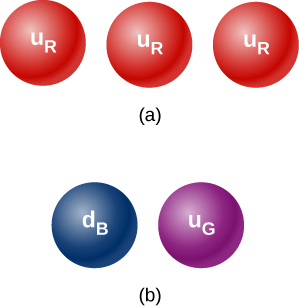
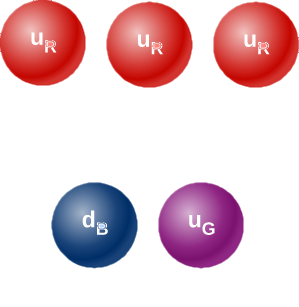
Answer
11-45 §11.3 source ↗
Answer
11-47 §11.4 source ↗
Answer
11-49 §11.4 source ↗
Answer
This is the mass of the upsilon (1S) meson first observed at Fermi lab in 1977. The upsilon meson consists of a bottom quark and its antiparticle .
11-51 §11.4 source ↗
Answer
11-53 §11.4 source ↗
Answer
11-55 §11.5 source ↗
Answer
11-57 §11.5 source ↗
Answer
11-59 §11.5 source ↗
Answer
11-61 §11.6 source ↗
Answer
11-63 §11.6 source ↗
Answer
11-65 §11.6 source ↗
Answer
11-67 §11.6 source ↗
Answer
11-69 §11.6 source ↗
Answer
11-71 §11.AP source ↗
Each of the following reactions is missing a single particle. Identify the missing particle for each reaction.
Answer
11-73 §11.AP source ↗
Answer
11-75 §11.AP source ↗
Answer
11-77 §11.AP source ↗
Answer
11-79 §11.CP source ↗
The intensity of cosmic ray radiation decreases rapidly with increasing energy, but there are occasionally extremely energetic cosmic rays that create a shower of radiation from all the particles they create by striking a nucleus in the atmosphere. Suppose a cosmic ray particle having an energy of converts its energy into particles with masses averaging .
(a) How many particles are created? (b) If the particles rain down on a area, how many particles are there per square meter?
Answer
11-81 §11.CP source ↗
Answer
11-83 §11.CP source ↗
Answer
11-85 §11.CP source ↗
Answer
11-87 §11.CP source ↗
Answer
End of the book.
Problems and answers are adapted from University Physics Volume 3 by Samuel J. Ling, Jeff Sanny and William Moebs, OpenStax, and are used under the CC BY-NC-SA 4.0 licence. Access for free at https://openstax.org/books/university-physics-volume-3/pages/1-introduction. Illustrations: Copyright Rice University, OpenStax, under CC BY-NC-SA 4.0 license. This adaptation is released under the same licence, is non-commercial, and is neither affiliated with nor endorsed by OpenStax or Rice University.