Every problem in the chapter beside the book’s answer, a chapter at a time as you scroll.
Chapter 33: Particle Physics
27 problems · 2 figures33-1 §33.1 source ↗
Answer
33-3 §33.1 source ↗
Answer
33-4 §33.2 source ↗
(a) Find the ratio of the strengths of the weak and electromagnetic forces under ordinary circumstances.
(b) What does that ratio become under circumstances in which the forces are unified?
Answer
(a) to 1, weak to EM
(b) 1 to 1
33-6 §33.3 source ↗
At full energy, protons in the 2.00-km-diameter Fermilab synchrotron travel at nearly the speed of light, since their energy is about 1000 times their rest mass energy.
(a) How long does it take for a proton to complete one trip around?
(b) How many times per second will it pass through the target area?
Answer
(a)
(b)
33-8 §33.3 source ↗
Answer
33-10 §33.3 source ↗
Answer
33-12 §33.3 source ↗
Answer
33-13 §33.4 source ↗
Answer
33-15 §33.4 source ↗
The mass of a theoretical particle that may be associated with the unification of the electroweak and strong forces is .
(a) How many proton masses is this?
(b) How many electron masses is this? (This indicates how extremely relativistic the accelerator would have to be in order to make the particle, and how large the relativistic quantity would have to be.)
Answer
(a)
(b)
33-17 §33.4 source ↗
The decay mode of the positive tau is .
(a) What energy is released?
(b) Verify that charge and lepton family numbers are conserved.
(c) The is the antiparticle of the .Verify that all the decay products of the are the antiparticles of those in the decay of the given in the text.
Answer
(a)
(b)
(c)
33-19 §33.4 source ↗
(a) What is the uncertainty in the energy released in the decay of a due to its short lifetime?
(b) What fraction of the decay energy is this, noting that the decay mode is (so that all the mass is destroyed)?
Answer
(a) 3.9 eV
(b)
33-21 §33.5 source ↗
(a) Verify from its quark composition that the particle could be an excited state of the proton.
(b) There is a spread of about 100 MeV in the decay energy of the , interpreted as uncertainty due to its short lifetime. What is its approximate lifetime?
(c) Does its decay proceed via the strong or weak force?
Answer
(a) The composition is the same as for a proton.
(b)
(c) Strong (short lifetime)
33-23 §33.5 source ↗
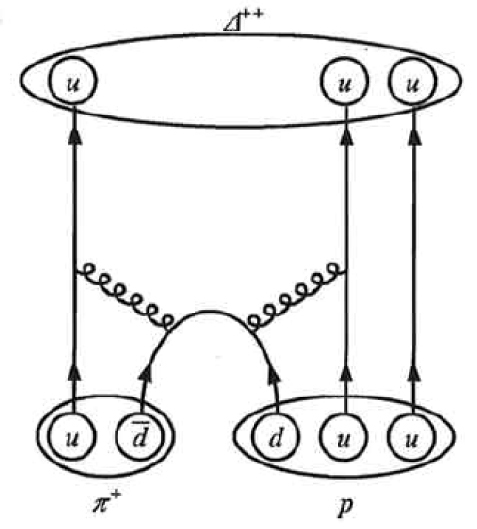
The reaction (described in the preceding problem) takes place via the strong force. (a) What is the baryon number of the particle?
(b) Draw a Feynman diagram of the reaction showing the individual quarks involved.
Answer
a)
b)
33-25 §33.5 source ↗
Answer
(a)
(b) , all lepton numbers are 0 before and after
(c)
33-27 §33.5 source ↗
One decay mode for the eta-zero meson is .
(a) Write the decay in terms of the quark constituents.
(b) How much energy is released?
(c) What is the ultimate release of energy, given the decay mode for the pi zero is ?
Answer
(a)
(b) 277.9 MeV
(c) 547.9 MeV
33-29 §33.5 source ↗
Answer
33-31 §33.5 source ↗
Answer
(a)Yes. , , all lepton family numbers are 0 before and after, spontaneous since mass greater before reaction.
(b)
33-33 §33.5 source ↗
(a) Three quarks form a baryon. How many combinations of the six known quarks are there if all combinations are possible?
(b) This number is less than the number of known baryons. Explain why.
Answer
(a) 216
(b) There are more baryons observed because we have the 6 antiquarks and various mixtures of quarks (as for the π-meson) as well.
33-35 §33.5 source ↗
| Category | Particle name | Symbol | Antiparticle | Rest mass | Lifetime4 (s) | |||||
|---|---|---|---|---|---|---|---|---|---|---|
| Gauge | Photon | Self | 0 | 0 | 0 | 0 | 0 | 0 | Stable | |
| Bosons | 0 | 0 | 0 | 0 | 0 | |||||
| Self | 0 | 0 | 0 | 0 | 0 | |||||
| Leptons | Electron | 0.511 | 0 | 0 | 0 | 0 | Stable | |||
| Neutrino (e) | 5 | 0 | 0 | 0 | 0 | Stable | ||||
| Muon | 105.7 | 0 | 0 | 0 | 0 | |||||
| Neutrino | 0 | 0 | 0 | 0 | Stable | |||||
| Tau | 1777 | 0 | 0 | 0 | 0 | |||||
| Neutrino | 0 | 0 | 0 | 0 | Stable | |||||
| Hadrons (selected) | ||||||||||
| Mesons | Pion | 139.6 | 0 | 0 | 0 | 0 | 0 | 2.60 × 10 −8 | ||
| Self | 135.0 | 0 | 0 | 0 | 0 | 0 | 8.4 × 10 −17 | |||
| Kaon | 493.7 | 0 | 0 | 0 | 0 | 1.24 × 10 −8 | ||||
| 497.6 | 0 | 0 | 0 | 0 | 0.90 × 10 −10 | |||||
| Eta | Self | 547.9 | 0 | 0 | 0 | 0 | 0 | 2.53 × 10 −19 | ||
| (many other mesons known) | ||||||||||
| Baryons | Proton | 938.3 | ± 1 | 0 | 0 | 0 | 0 | Stable6 | ||
| Neutron | 939.6 | ± 1 | 0 | 0 | 0 | 0 | 882 | |||
| Lambda | 1115.7 | ± 1 | 0 | 0 | 0 | 2.63 × 10 −10 | ||||
| Sigma | 1189.4 | ± 1 | 0 | 0 | 0 | 0.80 × 10 −10 | ||||
| 1192.6 | ± 1 | 0 | 0 | 0 | 7.4 × 10 −20 | |||||
| 1197.4 | ± 1 | 0 | 0 | 0 | 1.48 × 10 −10 | |||||
| Xi | 1314.9 | ± 1 | 0 | 0 | 0 | 2.90 × 10 −10 | ||||
| 1321.7 | ± 1 | 0 | 0 | 0 | 1.64 × 10 −10 | |||||
| Omega | 1672.5 | ± 1 | 0 | 0 | 0 | 0.82 × 10 −10 | ||||
| (many other baryons known) | ||||||||||
| Particle | Quark Composition | |
|---|---|---|
| Mesons | ||
| , mixture11 | ||
| , mixture12 | ||
| Baryons13,14 | ||
Answer
33-37 §33.5 source ↗
(a) How much energy would be released if the proton did decay via the conjectured reaction ?
(b) Given that the decays to two s and that the will find an electron to annihilate, what total energy is ultimately produced in proton decay?
(c) Why is this energy greater than the proton’s total mass (converted to energy)?
Answer
(a)803 MeV
(b) 938.8 MeV
(c) The annihilation energy of an extra electron is included in the total energy.
33-39 §33.5 source ↗
Answer
33-41 §33.5 source ↗
(a) What particle has the quark composition ?
(b) What should its decay mode be?
Answer
a)The antiproton
b)
33-43 §33.6 source ↗
Integrated Concepts
The intensity of cosmic ray radiation decreases rapidly with increasing energy, but there are occasionally extremely energetic cosmic rays that create a shower of radiation from all the particles they create by striking a nucleus in the atmosphere as seen in the figure given below. Suppose a cosmic ray particle having an energy of converts its energy into particles with masses averaging . (a) How many particles are created? (b) If the particles rain down on a area, how many particles are there per square meter?
Answer
(a)
(b)
33-45 §33.6 source ↗
Integrated Concepts
What is the wavelength of a 50-GeV electron, which is produced at SLAC? This provides an idea of the limit to the detail it can probe.
Answer
33-47 §33.6 source ↗
Integrated Concepts
The primary decay mode for the negative pion is . (a) What is the energy release in MeV in this decay? (b) Using conservation of momentum, how much energy does each of the decay products receive, given the is at rest when it decays? You may assume the muon antineutrino is massless and has momentum , just like a photon.
Answer
(a) 33.9 MeV
(b) Muon antineutrino 29.8 MeV, muon 4.1 MeV (kinetic energy)
33-49 §33.6 source ↗
Integrated Concepts
Suppose you are designing a proton decay experiment and you can detect 50 percent of the proton decays in a tank of water. (a) How many kilograms of water would you need to see one decay per month, assuming a lifetime of ? (b) How many cubic meters of water is this? (c) If the actual lifetime is , how long would you have to wait on an average to see a single proton decay?
Answer
(a)
(b)
(c)
33-53 §33.6 source ↗
Answer
(a)
(b)
(c)
(d) The proton has a positive charge, and the antiproton has a negative charge.
Loading chapter 34…
Problems and answers are adapted from College Physics 2e by Paul Peter Urone, Roger Hinrichs, Kim Dirks and Manjula Sharma, OpenStax, and are used under the CC BY-NC-SA 4.0 licence. Access for free at https://openstax.org/books/college-physics-2e/pages/1-introduction-to-science-and-the-realm-of-physics-physical-quantities-and-units. Illustrations: Copyright Rice University, OpenStax, under CC BY-NC-SA 4.0 license. This adaptation is released under the same licence, is non-commercial, and is neither affiliated with nor endorsed by OpenStax or Rice University.