Every problem in the chapter beside the book’s answer, a chapter at a time as you scroll.

Chapter 5: Further Applications of Newton's Laws: Friction, Drag, and Elasticity

21 problems · 2 figures

5-1 §5.1 source ↗

A physics major is cooking breakfast when he notices that the frictional force between his steel spatula and his Teflon frying pan is only 0.200 N. Knowing the coefficient of kinetic friction between the two materials, he quickly calculates the normal force. What is it?

Answer

5.00 N

5-4 §5.1 source ↗

Suppose you have a 120-kg wooden crate resting on a wood floor. (a) What maximum force can you exert horizontally on the crate without moving it? (b) If you continue to exert this force once the crate starts to slip, what will the magnitude of its acceleration then be?

Answer

(a) 588 N

(b) 1.96 m/s2

5-6 §5.1 source ↗

A team of eight dogs pulls a sled with waxed wood runners on wet snow (mush!). The dogs have average masses of 19.0 kg, and the loaded sled with its rider has a mass of 210 kg. (a) Calculate the magnitude of the acceleration starting from rest if each dog exerts an average force of 185 N backward on the snow. (b) What is the magnitude of the acceleration once the sled starts to move? (c) For both situations, calculate the magnitude of the force in the coupling between the dogs and the sled.

Answer

(a) 3.29 m/s2

(b) 3.52 m/s2

(c) 980 N; 945 N

5-10 §5.1 source ↗

Calculate the deceleration of a snow boarder going up a 5.0º, slope assuming the coefficient of friction for waxed wood on wet snow. The result of Exercise 5.9 may be useful, but be careful to consider the fact that the snow boarder is going uphill. Explicitly show how you follow the steps in Problem-Solving Strategies.

Answer

1 . 83 m/s 2

5-14 §5.1 source ↗

Calculate the maximum acceleration of a car that is heading up a 4º slope (one that makes an angle of 4º with the horizontal) under the following road conditions. Assume that only half the weight of the car is supported by the two drive wheels and that the coefficient of static friction is involved—that is, the tires are not allowed to slip during the acceleration. (Ignore rolling.) (a) On dry concrete. (b) On wet concrete. (c) On ice, assuming that μ s = 0.100 , the same as for shoes on ice.

Answer

(a) 4.20 m/s2

(b) 2.74 m/s2

(c) –0.195 m/s2

5-16 §5.1 source ↗

A freight train consists of two 8.00×10⁵-kg engines and 45 cars with average masses of 5.50×10⁵ kg. (a) What force must each engine exert backward on the track to accelerate the train at a rate of 5.00×10⁻²m/s2 if the force of friction is 7.50×10⁵N, assuming the engines exert identical forces? This is not a large frictional force for such a massive system. Rolling friction for trains is small, and consequently trains are very energy-efficient transportation systems. (b) What is the magnitude of the force in the coupling between the 37th and 38th cars (this is the force each exerts on the other), assuming all cars have the same mass and that friction is evenly distributed among all of the cars and engines?

Answer

(a) 1.03×10⁶N

(b) 3.48×10⁵N

5-18 §5.1 source ↗

A contestant in a winter sporting event pushes a 45.0-kg block of ice across a frozen lake as shown in Figure 5.21(a). (a) Calculate the minimum force F he must exert to get the block moving. (b) What is the magnitude of its acceleration once it starts to move, if that force is maintained?
Figure 5.21 in the book ↗
Which method of sliding a block of ice requires less force—(a) pushing or (b) pulling at the same angle above the horizontal?

Answer

(a) 51.0 N

(b) 0.720 m/s2

5-20 §5.2 source ↗

The terminal velocity of a person falling in air depends upon the weight and the area of the person facing the fluid. Find the terminal velocity (in meters per second and kilometers per hour) of an 80.0-kg skydiver falling in a headfirst position with a cross-section area facing the fluid of 0.140 m2.

Answer

115 m/s; 414 km/hr

5-22 §5.2 source ↗

A 560-g squirrel with a cross-section area facing the fluid of 144 cm2 falls from a 5.0-m tree to the ground. Estimate its terminal velocity. (Use a drag coefficient for a horizontal skydiver.) What will be the velocity of a 56-kg person hitting the ground, assuming no drag contribution in such a short distance?

Answer

25.1 m/s; 9.90 m/s

5-24 §5.2 source ↗

By what factor does the drag force on a car increase as it goes from 65 to 110 km/h?

Answer

2 . 9

5-26 §5.2 source ↗

Using Stokes’ law, verify that the units for viscosity are kilograms per meter per second.

Answer

η = F s r v = kg ⋅ m/s 2 m ⋅ m/s = kg m ⋅ s

5-28 §5.2 source ↗

Stokes’ law describes sedimentation of particles in liquids and can be used to measure viscosity. Particles in liquids achieve terminal velocity quickly. One can measure the time it takes for a particle to fall a certain distance and then use Stokes’ law to calculate the viscosity of the liquid. Suppose a steel ball bearing (density 7.8×10³ kg/m3, diameter 3.0 mm) is dropped in a container of motor oil. It takes 12 s to fall a distance of 0.60 m. Calculate the viscosity of the oil.

Answer

0 . 76 kg/m ⋅ s

5-29 §5.3 source ↗

During a circus act, one performer swings upside down hanging from a trapeze holding another, also upside-down, performer by the legs. If the upward force on the lower performer is three times her weight, how much do the bones (the femurs) in her upper legs stretch? You may assume each is equivalent to a uniform rod 35.0 cm long and 1.80 cm in radius. Her mass is 60.0 kg.

Answer

1 . 90 × 10 − 3 cm

5-31 §5.3 source ↗

(a) The “lead” in pencils is a graphite composition with a Young’s modulus of about 1 × 10 9 N / m 2 . Calculate the change in length of the lead in an automatic pencil if you tap it straight into the pencil with a force of 4.0 N. The lead is 0.50 mm in diameter and 60 mm long. (b) Is the answer reasonable? That is, does it seem to be consistent with what you have observed when using pencils?

Answer

(a)1 mm
(b) This does seem reasonable, since the lead does seem to shrink a little when you push on it.

5-33 §5.3 source ↗

(a) By how much does a 65.0-kg mountain climber stretch her 0.800-cm diameter nylon rope when they hang 35.0 m below a rock outcropping? (b) Does the answer seem to be consistent with what you have observed for nylon ropes? Would it make sense if the rope were actually a bungee cord?

Answer

(a)9 cm
(b)This seems reasonable for nylon climbing rope, since it is not supposed to stretch that much.

5-35 §5.3 source ↗

As an oil well is drilled, each new section of drill pipe supports its own weight and that of the pipe and drill bit beneath it. Calculate the stretch in a new 6.00 m length of steel pipe that supports 3.00 km of pipe having a mass of 20.0 kg/m and a 100-kg drill bit. The pipe is equivalent in stiffness to a solid cylinder 5.00 cm in diameter.

Answer

8.59 mm

5-37 §5.3 source ↗

A vertebra is subjected to a shearing force of 500 N. Find the shear deformation, taking the vertebra to be a cylinder 3.00 cm high and 4.00 cm in diameter.

Answer

1 . 49 × 10 − 7 m

5-39 §5.3 source ↗

When using a pencil eraser, you exert a vertical force of 6.00 N at a distance of 2.00 cm from the hardwood-eraser joint. The pencil is 6.00 mm in diameter and is held at an angle of 20.0º to the horizontal. (a) By how much does the wood flex perpendicular to its length? (b) How much is it compressed lengthwise?

Answer

(a) 3.99×10⁻⁷m

(b) 9.67×10⁻⁸m

5-41 §5.3 source ↗

A farmer making grape juice fills a glass bottle to the brim and caps it tightly. The juice expands more than the glass when it warms up, in such a way that the volume increases by 0.2% (that is, ΔV/V0= 2×10⁻³) relative to the space available. Calculate the magnitude of the normal force exerted by the juice per square centimeter if its bulk modulus is 1.8×10⁹N/m2, assuming the bottle does not break. In view of your answer, do you think the bottle will survive?

Answer

4×10⁶N/m2. This is about 36 atm, greater than a typical jar can withstand.

5-43 §5.3 source ↗

This problem returns to the tightrope walker studied in Example 4.6, who created a tension of 3 . 94 × 10 3 N in a wire making an angle 5.0º below the horizontal with each supporting pole. Calculate how much this tension stretches the steel wire if it was originally 15 m long and 0.50 cm in diameter.
Example 4.6 What Is the Tension in a Tightrope? in the book ↗

Answer

1.4 cm

5-45 §5.3 source ↗

Critical Thinking Two spherical beads of the same mass fall at a constant speed due to a drag force. Bead A takes twice as long to fall the same distance as bead B. (a) Which of these beads has the larger radius? (b) Based on experimental data, an equation that fits the data is suggested for radius of a bead, r, which may not be correct: r=Kt−12, where K is a constant with appropriate units and t is the time it takes for a bead to reach a determined distance. Is this equation consistent with your answer from part a? Explain why or why not. Does this equation make sense? Explain why or why not. (c) Beads of different radii are selected and the time it takes to fall a set distance is recorded. Graph the radius of these beads as a function of the time it takes to fall a determined distance.

Answer

(a) Bead A has the larger radius because both have the same weight and drag force. Since A takes longer to fall, its speed is less and, therefore, it must have larger area or radius.

(b) i. This equation is not consistent because it shows that the bead that took longer to fall has a smaller radius. ii. It does not make sense because r is proportional to t.

(c)
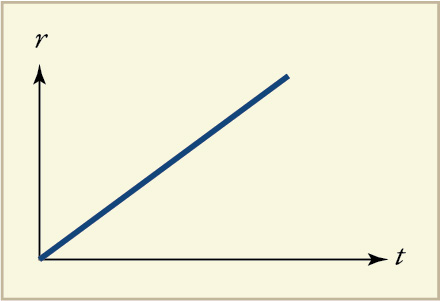
The figure is a plot of r as a function of t. The plot is a straight line through the origin with a positive slope.

Loading chapter 6…

Problems and answers are adapted from College Physics 2e by Paul Peter Urone, Roger Hinrichs, Kim Dirks and Manjula Sharma, OpenStax, and are used under the CC BY-NC-SA 4.0 licence. Access for free at https://openstax.org/books/college-physics-2e/pages/1-introduction-to-science-and-the-realm-of-physics-physical-quantities-and-units. Illustrations: Copyright Rice University, OpenStax, under CC BY-NC-SA 4.0 license. This adaptation is released under the same licence, is non-commercial, and is neither affiliated with nor endorsed by OpenStax or Rice University.