Every problem in the chapter beside the book’s answer, a chapter at a time as you scroll.

Chapter 13: Structure Determination: Nuclear Magnetic Resonance Spectroscopy

23 problems · 36 figures

13-1 §13.1 source ↗

The amount of energy required to spin-flip a nucleus depends both on the strength of the external magnetic field and on the nucleus. At a field strength of 4.7 T, rf energy of 200 MHz is required to bring a 1H nucleus into resonance, but energy of only 187 MHz will bring a 19F nucleus into resonance. Calculate the amount of energy required to spin-flip a 19F nucleus. Is this amount greater or less than that required to spin-flip a 1H nucleus?

Answer

7.5 × 10⁻⁵ kJ/mol for 19F; 8.0 × 10⁻⁵ kJ/mol for 1H

13-2 §13.1 source ↗

Calculate the amount of energy required to spin-flip a proton in a spectrometer operating at 300 MHz. Does increasing the spectrometer frequency from 200 to 300 MHz increase or decrease the amount of energy necessary for resonance?

Answer

1.2 × 10⁻⁴ kJ/mol

13-3 §13.2 source ↗

2-Chloropropene shows signals for three kinds of protons in its 1H NMR spectrum. Explain.

Answer

The vinylic C − H protons are nonequivalent.

13-4 §13.3 source ↗

The following 1H NMR peaks were recorded on a spectrometer operating at 200 MHz. Convert each into δ units.
(a)
CHCl3; 1454 Hz
(b)
CH3Cl; 610 Hz
(c)
CH3OH; 693 Hz
(d)
CH2Cl2; 1060 Hz

Answer (4 parts)

(a)
7.27 δ
(b)
3.05 δ
(c)
3.46 δ
(d)
5.30 δ

13-5 §13.3 source ↗

When the 1H NMR spectrum of acetone, CH3COCH3, is recorded on an instrument operating at 200 MHz, a single sharp resonance at 2.1 δ is seen.
(a)
How many hertz downfield from TMS does the acetone resonance correspond to?
(b)
If the 1H NMR spectrum of acetone is recorded at 500 MHz, what would the position of the absorption be in δ units?
(c)
How many hertz downfield from TMS does this 500 MHz resonance correspond to?

Answer (3 parts)

(a)
420 Hz
(b)
2.1 δ
(c)
1050 Hz

13-6 §13.4 source ↗

Each of the following compounds has a single 1H NMR peak. Approximately where would you expect each compound to absorb?
(a)
(b)
(c)
(d)
(e)
(f)

Answer (6 parts)

(a)
1.43 δ
(b)
2.17 δ
(c)
7.37 δ
(d)
5.30 δ
(e)
9.70 δ
(f)
2.12 δ

13-7 §13.4 source ↗

Identify the different types of protons in the following molecule, and tell where you would expect each to absorb:

Answer

There are seven kinds of protons labeled. The types and expected range of absorption of each follow. a: ether, 3.5–4.5 δ; b: aryl, 6.5–8.0 δ; c: aryl, 6.5–8.0; d: vinylic, 4.5–6.5 δ; e: vinylic, 4.5–6.5 δ; f: alkyl (secondary), 1.2–1.6 δ; g: alkyl (primary), 0.7–1.3 δ.

13-8 §13.5 source ↗

How many peaks would you expect in the 1H NMR spectrum of 1,4-dimethylbenzene (para-xylene, or p-xylene)? What ratio of peak areas would you expect on integration of the spectrum? Refer to Table 13.3 for approximate chemical shifts, and sketch what the spectrum would look like. (Remember from Section 2.4 that aromatic rings have two resonance forms.)
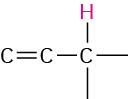
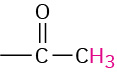
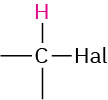
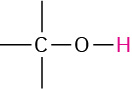
Table 13.3 Correlation of 1H Chemical Shifts with Environment in the book ↗
Type of hydrogen Diagram Chemical shift (δ)
Reference Si(CH3)4 0
Alkyl (primary) —CH3 0.7–1.3
Alkyl (secondary) —CH2— 1.2–1.6
Alkyl (tertiary) A C H group with three open single bonds. The hydrogen atom is highlighted. 1.4–1.8
Allylic A 3-carbon chain with a double bond between C 1 and C 2. C 3 with two open single bonds is bonded to a highlighted hydrogen atom. 1.6–2.2
Methyl ketone A carbonyl group with an open single bond is bonded to a methyl group, in which the hydrogen atoms are highlighted. 2.0–2.4
Aromatic methyl Ar—CH3 2.4–2.7
Alkynyl —C≡C—H 2.5–3.0
Alkyl halide A carbon with two open single bonds is bonded to a highlighted hydrogen and halogen. 2.5–4.0
Alcohol A carbon with three open single bonds is bonded to an oxygen atom, which is bonded to a highlighted hydrogen atom. 2.5–5.0
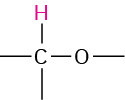
Alcohol, ether A carbon with two open single bonds is bonded to a highlighted hydrogen and oxygen atom that has an open single bond. 3.3–4.5
Vinylic A carbon with two open bonds is double bonded to another carbon that has an open single bond and is bonded to highlighted hydrogen. 4.5–6.5
Aryl Ar—H 6.5–8.0
Aldehyde A carbonyl group with an open single bond is bonded to a highlighted hydrogen atom. 9.7–10.0
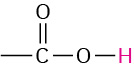
Carboxylic acid A carbonyl group with an open single bond is bonded to an oxygen atom, which is bonded to a highlighted hydrogen atom. 11.0–12.0

Answer

Two peaks; 3 : 2 ratio

13-9 §13.6 source ↗

Predict the splitting patterns you would expect for each proton in the following molecules:
(a)
(b)
(c)
(d)
(e)
(f)

Answer (6 parts)

(a)
−CHBr2, quartet; −CH3, doublet
(b)
CH3O−, singlet; −OCH2 −, triplet; −CH2Br, triplet
(c)
ClCH2− , triplet; −CH2−, quintet
(d)
CH3− , triplet; −CH2− , quartet; −CH− , septet; (CH3)2, doublet
(e)
CH3−, triplet; −CH2−, quartet; −CH−, septet; (CH3)2, doublet
(f)
= CH, triplet, −CH2−, doublet, aromatic C−H, two multiplets

13-10 §13.6 source ↗

Draw structures for compounds that meet the following descriptions:
(a)
C2H6O; one singlet
(b)
C3H7Cl; one doublet and one septet
(c)
C4H8Cl2O; two triplets
(d)
C4H8O2; one singlet, one triplet, and one quartet

Answer (4 parts)

(a)
CH3OCH3
(b)
CH3CH(Cl)CH3
(c)
ClCH2CH2OCH2CH2Cl
(d)
CH3CH2CO2CH3 or CH3CO2CH2CH3

13-11 §13.6 source ↗

The integrated 1H NMR spectrum of a compound of formula C4H10O is shown in Figure 13.12. Propose a structure.

Figure 13.12 An integrated 1H NMR spectrum for Problem 11.
Figure 13.12 in the book ↗
An integrated 1H NMR spectrum for Problem 11.

Answer

CH3CH2OCH2CH3

13-12 §13.7 source ↗

Identify the indicated sets of protons as unrelated, homotopic, enantiotopic, or diastereotopic:
(a)
(b)
(c)
(d)
(e)
(f)

Answer (6 parts)

(a)
Enantiotopic
(b)
Diastereotopic
(c)
Diastereotopic
(d)
Diastereotopic
(e)
Diastereotopic
(f)
Homotopic

13-13 §13.7 source ↗

How many kinds of electronically nonequivalent protons are present in each of the following compounds, and thus how many NMR absorptions might you expect in each?
(a)
CH3CH2Br
(b)
CH3OCH2CH(CH3)2
(c)
CH3CH2CH2NO2
(d)
Methylbenzene
(e)
2-Methyl-1-butene
(f)
cis-3-Hexene

Answer (6 parts)

(a)
2
(b)
4
(c)
3
(d)
4
(e)
5
(f)
3

13-14 §13.7 source ↗

How many absorptions would you expect (S)-malate, an intermediate in carbohydrate metabolism, to have in its 1H NMR spectrum? Explain.

Answer

4

13-15 §13.8 source ↗

3-Bromo-1-phenyl-1-propene shows a complex NMR spectrum in which the vinylic proton at C2 is coupled with both the C1 vinylic proton (J = 16 Hz) and the C3 methylene protons (J = 8 Hz). Draw a tree diagram for the C2 proton signal, and account for the fact that a five-line multiplet is observed.

Answer

J1–2 = 16 Hz; J2–3 = 8 Hz

13-16 §13.9 source ↗

How could you use 1H NMR to determine the regiochemistry of electrophilic addition to alkenes? For example, does addition of HCl to 1-methylcyclohexene yield 1-chloro-1-methylcyclohexane or 1-chloro-2-methylcyclohexane?

Answer

1-Chloro-1-methylcyclohexane has a singlet methyl absorption.

13-17 §13.11 source ↗

Predict the number of carbon resonance lines you would expect in the 13C NMR spectra of the following compounds:
(a)
Methylcyclopentane
(b)
1-Methylcyclohexene
(c)
1,2-Dimethylbenzene
(d)
2-Methyl-2-butene
(e)
(f)

Answer (6 parts)

(a)
4
(b)
7
(c)
4
(d)
5
(e)
5
(f)
7

13-18 §13.11 source ↗

Propose structures for compounds that fit the following descriptions:
(a)
A hydrocarbon with seven lines in its 13C NMR spectrum
(b)
A six-carbon compound with only five lines in its 13C NMR spectrum
(c)
A four-carbon compound with three lines in its 13C NMR spectrum

Answer (3 parts)

(a)
1,3-Dimethylcyclopentene
(b)
2-Methylpentane
(c)
1-Chloro-2-methylpropane

13-19 §13.11 source ↗

Classify the resonances in the 13C NMR spectrum of methyl propanoate, CH3CH2CO2CH3 (Figure 13.20).

Figure 13.20 13C NMR spectrum of methyl propanoate, Problem 19.
Figure 13.20 in the book ↗
13C NMR spectrum of methyl propanoate, Problem 19.

Answer

−CH3, 9.3 δ; −CH2− , 27.6 δ; C=O, 174.6 δ;− OCH3, 51.4 δ

13-20 §13.12 source ↗

Assign a chemical shift to each carbon in 6-methyl-5-hepten-2-ol (Figure 13.21).
Figure 13.21 in the book ↗
DEPT–NMR spectra for 6-methyl-5-hepten-2-ol. Part (a) is an ordinary broadband-decoupled spectrum, which shows signals for all eight carbons. Part (b) is a DEPT-90 spectrum, which shows only signals for the two CH carbons. Part (c) is a DEPT-135 spectrum, which shows positive signals for the two CH and three CH3 carbons and negative signals for the two CH2 carbons.

Answer

13-21 §13.12 source ↗

Estimate the chemical shift of each carbon in the following molecule. Predict which carbons will appear in the DEPT-90 spectrum, which will give positive peaks in the DEPT-135 spectrum, and which will give negative peaks in the DEPT-135 spectrum.

Answer

13-22 §13.12 source ↗

Propose a structure for an aromatic hydrocarbon, C11H16, that has the following 13C NMR spectral data:

• Broadband decoupled: 29.5, 31.8, 50.2, 125.5, 127.5, 130.3, 139.8 δ

• DEPT-90: 125.5, 127.5, 130.3 δ

• DEPT-135: positive peaks at 29.5, 125.5, 127.5, 130.3 δ; negative peak at 50.2 δ

Answer

13-23 §13.13 source ↗

We saw in Section 9.3 that addition of HBr to a terminal alkyne leads to the Markovnikov addition product, with the Br bonding to the more highly substituted carbon. How could you use 13C NMR to identify the product of the addition of 1 equivalent of HBr to 1-hexyne?

Answer

A DEPT-90 spectrum would show two absorptions for the non-Markovnikov product (RCH = CHBr) but no absorptions for the Markovnikov product (RBrC = CH2).

Loading chapter 14…

Problems and answers are adapted from Organic Chemistry: A Tenth Edition by John McMurry, OpenStax, and are used under the CC BY-NC-SA 4.0 licence. Access for free at https://openstax.org/books/organic-chemistry/pages/1-why-this-chapter. Illustrations: Copyright Rice University, OpenStax, under CC BY-NC-SA 4.0 license. This adaptation is released under the same licence, is non-commercial, and is neither affiliated with nor endorsed by OpenStax or Rice University.