Every problem in the chapter beside the book’s answer, a chapter at a time as you scroll.

Chapter 24: Amines and Heterocycles

25 problems · 36 figures

24-1 §24.1 source ↗

Name the following compounds:
(a)
(b)
(c)
(d)
(e)
(f)

Answer (6 parts)

(a)
N-Methylethylamine
(b)
Tricyclohexylamine
(c)
N-Ethyl-N-methylcyclohexylamine
(d)
N-Methylpyrrolidine
(e)
Diisopropylamine
(f)
1,3-Butanediamine

24-2 §24.1 source ↗

Draw structures corresponding to the following IUPAC names:
(a)
Triisopropylamine
(b)
Triallylamine
(c)
N-Methylaniline
(d)
N-Ethyl-N-methylcyclopentylamine
(e)
N-Isopropylcyclohexylamine
(f)
N-Ethylpyrrole

Answer (6 parts)

(a)
(b)
(c)
(d)
(e)
(f)

24-3 §24.1 source ↗

Draw structures for the following heterocyclic amines:
(a)
5-Methoxyindole
(b)
1,3-Dimethylpyrrole
(c)
4-(N,N-Dimethylamino)pyridine
(d)
5-aminopyrimidine

Answer (4 parts)

(a)
(b)
(c)
(d)

24-4 §24.3 source ↗

Which compound in each of the following pairs is more basic?
(a)
CH3CH2NH2 or CH3CH2CONH2
(b)
NaOH or CH3NH2
(c)
CH3NHCH3 or pyridine

Answer (3 parts)

(a)
CH3CH2NH2
(b)
NaOH
(c)
CH3NHCH3

24-5 §24.3 source ↗

The benzylammonium ion (C6H5CH2NH3+) has pKa = 9.33, and the propylammonium ion has pKa = 10.71. Which is the stronger base, benzylamine or propylamine? What are the pKb’s of benzylamine and propylamine?

Answer

Propylamine is stronger; benzylamine pKb = 4.67; propylamine pKb = 3.29

24-6 §24.4 source ↗

Without looking at Table 24.2, rank the following compounds in order of ascending basicity.
(a)
p-Nitroaniline, p-aminobenzaldehyde, p-bromoaniline
(b)
p-Chloroaniline, p-aminoacetophenone, p-methylaniline
(c)
p-(Trifluoromethyl)aniline, p-methylaniline, p-(fluoromethyl)aniline
Table 24.2 Base Strength of Some p-Substituted Anilines in the book ↗
The reversible reaction of para-substituted amine with water to form para-substituted anilinium ion and hydroxide ion.
  Substituent, Y pKa  
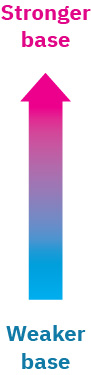
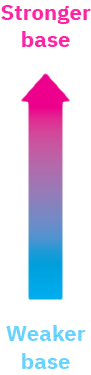
An arrow points upward; the bottom (blue) says weaker base, and the top (red) says stronger base.An arrow points upward; the bottom (blue) says weaker base, and the top (red) says stronger base. –NH2 6.15 Activating groups
–OCH3 5.34
–CH3 5.08
–H 4.63  
–Cl 3.98 Deactivating groups
–Br 3.86
–CN 1.74
–NO2 1.00

Answer (3 parts)

(a)
p-Nitroaniline < p-Aminobenzaldehyde < p-Bromoaniline
(b)
p-Aminoacetophenone < p-Chloroaniline < p-Methylaniline
(c)
p-(Trifluoromethyl)aniline < p-(Fluoromethyl)aniline < p-Methylaniline

24-7 §24.5 source ↗

Calculate the percentages of neutral and protonated forms present in a solution of 0.0010 Molar pyrimidine at pH = 7.3. The pKa of pyrimidinium ion is 1.3.

Answer

Pyrimidine is essentially 100% neutral (unprotonated).

24-8 §24.6 source ↗

Propose structures for either a nitrile or an amide that might be a precursor of each of the following amines:
(a)
CH3CH2CH2NH2
(b)
(CH3CH2CH2)2NH
(c)
Benzylamine, C6H5CH2NH2
(d)
N-Ethylaniline

Answer (4 parts)

(a)
Propanenitrile or propanamide
(b)
N-Propylpropanamide
(c)
Benzonitrile or benzamide
(d)
N-Phenylacetamide

24-9 §24.6 source ↗

Write the mechanism of the last step in Gabriel amine synthesis, the base-promoted hydrolysis of a phthalimide to yield an amine plus phthalate ion.

Answer

The reaction takes place by two nucleophilic acyl substitution reactions.

24-10 §24.6 source ↗

Show two methods for the synthesis of dopamine, a neurotransmitter involved in regulation of the central nervous system. Use any alkyl halide needed.

Answer

24-11 §24.6 source ↗

How might the following amines be prepared using reductive amination reactions? Show all precursors if more than one is possible.
(a)
(b)
(c)

Answer (3 parts)

(a)
Ethylamine + acetone, or isopropylamine + acetaldehyde
(b)
Aniline + acetaldehyde
(c)
Cyclopentylamine + formaldehyde, or methylamine + cyclopentanone

24-12 §24.6 source ↗

How could you prepare the following amine using a reductive amination reaction?

Answer

24-13 §24.6 source ↗

How would you prepare the following amines, using both Hofmann and Curtius rearrangements on a carboxylic acid derivative?
(a)
(b)

Answer (2 parts)

(a)
4,4-Dimethylpentanamide or 4,4-dimethylpentanoyl azide
(b)
p-Methylbenzamide or p-methylbenzoyl azide

24-14 §24.7 source ↗

What products would you expect from Hofmann elimination of the following amines? If more than one product is formed, indicate which is major.
(a)
(b)
(c)
(d)

Answer (4 parts)

(a)
3-Octene and 4-octene
(b)
Cyclohexene
(c)
3-Heptene
(d)
Ethylene and cyclohexene

24-15 §24.7 source ↗

What product would you expect from Hofmann elimination of a heterocyclic amine such as piperidine? Write all the steps.

Answer

H2C ═ CHCH2CH2CH2N(CH3)2

24-16 §24.8 source ↗

Propose a synthesis of the drug sulfathiazole from benzene and any necessary amine.

Answer

1. HNO3, H2SO4; 2. H2/PtO2; 3. (CH3CO)2O; 4. HOSO2Cl; 5. aminothiazole; 6. H2O, NaOH

24-17 §24.8 source ↗

Propose syntheses of the following compounds from benzene:
(a)
N,N-Dimethylaniline
(b)
p-Chloroaniline
(c)
m-Chloroaniline
(d)
2,4-Dimethylaniline

Answer (4 parts)

(a)
1. HNO3, H2SO4; 2. H2/PtO2; 3. 2 CH3Br
(b)
1. HNO3, H2SO4; 2. H2/PtO2; 3. (CH3CO)2O; 4. Cl2; 5. H2O, NaOH
(c)
1. HNO3, H2SO4; 2. Cl2, FeCl3; 3. SnCl2
(d)
1. HNO3, H2SO4; 2. H2/PtO2; 3. (CH3CO)2O; 4. 2 CH3Cl, AlCl3; 5. H2O, NaOH

24-18 §24.8 source ↗

How would you prepare the following compounds from benzene, using a diazonium replacement reaction in your scheme?
(a)
p-Bromobenzoic acid
(b)
m-Bromobenzoic acid
(c)
m-Bromochlorobenzene
(d)
p-Methylbenzoic acid
(e)
1,2,4-Tribromobenzene

Answer (5 parts)

(a)
1. CH3Cl, AlCl3; 2. HNO3, H2SO4; 3. SnCl2; 4. NaNO2, H2SO4; 5. CuBr; 6. KMnO4, H2O
(b)
1. HNO3, H2SO4; 2. Br2, FeBr3; 3. SnCl2, H3O+; 4. NaNO2, H2SO4; 5. CuCN; 6. H3O+
(c)
1. HNO3, H2SO4; 2. Cl2, FeCl3; 3. SnCl2; 4. NaNO2, H2SO4; 5. CuBr
(d)
1. CH3Cl, AlCl3; 2. HNO3, H2SO4; 3. SnCl2; 4. NaNO2, H2SO4; 5. CuCN; 6. H3O+
(e)
1. HNO3, H2SO4; 2. H2/PtO2; 3. (CH3CO)2O; 4. 2 Br2; 5. H2O, NaOH; 6. NaNO2, H2SO4; 7. CuBr

24-19 §24.8 source ↗

Propose a synthesis of p-(dimethylamino)azobenzene with benzene as your only organic starting material.

Answer

1. HNO3, H2SO4; 2. SnCl2; 3a. 2 equiv. CH3I; 3b. NaNO2, H2SO4; 4. product of 3a + product of 3b

24-20 §24.9 source ↗

Draw an orbital picture of thiazole. Assume that both the nitrogen and sulfur atoms are sp2-hybridized, and show the orbitals that the lone pairs occupy.

Answer

24-21 §24.9 source ↗

What is the percent protonation of the imidazole nitrogen atom in histidine at a physiological pH of 7.3 (Section 24.5)?

Answer

4.1% protonated

24-22 §24.9 source ↗

Electrophilic aromatic substitution reactions of pyridine normally occur at C3. Draw the carbocation intermediates resulting from reaction of an electrophile at C2, C3, and C4, and explain the observed result.

Answer

24-23 §24.9 source ↗

Which nitrogen atom in the hallucinogenic indole alkaloid N,N-dimethyltryptamine is more basic? Explain.

Answer

The side-chain nitrogen is more basic than the ring nitrogen.

24-24 §24.9 source ↗

Indole reacts with electrophiles at C3 rather than at C2. Draw resonance forms of the intermediate cations resulting from reaction at C2 and C3, and explain the observed results.

Answer

Reaction at C2 is disfavored because the aromaticity of the benzene ring is lost.

24-25 §24.10 source ↗

Compound A, C6H12O, has an IR absorption at 1715 cm–1 and gives compound B, C6H15N, when treated with ammonia and NaBH4. The IR and 1H NMR spectra of B are shown. What are the structures of A and B?

Answer

(CH3)3CCOCH3 ​→ ​(CH3)3CCH(NH2)CH3

Loading chapter 25…

Problems and answers are adapted from Organic Chemistry: A Tenth Edition by John McMurry, OpenStax, and are used under the CC BY-NC-SA 4.0 licence. Access for free at https://openstax.org/books/organic-chemistry/pages/1-why-this-chapter. Illustrations: Copyright Rice University, OpenStax, under CC BY-NC-SA 4.0 license. This adaptation is released under the same licence, is non-commercial, and is neither affiliated with nor endorsed by OpenStax or Rice University.