Every problem in the chapter beside the book’s answer, a chapter at a time as you scroll.

Chapter 3: Organic Compounds: Alkanes and Their Stereochemistry

18 problems · 43 figures

3-1 §3.1 source ↗

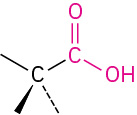
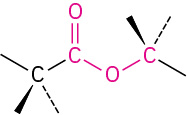
Use Table 3.1 to identify the functional groups in each of the following molecules:
(a)
(b)
(c)
Table 3.1 Structures of Some Common Functional Groups in the book ↗
Name Structure* Name ending Example
Alkene (double bond) The general structure of alkene. -ene H2C═CH2
Ethene
Alkyne (triple bond) –C≡C– -yne HC≡CH
Ethyne
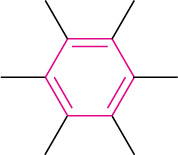
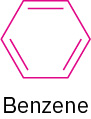
Arene (aromatic ring) The general structure of arene. None The general structure of benzene.
Halide The general structure of halide where X represents any halogen element.

(X=F, Cl, Br, I)

None CH3Cl
Chloromethane
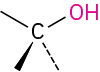
Alcohol The general structure of alcohol. -ol CH3OH
Methanol
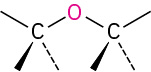
Ether The general structure of ether. ether CH3OCH3
Dimethyl ether
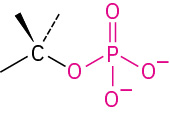
Monophosphate The general structure of monophosphate. phosphate CH3OPO32−
Methyl phosphate
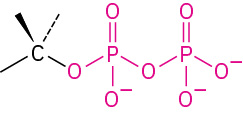
Diphosphate The general structure of diphosphate. diphosphate CH3OP2O63−
Methyl diphosphate
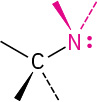
Amine The general structure of amine featuring a lone pair on nitrogen. -amine CH3NH2
Methylamine
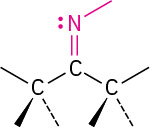
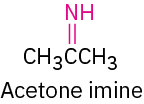
Imine (Schiff base) The general structure of imine (Schiff base). None The chemical structure of acetone imine.
Nitrile –C≡N -nitrile CH3C≡N
Ethanenitrile
Thiol The general structure of thiol. -thiol CH3SH
Methanethiol
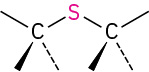
Sulfide The general structure of sulfide. sulfide CH3SCH3
Dimethyl sulfide
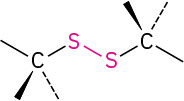
Disulfide The general structure of disulfide. disulfide CH3SSCH3
Dimethyl disulfide
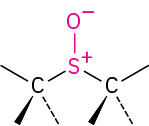
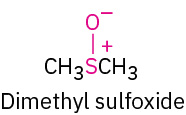
Sulfoxide The general structure of sulfoxide. sulfoxide The chemical structure of dimethyl sulfoxide where a positive and a negative charge is placed on sulphur and oxygen, respectively.
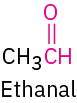
Aldehyde The general structure of aldehyde. -al The chemical structure of ethanal.
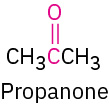
Ketone The general structure of ketone. -one The chemical structure of propanone.
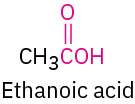
Carboxylic acid The general structure of carboxylic acid. -oic acid The chemical structure of ethanoic acid.
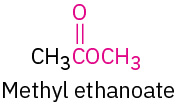
Ester The general structure of ester. -oate The chemical structure of methyl ethanoate.
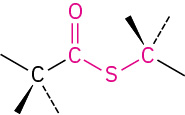
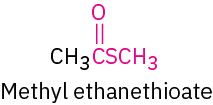
Thioester The general structure of thioester. -thioate The molecular structure of methyl ethanethioate.
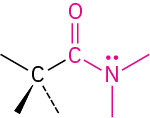
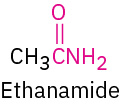
Amide The general structure of amide featuring a lone pair on nitrogen. -amide The chemical structure of ethanamide.
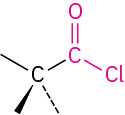
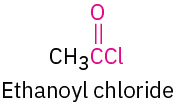
Acid chloride The general structure of acid chloride. -oyl chloride The chemical structure of ethanoyl chloride.
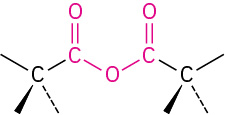
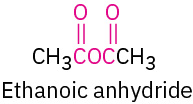
Carboxylic acid anhydride The general structure of carboxylic acid anhydride. -oic anhydride The chemical structure of ethanoic anhydride.

Answer (3 parts)

(a)
Sulfide, carboxylic acid, amine
(b)
Aromatic ring, carboxylic acid
(c)
Ether, alcohol, aromatic ring, amide, C = C bond

3-2 §3.1 source ↗

Propose structures for simple molecules that contain the following functional groups:
(a)
Alcohol
(b)
Aromatic ring
(c)
Carboxylic acid
(d)
Amine
(e)
Both ketone and amine
(f)
Two double bonds

Answer (6 parts)

(a)
(b)
(c)
(d)
(e)
(f)

3-3 §3.1 source ↗

Identify the functional groups in the following model of arecoline, a veterinary drug used to control worms in animals. Convert the drawing into a line-bond structure and a molecular formula (red = O, blue = N, black = C, gray = H).

Answer

3-4 §3.2 source ↗

Draw structures of the five isomers of C6H14.

Answer

3-5 §3.2 source ↗

Propose structures that meet the following descriptions:
(a)
Two isomeric esters with the formula C5H10O2:
(b)
Two isomeric nitriles with the formula C4H7N
(c)
Two isomeric disulfides with the formula C4H10S2

Answer (3 parts)

(a)
(b)
(c)

3-6 §3.2 source ↗

How many isomers are there with the following descriptions?
(a)
Alcohols with the formula C3H8O
(b)
Bromoalkanes with the formula C4H9Br
(c)
Thioesters with the formula C4H8OS

Answer (3 parts)

(a)
Two
(b)
Four
(c)
Four

3-7 §3.3 source ↗

Draw the eight 5-carbon alkyl groups (pentyl isomers).

Answer

3-8 §3.3 source ↗

Identify the carbon atoms in the following molecules as primary, secondary, tertiary, or quaternary:
(a)
(b)
(c)

Answer (3 parts)

(a)
(b)
(c)

3-9 §3.3 source ↗

Identify the hydrogen atoms on the compounds shown in Problem 3-8 as primary, secondary, or tertiary.

Answer

Primary carbons have primary hydrogens, secondary carbons have secondary hydrogens, and tertiary carbons have tertiary hydrogens.

3-10 §3.3 source ↗

Draw structures of alkanes that meet the following descriptions:
(a)
An alkane with two tertiary carbons
(b)
An alkane that contains an isopropyl group
(c)
An alkane that has one quaternary and one secondary carbon

Answer (3 parts)

(a)
(b)
(c)

3-11 §3.4 source ↗

Give IUPAC names for the following compounds:
(a)
(b)
(c)
(d)

Answer (4 parts)

(a)
Pentane, 2-methylbutane, 2,2-dimethylpropane
(b)
2,3-Dimethylpentane
(c)
2,4-Dimethylpentane
(d)
2,2,5-Trimethylhexane

3-12 §3.4 source ↗

Draw structures corresponding to the following IUPAC names:
(a)
3,4-Dimethylnonane
(b)
3-Ethyl-4,4-dimethylheptane
(c)
2,2-Dimethyl-4-propyloctane
(d)
2,2,4-Trimethylpentane

Answer (4 parts)

(a)
(b)
(c)
(d)

3-13 §3.4 source ↗

Name the eight 5-carbon alkyl groups you drew in Problem 3-7.

Answer

Pentyl, 1-methylbutyl, 1-ethylpropyl, 2-methylbutyl, 3-methylbutyl, 1,1-dimethylpropyl, 1,2-dimethylpropyl, 2,2-dimethylpropyl

3-14 §3.4 source ↗

Give the IUPAC name for the following hydrocarbon, and convert the drawing into a skeletal structure.

Answer

3-15 §3.7 source ↗

Make a graph of potential energy versus angle of bond rotation for propane, and assign values to the energy maxima.

Answer

3-16 §3.7 source ↗

Sight along the C2–C1 bond of 2-methylpropane (isobutane).
(a)
Draw a Newman projection of the most stable conformation.
(b)
Draw a Newman projection of the least stable conformation.
(c)
Make a graph of energy versus angle of rotation around the C2–C1 bond.
(d)
Assign relative values to the maxima and minima in your graph, given that an H ⟷ H eclipsing interaction costs 4.0 kJ/mol and an H ⟷ CH3 eclipsing interaction costs 6.0 kJ/mol.

Answer (4 parts)

(a)
(b)
(c)
(d)

3-17 §3.7 source ↗

Sight along the C2–C3 bond of 2,3-dimethylbutane, and draw a Newman projection of the most stable conformation.

Answer

3-18 §3.7 source ↗

Draw a Newman projection along the C2–C3 bond of the following conformation of 2,3-dimethylbutane, and calculate a total strain energy:

Answer

Loading chapter 4…

Problems and answers are adapted from Organic Chemistry: A Tenth Edition by John McMurry, OpenStax, and are used under the CC BY-NC-SA 4.0 licence. Access for free at https://openstax.org/books/organic-chemistry/pages/1-why-this-chapter. Illustrations: Copyright Rice University, OpenStax, under CC BY-NC-SA 4.0 license. This adaptation is released under the same licence, is non-commercial, and is neither affiliated with nor endorsed by OpenStax or Rice University.