Every problem in the chapter beside the book’s answer, a chapter at a time as you scroll.

Chapter 26: Biomolecules: Amino Acids, Peptides, and Proteins

18 problems · 12 figures

26-1 §26.1 source ↗

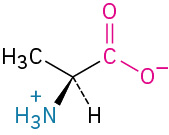
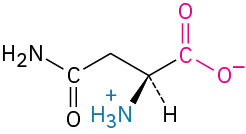
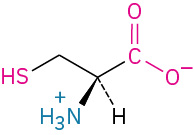
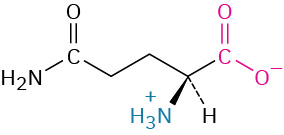
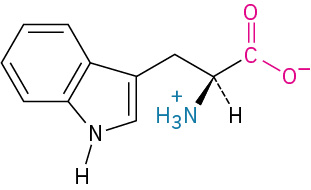
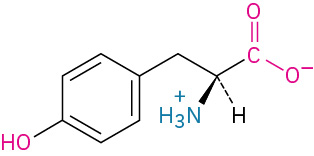
How many of the α-amino acids shown in Table 26.1 contain aromatic rings? How many contain sulfur? How many contain alcohol groups? How many contain hydrocarbon side chains?
Table 26.1 The 20 Common Amino Acids in Proteins in the book ↗
Name Abbreviations MW Structure pKa α-CO2H pKa α-NH3+ pKa side chain pI
Neutral Amino Acids
Alanine Ala A 89 The ball-and-stick model in electrostatic potential map and structures of uncharged and zwitterionic forms of L-alanine. The uncharged form undergoes a reversible reaction to form a zwitterion. 2.34 9.69 — 6.01
Asparagine Asn N 132 The structure of L-asparagine. It has a carbon linked to methylene connected to amide, carboxylate ion, dashed hydrogen, and wedged ammonia ion. 2.02 8.80 — 5.41
Cysteine Cys C 121 The structure of L-cysteine. It has a carbon linked to methylene connected to thiol, carboxylate ion, dashed hydrogen, and wedged ammonia ion. 1.96 10.28 8.18 5.07
Glutamine Gln Q 146 The structure of L-glutamine. It has a carbon linked to two methylene connected to amide, carboxylate ion, dashed hydrogen, and wedged ammonia ion. 2.17 9.13 — 5.65
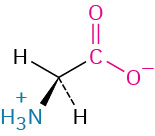
Glycine Gly G 75 The structure of glycine. It has a carbon linked to hydrogen, carboxylate ion, dashed hydrogen, and wedged ammonia ion. 2.34 9.60 — 5.97
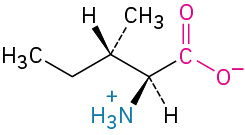
Isoleucine Ile I 131 The structure of L-isoleucine. Carbon is linked to C-H bonded to dashed methyl, wedged hydrogen and methylene is linked to methyl group, carboxylate ion, dashed hydrogen, and wedged ammonia ion. 2.36 9.60 — 6.02
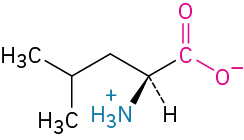
Leucine Leu L 131 The structure of L-leucine. It has a carbon linked to methylene linked to C-H bonded to two methyl groups, carboxylate ion, dashed hydrogen, and wedged ammonia ion. 2.36 9.60 — 5.98
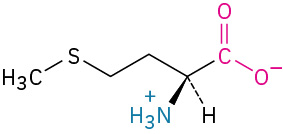
Methionine Met M 149 The structure of L-methionine. It has a carbon linked to two methylene groups linked to sulfur and methyl group, carboxylate ion, dashed hydrogen, and wedged ammonia ion. 2.28 9.21 — 5.74
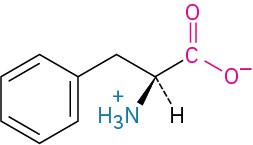
Phenylalanine Phe F 165 The structure of L-phenylalanine. It has a carbon linked to methylene linked to a benzene ring, carboxylate ion, dashed hydrogen, and wedged ammonia ion. 1.83 9.13 — 5.48
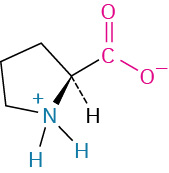
Proline Pro P 115 The structure of L-proline. It has a carbon linked to cyclopentane with wedged bond linked to N H 2 positive, carboxylate ion, dashed hydrogen, and wedged ammonia ion. 1.99 10.60 — 6.30
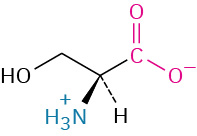
Serine Ser S 105 The structure of L-serine. It has a carbon linked to methylene connected to an alcohol, carboxylate ion, dashed hydrogen, and wedged ammonia ion. 2.21 9.15 — 5.68
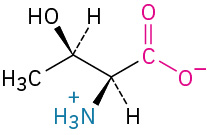
Threonine Thr T 119 The structure of L-threonine. It has a carbon linked to C-H bonded to dashed hydrogen, wedged alcohol and methyl group, carboxylate ion, dashed hydrogen, and wedged ammonia ion. 2.09 9.10 — 5.60
Tryptophan Trp W 204 The structure of L-tryptophan. It has a carbon linked to methylene linked to cyclopentene with N-H fused to a benzene ring, carboxylate ion, dashed hydrogen, and wedged ammonia ion. 2.83 9.39 — 5.89
Tyrosine Tyr Y 181 The structure of L-tyrosine. It has a carbon linked to methylene linked to phenol, carboxylate ion, dashed hydrogen, and wedged ammonia ion. 2.20 9.11 10.07 5.66
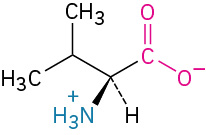
Valine Val V 117 The structure of L-valine. It has a carbon linked to C-H linked to two methyl groups, carboxylate ion, dashed hydrogen, and wedged ammonia ion. 2.32 9.62 — 5.96
Acidic Amino Acids
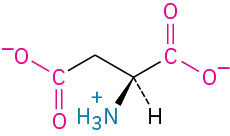
Aspartic acid Asp D 133 The structure of L-aspartic acid. It has a carbon linked to methylene linked to carboxylate ion, carboxylate ion, dashed hydrogen, and wedged ammonia ion. 1.88 9.60 3.65 2.77
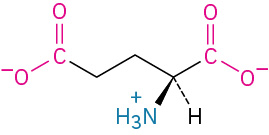
Glutamic acid Glu E 147 The structure of L-glutamic acid. It has a carbon linked to two methylene groups linked to carboxylate ion, carboxylate ion, dashed hydrogen, and wedged ammonia ion. 2.19 9.67 4.25 3.22
Basic Amino Acids
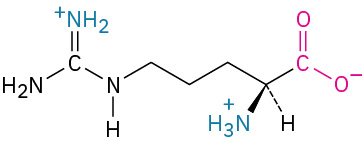
Arginine Arg R 174 The structure of L-arginine comprises carbon linked to three methylene to N-H, carbon linked to an amine, and an alkene bonded to amine cation, carboxylate, dashed hydrogen, and wedged ammonia. 2.17 9.04 12.48 10.76
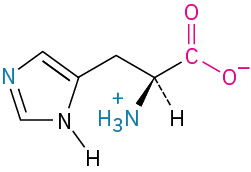
Histidine His H 155 The structure of L-histidine. It has a carbon linked to methylene group linked to cyclopentadiene with nitrogen and N-H, carboxylate ion, dashed hydrogen, and wedged ammonia ion. 1.82 9.17 6.00 7.59
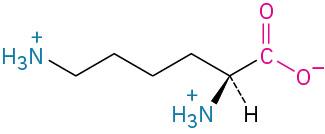
Lysine Lys K 146 The structure of lysine. It has a carbon linked to four methylene groups linked to ammonia cation, carboxylate ion, dashed hydrogen, and wedged ammonia ion. 2.18 8.95 10.53 9.74

Answer

Aromatic: Phe, Tyr, Trp, His; sulfur-containing: Cys, Met; alcohols: Ser, Thr; hydrocarbon side chains: Ala, Ile, Leu, Val, Phe

26-2 §26.1 source ↗

Of the 19 L amino acids, 18 have the S configuration at the α carbon. Cysteine is the only L amino acid that has an R configuration. Explain.

Answer

The sulfur atom in the −CH2SH group of cysteine makes the side chain higher in ranking than the −CO2H group.

26-3 §26.1 source ↗

The amino acid threonine, (2S,3R)-2-amino-3-hydroxybutanoic acid, has two chirality centers.

(a) Draw threonine, using normal, wedged, and dashed lines to show dimensionality.

(b) Draw a diastereomer of threonine, and label its chirality centers as R or S.

Answer

26-4 §26.2 source ↗

Hemoglobin has pI = 6.8. Does hemoglobin have a net negative charge or net positive charge at pH = 5.3? At pH = 7.3?

Answer

Net positive at pH = 5.3; net negative at pH = 7.3

26-5 §26.3 source ↗

Show how you could prepare the following α-amino acids from the appropriate carboxylic acids:
(a)
Phenylalanine
(b)
Valine

Answer (2 parts)

(a)
Start with 3-phenylpropanoic acid: 1. Br2, PBr3; 2. NH3
(b)
Start with 3-methylbutanoic acid: 1. Br2, PBr3; 2. NH3

26-6 §26.3 source ↗

What alkyl halides would you use to prepare the following α-amino acids by the amidomalonate method?
(a)
Leucine
(b)
Histidine
(c)
Tryptophan
(d)
Methionine

Answer (4 parts)

(a)
(b)
(c)
(d)

26-7 §26.3 source ↗

Show how you could prepare the following amino acid enantioselectively:

Answer

26-8 §26.4 source ↗

Six isomeric tripeptides contain valine, tyrosine, and glycine. Name them using both three- and one-letter abbreviations.

Answer

Val-Tyr-Gly (VYG), Tyr-Gly-Val (YGV), Gly-Val-Tyr (GVY), Val-Gly-Tyr (VGY), Tyr-Val-Gly (YVG), Gly-Tyr-Val (GYV)

26-9 §26.4 source ↗

Draw the structure of M-P-V-G, and indicate its amide bonds.

Answer

26-10 §26.5 source ↗

Show the structure of the product you would expect to obtain by SN2 reaction of a cysteine residue with iodoacetic acid.

Answer

26-11 §26.5 source ↗

Show the structures of the products obtained on reaction of valine with ninhydrin.

Answer

26-12 §26.6 source ↗

The octapeptide angiotensin II has the sequence Asp-Arg-Val-Tyr-Ile-His-Pro-Phe. What fragments would result if angiotensin II were cleaved with trypsin? With chymotrypsin?

Answer

Trypsin: Asp-Arg + Val-Tyr-Ile-His-Pro-Phe

Chymotrypsin: Asp-Arg-Val-Tyr + Ile-His-Pro-Phe

26-13 §26.6 source ↗

What is the N-terminal residue on a peptide that gives the following PTH derivative upon Edman degradation?

Answer

Methionine

26-14 §26.6 source ↗

Draw the structure of the PTH derivative that would be formed by Edman degradation of angiotensin II (Problem 26-12).

Answer

26-15 §26.6 source ↗

Give the amino acid sequence of hexapeptides that produce the following sets of fragments upon partial acid hydrolysis:
(a)
Arg, Gly, Ile, Leu, Pro, Val gives Pro-Leu-Gly, Arg-Pro, Gly-Ile-Val
(b)
N, L, M, W, V2 gives V-L, V-M-W, W-N-V

Answer (2 parts)

(a)
Arg-Pro-Leu-Gly-Ile-Val
(b)
Val-Met-Trp-Asp-Val-Leu (VMWNVL)

26-16 §26.7 source ↗

Show the mechanism for formation of a Boc derivative by reaction of an amino acid with di-tert-butyl dicarbonate.

Answer

This is a typical nucleophilic acyl substitution reaction, with the amine of the amino acid as the nucleophile and tert-butyl carbonate as the leaving group. The tert-butyl carbonate then loses CO2 and gives tert-butoxide, which is protonated.

26-17 §26.7 source ↗

Write all five steps required for the synthesis of Leu-Ala from alanine and leucine.

Answer

(1) Protect the amino group of leucine.

(2) Protect the carboxylic acid group of alanine.

(3) Couple the protected amino acids with DCC.

(4) Remove the leucine protecting group.

(5) Remove the alanine protecting group.

26-18 §26.10 source ↗

To what classes do the following enzymes belong?
(a)
Pyruvate decarboxylase
(b)
Chymotrypsin
(c)
Alcohol dehydrogenase

Answer (3 parts)

(a)
Lyase
(b)
Hydrolase
(c)
Oxidoreductase

Loading chapter 27…

Problems and answers are adapted from Organic Chemistry: A Tenth Edition by John McMurry, OpenStax, and are used under the CC BY-NC-SA 4.0 licence. Access for free at https://openstax.org/books/organic-chemistry/pages/1-why-this-chapter. Illustrations: Copyright Rice University, OpenStax, under CC BY-NC-SA 4.0 license. This adaptation is released under the same licence, is non-commercial, and is neither affiliated with nor endorsed by OpenStax or Rice University.