Every problem in the chapter beside the book’s answer, a chapter at a time as you scroll.

Chapter 16: Chemistry of Benzene: Electrophilic Aromatic Substitution

23 problems · 18 figures

16-1 §16.1 source ↗

Monobromination of toluene gives a mixture of three bromotoluene products. Draw and name them.

Answer

o-, m-, and p-Bromotoluene

16-2 §16.2 source ↗

Propose a mechanism for the electrophilic fluorination of benzene with SelectFluor.

Answer

16-3 §16.2 source ↗

How many products might be formed on chlorination of o-xylene (o-dimethylbenzene), m-xylene, and p-xylene?

Answer

o-xylene: 2; p-xylene: 1; m-xylene: 3

16-4 §16.2 source ↗

When benzene is treated with D2SO4, deuterium slowly replaces all six hydrogens in the aromatic ring. Explain.

Answer

D+ does electrophilic substitutions on the ring.

16-5 §16.3 source ↗

Which of the following alkyl halides would you expect to undergo Friedel–Crafts reaction with rearrangement and which without? Explain.

(a) CH3CH2Cl (b) CH3CH2CH(Cl)CH3 (c) CH3CH2CH2Cl (d) (CH3)3CCH2Cl
(e) Chlorocyclohexane

Answer

No rearrangement: (a), (b), (e)

16-6 §16.3 source ↗

What is the major monosubstitution product from the Friedel–Crafts reaction of benzene with 1-chloro-2-methylpropane in the presence of AlCl3?

Answer

tert-Butylbenzene

16-7 §16.3 source ↗

Identify the carboxylic acid chloride that might be used in a Friedel–Crafts acylation reaction to prepare each of the following acylbenzenes:
(a)
(b)

Answer (2 parts)

(a)
(CH3)2CHCOCl
(b)
PhCOCl

16-8 §16.4 source ↗

Rank the compounds in each of the following groups in order of their reactivity to electrophilic substitution:
(a)
Nitrobenzene, phenol, toluene, benzene
(b)
Phenol, benzene, chlorobenzene, benzoic acid
(c)
Benzene, bromobenzene, benzaldehyde, aniline

Answer (3 parts)

(a)
Phenol > Toluene > Benzene > Nitrobenzene
(b)
Phenol > Benzene > Chlorobenzene > Benzoic acid
(c)
Aniline > Benzene > Bromobenzene > Benzaldehyde

16-9 §16.4 source ↗

Predict the major products of the following reactions:
(a)
Nitration of bromobenzene
(b)
Bromination of nitrobenzene
(c)
Chlorination of phenol
(d)
Bromination of aniline

Answer (4 parts)

(a)
o- and p-Bromonitrobenzene
(b)
m-Bromonitrobenzene
(c)
o- and p-Chlorophenol
(d)
o- and p-Bromoaniline

16-10 §16.4 source ↗

Use Figure 16.12 to explain why Friedel–Crafts alkylations often give polysubstitution but Friedel–Crafts acylations do not.
Figure 16.12 in the book ↗
Classification of substituent effects in electrophilic aromatic substitution. All activating groups are ortho- and para-directing, and all deactivating groups other than halogen are meta-directing. Halogens are unique in being deactivating but ortho- and para-directing.

Answer

Alkylbenzenes are more reactive than benzene itself, but acylbenzenes are less reactive.

16-11 §16.4 source ↗

An electrostatic potential map of (trifluoromethyl)benzene, C6H5CF3, is shown. Would you expect (trifluoromethyl)benzene to be more reactive or less reactive than toluene toward electrophilic substitution? Explain.

Answer

Toluene is more reactive; the trifluoromethyl group is electron-withdrawing.

16-12 §16.4 source ↗

Acetanilide is less reactive than aniline toward electrophilic substitution. Explain.

Answer

The nitrogen electrons are donated to the nearby carbonyl group by resonance and are less available to the ring.

16-13 §16.4 source ↗

Draw resonance structures for the intermediates from the reaction of an electrophile at the ortho, meta, and para positions of nitrobenzene. Which intermediates are most stable?

Answer

The meta intermediate is most favored.

16-14 §16.5 source ↗

At what position would you expect electrophilic substitution to occur in each of the following substances:
(a)
(b)
(c)

Answer (3 parts)

(a)
Ortho and para to − OCH3
(b)
Ortho and para to − NH2
(c)
Ortho and para to − Cl

16-15 §16.5 source ↗

Show the major product(s) from reaction of the following substances with (1) CH3CH2Cl, AlCl3 and (2) HNO3, H2SO4:
(a)
(b)

Answer (2 parts)

(a)
Reaction occurs ortho and para to the − CH3 group.
(b)
Reaction occurs ortho and para to the − OCH3 group.

16-16 §16.6 source ↗

The herbicide oxyfluorfen can be prepared by reaction between a phenol and an aryl fluoride. Propose a mechanism.

Answer

The phenol is deprotonated by KOH to give an anion that carries out a nucleophilic acyl substitution reaction on the fluoronitrobenzene.

16-17 §16.7 source ↗

Treatment of p-bromotoluene with NaOH at 300 °C yields a mixture of two products, but treatment of m-bromotoluene with NaOH yields a mixture of three products. Explain.

Answer

Only one benzyne intermediate can form from p-bromotoluene; two different benzyne intermediates can form from m-bromotoluene.

16-18 §16.8 source ↗

What aromatic products would you obtain from the KMnO4 oxidation of the following substances?
(a)
(b)

Answer (2 parts)

(a)
m-Nitrobenzoic acid
(b)
p-tert-Butylbenzoic acid

16-19 §16.8 source ↗

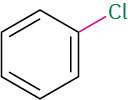
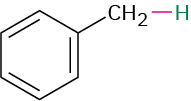
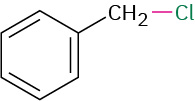
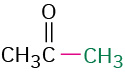
Refer to Table 6.3 for a quantitative idea of the stability of a benzyl radical. How much more stable (in kJ/mol) is the benzyl radical than a primary alkyl radical? How does a benzyl radical compare in stability to an allyl radical?
Table 6.3 Some Bond Dissociation Energies, D in the book ↗
Bond D (kJ/mol) Bond D (kJ/mol) Bond D (kJ/mol)
H―H 436 (CH3)2CH―H 410 C2H5―CH3 370
H―F 570 (CH3)2CH―Cl 354 (CH3)2CH―CH3 369
H―Cl 431 (CH3)2CH―Br 299 (CH3)3C―CH3 363
H―Br 366 (CH3)3C―H 400 H2C═CH―CH3 426
H―I 298 (CH3)3C―Cl 352 H2C═CHCH2―CH3 318
Cl―Cl 242 (CH3)3C―Br 293 H2C═CH2 728
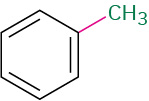
Br―Br 194 (CH3)3C―I 227 A benzene ring with a methyl group, highlighted in green, at C1. 427
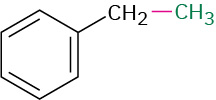
I―I 152 H2C═CH―H 464 A benzene ring with a methylene group at C1. The methylene is further bonded to methyl group, highlighted in green. 325
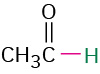
CH3―H 439 H2C═CH―Cl 396 The structure of ethanal, with the aldehyde hydrogen highlighted in green. 374
CH3―Cl 350 H2C═CHCH2―H 369 HO―H 497
CH3―Br 294 H2C═CHCH2―Cl 298 HO―OH 211
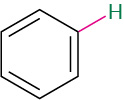
CH3―I 239 A benzene ring with a hydrogen atom, highlighted in green, bonded at C1. 472 CH3O―H 440
CH3―OH 385 A benzene ring with a single bonded chlorine atom, highlighted in green. 400 CH3S―H 366
CH3―NH2 386 A benzene ring with a methylene group at C1. The methylene is further bonded to a hydrogen atom, highlighted in green. 375 C2H5O―H 441
C2H5―H 421 A benzene ring with its C1 bonded to a methylene group, which is further bonded to a chlorine atom, highlighted in green. 300 The structure of acetone, with one methyl group highlighted in green. 352
C2H5―Cl 352 A benzene ring with a bromine atom, highlighted in green, at C1. 336 CH3CH2O―CH3 355
C2H5―Br 293 A benzene ring with a hydroxyl group, highlighted in green, at C1. 464 NH2―H 450
C2H5―I 233 HC≡C―H 558 H―CN 528
C2H5―OH 391 CH3―CH3 377

Answer

A benzyl radical is more stable than a primary alkyl radical by 52 kJ/mol and is similar in stability to an allyl radical.

16-20 §16.8 source ↗

Styrene, the simplest alkenylbenzene, is prepared commercially for use in plastics manufacture by catalytic dehydrogenation of ethylbenzene. How might you prepare styrene from benzene using reactions you’ve studied?

Answer

1. CH3CH2Cl, AlCl3; 2. NBS; 3. KOH, ethanol

16-21 §16.9 source ↗

How would you prepare diphenylmethane, (Ph)2CH2, from benzene and an acid chloride?

Answer

1. PhCOCl, AlCl3; 2. H2/Pd

16-22 §16.10 source ↗

How might you synthesize the following substances from benzene?
(a)
m-Chloronitrobenzene
(b)
m-Chloroethylbenzene
(c)
4-Chloro-1-nitro-2-propylbenzene
(d)
3-Bromo-2-methylbenzenesulfonic acid

Answer (4 parts)

(a)
1. HNO3, H2SO4; 2. Cl2, FeCl3
(b)
1. CH3COCl, AlCl3; 2. Cl2, FeCl3; 3. H2/Pd
(c)
1. CH3CH2COCl, AlCl3; 2. Cl2, FeCl3; 3. H2/Pd; 4. HNO3, H2SO4
(d)
1. CH3Cl, AlCl3; 2. Br2, FeBr3; 3. SO3, H2SO4

16-23 §16.10 source ↗

In planning a synthesis, it’s as important to know what not to do as to know what to do. As written, the following reaction schemes have flaws in them. What is wrong with each?
(a)
(b)

Answer (2 parts)

(a)
Friedel–Crafts acylation does not occur on a deactivated ring.
(b)
Rearrangement occurs during Friedel–Crafts alkylation with primary halides; chlorination occurs ortho to the alkyl group.

Loading chapter 17…

Problems and answers are adapted from Organic Chemistry: A Tenth Edition by John McMurry, OpenStax, and are used under the CC BY-NC-SA 4.0 licence. Access for free at https://openstax.org/books/organic-chemistry/pages/1-why-this-chapter. Illustrations: Copyright Rice University, OpenStax, under CC BY-NC-SA 4.0 license. This adaptation is released under the same licence, is non-commercial, and is neither affiliated with nor endorsed by OpenStax or Rice University.