Every problem in the chapter beside the book’s answer, a chapter at a time as you scroll.
Chapter 2: Vectors in Space
270 problems · 81 figuresCheckpoint 2.1 §2.1 source ↗
Answer
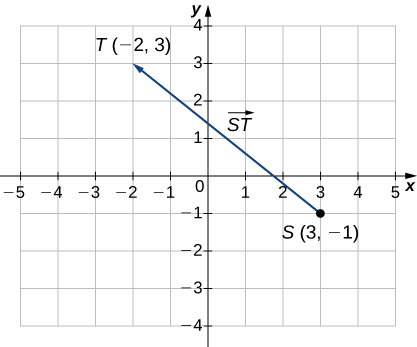
Checkpoint 2.2 §2.1 source ↗
Answer
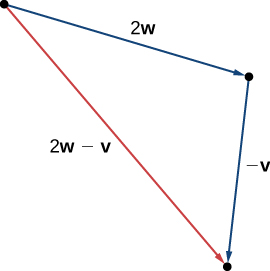
Checkpoint 2.3 §2.1 source ↗
Which of the following vectors are equivalent?
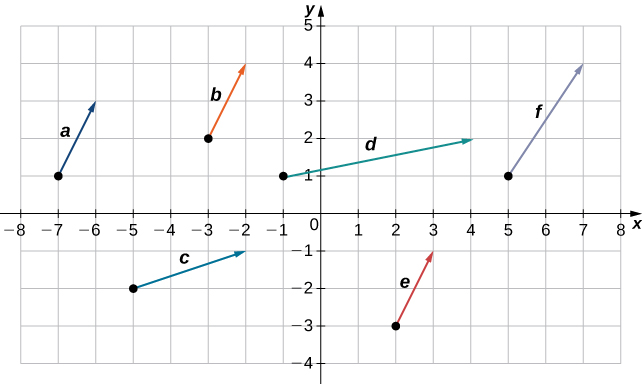
Answer
Checkpoint 2.4 §2.1 source ↗
Answer
Checkpoint 2.5 §2.1 source ↗
Let and let be the vector with initial point and terminal point
a. Find
b. Express in component form.
c. Find
Answer
Checkpoint 2.7 §2.1 source ↗
Answer
Checkpoint 2.8 §2.1 source ↗
Answer
Checkpoint 2.9 §2.1 source ↗
Answer
Checkpoint 2.10 §2.1 source ↗
Answer
2-1 §2.1 source ↗
For the following exercises, consider points and Determine the requested vectors and express each of them a. in component form and b. by using the standard unit vectors.
Answer
2-3 §2.1 source ↗
For the following exercises, consider points and Determine the requested vectors and express each of them a. in component form and b. by using the standard unit vectors.
Answer
2-5 §2.1 source ↗
For the following exercises, consider points and Determine the requested vectors and express each of them a. in component form and b. by using the standard unit vectors.
Answer
2-7 §2.1 source ↗
For the following exercises, consider points and Determine the requested vectors and express each of them a. in component form and b. by using the standard unit vectors.
Answer
2-9 §2.1 source ↗
For the following exercises, consider points and Determine the requested vectors and express each of them a. in component form and b. by using the standard unit vectors.
The unit vector in the direction of
Answer
2-11 §2.1 source ↗
For the following exercises, consider points and Determine the requested vectors and express each of them a. in component form and b. by using the standard unit vectors.
A vector has initial point and terminal point Find the unit vector in the direction of Express the answer in component form.
Answer
2-13 §2.1 source ↗
For the following exercises, consider points and Determine the requested vectors and express each of them a. in component form and b. by using the standard unit vectors.
The vector has initial point and terminal point that is on the y-axis and above the initial point. Find the coordinates of terminal point such that the magnitude of the vector is
Answer
2-15 §2.1 source ↗
For the following exercises, use the given vectors and
Answer
2-17 §2.1 source ↗
For the following exercises, use the given vectors and
Let be a standard-position vector with terminal point Let be a vector with initial point and terminal point Find the magnitude of vector
Answer
2-19 §2.1 source ↗
For the following exercises, use the given vectors and
Let and be two nonzero vectors that are nonequivalent. Consider the vectors and defined in terms of and Find the scalar such that vectors and are equivalent.
Answer
2-21 §2.1 source ↗
For the following exercises, use the given vectors and
Consider the vector with components that depend on a real number As the number varies, the components of change as well, depending on the functions that define them.
a. Write the vectors and in component form.
b. Show that the magnitude of vector remains constant for any real number
c. As varies, show that the terminal point of vector describes a circle centered at the origin of radius
Answer
2-23 §2.1 source ↗
For the following exercises, use the given vectors and
Show that vectors and are equivalent for and where is an integer.
Answer
2-25 §2.1 source ↗
For the following exercises, find vector with the given magnitude and in the same direction as vector
Answer
2-27 §2.1 source ↗
For the following exercises, find vector with the given magnitude and in the same direction as vector
Answer
2-29 §2.1 source ↗
For the following exercises, find the component form of vector given its magnitude and the angle the vector makes with the positive x-axis. Give exact answers when possible.
Answer
2-31 §2.1 source ↗
For the following exercises, find the component form of vector given its magnitude and the angle the vector makes with the positive x-axis. Give exact answers when possible.
Answer
2-33 §2.1 source ↗
For the following exercises, find the component form of vector given its magnitude and the angle the vector makes with the positive x-axis. Give exact answers when possible.
Answer
2-35 §2.1 source ↗
For the following exercises, vector is given. Find the angle that vector makes with the positive direction of the x-axis, in a counter-clockwise direction.
Answer
2-37 §2.1 source ↗
For the following exercises, vector is given. Find the angle that vector makes with the positive direction of the x-axis, in a counter-clockwise direction.
Let and be three nonzero vectors. If then show there are two scalars, and such that
Answer
2-39 §2.1 source ↗
For the following exercises, vector is given. Find the angle that vector makes with the positive direction of the x-axis, in a counter-clockwise direction.
Let be a fixed point on the graph of the differentiable function with a domain that is the set of real numbers.
a. Determine the real number such that point is situated on the line tangent to the graph of at point
b. Determine the unit vector with initial point in the direction of vector
Answer
2-43 §2.1 source ↗
For the following exercises, vector is given. Find the angle that vector makes with the positive direction of the x-axis, in a counter-clockwise direction.
Calculate the coordinates of point such that is a parallelogram, with and
Answer
2-45 §2.1 source ↗
For the following exercises, vector is given. Find the angle that vector makes with the positive direction of the x-axis, in a counter-clockwise direction.
The speed of an object is the magnitude of its related velocity vector. A football thrown by a quarterback has an initial speed of mph and an angle of elevation of Determine the velocity vector in mph and express it in component form. (Round to two decimal places.)
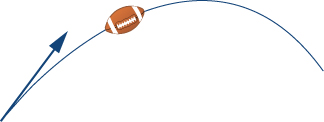
Answer
2-47 §2.1 source ↗
For the following exercises, vector is given. Find the angle that vector makes with the positive direction of the x-axis, in a counter-clockwise direction.
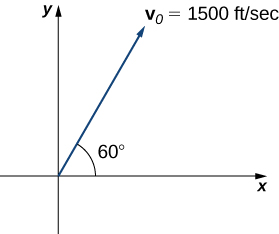
A bullet is fired with an initial velocity of ft/sec at an angle of with the horizontal. Find the horizontal and vertical components of the velocity vector of the bullet. (Round to two decimal places.)
Answer
2-49 §2.1 source ↗
For the following exercises, vector is given. Find the angle that vector makes with the positive direction of the x-axis, in a counter-clockwise direction.
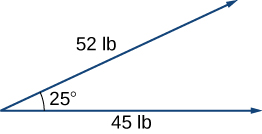
[T] Two forces, a horizontal force of lb and another of lb, act on the same object. The angle between these forces is Find the magnitude and direction angle from the positive x-axis of the resultant force that acts on the object. (Round to two decimal places.)
Answer
2-51 §2.1 source ↗
For the following exercises, vector is given. Find the angle that vector makes with the positive direction of the x-axis, in a counter-clockwise direction.
[T] Three forces act on object. Two of the forces have the magnitudes N and N, and make angles and respectively, with the positive x-axis. Find the magnitude and the direction angle from the positive x-axis of the third force such that the resultant force acting on the object is zero. (Round to two decimal places.)
Answer
2-53 §2.1 source ↗
For the following exercises, vector is given. Find the angle that vector makes with the positive direction of the x-axis, in a counter-clockwise direction.
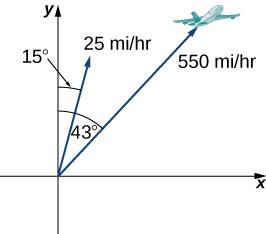
[T] An airplane is flying in the direction of east of north (also abbreviated as at a speed of mph. A wind with speed mph comes from the southwest at a bearing of What are the ground speed and new direction of the airplane?
Answer
2-55 §2.1 source ↗
For the following exercises, vector is given. Find the angle that vector makes with the positive direction of the x-axis, in a counter-clockwise direction.
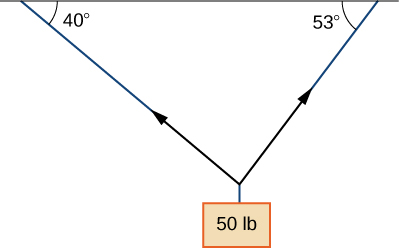
[T] A 50-lb weight is hung by a cable so that the two portions of the cable make angles of and respectively, with the horizontal. Find the magnitudes of the forces of tension and in the cables if the resultant force acting on the object is zero. (Round to two decimal places.)
Answer
2-57 §2.1 source ↗
For the following exercises, vector is given. Find the angle that vector makes with the positive direction of the x-axis, in a counter-clockwise direction.
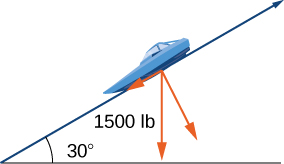
[T] A 1500-lb boat is parked on a ramp that makes an angle of with the horizontal. The boat’s weight vector points downward and is a sum of two vectors: a horizontal vector that is parallel to the ramp and a vertical vector that is perpendicular to the inclined surface. The magnitudes of vectors and are the horizontal and vertical component, respectively, of the boat’s weight vector. Find the magnitudes of and (Round to the nearest integer.)
Answer
2-59 §2.1 source ↗
For the following exercises, vector is given. Find the angle that vector makes with the positive direction of the x-axis, in a counter-clockwise direction.
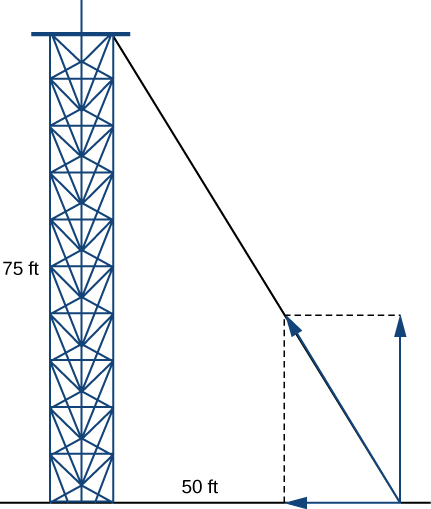
A guy-wire supports a pole that is
ft high. One end of the wire is attached to the top of the pole and the other end is anchored to the ground ft from the base of the pole. Determine the horizontal and vertical components of the force of tension in the wire if its magnitude is lb. (Round to the nearest integer.)
Answer
Checkpoint 2.11 §2.2 source ↗
Answer
Checkpoint 2.12 §2.2 source ↗
Answer
Checkpoint 2.13 §2.2 source ↗
Answer
Checkpoint 2.14 §2.2 source ↗
Answer
Checkpoint 2.15 §2.2 source ↗
Answer
Checkpoint 2.16 §2.2 source ↗
Answer
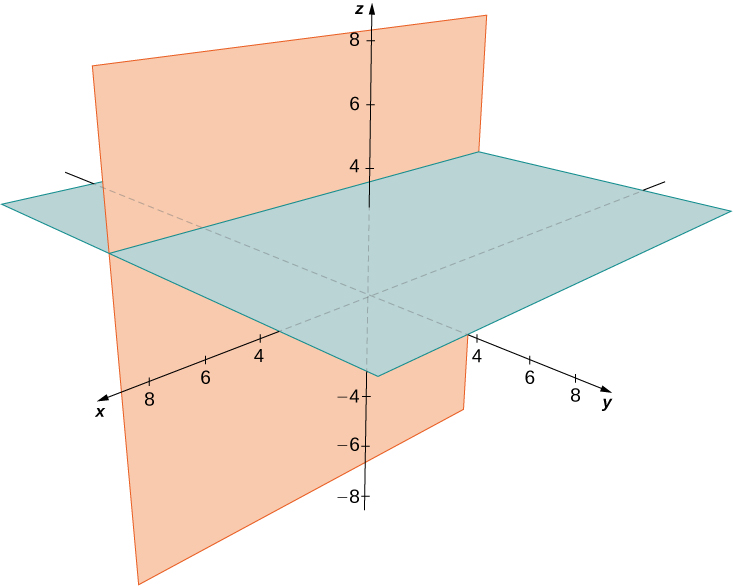
The set of points forms the two planes and
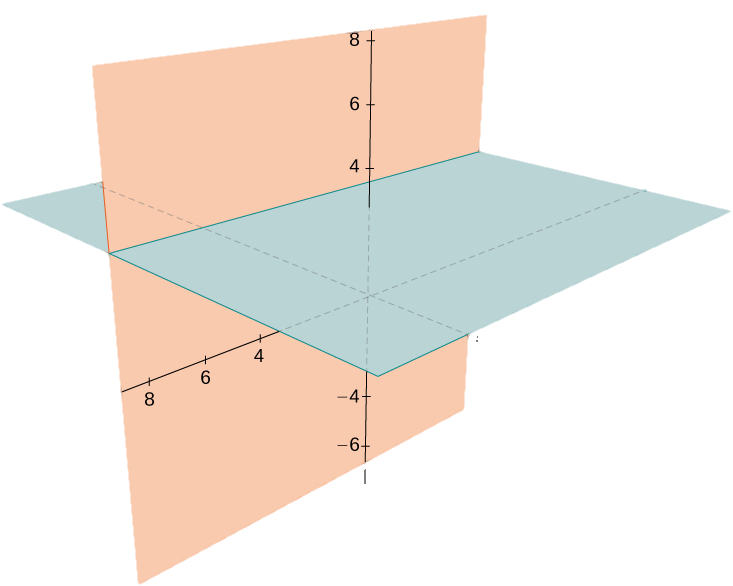
Checkpoint 2.17 §2.2 source ↗
Answer
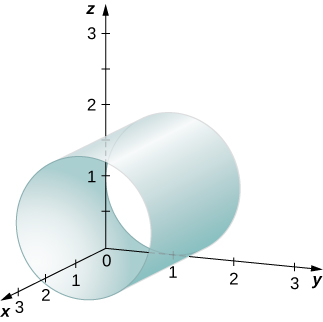
A cylinder of radius 4 centered on the line with
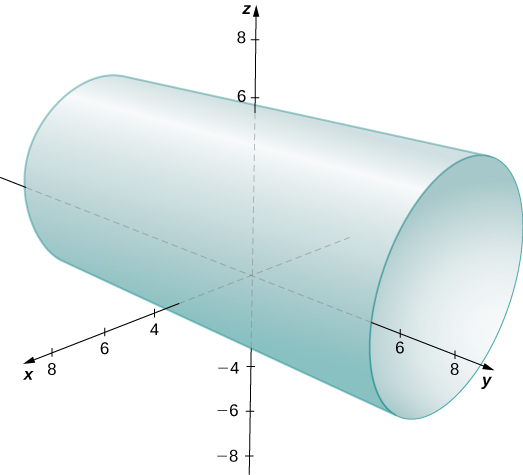
Checkpoint 2.18 §2.2 source ↗
Answer
Checkpoint 2.19 §2.2 source ↗
Answer
Checkpoint 2.20 §2.2 source ↗
Answer
2-61 §2.2 source ↗
Consider a rectangular box with one of the vertices at the origin, as shown in the following figure. If point is the opposite vertex to the origin, then find
a. the coordinates of the other six vertices of the box and
b. the length of the diagonal of the box determined by the vertices and
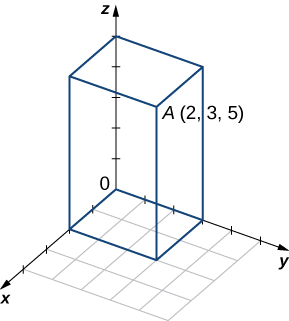
Answer
2-63 §2.2 source ↗
For the following exercises, describe and graph the set of points that satisfies the given equation.
Answer
A union of two planes: (a plane parallel to the xz-plane) and (a plane parallel to the xy-plane)
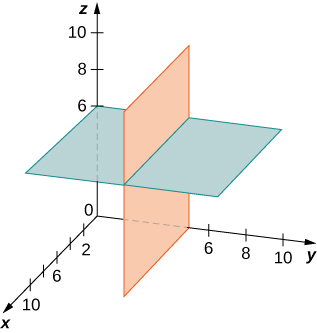
2-65 §2.2 source ↗
For the following exercises, describe and graph the set of points that satisfies the given equation.
Answer
A cylinder of radius centered on the line
2-67 §2.2 source ↗
For the following exercises, describe and graph the set of points that satisfies the given equation.
Write the equation of the plane passing through point that is parallel to the xy-plane.
Answer
2-69 §2.2 source ↗
For the following exercises, describe and graph the set of points that satisfies the given equation.
Find an equation of the plane passing through points and
Answer
2-71 §2.2 source ↗
For the following exercises, find an equation of the sphere in standard form that satisfies the given conditions.
Center and radius
Answer
2-73 §2.2 source ↗
For the following exercises, find an equation of the sphere in standard form that satisfies the given conditions.
Diameter where and
Answer
2-75 §2.2 source ↗
For the following exercises, find the center and radius of the sphere with an equation in general form that is given.
Answer
2-77 §2.2 source ↗
For the following exercises, express vector with the initial point at and the terminal point at
and
Answer
2-79 §2.2 source ↗
For the following exercises, express vector with the initial point at and the terminal point at
and where is the midpoint of the line segment
Answer
2-81 §2.2 source ↗
For the following exercises, express vector with the initial point at and the terminal point at
Find terminal point of vector with the initial point at
Answer
2-83 §2.2 source ↗
For the following exercises, use the given vectors and to find and express the vectors and in component form.
Answer
2-85 §2.2 source ↗
For the following exercises, use the given vectors and to find and express the vectors and in component form.
Answer
2-87 §2.2 source ↗
For the following exercises, vectors u and v are given. Find the magnitudes of vectors and
Answer
2-89 §2.2 source ↗
For the following exercises, vectors u and v are given. Find the magnitudes of vectors and
where is a real number.
Answer
2-91 §2.2 source ↗
For the following exercises, find the unit vector in the direction of the given vector and express it using standard unit vectors.
Answer
2-93 §2.2 source ↗
For the following exercises, find the unit vector in the direction of the given vector and express it using standard unit vectors.
where and
Answer
2-95 §2.2 source ↗
For the following exercises, find the unit vector in the direction of the given vector and express it using standard unit vectors.
where and
Answer
2-97 §2.2 source ↗
For the following exercises, find the unit vector in the direction of the given vector and express it using standard unit vectors.
Determine whether and are equivalent vectors, where and
Answer
2-99 §2.2 source ↗
For the following exercises, find vector with a magnitude that is given and satisfies the given conditions.
and have the same direction
Answer
2-101 §2.2 source ↗
For the following exercises, find vector with a magnitude that is given and satisfies the given conditions.
and have opposite directions for any where is a real number
Answer
2-103 §2.2 source ↗
For the following exercises, find vector with a magnitude that is given and satisfies the given conditions.
Determine a vector of magnitude in the direction of vector where and
Answer
2-105 §2.2 source ↗
For the following exercises, find vector with a magnitude that is given and satisfies the given conditions.
Consider the points and where and are negative real numbers. Find and such that
Answer
2-111 §2.2 source ↗
For the following exercises, find vector with a magnitude that is given and satisfies the given conditions.
[T] A force of acts on a particle in the direction of the vector where
a. Express the force as a vector in component form.
b. Find the angle between force and the positive direction of the x-axis. Express the answer in degrees rounded to the nearest integer.
Answer
2-113 §2.2 source ↗
For the following exercises, find vector with a magnitude that is given and satisfies the given conditions.
If is a force that moves an object from point to another point then the displacement vector is defined as A metal container is lifted m vertically by a constant force Express the displacement vector by using standard unit vectors.
Answer
2-115 §2.2 source ↗
For the following exercises, find vector with a magnitude that is given and satisfies the given conditions.
The sum of the forces acting on an object is called the resultant or net force. An object is said to be in static equilibrium if the resultant force of the forces that act on it is zero. Let and be three forces acting on a box. Find the force acting on the box such that the box is in static equilibrium. Express the answer in component form.
Answer
2-117 §2.2 source ↗
For the following exercises, find vector with a magnitude that is given and satisfies the given conditions.
The force of gravity acting on an object is given by where m is the mass of the object (expressed in kilograms) and is acceleration resulting from gravity, with A 2-kg disco ball hangs by a chain from the ceiling of a room.
a. Find the force of gravity acting on the disco ball and find its magnitude.
b. Find the force of tension in the chain and its magnitude.
Express the answers using standard unit vectors.
Answer
2-119 §2.2 source ↗
For the following exercises, find vector with a magnitude that is given and satisfies the given conditions.
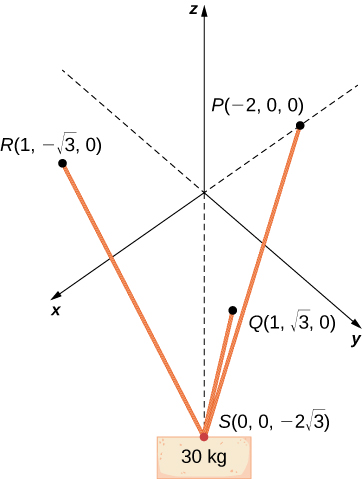
[T] A 30-kg block of cement is suspended by three cables of equal length that are anchored at points and The load is located at as shown in the following figure. Let and be the forces of tension resulting from the load in cables and respectively.
a. Find the gravitational force acting on the block of cement that counterbalances the sum of the forces of tension in the cables.
b. Find forces and Express the answer in component form.
Answer
2-121 §2.2 source ↗
For the following exercises, find vector with a magnitude that is given and satisfies the given conditions.
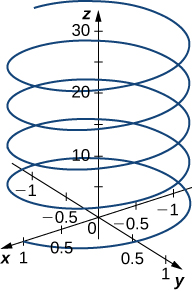
Let be the position vector of a particle at the time where and are smooth functions on The instantaneous velocity of the particle at time is defined by vector with components that are the derivatives with respect to of the functions x, y, and z, respectively. The magnitude of the instantaneous velocity vector is called the speed of the particle at time t. Vector with components that are the second derivatives with respect to of the functions and respectively, gives the acceleration of the particle at time Consider the position vector of a particle at time where the components of are expressed in centimeters and time is expressed in seconds.
a. Find the instantaneous velocity, speed, and acceleration of the particle after the first second. Round your answer to two decimal places.
b. Use a CAS to visualize the path of the particle—that is, the set of all points of coordinates where
Answer
a. (each component is expressed in centimeters per second); (expressed in centimeters per second); (each component expressed in centimeters per second squared);
b.
Checkpoint 2.21 §2.3 source ↗
Answer
Checkpoint 2.22 §2.3 source ↗
Find the following products for and
a.
b.
Answer
Checkpoint 2.23 §2.3 source ↗
Answer
Checkpoint 2.24 §2.3 source ↗
Answer
Checkpoint 2.25 §2.3 source ↗
Let Find the measure of the angles formed by each pair of vectors.
a. and i
b. and j
c. and k
Answer
Checkpoint 2.26 §2.3 source ↗
Answer
Checkpoint 2.27 §2.3 source ↗
Answer
Checkpoint 2.28 §2.3 source ↗
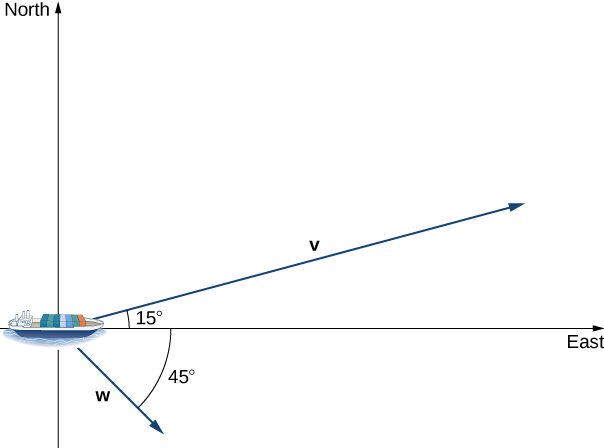
Repeat the previous example, but assume the ocean current is moving southeast instead of northeast, as shown in the following figure.
Answer
Checkpoint 2.29 §2.3 source ↗
Answer
2-123 §2.3 source ↗
For the following exercises, the vectors and are given. Calculate the dot product
Answer
2-125 §2.3 source ↗
For the following exercises, the vectors and are given. Calculate the dot product
Answer
2-127 §2.3 source ↗
For the following exercises, the vectors a, b, and c are given. Determine the vectors and Express the vectors in component form.
Answer
2-129 §2.3 source ↗
For the following exercises, the vectors a, b, and c are given. Determine the vectors and Express the vectors in component form.
Answer
2-131 §2.3 source ↗
For the following exercises, the two-dimensional vectors a and b are given.
[T]
Answer
2-133 §2.3 source ↗
For the following exercises, the two-dimensional vectors a and b are given.
Answer
2-135 §2.3 source ↗
For the following exercises, find the measure of the angle between the three-dimensional vectors a and b. Express the answer in radians rounded to two decimal places, if it is not possible to express it exactly.
Answer
2-137 §2.3 source ↗
For the following exercises, find the measure of the angle between the three-dimensional vectors a and b. Express the answer in radians rounded to two decimal places, if it is not possible to express it exactly.
Answer
2-139 §2.3 source ↗
For the following exercises, find the measure of the angle between the three-dimensional vectors a and b. Express the answer in radians rounded to two decimal places, if it is not possible to express it exactly.
[T] where and
Answer
2-141 §2.3 source ↗
For the following exercises determine whether the given vectors are orthogonal.
where x and y are nonzero real numbers
Answer
2-143 §2.3 source ↗
For the following exercises determine whether the given vectors are orthogonal.
Answer
2-145 §2.3 source ↗
For the following exercises determine whether the given vectors are orthogonal.
Find all two-dimensional vectors a orthogonal to vector Express the answer in component form.
Answer
2-147 §2.3 source ↗
For the following exercises determine whether the given vectors are orthogonal.
Determine all three-dimensional vectors orthogonal to vector Express the answer by using standard unit vectors.
Answer
2-149 §2.3 source ↗
For the following exercises determine whether the given vectors are orthogonal.
Determine the real number such that vectors and are orthogonal.
Answer
2-151 §2.3 source ↗
For the following exercises determine whether the given vectors are orthogonal.
[T] Consider the points and
a. Determine vectors and Express the answer by using standard unit vectors.
b. Determine the measure of angle O in triangle OPQ. Express the answer in degrees rounded to two decimal places.
Answer
2-153 §2.3 source ↗
For the following exercises determine whether the given vectors are orthogonal.
Determine the measure of angle A in triangle ABC, where and Express your answer in degrees rounded to two decimal places.
Answer
2-155 §2.3 source ↗
For the following exercises, determine which (if any) pairs of the following vectors are orthogonal.
Answer
2-161 §2.3 source ↗
For the following problems, the vector is given.
Answer
2-163 §2.3 source ↗
For the following problems, the vector is given.
Answer
2-167 §2.3 source ↗
For the following exercises, the vectors and are given.
Answer
2-169 §2.3 source ↗
For the following exercises, the vectors and are given.
Answer
2-171 §2.3 source ↗
For the following exercises, the vectors and are given.
Consider the vectors and
a. Find the component form of vector that represents the projection of onto .
b. Write the decomposition of vector into the orthogonal components and , where is the projection of onto and is a vector orthogonal to the direction of .
Answer
2-173 §2.3 source ↗
For the following exercises, the vectors and are given.
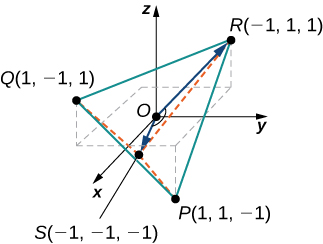
A methane molecule has a carbon atom situated at the origin and four hydrogen atoms located at points (see figure).
a. Find the distance between the hydrogen atoms located at P and R.
b. Find the angle between vectors and that connect the carbon atom with the hydrogen atoms located at S and R, which is also called the bond angle. Express the answer in degrees rounded to two decimal places.
Answer
2-175 §2.3 source ↗
For the following exercises, the vectors and are given.
Find the work done by force (measured in Newtons) that moves a particle from point to point along a straight line (the distance is measured in meters).
Answer
2-177 §2.3 source ↗
For the following exercises, the vectors and are given.
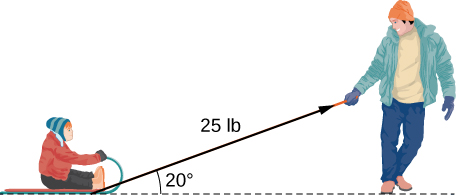
[T] A father is pulling his son on a sled at an angle of with the horizontal with a force of 25 lb (see the following image). He pulls the sled in a straight path of 50 ft. How much work was done by the man pulling the sled? (Round the answer to the nearest integer.)
Answer
2-179 §2.3 source ↗
For the following exercises, the vectors and are given.
[T] A boat sails north aided by a wind blowing in a direction of with a magnitude of 500 lb. How much work is performed by the wind as the boat moves 100 ft? (Round the answer to two decimal places.)
Answer
2-181 §2.3 source ↗
For the following exercises, the vectors and are given.
[T] Two forces and are represented by vectors with initial points that are at the origin. The first force has a magnitude of 20 lb and the terminal point of the vector is point The second force has a magnitude of 40 lb and the terminal point of its vector is point Let F be the resultant force of forces and
a. Find the magnitude of F. (Round the answer to one decimal place.)
b. Find the direction angles of F. (Express the answer in degrees rounded to one decimal place.)
Answer
Checkpoint 2.30 §2.4 source ↗
Answer
Checkpoint 2.31 §2.4 source ↗
Answer
Checkpoint 2.32 §2.4 source ↗
Answer
Checkpoint 2.33 §2.4 source ↗
Answer
Checkpoint 2.34 §2.4 source ↗
Answer
Checkpoint 2.35 §2.4 source ↗
Answer
Checkpoint 2.36 §2.4 source ↗
Answer
Checkpoint 2.37 §2.4 source ↗
Answer
Checkpoint 2.38 §2.4 source ↗
Answer
Checkpoint 2.39 §2.4 source ↗
Answer
Checkpoint 2.40 §2.4 source ↗
Answer
Checkpoint 2.41 §2.4 source ↗
Answer
Checkpoint 2.42 §2.4 source ↗
Answer
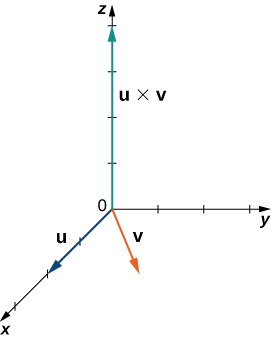
2-183 §2.4 source ↗
For the following exercises, the vectors and are given.
Answer
a.
b.
2-185 §2.4 source ↗
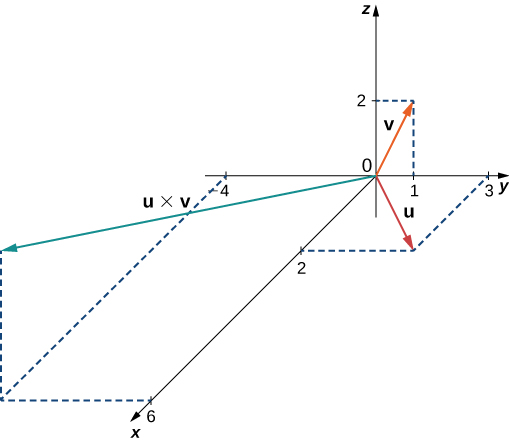
For the following exercises, the vectors and are given.
Answer
a.
b.
2-187 §2.4 source ↗
For the following exercises, the vectors and are given.
Simplify
Answer
2-189 §2.4 source ↗
In the following exercises, vectors and are given. Find unit vector in the direction of the cross product vector Express your answer using standard unit vectors.
Answer
2-191 §2.4 source ↗
In the following exercises, vectors and are given. Find unit vector in the direction of the cross product vector Express your answer using standard unit vectors.
where and
Answer
2-193 §2.4 source ↗
In the following exercises, vectors and are given. Find unit vector in the direction of the cross product vector Express your answer using standard unit vectors.
Determine the real number such that and are orthogonal, where and
Answer
2-197 §2.4 source ↗
In the following exercises, vectors and are given. Find unit vector in the direction of the cross product vector Express your answer using standard unit vectors.
Calculate the determinant
Answer
2-199 §2.4 source ↗
For the following exercises, the vectors and are given. Use determinant notation to find vector orthogonal to vectors and
where is a real number
Answer
2-201 §2.4 source ↗
For the following exercises, the vectors and are given. Use determinant notation to find vector orthogonal to vectors and
Find vector where and
Answer
2-203 §2.4 source ↗
For the following exercises, the vectors and are given. Use determinant notation to find vector orthogonal to vectors and
[T] Use the cross product to find the acute angle between vectors and where and Express the answer in degrees rounded to the nearest integer.
Answer
2-209 §2.4 source ↗
For the following exercises, the vectors and are given. Use determinant notation to find vector orthogonal to vectors and
Find the area of the parallelogram with adjacent sides and
Answer
2-211 §2.4 source ↗
For the following exercises, the vectors and are given. Use determinant notation to find vector orthogonal to vectors and
Consider points and
a. Find the area of parallelogram with adjacent sides and
b. Find the area of triangle
c. Find the distance from point to line
Answer
2-213 §2.4 source ↗
In the following exercises, vectors are given.
and
Answer
2-215 §2.4 source ↗
In the following exercises, vectors are given.
Calculate the triple scalar products and where and
Answer
2-217 §2.4 source ↗
In the following exercises, vectors are given.
Find vectors with a triple scalar product given by the determinant
Determine their triple scalar product.
Answer
2-219 §2.4 source ↗
In the following exercises, vectors are given.
Consider the parallelepiped with edges and where and
a. Find the real number such that the volume of the parallelepiped is units3.
b. For find the height from vertex of the parallelepiped to the plane formed by the edges and .
Answer
a. b.
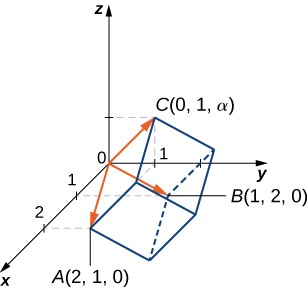
2-225 §2.4 source ↗
In the following exercises, vectors are given.
Consider points and Are vectors and linearly dependent (that is, one of the vectors is a linear combination of the other two)?
Answer
2-227 §2.4 source ↗
In the following exercises, vectors are given.
Let and be two-dimensional vectors. The cross product of vectors and is not defined. However, if the vectors are regarded as the three-dimensional vectors and respectively, then, in this case, we can define the cross product of and In particular, in determinant notation, the cross product of and is given by
Use this result to compute where is a real number.
Answer
2-229 §2.4 source ↗
In the following exercises, vectors are given.
Determine a vector of magnitude perpendicular to the plane passing through the x-axis and point
Answer
2-233 §2.4 source ↗
In the following exercises, vectors are given.
Find all vectors that satisfy the equation
Answer
2-235 §2.4 source ↗
In the following exercises, vectors are given.
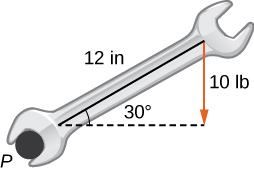
[T] A mechanic uses a 12-in. wrench to turn a bolt. The wrench makes a angle with the horizontal. If the mechanic applies a vertical force of lb on the wrench handle, what is the magnitude of the torque at point (see the following figure)? Express the answer in foot-pounds rounded to two decimal places.
Answer
2-237 §2.4 source ↗
In the following exercises, vectors are given.
[T] Find the magnitude of the force that needs to be applied to the end of a 20-cm wrench located on the positive direction of the y-axis if the force is applied in the direction and it produces a N·m torque to the bolt located at the origin.
Answer
2-239 §2.4 source ↗
In the following exercises, vectors are given.
[T] The force vector acting on a proton with an electric charge of (in coulombs) moving in a magnetic field where the velocity vector is given by (here, is expressed in meters per second, is in tesla [T], and is in newtons [N]). Find the force that acts on a proton that moves in the xy-plane at velocity (in meters per second) in a magnetic field given by
Answer
2-241 §2.4 source ↗
In the following exercises, vectors are given.
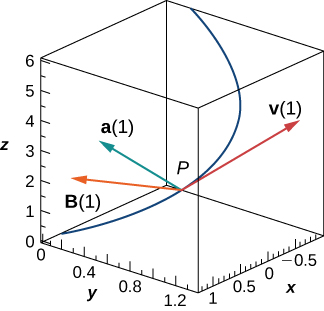
[T] Consider the position vector of a particle at time where the components of are expressed in centimeters and time in seconds. Let be the position vector of the particle after sec.
a. Determine unit vector (called the binormal unit vector) that has the direction of cross product vector where and are the instantaneous velocity vector and, respectively, the acceleration vector of the particle after seconds.
b. Use a CAS to visualize vectors and as vectors starting at point along with the path of the particle.
Answer
a.
b.
Checkpoint 2.43 §2.5 source ↗
Answer
Possible set of parametric equations:
related set of symmetric equations:
Checkpoint 2.44 §2.5 source ↗
Answer
Checkpoint 2.45 §2.5 source ↗
Answer
Checkpoint 2.46 §2.5 source ↗
Describe the relationship between the lines with the following parametric equations:
Answer
Checkpoint 2.47 §2.5 source ↗
Find an equation of the plane containing the lines and
Answer
Checkpoint 2.48 §2.5 source ↗
Answer
Checkpoint 2.49 §2.5 source ↗
Answer
Checkpoint 2.50 §2.5 source ↗
Answer
Checkpoint 2.51 §2.5 source ↗
Answer
2-243 §2.5 source ↗
In the following exercises, points and are given. Let be the line passing through points and
Answer
2-245 §2.5 source ↗
In the following exercises, points and are given. Let be the line passing through points and
Answer
2-247 §2.5 source ↗
For the following exercises, point and vector are given. Let be the line passing through point with direction
Answer
2-249 §2.5 source ↗
For the following exercises, point and vector are given. Let be the line passing through point with direction
where and
Answer
2-251 §2.5 source ↗
For the following exercises, line is given.
Answer
2-253 §2.5 source ↗
For the following exercises, line is given.
Find the distance between point and the line of symmetric equations
Answer
2-255 §2.5 source ↗
For the following exercises, lines and are given.
Answer
2-259 §2.5 source ↗
For the following exercises, lines and are given.
Find the point of intersection of the lines of equations and
Answer
2-261 §2.5 source ↗
For the following exercises, lines and are given. Determine whether the lines are equal, parallel but not equal, skew, or intersecting.
and
Answer
2-263 §2.5 source ↗
For the following exercises, lines and are given. Determine whether the lines are equal, parallel but not equal, skew, or intersecting.
and
Answer
2-265 §2.5 source ↗
For the following exercises, lines and are given. Determine whether the lines are equal, parallel but not equal, skew, or intersecting.
Consider line of symmetric equations and point
a. Find parametric equations for a line parallel to that passes through point
b. Find symmetric equations of a line skew to and that passes through point
c. Find symmetric equations of a line that intersects and passes through point
Answer
2-267 §2.5 source ↗
For the following exercises, point and vector are given.
Answer
2-269 §2.5 source ↗
For the following exercises, point and vector are given.
Answer
2-271 §2.5 source ↗
For the following exercises, the equation of a plane is given.
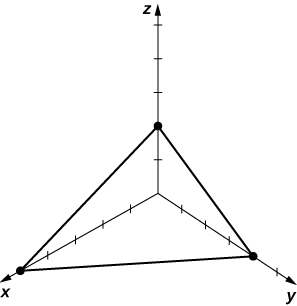
[T]
Answer
a. b. and
c.
2-273 §2.5 source ↗
For the following exercises, the equation of a plane is given.
Answer
a. b.
c.
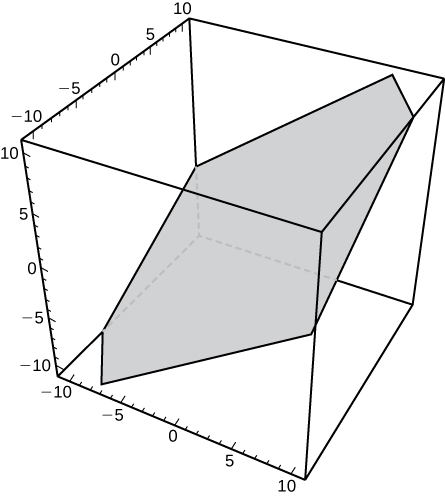
2-275 §2.5 source ↗
For the following exercises, the equation of a plane is given.
Given point and vector find point on the x-axis such that and are orthogonal.
Answer
2-277 §2.5 source ↗
For the following exercises, the equation of a plane is given.
Find parametric equations of the line passing through point that is perpendicular to the plane of equation
Answer
2-281 §2.5 source ↗
For the following exercises, points are given.
and
Answer
a. b. c.
Answers may vary by a sign, depending on how the vector cross multiplication is performed.
2-283 §2.5 source ↗
For the following exercises, points are given.
Consider the planes of equations and
a. Show that the planes intersect.
b. Find symmetric equations of the line passing through point that is parallel to the line of intersection of the planes.
Answer
2-285 §2.5 source ↗
For the following exercises, points are given.
Find the scalar equation of the plane that passes through point and is perpendicular to the line of intersection of planes and
Answer
2-287 §2.5 source ↗
For the following exercises, points are given.
Determine whether the line of parametric equations intersects the plane with equation If it does intersect, find the point of intersection.
Answer
2-289 §2.5 source ↗
For the following exercises, points are given.
Find the distance from point to the plane of equation
Answer
2-291 §2.5 source ↗
For the following exercises, the equations of two planes are given.
[T]
Answer
2-293 §2.5 source ↗
For the following exercises, the equations of two planes are given.
Answer
2-295 §2.5 source ↗
For the following exercises, the equations of two planes are given.
Show that the lines of equations and are skew, and find the distance between them.
Answer
2-297 §2.5 source ↗
For the following exercises, the equations of two planes are given.
Consider point and the plane of equation
a. Find the radius of the sphere with center tangent to the given plane.
b. Find point P of tangency.
Answer
2-299 §2.5 source ↗
For the following exercises, the equations of two planes are given.
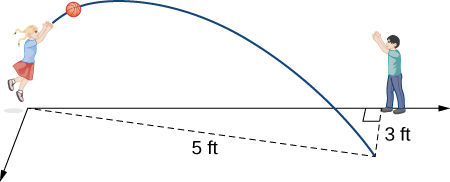
Two children are playing with a ball. The girl throws the ball to the boy. The ball travels in
the air, curves ft to the right, and falls ft away from the girl (see the following figure). If the plane that contains the trajectory of the ball is perpendicular to the ground, find its equation.
Answer
2-301 §2.5 source ↗
For the following exercises, the equations of two planes are given.
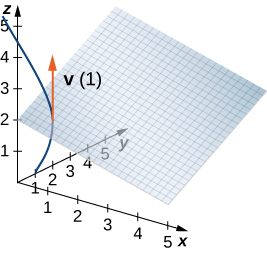
[T] Consider the position vector of a particle at time where the components of r are expressed in centimeters and time is measured in seconds. Let be the position vector of the particle after sec.
a. Determine the velocity vector of the particle after sec.
b. Find the scalar equation of the plane that is perpendicular to and passes through point This plane is called the normal plane to the path of the particle at point
c. Use a CAS to visualize the path of the particle along with the velocity vector and normal plane at point
Answer
a. b.
c.
Checkpoint 2.52 §2.6 source ↗
Answer
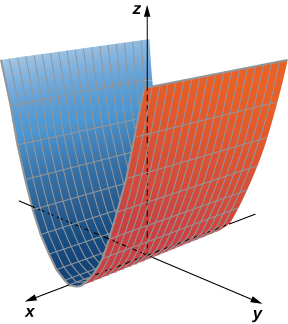
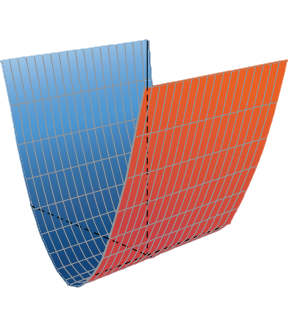
Checkpoint 2.53 §2.6 source ↗
Answer
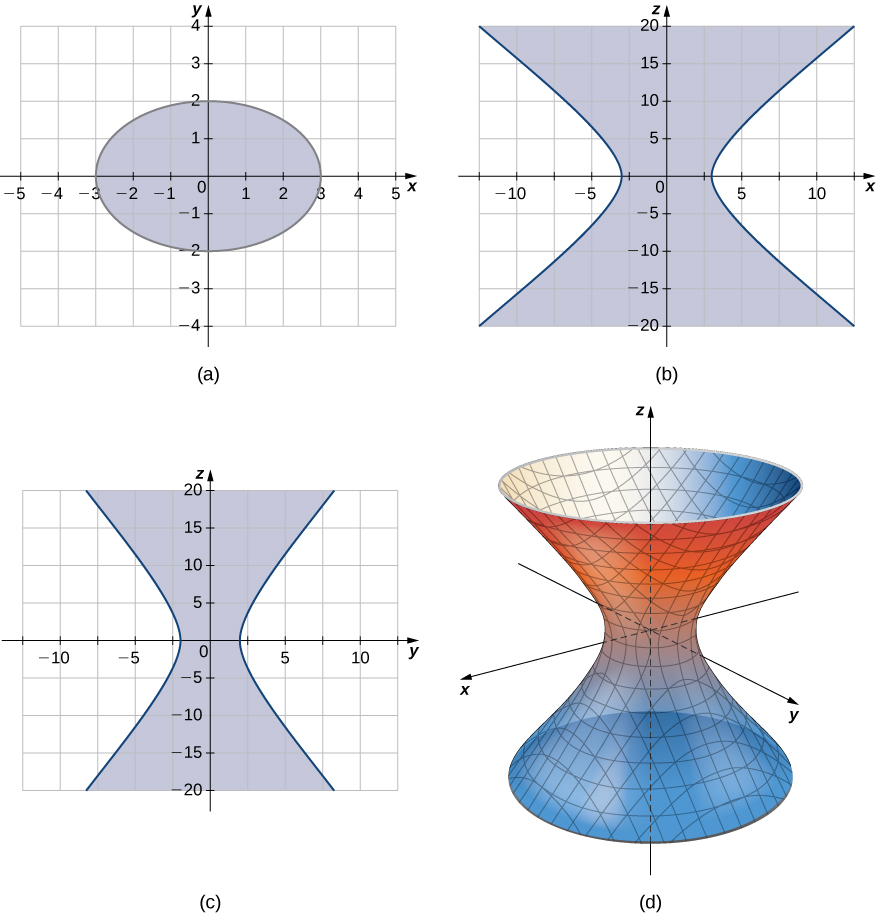
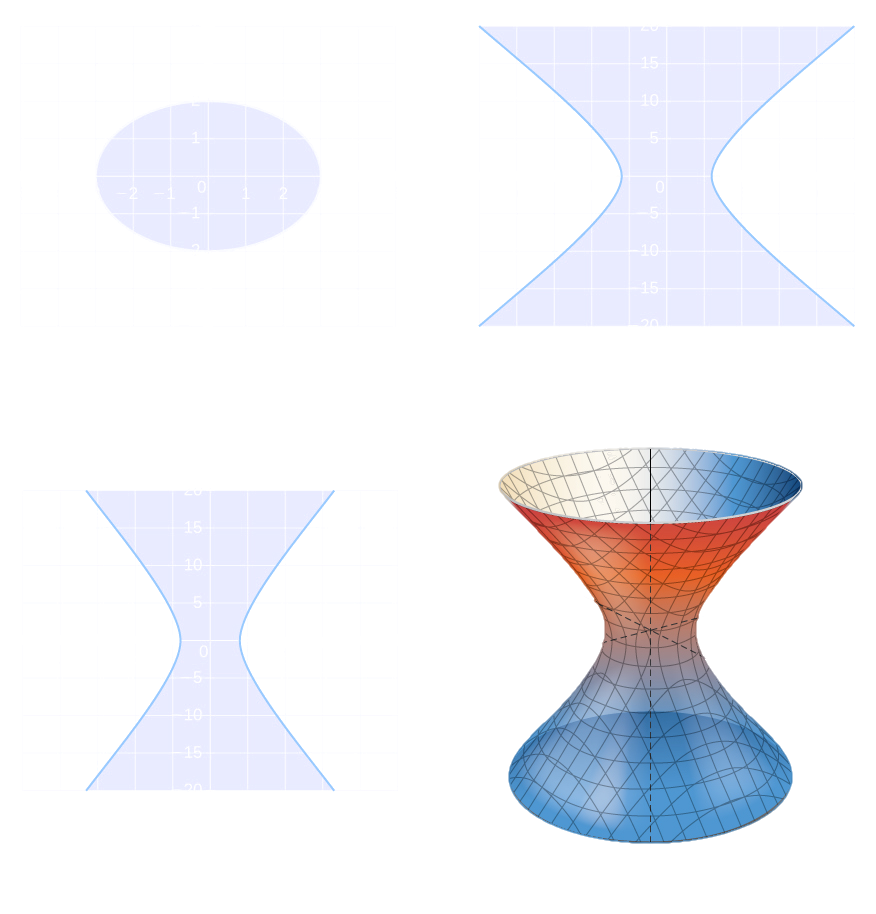
The traces parallel to the xy-plane are ellipses and the traces parallel to the xz- and yz-planes are hyperbolas. Specifically, the trace in the xy-plane is ellipse the trace in the xz-plane is hyperbola and the trace in the yz-plane is hyperbola (see the following figure).
Checkpoint 2.54 §2.6 source ↗
Answer
2-303 §2.6 source ↗
For the following exercises, sketch and describe the cylindrical surface of the given equation.
[T]
Answer
The surface is a cylinder with the rulings parallel to the y-axis.
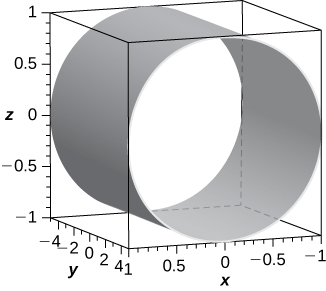
2-305 §2.6 source ↗
For the following exercises, sketch and describe the cylindrical surface of the given equation.
[T]
Answer
The surface is a cylinder with rulings parallel to the y-axis.
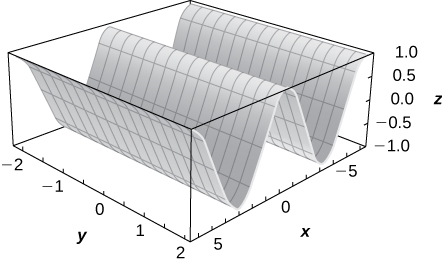
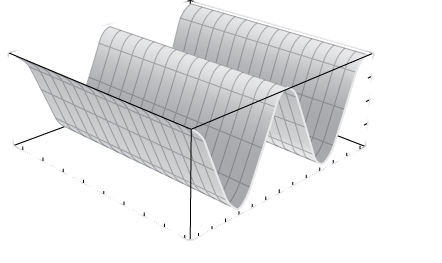
2-307 §2.6 source ↗
For the following exercises, sketch and describe the cylindrical surface of the given equation.
[T]
Answer
The surface is a cylinder with rulings parallel to the x-axis.
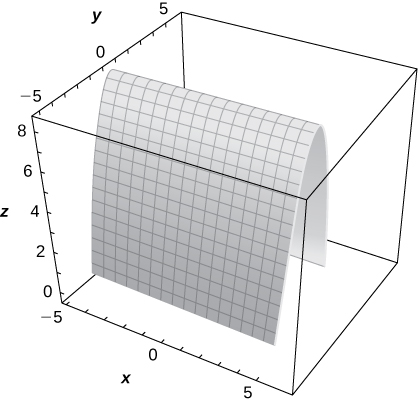
2-309 §2.6 source ↗
For the following exercises, the graph of a quadric surface is given.
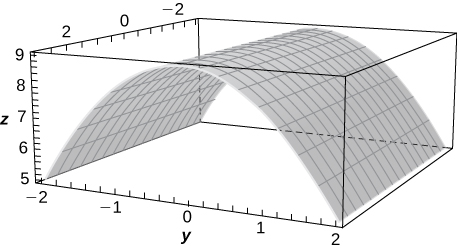
Answer
2-311 §2.6 source ↗
For the following exercises, the graph of a quadric surface is given.
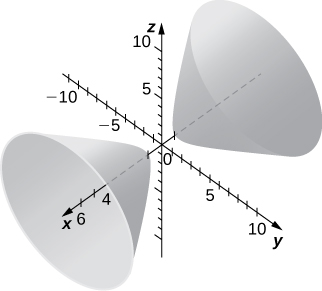
Answer
2-313 §2.6 source ↗
For the following exercises, match the given quadric surface with its corresponding equation in standard form.
Hyperboloid of two sheets
Answer
2-315 §2.6 source ↗
For the following exercises, match the given quadric surface with its corresponding equation in standard form.
Elliptic paraboloid
Answer
2-317 §2.6 source ↗
For the following exercises, match the given quadric surface with its corresponding equation in standard form.
Hyperboloid of one sheet
Answer
2-319 §2.6 source ↗
For the following exercises, rewrite the given equation of the quadric surface in standard form. Identify the surface.
Answer
2-321 §2.6 source ↗
For the following exercises, rewrite the given equation of the quadric surface in standard form. Identify the surface.
Answer
2-323 §2.6 source ↗
For the following exercises, rewrite the given equation of the quadric surface in standard form. Identify the surface.
Answer
2-325 §2.6 source ↗
For the following exercises, rewrite the given equation of the quadric surface in standard form. Identify the surface.
Answer
2-327 §2.6 source ↗
For the following exercises, rewrite the given equation of the quadric surface in standard form. Identify the surface.
Answer
2-329 §2.6 source ↗
For the following exercises, rewrite the given equation of the quadric surface in standard form. Identify the surface.
Answer
2-331 §2.6 source ↗
For the following exercises, find the trace of the given quadric surface in the specified plane of coordinates and sketch it.
[T]
Answer
Parabola
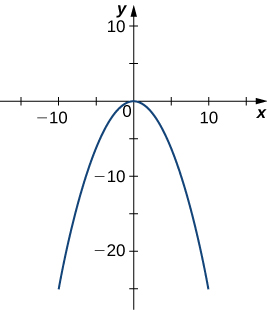
2-333 §2.6 source ↗
For the following exercises, find the trace of the given quadric surface in the specified plane of coordinates and sketch it.
[T]
Answer
Ellipse
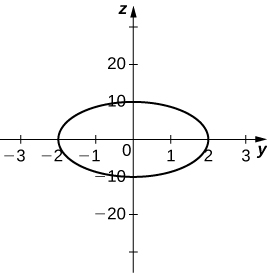
2-335 §2.6 source ↗
For the following exercises, find the trace of the given quadric surface in the specified plane of coordinates and sketch it.
[T]
Answer
Ellipse
2-337 §2.6 source ↗
For the following exercises, find the trace of the given quadric surface in the specified plane of coordinates and sketch it.
Use the graph of the given quadric surface to answer the questions.
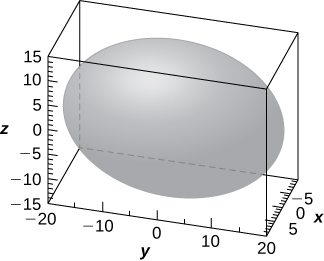
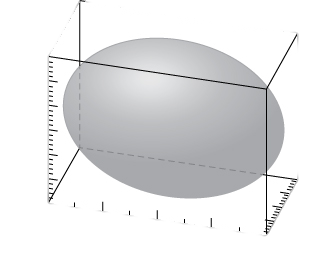
a. Specify the name of the quadric surface.
b. Which of the equations— or —corresponds to the graph?
c. Use b. to write the equation of the quadric surface in standard form.
Answer
2-339 §2.6 source ↗
For the following exercises, the equation of a quadric surface is given.
Answer
2-341 §2.6 source ↗
For the following exercises, the equation of a quadric surface is given.
Answer
2-343 §2.6 source ↗
For the following exercises, the equation of a quadric surface is given.
Answer
2-345 §2.6 source ↗
For the following exercises, the equation of a quadric surface is given.
Write the standard form of the equation of the ellipsoid centered at the origin that passes through points and
Answer
2-347 §2.6 source ↗
For the following exercises, the equation of a quadric surface is given.
Determine the intersection points of elliptic cone with the line of symmetric equations
Answer
2-349 §2.6 source ↗
For the following exercises, the equation of a quadric surface is given.
Find an equation of the quadric surface with points that are equidistant from point and plane of equation Identify the surface.
Answer
2-351 §2.6 source ↗
For the following exercises, the equation of a quadric surface is given.
If the surface of a parabolic reflector is described by equation find the focal point of the reflector.
Answer
2-355 §2.6 source ↗
For the following exercises, the equation of a quadric surface is given.
[T] The intersection between cylinder and sphere is called a Viviani curve.
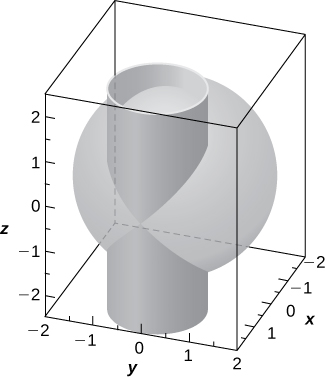
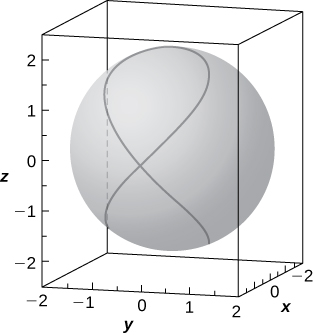
a. Solve the system consisting of the equations of the surfaces to find the equations of the intersection curve. (Hint: Find and in terms of
b. Use a computer algebra system (CAS) to visualize the intersection curve on sphere
Answer
a. where
b.
2-357 §2.6 source ↗
For the following exercises, the equation of a quadric surface is given.
[T] Use a CAS to create the intersection between cylinder and ellipsoid and find the equations of the intersection curves.
Answer
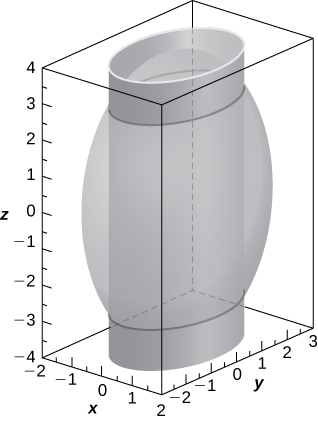
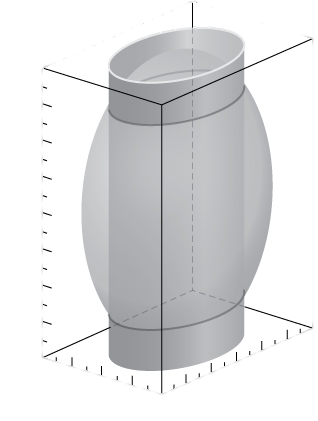
two ellipses of equations in planes
2-359 §2.6 source ↗
For the following exercises, the equation of a quadric surface is given.
[T] In cartography, Earth is approximated by an oblate spheroid rather than a sphere. The radii at the equator and poles are approximately mi and mi, respectively.
a. Write the equation in standard form of the ellipsoid that represents the shape of Earth. Assume the center of Earth is at the origin and that the trace formed by plane corresponds to the equator.
b. Sketch the graph.
c. Find an equation of the intersection curve of the surface with plane that is parallel to the xy-plane. The intersection curve is called a parallel.
d. Find an equation of the intersection curve of the surface with plane that passes through the z-axis. The intersection curve is called a meridian.
Answer
a.
b.
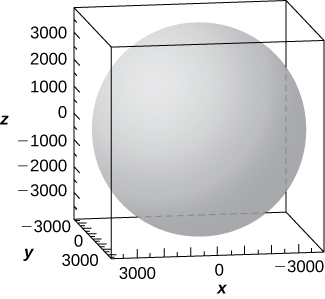
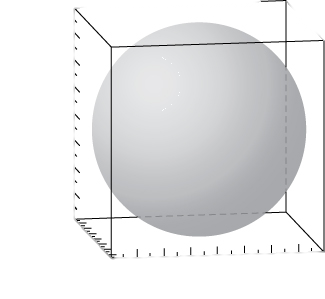
;
c. The intersection curve is the ellipse of equation and the intersection is an ellipse.; d. The intersection curve is the ellipse of equation
2-361 §2.6 source ↗
For the following exercises, the equation of a quadric surface is given.
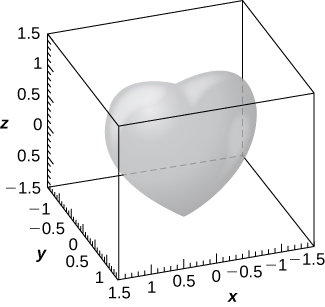
[T] A heart-shaped surface is given by equation
a. Use a CAS to graph the surface that models this shape.
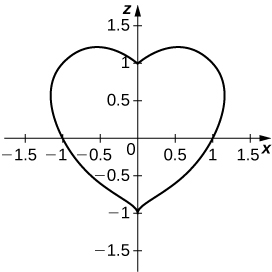
b. Determine and sketch the trace of the heart-shaped surface on the xz-plane.
Answer
a.
b. The intersection curve is
Checkpoint 2.55 §2.7 source ↗
Answer
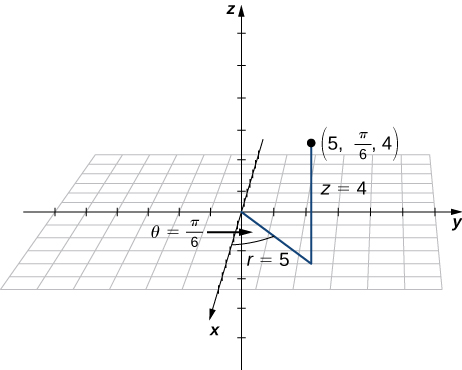
The rectangular coordinates of the point are
Checkpoint 2.56 §2.7 source ↗
Answer
Checkpoint 2.57 §2.7 source ↗
Answer
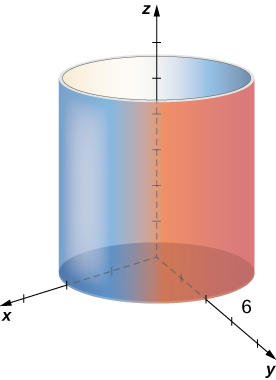
This surface is a cylinder with radius
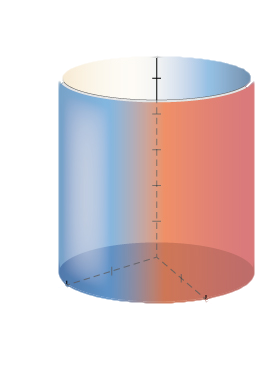
Checkpoint 2.58 §2.7 source ↗
Answer
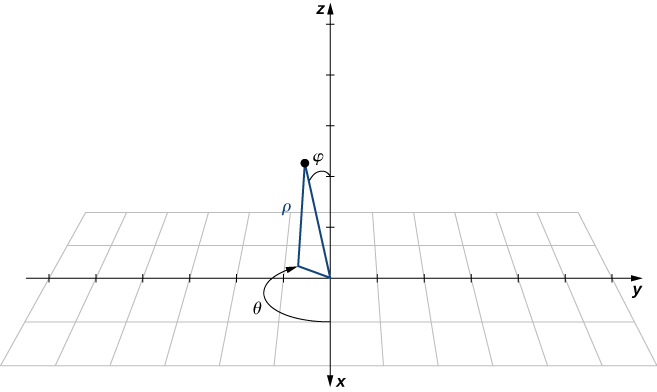
Cartesian: cylindrical:
Checkpoint 2.59 §2.7 source ↗
Describe the surfaces defined by the following equations.
a.
b.
c.
Answer
Checkpoint 2.60 §2.7 source ↗
Answer
Checkpoint 2.61 §2.7 source ↗
Which coordinate system is most appropriate for creating a star map, as viewed from Earth (see the following figure)?
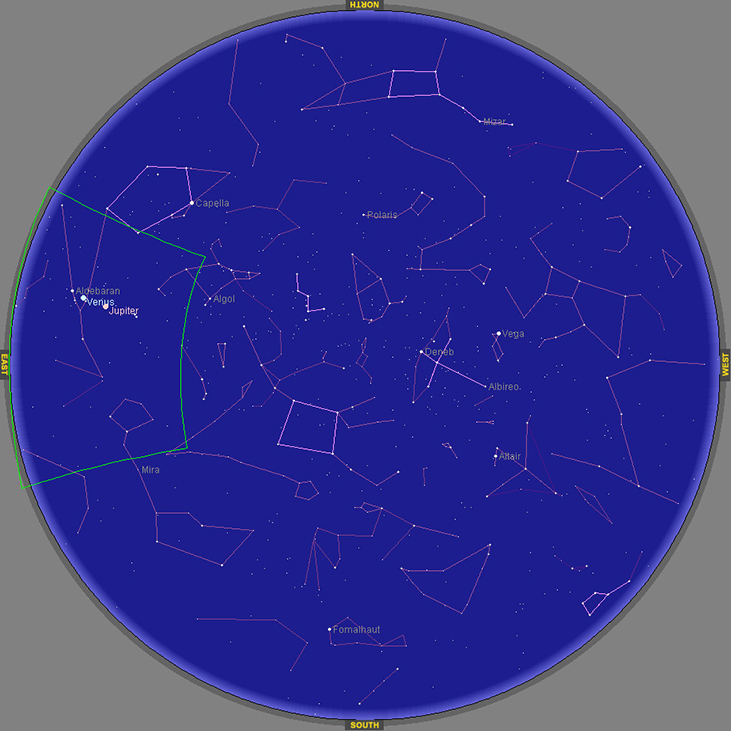
How should we orient the coordinate axes?
Answer
2-363 §2.7 source ↗
Use the following figure as an aid in identifying the relationship between the rectangular, cylindrical, and spherical coordinate systems.
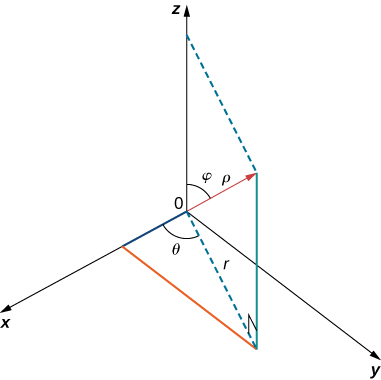
For the following exercises, the cylindrical coordinates of a point are given. Find the rectangular coordinates of the point.
Answer
2-365 §2.7 source ↗
Use the following figure as an aid in identifying the relationship between the rectangular, cylindrical, and spherical coordinate systems.
For the following exercises, the cylindrical coordinates of a point are given. Find the rectangular coordinates of the point.
Answer
2-367 §2.7 source ↗
For the following exercises, the rectangular coordinates of a point are given. Find the cylindrical coordinates of the point.
Answer
2-369 §2.7 source ↗
For the following exercises, the rectangular coordinates of a point are given. Find the cylindrical coordinates of the point.
Answer
2-371 §2.7 source ↗
For the following exercises, the equation of a surface in cylindrical coordinates is given.
Find an equation of the surface in rectangular coordinates. Identify and graph the surface.
[T]
Answer
A cylinder of equation with its center at the origin and rulings parallel to the z-axis,
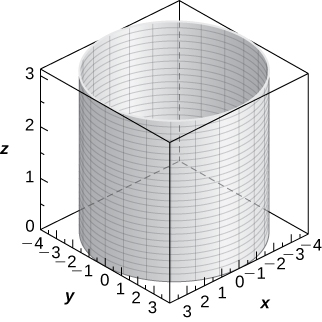
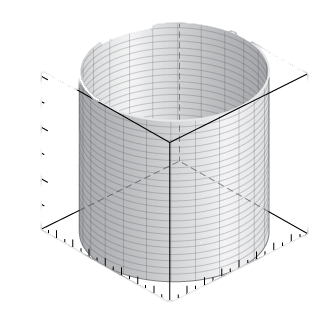
2-373 §2.7 source ↗
For the following exercises, the equation of a surface in cylindrical coordinates is given.
Find an equation of the surface in rectangular coordinates. Identify and graph the surface.
[T]
Answer
Hyperboloid of two sheets of equation with the y-axis as the axis of symmetry,
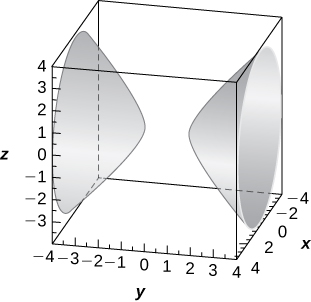
2-375 §2.7 source ↗
For the following exercises, the equation of a surface in cylindrical coordinates is given.
Find an equation of the surface in rectangular coordinates. Identify and graph the surface.
[T]
Answer
Cylinder of equation with a center at and radius with rulings parallel to the z-axis,
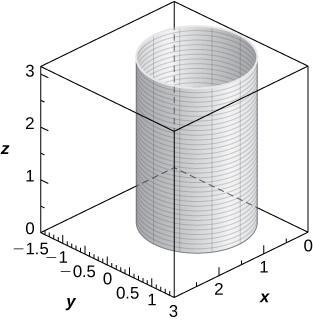
2-377 §2.7 source ↗
For the following exercises, the equation of a surface in cylindrical coordinates is given.
Find an equation of the surface in rectangular coordinates. Identify and graph the surface.
[T]
Answer
Plane of equation
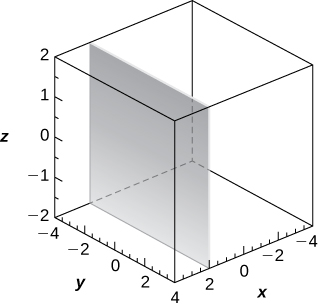
2-379 §2.7 source ↗
For the following exercises, the equation of a surface in rectangular coordinates is given. Find an equation of the surface in cylindrical coordinates.
Answer
2-381 §2.7 source ↗
For the following exercises, the equation of a surface in rectangular coordinates is given. Find an equation of the surface in cylindrical coordinates.
Answer
2-383 §2.7 source ↗
For the following exercises, the equation of a surface in rectangular coordinates is given. Find an equation of the surface in cylindrical coordinates.
Answer
2-385 §2.7 source ↗
For the following exercises, the spherical coordinates of a point are given. Find the rectangular coordinates of the point.
Answer
2-387 §2.7 source ↗
For the following exercises, the spherical coordinates of a point are given. Find the rectangular coordinates of the point.
Answer
2-389 §2.7 source ↗
For the following exercises, the rectangular coordinates of a point are given. Find the spherical coordinates of the point. Express the measure of the angles in degrees rounded to the nearest integer.
Answer
2-391 §2.7 source ↗
For the following exercises, the rectangular coordinates of a point are given. Find the spherical coordinates of the point. Express the measure of the angles in degrees rounded to the nearest integer.
Answer
2-393 §2.7 source ↗
For the following exercises, the equation of a surface in spherical coordinates is given. Find an equation of the surface in rectangular coordinates. Identify and graph the surface.
[T]
Answer
Sphere of equation centered at the origin with radius
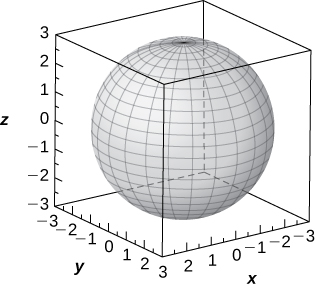
2-395 §2.7 source ↗
For the following exercises, the equation of a surface in spherical coordinates is given. Find an equation of the surface in rectangular coordinates. Identify and graph the surface.
[T]
Answer
Sphere of equation centered at with radius
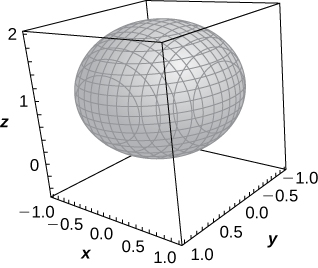
2-397 §2.7 source ↗
For the following exercises, the equation of a surface in spherical coordinates is given. Find an equation of the surface in rectangular coordinates. Identify and graph the surface.
[T]
Answer
The xy-plane of equation
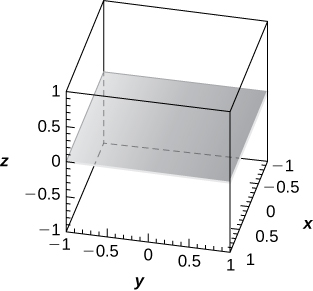
2-399 §2.7 source ↗
For the following exercises, the equation of a surface in rectangular coordinates is given. Find an equation of the surface in spherical coordinates. Identify the surface.
Answer
2-401 §2.7 source ↗
For the following exercises, the equation of a surface in rectangular coordinates is given. Find an equation of the surface in spherical coordinates. Identify the surface.
Answer
2-403 §2.7 source ↗
For the following exercises, the cylindrical coordinates of a point are given. Find its associated spherical coordinates, with the measure of the angle in radians rounded to four decimal places.
[T]
Answer
2-405 §2.7 source ↗
For the following exercises, the cylindrical coordinates of a point are given. Find its associated spherical coordinates, with the measure of the angle in radians rounded to four decimal places.
Answer
2-407 §2.7 source ↗
For the following exercises, the spherical coordinates of a point are given. Find its associated cylindrical coordinates.
Answer
2-409 §2.7 source ↗
For the following exercises, the spherical coordinates of a point are given. Find its associated cylindrical coordinates.
Answer
2-411 §2.7 source ↗
For the following exercises, find the most suitable system of coordinates to describe the solids.
The solid situated in the first octant with a vertex at the origin and enclosed by a cube of edge length where
Answer
2-413 §2.7 source ↗
For the following exercises, find the most suitable system of coordinates to describe the solids.
A solid inside sphere and outside cylinder
Answer
2-415 §2.7 source ↗
For the following exercises, find the most suitable system of coordinates to describe the solids.
[T] Use a CAS to graph the region between elliptic paraboloid and cone Then describe the region in cylindrical coordinates.
Answer
The region is described by the set of points
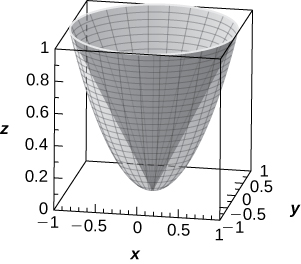
2-417 §2.7 source ↗
For the following exercises, find the most suitable system of coordinates to describe the solids.
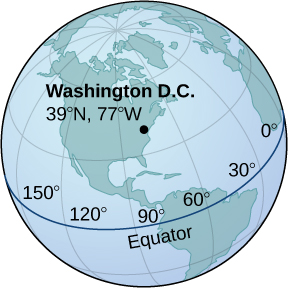
Washington, DC, is located at N and W (see the following figure). Assume the radius of Earth is mi. Express the location of Washington, DC, in spherical coordinates.
Answer
2-419 §2.7 source ↗
For the following exercises, find the most suitable system of coordinates to describe the solids.
Find the latitude and longitude of Rio de Janeiro if its spherical coordinates are
Answer
2-421 §2.7 source ↗
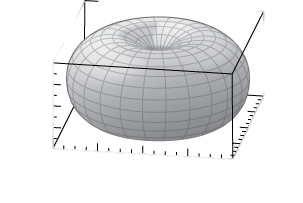
For the following exercises, find the most suitable system of coordinates to describe the solids.
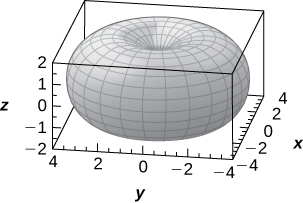
[T] Consider the torus of equation where
a. Write the equation of the torus in spherical coordinates.
b. If the surface is called a horn torus. Show that the equation of a horn torus in spherical coordinates is
c. Use a CAS to graph the horn torus with in spherical coordinates.
Answer
a.
c.
2-423 §2.R source ↗
For the following exercises, determine whether the statement is true or false. Justify the answer with a proof or a counterexample.
For vectors and and any given scalar
Answer
2-425 §2.R source ↗
For the following exercises, determine whether the statement is true or false. Justify the answer with a proof or a counterexample.
The symmetric equation for the line of intersection between two planes and is given by
Answer
2-427 §2.R source ↗
For the following exercises, use the given vectors to find the quantities.
a.
b.
c.
d.
Answer
2-429 §2.R source ↗
For the following exercises, use the given vectors to find the quantities.
Find the values of such that vectors and are orthogonal.
Answer
2-431 §2.R source ↗
For the following exercises, find the unit vectors.
Find the unit vector that has the same direction as vector that begins at and ends at
Answer
2-433 §2.R source ↗
For the following exercises, find the area or volume of the given shapes.
The parallelepiped formed by and
Answer
2-435 §2.R source ↗
For the following exercises, find the vector and parametric equations of the line with the given properties.
The line that passes through points and
Answer
2-437 §2.R source ↗
For the following exercises, find an equation of the plane with the given properties.
The plane that passes through points
Answer
2-439 §2.R source ↗
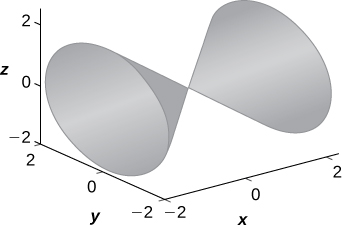
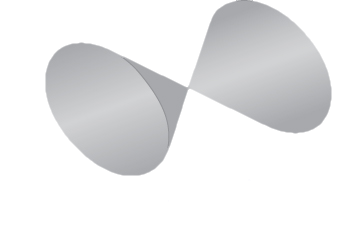
For the following exercises, find the traces for the surfaces in planes Then, describe and draw the surfaces.
Answer
trace: is a circle, trace: is a hyperbola (or a pair of lines if trace: is a hyperbola (or a pair of lines if The surface is a cone.
2-441 §2.R source ↗
For the following exercises, write the given equation in cylindrical coordinates and spherical coordinates.
Answer
2-443 §2.R source ↗
For the following exercises, convert the given equations from cylindrical or spherical coordinates to rectangular coordinates. Identify the given surface.
Answer
2-445 §2.R source ↗
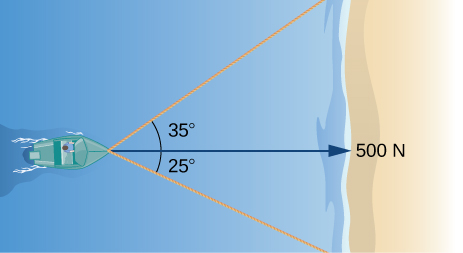
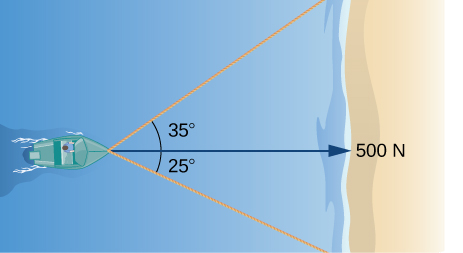
For the following exercises, consider a small boat crossing a river.
When the boat reaches the shore, two ropes are thrown to people to help pull the boat ashore. One rope is at an angle of and the other is at If the boat must be pulled straight and at a force of find the magnitude of force for each rope (see the following figure).
Answer
2-447 §2.R source ↗
For the following exercises, consider a small boat crossing a river.
Calculate the work done by moving a particle from position to along a straight line with a force
Answer
2-449 §2.R source ↗
The following problems consider your unsuccessful attempt to take the tire off your car using a wrench to loosen the bolts. Assume the wrench is m long and you are able to apply a 200-N force.
Someone lends you a tire jack and you are now able to apply a 200-N force at an angle. Is your resulting torque going to be more or less? What is the new resulting torque at the center of the bolt? Assume this force is not enough to loosen the bolt.
Answer
Loading chapter 3…
Problems and answers are adapted from Calculus Volume 3 by Gilbert Strang and Edwin “Jed” Herman, OpenStax, and are used under the CC BY-NC-SA 4.0 licence. Access for free at https://openstax.org/books/calculus-volume-3/pages/1-introduction. Illustrations: Copyright Rice University, OpenStax, under CC BY-NC-SA 4.0 license. This adaptation is released under the same licence, is non-commercial, and is neither affiliated with nor endorsed by OpenStax or Rice University.