Every problem in the chapter beside the book’s answer, a chapter at a time as you scroll.
Chapter 7: Second-Order Differential Equations
87 problems · 5 figuresCheckpoint 7.1 §7.1 source ↗
Classify each of the following equations as linear or nonlinear. If the equation is linear, determine further whether it is homogeneous or nonhomogeneous.
a.
b.
Answer
a. Nonlinear
b. Linear, nonhomogeneous
Checkpoint 7.4 §7.1 source ↗
Answer
Checkpoint 7.5 §7.1 source ↗
Answer
Checkpoint 7.6 §7.1 source ↗
Find the general solution to the following differential equations:
a.
b.
Answer
a.
b.
Checkpoint 7.7 §7.1 source ↗
Answer
Checkpoint 7.8 §7.1 source ↗
Answer
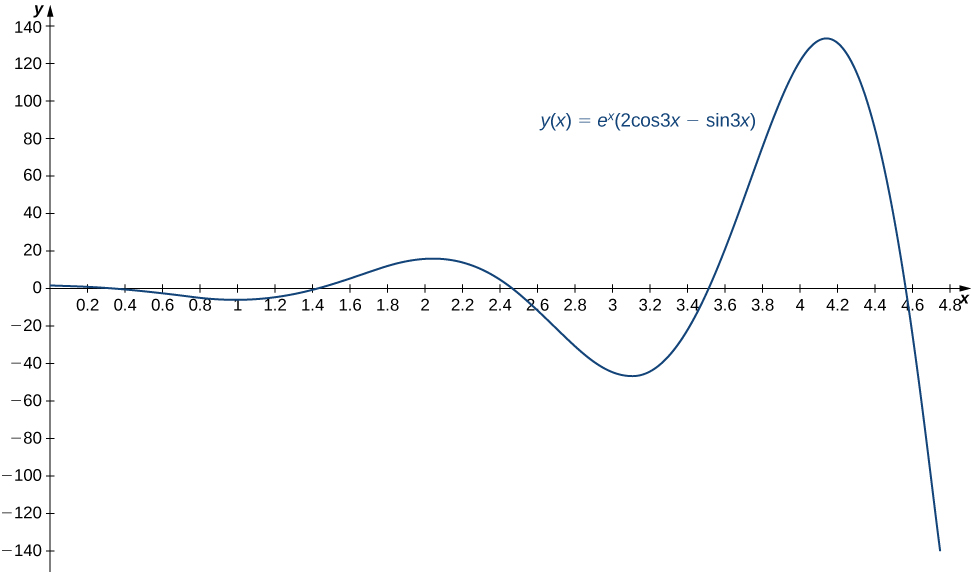
Checkpoint 7.9 §7.1 source ↗
Suppose the following initial-value problem models the position (in feet) of a mass in a spring-mass system at any given time. Solve the initial-value problem and graph the solution. What is the position of the mass at time sec? How fast is it moving at time sec? In what direction?
Answer
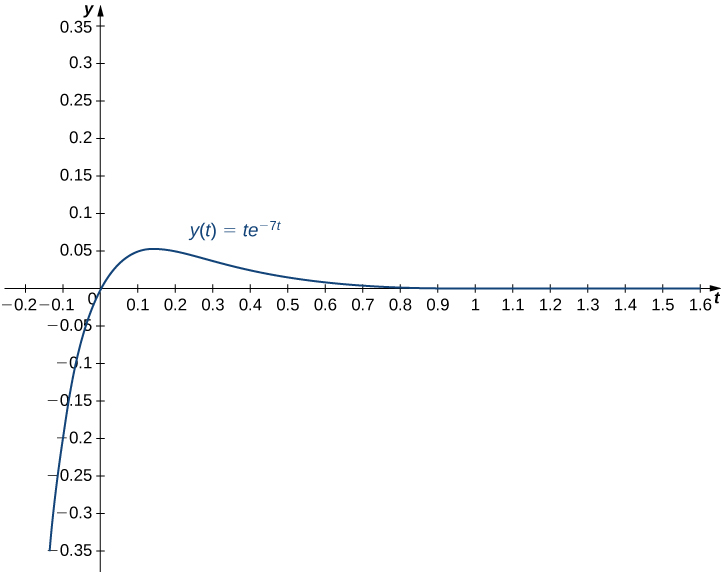
At time The mass is 0.0367 ft below equilibrium. At time The mass is moving downward at a speed of 0.1490 ft/sec.
7-1 §7.1 source ↗
Classify each of the following equations as linear or nonlinear. If the equation is linear, determine whether it is homogeneous or nonhomogeneous.
Answer
7-3 §7.1 source ↗
Classify each of the following equations as linear or nonlinear. If the equation is linear, determine whether it is homogeneous or nonhomogeneous.
Answer
7-5 §7.1 source ↗
Classify each of the following equations as linear or nonlinear. If the equation is linear, determine whether it is homogeneous or nonhomogeneous.
Answer
7-11 §7.1 source ↗
For each of the following problems, verify that the given function is a solution to the differential equation. Use a graphing utility to graph the particular solutions for several values of c1 and c2. What do the solutions have in common?
Answer
7-13 §7.1 source ↗
For each of the following problems, verify that the given function is a solution to the differential equation. Use a graphing utility to graph the particular solutions for several values of c1 and c2. What do the solutions have in common?
Answer
7-15 §7.1 source ↗
For each of the following problems, verify that the given function is a solution to the differential equation. Use a graphing utility to graph the particular solutions for several values of c1 and c2. What do the solutions have in common?
Answer
7-17 §7.1 source ↗
For each of the following problems, verify that the given function is a solution to the differential equation. Use a graphing utility to graph the particular solutions for several values of c1 and c2. What do the solutions have in common?
Answer
7-19 §7.1 source ↗
For each of the following problems, verify that the given function is a solution to the differential equation. Use a graphing utility to graph the particular solutions for several values of c1 and c2. What do the solutions have in common?
Answer
7-21 §7.1 source ↗
For each of the following problems, verify that the given function is a solution to the differential equation. Use a graphing utility to graph the particular solutions for several values of c1 and c2. What do the solutions have in common?
Answer
7-23 §7.1 source ↗
For each of the following problems, verify that the given function is a solution to the differential equation. Use a graphing utility to graph the particular solutions for several values of c1 and c2. What do the solutions have in common?
Answer
7-25 §7.1 source ↗
For each of the following problems, verify that the given function is a solution to the differential equation. Use a graphing utility to graph the particular solutions for several values of c1 and c2. What do the solutions have in common?
Answer
7-27 §7.1 source ↗
For each of the following problems, verify that the given function is a solution to the differential equation. Use a graphing utility to graph the particular solutions for several values of c1 and c2. What do the solutions have in common?
Answer
7-29 §7.1 source ↗
For each of the following problems, verify that the given function is a solution to the differential equation. Use a graphing utility to graph the particular solutions for several values of c1 and c2. What do the solutions have in common?
Answer
7-31 §7.1 source ↗
Solve the initial-value problem.
Answer
7-33 §7.1 source ↗
Solve the initial-value problem.
Answer
7-35 §7.1 source ↗
Solve the initial-value problem.
Answer
7-37 §7.1 source ↗
Solve the initial-value problem.
Answer
7-39 §7.1 source ↗
Solve the boundary-value problem, if possible.
Answer
7-41 §7.1 source ↗
Solve the boundary-value problem, if possible.
Answer
7-43 §7.1 source ↗
Solve the boundary-value problem, if possible.
Answer
7-45 §7.1 source ↗
Solve the boundary-value problem, if possible.
Answer
7-47 §7.1 source ↗
Solve the boundary-value problem, if possible.
Find a differential equation with a general solution that is
Answer
7-49 §7.1 source ↗
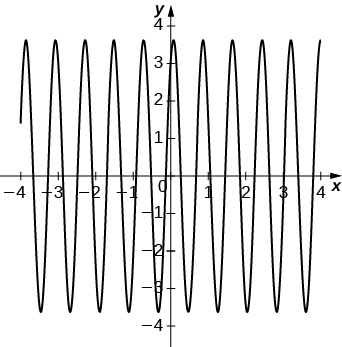
For each of the following differential equations:
Answer
a.
b.
7-51 §7.1 source ↗
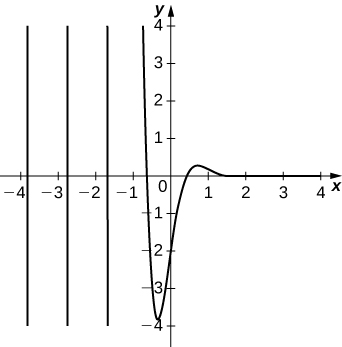
For each of the following differential equations:
Answer
a.
b.
Checkpoint 7.10 §7.2 source ↗
Answer
Checkpoint 7.11 §7.2 source ↗
Answer
Checkpoint 7.12 §7.2 source ↗
Find the general solution to the following differential equations.
a.
b.
Answer
a.
b.
Checkpoint 7.13 §7.2 source ↗
Use Cramer’s rule to solve the following system of equations.
Answer
Checkpoint 7.14 §7.2 source ↗
Find the general solution to the following differential equations.
a.
b.
Answer
a.
b.
7-55 §7.2 source ↗
Solve the following equations using the method of undetermined coefficients.
Answer
7-57 §7.2 source ↗
Solve the following equations using the method of undetermined coefficients.
Answer
7-59 §7.2 source ↗
Solve the following equations using the method of undetermined coefficients.
Answer
7-61 §7.2 source ↗
Solve the following equations using the method of undetermined coefficients.
Answer
7-63 §7.2 source ↗
Solve the following equations using the method of undetermined coefficients.
Answer
7-65 §7.2 source ↗
Solve the following equations using the method of undetermined coefficients.
Answer
7-67 §7.2 source ↗
In each of the following problems,
Answer
b.
7-69 §7.2 source ↗
In each of the following problems,
Answer
b.
7-71 §7.2 source ↗
In each of the following problems,
Answer
b.
7-73 §7.2 source ↗
Solve the differential equation using either the method of undetermined coefficients or the variation of parameters.
Answer
7-75 §7.2 source ↗
Solve the differential equation using either the method of undetermined coefficients or the variation of parameters.
Answer
7-77 §7.2 source ↗
Solve the differential equation using the method of variation of parameters.
Answer
7-79 §7.2 source ↗
Solve the differential equation using the method of variation of parameters.
Answer
7-81 §7.2 source ↗
Find the unique solution satisfying the differential equation and the initial conditions given, where is the particular solution.
Answer
7-83 §7.2 source ↗
Find the unique solution satisfying the differential equation and the initial conditions given, where is the particular solution.
Answer
7-85 §7.2 source ↗
In each of the following problems, two linearly independent solutions— and —are given that satisfy the corresponding homogeneous equation. Use the method of variation of parameters to find a particular solution to the given nonhomogeneous equation. Assume x > 0 in each exercise.
Answer
Checkpoint 7.15 §7.3 source ↗
Answer
Checkpoint 7.16 §7.3 source ↗
Answer
Checkpoint 7.17 §7.3 source ↗
Answer
Checkpoint 7.18 §7.3 source ↗
Answer
Checkpoint 7.19 §7.3 source ↗
Answer
Checkpoint 7.20 §7.3 source ↗
Answer
Checkpoint 7.21 §7.3 source ↗
Answer
7-87 §7.3 source ↗
Answer
7-89 §7.3 source ↗
Answer
7-91 §7.3 source ↗
A block has a mass of 5 kg and is attached to a vertical spring with a spring constant of 20 N/m. The block is released from the equilibrium position with a downward velocity of 10 m/sec.
a. Find the position function of the block.
b. Find the period and frequency of the vibration.
c. Sketch a graph of
d. At what time does the block first pass through the equilibrium position?
Answer
a.
b. period frequency
c.
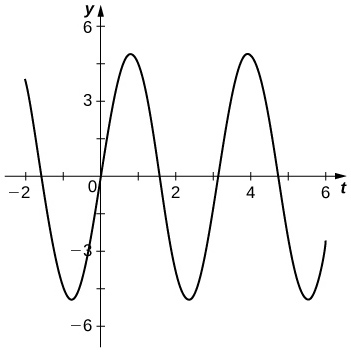
d.
7-93 §7.3 source ↗
An 800-lb weight (25 slugs) is attached to a vertical spring with a spring constant of 226 lb/ft. The system is immersed in a medium that imparts a damping force equal to 10 times the instantaneous velocity of the mass.
a. Find the equation of motion if it is released from a position 20 ft below its equilibrium position with a downward velocity of 41 ft/sec.
b. Graph the solution and determine whether the motion is overdamped, critically damped, or underdamped.
Answer
b. underdamped
7-95 §7.3 source ↗
A 1-kg mass stretches a spring 61.25 cm. The resistance in the spring-mass system is equal to eight times the instantaneous velocity of the mass.
a. Find the equation of motion if the mass is released from a position 5 m below its equilibrium position with an upward velocity of 10 m/sec.
b. Determine whether the motion is overdamped, critically damped, or underdamped.
Answer
b. underdamped
7-97 §7.3 source ↗
Answer
7-99 §7.3 source ↗
Answer
7-101 §7.3 source ↗
Answer
7-103 §7.3 source ↗
Answer
Checkpoint 7.22 §7.4 source ↗
Find a power series solution for the following differential equations.
a.
b.
Answer
a.
b.
7-105 §7.4 source ↗
Find a power series solution for the following differential equations.
Answer
7-107 §7.4 source ↗
Find a power series solution for the following differential equations.
Answer
7-109 §7.4 source ↗
Find a power series solution for the following differential equations.
Answer
7-111 §7.4 source ↗
Find a power series solution for the following differential equations.
Answer
7-113 §7.4 source ↗
Find a power series solution for the following differential equations.
Answer
7-115 §7.4 source ↗
Find a power series solution for the following differential equations.
Answer
7-117 §7.R source ↗
True or False? Justify your answer with a proof or a counterexample.
If and are both solutions to then is also a solution.
Answer
7-119 §7.R source ↗
True or False? Justify your answer with a proof or a counterexample.
is a solution to the second-order differential equation
Answer
7-121 §7.R source ↗
Classify the differential equation. Determine the order, whether it is linear and, if linear, whether the differential equation is homogeneous or nonhomogeneous. If the equation is second-order homogeneous and linear, find the characteristic equation.
Answer
7-123 §7.R source ↗
Classify the differential equation. Determine the order, whether it is linear and, if linear, whether the differential equation is homogeneous or nonhomogeneous. If the equation is second-order homogeneous and linear, find the characteristic equation.
Answer
7-125 §7.R source ↗
For the following problems, find the general solution.
Answer
7-127 §7.R source ↗
For the following problems, find the general solution.
Answer
7-129 §7.R source ↗
For the following problems, find the general solution.
Answer
7-131 §7.R source ↗
For the following problems, find the general solution.
Answer
7-133 §7.R source ↗
For the following problems, find the solution to the initial-value problem, if possible.
Answer
7-135 §7.R source ↗
For the following problems, find the solution to the boundary-value problem, if possible.
Answer
7-137 §7.R source ↗
For the following problem, set up and solve the differential equation.
The motion of a swinging pendulum for small angles can be approximated by where is the angle the pendulum makes with respect to a vertical line, g is the acceleration resulting from gravity, and L is the length of the pendulum. Find the equation describing the angle of the pendulum at time assuming an initial displacement of and an initial velocity of zero.
Answer
7-141 §7.R source ↗
For the following problem, set up and solve the differential equations.
An opera singer is attempting to shatter a glass by singing a particular note. The vibrations of the glass can be modeled by where represents the natural frequency of the glass and the singer is forcing the vibrations at For what value would the singer be able to break that glass? (Note: in order for the glass to break, the oscillations would need to get higher and higher.)
Answer
End of the book.
Problems and answers are adapted from Calculus Volume 3 by Gilbert Strang and Edwin “Jed” Herman, OpenStax, and are used under the CC BY-NC-SA 4.0 licence. Access for free at https://openstax.org/books/calculus-volume-3/pages/1-introduction. Illustrations: Copyright Rice University, OpenStax, under CC BY-NC-SA 4.0 license. This adaptation is released under the same licence, is non-commercial, and is neither affiliated with nor endorsed by OpenStax or Rice University.