Every problem in the chapter beside the book’s answer, a chapter at a time as you scroll.
Chapter 6: Vector Calculus
293 problems · 48 figuresCheckpoint 6.1 §6.1 source ↗
Answer
Checkpoint 6.2 §6.1 source ↗
Answer
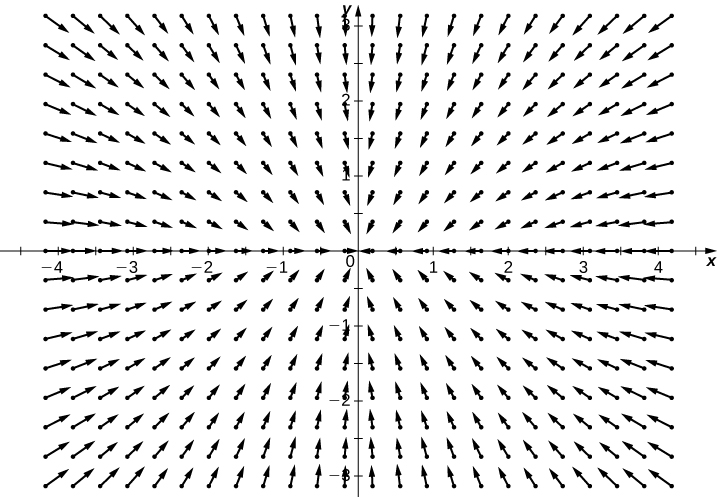
Checkpoint 6.3 §6.1 source ↗
Answer
Rotational
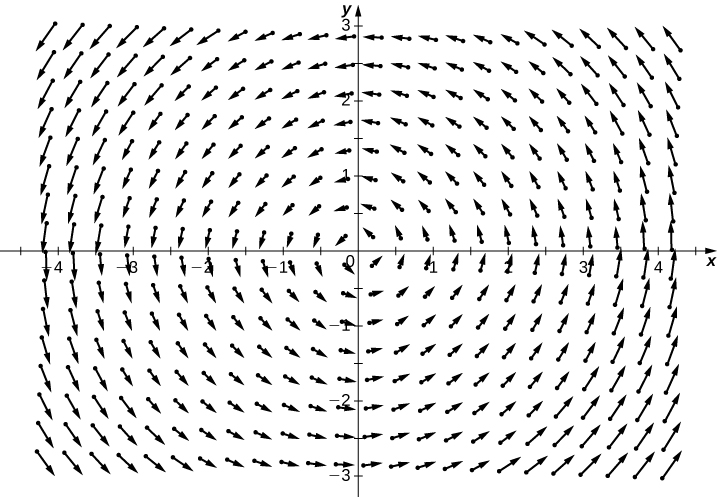
Checkpoint 6.4 §6.1 source ↗
Answer
Checkpoint 6.5 §6.1 source ↗
Answer
Checkpoint 6.6 §6.1 source ↗
Answer
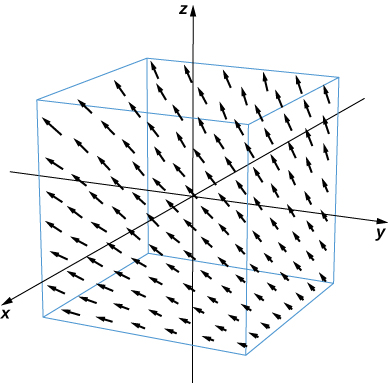
Checkpoint 6.7 §6.1 source ↗
Answer
Checkpoint 6.8 §6.1 source ↗
Answer
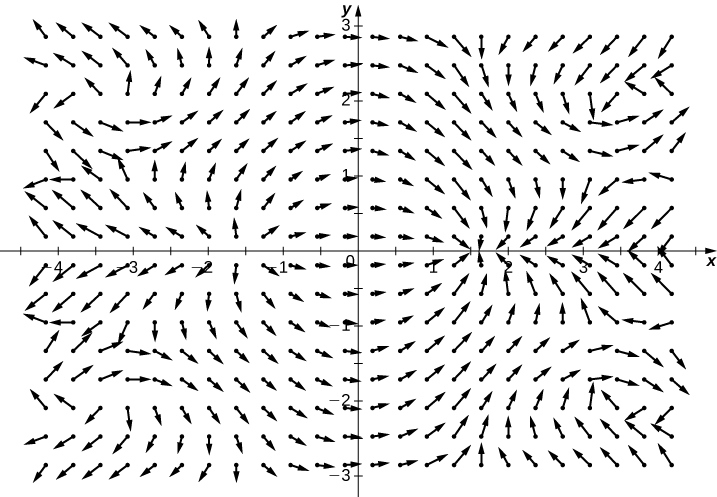
Checkpoint 6.9 §6.1 source ↗
Answer
Checkpoint 6.10 §6.1 source ↗
Answer
Checkpoint 6.11 §6.1 source ↗
Answer
Checkpoint 6.12 §6.1 source ↗
Answer
6-1 §6.1 source ↗
Answer
6-3 §6.1 source ↗
For the following exercises, determine whether the statement is true or false.
Vector field is constant in direction and magnitude on a unit circle.
Answer
6-5 §6.1 source ↗
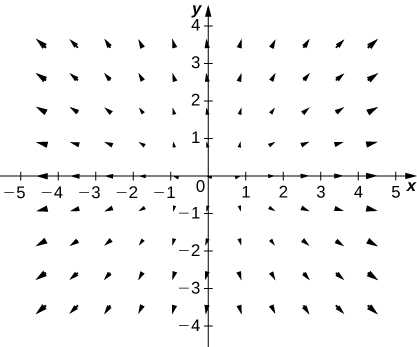
For the following exercises, describe each vector field by drawing some of its vectors.
[T]
Answer
6-7 §6.1 source ↗
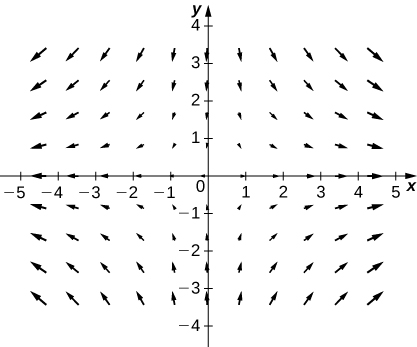
For the following exercises, describe each vector field by drawing some of its vectors.
[T]
Answer
6-9 §6.1 source ↗
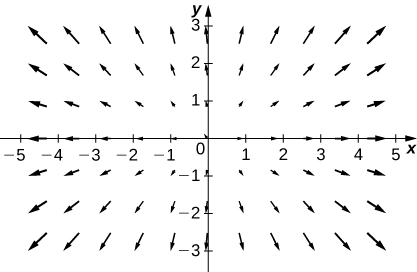
For the following exercises, describe each vector field by drawing some of its vectors.
[T]
Answer
6-11 §6.1 source ↗
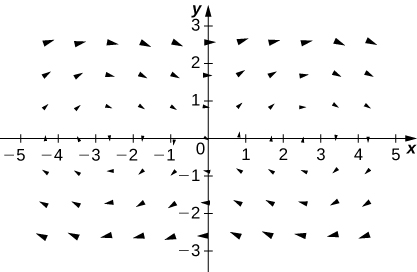
For the following exercises, describe each vector field by drawing some of its vectors.
[T]
Answer
6-13 §6.1 source ↗
For the following exercises, describe each vector field by drawing some of its vectors.
[T]
Answer
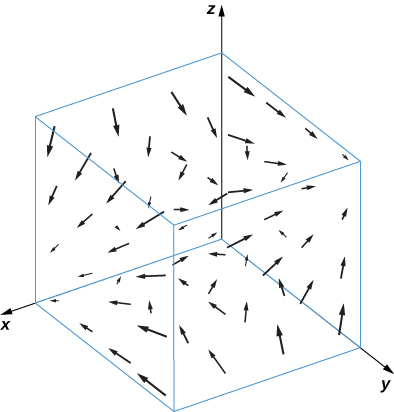
6-15 §6.1 source ↗
For the following exercises, find the gradient vector field of each function
Answer
6-17 §6.1 source ↗
For the following exercises, find the gradient vector field of each function
Answer
6-19 §6.1 source ↗
For the following exercises, find the gradient vector field of each function
Answer
6-21 §6.1 source ↗
For the following exercises, find the gradient vector field of each function
What is vector field with a value at that is of unit length and points toward
Answer
6-23 §6.1 source ↗
For the following exercises, write formulas for the vector fields with the given properties.
All vectors point toward the origin and have constant length.
Answer
6-25 §6.1 source ↗
For the following exercises, write formulas for the vector fields with the given properties.
Give a formula for the vector field in a plane that has the properties that at and that at any other point F is tangent to circle and points in the clockwise direction with magnitude
Answer
6-27 §6.1 source ↗
For the following exercises, write formulas for the vector fields with the given properties.
Find a formula for vector field given the fact that for all points F points toward the origin and
Answer
6-29 §6.1 source ↗
For the following exercises, assume that an electric field in the xy-plane caused by an infinite line of charge along the x-axis is a gradient field with potential function where is a constant and is a reference distance at which the potential is assumed to be zero.
Show that the electric field at a point in the xy-plane is directed outward from the origin and has magnitude , where .
Answer
6-31 §6.1 source ↗
A flow line (or streamline) of a vector field is a curve such that If represents the velocity field of a moving particle, then the flow lines are paths taken by the particle. Therefore, flow lines are tangent to the vector field. For the following exercises, show that the given curve is a flow line of the given velocity vector field
Answer
6-33 §6.1 source ↗
For the following exercises, let and Match F, G, and H with their graphs.
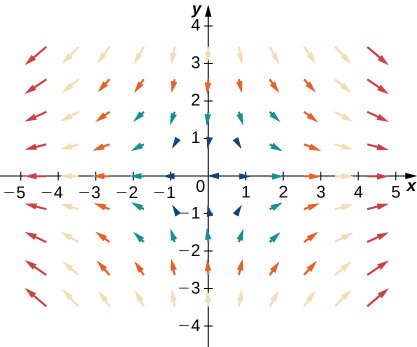
Answer
6-35 §6.1 source ↗
For the following exercises, let and Match the vector fields in a through d with their graphs.
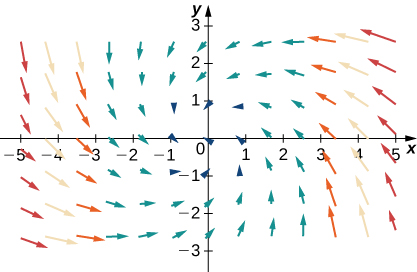
Answer
6-37 §6.1 source ↗
For the following exercises, let and Match the vector fields in a through d with their graphs.
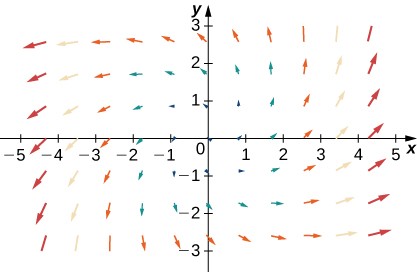
Answer
Checkpoint 6.13 §6.2 source ↗
Answer
Checkpoint 6.14 §6.2 source ↗
Answer
Checkpoint 6.15 §6.2 source ↗
Answer
Checkpoint 6.16 §6.2 source ↗
Answer
Checkpoint 6.17 §6.2 source ↗
Answer
Checkpoint 6.18 §6.2 source ↗
Answer
Checkpoint 6.19 §6.2 source ↗
Answer
Checkpoint 6.20 §6.2 source ↗
Answer
Checkpoint 6.21 §6.2 source ↗
Answer
Checkpoint 6.22 §6.2 source ↗
Answer
Checkpoint 6.23 §6.2 source ↗
Answer
6-39 §6.2 source ↗
Answer
6-41 §6.2 source ↗
Answer
6-43 §6.2 source ↗
Answer
6-45 §6.2 source ↗
For the following exercises, use a computer algebra system (CAS) to evaluate the line integrals over the indicated path.
[T]
when
Answer
6-47 §6.2 source ↗
For the following exercises, use a computer algebra system (CAS) to evaluate the line integrals over the indicated path.
[T] Evaluate where C is the right half of circle and is traversed in the clockwise direction.
Answer
6-49 §6.2 source ↗
For the following exercises, find the work done.
Find the work done by vector field on a particle moving along a line segment that goes from to
Answer
6-51 §6.2 source ↗
For the following exercises, find the work done.
Find the work done by force field on a particle as it moves along the helix from point to point
Answer
6-53 §6.2 source ↗
For the following exercises, find the work done.
Find the work done by force in moving an object along curve where
Answer
6-55 §6.2 source ↗
For the following exercises, evaluate the line integrals.
Evaluate where and C is the part of the graph of from to
Answer
6-57 §6.2 source ↗
For the following exercises, evaluate the line integrals.
Evaluate over the line segment from to
Answer
6-59 §6.2 source ↗
For the following exercises, evaluate the line integrals.
[T] Use a computer algebra system to evaluate the line integral where C is the arc of the parabola from (−5, −3) to (0, 2).
Answer
6-61 §6.2 source ↗
For the following exercises, evaluate the line integrals.
[T] Use a CAS to evaluate line integral over path C given by where
Answer
6-63 §6.2 source ↗
For the following exercises, evaluate the line integrals.
[T] Use a CAS to evaluate where C is
Answer
6-65 §6.2 source ↗
In the following exercises, find the work done by force field F on an object moving along the indicated path.
Answer
6-67 §6.2 source ↗
In the following exercises, find the work done by force field F on an object moving along the indicated path.
Answer
6-69 §6.2 source ↗
In the following exercises, find the work done by force field F on an object moving along the indicated path.
Compute the work done by force along path where
Answer
6-71 §6.2 source ↗
In the following exercises, find the work done by force field F on an object moving along the indicated path.
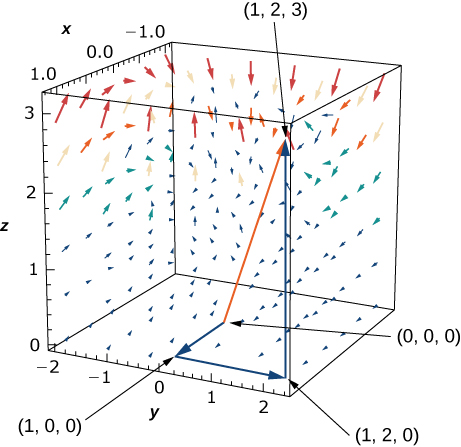
Force acts on a particle that travels from the origin to point (1, 2, 3). Calculate the work done if the particle travels:
a. along the path along straight-line segments joining each pair of endpoints;
b. along the straight line joining the initial and final points.
c. Is the work the same along the two paths?
Answer
6-73 §6.2 source ↗
In the following exercises, find the work done by force field F on an object moving along the indicated path.
How much work is required to move an object in vector field along the upper part of ellipse from (2, 0) to
Answer
6-75 §6.2 source ↗
In the following exercises, find the work done by force field F on an object moving along the indicated path.
Evaluate the line integral of scalar function along parabolic path connecting the origin to point (1, 1).
Answer
6-77 §6.2 source ↗
In the following exercises, find the work done by force field F on an object moving along the indicated path.
Find along C: from (0, 0) to (1, 3).
Answer
6-79 §6.2 source ↗
For the following exercises, use a CAS to evaluate the given line integrals.
[T] Evaluate line integral where, is the arc of curve from to
Answer
6-81 §6.2 source ↗
For the following exercises, use a CAS to evaluate the given line integrals.
[T] Evaluate line integral where is curve from (1, 0) toward
Answer
6-83 §6.2 source ↗
For the following exercises, use a CAS to evaluate the given line integrals.
[T] Evaluate where and
C:
Answer
6-85 §6.2 source ↗
For the following exercises, use a CAS to evaluate the given line integrals.
Find the line integral of over path C defined by from point (0, 0, 0) to point (2, 4, 8).
Answer
6-87 §6.2 source ↗
For the following exercises, find the flux.
Compute the flux of across a line segment from (0, 0) to (1, 2).
Answer
6-89 §6.2 source ↗
For the following exercises, find the flux.
Let and let C be curve Find the flux across C.
Answer
6-91 §6.2 source ↗
For the following exercises, find the flux.
Let Calculate flux F orientated counterclockwise across curve C:
Answer
6-93 §6.2 source ↗
For the following exercises, find the flux.
A spring is made of a thin wire twisted into the shape of a circular helix Find the mass of two turns of the spring if the wire has constant mass density.
Answer
6-95 §6.2 source ↗
For the following exercises, find the flux.
An object moves in force field counterclockwise from point (2, 0) along elliptical path to and back to point (2, 0) along the x-axis. How much work is done by the force field on the object?
Answer
6-97 §6.2 source ↗
For the following exercises, find the flux.
If an inverse force field F is given by where k is a constant, find the work done by F as its point of application moves along the x-axis from
Answer
Checkpoint 6.24 §6.3 source ↗
Answer
Checkpoint 6.25 §6.3 source ↗
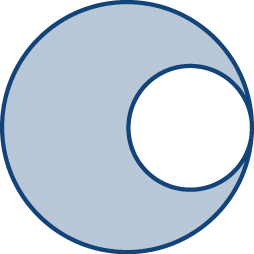
Is the region in the below image connected? Is the region simply connected?
Answer
Checkpoint 6.26 §6.3 source ↗
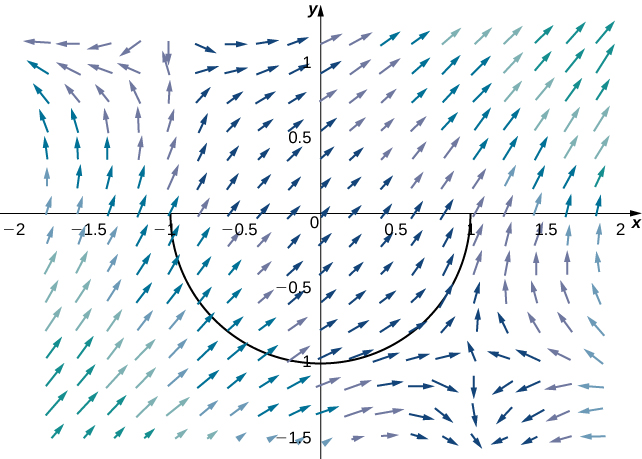
Given that is a potential function for calculate integral where C is the lower half of the unit circle oriented counterclockwise.
Answer
Checkpoint 6.27 §6.3 source ↗
Answer
Checkpoint 6.28 §6.3 source ↗
Answer
Checkpoint 6.29 §6.3 source ↗
Answer
Checkpoint 6.30 §6.3 source ↗
Answer
Checkpoint 6.31 §6.3 source ↗
Answer
Checkpoint 6.32 §6.3 source ↗
Answer
Checkpoint 6.33 §6.3 source ↗
Answer
6-99 §6.3 source ↗
Answer
6-101 §6.3 source ↗
Answer
6-103 §6.3 source ↗
Answer
6-105 §6.3 source ↗
Answer
6-107 §6.3 source ↗
For the following exercises, determine whether the vector field is conservative and, if it is, find the potential function.
Answer
6-109 §6.3 source ↗
For the following exercises, determine whether the vector field is conservative and, if it is, find the potential function.
Answer
6-111 §6.3 source ↗
For the following exercises, determine whether the vector field is conservative and, if it is, find the potential function.
Answer
6-113 §6.3 source ↗
For the following exercises, evaluate the line integrals using the Fundamental Theorem of Line Integrals.
where C is the line segment from (0, 0) to (4, 4)
Answer
6-115 §6.3 source ↗
For the following exercises, evaluate the line integrals using the Fundamental Theorem of Line Integrals.
Find the conservative vector field for the potential function
Answer
6-117 §6.3 source ↗
For the following exercises, determine whether the vector field is conservative and, if so, find a potential function.
Answer
6-119 §6.3 source ↗
For the following exercises, determine whether the vector field is conservative and, if so, find a potential function.
Answer
6-121 §6.3 source ↗
For the following exercises, determine whether the vector field is conservative and, if so, find a potential function.
Answer
6-123 §6.3 source ↗
For the following exercises, determine whether the vector field is conservative and, if so, find a potential function.
Answer
6-125 §6.3 source ↗
For the following exercises, determine whether the vector field is conservative and, if so, find a potential function.
Answer
6-127 §6.3 source ↗
For the following exercises, evaluate the integral using the Fundamental Theorem of Line Integrals.
[T] Evaluate where and C is a straight line from to
Answer
6-129 §6.3 source ↗
For the following exercises, evaluate the integral using the Fundamental Theorem of Line Integrals.
Evaluate where and C has initial point (1, 2, 3) and terminal point (3, 5, 1).
Answer
6-131 §6.3 source ↗
For the following exercises, let and and let C1 be the curve consisting of the circle of radius 2, centered at the origin and oriented counterclockwise, and C2 be the curve consisting of a line segment from (0, 0) to (1, 1) followed by a line segment from (1, 1) to (3, 1).
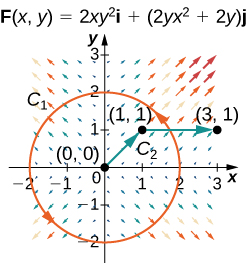
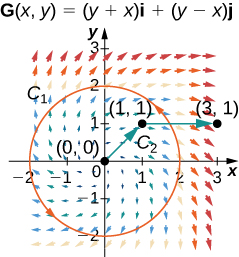
Calculate the line integral of G over C1.
Answer
6-133 §6.3 source ↗
For the following exercises, let and and let C1 be the curve consisting of the circle of radius 2, centered at the origin and oriented counterclockwise, and C2 be the curve consisting of a line segment from (0, 0) to (1, 1) followed by a line segment from (1, 1) to (3, 1).
Calculate the line integral of G over C2.
Answer
6-135 §6.3 source ↗
For the following exercises, let and and let C1 be the curve consisting of the circle of radius 2, centered at the origin and oriented counterclockwise, and C2 be the curve consisting of a line segment from (0, 0) to (1, 1) followed by a line segment from (1, 1) to (3, 1).
[T] Find line integral of vector field along curve C parameterized by
Answer
6-137 §6.3 source ↗
For the following exercises, show that the following vector fields are conservative by using a computer. Calculate for the given curve.
C is parameterized by
Answer
6-139 §6.3 source ↗
For the following exercises, show that the following vector fields are conservative by using a computer. Calculate for the given curve.
The mass of Earth is approximately and that of the Sun is 330,000 times as much. The gravitational constant is The distance of Earth from the Sun is about Compute, approximately, the work necessary to increase the distance of Earth from the Sun by
Answer
6-141 §6.3 source ↗
For the following exercises, show that the following vector fields are conservative by using a computer. Calculate for the given curve.
[T] Let be given by Use a computer to compute the integral where
Answer
6-143 §6.3 source ↗
For the following exercises, show that the following vector fields are conservative by using a computer. Calculate for the given curve.
Find the circulation and flux of field around and across the closed semicircular path that consists of semicircular arch followed by line segment
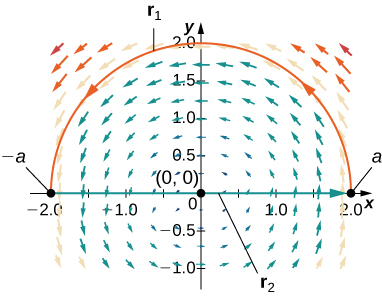
Answer
Checkpoint 6.34 §6.4 source ↗
Use Green’s theorem to calculate line integral
where C is a right triangle with vertices and oriented counterclockwise.
Answer
Checkpoint 6.35 §6.4 source ↗
Find the area of the region enclosed by the curve with parameterization
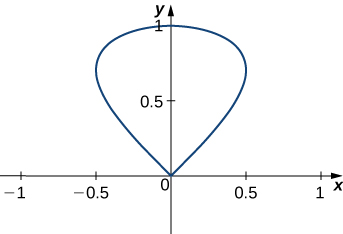
Answer
Checkpoint 6.36 §6.4 source ↗
Answer
Checkpoint 6.37 §6.4 source ↗
Answer
Checkpoint 6.38 §6.4 source ↗
Answer
Checkpoint 6.39 §6.4 source ↗
Answer
6-147 §6.4 source ↗
For the following exercises, evaluate the line integrals by applying Green’s theorem.
where C is the boundary of the region lying between the graphs of and oriented in the counterclockwise direction
Answer
6-149 §6.4 source ↗
For the following exercises, evaluate the line integrals by applying Green’s theorem.
where C is the boundary of the region lying between the graphs of and oriented in the counterclockwise direction
Answer
6-151 §6.4 source ↗
For the following exercises, evaluate the line integrals by applying Green’s theorem.
where C consists of line segment C1 from to (1, 0), followed by the semicircular arc C2 from (1, 0) back to (–1, 0)
Answer
6-153 §6.4 source ↗
For the following exercises, use Green’s theorem.
Evaluate line integral where C is the boundary of the region between circles and and is a positively oriented curve.
Answer
6-155 §6.4 source ↗
For the following exercises, use Green’s theorem.
Evaluate where C is the positively oriented circle of radius 2 centered at the origin.
Answer
6-157 §6.4 source ↗
For the following exercises, use Green’s theorem.
Calculate where C is a circle of radius 2 centered at the origin and oriented in the counterclockwise direction.
Answer
6-159 §6.4 source ↗
For the following exercises, use Green’s theorem.
Evaluate integral where C is the curve that follows parabola then the line from (2, 4) to (2, 0), and finally the line from (2, 0) to (0, 0).
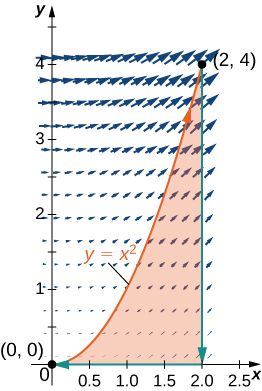
Answer
6-161 §6.4 source ↗
For the following exercises, use Green’s theorem to find the area.
Find the area between ellipse and circle
Answer
6-163 §6.4 source ↗
For the following exercises, use Green’s theorem to find the area.
Find the area of the region bounded by hypocycloid The curve is parameterized by
Answer
6-165 §6.4 source ↗
For the following exercises, use Green’s theorem to find the area.
Use Green’s theorem to evaluate where is the perimeter of square oriented counterclockwise.
Answer
6-167 §6.4 source ↗
For the following exercises, use Green’s theorem to find the area.
Use Green’s theorem to find the area of one loop of a four-leaf rose (Hint:
Answer
6-169 §6.4 source ↗
For the following exercises, use Green’s theorem to find the area.
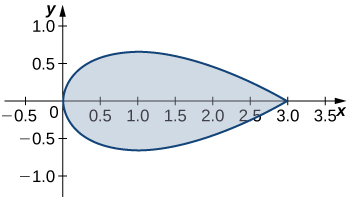
Use Green’s theorem to find the area of the region enclosed by curve
Answer
6-171 §6.4 source ↗
For the following exercises, use Green’s theorem to find the area.
Evaluate where C is the boundary of the unit square traversed counterclockwise. Use for this exercise.
Answer
6-173 §6.4 source ↗
For the following exercises, use Green’s theorem to find the area.
Evaluate where C is any piecewise, smooth simple closed curve enclosing the origin, traversed counterclockwise.
Answer
6-175 §6.4 source ↗
For the following exercises, use Green’s theorem to calculate the work done by force F on a particle that is moving counterclockwise around closed path C.
C : boundary of a triangle with vertices (0, 0), (5, 0), and (0, 5)
Answer
6-177 §6.4 source ↗
For the following exercises, use Green’s theorem to calculate the work done by force F on a particle that is moving counterclockwise around closed path C.
A particle starts at point moves along the x-axis to (2, 0), and then travels along semicircle to the starting point. Use Green’s theorem to find the work done on this particle by force field
Answer
6-179 §6.4 source ↗
For the following exercises, use Green’s theorem to calculate the work done by force F on a particle that is moving counterclockwise around closed path C.
Use Green’s theorem to find the work done by force field when an object moves once counterclockwise around ellipse
Answer
6-181 §6.4 source ↗
For the following exercises, use Green’s theorem to calculate the work done by force F on a particle that is moving counterclockwise around closed path C.
Evaluate line integral where C is the boundary of a triangle with vertices with the counterclockwise orientation.
Answer
6-183 §6.4 source ↗
For the following exercises, use Green’s theorem to calculate the work done by force F on a particle that is moving counterclockwise around closed path C.
Use Green’s theorem to evaluate line integral where C is a triangle with vertices (0, 0), (1, 0), and (1, 3) oriented clockwise.
Answer
6-185 §6.4 source ↗
For the following exercises, use Green’s theorem to calculate the work done by force F on a particle that is moving counterclockwise around closed path C.
Use Green’s theorem to evaluate line integral where C is circle oriented in the counterclockwise direction.
Answer
6-187 §6.4 source ↗
For the following exercises, use Green’s theorem to calculate the work done by force F on a particle that is moving counterclockwise around closed path C.
Let C be a triangular closed curve from (0, 0) to (1, 0) to (1, 1) and finally back to (0, 0). Let Use Green’s theorem to evaluate
Answer
6-189 §6.4 source ↗
For the following exercises, use Green’s theorem to calculate the work done by force F on a particle that is moving counterclockwise around closed path C.
Use Green’s theorem to evaluate line integral where C is any smooth simple closed curve joining the origin to itself oriented in the counterclockwise direction.
Answer
6-191 §6.4 source ↗
For the following exercises, use Green’s theorem to calculate the work done by force F on a particle that is moving counterclockwise around closed path C.
Use Green’s theorem to evaluate where C is a triangle with vertices (0, 0), (1, 0), and (1, 2) with positive orientation.
Answer
6-193 §6.4 source ↗
For the following exercises, use Green’s theorem to calculate the work done by force F on a particle that is moving counterclockwise around closed path C.
Let Find the counterclockwise circulation where C is a curve consisting of the line segment joining half circle the line segment joining (1, 0) and (2, 0), and half circle
Answer
6-195 §6.4 source ↗
For the following exercises, use Green’s theorem to calculate the work done by force F on a particle that is moving counterclockwise around closed path C.
Let C be the boundary of square traversed counterclockwise. Use Green’s theorem to find
Answer
6-197 §6.4 source ↗
For the following exercises, use Green’s theorem to calculate the work done by force F on a particle that is moving counterclockwise around closed path C.
Use Green’s Theorem to evaluate integral where and C is a unit circle oriented in the counterclockwise direction.
Answer
6-199 §6.4 source ↗
For the following exercises, use Green’s theorem to calculate the work done by force F on a particle that is moving counterclockwise around closed path C.
Calculate the outward flux of over a square with corners where the unit normal is outward pointing and oriented in the counterclockwise direction.
Answer
6-201 §6.4 source ↗
For the following exercises, use Green’s theorem to calculate the work done by force F on a particle that is moving counterclockwise around closed path C.
Find the flux of field across oriented in the counterclockwise direction.
Answer
6-203 §6.4 source ↗
For the following exercises, use Green’s theorem to calculate the work done by force F on a particle that is moving counterclockwise around closed path C.
[T] Let C be unit circle traversed once counterclockwise. Evaluate by using a computer algebra system.
Answer
6-205 §6.4 source ↗
For the following exercises, use Green’s theorem to calculate the work done by force F on a particle that is moving counterclockwise around closed path C.
Consider region R bounded by parabolas Let C be the boundary of R oriented counterclockwise. Use Green’s theorem to evaluate
Answer
Checkpoint 6.40 §6.5 source ↗
Answer
Checkpoint 6.41 §6.5 source ↗
Answer
Checkpoint 6.42 §6.5 source ↗
Answer
Checkpoint 6.43 §6.5 source ↗
Answer
Checkpoint 6.44 §6.5 source ↗
Answer
Checkpoint 6.45 §6.5 source ↗
Answer
Checkpoint 6.46 §6.5 source ↗
Answer
6-207 §6.5 source ↗
For the following exercises, determine whether the statement is true or false.
Answer
6-209 §6.5 source ↗
For the following exercises, determine whether the statement is true or false.
If then F is conservative.
Answer
6-211 §6.5 source ↗
For the following exercises, determine whether the statement is true or false.
If F is a constant vector field then
Answer
6-213 §6.5 source ↗
For the following exercises, find the curl of F.
Answer
6-215 §6.5 source ↗
For the following exercises, find the curl of F.
Answer
6-217 §6.5 source ↗
For the following exercises, find the curl of F.
Answer
6-219 §6.5 source ↗
For the following exercises, find the curl of F.
Answer
6-221 §6.5 source ↗
For the following exercises, find the curl of F.
for constants a, b, c
Answer
6-223 §6.5 source ↗
For the following exercises, find the divergence of F.
Answer
6-225 §6.5 source ↗
For the following exercises, find the divergence of F.
Answer
6-227 §6.5 source ↗
For the following exercises, find the divergence of F.
Answer
6-229 §6.5 source ↗
For the following exercises, find the divergence of F.
for constants a, b, c
Answer
6-231 §6.5 source ↗
For the following exercises, find the divergence of F.
Answer
6-233 §6.5 source ↗
For the following exercises, determine whether each of the given scalar functions is harmonic.
Answer
6-235 §6.5 source ↗
For the following exercises, determine whether each of the given scalar functions is harmonic.
If and find
Answer
6-237 §6.5 source ↗
For the following exercises, determine whether each of the given scalar functions is harmonic.
Find the divergence of F for vector field
Answer
6-239 §6.5 source ↗
For the following exercises, use and
Find
Answer
6-241 §6.5 source ↗
For the following exercises, use and
Find
Answer
6-243 §6.5 source ↗
For the following exercises, use a computer algebra system to find the curl of the given vector fields.
[T]
Answer
6-245 §6.5 source ↗
For the following exercises, find the divergence of F at the given point.
at
Answer
6-247 §6.5 source ↗
For the following exercises, find the divergence of F at the given point.
at
Answer
6-249 §6.5 source ↗
For the following exercises, find the divergence of F at the given point.
at (0, 0, 3)
Answer
6-251 §6.5 source ↗
For the following exercises, find the curl of F at the given point.
at
Answer
6-253 §6.5 source ↗
For the following exercises, find the curl of F at the given point.
at (1, 2, 1)
Answer
6-255 §6.5 source ↗
For the following exercises, find the curl of F at the given point.
Let For what value of a is F conservative?
Answer
6-257 §6.5 source ↗
For the following exercises, find the curl of F at the given point.
Given vector field on domain is F conservative?
Answer
6-259 §6.5 source ↗
For the following exercises, find the curl of F at the given point.
Compute the divergence of
Answer
6-261 §6.5 source ↗
For the following exercises, consider a rigid body that is rotating about the x-axis counterclockwise with constant angular velocity If P is a point in the body located at the velocity at P is given by vector field
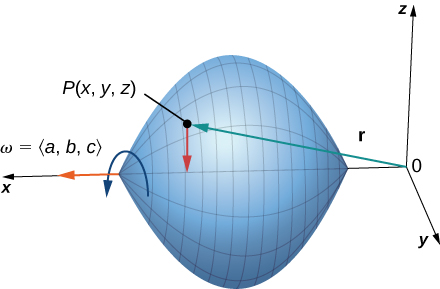
Express F in terms of i, j, and k vectors.
Answer
6-263 §6.5 source ↗
For the following exercises, consider a rigid body that is rotating about the x-axis counterclockwise with constant angular velocity If P is a point in the body located at the velocity at P is given by vector field
Find
Answer
6-265 §6.5 source ↗
In the following exercises, suppose that and
Does necessarily have zero divergence?
Answer
6-267 §6.5 source ↗
In the following exercises, suppose a solid object in has a temperature distribution given by . The heat flow vector field in the object is where is a property of the material. The heat flow vector points in the direction opposite to that of the gradient, which is the direction of greatest temperature decrease. The divergence of the heat flow vector is
Compute the divergence.
Answer
Checkpoint 6.47 §6.6 source ↗
Answer
Checkpoint 6.48 §6.6 source ↗
Answer
Checkpoint 6.49 §6.6 source ↗
Answer
Checkpoint 6.50 §6.6 source ↗
Answer
Checkpoint 6.51 §6.6 source ↗
Answer
Checkpoint 6.52 §6.6 source ↗
Answer
Checkpoint 6.53 §6.6 source ↗
Answer
Checkpoint 6.54 §6.6 source ↗
Answer
Checkpoint 6.55 §6.6 source ↗
Answer
Checkpoint 6.56 §6.6 source ↗
Answer
Checkpoint 6.57 §6.6 source ↗
Answer
Checkpoint 6.58 §6.6 source ↗
Answer
Checkpoint 6.59 §6.6 source ↗
Answer
Checkpoint 6.60 §6.6 source ↗
Answer
6-269 §6.6 source ↗
For the following exercises, determine whether the statements are true or false.
If surface S is given by then
Answer
6-271 §6.6 source ↗
For the following exercises, determine whether the statements are true or false.
Surface is the same as surface for
Answer
6-273 §6.6 source ↗
For the following exercises, find parametric descriptions for the following surfaces.
Plane
Answer
6-275 §6.6 source ↗
For the following exercises, find parametric descriptions for the following surfaces.
Plane
Answer
6-277 §6.6 source ↗
For the following exercises, find parametric descriptions for the following surfaces.
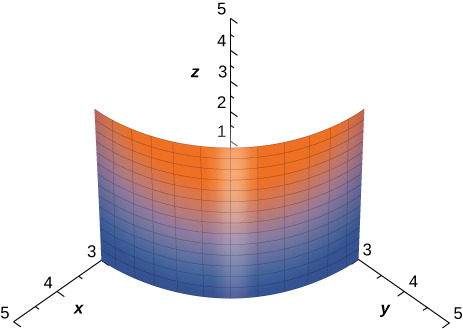
The portion of cylinder in the first octant, for
Answer
6-279 §6.6 source ↗
For the following exercises, use a computer algebra system to approximate the area of the following surfaces using a parametric description of the surface.
[T] Half cylinder
Answer
6-281 §6.6 source ↗
For the following exercises, let S be the hemisphere with and evaluate each surface integral.
Answer
6-283 §6.6 source ↗
For the following exercises, let S be the hemisphere with and evaluate each surface integral.
Answer
6-285 §6.6 source ↗
For the following exercises, evaluate for vector field F, where N is an upward pointing normal vector to surface S.
and S is hemisphere
Answer
6-287 §6.6 source ↗
For the following exercises, approximate the mass of the lamina that has the shape of given surface S. Round to four decimal places.
[T] S is surface
Answer
6-289 §6.6 source ↗
For the following exercises, approximate the mass of the lamina that has the shape of given surface S. Round to four decimal places.
[T] S is surface
Answer
6-291 §6.6 source ↗
For the following exercises, approximate the mass of the lamina that has the shape of given surface S. Round to four decimal places.
Evaluate surface integral where and S is the portion of plane that lies over unit square R:
Answer
6-293 §6.6 source ↗
For the following exercises, approximate the mass of the lamina that has the shape of given surface S. Round to four decimal places.
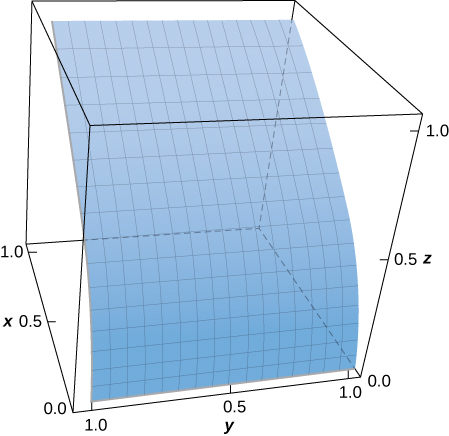
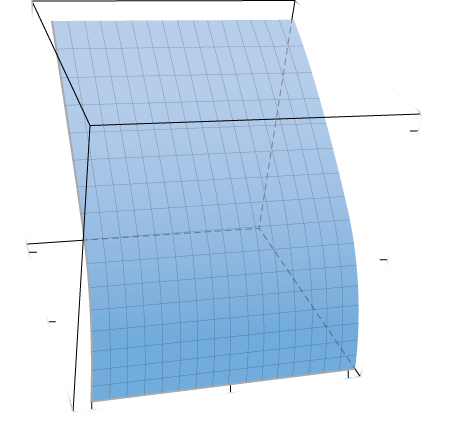
[T] Evaluate where S is the surface defined by
Answer
6-295 §6.6 source ↗
For the following exercises, approximate the mass of the lamina that has the shape of given surface S. Round to four decimal places.
Evaluate where S is the surface of hemisphere and above the plane
Answer
6-297 §6.6 source ↗
For the following exercises, approximate the mass of the lamina that has the shape of given surface S. Round to four decimal places.
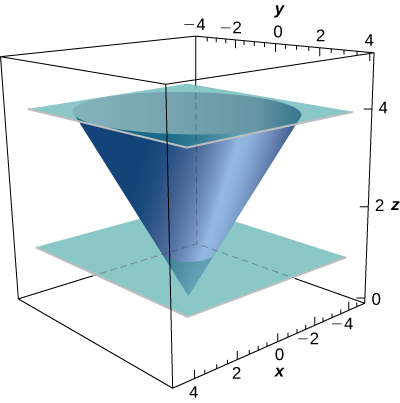
[T] Evaluate where S is the portion of cone that lies between planes and
Answer
6-299 §6.6 source ↗
For the following exercises, approximate the mass of the lamina that has the shape of given surface S. Round to four decimal places.
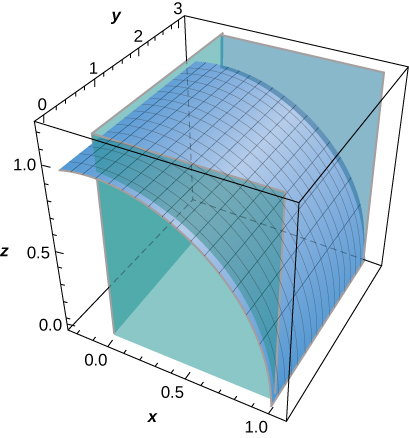
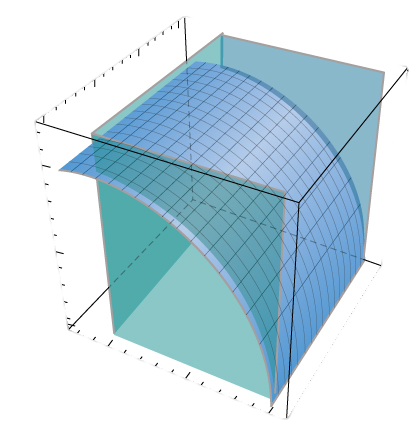
[T] Evaluate where S is the part of the graph of in the first octant between the xz-plane and plane
Answer
6-301 §6.6 source ↗
For the following exercises, approximate the mass of the lamina that has the shape of given surface S. Round to four decimal places.
Find the mass of a lamina of density in the shape of hemisphere
Answer
6-303 §6.6 source ↗
For the following exercises, approximate the mass of the lamina that has the shape of given surface S. Round to four decimal places.
Compute where and N is an upward pointing normal vector , where S is the triangular region of the plane in the first octant.
Answer
6-305 §6.6 source ↗
For the following exercises, approximate the mass of the lamina that has the shape of given surface S. Round to four decimal places.
Compute where and N is an outward normal vector S, where S is the surface of the five faces of the unit cube missing
Answer
6-307 §6.6 source ↗
For the following exercises, express the surface integral as an iterated double integral by using a projection on S on the yz-plane.
S is the portion of the graph of bounded by the coordinate planes and plane
Answer
6-309 §6.6 source ↗
For the following exercises, express the surface integral as an iterated double integral by using a projection on S on the xz-plane
S is the portion of the graph of bounded by the coordinate planes and plane
Answer
6-311 §6.6 source ↗
For the following exercises, express the surface integral as an iterated double integral by using a projection on S on the xz-plane
Evaluate surface integral where S is hemisphere
Answer
6-313 §6.6 source ↗
For the following exercises, express the surface integral as an iterated double integral by using a projection on S on the xz-plane
Evaluate surface integral where S is the part of plane that lies above rectangle
Answer
6-315 §6.6 source ↗
For the following exercises, express the surface integral as an iterated double integral by using a projection on S on the xz-plane
Evaluate surface integral where S is the part of plane that lies inside cylinder
Answer
6-317 §6.6 source ↗
For the following exercises, use geometric reasoning to evaluate the given surface integrals.
where S is surface oriented with unit normal vectors pointing outward
Answer
6-319 §6.6 source ↗
For the following exercises, use geometric reasoning to evaluate the given surface integrals.
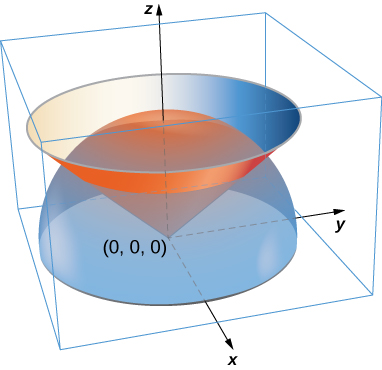
A lamina has the shape of a portion of sphere that lies within cone Let S be the spherical shell centered at the origin with radius a, and let C be the right circular cone with a vertex at the origin and an axis of symmetry that coincides with the z-axis. Determine the mass of the lamina if
Answer
6-321 §6.6 source ↗
For the following exercises, use geometric reasoning to evaluate the given surface integrals.
A paper cup has the shape of an inverted right circular cone of height 6 in. and radius of top 3 in. If the cup is full of water weighing find the total force exerted by the water on the inside surface of the cup.
Answer
6-323 §6.6 source ↗
For the following exercises, the heat flow vector field for conducting objects is is the temperature in the object and is a constant that depends on the material. Find the outward flux of F across the following surfaces S for the given temperature distributions and assume
S is sphere
Answer
6-325 §6.6 source ↗
For the following exercises, consider the radial fields where p is a real number. Let S consist of spheres A and B centered at the origin with radii The total outward flux across S consists of the outward flux across the outer sphere B less the flux into S across inner sphere A.
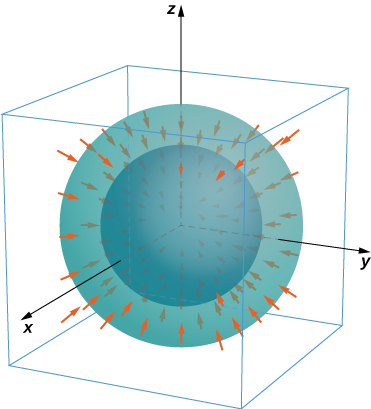
Show that for the flux across S is independent of a and b.
Answer
Checkpoint 6.61 §6.7 source ↗
Answer
Checkpoint 6.62 §6.7 source ↗
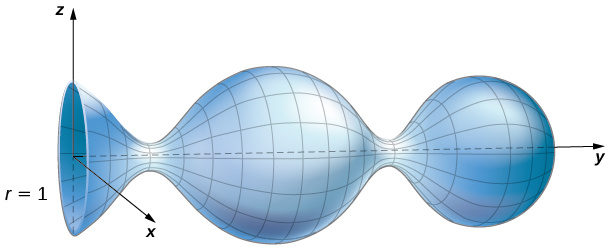
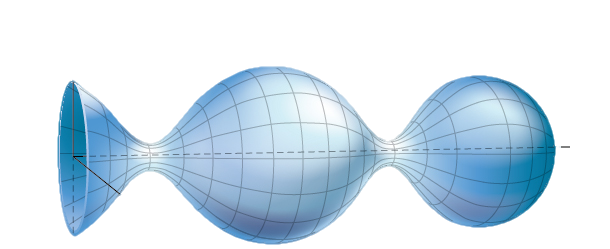
Use Stokes’ theorem to calculate surface integral where and S is the surface as shown in the following figure. The boundary curve, C, is oriented clockwise when looking along the positive y-axis.
Answer
Checkpoint 6.63 §6.7 source ↗
Answer
Checkpoint 6.64 §6.7 source ↗
Answer
6-327 §6.7 source ↗
For the following exercises, without using Stokes’ theorem, calculate directly both the flux of over the given surface and the circulation integral around its boundary, assuming all boundaries have positive orientation.
S is hemisphere
Answer
6-329 §6.7 source ↗
For the following exercises, without using Stokes’ theorem, calculate directly both the flux of over the given surface and the circulation integral around its boundary, assuming all boundaries have positive orientation.
S is upper hemisphere
Answer
6-331 §6.7 source ↗
For the following exercises, without using Stokes’ theorem, calculate directly both the flux of over the given surface and the circulation integral around its boundary, assuming all boundaries have positive orientation.
S is a portion of paraboloid and is above the xy-plane.
Answer
6-333 §6.7 source ↗
For the following exercises, use Stokes’ theorem to evaluate for the vector fields and surface.
and S is the part of paraboloid below plane and using the outward normal vector.
Answer
6-335 §6.7 source ↗
For the following exercises, use Stokes’ theorem to evaluate for the vector fields and surface.
Use Stokes’ theorem to evaluate where C is the curve given by traversed in the direction of increasing t.
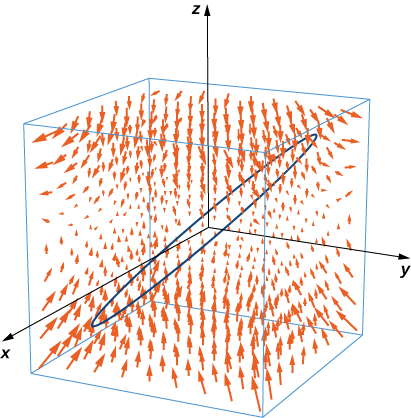
Answer
6-337 §6.7 source ↗
For the following exercises, use Stokes’ theorem to evaluate for the vector fields and surface.
[T] Use a CAS and Stokes’ theorem to approximate line integral where C is the intersection of the xy-plane and hemisphere traversed counterclockwise viewed from the top—that is, from the positive z-axis toward the xy-plane.
Answer
6-339 §6.7 source ↗
For the following exercises, use Stokes’ theorem to evaluate for the vector fields and surface.
Use Stokes’ theorem to evaluate where and S is half of sphere oriented out toward the positive x-axis.
Answer
6-341 §6.7 source ↗
For the following exercises, use Stokes’ theorem to evaluate for the vector fields and surface.
[T] Use a CAS and Stokes’ theorem to evaluate where and S consists of the top and the four sides but not the bottom of the cube with vertices oriented outward.
Answer
6-343 §6.7 source ↗
For the following exercises, use Stokes’ theorem to evaluate for the vector fields and surface.
Use Stokes’ theorem to evaluate where and S is a triangle with vertices (1, 0, 0), (0, 1, 0) and (0, 0, 1) with upward orientation.
Answer
6-345 §6.7 source ↗
For the following exercises, use Stokes’ theorem to evaluate for the vector fields and surface.
Use Stokes’ theorem to evaluate where C is the curve of intersection of plane and ellipsoid oriented clockwise from the origin.
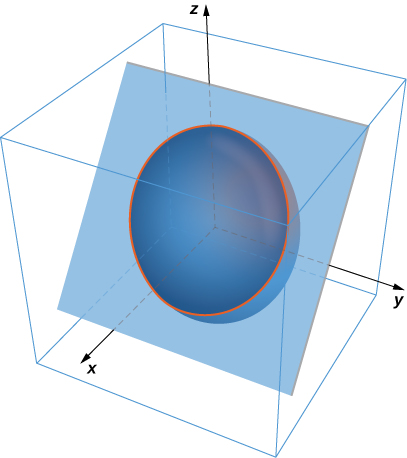
Answer
6-347 §6.7 source ↗
For the following exercises, use Stokes’ theorem to evaluate for the vector fields and surface.
Use Stokes’ theorem to evaluate for vector field where S is surface C is boundary circle and S is oriented in the positive z-direction.
Answer
6-349 §6.7 source ↗
For the following exercises, use Stokes’ theorem to evaluate for the vector fields and surface.
A certain closed path C in plane is known to project onto unit circle in the xy-plane. Let c be a constant and let Use Stokes’ theorem to evaluate
Answer
6-351 §6.7 source ↗
For the following exercises, use Stokes’ theorem to evaluate for the vector fields and surface.
Let S be hemisphere with oriented upward. Let be a vector field. Use Stokes’ theorem to evaluate
Answer
6-353 §6.7 source ↗
For the following exercises, use Stokes’ theorem to evaluate for the vector fields and surface.
Use Stokes’ theorem to evaluate where and C is a triangle with vertices (0, 0, 0), (2, 0, 0) and oriented counterclockwise when viewed from above.
Answer
6-355 §6.7 source ↗
For the following exercises, use Stokes’ theorem to evaluate for the vector fields and surface.
Use Stokes’ theorem to compute where and S is a part of plane inside cylinder and oriented upward.
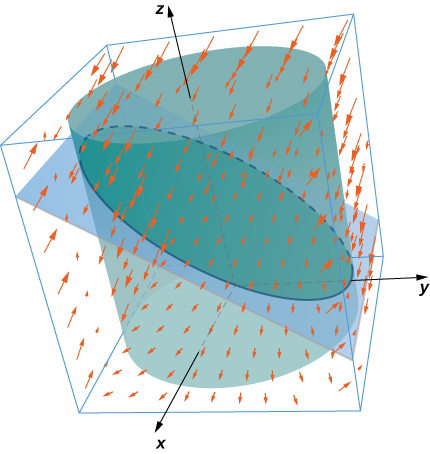
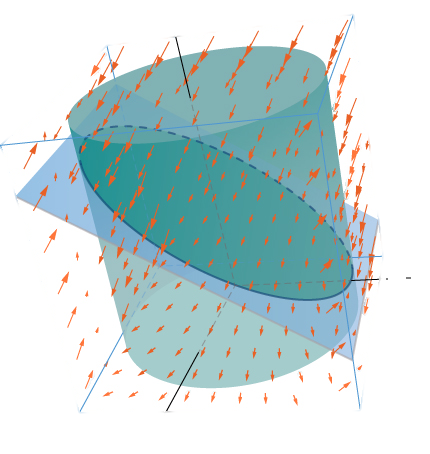
Answer
6-357 §6.7 source ↗
For the following exercises, use Stokes’ theorem to evaluate for the vector fields and surface.
Let and let C be the intersection of plane and cylinder which is oriented counterclockwise when viewed from the top. Compute the line integral of F over C using Stokes’ theorem.
Answer
6-359 §6.7 source ↗
For the following exercises, use Stokes’ theorem to evaluate for the vector fields and surface.
Let S be ellipsoid oriented outward and let F be a vector field with component functions that have continuous partial derivatives. Compute
Answer
6-361 §6.7 source ↗
For the following exercises, use Stokes’ theorem to evaluate for the vector fields and surface.
[T] Use a CAS and Stokes’ theorem to evaluate if where C is the curve given by
Answer
6-363 §6.7 source ↗
For the following exercises, use Stokes’ theorem to evaluate for the vector fields and surface.
[T] Use a CAS to evaluate where and S is the surface parametrically by
Answer
6-365 §6.7 source ↗
For the following application exercises, the goal is to evaluate where and S is the upper half of ellipsoid
Evaluate a surface integral over a more convenient surface to find the value of A.
Answer
6-367 §6.7 source ↗
For the following application exercises, the goal is to evaluate where and S is the upper half of ellipsoid
Take paraboloid for and slice it with plane Let S be the surface that remains for including the planar surface in the xz-plane. Let C be the semicircle and line segment that bounded the cap of S in plane with counterclockwise orientation. Let Evaluate
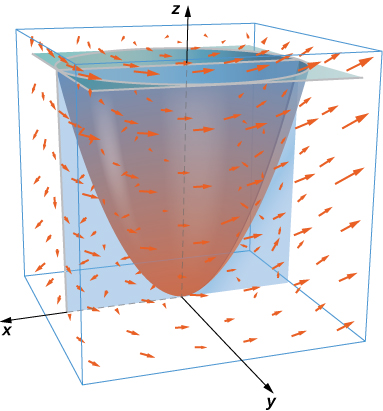
Answer
6-369 §6.7 source ↗
For the following exercises, let S be the disk enclosed by curve
for where is a fixed angle.
What is the circulation of C of vector field as a function of
Answer
6-371 §6.7 source ↗
For the following exercises, let S be the disk enclosed by curve
for where is a fixed angle.
Circle C in plane has radius 4 and center (2, 3, 3). Evaluate for where C has a counterclockwise orientation when viewed from above.
Answer
6-373 §6.7 source ↗
For the following exercises, let S be the disk enclosed by curve
for where is a fixed angle.
Evaluate integral where and S is the cap of paraboloid above plane and n points in the positive z-direction on S.
Answer
6-375 §6.7 source ↗
For the following exercises, use Stokes’ theorem to find the circulation of the following vector fields around any smooth, simple closed curve C.
Answer
Checkpoint 6.65 §6.8 source ↗
Answer
Checkpoint 6.66 §6.8 source ↗
Use the divergence theorem to calculate flux integral where S is the boundary of the box given by and (see the following figure).
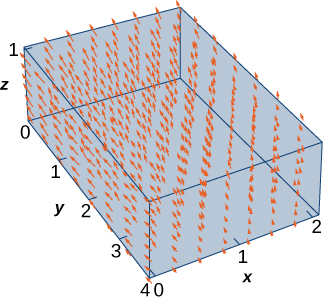
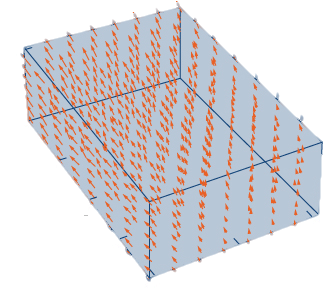
Answer
Checkpoint 6.67 §6.8 source ↗
Let be the velocity field of a fluid. Let C be the solid cube given by and let S be the boundary of this cube (see the following figure). Find the flow rate of the fluid across S.
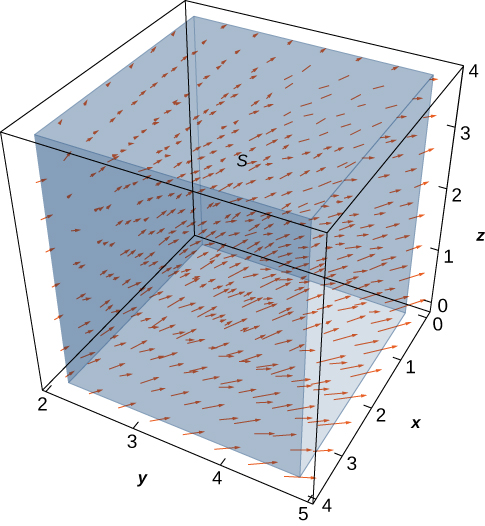
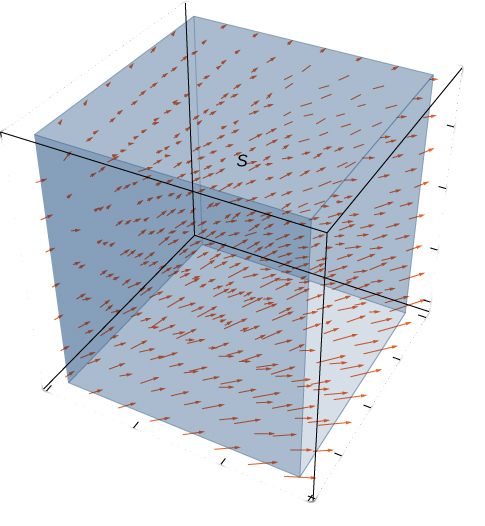
Answer
Checkpoint 6.68 §6.8 source ↗
Answer
6-377 §6.8 source ↗
For the following exercises, use a computer algebraic system (CAS) and the divergence theorem to evaluate surface integral for the given choice of F and the boundary surface S. For each closed surface, assume N is the outward unit normal vector.
[T] S is the surface of hemisphere together with disk in the xy-plane.
Answer
6-379 §6.8 source ↗
For the following exercises, use a computer algebraic system (CAS) and the divergence theorem to evaluate surface integral for the given choice of F and the boundary surface S. For each closed surface, assume N is the outward unit normal vector.
[T] S is the surface of the solid bounded by the parabola and the plane .
Answer
6-381 §6.8 source ↗
For the following exercises, use a computer algebraic system (CAS) and the divergence theorem to evaluate surface integral for the given choice of F and the boundary surface S. For each closed surface, assume N is the outward unit normal vector.
[T] S is the surface of the solid bounded by cylinder and planes
Answer
6-383 §6.8 source ↗
For the following exercises, use a computer algebraic system (CAS) and the divergence theorem to evaluate surface integral for the given choice of F and the boundary surface S. For each closed surface, assume N is the outward unit normal vector.
[T] S is the surface of the solid bounded by cylinder and planes
Answer
6-385 §6.8 source ↗
For the following exercises, use a computer algebraic system (CAS) and the divergence theorem to evaluate surface integral for the given choice of F and the boundary surface S. For each closed surface, assume N is the outward unit normal vector.
Use the divergence theorem to calculate surface integral where and S is the surface of the solid bounded by the sphere and below by the plane .
Answer
6-387 §6.8 source ↗
For the following exercises, use a computer algebraic system (CAS) and the divergence theorem to evaluate surface integral for the given choice of F and the boundary surface S. For each closed surface, assume N is the outward unit normal vector.
Use the divergence theorem to calculate surface integral when and S is the surface of the box with vertices
Answer
6-389 §6.8 source ↗
For the following exercises, use a computer algebraic system (CAS) and the divergence theorem to evaluate surface integral for the given choice of F and the boundary surface S. For each closed surface, assume N is the outward unit normal vector.
[T] Use a CAS and the divergence theorem to calculate flux where and S is a sphere with center (0, 0, 0) and radius 2.
Answer
6-391 §6.8 source ↗
For the following exercises, use a computer algebraic system (CAS) and the divergence theorem to evaluate surface integral for the given choice of F and the boundary surface S. For each closed surface, assume N is the outward unit normal vector.
Use the divergence theorem to compute flux integral where and S consists of the union of paraboloid and disk oriented outward. What is the flux through just the paraboloid?
Answer
6-393 §6.8 source ↗
For the following exercises, use a computer algebraic system (CAS) and the divergence theorem to evaluate surface integral for the given choice of F and the boundary surface S. For each closed surface, assume N is the outward unit normal vector.
Use the divergence theorem to calculate surface integral for where S is the surface inside the cylinder between the planes
Answer
6-395 §6.8 source ↗
For the following exercises, use a CAS along with the divergence theorem to compute the net outward flux for the fields across the given surfaces S.
[T] S is sphere
Answer
6-397 §6.8 source ↗
For the following exercises, use a CAS along with the divergence theorem to compute the net outward flux for the fields across the given surfaces S.
[T] S is sphere
Answer
6-399 §6.8 source ↗
For the following exercises, use a CAS and the divergence theorem to compute the net outward flux for the vector fields across the boundary of the given regions D.
[T] D is the region between spheres of radius 2 and 4 centered at the origin.
Answer
6-401 §6.8 source ↗
For the following exercises, use a CAS and the divergence theorem to compute the net outward flux for the vector fields across the boundary of the given regions D.
[T] D is the region in the first octant between planes and
Answer
6-403 §6.8 source ↗
For the following exercises, use a CAS and the divergence theorem to compute the net outward flux for the vector fields across the boundary of the given regions D.
Use the divergence theorem to find the outward flux of field through the cube bounded by planes
Answer
6-405 §6.8 source ↗
For the following exercises, use a CAS and the divergence theorem to compute the net outward flux for the vector fields across the boundary of the given regions D.
Evaluate where and S is the surface consisting of all faces of the tetrahedron bounded by plane and the coordinate planes, with outward unit normal vector N.
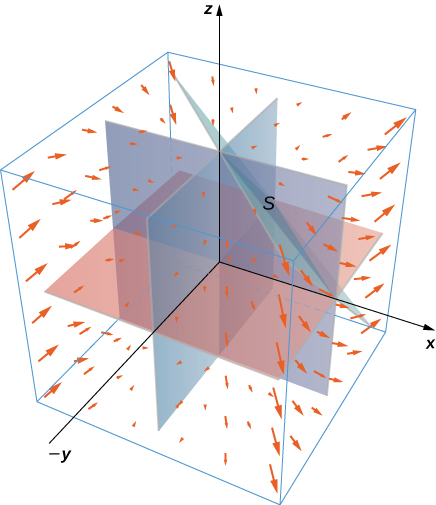
Answer
6-407 §6.8 source ↗
For the following exercises, use a CAS and the divergence theorem to compute the net outward flux for the vector fields across the boundary of the given regions D.
Use the divergence theorem to evaluate where and S is sphere with constant
Answer
6-409 §6.8 source ↗
For the following exercises, use a CAS and the divergence theorem to compute the net outward flux for the vector fields across the boundary of the given regions D.
Let R be the region defined by Use the divergence theorem to find
Answer
6-411 §6.8 source ↗
For the following exercises, use a CAS and the divergence theorem to compute the net outward flux for the vector fields across the boundary of the given regions D.
Let E be the solid unit cube with diagonally opposite corners at the origin and (1, 1, 1), and faces parallel to the coordinate planes. Let S be the surface of E, oriented with the outward-pointing normal. Use a CAS to find using the divergence theorem if
Answer
6-413 §6.8 source ↗
For the following exercises, use a CAS and the divergence theorem to compute the net outward flux for the vector fields across the boundary of the given regions D.
Find where and S is the outwardly oriented surface obtained by removing cube from cube
Answer
6-415 §6.8 source ↗
For the following exercises, use a CAS and the divergence theorem to compute the net outward flux for the vector fields across the boundary of the given regions D.
Compute the flux of water through parabolic cylinder from if the velocity vector is
Answer
6-417 §6.8 source ↗
For the following exercises, use a CAS and the divergence theorem to compute the net outward flux for the vector fields across the boundary of the given regions D.
[T] Use a CAS to find the flux of vector field through surface S, where S is given by from oriented so the unit normal vector points downward.
Answer
6-419 §6.8 source ↗
For the following exercises, use a CAS and the divergence theorem to compute the net outward flux for the vector fields across the boundary of the given regions D.
Evaluate where and S is the boundary of the solid cylinder and
Answer
6-421 §6.8 source ↗
For the following exercises, use a CAS and the divergence theorem to compute the net outward flux for the vector fields across the boundary of the given regions D.
Use the divergence theorem to evaluate where and S is the surface consisting of three pieces: on the top; on the sides; and on the bottom.
Answer
6-423 §6.8 source ↗
For the following exercises, use a CAS and the divergence theorem to compute the net outward flux for the vector fields across the boundary of the given regions D.
Use the divergence theorem to evaluate where and S is the boundary of the solid enclosed by paraboloid cylinder and plane and S is oriented outward.
Answer
6-425 §6.8 source ↗
For the following exercises, Fourier’s law of heat transfer states that the heat flow vector F at a point is proportional to the negative gradient of the temperature; that is, which means that heat energy flows hot regions to cold regions. The constant is called the conductivity, which has metric units of joules per meter per second-kelvin or watts per meter-kelvin. A temperature function for region D is given. Use the divergence theorem to find net outward heat flux across the boundary S of D, where
Answer
6-427 §6.R source ↗
True or False? Justify your answer with a proof or a counterexample.
Vector field is conservative.
Answer
6-429 §6.R source ↗
True or False? Justify your answer with a proof or a counterexample.
The divergence of a vector field is a vector field.
Answer
6-431 §6.R source ↗
Draw the following vector fields.
Answer
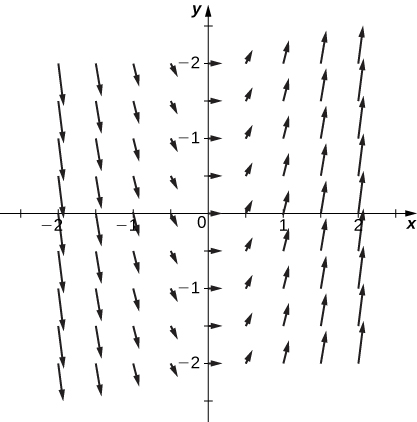
6-433 §6.R source ↗
Are the following the vector fields conservative? If so, find the potential function such that
Answer
6-435 §6.R source ↗
Are the following the vector fields conservative? If so, find the potential function such that
Answer
6-437 §6.R source ↗
Evaluate the following integrals.
along from (0, 0) to (4, 2)
Answer
6-439 §6.R source ↗
Evaluate the following integrals.
where S is surface
Answer
6-441 §6.R source ↗
Find the divergence and curl for the following vector fields.
Answer
6-443 §6.R source ↗
Use Green’s theorem to evaluate the following integrals.
where C is a circle centered at the origin with radius 3
Answer
6-445 §6.R source ↗
Use Stokes’ theorem to evaluate
where is the upward-facing paraboloid lying in cylinder
Answer
6-447 §6.R source ↗
Use the divergence theorem to evaluate
where is bounded by paraboloid and plane
Answer
6-449 §6.R source ↗
Use the divergence theorem to evaluate
Find the total mass of a thin wire in the shape of an upper semicircle with radius and a density function of
Answer
6-451 §6.R source ↗
Use the divergence theorem to evaluate
Use the divergence theorem to compute the value of the flux integral over the unit sphere with
Answer
Loading chapter 7…
Problems and answers are adapted from Calculus Volume 3 by Gilbert Strang and Edwin “Jed” Herman, OpenStax, and are used under the CC BY-NC-SA 4.0 licence. Access for free at https://openstax.org/books/calculus-volume-3/pages/1-introduction. Illustrations: Copyright Rice University, OpenStax, under CC BY-NC-SA 4.0 license. This adaptation is released under the same licence, is non-commercial, and is neither affiliated with nor endorsed by OpenStax or Rice University.