Every problem in the chapter beside the book’s answer, a chapter at a time as you scroll.
Chapter 5: Multiple Integration
246 problems · 86 figuresCheckpoint 5.1 §5.1 source ↗
Use the same function over the rectangular region
Divide R into the same four squares with and choose the sample points as the upper left corner point of each square and (Figure 5.6) to approximate the signed volume of the solid S that lies above and “under” the graph of
Answer
Checkpoint 5.2 §5.1 source ↗
a. Use the properties of the double integral and Fubini’s theorem to evaluate the integral
b. Show that where
Answer
Checkpoint 5.3 §5.1 source ↗
Answer
Checkpoint 5.4 §5.1 source ↗
Answer
Checkpoint 5.5 §5.1 source ↗
Answer
Checkpoint 5.6 §5.1 source ↗
A contour map is shown for a function on the rectangle
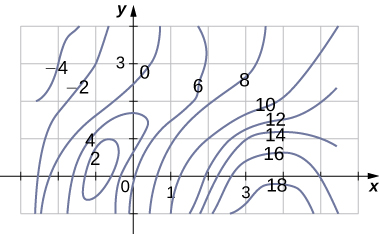
a. Use the midpoint rule with and to estimate the value of
b. Estimate the average value of the function
Answer
5-1 §5.1 source ↗
In the following exercises, use the midpoint rule with and to estimate the volume of the solid bounded by the surface the vertical planes and and the horizontal plane
Answer
5-3 §5.1 source ↗
In the following exercises, estimate by using a Riemann sum with and the sample points to be the lower left corners of the subrectangles of the partition.
Answer
5-5 §5.1 source ↗
In the following exercises, estimate by using a Riemann sum with and the sample points to be the lower left corners of the subrectangles of the partition.
Use the midpoint rule with to estimate where the values of the function f on are given in the following table.
| y | |||||
| x | 9 | 9.5 | 10 | 10.5 | 11 |
| 8 | 9.8 | 5 | 6.7 | 5 | 5.6 |
| 8.5 | 9.4 | 4.5 | 8 | 5.4 | 3.4 |
| 9 | 8.7 | 4.6 | 6 | 5.5 | 3.4 |
| 9.5 | 6.7 | 6 | 4.5 | 5.4 | 6.7 |
| 10 | 6.8 | 6.4 | 5.5 | 5.7 | 6.8 |
Answer
5-7 §5.1 source ↗
In the following exercises, estimate by using a Riemann sum with and the sample points to be the lower left corners of the subrectangles of the partition.
The depth of a children’s 4-ft by 4-ft swimming pool, measured at 1-ft intervals, is given in the following table.
a. Estimate the volume of water in the swimming pool by using a Riemann sum with Select the sample points using the midpoint rule on
b. Approximate the average depth of the swimming pool.
| y | |||||
| x | 0 | 1 | 2 | 3 | 4 |
| 0 | 1 | 1.5 | 2 | 2.5 | 3 |
| 1 | 1 | 1.5 | 2 | 2.5 | 3 |
| 2 | 1 | 1.5 | 1.5 | 2.5 | 3 |
| 3 | 1 | 1 | 1.5 | 2 | 2.5 |
| 4 | 1 | 1 | 1 | 1.5 | 2 |
Answer
5-9 §5.1 source ↗
In the following exercises, estimate by using a Riemann sum with and the sample points to be the lower left corners of the subrectangles of the partition.
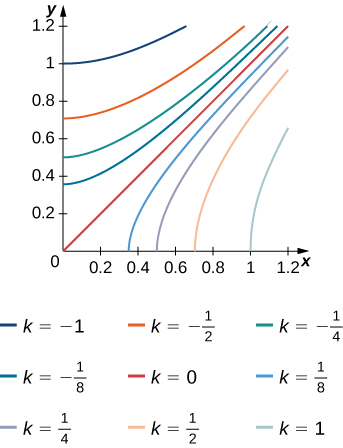
The level curves of the function f are given in the following graph, where k is a constant.
a. Apply the midpoint rule with to estimate the double integral where
b. Estimate the average value of the function f on R.
Answer
5-11 §5.1 source ↗
In the following exercises, estimate by using a Riemann sum with and the sample points to be the lower left corners of the subrectangles of the partition.
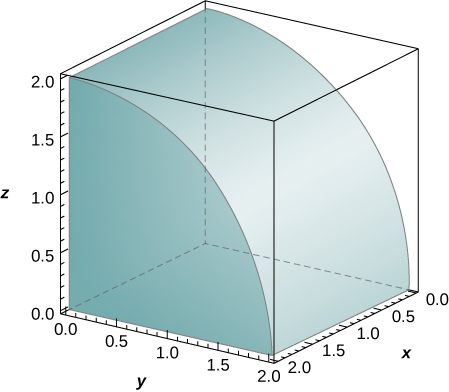
The solid lying under the surface and above the rectangular region is illustrated in the following graph. Evaluate the double integral where by finding the volume of the corresponding solid.
Answer
5-13 §5.1 source ↗
In the following exercises, calculate the integrals by interchanging the order of integration.
Answer
5-15 §5.1 source ↗
In the following exercises, calculate the integrals by interchanging the order of integration.
Answer
5-17 §5.1 source ↗
In the following exercises, calculate the integrals by interchanging the order of integration.
Answer
5-19 §5.1 source ↗
In the following exercises, calculate the integrals by interchanging the order of integration.
Answer
5-21 §5.1 source ↗
In the following exercises, evaluate the iterated integrals by choosing the order of integration.
Answer
5-23 §5.1 source ↗
In the following exercises, evaluate the iterated integrals by choosing the order of integration.
Answer
5-25 §5.1 source ↗
In the following exercises, evaluate the iterated integrals by choosing the order of integration.
Answer
5-27 §5.1 source ↗
In the following exercises, evaluate the iterated integrals by choosing the order of integration.
Answer
5-29 §5.1 source ↗
In the following exercises, evaluate the iterated integrals by choosing the order of integration.
Answer
5-31 §5.1 source ↗
In the following exercises, evaluate the iterated integrals by choosing the order of integration.
Answer
5-33 §5.1 source ↗
In the following exercises, evaluate the iterated integrals by choosing the order of integration.
Answer
5-35 §5.1 source ↗
In the following exercises, find the average value of the function over the given rectangles.
Answer
5-37 §5.1 source ↗
In the following exercises, find the average value of the function over the given rectangles.
Answer
5-49 §5.1 source ↗
In the following exercises, the function f is given in terms of double integrals.
[T] where
Answer
a. b. c.
d.
5-53 §5.1 source ↗
In the following exercises, the function f is given in terms of double integrals.
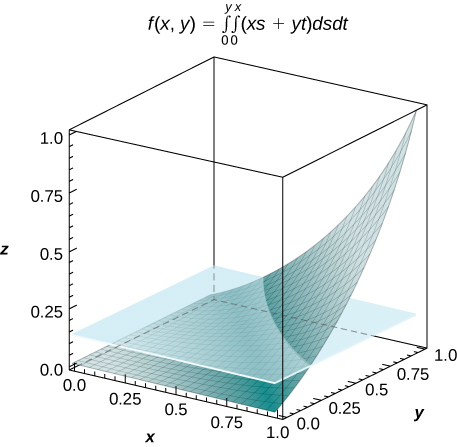
[T] Consider the function where
a. Use the midpoint rule with to estimate the double integral Round your answers to the nearest hundredths.
b. For find the average value of f over the region R. Round your answer to the nearest hundredths.
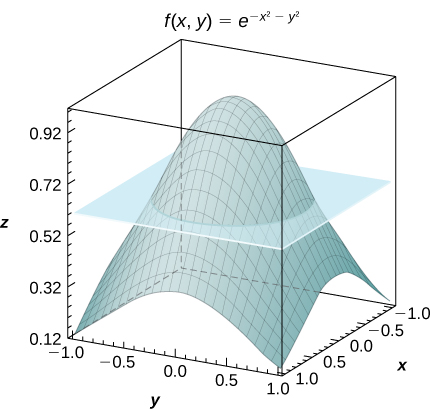
c. Use a CAS to graph in the same coordinate system the solid whose volume is given by and the plane
Answer
a. For b.
c.
5-55 §5.1 source ↗
In the following exercises, the functions are given, where is a natural number.
Answer
5-59 §5.1 source ↗
In the following exercises, the functions are given, where is a natural number.
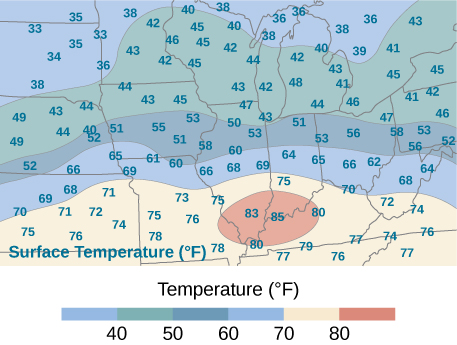
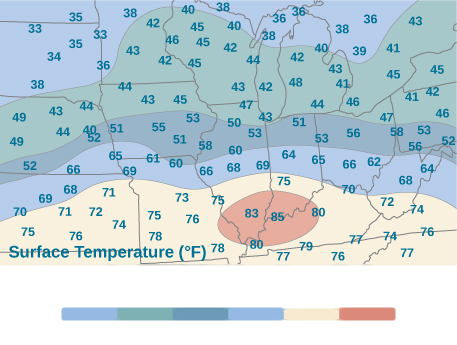
An isotherm map is a chart connecting points having the same temperature at a given time for a given period of time. Use the preceding exercise and apply the midpoint rule with to find the average temperature over the region given in the following figure.
Answer
Checkpoint 5.7 §5.2 source ↗
Answer
Checkpoint 5.8 §5.2 source ↗
Answer
Checkpoint 5.9 §5.2 source ↗
Answer
Checkpoint 5.10 §5.2 source ↗
Answer
Checkpoint 5.11 §5.2 source ↗
Answer
Checkpoint 5.12 §5.2 source ↗
Answer
Checkpoint 5.13 §5.2 source ↗
Answer
Checkpoint 5.14 §5.2 source ↗
Answer
Checkpoint 5.15 §5.2 source ↗
Answer
Checkpoint 5.16 §5.2 source ↗
The joint density function for two random variables and is given by
Find the probability that is at most and is at least
Answer
5-61 §5.2 source ↗
In the following exercises, specify whether the region is of Type I or Type II.
Find the average value of the function on the region graphed in the previous exercise.
Answer
5-63 §5.2 source ↗
In the following exercises, specify whether the region is of Type I or Type II.
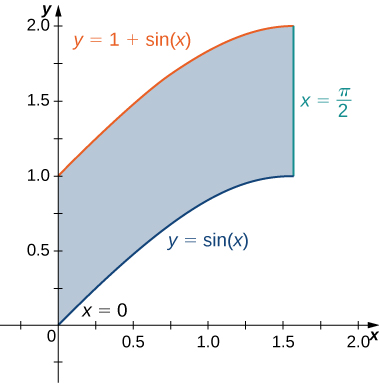
The region bounded by as given in the following figure.
Answer
5-65 §5.2 source ↗
In the following exercises, specify whether the region is of Type I or Type II.
Find the area of the region given in the previous exercise.
Answer
5-67 §5.2 source ↗
In the following exercises, specify whether the region is of Type I or Type II.
Find the volume of the solid under the graph of the function and above the region in the figure in the previous exercise.
Answer
5-69 §5.2 source ↗
In the following exercises, specify whether the region is of Type I or Type II.
Find the signed volume of the solid under the graph of the function and above the region in the figure from the previous exercise.
Answer
5-71 §5.2 source ↗
In the following exercises, specify whether the region is of Type I or Type II.
The region bounded by and as given in the following figure.
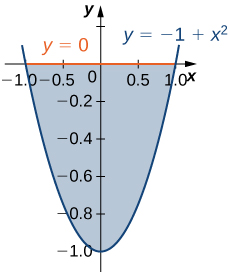
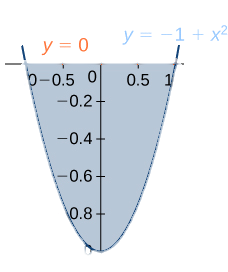
Answer
5-73 §5.2 source ↗
In the following exercises, specify whether the region is of Type I or Type II.
Let be the region bounded above by the curve of the equation and below by and the -axis. Explain why is neither of Type I nor II.
Answer
5-75 §5.2 source ↗
In the following exercises, evaluate the double integral over the region
and
Answer
5-77 §5.2 source ↗
In the following exercises, evaluate the double integral over the region
and
Answer
5-79 §5.2 source ↗
In the following exercises, evaluate the double integral over the region
and is the triangular region with vertices
Answer
5-81 §5.2 source ↗
Evaluate the iterated integrals.
Answer
5-83 §5.2 source ↗
Evaluate the iterated integrals.
Answer
5-85 §5.2 source ↗
Evaluate the iterated integrals.
Answer
5-87 §5.2 source ↗
Evaluate the iterated integrals.
Let be the region bounded by and the -axis.
a. Show that by dividing into two regions of Type I.
b. Evaluate the integral
Answer
5-89 §5.2 source ↗
Evaluate the iterated integrals.
Let be the region bounded by and
a. Show that by dividing the region into two regions of Type II, where
b. Evaluate the integral
Answer
5-91 §5.2 source ↗
Evaluate the iterated integrals.
The region bounded by and is shown in the following figure. Find the area of the region
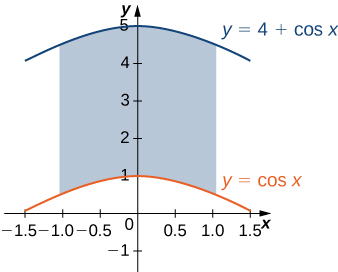
Answer
5-93 §5.2 source ↗
Evaluate the iterated integrals.
Let be the region bounded by and the -axis. Find the area of the region
Answer
5-95 §5.2 source ↗
Evaluate the iterated integrals.
Find the average value of the function on the triangular region with vertices and
Answer
5-97 §5.2 source ↗
In the following exercises, change the order of integration and evaluate the integral.
Answer
5-99 §5.2 source ↗
In the following exercises, change the order of integration and evaluate the integral.
Answer
5-101 §5.2 source ↗
In the following exercises, change the order of integration and evaluate the integral.
The region is given in the following figure. Evaluate the double integral by using the easier order of integration.
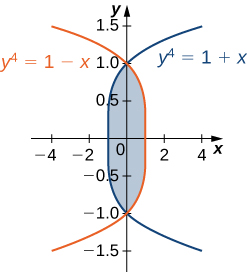
Answer
5-103 §5.2 source ↗
In the following exercises, change the order of integration and evaluate the integral.
Find the volume in the first octant of the solid under the plane and above the region determined by and
Answer
5-105 §5.2 source ↗
In the following exercises, change the order of integration and evaluate the integral.
Find the volume of the solid under the surface and above the plane region bounded by and for values of between
Answer
5-109 §5.2 source ↗
In the following exercises, change the order of integration and evaluate the integral.
Find the volume of the solid situated in the first octant and bounded by the planes
Answer
5-111 §5.2 source ↗
In the following exercises, change the order of integration and evaluate the integral.
Find the volume of the solid bounded by the planes
Answer
5-113 §5.2 source ↗
In the following exercises, change the order of integration and evaluate the integral.
Let be the solids situated in the first octant under the planes and respectively, and let be the solid situated between
a. Find the volume of the solid
b. Find the volume of the solid
c. Find the volume of the solid by subtracting the volumes of the solids
Answer
5-115 §5.2 source ↗
In the following exercises, change the order of integration and evaluate the integral.
Consider the plane and the cylinder in the first octant.
a. Find the volume under the plane.
b. Find the volume inside the cylinder under the plane .
c. Find the volume above the plane, inside the cylinder, and below the plane .
Answer
5-117 §5.2 source ↗
In the following exercises, change the order of integration and evaluate the integral.
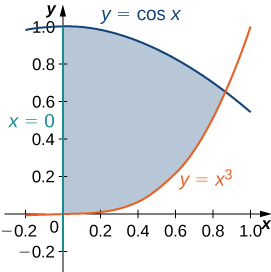
[T] The region bounded by the curves is shown in the following figure. Use a graphing calculator or CAS to find the x-coordinates of the intersection points of the curves and to determine the area of the region Round your answers to six decimal places.
Answer
5-119 §5.2 source ↗
In the following exercises, change the order of integration and evaluate the integral.
Consider two random variables of probability densities and respectively. The random variables are said to be independent if their joint density function is given by At a drive-thru restaurant, customers spend, on average, minutes placing their orders and an additional minutes paying for and picking up their meals. Assume that placing the order and paying for/picking up the meal are two independent events and If the waiting times are modeled by the exponential probability densities
respectively, the probability that a customer will spend less than 6 minutes in the drive-thru line is given by where Find and interpret the result.
Answer
Checkpoint 5.17 §5.3 source ↗
Answer
Checkpoint 5.18 §5.3 source ↗
Answer
Checkpoint 5.19 §5.3 source ↗
Evaluate the integral
Answer
Checkpoint 5.20 §5.3 source ↗
Answer
Checkpoint 5.21 §5.3 source ↗
Answer
Checkpoint 5.22 §5.3 source ↗
Answer
5-123 §5.3 source ↗
In the following exercises, express the region in polar coordinates.
is the region between the circles of radius and radius centered at the origin that lies in the second quadrant.
Answer
5-125 §5.3 source ↗
In the following exercises, express the region in polar coordinates.
is the region bounded by the -axis and
Answer
5-127 §5.3 source ↗
In the following exercises, express the region in polar coordinates.
Answer
5-129 §5.3 source ↗
In the following exercises, the graph of the polar rectangular region is given. Express in polar coordinates.
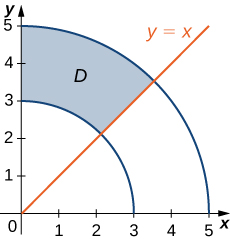
Answer
5-131 §5.3 source ↗
In the following exercises, the graph of the polar rectangular region is given. Express in polar coordinates.
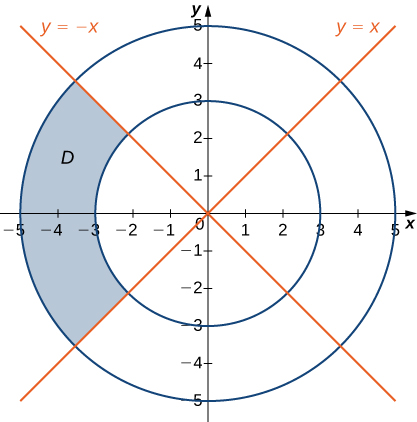
Answer
5-133 §5.3 source ↗
In the following exercises, the graph of the polar rectangular region is given. Express in polar coordinates.
In the following graph, the region is bounded by and
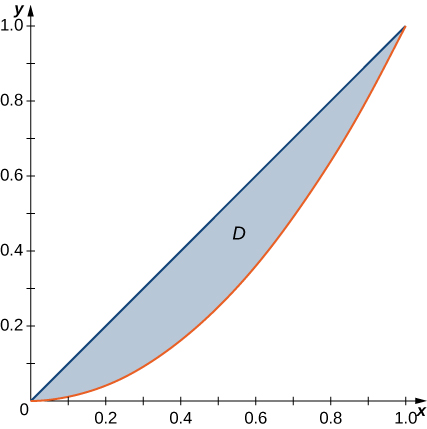
Answer
5-135 §5.3 source ↗
In the following exercises, evaluate the double integral over the polar rectangular region
Answer
5-137 §5.3 source ↗
In the following exercises, evaluate the double integral over the polar rectangular region
Answer
5-139 §5.3 source ↗
In the following exercises, evaluate the double integral over the polar rectangular region
where
Answer
5-141 §5.3 source ↗
In the following exercises, evaluate the double integral over the polar rectangular region
where
Answer
5-143 §5.3 source ↗
In the following exercises, evaluate the double integral over the polar rectangular region
Answer
5-145 §5.3 source ↗
In the following exercises, the integrals have been converted to polar coordinates. Verify that the identities are true and choose the easiest way to evaluate the integrals, in rectangular or polar coordinates.
Answer
5-147 §5.3 source ↗
In the following exercises, the integrals have been converted to polar coordinates. Verify that the identities are true and choose the easiest way to evaluate the integrals, in rectangular or polar coordinates.
Answer
5-149 §5.3 source ↗
In the following exercises, convert the integrals to polar coordinates and evaluate them.
Answer
5-151 §5.3 source ↗
In the following exercises, convert the integrals to polar coordinates and evaluate them.
Answer
5-153 §5.3 source ↗
In the following exercises, convert the integrals to polar coordinates and evaluate them.
Find the area of the region bounded by the polar axis and the upper half of the cardioid
Answer
5-155 §5.3 source ↗
In the following exercises, convert the integrals to polar coordinates and evaluate them.
Find the total area of the region enclosed by the four-leaved rose (see the figure in the previous exercise).
Answer
5-157 §5.3 source ↗
In the following exercises, convert the integrals to polar coordinates and evaluate them.
Find the area of the region which is the region inside the disk and to the right of the line
Answer
5-159 §5.3 source ↗
In the following exercises, convert the integrals to polar coordinates and evaluate them.
Determine the average value of the function over the region bounded by the polar curve where (see the following graph).
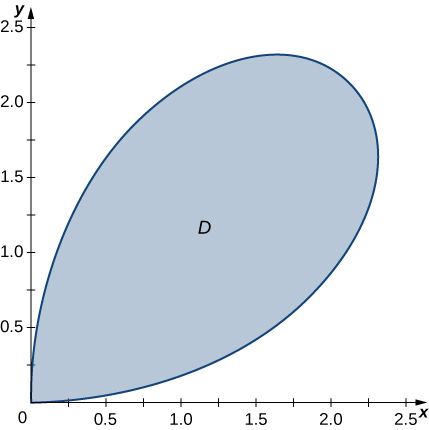
Answer
5-161 §5.3 source ↗
In the following exercises, convert the integrals to polar coordinates and evaluate them.
Find the volume of the solid bounded by the paraboloid and the plane
Answer
5-163 §5.3 source ↗
In the following exercises, convert the integrals to polar coordinates and evaluate them.
a. Find the volume of the solid inside the unit sphere and above the plane
b. Find the volume of the solid inside the double cone and above the plane
c. Find the volume of the solid outside the double cone and inside the sphere
Answer
5-165 §5.3 source ↗
For the following two exercises, consider a spherical ring, which is a sphere with a cylindrical hole cut so that the axis of the cylinder passes through the center of the sphere (see the following figure).

A cylindrical hole of diameter cm is bored through a sphere of radius cm such that the axis of the cylinder passes through the center of the sphere. Find the volume of the resulting spherical ring.
Answer
5-167 §5.3 source ↗
For the following two exercises, consider a spherical ring, which is a sphere with a cylindrical hole cut so that the axis of the cylinder passes through the center of the sphere (see the following figure).
Find the volume of the solid that lies under the paraboloid inside the cylinder and above the plane
Answer
5-169 §5.3 source ↗
For the following two exercises, consider a spherical ring, which is a sphere with a cylindrical hole cut so that the axis of the cylinder passes through the center of the sphere (see the following figure).
Find the volume of the solid that lies under the plane and above the unit disk
Answer
5-171 §5.3 source ↗
For the following two exercises, consider a spherical ring, which is a sphere with a cylindrical hole cut so that the axis of the cylinder passes through the center of the sphere (see the following figure).
Use the information from the preceding exercise to calculate the integral where is the unit disk.
Answer
5-173 §5.3 source ↗
For the following two exercises, consider a spherical ring, which is a sphere with a cylindrical hole cut so that the axis of the cylinder passes through the center of the sphere (see the following figure).
Apply the preceding exercise to calculate the integral where is the annular region between the circles of radii and situated in the third quadrant.
Answer
5-175 §5.3 source ↗
For the following two exercises, consider a spherical ring, which is a sphere with a cylindrical hole cut so that the axis of the cylinder passes through the center of the sphere (see the following figure).
Apply the preceding exercise to calculate the integral where
Answer
5-177 §5.3 source ↗
For the following two exercises, consider a spherical ring, which is a sphere with a cylindrical hole cut so that the axis of the cylinder passes through the center of the sphere (see the following figure).
Evaluate where
Answer
Checkpoint 5.23 §5.4 source ↗
Answer
Checkpoint 5.24 §5.4 source ↗
Answer
Checkpoint 5.25 §5.4 source ↗
Write five different iterated integrals equal to the given integral
Answer
Checkpoint 5.26 §5.4 source ↗
Answer
5-181 §5.4 source ↗
In the following exercises, evaluate the triple integrals over the rectangular solid box
where
Answer
5-183 §5.4 source ↗
In the following exercises, evaluate the triple integrals over the rectangular solid box
where
Answer
5-185 §5.4 source ↗
In the following exercises, change the order of integration by integrating first with respect to then then
Answer
5-187 §5.4 source ↗
In the following exercises, change the order of integration by integrating first with respect to then then
Answer
5-191 §5.4 source ↗
In the following exercises, evaluate the triple integrals over the bounded region
where
Answer
5-193 §5.4 source ↗
In the following exercises, evaluate the triple integrals over the bounded region
where
Answer
5-195 §5.4 source ↗
In the following exercises, evaluate the triple integrals over the indicated bounded region
where
Answer
5-197 §5.4 source ↗
In the following exercises, evaluate the triple integrals over the indicated bounded region
where
Answer
5-199 §5.4 source ↗
In the following exercises, evaluate the triple integrals over the bounded region of the form
where
Answer
5-201 §5.4 source ↗
In the following exercises, evaluate the triple integrals over the bounded region of the form
where
Answer
5-203 §5.4 source ↗
In the following exercises, evaluate the triple integrals over the bounded region
where
Answer
5-205 §5.4 source ↗
In the following exercises, evaluate the triple integrals over the bounded region
where
Answer
5-207 §5.4 source ↗
In the following exercises, evaluate the triple integrals over the bounded region
where is the projection of onto the -plane.
where
Answer
5-209 §5.4 source ↗
In the following exercises, evaluate the triple integrals over the bounded region
where is the projection of onto the -plane.
where
Answer
5-211 §5.4 source ↗
In the following exercises, evaluate the triple integrals over the bounded region
where is the projection of onto the -plane.
The solid bounded by and is shown in the following figure. Evaluate the integral by integrating first with respect to then
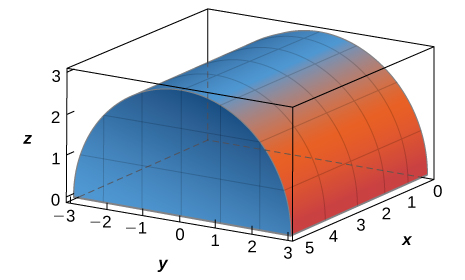
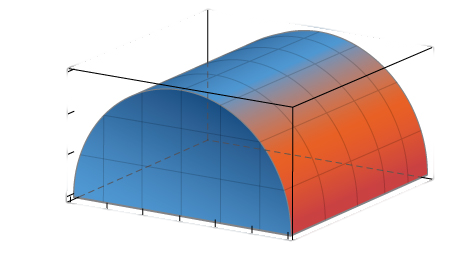
Answer
5-213 §5.4 source ↗
In the following exercises, evaluate the triple integrals over the bounded region
where is the projection of onto the -plane.
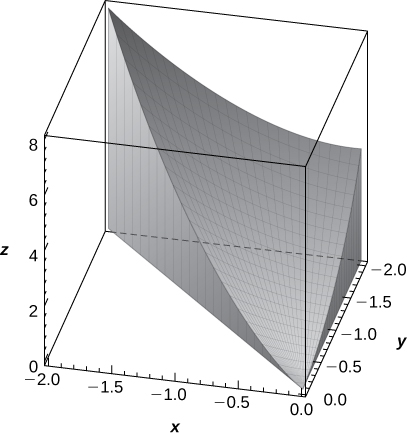
[T] The volume of a solid is given by the integral Use a computer algebra system (CAS) to graph and find its volume. Round your answer to two decimal places.
Answer
5-215 §5.4 source ↗
In the following exercises, use two circular permutations of the variables to write new integrals whose values equal the value of the original integral. A circular permutation of is the arrangement of the numbers in one of the following orders:
Answer
5-217 §5.4 source ↗
In the following exercises, use two circular permutations of the variables to write new integrals whose values equal the value of the original integral. A circular permutation of is the arrangement of the numbers in one of the following orders:
Answer
5-219 §5.4 source ↗
In the following exercises, use two circular permutations of the variables to write new integrals whose values equal the value of the original integral. A circular permutation of is the arrangement of the numbers in one of the following orders:
Set up the integral that gives the volume of the solid bounded by and where and
Answer
5-221 §5.4 source ↗
In the following exercises, use two circular permutations of the variables to write new integrals whose values equal the value of the original integral. A circular permutation of is the arrangement of the numbers in one of the following orders:
Find the average value of the function over the parallelepiped determined by and
Answer
5-223 §5.4 source ↗
In the following exercises, use two circular permutations of the variables to write new integrals whose values equal the value of the original integral. A circular permutation of is the arrangement of the numbers in one of the following orders:
Find the volume of the solid that lies under the plane and whose projection onto the -plane is bounded by and
Answer
5-225 §5.4 source ↗
In the following exercises, use two circular permutations of the variables to write new integrals whose values equal the value of the original integral. A circular permutation of is the arrangement of the numbers in one of the following orders:
Consider the pyramid with the base in the -plane of and the vertex at the point
a. Show that the equations of the planes of the lateral faces of the pyramid are and
b. Find the volume of the pyramid.
Answer
5-227 §5.4 source ↗
In the following exercises, use two circular permutations of the variables to write new integrals whose values equal the value of the original integral. A circular permutation of is the arrangement of the numbers in one of the following orders:
The solid bounded by the sphere of equation with and located in the first octant is represented in the following figure.
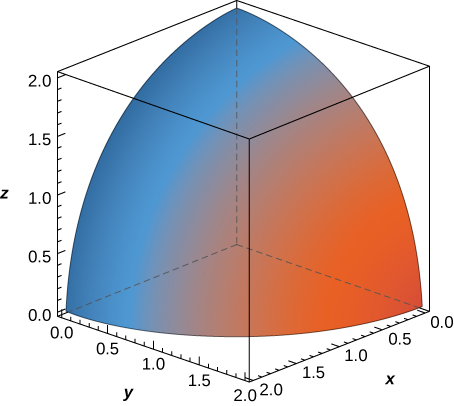
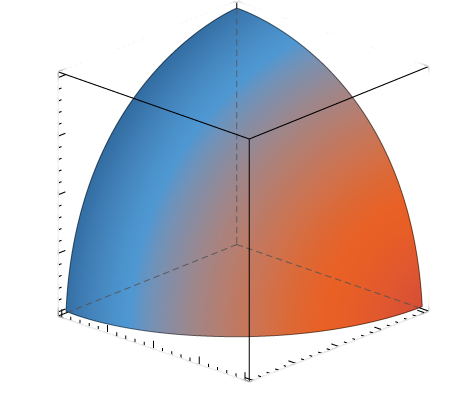
a. Write the triple integral that gives the volume of by integrating first with respect to then with and then with
b. Rewrite the integral in part a. as an equivalent integral in five other orders.
Answer
5-229 §5.4 source ↗
In the following exercises, use two circular permutations of the variables to write new integrals whose values equal the value of the original integral. A circular permutation of is the arrangement of the numbers in one of the following orders:
Find the volume of the prism with vertices
Answer
5-231 §5.4 source ↗
In the following exercises, use two circular permutations of the variables to write new integrals whose values equal the value of the original integral. A circular permutation of is the arrangement of the numbers in one of the following orders:
The solid bounded by and situated in the first octant is given in the following figure. Find the volume of the solid.
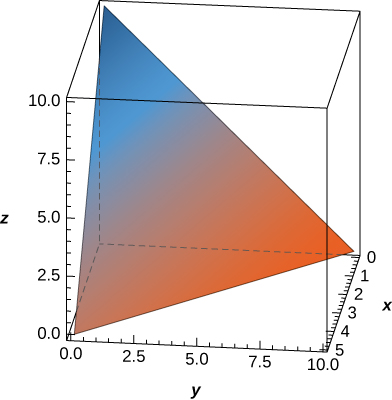
Answer
5-233 §5.4 source ↗
In the following exercises, use two circular permutations of the variables to write new integrals whose values equal the value of the original integral. A circular permutation of is the arrangement of the numbers in one of the following orders:
The midpoint rule for the triple integral over the rectangular solid box is a generalization of the midpoint rule for double integrals. The region is divided into subboxes of equal sizes and the integral is approximated by the triple Riemann sum where is the center of the box and is the volume of each subbox. Apply the midpoint rule to approximate over the solid by using a partition of eight cubes of equal size. Round your answer to three decimal places.
Answer
5-235 §5.4 source ↗
In the following exercises, use two circular permutations of the variables to write new integrals whose values equal the value of the original integral. A circular permutation of is the arrangement of the numbers in one of the following orders:
Suppose that the temperature in degrees Celsius at a point of a solid bounded by the coordinate planes and is Find the average temperature over the solid.
Answer
Checkpoint 5.27 §5.5 source ↗
Answer
Checkpoint 5.28 §5.5 source ↗
Answer
Checkpoint 5.29 §5.5 source ↗
Answer
Checkpoint 5.30 §5.5 source ↗
Answer
Checkpoint 5.31 §5.5 source ↗
Answer
Checkpoint 5.32 §5.5 source ↗
Use rectangular, cylindrical, and spherical coordinates to set up triple integrals for finding the volume of the region inside the sphere but outside the cylinder
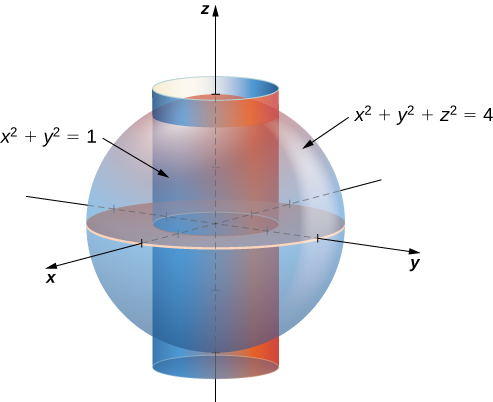
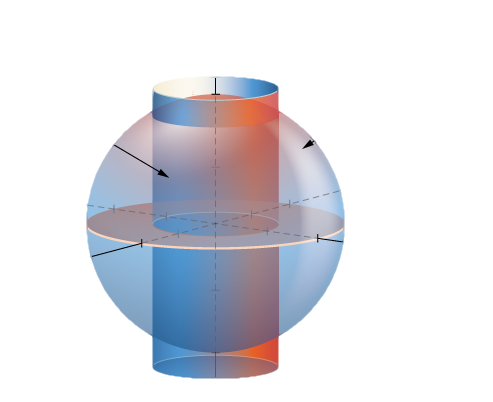
Answer
Cylindrical:
Spherical:
5-241 §5.5 source ↗
In the following exercises, evaluate the triple integrals over the solid
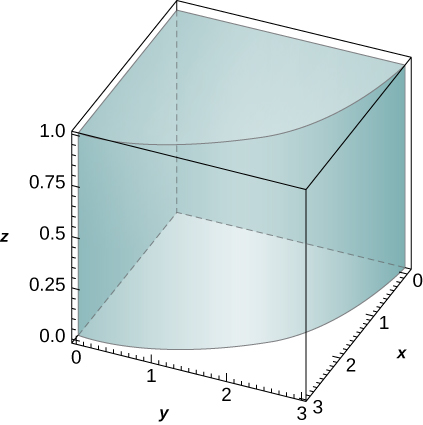
Answer
5-243 §5.5 source ↗
In the following exercises, evaluate the triple integrals over the solid
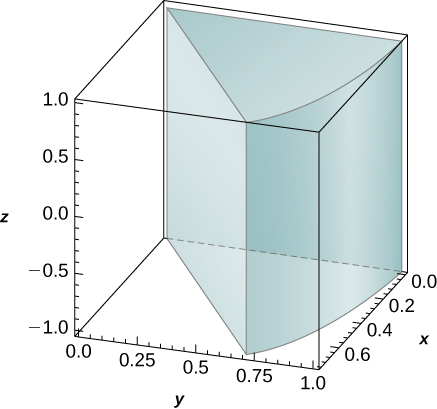
Answer
5-245 §5.5 source ↗
In the following exercises, evaluate the triple integrals over the solid
Answer
5-249 §5.5 source ↗
In the following exercises, the boundaries of the solid are given in cylindrical coordinates. Let be the corresponding function in cylindrical coordinates.
is inside the right circular cylinder above the -plane, and inside the sphere
Answer
5-251 §5.5 source ↗
In the following exercises, the boundaries of the solid are given in cylindrical coordinates. Let be the corresponding function in cylindrical coordinates.
is located in the first octant and is bounded by the circular paraboloid the cylinder and the plane
Answer
5-253 §5.5 source ↗
In the following exercises, the function and region are given in rectangular coordinates.
Answer
5-255 §5.5 source ↗
In the following exercises, the function and region are given in rectangular coordinates.
Answer
5-257 §5.5 source ↗
In the following exercises, find the volume of the solid whose boundaries are given in rectangular coordinates.
is above the -plane, inside the cylinder and below the plane
Answer
5-259 §5.5 source ↗
In the following exercises, find the volume of the solid whose boundaries are given in rectangular coordinates.
is bounded by the circular cone and
Answer
5-261 §5.5 source ↗
In the following exercises, find the volume of the solid whose boundaries are given in rectangular coordinates.
is located inside the cylinder and between the circular paraboloids and
Answer
5-263 §5.5 source ↗
In the following exercises, find the volume of the solid whose boundaries are given in rectangular coordinates.
is located inside the circular cone and between the planes and
Answer
5-265 §5.5 source ↗
In the following exercises, find the volume of the solid whose boundaries are given in rectangular coordinates.
[T] Use a computer algebra system (CAS) to graph the solid whose volume is given by the iterated integral in cylindrical coordinates Find the volume of the solid. Round your answer to four decimal places.
Answer
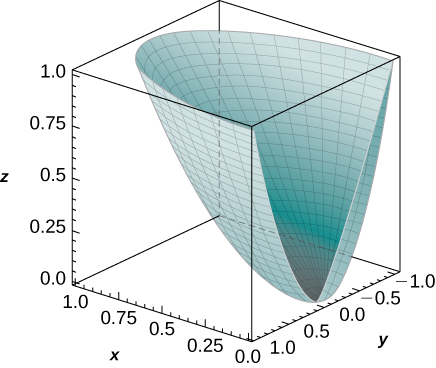
5-267 §5.5 source ↗
In the following exercises, find the volume of the solid whose boundaries are given in rectangular coordinates.
Convert the integral into an integral in cylindrical coordinates.
Answer
5-269 §5.5 source ↗
In the following exercises, evaluate the triple integral over the solid
Answer
5-271 §5.5 source ↗
In the following exercises, evaluate the triple integral over the solid
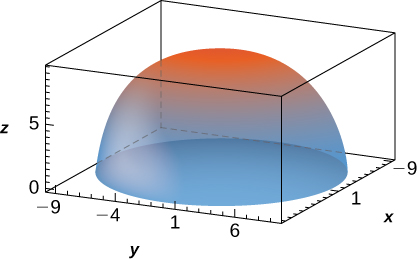
is bounded above by the half-sphere with and below by the cone
Answer
5-277 §5.5 source ↗
In the following exercises, the function and region are given in rectangular coordinates.
Answer
5-279 §5.5 source ↗
In the following exercises, the function and region are given in rectangular coordinates.
Answer
5-281 §5.5 source ↗
In the following exercises, find the volume of the solid whose boundaries are given in rectangular coordinates.
Answer
5-283 §5.5 source ↗
In the following exercises, find the volume of the solid whose boundaries are given in rectangular coordinates.
Use spherical coordinates to find the volume of the ball that is situated between the cones
Answer
5-285 §5.5 source ↗
In the following exercises, find the volume of the solid whose boundaries are given in rectangular coordinates.
Convert the integral into an integral in spherical coordinates.
Answer
5-287 §5.5 source ↗
In the following exercises, find the volume of the solid whose boundaries are given in rectangular coordinates.
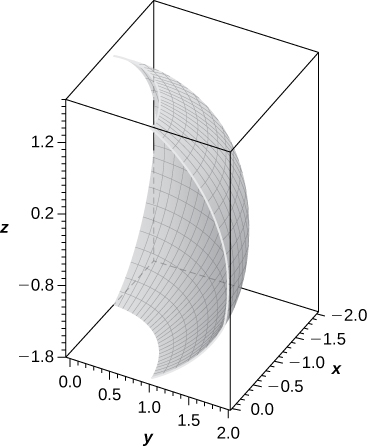
[T] Use a CAS to graph the solid whose volume is given by the iterated integral in spherical coordinates Find the volume of the solid. Round your answer to three decimal places.
Answer
5-289 §5.5 source ↗
In the following exercises, find the volume of the solid whose boundaries are given in rectangular coordinates.
[T] Use a CAS to evaluate the integral where lies above the paraboloid and below the plane
Answer
5-291 §5.5 source ↗
In the following exercises, find the volume of the solid whose boundaries are given in rectangular coordinates.
Express the volume of the solid inside the sphere and outside the cylinder as triple integrals in cylindrical coordinates and spherical coordinates.
Answer
5-293 §5.5 source ↗
In the following exercises, find the volume of the solid whose boundaries are given in rectangular coordinates.
The power emitted by an antenna has a power density per unit volume given in spherical coordinates by
where is a constant with units in watts. The total power within a sphere of radius meters is defined as Find the total power within a sphere of radius 20 meters.
Answer
5-295 §5.5 source ↗
In the following exercises, find the volume of the solid whose boundaries are given in rectangular coordinates.
A charge cloud contained in a sphere of radius r centimeters centered at the origin has its charge density given by where The total charge contained in is given by Find the total charge
Answer
Checkpoint 5.33 §5.6 source ↗
Answer
Checkpoint 5.34 §5.6 source ↗
Answer
Checkpoint 5.35 §5.6 source ↗
Answer
Checkpoint 5.36 §5.6 source ↗
Answer
Checkpoint 5.37 §5.6 source ↗
Answer
Checkpoint 5.38 §5.6 source ↗
Answer
Checkpoint 5.39 §5.6 source ↗
Answer
Checkpoint 5.40 §5.6 source ↗
Answer
Checkpoint 5.41 §5.6 source ↗
Answer
Checkpoint 5.42 §5.6 source ↗
Answer
5-297 §5.6 source ↗
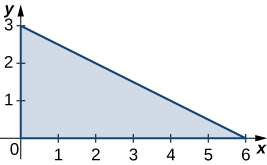
In the following exercises, the region occupied by a lamina is shown in a graph. Find the mass of with the density function
is the triangular region with vertices and
Answer
5-299 §5.6 source ↗
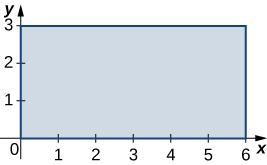
In the following exercises, the region occupied by a lamina is shown in a graph. Find the mass of with the density function
is the rectangular region with vertices and
Answer
5-301 §5.6 source ↗
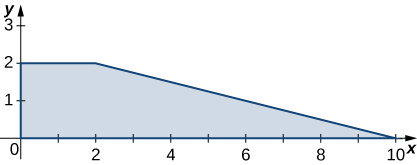
In the following exercises, the region occupied by a lamina is shown in a graph. Find the mass of with the density function
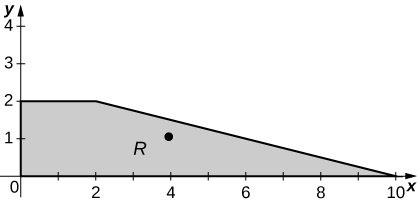
is the trapezoidal region determined by the lines and
Answer
5-303 §5.6 source ↗
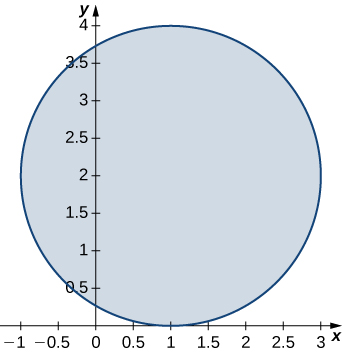
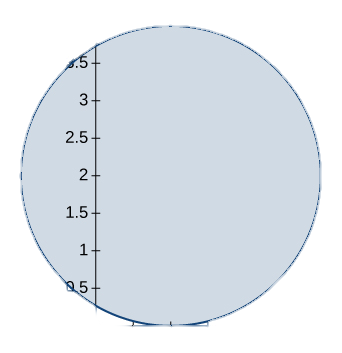
In the following exercises, the region occupied by a lamina is shown in a graph. Find the mass of with the density function
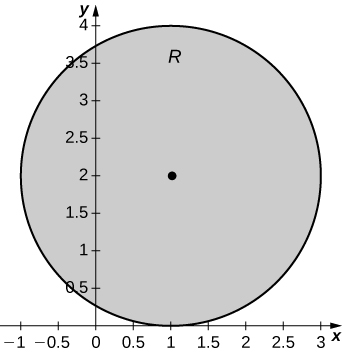
is the disk of radius centered at
Answer
5-305 §5.6 source ↗
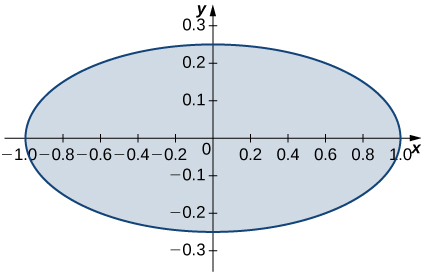
In the following exercises, the region occupied by a lamina is shown in a graph. Find the mass of with the density function
is the region enclosed by the ellipse
Answer
5-307 §5.6 source ↗
In the following exercises, the region occupied by a lamina is shown in a graph. Find the mass of with the density function
is the region bounded by
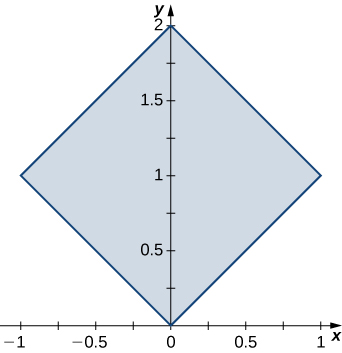
Answer
5-309 §5.6 source ↗
In the following exercises, consider a lamina occupying the region and having the density function given in the preceding group of exercises. Use a computer algebra system (CAS) to answer the following questions.
[T] is the triangular region with vertices and
Answer
a. b.
c.
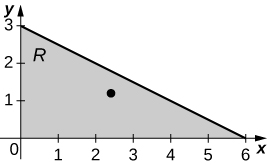
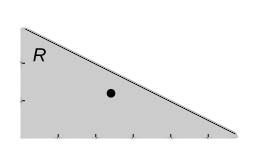
5-311 §5.6 source ↗
In the following exercises, consider a lamina occupying the region and having the density function given in the preceding group of exercises. Use a computer algebra system (CAS) to answer the following questions.
[T] is the rectangular region with vertices
Answer
a. b.
c.
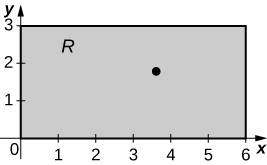
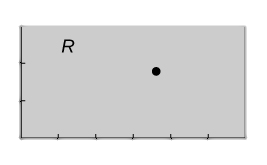
5-313 §5.6 source ↗
In the following exercises, consider a lamina occupying the region and having the density function given in the preceding group of exercises. Use a computer algebra system (CAS) to answer the following questions.
[T] is the trapezoidal region determined by the lines
Answer
a. b.
c.
5-315 §5.6 source ↗
In the following exercises, consider a lamina occupying the region and having the density function given in the preceding group of exercises. Use a computer algebra system (CAS) to answer the following questions.
[T] is the disk of radius centered at
Answer
a. b.
c.
5-317 §5.6 source ↗
In the following exercises, consider a lamina occupying the region and having the density function given in the preceding group of exercises. Use a computer algebra system (CAS) to answer the following questions.
[T] is the region enclosed by the ellipse
Answer
a. b.
c.
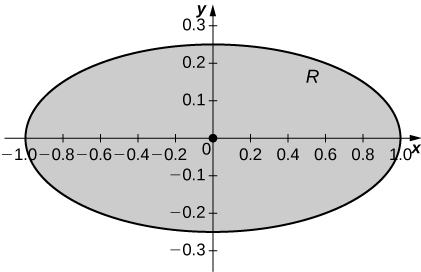
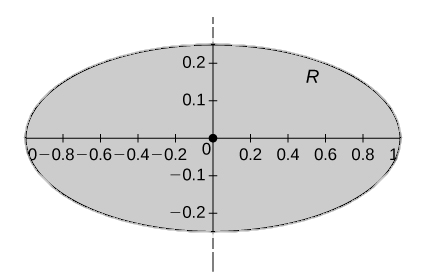
5-319 §5.6 source ↗
In the following exercises, consider a lamina occupying the region and having the density function given in the preceding group of exercises. Use a computer algebra system (CAS) to answer the following questions.
[T] is the region bounded by and
Answer
a. b.
c.
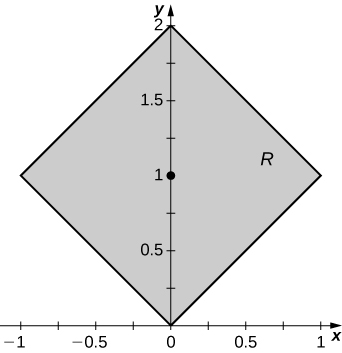
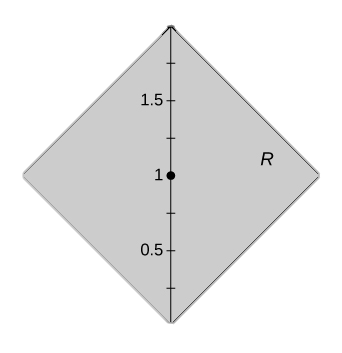
5-321 §5.6 source ↗
In the following exercises, consider a lamina occupying the region and having the density function given in the first two groups of Exercises.
is the triangular region with vertices and
Answer
5-323 §5.6 source ↗
In the following exercises, consider a lamina occupying the region and having the density function given in the first two groups of Exercises.
is the rectangular region with vertices and
Answer
5-325 §5.6 source ↗
In the following exercises, consider a lamina occupying the region and having the density function given in the first two groups of Exercises.
is the trapezoidal region determined by the lines and
Answer
5-327 §5.6 source ↗
In the following exercises, consider a lamina occupying the region and having the density function given in the first two groups of Exercises.
is the disk of radius centered at
Answer
5-329 §5.6 source ↗
In the following exercises, consider a lamina occupying the region and having the density function given in the first two groups of Exercises.
is the region enclosed by the ellipse
Answer
5-331 §5.6 source ↗
In the following exercises, consider a lamina occupying the region and having the density function given in the first two groups of Exercises.
is the region bounded by
Answer
5-333 §5.6 source ↗
In the following exercises, consider a lamina occupying the region and having the density function given in the first two groups of Exercises.
Let be the solid unit cube. Find the mass of the solid if its density is equal to the square of the distance of an arbitrary point of to the
Answer
5-337 §5.6 source ↗
In the following exercises, consider a lamina occupying the region and having the density function given in the first two groups of Exercises.
[T] The solid has density equal to the distance to the Use a CAS to answer the following questions.
a. Find the mass of
b. Find the moments about the and respectively.
c. Find the center of mass of
d. Graph and locate its center of mass.
Answer
a. b. c. d. the solid and its center of mass are shown in the following figure.
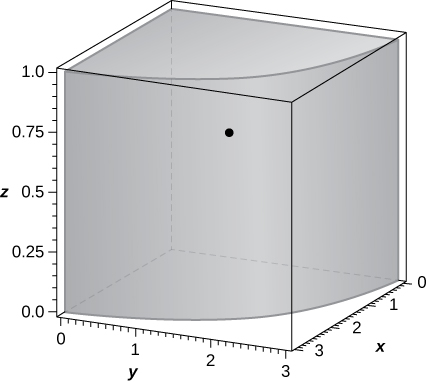
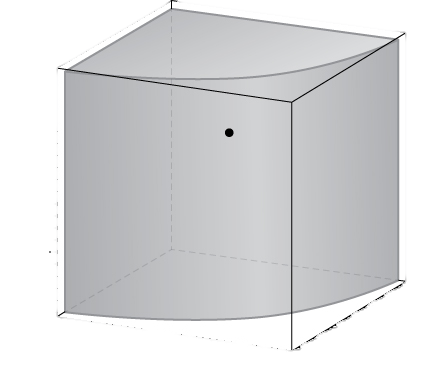
5-339 §5.6 source ↗
In the following exercises, consider a lamina occupying the region and having the density function given in the first two groups of Exercises.
[T] The solid has the mass given by the triple integral Use a CAS to answer the following questions.
a. Show that the center of mass of is located in the
b. Graph and locate its center of mass.
Answer
a. b. the solid and its center of mass are shown in the following figure.
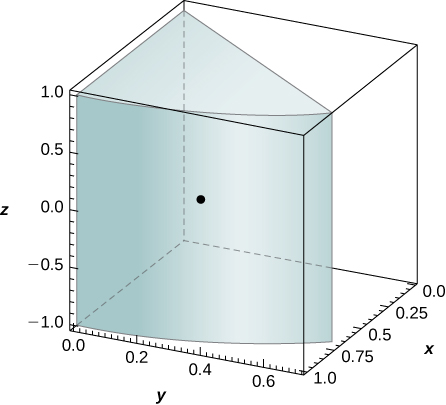
5-343 §5.6 source ↗
In the following exercises, consider a lamina occupying the region and having the density function given in the first two groups of Exercises.
The mass of a solid is given by where is an integer. Determine such that the mass of the solid is
Answer
5-349 §5.6 source ↗
In the following exercises, consider a lamina occupying the region and having the density function given in the first two groups of Exercises.
The solid has the moment of inertia about the given by the triple integral
a. Find the density of
b. Find the moment of inertia about the
Answer
5-351 §5.6 source ↗
In the following exercises, consider a lamina occupying the region and having the density function given in the first two groups of Exercises.
Let be the solid bounded by the the cylinder and the plane where is a real number. Find the moment of the solid about the if its density given in cylindrical coordinates is where is a differentiable function with the first and second derivatives continuous and differentiable on
Answer
5-355 §5.6 source ↗
In the following exercises, consider a lamina occupying the region and having the density function given in the first two groups of Exercises.
Show that the moments of inertia about the and respectively, of the unit ball centered at the origin whose density is are the same. Round your answer to two decimal places.
Answer
Checkpoint 5.43 §5.7 source ↗
Answer
Checkpoint 5.44 §5.7 source ↗
Answer
Checkpoint 5.45 §5.7 source ↗
Answer
Checkpoint 5.46 §5.7 source ↗
Answer
Checkpoint 5.47 §5.7 source ↗
Answer
Checkpoint 5.48 §5.7 source ↗
Let be the region in defined by
Evaluate by using the transformation and
Answer
5-357 §5.7 source ↗
In the following exercises, the function on the region bounded by the unit square is given, where is the image of under
Answer
a. and The functions and are continuous and differentiable, and the partial derivatives are continuous on b. and c. is the rectangle of vertices in the the following figure.
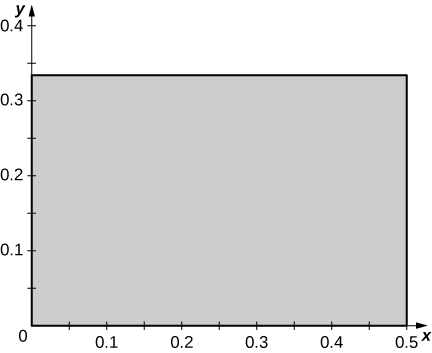
5-359 §5.7 source ↗
In the following exercises, the function on the region bounded by the unit square is given, where is the image of under
Answer
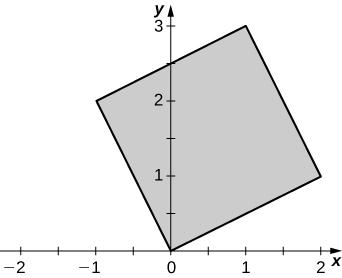
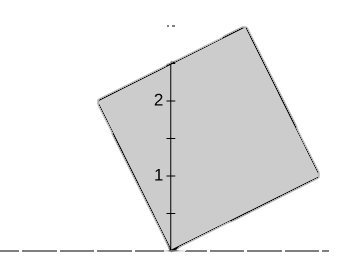
a. and The functions and are continuous and differentiable, and the partial derivatives and are continuous on b. and c. is the sqaure of vertices in the see the following figure.
5-361 §5.7 source ↗
In the following exercises, the function on the region bounded by the unit square is given, where is the image of under
Answer
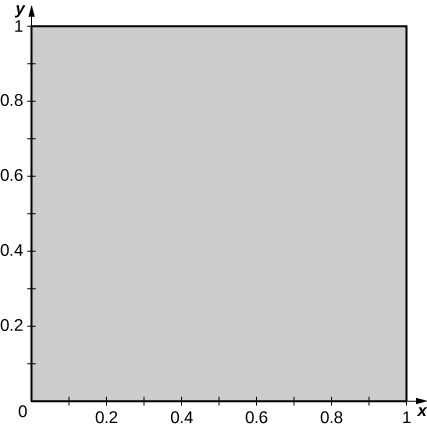
a. and The functions and are continuous and differentiable, and the partial derivatives and are continuous on b. and c. is the unit square in the see the following figure.
5-363 §5.7 source ↗
In the following exercises, determine whether the transformations are one-to-one or not.
is the triangle of vertices
Answer
5-365 §5.7 source ↗
In the following exercises, determine whether the transformations are one-to-one or not.
where is the triangle of vertices
Answer
5-367 §5.7 source ↗
In the following exercises, determine whether the transformations are one-to-one or not.
where
Answer
5-369 §5.7 source ↗
In the following exercises, the transformations are one-to-one. Find their related inverse transformations
where
Answer
5-371 §5.7 source ↗
In the following exercises, the transformations are one-to-one. Find their related inverse transformations
where and
Answer
5-373 §5.7 source ↗
In the following exercises, the transformations are one-to-one. Find their related inverse transformations
where
Answer
5-375 §5.7 source ↗
In the following exercises, the transformation and the region are given. Find the region
where
Answer
5-377 §5.7 source ↗
In the following exercises, the transformation and the region are given. Find the region
where
Answer
5-379 §5.7 source ↗
In the following exercises, find the Jacobian of the transformation.
Answer
5-381 §5.7 source ↗
In the following exercises, find the Jacobian of the transformation.
Answer
5-383 §5.7 source ↗
In the following exercises, find the Jacobian of the transformation.
Answer
5-385 §5.7 source ↗
In the following exercises, find the Jacobian of the transformation.
Answer
5-387 §5.7 source ↗
In the following exercises, find the Jacobian of the transformation.
Answer
5-389 §5.7 source ↗
In the following exercises, find the Jacobian of the transformation.
The triangular region with the vertices is shown in the following figure.
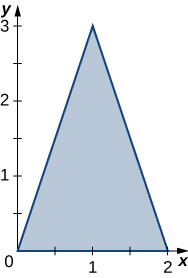
a. Find a transformation where and are real numbers with such that and
b. Use the transformation to find the area of the region
Answer
5-391 §5.7 source ↗
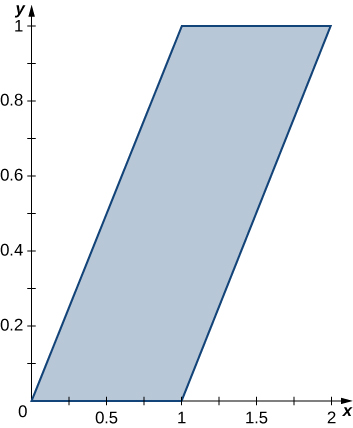
In the following exercises, use the transformation to evaluate the integrals on the parallelogram of vertices shown in the following figure.
Answer
5-393 §5.7 source ↗
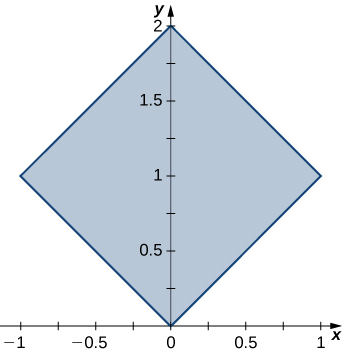
In the following exercises, use the transformation to evaluate the integrals on the square determined by the lines and shown in the following figure.
Answer
5-395 §5.7 source ↗
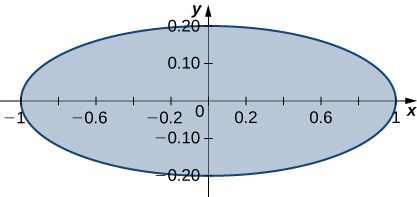
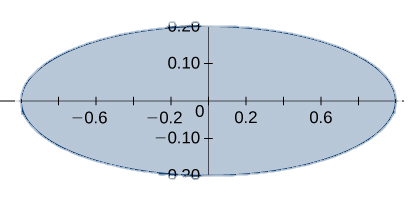
In the following exercises, use the transformation to evaluate the integrals on the region bounded by the ellipse shown in the following figure.
Answer
5-397 §5.7 source ↗
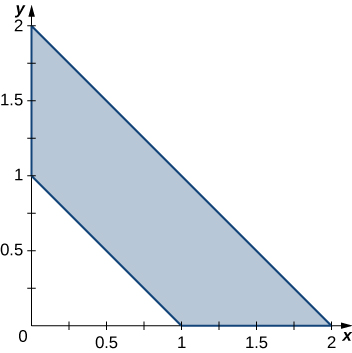
In the following exercises, use the transformation to evaluate the integrals on the trapezoidal region determined by the points shown in the following figure.
Answer
5-399 §5.7 source ↗
In the following exercises, use the transformation to evaluate the integrals on the trapezoidal region determined by the points shown in the following figure.
The solid bounded by the circular cylinder and the planes is shown in the following figure. Find a transformation from a cylindrical box in to the solid in
Answer
5-403 §5.7 source ↗
In the following exercises, use the transformation to evaluate the integrals on the trapezoidal region determined by the points shown in the following figure.
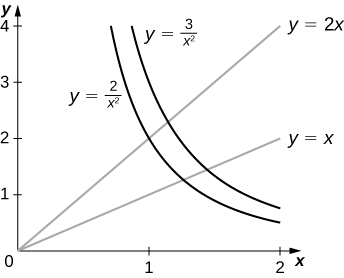
[T] Find the area of the region bounded by the curves and by using the transformation and
Answer
The area of the region is A graph of the region is:
5-405 §5.7 source ↗
In the following exercises, use the transformation to evaluate the integrals on the trapezoidal region determined by the points shown in the following figure.
Evaluate the triple integral by using the transformation
Answer
5-409 §5.7 source ↗
In the following exercises, use the transformation to evaluate the integrals on the trapezoidal region determined by the points shown in the following figure.
[T] The transformations defined by and are called reflections about the origin, and the line respectively.
a. Find the image of the region in the through the transformation
b. Use a CAS to graph the image of
c. Evaluate the integral by using a CAS. Round your answer to two decimal places.
Answer
a. b. is graphed in the following figure;
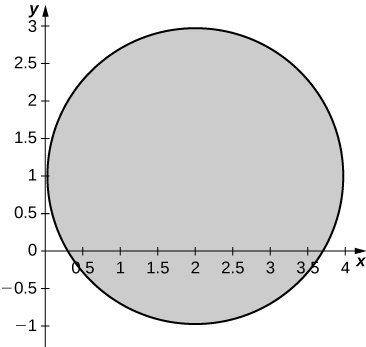
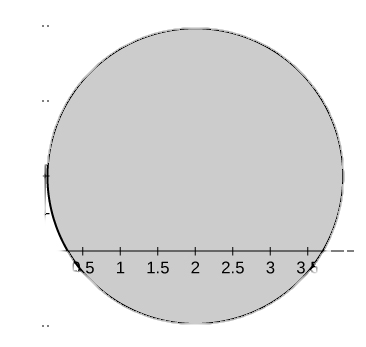
c.
5-411 §5.7 source ↗
In the following exercises, use the transformation to evaluate the integrals on the trapezoidal region determined by the points shown in the following figure.
[T] The transformation where is a real number, is called a shear in the The transformation, where is a real number, is called a shear in the
a. Find transformations
b. Find the image of the trapezoidal region bounded by and through the transformation
c. Use a CAS to graph the image in the
d. Find the area of the region by using the area of region
Answer
a. b. The image is the quadrilateral of vertices c. is graphed in the following figure;
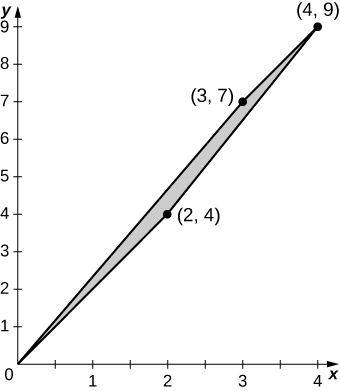
d.
5-413 §5.7 source ↗
In the following exercises, use the transformation to evaluate the integrals on the trapezoidal region determined by the points shown in the following figure.
Find the volume of a football whose shape is a spheroid whose length from tip to tip is inches and circumference at the center is inches. Round your answer to two decimal places.
Answer
5-415 §5.7 source ↗
In the following exercises, use the transformation to evaluate the integrals on the trapezoidal region determined by the points shown in the following figure.
[T] Lamé ovals have been consistently used by designers and architects. For instance, Gerald Robinson, a Canadian architect, has designed a parking garage in a shopping center in Peterborough, Ontario, in the shape of a superellipse of the equation with and Use a CAS to find an approximation of the area of the parking garage in the case yards, yards, and .
Answer
5-417 §5.R source ↗
True or False? Justify your answer with a proof or a counterexample.
Fubini’s theorem can be extended to three dimensions, as long as is continuous in all variables.
Answer
5-419 §5.R source ↗
True or False? Justify your answer with a proof or a counterexample.
The Jacobian of the transformation is given by
Answer
5-421 §5.R source ↗
Evaluate the following integrals.
Answer
5-423 §5.R source ↗
Evaluate the following integrals.
Answer
5-425 §5.R source ↗
Evaluate the following integrals.
where
Answer
5-427 §5.R source ↗
Evaluate the following integrals.
Answer
5-429 §5.R source ↗
For the following problems, find the specified area or volume.
The area of region enclosed by one petal of
Answer
5-431 §5.R source ↗
For the following problems, find the specified area or volume.
The volume of the solid bounded by the cylinder and from and
Answer
5-433 §5.R source ↗
For the following problems, find the center of mass of the region.
on the circle with radius in the first quadrant only.
Answer
5-435 §5.R source ↗
For the following problems, find the center of mass of the region.
on the inverted cone with radius and height
Answer
5-437 §5.R source ↗
The following problems examine Mount Holly in the state of Michigan. Mount Holly is a landfill that was converted into a ski resort. The shape of Mount Holly can be approximated by a right circular cone of height ft and radius ft.
If the compacted trash used to build Mount Holly on average has a density find the amount of work required to build the mountain.
Answer
5-439 §5.R source ↗
The following problems consider the temperature and density of Earth’s layers.
[T] The temperature of Earth’s layers is exhibited in the table below. Use your calculator to fit a polynomial of degree to the temperature along the radius of the Earth. Then find the average temperature of Earth. (Hint: begin at in the inner core and increase outward toward the surface)
| Layer | Depth from center (km) | Temperature |
|---|---|---|
| Rocky Crust | 0 to 40 | 0 |
| Upper Mantle | 40 to 150 | 870 |
| Mantle | 400 to 650 | 870 |
| Inner Mantel | 650 to 2700 | 870 |
| Molten Outer Core | 2890 to 5150 | 4300 |
| Inner Core | 5150 to 6378 | 7200 |
Answer
5-441 §5.R source ↗
The following problems concern the Theorem of Pappus (see Moments and Centers of Mass for a refresher), a method for calculating volume using centroids. Assuming a region when you revolve around the the volume is given by and when you revolve around the the volume is given by where is the area of Consider the region bounded by and above
Find the volume when you revolve the region around the
Answer
Loading chapter 6…
Problems and answers are adapted from Calculus Volume 3 by Gilbert Strang and Edwin “Jed” Herman, OpenStax, and are used under the CC BY-NC-SA 4.0 licence. Access for free at https://openstax.org/books/calculus-volume-3/pages/1-introduction. Illustrations: Copyright Rice University, OpenStax, under CC BY-NC-SA 4.0 license. This adaptation is released under the same licence, is non-commercial, and is neither affiliated with nor endorsed by OpenStax or Rice University.