Every problem in the chapter beside the book’s answer, a chapter at a time as you scroll.
Chapter 4: Differentiation of Functions of Several Variables
248 problems · 26 figuresCheckpoint 4.1 §4.1 source ↗
Answer
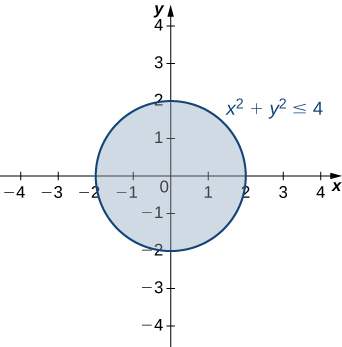
The domain is the shaded circle defined by the inequality which has a circle of radius as its boundary. The range is
Checkpoint 4.2 §4.1 source ↗
Answer
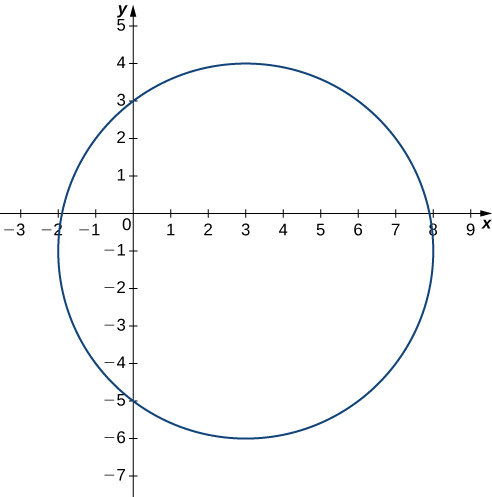
The equation of the level curve can be written as which is a circle with radius centered at
Checkpoint 4.3 §4.1 source ↗
Answer
Checkpoint 4.4 §4.1 source ↗
Answer
Checkpoint 4.5 §4.1 source ↗
Find an equation of the level surface of the function
corresponding to and describe the surface, if possible.
Answer
4-1 §4.1 source ↗
For the following exercises, evaluate each function at the indicated values.
Find
Answer
4-3 §4.1 source ↗
For the following exercises, evaluate each function at the indicated values.
The volume of a right circular cylinder is calculated by a function of two variables, where is the radius of the right circular cylinder and represents the height of the cylinder. Evaluate and explain what this means.
Answer
4-5 §4.1 source ↗
For the following exercises, find the domain of the function.
Answer
4-7 §4.1 source ↗
For the following exercises, find the domain of the function.
Answer
4-9 §4.1 source ↗
For the following exercises, find the domain of the function.
Answer
4-11 §4.1 source ↗
Find the range of the functions.
Answer
4-13 §4.1 source ↗
Find the range of the functions.
Answer
4-15 §4.1 source ↗
For the following exercises, find the level curves of each function at the indicated value of to visualize the given function.
Answer
4-17 §4.1 source ↗
For the following exercises, find the level curves of each function at the indicated value of to visualize the given function.
Answer
4-19 §4.1 source ↗
For the following exercises, find the level curves of each function at the indicated value of to visualize the given function.
Answer
4-21 §4.1 source ↗
For the following exercises, find the level curves of each function at the indicated value of to visualize the given function.
Answer
4-23 §4.1 source ↗
For the following exercises, find the level curves of each function at the indicated value of to visualize the given function.
Answer
4-25 §4.1 source ↗
For the following exercises, find the level curves of each function at the indicated value of to visualize the given function.
Answer
4-27 §4.1 source ↗
For the following exercises, find the level curves of each function at the indicated value of to visualize the given function.
Answer
4-29 §4.1 source ↗
For the following exercises, find the level curves of each function at the indicated value of to visualize the given function.
any constant
Answer
4-31 §4.1 source ↗
For the following exercises, find the vertical traces of the functions at the indicated values of and y, and plot the traces.
Answer
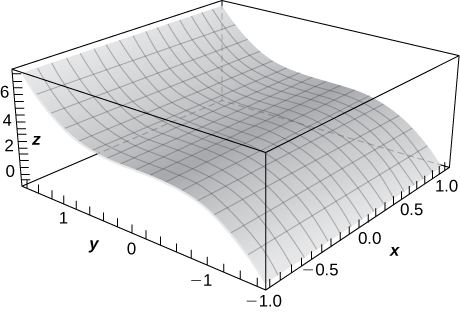
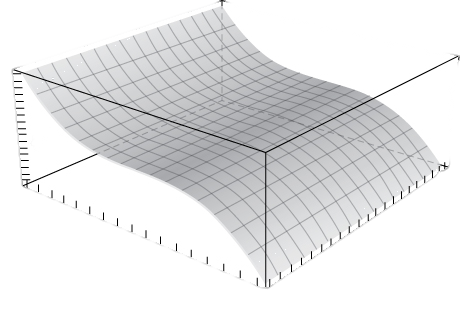
a curve in the with rulings parallel to the
4-33 §4.1 source ↗
Find the domain of the following functions.
Answer
4-35 §4.1 source ↗
Find the domain of the following functions.
Answer
4-37 §4.1 source ↗
Find the domain of the following functions.
Answer
4-39 §4.1 source ↗
For the following exercises, plot a graph of the function.
Answer
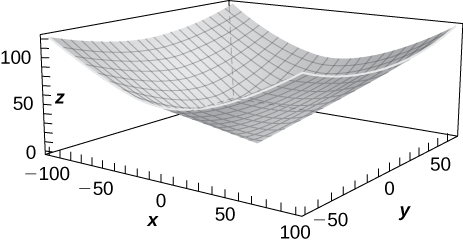
4-41 §4.1 source ↗
For the following exercises, plot a graph of the function.
Use technology to graph
Answer
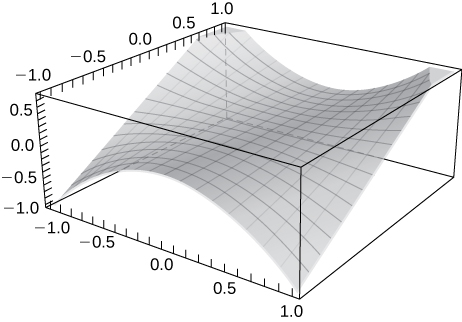
4-43 §4.1 source ↗
Sketch the following by finding the level curves. Verify the graph using technology.
Answer
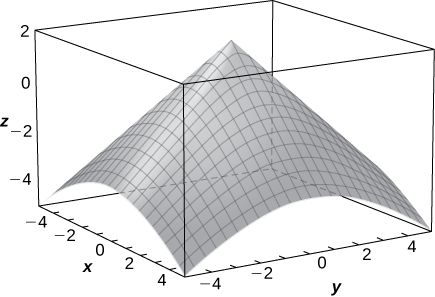
4-45 §4.1 source ↗
Sketch the following by finding the level curves. Verify the graph using technology.
Answer
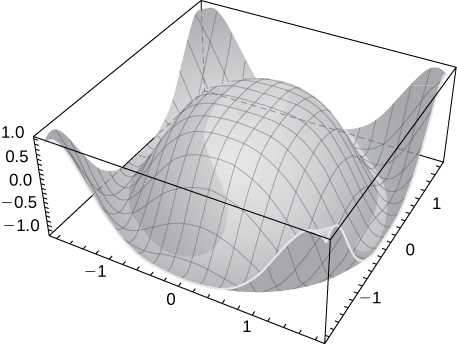
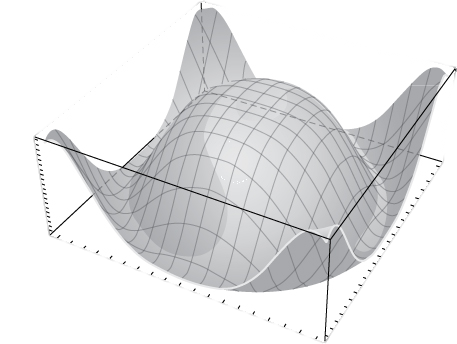
4-47 §4.1 source ↗
Sketch the following by finding the level curves. Verify the graph using technology.
Describe the contour lines for several values of for
Answer
4-49 §4.1 source ↗
Find the level surface for the functions of three variables and describe it.
Answer
4-51 §4.1 source ↗
Find the level surface for the functions of three variables and describe it.
Answer
4-53 §4.1 source ↗
For the following exercises, find an equation of the level curve of that contains the point
Answer
4-55 §4.1 source ↗
For the following exercises, find an equation of the level curve of that contains the point
Answer
4-57 §4.1 source ↗
For the following exercises, find an equation of the level curve of that contains the point
A thin plate made of iron is located in the The temperature in degrees Celsius at a point is inversely proportional to the square of its distance from the origin. Express as a function of
Answer
4-59 §4.1 source ↗
For the following exercises, find an equation of the level curve of that contains the point
Refer to the preceding problem. Find the level curves for and describe what the level curves represent.
Answer
Checkpoint 4.6 §4.2 source ↗
Evaluate the following limit:
Answer
Checkpoint 4.7 §4.2 source ↗
Show that
does not exist.
Answer
Checkpoint 4.8 §4.2 source ↗
Evaluate the following limit:
Answer
Checkpoint 4.9 §4.2 source ↗
Answer
1. The domain of contains the ordered pair because
2.
3.
Checkpoint 4.10 §4.2 source ↗
Answer
Checkpoint 4.11 §4.2 source ↗
Answer
4-61 §4.2 source ↗
For the following exercises, find the limit of the function.
Answer
4-63 §4.2 source ↗
For the following exercises, evaluate the limits at the indicated values of If the limit does not exist, state this and explain why the limit does not exist.
Answer
4-65 §4.2 source ↗
For the following exercises, evaluate the limits at the indicated values of If the limit does not exist, state this and explain why the limit does not exist.
Answer
4-67 §4.2 source ↗
For the following exercises, evaluate the limits at the indicated values of If the limit does not exist, state this and explain why the limit does not exist.
Answer
4-69 §4.2 source ↗
For the following exercises, evaluate the limits at the indicated values of If the limit does not exist, state this and explain why the limit does not exist.
Answer
4-71 §4.2 source ↗
For the following exercises, evaluate the limits at the indicated values of If the limit does not exist, state this and explain why the limit does not exist.
Answer
4-73 §4.2 source ↗
For the following exercises, evaluate the limits at the indicated values of If the limit does not exist, state this and explain why the limit does not exist.
Answer
4-75 §4.2 source ↗
For the following exercises, evaluate the limits at the indicated values of If the limit does not exist, state this and explain why the limit does not exist.
Answer
4-77 §4.2 source ↗
For the following exercises, evaluate the limits at the indicated values of If the limit does not exist, state this and explain why the limit does not exist.
Answer
4-79 §4.2 source ↗
For the following exercises, complete the statement.
A point in a plane region is called a boundary point of if ___________.
Answer
4-81 §4.2 source ↗
For the following exercises, use algebraic techniques to evaluate the limit.
Answer
4-83 §4.2 source ↗
For the following exercises, use algebraic techniques to evaluate the limit.
Answer
4-85 §4.2 source ↗
For the following exercises, evaluate the limits of the functions of three variables.
Answer
4-87 §4.2 source ↗
For the following exercises, evaluate the limit of the function by determining the value the function approaches along the indicated paths. If the limit does not exist, explain why not.
Evaluate using the results of previous problem.
Answer
4-89 §4.2 source ↗
For the following exercises, evaluate the limit of the function by determining the value the function approaches along the indicated paths. If the limit does not exist, explain why not.
Evaluate using the results of previous problem.
Answer
4-91 §4.2 source ↗
Discuss the continuity of the following functions. Find the largest region in the in which the following functions are continuous.
Answer
4-93 §4.2 source ↗
Discuss the continuity of the following functions. Find the largest region in the in which the following functions are continuous.
Answer
4-95 §4.2 source ↗
For the following two exercises, determine the region in which the function is continuous. Explain your answer.
Answer
4-97 §4.2 source ↗
For the following two exercises, determine the region in which the function is continuous. Explain your answer.
Determine whether is continuous at
Answer
4-99 §4.2 source ↗
For the following two exercises, determine the region in which the function is continuous. Explain your answer.
Determine the region of the in which the function is continuous. Use technology to support your conclusion.
Answer
4-101 §4.2 source ↗
For the following two exercises, determine the region in which the function is continuous. Explain your answer.
At what points in space is continuous?
Answer
4-103 §4.2 source ↗
For the following two exercises, determine the region in which the function is continuous. Explain your answer.
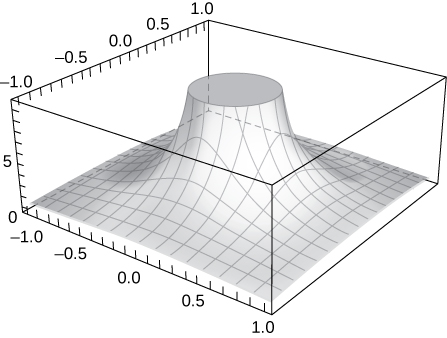
Show that does not exist at by plotting the graph of the function.
Answer
The graph increases without bound as both approach zero.
4-105 §4.2 source ↗
For the following two exercises, determine the region in which the function is continuous. Explain your answer.
[T]
a. Use a CAS to draw a contour map of
b. What is the name of the geometric shape of the level curves?
c. Give the general equation of the level curves.
d. What is the maximum value of
e. What is the domain of the function?
f. What is the range of the function?
Answer
a.
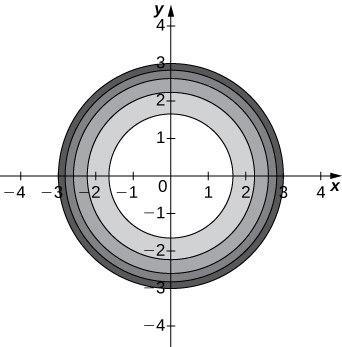
b. The level curves are circles centered at with radius c. d. e. f.
4-107 §4.2 source ↗
For the following two exercises, determine the region in which the function is continuous. Explain your answer.
Use polar coordinates to find You can also find the limit using L’Hôpital’s rule.
Answer
4-109 §4.2 source ↗
For the following two exercises, determine the region in which the function is continuous. Explain your answer.
Discuss the continuity of where and
Answer
4-111 §4.2 source ↗
For the following two exercises, determine the region in which the function is continuous. Explain your answer.
Given find
Answer
Checkpoint 4.12 §4.3 source ↗
Use the definition of the partial derivative as a limit to calculate and for the function
Answer
Checkpoint 4.13 §4.3 source ↗
Answer
Checkpoint 4.14 §4.3 source ↗
Use a contour map to estimate at point for the function
Compare this with the exact answer.
Answer
Using the curves corresponding to we obtain
The exact answer is
Checkpoint 4.15 §4.3 source ↗
Use the limit definition of partial derivatives to calculate for the function
Then find and by setting the other two variables constant and differentiating accordingly.
Answer
Checkpoint 4.16 §4.3 source ↗
Answer
Checkpoint 4.17 §4.3 source ↗
Calculate all four second partial derivatives for the function
Answer
4-113 §4.3 source ↗
For the following exercises, calculate the partial derivative using the limit definitions only.
for
Answer
4-115 §4.3 source ↗
For the following exercises, calculate the sign of the partial derivative using the graph of the surface.
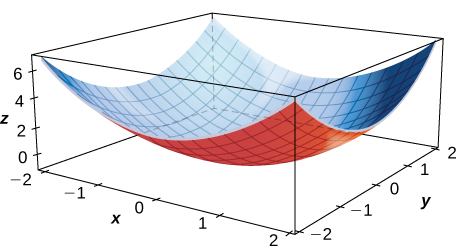
Answer
4-117 §4.3 source ↗
For the following exercises, calculate the sign of the partial derivative using the graph of the surface.
Answer
4-119 §4.3 source ↗
For the following exercises, calculate the partial derivatives.
for
Answer
4-121 §4.3 source ↗
For the following exercises, calculate the partial derivatives.
and for
Answer
4-123 §4.3 source ↗
For the following exercises, calculate the partial derivatives.
Let Find and
Answer
4-125 §4.3 source ↗
For the following exercises, calculate the partial derivatives.
Let Find and
Answer
4-127 §4.3 source ↗
For the following exercises, calculate the partial derivatives.
Let Evaluate and
Answer
4-129 §4.3 source ↗
For the following exercises, calculate the partial derivatives.
Find at for Evaluate the partial derivatives at point
Answer
4-131 §4.3 source ↗
For the following exercises, calculate the partial derivatives.
Given find and
Answer
4-133 §4.3 source ↗
For the following exercises, calculate the partial derivatives.
Express the volume of a right circular cylinder as a function of two variables:
a. its radius and its height
b. Show that the rate of change of the volume of the cylinder with respect to its radius is the product of its circumference multiplied by its height.
c. Show that the rate of change of the volume of the cylinder with respect to its height is equal to the area of the circular base.
Answer
4-135 §4.3 source ↗
Find the indicated higher-order partial derivatives.
for
Answer
4-137 §4.3 source ↗
Find the indicated higher-order partial derivatives.
Let Find and
Answer
4-139 §4.3 source ↗
Find the indicated higher-order partial derivatives.
Given find and
Answer
4-141 §4.3 source ↗
Find the indicated higher-order partial derivatives.
Show that is a solution of the differential equation
Answer
4-143 §4.3 source ↗
Find the indicated higher-order partial derivatives.
Let Find
Answer
4-145 §4.3 source ↗
Find the indicated higher-order partial derivatives.
Given find all points at which simultaneously.
Answer
4-147 §4.3 source ↗
Find the indicated higher-order partial derivatives.
Given find all points on at which simultaneously.
Answer
4-149 §4.3 source ↗
Find the indicated higher-order partial derivatives.
Show that satisfies the equation
Answer
4-151 §4.3 source ↗
Find the indicated higher-order partial derivatives.
Show that satisfies the heat equation
Answer
4-153 §4.3 source ↗
Find the indicated higher-order partial derivatives.
Find for
Answer
4-155 §4.3 source ↗
Find the indicated higher-order partial derivatives.
Find for
Answer
4-159 §4.3 source ↗
Find the indicated higher-order partial derivatives.
The law of cosines can be thought of as a function of three variables. Let and be two sides of any triangle where the angle is the included angle between the two sides. Then, gives the square of the third side of the triangle. Find and when and
Answer
4-161 §4.3 source ↗
Find the indicated higher-order partial derivatives.
A Cobb-Douglas production function is where represent the amount of labor and capital available. Let and Find and at these values, which represent the marginal productivity of labor and capital, respectively.
Answer
Checkpoint 4.19 §4.4 source ↗
Answer
Checkpoint 4.20 §4.4 source ↗
Answer
Checkpoint 4.21 §4.4 source ↗
Answer
Checkpoint 4.22 §4.4 source ↗
Answer
4-163 §4.4 source ↗
For the following exercises, find a unit normal vector to the surface at the indicated point.
Answer
4-165 §4.4 source ↗
For the following exercises, as a useful review for techniques used in this section, find a normal vector and a tangent vector at point
Answer
4-167 §4.4 source ↗
For the following exercises, as a useful review for techniques used in this section, find a normal vector and a tangent vector at point
Answer
4-169 §4.4 source ↗
For the following exercises, as a useful review for techniques used in this section, find a normal vector and a tangent vector at point
Answer
4-171 §4.4 source ↗
For the following exercises, find the equation for the tangent plane to the surface at the indicated point. (Hint: Solve for in terms of and
Answer
4-173 §4.4 source ↗
For the following exercises, find the equation for the tangent plane to the surface at the indicated point. (Hint: Solve for in terms of and
Answer
4-175 §4.4 source ↗
For the following exercises, find the equation for the tangent plane to the surface at the indicated point. (Hint: Solve for in terms of and
Answer
4-177 §4.4 source ↗
For the following exercises, find the equation for the tangent plane to the surface at the indicated point. (Hint: Solve for in terms of and
Answer
4-179 §4.4 source ↗
For the following exercises, find the equation for the tangent plane to the surface at the indicated point. (Hint: Solve for in terms of and
Answer
4-181 §4.4 source ↗
For the following exercises, find the equation for the tangent plane to the surface at the indicated point. (Hint: Solve for in terms of and
Answer
4-183 §4.4 source ↗
For the following exercises, find parametric equations for the normal line to the surface at the indicated point. (Recall that to find the equation of a line in space, you need a point on the line, and a vector that is parallel to the line. Then the equation of the line is
Answer
4-185 §4.4 source ↗
For the following exercises, find parametric equations for the normal line to the surface at the indicated point. (Recall that to find the equation of a line in space, you need a point on the line, and a vector that is parallel to the line. Then the equation of the line is
Answer
4-187 §4.4 source ↗
For the following exercises, find parametric equations for the normal line to the surface at the indicated point. (Recall that to find the equation of a line in space, you need a point on the line, and a vector that is parallel to the line. Then the equation of the line is
at point
Answer
4-189 §4.4 source ↗
For the following exercises, use the figure shown here.
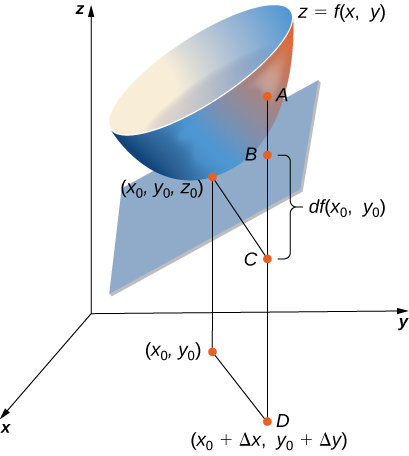
The length of line segment is equal to what mathematical expression?
Answer
4-191 §4.4 source ↗
For the following exercises, complete each task.
Show that is differentiable at point
Answer
4-193 §4.4 source ↗
For the following exercises, complete each task.
Show that is differentiable at every point. In other words, show that where both and approach zero as approaches
Answer
4-195 §4.4 source ↗
For the following exercises, complete each task.
Let Compute from to and then find the approximate change in from point to point Recall and and are approximately equal.
Answer
4-197 §4.4 source ↗
For the following exercises, complete each task.
See the preceding problem. Use differentials to estimate the volume of aluminum in an enclosed aluminum can with diameter and height if the aluminum is cm thick.
Answer
4-199 §4.4 source ↗
For the following exercises, complete each task.
Let Find the exact change in the function and the approximate change in the function as changes from and changes from
Answer
4-201 §4.4 source ↗
For the following exercises, complete each task.
The radius and height of a right circular cylinder are measured with possible errors of respectively. Approximate the maximum possible percentage error in measuring the volume (Recall that the percentage error is the ratio of the amount of error over the original amount. So, in this case, the percentage error in is given by
Answer
4-203 §4.4 source ↗
For the following exercises, complete each task.
The electrical resistance produced by wiring resistors and in parallel can be calculated from the formula If and are measured to be and respectively, and if these measurements are accurate to within estimate the maximum possible error in computing (The symbol represents an ohm, the unit of electrical resistance.)
Answer
4-205 §4.4 source ↗
For the following exercises, complete each task.
The period of a simple pendulum with small oscillations is calculated from the formula where is the length of the pendulum and is the acceleration resulting from gravity. Suppose that and have errors of, at most, and respectively. Use differentials to approximate the maximum percentage error in the calculated value of
Answer
4-207 §4.4 source ↗
For the following exercises, find the linear approximation of each function at the indicated point.
Answer
4-209 §4.4 source ↗
For the following exercises, find the linear approximation of each function at the indicated point.
Answer
4-211 §4.4 source ↗
For the following exercises, find the linear approximation of each function at the indicated point.
Answer
4-213 §4.4 source ↗
For the following exercises, find the linear approximation of each function at the indicated point.
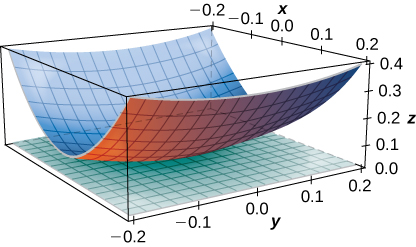
[T] Find the equation for the tangent plane to the surface at the indicated point, and graph the surface and the tangent plane:
Answer
Checkpoint 4.23 §4.5 source ↗
Calculate given the following functions. Express the final answer in terms of
Answer
Checkpoint 4.24 §4.5 source ↗
Calculate and given the following functions:
Answer
Checkpoint 4.25 §4.5 source ↗
Calculate and given the following functions:
Answer
Checkpoint 4.26 §4.5 source ↗
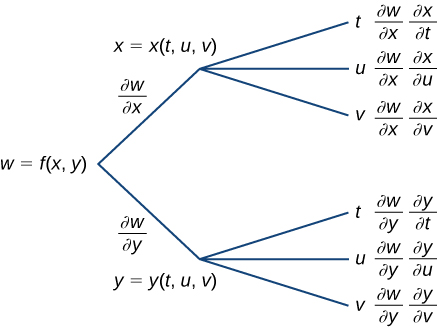
Create a tree diagram for the case when
and write out the formulas for the three partial derivatives of
Answer
Checkpoint 4.27 §4.5 source ↗
Answer
Equation of the tangent line:
4-215 §4.5 source ↗
For the following exercises, use the information provided to solve the problem.
Let where and Find
Answer
4-217 §4.5 source ↗
For the following exercises, use the information provided to solve the problem.
If and find and
Answer
4-219 §4.5 source ↗
For the following exercises, use the information provided to solve the problem.
If and find and express the answer in terms of and
Answer
4-221 §4.5 source ↗
For the following exercises, find using the chain rule and direct substitution.
Answer
4-223 §4.5 source ↗
For the following exercises, find using the chain rule and direct substitution.
Answer
4-225 §4.5 source ↗
For the following exercises, find using the chain rule and direct substitution.
Answer
4-227 §4.5 source ↗
For the following exercises, find using the chain rule and direct substitution.
Let and Express as a function of and find directly. Then, find using the chain rule.
Answer
4-229 §4.5 source ↗
For the following exercises, find using the chain rule and direct substitution.
Let where and Find when and
Answer
4-231 §4.5 source ↗
For the following exercises, find using partial derivatives.
Answer
4-233 §4.5 source ↗
For the following exercises, find using partial derivatives.
Answer
4-235 §4.5 source ↗
For the following exercises, find using partial derivatives.
Answer
4-237 §4.5 source ↗
For the following exercises, find using partial derivatives.
Answer
4-239 §4.5 source ↗
For the following exercises, find using partial derivatives.
Find using the chain rule where and
Answer
4-241 §4.5 source ↗
For the following exercises, find using partial derivatives.
Let and Find
Answer
4-243 §4.5 source ↗
For the following exercises, find using partial derivatives.
Let and Find and
Answer
4-245 §4.5 source ↗
For the following exercises, find using partial derivatives.
If and find and when and
Answer
4-247 §4.5 source ↗
For the following exercises, find using partial derivatives.
If and find
Answer
4-249 §4.5 source ↗
For the following exercises, use this information: A function is said to be homogeneous of degree if For all homogeneous functions of degree the following equation is true: Show that the given function is homogeneous and verify that
Answer
4-251 §4.5 source ↗
For the following exercises, use this information: A function is said to be homogeneous of degree if For all homogeneous functions of degree the following equation is true: Show that the given function is homogeneous and verify that
The volume of a right circular cylinder is given by where is the radius of the cylinder and y is the cylinder height. Suppose and are functions of given by and so that are both increasing with time. How fast is the volume increasing when and
Answer
4-253 §4.5 source ↗
For the following exercises, use this information: A function is said to be homogeneous of degree if For all homogeneous functions of degree the following equation is true: Show that the given function is homogeneous and verify that
The radius of a right circular cone is increasing at cm/min whereas the height of the cone is decreasing at cm/min. Find the rate of change of the volume of the cone when the radius is cm and the height is cm.
Answer
4-255 §4.5 source ↗
For the following exercises, use this information: A function is said to be homogeneous of degree if For all homogeneous functions of degree the following equation is true: Show that the given function is homogeneous and verify that
A closed box is in the shape of a rectangular solid with dimensions (Dimensions are in inches.) Suppose each dimension is changing at the rate of in./min. Find the rate of change of the total surface area of the box when
Answer
4-257 §4.5 source ↗
For the following exercises, use this information: A function is said to be homogeneous of degree if For all homogeneous functions of degree the following equation is true: Show that the given function is homogeneous and verify that
The temperature at a point is and is measured using the Celsius scale. A fly crawls so that its position after seconds is given by and where are measured in centimeters. The temperature function satisfies and How fast is the temperature increasing on the fly’s path after sec?
Answer
4-259 §4.5 source ↗
For the following exercises, use this information: A function is said to be homogeneous of degree if For all homogeneous functions of degree the following equation is true: Show that the given function is homogeneous and verify that
Let where Use a tree diagram and the chain rule to find an expression for
Answer
Checkpoint 4.28 §4.6 source ↗
Answer
Checkpoint 4.29 §4.6 source ↗
Answer
Checkpoint 4.30 §4.6 source ↗
Answer
Checkpoint 4.31 §4.6 source ↗
Answer
Tangent vector: or
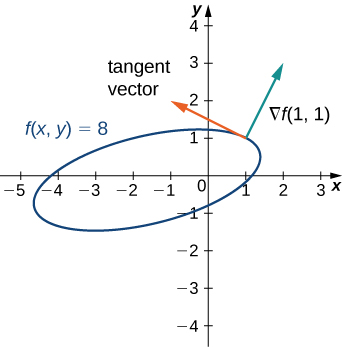
Checkpoint 4.32 §4.6 source ↗
Answer
Checkpoint 4.33 §4.6 source ↗
Answer
4-261 §4.6 source ↗
For the following exercises, find the directional derivative using the limit definition only.
at point in the direction of
Answer
4-263 §4.6 source ↗
For the following exercises, find the directional derivative of the function at point in the direction of or as appropriate.
Answer
4-265 §4.6 source ↗
For the following exercises, find the directional derivative of the function at point in the direction of or as appropriate.
Answer
4-267 §4.6 source ↗
For the following exercises, find the directional derivative of the function at point in the direction of or as appropriate.
Answer
4-269 §4.6 source ↗
For the following exercises, find the directional derivative of the function at point in the direction of or as appropriate.
Answer
4-271 §4.6 source ↗
For the following exercises, find the directional derivative of the function at point in the direction of or as appropriate.
Answer
4-273 §4.6 source ↗
For the following exercises, find the directional derivative of the function at point in the direction of or as appropriate.
Answer
4-275 §4.6 source ↗
For the following exercises, find the directional derivative of the function in the direction of the unit vector
Answer
4-277 §4.6 source ↗
For the following exercises, find the directional derivative of the function in the direction of the unit vector
Answer
4-279 §4.6 source ↗
For the following exercises, find the directional derivative of the function in the direction of the unit vector
Answer
4-281 §4.6 source ↗
For the following exercises, find the gradient.
Find the gradient of at point
Answer
4-283 §4.6 source ↗
For the following exercises, find the gradient.
Answer
4-285 §4.6 source ↗
For the following exercises, find the directional derivative of the function at point in the direction of
Answer
4-287 §4.6 source ↗
For the following exercises, find the derivative of the function at in the direction of
Answer
4-289 §4.6 source ↗
For the following exercises, find the derivative of the function at in the direction of
[T] Use technology to sketch the level curve of that passes through and draw the gradient vector at
Answer
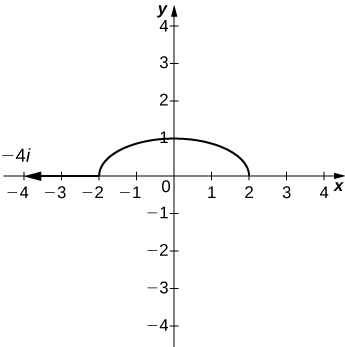
4-291 §4.6 source ↗
For the following exercises, find the gradient vector at the indicated point.
Answer
4-293 §4.6 source ↗
For the following exercises, find the gradient vector at the indicated point.
Answer
4-295 §4.6 source ↗
For the following exercises, find the derivative of the function.
at point in the direction the function increases most rapidly
Answer
4-297 §4.6 source ↗
For the following exercises, find the derivative of the function.
at point in the direction the function increases most rapidly
Answer
4-299 §4.6 source ↗
For the following exercises, find the maximum rate of change of at the given point and the direction in which it occurs.
Answer
4-301 §4.6 source ↗
For the following exercises, find the maximum rate of change of at the given point and the direction in which it occurs.
Answer
4-303 §4.6 source ↗
For the following exercises, find equations of
at point
Answer
4-305 §4.6 source ↗
For the following exercises, find equations of
at point
Answer
4-307 §4.6 source ↗
For the following exercises, solve the problem.
The electrical potential (voltage) in a certain region of space is given by the function
a. Find the rate of change of the voltage at point in the direction of the vector
b. In which direction does the voltage change most rapidly at point
c. What is the maximum rate of change of the voltage at point
Answer
4-309 §4.6 source ↗
For the following exercises, solve the problem.
In two dimensions, the motion of an ideal fluid is governed by a velocity potential The velocity components of the fluid in the x-direction and in the y-direction, are given by Find the velocity components associated with the velocity potential
Answer
Checkpoint 4.34 §4.7 source ↗
Answer
Checkpoint 4.35 §4.7 source ↗
Use the second derivative to find the local extrema of the function
Answer
Checkpoint 4.36 §4.7 source ↗
Use the problem-solving strategy for finding absolute extrema of a function to find the absolute extrema of the function
on the domain defined by and
Answer
The absolute minimum occurs at
The absolute maximum occurs at
4-311 §4.7 source ↗
For the following exercises, find all critical points.
Answer
4-313 §4.7 source ↗
For the following exercises, find all critical points.
Answer
4-315 §4.7 source ↗
For the following exercises, find the critical points of the function by using algebraic techniques (completing the square) or by examining the form of the equation. Verify your results using the partial derivatives test.
Answer
4-317 §4.7 source ↗
For the following exercises, find the critical points of the function by using algebraic techniques (completing the square) or by examining the form of the equation. Verify your results using the partial derivatives test.
Answer
4-319 §4.7 source ↗
For the following exercises, use the second derivative test to classify any critical points and determine whether each critical point is a maximum, minimum, saddle point, or none of these.
Answer
4-321 §4.7 source ↗
For the following exercises, use the second derivative test to classify any critical points and determine whether each critical point is a maximum, minimum, saddle point, or none of these.
Answer
4-323 §4.7 source ↗
For the following exercises, use the second derivative test to classify any critical points and determine whether each critical point is a maximum, minimum, saddle point, or none of these.
Answer
4-325 §4.7 source ↗
For the following exercises, use the second derivative test to classify any critical points and determine whether each critical point is a maximum, minimum, saddle point, or none of these.
Answer
4-327 §4.7 source ↗
For the following exercises, use the second derivative test to classify any critical points and determine whether each critical point is a maximum, minimum, saddle point, or none of these.
Answer
4-329 §4.7 source ↗
For the following exercises, use the second derivative test to classify any critical points and determine whether each critical point is a maximum, minimum, saddle point, or none of these.
Answer
4-331 §4.7 source ↗
For the following exercises, use the second derivative test to classify any critical points and determine whether each critical point is a maximum, minimum, saddle point, or none of these.
Answer
4-333 §4.7 source ↗
For the following exercises, use the second derivative test to classify any critical points and determine whether each critical point is a maximum, minimum, saddle point, or none of these.
Answer
4-335 §4.7 source ↗
For the following exercises, use the second derivative test to classify any critical points and determine whether each critical point is a maximum, minimum, saddle point, or none of these.
Answer
4-337 §4.7 source ↗
For the following exercises, use the second derivative test to classify any critical points and determine whether each critical point is a maximum, minimum, saddle point, or none of these.
Answer
4-339 §4.7 source ↗
For the following exercises, use the second derivative test to classify any critical points and determine whether each critical point is a maximum, minimum, saddle point, or none of these.
Answer
4-341 §4.7 source ↗
For the following exercises, determine the extreme values and the saddle points. Use a CAS to graph the function.
[T]
Answer
A saddle point is located at
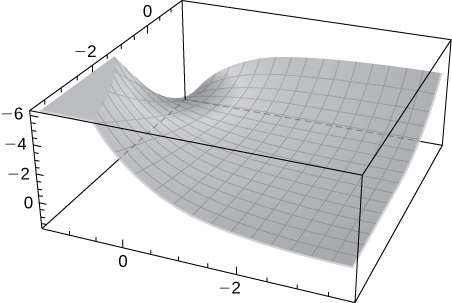
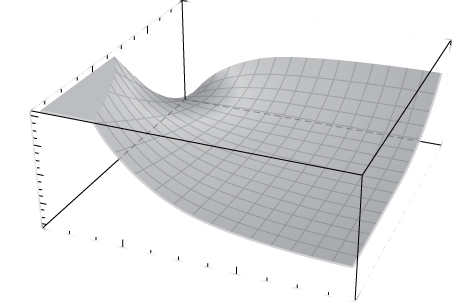
4-343 §4.7 source ↗
For the following exercises, determine the extreme values and the saddle points. Use a CAS to graph the function.
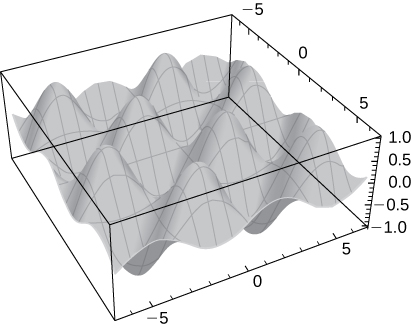
[T]
Answer
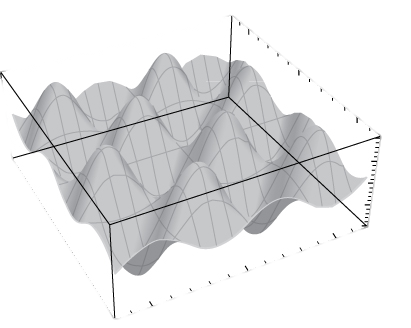
There is a saddle point at local maxima at and local minima at
4-345 §4.7 source ↗
Find the absolute extrema of the given function on the indicated closed and bounded set
Find the absolute maximum and minimum values of on the region
Answer
4-347 §4.7 source ↗
Find the absolute extrema of the given function on the indicated closed and bounded set
on
Answer
4-349 §4.7 source ↗
Find the absolute extrema of the given function on the indicated closed and bounded set
Find the points on the surface that are closest to the origin.
Answer
4-351 §4.7 source ↗
Find the absolute extrema of the given function on the indicated closed and bounded set
The sum of the length and the girth (perimeter of a cross-section) of a package carried by a delivery service cannot exceed in. Find the dimensions of the rectangular package of largest volume that can be sent.
Answer
4-353 §4.7 source ↗
Find the absolute extrema of the given function on the indicated closed and bounded set
Find the point on the surface nearest the plane Identify the point on the plane.
Answer
4-355 §4.7 source ↗
Find the absolute extrema of the given function on the indicated closed and bounded set
A company manufactures two types of athletic shoes: jogging shoes and cross-trainers. The total revenue from jogging shoes and cross-trainers is given by where and are in thousands of units. Find the values of x and y to maximize the total revenue.
Answer
4-357 §4.7 source ↗
Find the absolute extrema of the given function on the indicated closed and bounded set
Find the maximum volume of a cylindrical soda can such that the sum of its height and circumference is cm.
Answer
Checkpoint 4.37 §4.8 source ↗
Answer
Checkpoint 4.38 §4.8 source ↗
Answer
Checkpoint 4.39 §4.8 source ↗
Use the method of Lagrange multipliers to find the minimum value of the function
subject to the constraint
Answer
Checkpoint 4.40 §4.8 source ↗
Use the method of Lagrange multipliers to find the minimum value of the function
subject to the constraints and
Answer
4-359 §4.8 source ↗
For the following exercises, use the method of Lagrange multipliers to find the maximum and minimum values of the function subject to the given constraints.
Answer
4-361 §4.8 source ↗
For the following exercises, use the method of Lagrange multipliers to find the maximum and minimum values of the function subject to the given constraints.
Answer
4-363 §4.8 source ↗
For the following exercises, use the method of Lagrange multipliers to find the maximum and minimum values of the function subject to the given constraints.
Answer
4-365 §4.8 source ↗
For the following exercises, use the method of Lagrange multipliers to find the maximum and minimum values of the function subject to the given constraints.
Answer
4-367 §4.8 source ↗
For the following exercises, use the method of Lagrange multipliers to find the maximum and minimum values of the function subject to the given constraints.
Answer
4-369 §4.8 source ↗
For the following exercises, use the method of Lagrange multipliers to find the maximum and minimum values of the function subject to the given constraints.
Minimize on the hyperbola
Answer
4-371 §4.8 source ↗
For the following exercises, use the method of Lagrange multipliers to find the maximum and minimum values of the function subject to the given constraints.
Maximize on the sphere
Answer
4-373 §4.8 source ↗
For the following exercises, use the method of Lagrange multipliers to find the maximum and minimum values of the function subject to the given constraints.
The curve is asymptotic to the line Find the point(s) on the curve farthest from the line
Answer
4-375 §4.8 source ↗
For the following exercises, use the method of Lagrange multipliers to find the maximum and minimum values of the function subject to the given constraints.
Minimize
Answer
4-377 §4.8 source ↗
For the following exercises, use the method of Lagrange multipliers to find the maximum and minimum values of the function subject to the given constraints.
Minimize
Answer
4-379 §4.8 source ↗
For the following exercises, use the method of Lagrange multipliers to find the maximum and minimum values of the function subject to the given constraints.
Minimize when and
Answer
4-381 §4.8 source ↗
For the next group of exercises, use the method of Lagrange multipliers to solve the following applied problems.
A rectangular box without a top (a topless box) is to be made from ft2 of cardboard. Find the maximum volume of such a box.
Answer
4-383 §4.8 source ↗
For the next group of exercises, use the method of Lagrange multipliers to solve the following applied problems.
Find the point on the surface closest to the point
Answer
4-385 §4.8 source ↗
For the next group of exercises, use the method of Lagrange multipliers to solve the following applied problems.
Find the minimum distance from point to the parabola
Answer
4-387 §4.8 source ↗
For the next group of exercises, use the method of Lagrange multipliers to solve the following applied problems.
Find the minimum distance from the plane to point
Answer
4-389 §4.8 source ↗
For the next group of exercises, use the method of Lagrange multipliers to solve the following applied problems.
Find the point on the line that is closest to point
Answer
4-391 §4.8 source ↗
For the next group of exercises, use the method of Lagrange multipliers to solve the following applied problems.
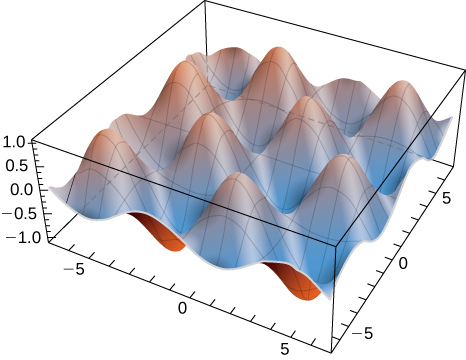
Find the maximum value of where denote the acute angles of a right triangle. Draw the contours of the function using a CAS.
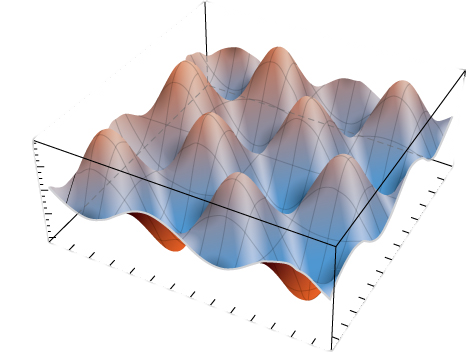
Answer
4-393 §4.8 source ↗
For the next group of exercises, use the method of Lagrange multipliers to solve the following applied problems.
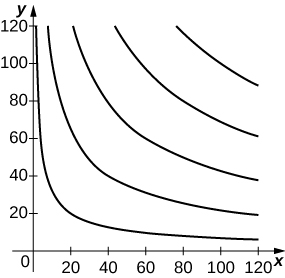
[T] By investing x units of labor and y units of capital, a watch manufacturer can produce watches. Find the maximum number of watches that can be produced on a budget of if labor costs $100/unit and capital costs $200/unit. Use a CAS to sketch a contour plot of the function.
Answer
Roughly 3365 watches at the critical point
4-395 §4.R source ↗
For the following exercises, determine whether the statement is true or false. Justify your answer with a proof or a counterexample.
If the function and all its second derivatives are continuous everywhere, then
Answer
4-397 §4.R source ↗
For the following exercises, determine whether the statement is true or false. Justify your answer with a proof or a counterexample.
is a critical point of
Answer
4-399 §4.R source ↗
For the following exercises, sketch the function in one graph and, in a second, sketch several level curves.
Answer
4-401 §4.R source ↗
For the following exercises, evaluate the following limits, if they exist. If they do not exist, prove it.
Answer
4-403 §4.R source ↗
For the following exercises, find the largest region of continuity for the function.
Answer
4-405 §4.R source ↗
For the following exercises, find all first derivatives, full or partial, as appropriate.
Answer
4-407 §4.R source ↗
For the following exercises, find all second partial derivatives.
Answer
4-409 §4.R source ↗
For the following exercises, find an equation of the tangent plane to the specified surface at the given point.
at point
Answer
4-411 §4.R source ↗
For the following exercises, find an equation of the tangent plane to the specified surface at the given point.
Find the differential of and approximate at the point Let and
Answer
4-413 §4.R source ↗
For the following exercises, find an equation of the tangent plane to the specified surface at the given point.
Find the maximal directional derivative magnitude and direction for the function at point
Answer
4-415 §4.R source ↗
For the following exercises, find the gradient.
Answer
4-417 §4.R source ↗
For the following exercises, use Lagrange multipliers to find the maximum and minimum values for the functions with the given constraints.
Answer
4-419 §4.R source ↗
For the following exercises, use Lagrange multipliers to find the maximum and minimum values for the functions with the given constraints.
A machinist is constructing a right circular cone out of a block of aluminum. The machine gives an error of in height and in radius. Find the maximum error in the volume of the cone if the machinist creates a cone of height cm and radius cm.
Answer
Loading chapter 5…
Problems and answers are adapted from Calculus Volume 3 by Gilbert Strang and Edwin “Jed” Herman, OpenStax, and are used under the CC BY-NC-SA 4.0 licence. Access for free at https://openstax.org/books/calculus-volume-3/pages/1-introduction. Illustrations: Copyright Rice University, OpenStax, under CC BY-NC-SA 4.0 license. This adaptation is released under the same licence, is non-commercial, and is neither affiliated with nor endorsed by OpenStax or Rice University.