Every problem in the chapter beside the book’s answer, a chapter at a time as you scroll.
Chapter 10: Monopolistic Competition and Oligopoly
4 problems · 3 figures10-1 §10.1 source ↗
Answer
10-2 §10.1 source ↗
Answer
10-3 §10.2 source ↗
Consider the curve in the figure below, which shows the market demand, marginal cost, and marginal revenue curve for firms in an oligopolistic industry. In this example, we assume firms have zero fixed costs.
a. Suppose the firms collude to form a cartel. What price will the cartel charge? What quantity will the cartel supply? How much profit will the cartel earn?
b. Suppose now that the cartel breaks up and the oligopolistic firms compete as vigorously as possible by cutting the price and increasing sales. What will be the industry quantity and price? What will be the collective profits of all firms in the industry?
c. Compare the equilibrium price, quantity, and profit for the cartel and cutthroat competition outcomes.
Answer
a. If the firms form a cartel, they will act like a monopoly, choosing the quantity of output where MR = MC. Drawing a line from the monopoly quantity up to the demand curve shows the monopoly price. Assuming that fixed costs are zero, and with an understanding of cost and profit, we can infer that when the marginal cost curve is horizontal, average cost is the same as marginal cost. Thus, the cartel will earn positive economic profits equal to the area of the rectangle, with a base equal to the monopoly quantity and a height equal to the difference between price (on the demand above the monopoly quantity) and average cost, as shown in the following figure. 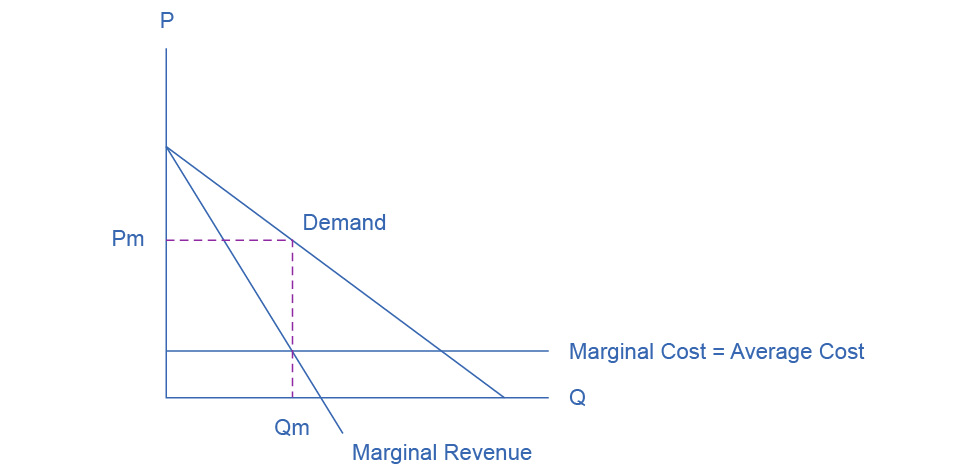
b. The firms will expand output and cut price as long as there are profits remaining. The long-run equilibrium will occur at the point where average cost equals demand. As a result, the oligopoly will earn zero economic profits due to “cutthroat competition,” as shown in the next figure. 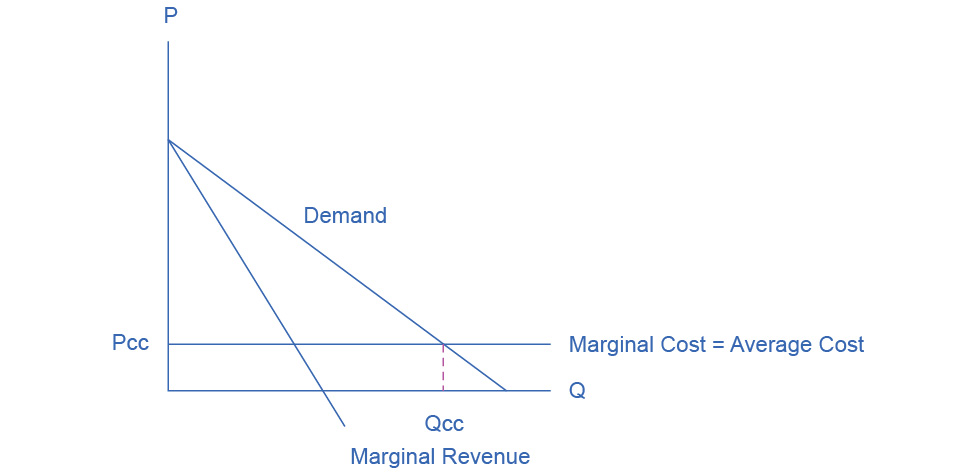
c. Pc > Pcc. Qc < Qcc. Profit for the cartel is positive and large. Profit for cutthroat competition is zero.
10-4 §10.2 source ↗
Sometimes oligopolies in the same industry are very different in size. Suppose we have a duopoly where one firm (Firm A) is large and the other firm (Firm B) is small, as the prisoner’s dilemma box in Table 10.4 shows.
Assuming that both firms know the payoffs, what is the likely outcome in this case?
| Firm B colludes with Firm A | Firm B cheats by selling more output | |
| Firm A colludes with Firm B | A gets $1,000, B gets $100 | A gets $800, B gets $200 |
| Firm A cheats by selling more output | A gets $1,050, B gets $50 | A gets $500, B gets $20 |
Answer
Loading chapter 11…
Problems and answers are adapted from Principles of Economics 3e by Steven A. Greenlaw, David Shapiro and Daniel MacDonald, OpenStax, and are used under the CC BY-NC-SA 4.0 licence. Access for free at https://openstax.org/books/principles-economics-3e/pages/1-introduction. Illustrations: Copyright Rice University, OpenStax, under CC BY-NC-SA 4.0 license. This adaptation is released under the same licence, is non-commercial, and is neither affiliated with nor endorsed by OpenStax or Rice University.