Every problem in the chapter beside the book’s answer, a chapter at a time as you scroll.
Chapter 11: Monopoly and Antitrust Policy
10 problems · 1 figure11-1 §11.1 source ↗
Answer
11-2 §11.1 source ↗
Answer
11-3 §11.1 source ↗
Answer
11-4 §11.1 source ↗
Answer
11-5 §11.2 source ↗
Answer
11-6 §11.3 source ↗
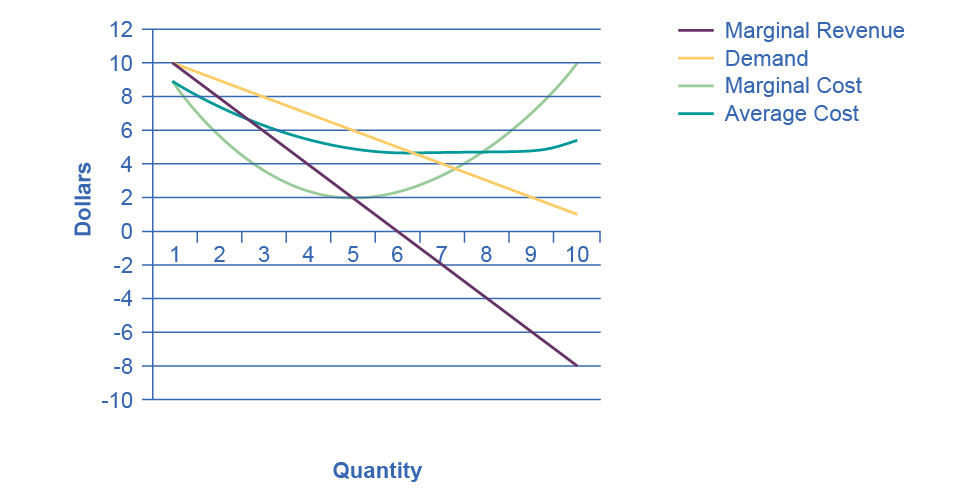
Urban transit systems, especially those with rail systems, typically experience significant economies of scale in operation. Consider the transit system data in Table 11.4. Note that the quantity is in millions of riders.
Draw the demand, marginal revenue, marginal cost, and average cost curves. Do they have the normal shapes?
| Demand: | Quantity | 1 | 2 | 3 | 4 | 5 | 6 | 7 | 8 | 9 | 10 |
| Price | 10 | 9 | 8 | 7 | 6 | 5 | 4 | 3 | 2 | 1 | |
| Marginal Revenue | 10 | 8 | 6 | 4 | 2 | 0 | –2 | –4 | –6 | –8 | |
| Costs: | Marginal Cost | 9 | 6 | 5 | 3 | 2 | 3 | 4 | 5 | 7 | 10 |
| Average Cost | 9 | 7.5 | 6.7 | 5.8 | 5 | 4.7 | 4.6 | 4.6 | 4.9 | 5.4 |
Answer
Yes, all curves have normal shapes.
11-7 §11.3 source ↗
Answer
11-8 §11.4 source ↗
Use the following information to answer the next three questions. In the years before wireless phones, when telephone technology required having a wire running to every home, it seemed plausible that telephone service had diminishing average costs and might require regulation like a natural monopoly. For most of the twentieth century, the national U.S. phone company was AT&T, and the company functioned as a regulated monopoly. Think about the deregulation of the U.S. telecommunications industry that has occurred over the last few decades. (This is not a research assignment, but a thought assignment based on what you have learned in this chapter.)
What real-world changes made the deregulation possible?
Answer
11-9 §11.4 source ↗
Use the following information to answer the next three questions. In the years before wireless phones, when telephone technology required having a wire running to every home, it seemed plausible that telephone service had diminishing average costs and might require regulation like a natural monopoly. For most of the twentieth century, the national U.S. phone company was AT&T, and the company functioned as a regulated monopoly. Think about the deregulation of the U.S. telecommunications industry that has occurred over the last few decades. (This is not a research assignment, but a thought assignment based on what you have learned in this chapter.)
What are some of the benefits of the deregulation?
Answer
11-10 §11.4 source ↗
Use the following information to answer the next three questions. In the years before wireless phones, when telephone technology required having a wire running to every home, it seemed plausible that telephone service had diminishing average costs and might require regulation like a natural monopoly. For most of the twentieth century, the national U.S. phone company was AT&T, and the company functioned as a regulated monopoly. Think about the deregulation of the U.S. telecommunications industry that has occurred over the last few decades. (This is not a research assignment, but a thought assignment based on what you have learned in this chapter.)
What might some of the negatives of deregulation be?
Answer
Loading chapter 12…
Problems and answers are adapted from Principles of Economics 3e by Steven A. Greenlaw, David Shapiro and Daniel MacDonald, OpenStax, and are used under the CC BY-NC-SA 4.0 licence. Access for free at https://openstax.org/books/principles-economics-3e/pages/1-introduction. Illustrations: Copyright Rice University, OpenStax, under CC BY-NC-SA 4.0 license. This adaptation is released under the same licence, is non-commercial, and is neither affiliated with nor endorsed by OpenStax or Rice University.