Every problem in the chapter beside the book’s answer, a chapter at a time as you scroll.

Chapter 2: Choice in a World of Scarcity

7 problems · 2 figures

2-1 §2.1 source ↗

Suppose Alphonso’s town raised the price of bus tickets from $0.50 per trip to $1 per trip (while the price of burgers stayed at $2 and his budget remained $10 per week.) Draw Alphonso’s new budget constraint. What happens to the opportunity cost of bus tickets?

Answer

The opportunity cost of bus tickets is the number of burgers that must be given up to obtain one more bus ticket. Originally, when the price of bus tickets was 50 cents per trip, this opportunity cost was 0.50/2 = .25 burgers. The reason for this is that at the original prices, one burger ($2) costs the same as four bus tickets ($0.50), so the opportunity cost of a burger is four bus tickets, and the opportunity cost of a bus ticket is .25 burgers (the inverse of the opportunity cost of a burger). With the new, higher price of bus tickets, the opportunity cost rises to $1/$2 or 0.50 burgers. You can see this graphically since the slope of the new budget constraint is steeper than the original one. If Alphonso spends all of his budget on burgers, the higher price of bus tickets has no impact so the vertical intercept of the budget constraint is the same. If he spends his entire budget on bus tickets, he can now afford only half as many, so the horizontal intercept is half as much. In short, the budget constraint rotates clockwise around the vertical intercept, steepening as it goes and the opportunity cost of bus tickets increases.
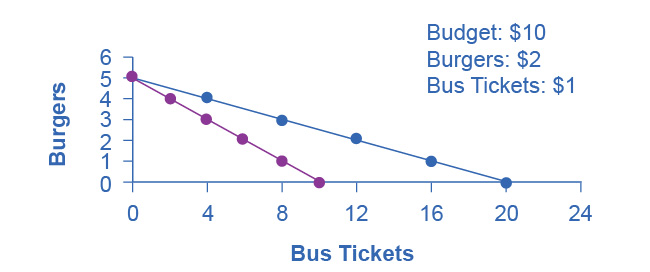
The graph shows how opportunity cost is affected by the purchase of either burgers or bus tickets. The opportunity cost of bus tickets is the number of burgers that must be given up to obtain one more bus ticket.

2-2 §2.2 source ↗

Return to the example in Figure 2.4. Suppose there is an improvement in medical technology that enables more healthcare with the same amount of resources. How would this affect the production possibilities curve and, in particular, how would it affect the opportunity cost of education?
Figure 2.4 Productive and Allocative Efficiency in the book ↗
Productive efficiency means it is impossible to produce more of one good without decreasing the quantity that is produced of another good. Thus, all choices along a given PPF like B, C, and D display productive efficiency, but R does not. Allocative efficiency means that the particular mix of goods being produced—that is, the specific choice along the production possibilities frontier—represents the allocation that society most desires.

Answer

Because of the improvement in technology, the vertical intercept of the PPF would be at a higher level of healthcare. In other words, the PPF would rotate clockwise around the horizontal intercept. This would make the PPF steeper, corresponding to an increase in the opportunity cost of education, since resources devoted to education would now mean forgoing a greater quantity of healthcare.

2-3 §2.2 source ↗

Could a nation be producing in a way that is allocatively efficient, but productively inefficient?

Answer

No. Allocative efficiency requires productive efficiency, because it pertains to choices along the production possibilities frontier.

2-4 §2.2 source ↗

What are the similarities between a consumer’s budget constraint and society’s production possibilities frontier, not just graphically but analytically?

Answer

Both the budget constraint and the PPF show the constraint that each operates under. Both show a tradeoff between having more of one good but less of the other. Both show the opportunity cost graphically as the slope of the constraint (budget or PPF).

2-5 §2.3 source ↗

Individuals may not act in the rational, calculating way described by the economic model of decision making, measuring utility and costs at the margin, but can you make a case that they behave approximately that way?

Answer

When individuals compare cost per unit in the grocery store, or characteristics of one product versus another, they are behaving approximately like the model describes.

2-6 §2.3 source ↗

Would an op-ed piece in a newspaper urging the adoption of a particular economic policy be a positive or normative statement?

Answer

Since an op-ed makes a case for what should be, it is considered normative.

2-7 §2.3 source ↗

Would a research study on the effects of soft drink consumption on children’s cognitive development be a positive or normative statement?

Answer

Assuming that the study is not taking an explicit position about whether soft drink consumption is good or bad, but just reporting the science, it would be considered positive.

Loading chapter 3…

Problems and answers are adapted from Principles of Economics 3e by Steven A. Greenlaw, David Shapiro and Daniel MacDonald, OpenStax, and are used under the CC BY-NC-SA 4.0 licence. Access for free at https://openstax.org/books/principles-economics-3e/pages/1-introduction. Illustrations: Copyright Rice University, OpenStax, under CC BY-NC-SA 4.0 license. This adaptation is released under the same licence, is non-commercial, and is neither affiliated with nor endorsed by OpenStax or Rice University.