Every problem in the chapter beside the book’s answer, a chapter at a time as you scroll.
Chapter 10: Liquids and Solids
72 problems · 11 figuresExample 10.1 §10.1 source ↗
Answer
Example 10.2 §10.1 source ↗
Answer
Example 10.3 §10.1 source ↗
Answer
Example 10.4 §10.2 source ↗
Answer
Example 10.5 §10.3 source ↗
| Compound | methanol CH3OH | ethanol C2H5OH | propanol C3H7OH | butanol C4H9OH |
| Vapor Pressure at 20 °C | 11.9 kPa | 5.95 kPa | 2.67 kPa | 0.56 kPa |
Answer
Pmethanol > Pethanol > Ppropanol > Pbutanol.
Example 10.6 §10.3 source ↗
Answer
Example 10.7 §10.3 source ↗
Answer
Example 10.8 §10.3 source ↗
Answer
Example 10.9 §10.3 source ↗
Answer
Example 10.10 §10.3 source ↗
Answer
Example 10.11 §10.4 source ↗
Answer
Example 10.12 §10.4 source ↗
Answer
at 1500 kPa: at −55 °C, at −10 °C;
at 50 kPa: at −60 °C
Example 10.13 §10.4 source ↗
Answer
Example 10.14 §10.6 source ↗
Answer
Then the density of Ni would be
Since the actual density of Ni is not close to this, Ni does not form a simple cubic structure.
Example 10.15 §10.6 source ↗
(a) What is the atomic radius of Ag in this structure?
(b) Calculate the density of Ag.
Answer
Example 10.16 §10.6 source ↗
Answer
Example 10.17 §10.6 source ↗
Answer
Example 10.18 §10.6 source ↗
Answer
Example 10.19 §10.6 source ↗
Answer
10-1 §10.1 source ↗
Answer
10-3 §10.1 source ↗
Answer
10-5 §10.1 source ↗
Answer
10-7 §10.1 source ↗
Define the following and give an example of each:
(a) dispersion force
(b) dipole-dipole attraction
(c) hydrogen bond
Answer
10-9 §10.1 source ↗
Answer
10-11 §10.1 source ↗
Arrange each of the following sets of compounds in order of increasing boiling point temperature:
(a) HCl, H2O, SiH4
(b) F2, Cl2, Br2
(c) CH4, C2H6, C3H8
(d) O2, NO, N2
Answer
10-13 §10.1 source ↗
Answer
10-15 §10.1 source ↗
Answer
10-17 §10.1 source ↗
Answer
10-19 §10.1 source ↗
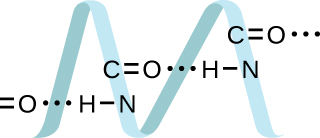
Proteins are chains of amino acids that can form in a variety of arrangements, one of which is a helix. What kind of IMF is responsible for holding the protein strand in this shape? On the protein image, show the locations of the IMFs that hold the protein together:
Answer
10-21 §10.1 source ↗
Identify the intermolecular forces present in the following solids:
(a) CH3CH2OH
(b) CH3CH2CH3
(c) CH3CH2Cl
Answer
10-23 §10.2 source ↗
Answer
10-25 §10.2 source ↗
Answer
10-27 §10.2 source ↗
The surface tension and viscosity of water at several different temperatures are given in this table.
| Water | Surface Tension (mN/m) | Viscosity (mPa s) |
|---|---|---|
| 0 °C | 75.6 | 1.79 |
| 20 °C | 72.8 | 1.00 |
| 60 °C | 66.2 | 0.47 |
| 100 °C | 58.9 | 0.28 |
(a) As temperature increases, what happens to the surface tension of water? Explain why this occurs, in terms of molecular interactions and the effect of changing temperature.
(b) As temperature increases, what happens to the viscosity of water? Explain why this occurs, in terms of molecular interactions and the effect of changing temperature.
Answer
10-29 §10.2 source ↗
Answer
10-31 §10.3 source ↗
Answer
10-33 §10.3 source ↗
Answer
10-35 §10.3 source ↗
Answer
10-37 §10.3 source ↗
Answer
10-39 §10.3 source ↗
Answer
10-41 §10.3 source ↗
Answer
10-43 §10.3 source ↗
Explain the following observations:
(a) It takes longer to cook an egg in Ft. Davis, Texas (altitude, 5000 feet above sea level) than it does in Boston (at sea level).
(b) Perspiring is a mechanism for cooling the body.
Answer
10-45 §10.3 source ↗
Answer
10-47 §10.3 source ↗
Answer
10-49 §10.3 source ↗
Answer
10-51 §10.3 source ↗
Answer
10-53 §10.3 source ↗
Titanium tetrachloride, TiCl4, has a melting point of −23.2 °C and has a ΔH fusion = 9.37 kJ/mol.
(a) How much energy is required to melt 263.1 g TiCl4?
(b) For TiCl4, which will likely have the larger magnitude: ΔH fusion or ΔH vaporization? Explain your reasoning.
Answer
10-55 §10.4 source ↗
Answer
10-57 §10.4 source ↗
From the phase diagram for carbon dioxide in Figure 10.34, determine the state of CO2 at:
(a) 20 °C and 1000 kPa
(b) 10 °C and 2000 kPa
(c) 10 °C and 100 kPa
(d) −40 °C and 500 kPa
(e) −80 °C and 1500 kPa
(f) −80 °C and 10 kPa
Answer
10-59 §10.4 source ↗
Answer
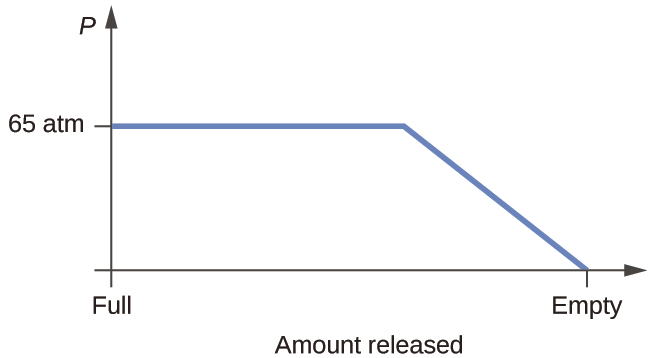
10-61 §10.4 source ↗
Answer
10-63 §10.4 source ↗
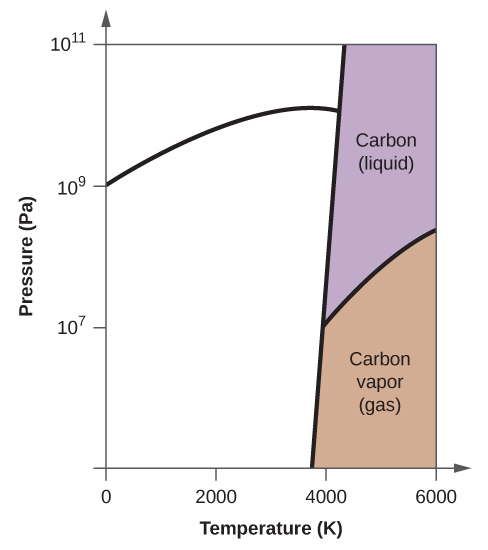
Elemental carbon has one gas phase, one liquid phase, and two different solid phases, as shown in the phase diagram:
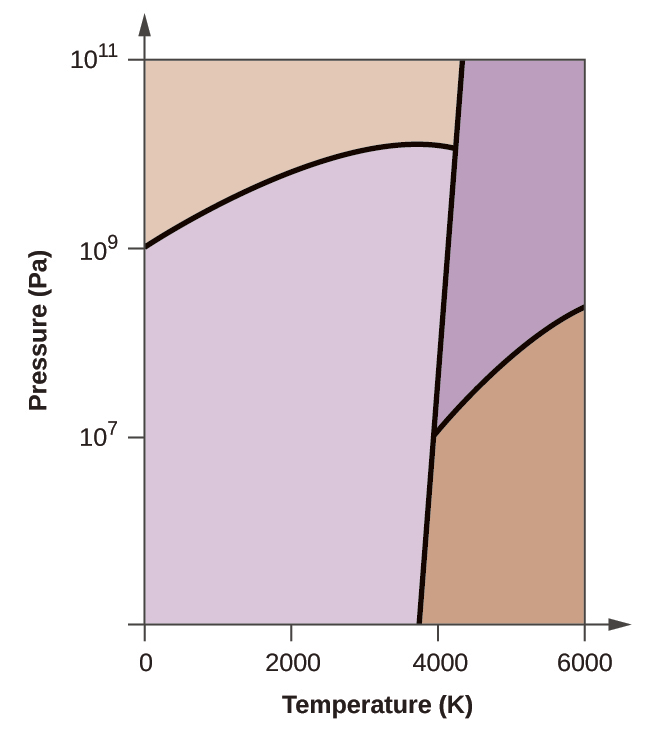
(a) On the phase diagram, label the gas and liquid regions.
(b) Graphite is the most stable phase of carbon at normal conditions. On the phase diagram, label the graphite phase.
(c) If graphite at normal conditions is heated to 2500 K while the pressure is increased to 1010 Pa, it is converted into diamond. Label the diamond phase.
(d) Circle each triple point on the phase diagram.
(e) In what phase does carbon exist at 5000 K and 108 Pa?
(f) If the temperature of a sample of carbon increases from 3000 K to 5000 K at a constant pressure of 106 Pa, which phase transition occurs, if any?
Answer
(a)
(b)
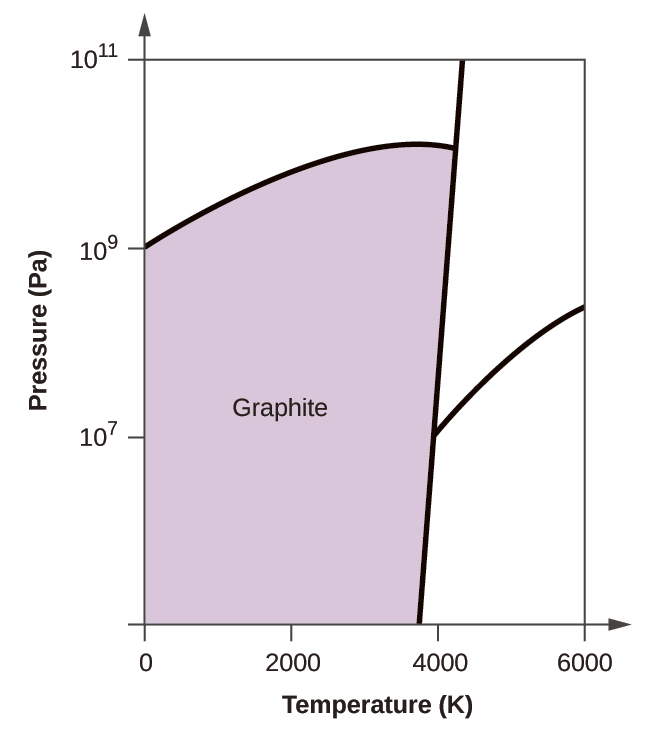
(c)
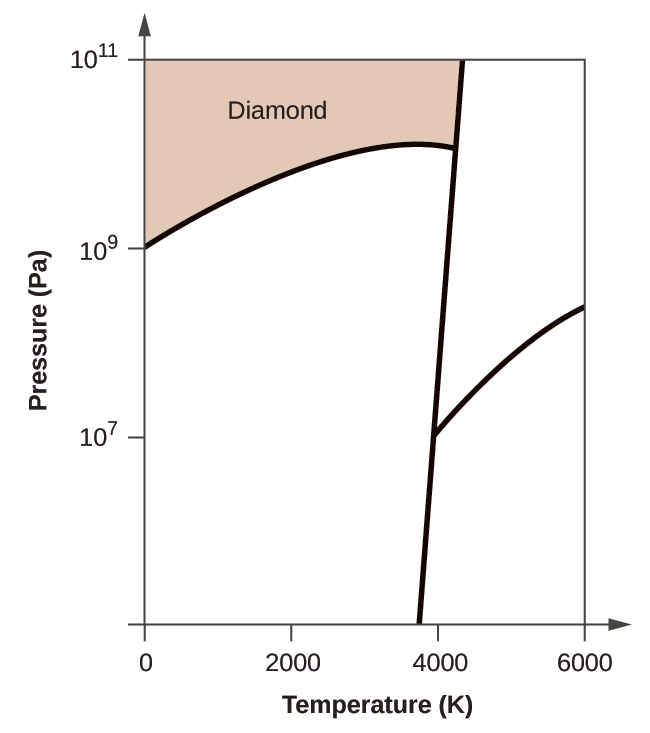
(d)
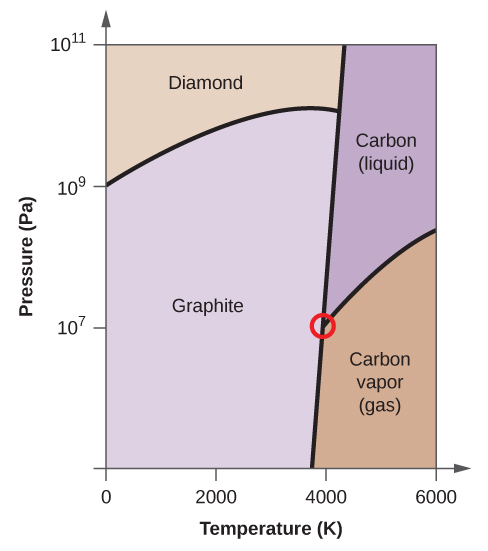
(e) liquid phase (f) sublimation
10-65 §10.5 source ↗
At very low temperatures oxygen, O2, freezes and forms a crystalline solid. Which best describes these crystals?
(a) ionic
(b) covalent network
(c) metallic
(d) amorphous
(e) molecular crystals
Answer
10-67 §10.5 source ↗
Answer
10-69 §10.5 source ↗
Identify the type of crystalline solid (metallic, network covalent, ionic, or molecular) formed by each of the following substances:
(a) CaCl2
(b) SiC
(c) N2
(d) Fe
(e) C (graphite)
(f) CH3CH2CH2CH3
(g) HCl
(h) NH4NO3
(i) K3PO4
Answer
10-71 §10.5 source ↗
Classify each substance in the table as either a metallic, ionic, molecular, or covalent network solid:
| Substance | Appearance | Melting Point | Electrical Conductivity | Solubility in Water |
|---|---|---|---|---|
| X | brittle, white | 800 °C | only if melted/dissolved | soluble |
| Y | shiny, malleable | 1100 °C | high | insoluble |
| Z | hard, colorless | 3550 °C | none | insoluble |
Answer
10-73 §10.5 source ↗
Substance A is shiny, conducts electricity well, and melts at 975 °C. Substance A is likely a(n):
(a) ionic solid
(b) metallic solid
(c) molecular solid
(d) covalent network solid
Answer
10-75 §10.6 source ↗
Answer
10-77 §10.6 source ↗
Answer
10-79 §10.6 source ↗
Answer
10-81 §10.6 source ↗
Tungsten crystallizes in a body-centered cubic unit cell with an edge length of 3.165 Å.
(a) What is the atomic radius of tungsten in this structure?
(b) Calculate the density of tungsten.
Answer
10-83 §10.6 source ↗
Barium crystallizes in a body-centered cubic unit cell with an edge length of 5.025 Å
(a) What is the atomic radius of barium in this structure?
(b) Calculate the density of barium.
Answer
10-85 §10.6 source ↗
Answer
10-87 §10.6 source ↗
Answer
10-89 §10.6 source ↗
Answer
10-91 §10.6 source ↗
Answer
10-93 §10.6 source ↗
Answer
10-95 §10.6 source ↗
Answer
10-97 §10.6 source ↗
Answer
10-99 §10.6 source ↗
Answer
10-101 §10.6 source ↗
Answer
10-103 §10.6 source ↗
Answer
10-105 §10.6 source ↗
Answer
Loading chapter 11…
Problems and answers are adapted from Chemistry 2e by Paul Flowers, Klaus Theopold, Richard Langley and William R. Robinson, OpenStax, and are used under the CC BY-NC-SA 4.0 licence. Access for free at https://openstax.org/books/chemistry-2e/pages/1-introduction. Illustrations: Copyright Rice University, OpenStax, under CC BY-NC-SA 4.0 license. This adaptation is released under the same licence, is non-commercial, and is neither affiliated with nor endorsed by OpenStax or Rice University.