Every problem in the chapter beside the book’s answer, a chapter at a time as you scroll.
Chapter 8: Advanced Theories of Covalent Bonding
32 problems · 20 figuresExample 8.1 §8.1 source ↗
(a) side-by-side overlap of a 4p and a 2p orbital
(b) end-to-end overlap of a 4p and 4p orbital
(c) end-to-end overlap of a 4p and a 2p orbital

Answer
Example 8.2 §8.2 source ↗
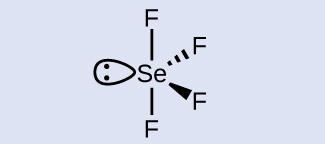
Answer
Example 8.3 §8.2 source ↗
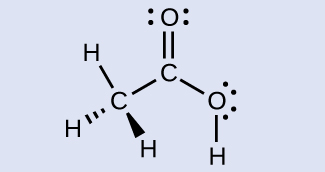
Answer
Example 8.4 §8.3 source ↗
Answer
Example 8.5 §8.4 source ↗

Answer
The orbital is located along the internuclear axis, so it is a σ orbital. There is a node bisecting the internuclear axis, so it is an antibonding orbital.

Example 8.6 §8.4 source ↗
Answer
Example 8.7 §8.4 source ↗
Answer
8-1 §8.1 source ↗
Answer
8-3 §8.1 source ↗
Answer
8-5 §8.1 source ↗
Answer
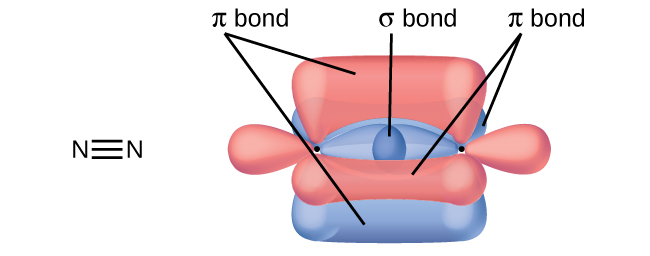
Bonding: One σ bond and one π bond. The s orbitals are filled and do not overlap. The p orbitals overlap along the axis to form a σ bond and side-by-side to form the π bond.
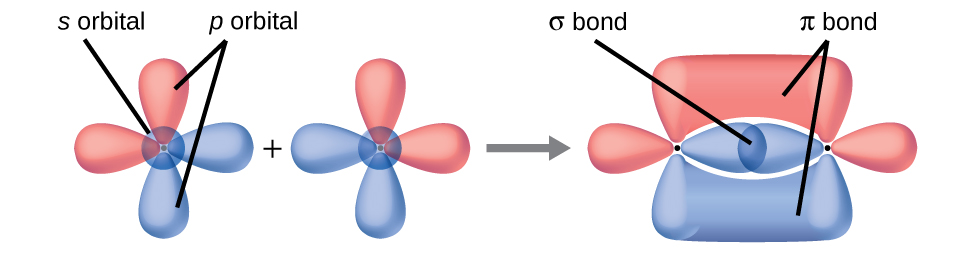
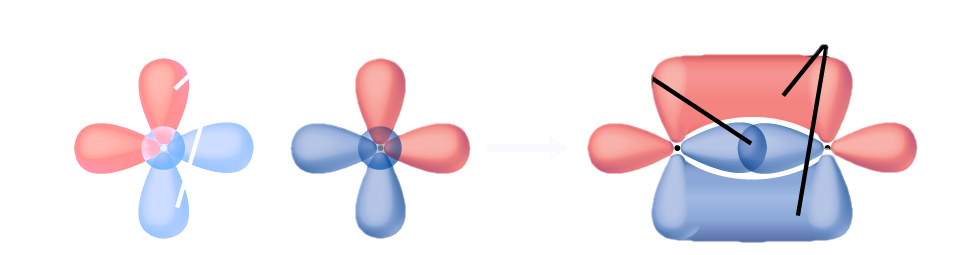
8-7 §8.1 source ↗
Answer
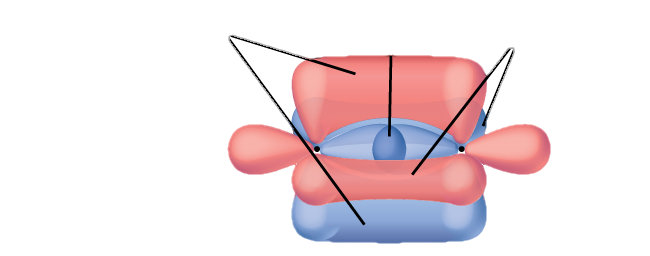
No, two of the p orbitals (one on each N) will be oriented end-to-end and will form a σ bond.
8-9 §8.2 source ↗
Answer
8-11 §8.2 source ↗
Answer
8-13 §8.2 source ↗
Answer
8-15 §8.2 source ↗
Sulfuric acid is manufactured by a series of reactions represented by the following equations:
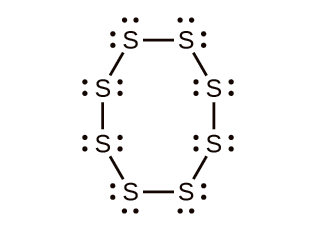
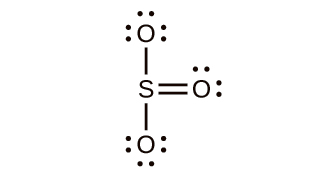
Draw a Lewis structure, predict the molecular geometry by VSEPR, and determine the hybridization of sulfur for the following:
(a) circular S8 molecule
(b) SO2 molecule
(c) SO3 molecule
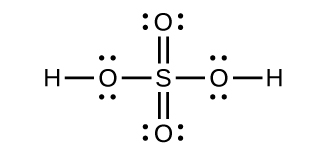
(d) H2SO4 molecule (the hydrogen atoms are bonded to oxygen atoms)
Answer
(a) Each S has a bent (109°) geometry, sp3
(b) Bent (120°), sp2

(c) Trigonal planar, sp2
(d) Tetrahedral, sp3
8-17 §8.2 source ↗
Analysis of a compound indicates that it contains 77.55% Xe and 22.45% F by mass.
(a) What is the empirical formula for this compound? (Assume this is also the molecular formula in responding to the remaining parts of this exercise).
(b) Write a Lewis structure for the compound.
(c) Predict the shape of the molecules of the compound.
(d) What hybridization is consistent with the shape you predicted?
Answer
(a) XeF2
(b)

(c) linear (d) sp3d
8-19 §8.2 source ↗
Strike-anywhere matches contain a layer of KClO3 and a layer of P4S3. The heat produced by the friction of striking the match causes these two compounds to react vigorously, which sets fire to the wooden stem of the match. KClO3 contains the ion. P4S3 is an unusual molecule with the skeletal structure.
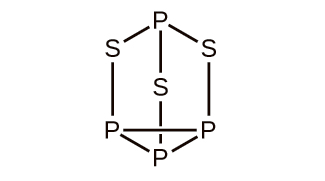
(a) Write Lewis structures for P4S3 and the ion.
(b) Describe the geometry about the P atoms, the S atom, and the Cl atom in these species.
(c) Assign a hybridization to the P atoms, the S atom, and the Cl atom in these species.
(d) Determine the oxidation states and formal charge of the atoms in P4S3 and the ion.
Answer
(a)
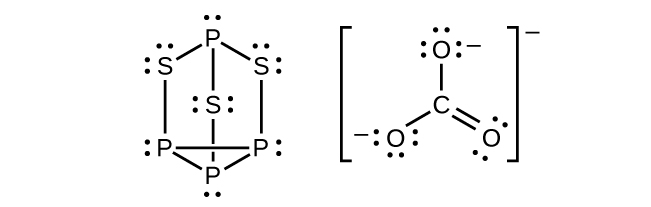
(b) P atoms, trigonal pyramidal; S atoms, bent, with two lone pairs; Cl atoms, trigonal pyramidal; (c) Hybridization about P, S, and Cl is, in all cases, sp3; (d) Oxidation states P +1, S Cl +5, O –2. Formal charges: P 0; S 0; Cl +2: O –1
8-21 §8.2 source ↗
Answer
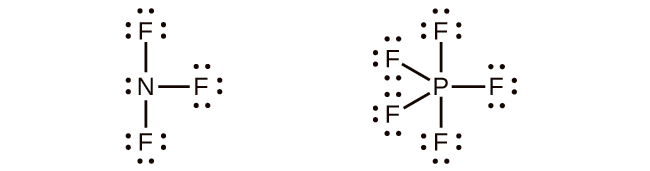
Phosphorus and nitrogen can form sp3 hybrids to form three bonds and hold one lone pair in PF3 and NF3, respectively. However, nitrogen has no valence d orbitals, so it cannot form a set of sp3d hybrid orbitals to bind five fluorine atoms in NF5. Phosphorus has d orbitals and can bind five fluorine atoms with sp3d hybrid orbitals in PF5.
8-23 §8.3 source ↗
Answer
8-25 §8.3 source ↗
A useful solvent that will dissolve salts as well as organic compounds is the compound acetonitrile, H3CCN. It is present in paint strippers.
(a) Write the Lewis structure for acetonitrile, and indicate the direction of the dipole moment in the molecule.
(b) Identify the hybrid orbitals used by the carbon atoms in the molecule to form σ bonds.
(c) Describe the atomic orbitals that form the π bonds in the molecule. Note that it is not necessary to hybridize the nitrogen atom.
Answer
(a)

(b) The terminal carbon atom uses sp3 hybrid orbitals, while the central carbon atom is sp hybridized. (c) Each of the two π bonds is formed by overlap of a 2p orbital on carbon and a nitrogen 2p orbital.
8-27 §8.3 source ↗
Identify the hybridization of the central atom in each of the following molecules and ions that contain multiple bonds:
(a) ClNO (N is the central atom)
(b) CS2
(c) Cl2CO (C is the central atom)
(d) Cl2SO (S is the central atom)
(e) SO2F2 (S is the central atom)
(f) XeO2F2 (Xe is the central atom)
(g) (Cl is the central atom)
Answer
8-29 §8.3 source ↗
For each of the following molecules, indicate the hybridization requested and whether or not the electrons will be delocalized:
(a) ozone (O3) central O hybridization
(b) carbon dioxide (CO2) central C hybridization
(c) nitrogen dioxide (NO2) central N hybridization
(d) phosphate ion central P hybridization
Answer
8-31 §8.3 source ↗
Answer
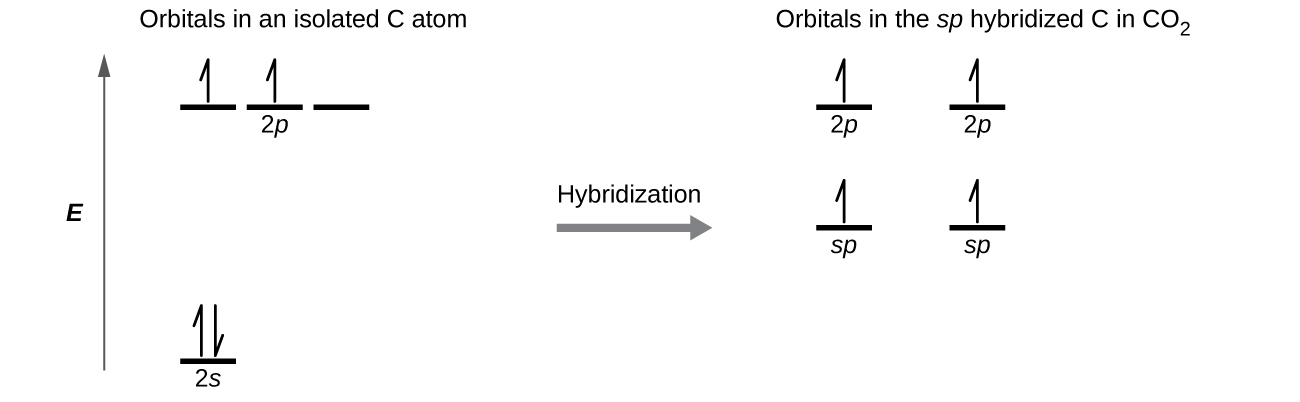

Each of the four electrons is in a separate orbital and overlaps with an electron on an oxygen atom.
8-33 §8.4 source ↗
How are the following similar, and how do they differ?
(a) σ molecular orbitals and π molecular orbitals
(b) ψ for an atomic orbital and ψ for a molecular orbital
(c) bonding orbitals and antibonding orbitals
Answer
8-35 §8.4 source ↗
Answer
8-37 §8.4 source ↗
Answer
8-39 §8.4 source ↗
Answer
8-41 §8.4 source ↗
Determine the bond order of each member of the following groups, and determine which member of each group is predicted by the molecular orbital model to have the strongest bond.
(a) H2,
(b) O2,
(c) Li2, Be2
(d) F2,
(e) N2,
Answer
8-43 §8.4 source ↗
Compare the atomic and molecular orbital diagrams to identify the member of each of the following pairs that has the highest first ionization energy (the most tightly bound electron) in the gas phase:
(a) H and H2
(b) N and N2
(c) O and O2
(d) C and C2
(e) B and B2
Answer
8-45 §8.4 source ↗
Answer
8-47 §8.4 source ↗
Answer
8-49 §8.4 source ↗
Answer
Loading chapter 9…
Problems and answers are adapted from Chemistry 2e by Paul Flowers, Klaus Theopold, Richard Langley and William R. Robinson, OpenStax, and are used under the CC BY-NC-SA 4.0 licence. Access for free at https://openstax.org/books/chemistry-2e/pages/1-introduction. Illustrations: Copyright Rice University, OpenStax, under CC BY-NC-SA 4.0 license. This adaptation is released under the same licence, is non-commercial, and is neither affiliated with nor endorsed by OpenStax or Rice University.