Every problem in the chapter beside the book’s answer, a chapter at a time as you scroll.

Chapter 15: Equilibria of Other Reaction Classes

68 problems · 10 figures

Example 15.1 §15.1 source ↗

Write the dissolution equation and the solubility product for each of the following slightly soluble compounds:

(a) BaSO4

(b) Ag2SO4

(c) Al(OH)3

(d) Pb(OH)Cl

Answer

(a)BaSO4(s)⇌Ba2+(aq)+SO42−(aq)Ksp=[Ba2+][SO42−];(b)Ag2SO4(s)⇌2Ag+(aq)+SO42−(aq)Ksp=[Ag+]2[SO42−];(c)Al(OH)3(s)⇌Al3+(aq)+3OH−(aq)Ksp=[Al3+][OH−]3;(d)Pb(OH)Cl(s)⇌Pb2+(aq)+OH−(aq)+Cl−(aq)Ksp=[Pb2+][OH−][Cl−]

Example 15.2 §15.1 source ↗

In a saturated solution of Mg(OH)2, the concentration of Mg2+ is 1.31 × 10⁻⁴ M. What is the solubility product for Mg(OH)2?Mg(OH)2(s)⇌Mg2+(aq)+2OH−(aq)

Answer

8.99 × 10⁻¹²

Example 15.3 §15.1 source ↗

The Ksp of AgI is 1.5 × 10⁻¹⁶. Calculate the molar solubility of silver iodide.

Answer

1.2 × 10⁻⁸ M

Example 15.4 §15.1 source ↗

The Ksp of PbI2 is 1.4 × 10⁻⁸. Calculate the molar solubility of lead(II) iodide.

Answer

1.5 × 10⁻³ M

Example 15.5 §15.1 source ↗

The solubility of TlCl [thallium(I) chloride], an intermediate formed when thallium is being isolated from ores, is 3.12 grams per liter at 20 °C. What is its solubility product?

Answer

1.69 × 10⁻⁴

Example 15.6 §15.1 source ↗

Determine the molar solubility of MgF2 from its solubility product: Ksp = 6.4 × 10⁻⁹.

Answer

1.2 × 10⁻³ M

Example 15.7 §15.1 source ↗

Predict whether CaHPO4 will precipitate from a solution with [Ca2+] = 0.0001 M and [HPO42−] = 0.001 M.

Answer

No precipitation of CaHPO4; Q = 1 × 10⁻⁷, which is less than Ksp (7 × 10⁻⁷)

Example 15.8 §15.1 source ↗

Will KClO4 precipitate when 20 mL of a 0.050-M solution of K+ is added to 80 mL of a 0.50-M solution of ClO4−? (Hint: Use the dilution equation to calculate the concentrations of potassium and perchlorate ions in the mixture.)

Answer

No, Q = 4.0 × 10⁻³, which is less than Ksp = 1.05 × 10⁻²

Example 15.9 §15.1 source ↗

If a solution contains 0.0020 mol of CrO42− per liter, what concentration of Ag+ ion must be reached by adding solid AgNO3 before Ag2CrO4 begins to precipitate? Neglect any increase in volume upon adding the solid silver nitrate.

Answer

6.7 × 10⁻⁵ M

Example 15.10 §15.1 source ↗

The first step in the preparation of magnesium metal is the precipitation of Mg(OH)2 from sea water by the addition of Ca(OH)2. The concentration of Mg2+(aq) in sea water is 5.37 × 10⁻² M. Calculate the pH at which [Mg2+] is decreased to 1.0 × 10⁻⁵ M

Answer

10.97

Example 15.11 §15.1 source ↗

If silver nitrate solution is added to a solution which is 0.050 M in both Cl– and Br– ions, at what [Ag+] would precipitation begin, and what would be the formula of the precipitate?

Answer

[Ag+] = 1.0 × 10⁻¹¹ M; AgBr precipitates first

Example 15.12 §15.1 source ↗

What is the effect on the amount of solid NiCO3 and the concentrations of Ni2+ and CO32− when each of the following are added to a saturated solution of NiCO3

(a) Ni(NO3)2

(b) KClO4

(c) NiCO3

(d) K2CO3

Answer

(a) mass of NiCO3(s) increases, [Ni2+] increases, [CO32−] decreases; (b) no appreciable effect; (c) no effect except to increase the amount of solid NiCO3; (d) mass of NiCO3(s) increases, [Ni2+] decreases, [CO32−] increases;

Example 15.13 §15.1 source ↗

Calculate the molar solubility of aluminum hydroxide, Al(OH)3, in a 0.015-M solution of aluminum nitrate, Al(NO3)3. The Ksp of Al(OH)3 is 2 × 10–32.

Answer

4 × 10–11 M

Example 15.14 §15.2 source ↗

Calculate the silver ion concentration, [Ag+], of a solution prepared by dissolving 1.00 g of AgNO3 and 10.0 g of KCN in sufficient water to make 1.00 L of solution. (Hint: Because Kf is very large, the silver/cyanide complex ion (see Appendix K), assume the reaction goes to completion and then calculate the [Ag+] produced by dissociation of the complex.)

Answer

2.9 × 10⁻²² M

Example 15.15 §15.3 source ↗

What is the solubility of aluminum hydroxide in a buffer comprised of 0.100 M formic acid and 0.100 M sodium formate?

Answer

0.1 M

Example 15.16 §15.3 source ↗

AgCl(s), silver chloride, has a very low solubility: AgCl(s)⇌ Ag+(aq)+ Cl−(aq), Ksp = 1.6 × 10⁻¹⁰. Adding ammonia significantly increases the solubility of AgCl because a complex ion is formed: Ag+(aq)+ 2NH3(aq)⇌ Ag(NH3)2+(aq), Kf = 1.7 × 10⁷. What mass of NH3 is required to prepare 1.00 L of solution that will dissolve 2.00 g of AgCl by formation of Ag(NH3)2+?

Answer

1.00 L of a solution prepared with 5.0 g NH3 dissolves 2.0 g of AgCl.

15-1 §15.1 source ↗

Complete the changes in concentrations for each of the following reactions:

(a)
AgI(s)⟶ Ag+(aq)+ I−(aq)x_____

(b)
CaCO3(s)⟶ Ca2+(aq)+CO3 2−(aq)____x

(c)
Mg(OH)2(s)⟶ Mg2+(aq)+2 OH−(aq)x_____

(d)
Mg3(PO4)2(s)⟶ 3Mg2+(aq)+ 2PO43−(aq) x _____

(e)
Ca5(PO4)3OH(s)⟶5Ca2+(aq)+3PO43−(aq)+OH−(aq)__________x

Answer

(a)
AgI(s)⇌Ag+(aq)+I−(aq)xx_
(b)
CaCO3(s)⇌Ca2+(aq)+CO32−(aq)x_x
(c)
Mg(OH)2(s)⇌Mg2+(aq)+2OH−(aq)x2x_
(d)
Mg3(PO4)2(s)⇌3Mg2+(aq)+2PO43−(aq) x_ 23x
(e)
Ca5(PO4)3OH(s)⇌5Ca2+(aq)+3PO43−(aq)+OH−(aq)5x_3x_x

15-3 §15.1 source ↗

How do the concentrations of Ag+ and CrO42− in a saturated solution above 1.0 g of solid Ag2CrO4 change when 100 g of solid Ag2CrO4 is added to the system? Explain.

Answer

There is no change. A solid has an activity of 1 whether there is a little or a lot.

15-5 §15.1 source ↗

What additional information do we need to answer the following question: How is the equilibrium of solid silver bromide with a saturated solution of its ions affected when the temperature is raised?

Answer

The solubility of silver bromide at the new temperature must be known. Normally the solubility increases and some of the solid silver bromide will dissolve.

15-7 §15.1 source ↗

Which of the following slightly soluble compounds has a solubility greater than that calculated from its solubility product because of hydrolysis of the anion present: AgCl, BaSO4, CaF2, Hg2I2, MnCO3, and ZnS?

Answer

CaF2, MnCO3, and ZnS

15-9 §15.1 source ↗

Write the ionic equation for the dissolution and the Ksp expression for each of the following slightly soluble ionic compounds:

(a) LaF3

(b) CaCO3

(c) Ag2SO4

(d) Pb(OH)2

Answer

(a) LaF3(s)⇌ La3+(aq)+ 3F−(aq) Ksp= [La3+][F−]3;
(b) CaCO3(s)⇌ Ca2+(aq)+ CO32−(aq) Ksp= [Ca2+][CO32−];
(c) Ag2SO4(s)⇌ 2Ag+(aq)+ SO42−(aq) Ksp= [Ag+]2[SO42−];
(d) Pb(OH)2(s)⇌ Pb2+(aq)+ 2OH−(aq) Ksp= [Pb2+][OH−]2

15-11 §15.1 source ↗

The Handbook of Chemistry and Physics gives solubilities of the following compounds in grams per 100 mL of water. Because these compounds are only slightly soluble, assume that the volume does not change on dissolution and calculate the solubility product for each.

(a) BaSeO4, 0.0118 g/100 mL

(b) Ba(BrO3)2·H2O, 0.30 g/100 mL

(c) NH4MgAsO4·6H2O, 0.038 g/100 mL

(d) La2(MoO4)3, 0.00179 g/100 mL

Answer

(a)1.77 × 10⁻⁷; (b) 1.6 × 10⁻⁶; (c) 2.2 × 10⁻⁹; (d) 7.91 × 10–22

15-13 §15.1 source ↗

Assuming that no equilibria other than dissolution are involved, calculate the molar solubility of each of the following from its solubility product:

(a) KHC4H4O6

(b) PbI2

(c) Ag4[Fe(CN)6], a salt containing the Fe(CN)64– ion

(d) Hg2I2

Answer

(a) 2 × 10⁻² M; (b) 1.5 × 10⁻³ M; (c) 2.27 × 10⁻⁹ M; (d) 2.2 × 10⁻¹⁰ M

15-15 §15.1 source ↗

Assuming that no equilibria other than dissolution are involved, calculate the concentration of all solute species in each of the following solutions of salts in contact with a solution containing a common ion. Show that changes in the initial concentrations of the common ions can be neglected.

(a) AgCl(s) in 0.025 M NaCl

(b) CaF2(s) in 0.00133 M KF

(c) Ag2SO4(s) in 0.500 L of a solution containing 19.50 g of K2SO4

(d) Zn(OH)2(s) in a solution buffered at a pH of 11.45

Answer

(a) 6.4 × 10⁻⁹ M = [Ag+], [Cl−] = 0.025 M. Check: 6.4×10⁻⁹M0.025M×100%= 2.6×10⁻⁵%,an insignificant change;
(b) 2.2 × 10⁻⁵ M = [Ca2+], [F−] = 0.0013 M. Check: 2.26×10⁻⁵M0.00133M×100%= 1.70%. This value is less than 5% and can be ignored.
(c) 0.2238 M = [SO42−]; [Ag+] = 7.4 × 10⁻³ M. Check: 3.7×10−30.2238×100%= 1.64×10⁻²; the condition is satisfied.
(d) [OH–] = 2.8 × 10⁻³ M; 5.7 × 10⁻¹² M = [Zn2+]. Check: 5.7×10−122.8×10−3×100%= 2.0×10⁻⁷%; x is less than 5% of [OH–] and is, therefore, negligible.

15-17 §15.1 source ↗

Assuming that no equilibria other than dissolution are involved, calculate the concentration of all solute species in each of the following solutions of salts in contact with a solution containing a common ion. State whether or not it is appropriate to neglect the changes in the initial concentrations of the common ions.

(a) TlCl(s) in 0.025 M TlNO3

(b) BaF2(s) in 0.313 M KF

(c) MgC2O4 in 2.250 L of a solution containing 8.156 g of Mg(NO3)2

(d) Ca(OH)2(s) in an unbuffered solution initially with a pH of 12.700

Answer

(a) The change in initial concentration of common ion may not be neglected (must solve quadratic equation)
[Ti+] =0.031 M
[Cl–] = 0.0056 M (b) The change in initial concentration of common ion may be neglected.
[Ba2+] = 2.4 × 10⁻⁴ M
[F–] = 0.313 M;
(c) The change in initial concentration of common ion may be neglected.
[Mg2+] = 0.0244 M
[C2O42−]= 2.9×10⁻⁵M
(d) The change in initial concentration of common ion may be neglected.
[Ca2+] = 5.18 × 10⁻⁴ M
[C2)42–] = 0.051 M

15-19 §15.1 source ↗

Explain why the changes in concentrations of the common ions in Exercise 15.18 cannot be neglected.

Answer

The changes in concentration are greater than 5% and thus exceed the maximum value for disregarding the change.

15-21 §15.1 source ↗

Refer to Appendix J for solubility products for calcium salts. Determine which of the calcium salts listed is most soluble in moles per liter and which is most soluble in grams per liter.

Answer

CaSO4∙2H2O is the most soluble Ca salt in mol/L, and it is also the most soluble Ca salt in g/L.

15-23 §15.1 source ↗

Public Health Service standards for drinking water set a maximum of 250 mg/L (2.60 × 10⁻³ M) of SO42− because of its cathartic action (it is a laxative). Does natural water that is saturated with CaSO4 (“gyp” water) as a result or passing through soil containing gypsum, CaSO4·2H2O, meet these standards? What is the concentration of SO42− in such water?

Answer

7.8 × 10⁻³ M = [SO42−] = [Ca2+]; Since this concentration is higher than 2.60 × 10⁻³ M, “gyp” water does not meet the standards.

15-25 §15.1 source ↗

The solubility product of CaSO4·2H2O is 2.4 × 10⁻⁵. What mass of this salt will dissolve in 1.0 L of 0.010 M SO42−?

Answer

Mass (CaSO4·2H2O) = 0.72 g

15-27 §15.1 source ↗

Assuming that no equilibria other than dissolution are involved, calculate the concentrations of ions in a saturated solution of each of the following (see Appendix J for solubility products):

(a) AgI

(b) Ag2SO4

(c) Mn(OH)2

(d) Sr(OH)2·8H2O

(e) the mineral brucite, Mg(OH)2

Answer

(a) [Ag+] = [I–] = 1.3 × 10⁻⁵ M; (b) [Ag+] = 2.88 × 10⁻² M, [SO42−]= 1.44 × 10⁻² M; (c) [Mn2+] = 3.7 × 10⁻⁵ M, [OH–] = 7.4 × 10⁻⁵ M; (d) [Sr2+] = 4.3 × 10⁻² M, [OH–] = 8.6 × 10⁻² M; (e) [Mg2+] = 1.3 × 10⁻⁴ M, [OH–] = 2.6 × 10⁻⁴ M.

15-29 §15.1 source ↗

The following concentrations are found in mixtures of ions in equilibrium with slightly soluble solids. From the concentrations given, calculate Ksp for each of the slightly soluble solids indicated:

(a) TlCl: [Tl+] = 1.21 × 10⁻² M, [Cl–] = 1.2 × 10⁻² M

(b) Ce(IO3)4: [Ce4+] = 1.8 × 10⁻⁴ M, [IO3−] = 2.6 × 10⁻¹³ M

(c) Gd2(SO4)3: [Gd3+] = 0.132 M, [SO42−] = 0.198 M

(d) Ag2SO4: [Ag+] = 2.40 × 10⁻² M, [SO42−] = 2.05 × 10⁻² M

(e) BaSO4: [Ba2+] = 0.500 M, [SO42−] = 2.16 × 10⁻¹⁰ M

Answer

(a) 1.45 × 10⁻⁴; (b) 8.2 × 10–55; (c) 1.35 × 10⁻⁴; (d) 1.18 × 10⁻⁵; (e) 1.08 × 10⁻¹⁰

15-31 §15.1 source ↗

Which of the following compounds precipitates from a solution that has the concentrations indicated? (See Appendix J for Ksp values.)

(a) CaCO3: [Ca2+] = 0.003 M, [CO32−] = 0.003 M

(b) Co(OH)2: [Co2+] = 0.01 M, [OH–] = 1 × 10⁻⁷ M

(c) CaHPO4: [Ca2+] = 0.01 M, [HPO42−] = 2 × 10⁻⁶ M

(d) Pb3(PO4)2: [Pb2+] = 0.01 M, [PO43−]= 1 × 10–13 M

Answer

(a) CaCO3 does precipitate. (b) The compound does not precipitate. (c) The compound does not precipitate. (d) The compound precipitates.

15-33 §15.1 source ↗

Calculate the concentration of sulfate ion when BaSO4 just begins to precipitate from a solution that is 0.0758 M in Ba2+.

Answer

1.42 × 10⁻⁹ M

15-35 §15.1 source ↗

Calculate the concentration of PO43− when Ag3PO4 starts to precipitate from a solution that is 0.0125 M in Ag+.

Answer

9.2 × 10⁻¹³ M

15-37 §15.1 source ↗

Calculate the concentration of Ag+ required to begin precipitation of Ag2CO3 in a solution that is 2.50 × 10⁻⁶ M in CO32−.

Answer

[Ag+] = 1.8 × 10⁻³ M

15-39 §15.1 source ↗

What [F–] is required to reduce [Ca2+] to 1.0 × 10⁻⁴ M by precipitation of CaF2?

Answer

6.3 × 10⁻⁴

15-41 §15.1 source ↗

Perform these calculations for nickel(II) carbonate. (a) With what volume of water must a precipitate containing NiCO3 be washed to dissolve 0.100 g of this compound? Assume that the wash water becomes saturated with NiCO3 (Ksp = 1.36 × 10⁻⁷).

(b) If the NiCO3 were a contaminant in a sample of CoCO3 (Ksp = 1.0 × 10⁻¹²), what mass of CoCO3 would have been lost? Keep in mind that both NiCO3 and CoCO3 dissolve in the same solution.

Answer

(a) 2.25 L; (b) 7.2 × 10⁻⁷ g

15-43 §15.1 source ↗

A solution is 0.010 M in both Cu2+ and Cd2+. What percentage of Cd2+ remains in the solution when 99.9% of the Cu2+ has been precipitated as CuS by adding sulfide?

Answer

100% of it is dissolved

15-45 §15.1 source ↗

What reagent might be used to separate the ions in each of the following mixtures, which are 0.1 M with respect to each ion? In some cases it may be necessary to control the pH. (Hint: Consider the Ksp values given in Appendix J.)

(a) Hg22+ and Cu2+

(b) SO42− and Cl–

(c) Hg2+ and Co2+

(d) Zn2+ and Sr2+

(e) Ba2+ and Mg2+

(f) CO32− and OH–

Answer

(a) Hg22+ and Cu2+: Add SO42−. (b) SO42− and Cl–: Add Ba2+. (c) Hg2+ and Co2+: Add S2–. (d) Zn2+ and Sr2+: Add OH– until [OH–] = 0.050 M. (e) Ba2+ and Mg2+: Add SO42−. (f) CO32− and OH–: Add Ba2+.

15-47 §15.1 source ↗

A solution contains 1.0 × 10⁻² mol of KI and 0.10 mol of KCl per liter. AgNO3 is gradually added to this solution. Which forms first, solid AgI or solid AgCl?

Answer

AgI will precipitate first.

15-49 §15.1 source ↗

About 50% of urinary calculi (kidney stones) consist of calcium phosphate, Ca3(PO4)2. The normal mid range calcium content excreted in the urine is 0.10 g of Ca2+ per day. The normal mid range amount of urine passed may be taken as 1.4 L per day. What is the maximum concentration of phosphate ion that urine can contain before a calculus begins to form?

Answer

1.5 × 10⁻¹² M

15-51 §15.1 source ↗

Magnesium metal (a component of alloys used in aircraft and a reducing agent used in the production of uranium, titanium, and other active metals) is isolated from sea water by the following sequence of reactions:

Mg 2+ (aq)+ Ca(OH) 2 (aq)⟶ Mg(OH) 2 (s)+ Ca 2+ (aq)

Mg(OH) 2 (s)+ 2HCl(aq)⟶ MgCl 2 (s)+ 2H 2 O(l)

MgCl 2 (l) → electrolysis Mg(s)+ Cl 2 (g)

Sea water has a density of 1.026 g/cm3 and contains 1272 parts per million of magnesium as Mg2+(aq) by mass. What mass, in kilograms, of Ca(OH)2 is required to precipitate 99.9% of the magnesium in 1.00 × 10³ L of sea water?

Answer

3.99 kg

15-53 §15.1 source ↗

Perform the following calculations involving concentrations of iodate ions:

(a) The iodate ion concentration of a saturated solution of La(IO3)3 was found to be 3.1 × 10⁻³ mol/L. Find the Ksp.

(b) Find the concentration of iodate ions in a saturated solution of Cu(IO3)2 (Ksp = 7.4 × 10⁻⁸).

Answer

(a) 3.1 × 10⁻¹¹; (b) [Cu2+] = 2.6 × 10⁻³; [IO3−] = 5.3 × 10⁻³

15-55 §15.1 source ↗

How many grams of Pb(OH)2 will dissolve in 500 mL of a 0.050-M PbCl2 solution (Ksp = 1.2 × 10⁻¹⁵)?

Answer

9.3 × 10⁻⁶ g Pb(OH)2

15-57 §15.1 source ↗

How many grams of Milk of Magnesia, Mg(OH)2 (s) (58.3 g/mol), would be soluble in 200 mL of water. Ksp = 7.1 × 10⁻¹². Include the ionic reaction and the expression for Ksp in your answer. (Kw = 1 × 10–14 = [H3O+][OH–])

Answer

Mg(OH)2(s)⇌ Mg2++ 2OH− Ksp= [Mg2+][OH−]2
1.23 × 10⁻³ g Mg(OH)2

15-59 §15.1 source ↗

The carbonate ion concentration is gradually increased in a solution containing equal concentrations of the divalent cations of magnesium, calcium, strontium, barium, and manganese. Which of the following carbonates will precipitate first? Which will precipitate last? Explain.

(a) MgCO3•3H2O Ksp= 1×10⁻⁵

(b) CaCO3 Ksp= 8.7×10⁻⁹

(c) SrCO3 Ksp= 7×10⁻¹⁰

(d) BaCO3 Ksp= 1.6×10⁻⁹

(e) MnCO3 Ksp= 8.8×10⁻¹¹

Answer

MnCO3 will form first since it has the smallest Ksp value among these homologous compounds and is therefore the least soluble. MgCO3•3H2O will be the last to precipitate since it has the largest K_sp value and is the most soluble. Ksp value.

15-62 §15.2 source ↗

Under what circumstances, if any, does a sample of solid AgCl completely dissolve in pure water?

Answer

when the amount of solid is so small that a saturated solution is not produced

15-64 §15.2 source ↗

Calculate the cadmium ion concentration, [Cd2+], in a solution prepared by mixing 0.100 L of 0.0100 M Cd(NO3)2 with 0.150 L of 0.100 NH3(aq).

Answer

8.2 × 10⁻⁵ M

15-66 §15.2 source ↗

Sometimes equilibria for complex ions are described in terms of dissociation constants, Kd. For the complex ion AlF63− the dissociation reaction is:

AlF63−⇌ Al3++ 6F− and Kd= [Al3+][F−]6[AlF63−]= 2×10⁻²⁴

Calculate the value of the formation constant, Kf, for AlF63−.

Answer

5 × 10²³

15-68 §15.2 source ↗

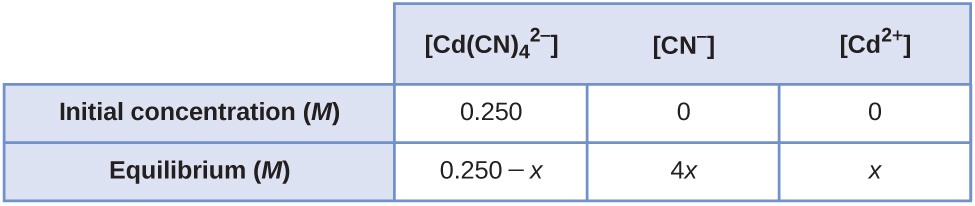
Using the dissociation constant, Kd = 3.3 × 10⁻¹⁹, calculate the equilibrium concentrations of Cd2+ and CN– in a 0.250-M solution of Cd(CN)42−.

Answer

This table has two main columns and three rows. The first row for the first column does not have a heading and then has the following in the first column: Initial concentration ( M ) and Equilibrium ( M ). The second column has the header, “[ C d ( C N ) subscript 4 to the second power superscript negative sign ] [ C N superscript negative sign ] [ C d to the second power superscript positive sign ].” Under the second column is a subgroup of two rows and three columns. The first column contains the following: 0.250 and 0.250 minus x. The second column contains the following: 0 and 4 x. The third column contains the following: 0 and x.


[Cd2+] = 5.0 × 10⁻⁵ M; [CN–] = 2.0 × 10⁻⁴ M

15-70 §15.2 source ↗

Using the dissociation constant, Kd = 2.2 × 10⁻³⁴, calculate the equilibrium concentrations of Co3+ and NH3 in a 0.500-M solution of Co(NH3)63+.

Answer

[Co3+] = 3.0 × 10⁻⁶ M; [NH3] = 1.8 × 10⁻⁵ M

15-72 §15.2 source ↗

Calculate the mass of potassium cyanide ion that must be added to 100 mL of solution to dissolve 2.0 × 10⁻² mol of silver cyanide, AgCN.

Answer

1.3 g

15-74 §15.2 source ↗

A roll of 35-mm black and white photographic film contains about 0.27 g of unexposed AgBr before developing. What mass of Na2S2O3·5H2O (sodium thiosulfate pentahydrate or hypo) in 1.0 L of fixer is required to dissolve the AgBr as Ag(S2O3)23− (Kf = 4.7 × 10¹³)?

Answer

0.79 g

15-76 §15.2 source ↗

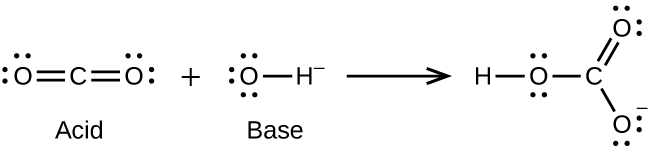
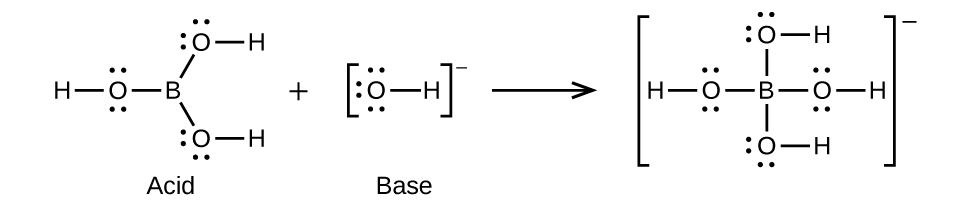
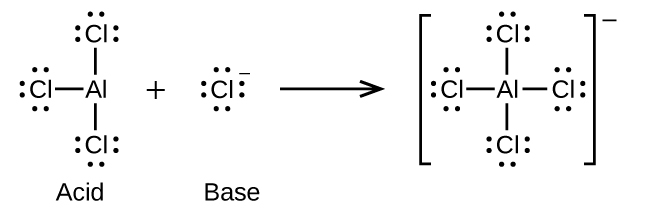
Write the Lewis structures of the reactants and product of each of the following equations, and identify the Lewis acid and the Lewis base in each:

(a) CO2+ OH−⟶ HCO3−

(b) B(OH)3+ OH−⟶ B(OH)4−

(c) I−+I2⟶I3−

(d) AlCl3+ Cl−⟶ AlCl4− (use Al-Cl single bonds)

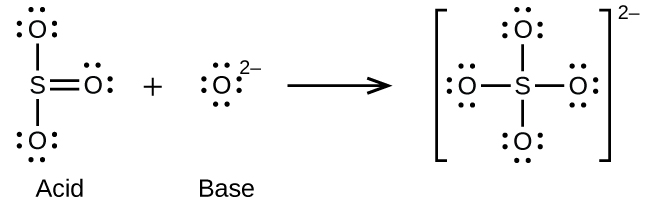
(e) O2−+ SO3⟶ SO42−

Answer

(a)

This figure shows a chemical reaction modeled with structural formulas. On the left side is a structure with a central C atom. O atoms, each with two unshared electron pairs, are double bonded to the left and right sides of the C atom. Following a plus sign is another structure in brackets which has an O atom with three unshared electron dot pairs single bonded to an H atom on the right. Outside the brackets is superscript negative sign. Following a right pointing arrow is a structure in brackets that has a central C atom to which 3 O atoms are bonded. Above and slightly to the right, one of the O atoms is connected with a double bond. This O atom has two unshared electron pairs. The second O atom is single bonded below and slightly to the right. This O atom has three unshared electron pairs. The third O atom is bonded to the left of the C atom. This O atom has two unshared electron pairs and an H atom single bonded to its left. Outside the brackets to the right is a superscript negative symbol.


(b)

This figure shows a chemical reaction modeled with structural formulas. On the left side is a structure that has a central B atom to which 3 O atoms are bonded. The O atoms above and below slightly right of the B atom each have an H atom single bonded to the right. The third O atom is single bonded to the left side of the B atom. This O atom has an H atom single bonded to its left side. All O atoms in this structure have two unshared electron pairs. Following a plus sign is another structure which has an O atom single bonded to an H atom on its right. The O atom has three unshared electron pairs. The structure appears in brackets with a superscript negative sign. Following a right pointing arrow is a structure in brackets has a central B atom to which 4 O atoms are bonded. The O atoms above, below, and right of the B atom each hav an H atom single bonded to the right. The third O atom is single bonded to the left side of the B atom. This O atom has an H atom single bonded to its left side. All O atoms in this structure have two unshared electron pairs. Outside the brackets to the right is a superscript negative symbol.


(c)

This figure illustrates a chemical reaction using structural formulas. On the left, two I atoms, each with 3 unshared electron pairs, are joined with a single bond. Following a plus sign is another structure which has an I atom with four pairs of electron dots and a superscript negative sign. Following a right pointing arrow is a structure in brackets that has three I atoms connected in a line with single bonds. The two end I atoms have three unshared electron dot pairs and the I atom at the center has two unshared electron pairs. Outside the brackets is a superscript negative sign.


(d)

This figure illustrates a chemical reaction using structural formulas. On the left, an A l atom is positioned at the center of a structure and three Cl atoms are single bonded above, left, and below. Each C l atom has three pairs of electron dots. Following a plus sign is another structure which has an F atom is surrounded by four electron dot pairs and a superscript negative symbol. Following a right pointing arrow is a structure in brackets that has a central A l atom to which 4 C l atoms are connected with single bonds above, below, to the left, and to the right. Each C l atom in this structure has three pairs of electron dots. Outside the brackets is a superscript negative symbol.


(e)

This figure illustrates a chemical reaction using structural formulas. On the left is a structure which has an S atom at the center. O atoms are single bonded above and below. These O atoms have three electron dot pairs each. To the right of the S atom is a double bonded O atom which has two pairs of electron dots. Following a plus sign is an O atom which is surrounded by four electron dot pairs and has a superscript 2 negative. Following a right pointing arrow is a structure in brackets that has a central S atom to which 4 O atoms are connected with single bonds above, below, to the left, and to the right. Each of the O atoms has three pairs of electron dots. Outside the brackets is a superscript 2 negative.

15-78 §15.2 source ↗

Using Lewis structures, write balanced equations for the following reactions:

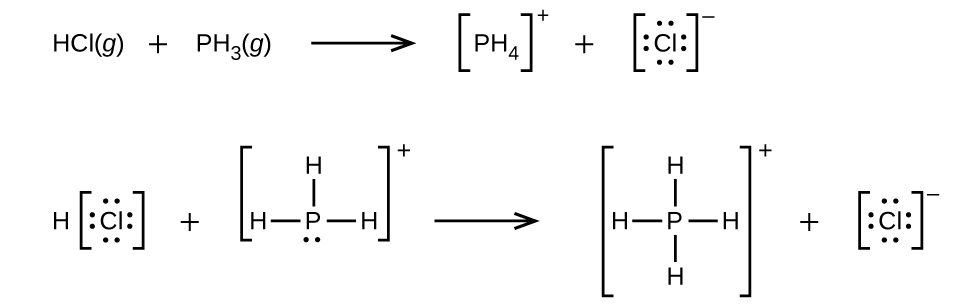
(a) HCl(g)+ PH3(g)⟶

(b) H3O++CH3−⟶

(c) CaO+SO3⟶

(d) NH4++ C2H5O−⟶

Answer

(a)

This figure represents a chemical reaction in two rows. The top row shows the reaction using chemical formulas. The second row uses structural formulas to represent the reaction. The first row contains the equation H C l ( g ) plus P H subscript 3 ( g ) right pointing arrow left bracket P H subscript 4 right bracket superscript plus plus left bracket C l with 4 pairs of electron dots right bracket superscript negative sign. The second row begins on the left with H left bracket C l with four unshared electron pairs right bracket plus a structure in brackets with a central P atom with H atoms single bonded at the left, above, and to the right. A single unshared electron pair is on the central P atom. Outside the brackets to the right is a superscript plus sign. Following a right pointing arrow is a structure in brackets with a central P atom with H atoms single bonded at the left, above, below, and to the right. Outside the brackets is a superscript plus sign. This structure is followed by a plus and a C l atom in brackets with four unshared electron pairs and a superscript negative sign.


(b) H3O++ CH3−⟶ CH4+ H2O

This figure represents a chemical reaction using structural formulas. A structure is shown in brackets on the left which is composed of a central O atom with one unshared electron pair and three single bonded H atoms to the left, right, and above the atom. Outside the brackets to the right is a superscript plus sign. Following a plus sign, is another structure in brackets composed of a central C atom with one unshared electron pair and three single bonded H atoms to the left, right, and above the atom. Outside the brackets to the right is a superscript negative sign. Following a right pointing arrow is a structure with a central C atom with H atoms single bonded above, below, left and right. Following a plus sign is a structure with a central O atom with two unshared electron pairs and two H atoms connected with single bonds.


(c) CaO+ SO3⟶ CaSO4

This figure represents a chemical reaction using structural formulas. On the left, C a superscript 2 plus is just left of bracket O with four unshared electron pairs right bracket superscript 2 negative plus a structure with a central S atom to which two O atoms are single bonded at the left and right, and a single O atom is double bonded above. The two single bonded O atoms each have three unshared electron pairs and the double bonded O atom has two unshared electron pairs. Following a right pointing arrow is C a superscript 2 plus just left of a structure in brackets with a central S atom which has 4 O atoms single bonded at the left, above, below, and to the right. Each of the O atoms has three unshared electron pairs. Outside the brackets to the right is a superscript two negative.


(d) NH4++ C2H5O−⟶ C2H5OH+ NH3

This figure represents a chemical reaction using structural formulas. A structure is shown in brackets on the left which is composed of a central N atom with four single bonded H atoms to the left, right, above, and below the atom. Outside the brackets to the right is a superscript plus sign. Following a plus sign, is another structure in brackets composed of a C atom with three single bonded H atoms above, below, and to the left. A second C atom is single bonded to the right. This C atom has H atoms single bonded above and below. To the right of the second C atom, an O atom is single bonded. This O atom has three unshared electron pairs. Outside the brackets to the right is a subperscript negative. Following a right pointing arrow is a structure composed of a C atom with three single bonded H atoms above, below, and to the left. A second C atom is single bonded to the right. This C atom has H atoms single bonded above and below. To the right of the second C atom, an O atom is single bonded. This O atom has two unshared electron pairs and an H atom single bonded to its right.

15-80 §15.2 source ↗

In a titration of cyanide ion, 28.72 mL of 0.0100 M AgNO3 is added before precipitation begins. [The reaction of Ag+ with CN– goes to completion, producing the Ag(CN)2− complex.] Precipitation of solid AgCN takes place when excess Ag+ is added to the solution, above the amount needed to complete the formation of Ag(CN)2−. How many grams of NaCN were in the original sample?

Answer

0.0281 g

15-82 §15.2 source ↗

In dilute aqueous solution HF acts as a weak acid. However, pure liquid HF (boiling point = 19.5 °C) is a strong acid. In liquid HF, HNO3 acts like a base and accepts protons. The acidity of liquid HF can be increased by adding one of several inorganic fluorides that are Lewis acids and accept F– ion (for example, BF3 or SbF5). Write balanced chemical equations for the reaction of pure HNO3 with pure HF and of pure HF with BF3.

Answer

HNO3(l)+ HF(l)⟶ H2NO3++ F−; HF(l)+ BF3(g)⟶ H++ BF4

15-84 §15.2 source ↗

Boric acid, H3BO3, is not a Brønsted-Lowry acid but a Lewis acid. (Hint: See the equation in Exercise 15.76)

(a) Write an equation for its reaction with water.

(b) Predict the shape of the anion thus formed.

(c) What is the hybridization on the boron, and is it consistent with the shape you have predicted?

Answer

(a) H3BO3+ H2O⟶ H4BO4−+ H+; (b) The electronic and molecular shapes are the same—both tetrahedral. (c) The tetrahedral structure is consistent with sp3 hybridization.

15-86 §15.3 source ↗

Calculate the equilibrium concentration of Ni2+ in a 1.0-M solution [Ni(NH3)6](NO3)2.

Answer

0.014 M

15-88 §15.3 source ↗

Calculate the equilibrium concentration of Cu2+ in a solution initially with 0.050 M Cu2+ and 1.00 M NH3.

Answer

7.2 × 10⁻¹⁵ M

15-90 §15.3 source ↗

Calculate the Fe3+ equilibrium concentration when 0.0888 mole of K3[Fe(CN)6] is added to a solution with 0.00010 M CN–.

Answer

4.4 × 10⁻²² M

15-93 §15.3 source ↗

Calculate the molar solubility of Al(OH)3 in a buffer solution with 0.100 M NH3 and 0.400 M NH4+.

Answer

[OH−] = 4.5 × 10⁻⁶; [Al3+] = 2 × 10–16 (molar solubility)

15-95 §15.3 source ↗

What is the molar solubility of BaSO4 in a 0.250-M solution of NaHSO4? Ka for HSO4− = 1.2 × 10⁻².

Answer

Ksp= [Ba2+][SO42−]= [Ba2+](0.049)= 1.08×10⁻¹⁰[Ba2+]= 2.2×10⁻⁹; (molar solubility)

15-97 §15.3 source ↗

What is the molar solubility of Pb(OH)2 in a 0.138-M solution of CH3NH2?

Answer

[OH–] = 7.6 × 10⁻³ M; [Pb2+] = 2.1 × 10⁻¹¹ (molar solubility)

15-99 §15.3 source ↗

A 0.125-M solution of Mn(NO3)2 is saturated with H2S ([H2S] = 0.10 M). At what pH does MnS begin to precipitate?

MnS(s)⇌ Mn2+(aq)+ S2−(aq) Ksp= 2.3×10⁻¹³

H 2 S(aq)+ 2 H 2 O(l)⇌ 2 H 3 O + (aq)+ S 2− (aq) K= 1.0× 10 −26

Answer

7.66

15-101 §15.3 source ↗

The following question is taken from a Chemistry Advanced Placement Examination and is used with the permission of the Educational Testing Service.

Solve the following problem:

MgF 2 (s)⇌ Mg 2+ (aq)+ 2 F − (aq)

In a saturated solution of MgF2 at 18 °C, the concentration of Mg2+ is 1.21 × 10⁻³ M. The equilibrium is represented by the preceding equation.

(a) Write the expression for the solubility-product constant, Ksp, and calculate its value at 18 °C.

(b) Calculate the equilibrium concentration of Mg2+ in 1.000 L of saturated MgF2 solution at 18 °C to which 0.100 mol of solid KF has been added. The KF dissolves completely. Assume the volume change is negligible.

(c) Predict whether a precipitate of MgF2 will form when 100.0 mL of a 3.00 × 10⁻³-M solution of Mg(NO3)2 is mixed with 200.0 mL of a 2.00 × 10⁻³-M solution of NaF at 18 °C. Show the calculations to support your prediction.

(d) At 27 °C the concentration of Mg2+ in a saturated solution of MgF2 is 1.17 × 10⁻³ M. Is the dissolving of MgF2 in water an endothermic or an exothermic process? Give an explanation to support your conclusion.

Answer

(a) Ksp = [Mg2+][F–]2 = (1.21 × 10⁻³)(2 × 1.21 × 10–3)2 = 7.09 × 10⁻⁹
(b) 7.09 × 10⁻⁷ M
(c) Determine the concentration of Mg2+ and F– that will be present in the final volume. Compare the value of the ion product [Mg2+][F–]2 with Ksp. If this value is larger than Ksp, precipitation will occur.
0.1000 L × 3.00 × 10–3 M Mg(NO3)2 = 0.3000 L × M Mg(NO3)2
M Mg(NO3)2 = 1.00 × 10⁻³ M
0.2000 L × 2.00 × 10–3 M NaF = 0.3000 L × M NaF
M NaF = 1.33 × 10⁻³ M
ion product = (1.00 × 10⁻³)(1.33 × 10⁻³)2 = 1.77 × 10⁻⁹ This value is smaller than Ksp, so no precipitation will occur.
(d) MgF2 is less soluble at 27 °C than at 18 °C. Because added heat acts like an added reagent, when it appears on the product side, the Le Châtelier’s principle states that the equilibrium will shift to the reactants’ side to counter the stress. Consequently, less reagent will dissolve. This situation is found in our case. Therefore, the reaction is exothermic.

15-103 §15.3 source ↗

Which of the following compounds, when dissolved in a 0.01-M solution of HClO4, has a solubility greater than in pure water: AgBr, BaF2, Ca3(PO4)2, ZnS, PbI2? Explain your answer.

Answer

BaF2, Ca3(PO4)2, ZnS; each is a salt of a weak acid, and the [H3O+] from perchloric acid reduces the equilibrium concentration of the anion, thereby increasing the concentration of the cations

15-105 §15.3 source ↗

What is the effect on the amount of CaHPO4 that dissolves and the concentrations of Ca2+ and HPO42− when each of the following are added to a mixture of solid CaHPO4 and water at equilibrium?

(a) CaCl2

(b) HCl

(c) KClO4

(d) NaOH

(e) CaHPO4

Answer

Effect on amount of solid CaHPO4, [Ca2+], [OH–]: (a) increase, increase, decrease; (b) decrease, increase, decrease; (c) no effect, no effect, no effect; (d) decrease, increase, decrease; (e) increase, no effect, no effect

Loading chapter 16…

Problems and answers are adapted from Chemistry 2e by Paul Flowers, Klaus Theopold, Richard Langley and William R. Robinson, OpenStax, and are used under the CC BY-NC-SA 4.0 licence. Access for free at https://openstax.org/books/chemistry-2e/pages/1-introduction. Illustrations: Copyright Rice University, OpenStax, under CC BY-NC-SA 4.0 license. This adaptation is released under the same licence, is non-commercial, and is neither affiliated with nor endorsed by OpenStax or Rice University.