Every problem in the chapter beside the book’s answer, a chapter at a time as you scroll.

Chapter 18: Representative Metals, Metalloids, and Nonmetals

58 problems · 27 figures

18-1 §18.1 source ↗

How do alkali metals differ from alkaline earth metals in atomic structure and general properties?

Answer

The alkali metals all have a single s electron in their outermost shell. In contrast, the alkaline earth metals have a completed s subshell in their outermost shell. In general, the alkali metals react faster and are more reactive than the corresponding alkaline earth metals in the same period.

18-3 §18.1 source ↗

Predict the formulas for the nine compounds that may form when each species in column 1 of the table reacts with each species in column 2.

1 2
Na I
Sr Se
Al O

Answer


Na+I2⟶2NaI2Na+Se⟶Na2Se2Na+O2⟶Na2O2
Sr+I2⟶SrI2Sr+Se⟶SrSe2Sr+O2⟶2SrO
2Al+3I2⟶2AlI32Al+3Se⟶Al2Se34Al+3O2⟶2Al2O3

18-5 §18.1 source ↗

Sodium chloride and strontium chloride are both white solids. How could you distinguish one from the other?

Answer

The possible ways of distinguishing between the two include infrared spectroscopy by comparison of known compounds, a flame test that gives the characteristic yellow color for sodium (strontium has a red flame), or comparison of their solubilities in water. At 20 °C, NaCl dissolves to the extent of 35.7 g100 mL compared with 53.8 g100 mL for SrCl2. Heating to 100 °C provides an easy test, since the solubility of NaCl is 39.12 g100 mL, but that of SrCl2 is 100.8 g100 mL. Density determination on a solid is sometimes difficult, but there is enough difference (2.165 g/mL NaCl and 3.052 g/mL SrCl2) that this method would be viable and perhaps the easiest and least expensive test to perform.

18-7 §18.1 source ↗

Write a balanced equation for the reaction of elemental strontium with each of the following:

(a) oxygen

(b) hydrogen bromide

(c) hydrogen

(d) phosphorus

(e) water

Answer

(a) 2Sr(s)+ O2(g)⟶ 2SrO(s); (b) Sr(s)+ 2HBr(g)⟶ SrBr2(s)+ H2(g); (c) Sr(s)+ H2(g)⟶ SrH2(s); (d) 6Sr(s)+ P4(s)⟶ 2Sr3P2(s); (e) Sr(s)+ 2H2O(l)⟶ Sr(OH)2(aq)+ H2(g)

18-9 §18.1 source ↗

What is the mass of fish, in kilograms, that one would have to consume to obtain a fatal dose of mercury, if the fish contains 30 parts per million of mercury by weight? (Assume that all the mercury from the fish ends up as mercury(II) chloride in the body and that a fatal dose is 0.20 g of HgCl2.) How many pounds of fish is this?

Answer

11 lb

18-11 §18.1 source ↗

Does metallic tin react with HCl?

Answer

Yes, tin reacts with hydrochloric acid to produce hydrogen gas.

18-13 §18.1 source ↗

Compare the nature of the bonds in PbCl2 to that of the bonds in PbCl4.

Answer

In PbCl2, the bonding is ionic, as indicated by its melting point of 501 °C. In PbCl4, the bonding is covalent, as evidenced by it being an unstable liquid at room temperature.

18-15 §18.2 source ↗

Write an equation for the reduction of cesium chloride by elemental calcium at high temperature.

Answer

2CsCl ( l ) + Ca ( g ) → countercurrent fractionating tower 2Cs ( g ) + CaCl 2 ( l )

18-17 §18.2 source ↗

Give balanced equations for the overall reaction in the electrolysis of molten lithium chloride and for the reactions occurring at the electrodes. You may wish to review the chapter on electrochemistry for relevant examples.

Answer

Cathode (reduction): 2Li++ 2e−⟶ 2Li(l); Anode (oxidation): 2Cl−⟶ Cl2(g)+ 2e−; Overall reaction: 2Li++ 2Cl−⟶ 2Li(l)+ Cl2(g)

18-19 §18.2 source ↗

What mass, in grams, of hydrogen gas forms during the complete reaction of 10.01 g of calcium with water?

Answer

0.5035 g H2

18-21 §18.2 source ↗

Magnesium is an active metal; it burns in the form of powder, ribbons, and filaments to provide flashes of brilliant light. Why is it possible to use magnesium in construction?

Answer

Despite its reactivity, magnesium can be used in construction even when the magnesium is going to come in contact with a flame because a protective oxide coating is formed, preventing gross oxidation. Only if the metal is finely subdivided or present in a thin sheet will a high-intensity flame cause its rapid burning.

18-23 §18.2 source ↗

Describe the production of metallic aluminum by electrolytic reduction.

Answer

Extract from ore: AlO(OH)(s)+ NaOH(aq)+ H2O(l)⟶ Na[Al(OH)4](aq)
Recover: 2Na[Al(OH)4](s)+ H2SO4(aq)⟶ 2Al(OH)3(s)+ Na2SO4(aq)+ 2H2O(l)
Sinter: 2Al(OH)3(s)⟶ Al2O3(s)+ 3H2O(g)
Dissolve in Na3AlF6(l) and electrolyze: Al3++ 3e−⟶ Al(s)

18-25 §18.2 source ↗

A chemist dissolves a 1.497-g sample of a type of metal (an alloy of Sn, Pb, Sb, and Cu) in nitric acid, and metastannic acid, H2SnO3, is precipitated. She heats the precipitate to drive off the water, which leaves 0.4909 g of tin(IV) oxide. What was the percentage of tin in the original sample?

Answer

25.83%

18-27 §18.2 source ↗

What mass of magnesium forms when 100,000 A is passed through a MgCl2 melt for 1.00 h if the yield of magnesium is 85% of the theoretical yield?

Answer

39 kg

18-29 §18.3 source ↗

Write a Lewis structure for each of the following molecules or ions. You may wish to review the chapter on chemical bonding.

(a) H3BPH3

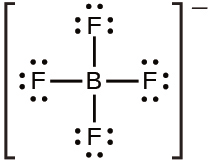
(b) BF4−

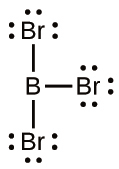
(c) BBr3

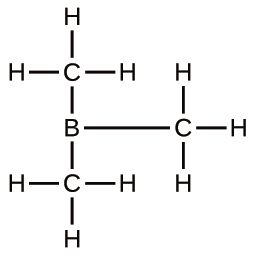
(d) B(CH3)3

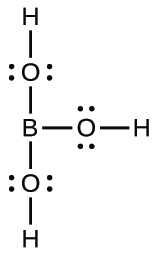
(e) B(OH)3

Answer

(a) H3BPH3:
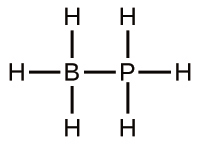
This Lewis structure is composed of a boron atom single bonded to a phosphorus atom. Each of these atoms is single bonded to three hydrogen atoms.


(b) BF4−:

This Lewis structure is composed of a boron atom single bonded to four fluorine atoms, each of which has three lone pairs of electrons. The structure is surrounded by brackets, and a negative sign appears as a superscript outside the brackets.


(c) BBr3:

This Lewis structure is composed of a boron atom single bonded to three bromine atoms, each of which has three lone pairs of electrons.


(d) B(CH3)3:

This Lewis structure is composed of a boron atom that is single bonded to three carbon atoms, each of which is single bonded to three hydrogen atoms.


(e) B(OH)3:

This Lewis structure is composed of a boron atom that is single bonded to three oxygen atoms, each of which has two lone pairs of electrons. Each oxygen atom is single bonded to a hydrogen atom.

18-31 §18.3 source ↗

Using only the periodic table, write the complete electron configuration for silicon, including any empty orbitals in the valence shell. You may wish to review the chapter on electronic structure.

Answer

1s22s22p63s23p23d0.

18-33 §18.3 source ↗

Describe the hybridization of silicon and the molecular structure of the following molecules and ions:

(a) (CH3)3SiH

(b) SiO44−

(c) Si2H6

(d) Si(OH)4

(e) SiF62−

Answer

(a) (CH3)3SiH: sp3 bonding about Si; the structure is tetrahedral; (b) SiO44−: sp3 bonding about Si; the structure is tetrahedral; (c) Si2H6: sp3 bonding about each Si; the structure is linear along the Si-Si bond; (d) Si(OH)4: sp3 bonding about Si; the structure is tetrahedral; (e) SiF62−: sp3d2 bonding about Si; the structure is octahedral

18-35 §18.3 source ↗

Classify each of the following molecules as polar or nonpolar. You may wish to review the chapter on chemical bonding.

(a) SiH4

(b) Si2H6

(c) SiCl3H

(d) SiF4

(e) SiCl2F2

Answer

(a) nonpolar; (b) nonpolar; (c) polar; (d) nonpolar; (e) polar

18-37 §18.3 source ↗

Name each of the following compounds:

(a) TeO2

(b) Sb2S3

(c) GeF4

(d) SiH4

(e) GeH4

Answer

(a) tellurium dioxide or tellurium(IV) oxide; (b) antimony(III) sulfide; (c) germanium(IV) fluoride; (d) silane or silicon(IV) hydride; (e) germanium(IV) hydride

18-39 §18.3 source ↗

Why is boron limited to a maximum coordination number of four in its compounds?

Answer

Boron has only s and p orbitals available, which can accommodate a maximum of four electron pairs. Unlike silicon, no d orbitals are available in boron.

18-41 §18.3 source ↗

From the data given in Appendix G, determine the standard enthalpy change and the standard free energy change for each of the following reactions:

(a) BF3(g)+ 3H2O(l)⟶ B(OH)3(s)+ 3HF(g)

(b) BCl3(g)+ 3H2O(l)⟶ B(OH)3(s)+ 3HCl(g)

(c) B2H6(g)+ 6H2O(l)⟶ 2B(OH)3(s)+ 6H2(g)

Answer

(a) ΔH° = 87 kJ; ΔG° = 44 kJ; (b) ΔH° = −109.9 kJ; ΔG° = −154.7 kJ; (c) ΔH° = −510 kJ; ΔG° = −601.5 kJ

18-43 §18.3 source ↗

Suppose you discovered a diamond completely encased in a silicate rock. How would you chemically free the diamond without harming it?

Answer

A mild solution of hydrofluoric acid would dissolve the silicate and would not harm the diamond.

18-45 §18.4 source ↗

Nitrogen in the atmosphere exists as very stable diatomic molecules. Why does phosphorus form less stable P4 molecules instead of P2 molecules?

Answer

In the N2 molecule, the nitrogen atoms have an σ bond and two π bonds holding the two atoms together. The presence of three strong bonds makes N2 a very stable molecule. Phosphorus is a third-period element, and as such, does not form π bonds efficiently; therefore, it must fulfill its bonding requirement by forming three σ bonds.

18-47 §18.4 source ↗

Determine the oxidation number of each element in each of the following compounds:

(a) HCN

(b) OF2

(c) AsCl3

Answer

(a) H = 1+, C = 2+, and N = 3−; (b) O = 2+ and F = 1−; (c) As = 3+ and Cl = 1−

18-49 §18.4 source ↗

Arrange the following in order of increasing electronegativity: F; Cl; O; and S.

Answer

S < Cl < O < F

18-51 §18.5 source ↗

Why does hydrogen not exhibit an oxidation state of 1− when bonded to nonmetals?

Answer

The electronegativity of the nonmetals is greater than that of hydrogen. Thus, the negative charge is better represented on the nonmetal, which has the greater tendency to attract electrons in the bond to itself.

18-53 §18.5 source ↗

In drawing Lewis structures, we learn that a hydrogen atom forms only one bond in a covalent compound. Why?

Answer

Hydrogen has only one orbital with which to bond to other atoms. Consequently, only one two-electron bond can form.

18-55 §18.5 source ↗

What mass of hydrogen gas results from the reaction of 8.5 g of KH with water?
KH+ H2O⟶ KOH+ H2

Answer

0.43 g H2

18-57 §18.6 source ↗

Complete and balance the following chemical equations:

(a) hardening of plaster containing slaked lime
Ca(OH)2+ CO2⟶

(b) removal of sulfur dioxide from the flue gas of power plants
CaO+SO2⟶

(c) the reaction of baking powder that produces carbon dioxide gas and causes bread to rise
NaHCO3+ NaH2PO4⟶

Answer

(a) Ca(OH)2(aq)+ CO2(g)⟶ CaCO3(s)+ H2O(l); (b) CaO(s)+ SO2(g)⟶ CaSO3(s);
(c) 2NaHCO3(s)+ NaH2PO4(aq)⟶ Na3PO4(aq)+ 2CO2(g)+ 2H2O(l)

18-59 §18.7 source ↗

Write the Lewis structures for each of the following:

(a) NH2−

(b) N2F4

(c) NH2−

(d) NF3

(e) N3−

Answer

(a) NH2−:

This Lewis structure shows a nitrogen atom with three lone pairs of electrons single bonded to a hydrogen atom. The structure is surrounded by brackets. Outside and superscript to the brackets is a two negative sign.


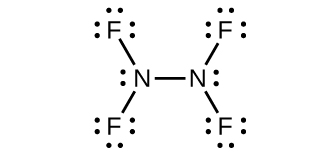
(b) N2F4:

This Lewis structure shows two nitrogen atoms, each with one lone pair of electrons, single bonded to one another and each single bonded to two fluorine atoms. Each fluorine atom has three lone pairs of electrons.


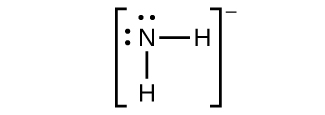
(c) NH2−:

This Lewis structure shows a nitrogen atom with two lone pairs of electrons single bonded to two hydrogen atoms. The structure is surrounded by brackets. Outside and superscript to the brackets is a negative sign.


(d) NF3:

This Lewis structure shows a nitrogen atom, with one lone pair of electrons, single bonded to three fluorine atoms. Each fluorine atom has three lone pairs of electrons.


(e) N3−:

Three Lewis structures are shown and connected by double-headed arrows in between. The left structure shows a nitrogen atom with a lone pair of electrons triple bonded to a second nitrogen which is single bonded to a third nitrogen. The third nitrogen has three lone pairs of electrons. The entire structure is surrounded by brackets, and outside and superscript to the brackets is a negative sign. The middle structure shows a nitrogen atom with three lone pair of electrons single bonded to a second nitrogen which is triple bonded to a third nitrogen. The third nitrogen which has one lone pair of electrons. The entire structure is surrounded by brackets, and outside and superscript to the brackets is a negative sign. The right structure shows a nitrogen atom with two lone pairs of electrons double bonded to a second nitrogen which is double bonded to a third nitrogen. The third nitrogen atom has two lone pairs of electrons. The entire structure is surrounded by brackets, and outside and superscript to the brackets is a negative sign.

18-61 §18.7 source ↗

Explain how ammonia can function both as a Brønsted base and as a Lewis base.

Answer

Ammonia acts as a Brønsted base because it readily accepts protons and as a Lewis base in that it has an electron pair to donate.
Brønsted base: NH3+ H3O+⟶ NH4++ H2O
Lewis base: 2NH3+ Ag+⟶ [H3N−Ag−NH3]+

18-63 §18.7 source ↗

For each of the following, draw the Lewis structure, predict the ONO bond angle, and give the hybridization of the nitrogen. You may wish to review the chapters on chemical bonding and advanced theories of covalent bonding for relevant examples.

(a) NO2

(b) NO2−

(c) NO2+

Answer

(a) NO2:

Two Lewis structures are shown and connected by double-headed arrows in between. The left structure shows a nitrogen atom with a single electron double bonded to an oxygen atom which has two lone pairs of electrons. The nitrogen atom is also single bonded to an oxygen atom with three lone pairs of electrons. The right structure is a mirror image of the left structure.


Nitrogen is sp2 hybridized. The molecule has a bent geometry with an ONO bond angle of approximately 120°.
(b) NO2−:

Two Lewis structures are shown and connected by double-headed arrows in between. Each structure is surrounded by brackets, and outside and superscript to the brackets is a negative sign. The left structure shows a nitrogen atom with a lone pair of electrons double bonded to an oxygen atom which has two lone pairs of electrons. The nitrogen atom is also single bonded to an oxygen atom with three lone pair of electrons. The right structure is a mirror image of the left structure.


Nitrogen is sp2 hybridized. The molecule has a bent geometry with an ONO bond angle slightly less than 120°.
(c) NO2+:
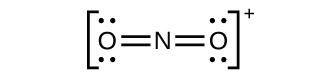
This Lewis structure shows a nitrogen atom double bonded on both sides to an oxygen atom which has two lone pairs of electrons each. The structure is surrounded by brackets and outside and superscript to the brackets is a negative sign.


Nitrogen is sp hybridized. The molecule has a linear geometry with an ONO bond angle of 180°.

18-65 §18.7 source ↗

Although PF5 and AsF5 are stable, nitrogen does not form NF5 molecules. Explain this difference among members of the same group.

Answer

Nitrogen cannot form a NF5 molecule because it does not have d orbitals to bond with the additional two fluorine atoms.

18-67 §18.8 source ↗

Write the Lewis structure for each of the following. You may wish to review the chapter on chemical bonding and molecular geometry.

(a) PH3

(b) PH4+

(c) P2H4

(d) PO43−

(e) PF5

Answer

(a)

This Lewis structure shows a phosphorus atom with a lone pair of electrons single bonded to three hydrogen atoms.


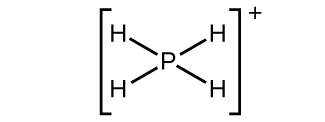
(b)

This Lewis structure shows a phosphorus atom single bonded to four hydrogen atoms. The structure is surrounded by brackets and has a superscript positive sign outside the brackets.


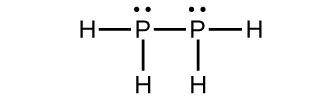
(c)

This Lewis structure shows two phosphorus atoms, each with a lone pair of electrons, single bonded to one another. Each phosphorus atom is also single bonded to two hydrogen atoms.


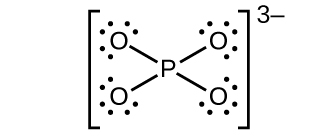
(d)

This Lewis structure shows a phosphorus atom single bonded to four oxygen atoms, each with three lone pairs of electrons. The structure is surrounded by brackets and has a superscript 3 negative sign outside the brackets.


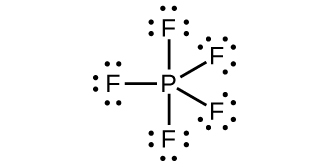
(e)

This Lewis structure shows a phosphorus atom single bonded to five fluorine atoms, each with three lone pairs of electrons.

18-69 §18.8 source ↗

Complete and balance each of the following chemical equations. (In some cases, there may be more than one correct answer.)

(a) P4+Al⟶

(b) P4+Na⟶

(c) P4+F2⟶

(d) P4+Cl2⟶

(e) P4+O2⟶

(f) P4O6+O2⟶

Answer

(a) P4(s)+ 4Al(s)⟶ 4AlP(s); (b) P4(s)+ 12Na(s)⟶ 4Na3P(s); (c) P4(s)+ 10F2(g)⟶ 4PF5(l); (d) P4(s)+ 6Cl2(g)⟶ 4PCl3(l) or P4(s)+ 10Cl2(g)⟶ 4PCl5(l); (e) P4(s)+ 3O2(g)⟶ P4O6(s) or P4(s)+ 5O2(g)⟶ P4O10(s); (f) P4O6(s)+ 2O2(g)⟶ P4O10(s)

18-71 §18.8 source ↗

What volume of 0.200 M NaOH is necessary to neutralize the solution produced by dissolving 2.00 g of PCl3 is an excess of water? Note that when H3PO3 is titrated under these conditions, only one proton of the acid molecule reacts.

Answer

291 mL

18-73 §18.8 source ↗

How many tons of Ca3(PO4)2 are necessary to prepare 5.0 tons of phosphorus if the yield is 90%?

Answer

28 tons

18-75 §18.8 source ↗

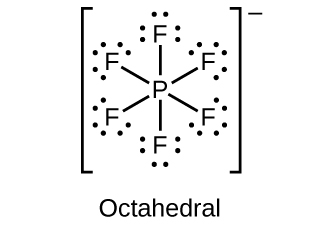
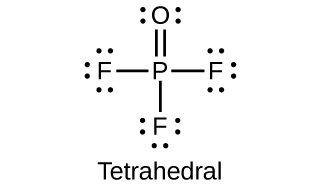
Draw the Lewis structures and describe the geometry for the following:

(a) PF4+

(b) PF5

(c) PF6−

(d) POF3

Answer

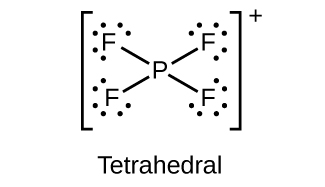
(a)

This Lewis structure shows a phosphorus atom single bonded to four fluorine atoms, each with three lone pairs of electrons. The structure is surrounded by brackets and has a superscript positive sign outside the brackets. The label, “Tetrahedral,” is written under the structure.


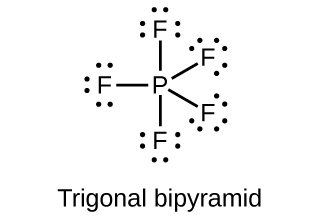
(b)

This Lewis structure shows a phosphorus atom single bonded to five fluorine atoms, each with three lone pairs of electrons. The label, “Trigonal bipyramidal,” is written under the structure.


(c)

A Lewis structure shows a phosphorus atom single bonded to six fluorine atoms, each with three lone pairs of electrons. The structure is surrounded by brackets and has a superscript negative sign outside the brackets. The label, “Octahedral,” is written under the structure.


(d)

This Lewis structure shows a phosphorus atom single bonded to three fluorine atoms, each with three lone pairs of electrons. The phosphorus atom is also double bonded to an oxygen atom with two lone pairs of electrons. The label, “Tetrahedral,” is written under the structure.

18-77 §18.8 source ↗

Assign an oxidation state to phosphorus in each of the following:

(a) NaH2PO3

(b) PF5

(c) P4O6

(d) K3PO4

(e) Na3P

(f) Na4P2O7

Answer

(a) P = 3+; (b) P = 5+; (c) P = 3+; (d) P = 5+; (e) P = 3−; (f) P = 5+

18-79 §18.9 source ↗

Predict the product of burning francium in air.

Answer

FrO2

18-81 §18.9 source ↗

Write balanced chemical equations for the following reactions:

(a) zinc metal heated in a stream of oxygen gas

(b) zinc carbonate heated until loss of mass stops

(c) zinc carbonate added to a solution of acetic acid, CH3CO2H

(d) zinc added to a solution of hydrobromic acid

Answer

(a) 2Zn(s)+ O2(g)⟶ 2ZnO(s); (b) ZnCO3(s)⟶ ZnO(s)+ CO2(g); (c) ZnCO3(s)+ 2CH3COOH(aq)⟶ Zn(CH3COO)2(aq)+ CO2(g)+ H2O(l); (d) Zn(s)+ 2HBr(aq)⟶ ZnBr2(aq)+ H2(g)

18-83 §18.9 source ↗

Illustrate the amphoteric nature of aluminum hydroxide by citing suitable equations.

Answer

Al(OH)3(s)+ 3H+(aq)⟶ Al3++ 3H2O(l); Al(OH)3(s)+ OH−⟶ [Al(OH)4]−(aq)

18-85 §18.9 source ↗

Write balanced chemical equations for the following reactions:

(a) sodium oxide added to water

(b) cesium carbonate added to an excess of an aqueous solution of HF

(c) aluminum oxide added to an aqueous solution of HClO4

(d) a solution of sodium carbonate added to solution of barium nitrate

(e) titanium metal produced from the reaction of titanium tetrachloride with elemental sodium

Answer

(a) Na2O(s)+ H2O(l)⟶ 2NaOH(aq); (b) Cs2CO3(s)+ 2HF(aq)⟶ 2CsF(aq)+ CO2(g)+ H2O(l); (c) Al2O3(s)+ 6HClO4(aq)⟶ 2Al(ClO4)3(aq)+ 3H2O(l); (d) Na2CO3(aq)+ Ba(NO3)2(aq)⟶ 2NaNO3(aq)+ BaCO3(s); (e) TiCl4(l)+ 4Na(s)⟶ Ti(s)+ 4NaCl(s)

18-87 §18.9 source ↗

Which is the stronger acid, HClO4 or HBrO4? Why?

Answer

HClO4 is the stronger acid because, in a series of oxyacids with similar formulas, the higher the electronegativity of the central atom, the stronger is the attraction of the central atom for the electrons of the oxygen(s). The stronger attraction of the oxygen electron results in a stronger attraction of oxygen for the electrons in the O-H bond, making the hydrogen more easily released. The weaker this bond, the stronger the acid.

18-89 §18.9 source ↗

Which is the stronger acid, H2SO4 or H2SeO4? Why? You may wish to review the chapter on acid-base equilibria.

Answer

As H2SO4 and H2SeO4 are both oxyacids and their central atoms both have the same oxidation number, the acid strength depends on the relative electronegativity of the central atom. As sulfur is more electronegative than selenium, H2SO4 is the stronger acid.

18-91 §18.10 source ↗

Give the hybridization and oxidation state for sulfur in SO2, in SO3, and in H2SO4.

Answer

SO2, sp2 4+; SO3, sp2, 6+; H2SO4, sp3, 6+

18-93 §18.10 source ↗

Determine the oxidation state of sulfur in SF6, SO2F2, and KHS.

Answer

SF6: S = 6+; SO2F2: S = 6+; KHS: S = 2−

18-95 §18.10 source ↗

Oxygen forms double bonds in O2, but sulfur forms single bonds in S8. Why?

Answer

Sulfur is able to form double bonds only at high temperatures (substantially endothermic conditions), which is not the case for oxygen.

18-97 §18.10 source ↗

Write two balanced chemical equations in which sulfuric acid acts as an oxidizing agent.

Answer

There are many possible answers including: Cu(s)+ 2H2SO4(l)⟶ CuSO4(aq)+ SO2(g)+ 2H2O(l) and C(s)+ 2H2SO4(l)⟶ CO2(g)+ 2SO2(g)+ 2H2O(l)

18-99 §18.10 source ↗

How many grams of Epsom salts (MgSO4⋅7H2O) will form from 5.0 kg of magnesium?

Answer

5.1 × 10⁴ g

18-101 §18.11 source ↗

Why is SnCl4 not classified as a salt?

Answer

SnCl4 is not a salt because it is covalently bonded. A salt must have ionic bonds.

18-103 §18.11 source ↗

Which is the stronger acid, HClO3 or HBrO3? Why?

Answer

In oxyacids with similar formulas, the acid strength increases as the electronegativity of the central atom increases. HClO3 is stronger than HBrO3; Cl is more electronegative than Br.

18-105 §18.11 source ↗

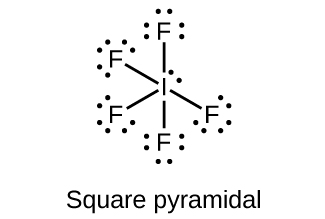
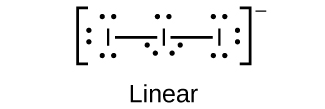
Predict the molecular geometries and draw Lewis structures for each of the following. You may wish to review the chapter on chemical bonding and molecular geometry.

(a) IF5

(b) I3−

(c) PCl5

(d) SeF4

(e) ClF3

Answer

(a)

This Lewis structure shows an iodine atom with one lone pair of electrons single bonded to five fluorine atoms, each of which has three lone pairs of electrons. The image is labeled, “Square pyramidal.”


(b)

This Lewis structure shows an iodine atom with three lone pairs of electrons single bonded to two iodine atoms, each of which has three lone pairs of electrons. The image is surrounded by brackets. A superscript negative sign appears outside the brackets. The image is labeled, “Linear.”


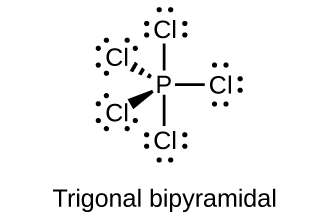
(c)

This Lewis structure shows a phosphorus atom single bonded to five chlorine atoms, each of which has three lone pairs of electrons. The image is labeled, “Trigonal bipyramidal.”


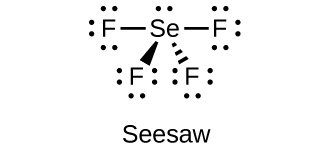
(d)

This Lewis structure shows a selenium atom with one lone pair of electrons single bonded to four fluorine atoms, each of which has three lone pairs of electrons. The image is labeled “Seesaw.”


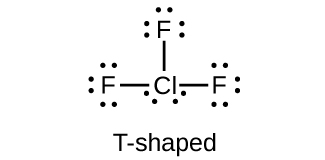
(e)

This Lewis structure shows a chlorine atom with two lone pairs of electrons single bonded to three fluorine atoms, each of which has three lone pairs of electrons. The image is labeled, “T-shaped.”

18-107 §18.11 source ↗

Name each of the following compounds:

(a) BrF3

(b) NaBrO3

(c) PBr5

(d) NaClO4

(e) KClO

Answer

(a) bromine trifluoride; (b) sodium bromate; (c) phosphorus pentabromide; (d) sodium perchlorate; (e) potassium hypochlorite

18-109 §18.11 source ↗

What is the oxidation state of the halogen in each of the following?

(a) H5IO6

(b) IO4−

(c) ClO2

(d) ICl3

(e) F2

Answer

(a) I: 7+; (b) I: 7+; (c) Cl: 4+; (d) I: 3+; Cl: 1−; (e) F: 0

18-111 §18.12 source ↗

Give the hybridization of xenon in each of the following. You may wish to review the chapter on the advanced theories of covalent bonding.

(a) XeF2

(b) XeF4

(c) XeO3

(d) XeO4

(e) XeOF4

Answer

(a) sp3d hybridized; (b) sp3d2 hybridized; (c) sp3 hybridized; (d) sp3 hybridized; (e) sp3d2 hybridized;

18-113 §18.12 source ↗

Indicate whether each of the following molecules is polar or nonpolar. You may wish to review the chapter on chemical bonding and molecular geometry.

(a) XeF2

(b) XeF4

(c) XeO3

(d) XeO4

(e) XeOF4

Answer

(a) nonpolar; (b) nonpolar; (c) polar; (d) nonpolar; (e) polar

18-115 §18.12 source ↗

A mixture of xenon and fluorine was heated. A sample of the white solid that formed reacted with hydrogen to yield 81 mL of xenon (at STP) and hydrogen fluoride, which was collected in water, giving a solution of hydrofluoric acid. The hydrofluoric acid solution was titrated, and 68.43 mL of 0.3172 M sodium hydroxide was required to reach the equivalence point. Determine the empirical formula for the white solid and write balanced chemical equations for the reactions involving xenon.

Answer

The empirical formula is XeF6, and the balanced reactions are: Xe(g)+3F2(g)→ΔXeF6(s)XeF6(s)+3H2(g)⟶6HF(g)+Xe(g)

Loading chapter 19…

Problems and answers are adapted from Chemistry 2e by Paul Flowers, Klaus Theopold, Richard Langley and William R. Robinson, OpenStax, and are used under the CC BY-NC-SA 4.0 licence. Access for free at https://openstax.org/books/chemistry-2e/pages/1-introduction. Illustrations: Copyright Rice University, OpenStax, under CC BY-NC-SA 4.0 license. This adaptation is released under the same licence, is non-commercial, and is neither affiliated with nor endorsed by OpenStax or Rice University.