Every problem in the chapter beside the book’s answer, a chapter at a time as you scroll.
Chapter 2: Atoms, Molecules, and Ions
45 problems · 11 figuresExample 2.1 §2.1 source ↗

Answer
Example 2.2 §2.1 source ↗
Answer
Example 2.3 §2.3 source ↗
Answer
Example 2.4 §2.3 source ↗
Answer
Example 2.5 §2.3 source ↗
Answer
Example 2.6 §2.4 source ↗
Answer
Example 2.7 §2.5 source ↗
(a) krypton
(b) selenium
(c) barium
(d) lithium
Answer
Example 2.8 §2.6 source ↗
Answer
Example 2.9 §2.6 source ↗
Answer
Example 2.10 §2.6 source ↗
Answer
Example 2.11 §2.6 source ↗
Answer
Example 2.12 §2.6 source ↗
(a) SO2
(b) CaF2
(c) N2H4
(d) Al2(SO4)3
Answer
Example 2.13 §2.7 source ↗
(a) chromium(III) phosphide
(b) mercury(II) sulfide
(c) manganese(II) phosphate
(d) copper(I) oxide
(e) iron(III) chloride dihydrate
Answer
Example 2.14 §2.7 source ↗
(a) phosphorus pentachloride
(b) dinitrogen monoxide
(c) iodine heptafluoride
(d) carbon tetrachloride
Answer
2-1 §2.1 source ↗
In the following drawing, the green spheres represent atoms of a certain element. The blue spheres represent atoms of another element. If the spheres of different elements touch, they are part of a single unit of a compound. The following chemical change represented by these spheres may violate one of the ideas of Dalton’s atomic theory. Which one?


Answer
2-3 §2.1 source ↗
Answer
2-5 §2.2 source ↗
Answer
2-7 §2.2 source ↗
Answer
2-9 §2.2 source ↗
Predict and test the behavior of α particles fired at a Rutherford atom model.
(a) Predict the paths taken by α particles that are fired at atoms with a Rutherford atom model structure. Explain why you expect the α particles to take these paths.
(b) If α particles of higher energy than those in (a) are fired at Rutherford atoms, predict how their paths will differ from the lower-energy α particle paths. Explain your reasoning.
(c) Predict how the paths taken by the α particles will differ if they are fired at Rutherford atoms of elements other than gold. What factor do you expect to cause this difference in paths, and why?
(d) Now test your predictions from (a), (b), and (c). Open the Rutherford Scattering simulation and select the “Rutherford Atom” tab. Due to the scale of the simulation, it is best to start with a small nucleus, so select “20” for both protons and neutrons, “min” for energy, show traces, and then start firing α particles. Does this match your prediction from (a)? If not, explain why the actual path would be that shown in the simulation. Pause or reset, set energy to “max,” and start firing α particles. Does this match your prediction from (b)? If not, explain the effect of increased energy on the actual path as shown in the simulation. Pause or reset, select “40” for both protons and neutrons, “min” for energy, show traces, and fire away. Does this match your prediction from (c)? If not, explain why the actual path would be that shown in the simulation. Repeat this with larger numbers of protons and neutrons. What generalization can you make regarding the type of atom and effect on the path of α particles? Be clear and specific.
Answer
2-11 §2.3 source ↗
Write the symbol for each of the following ions:
(a) the ion with a 1+ charge, atomic number 55, and mass number 133
(b) the ion with 54 electrons, 53 protons, and 74 neutrons
(c) the ion with atomic number 15, mass number 31, and a 3− charge
(d) the ion with 24 electrons, 30 neutrons, and a 3+ charge
Answer
2-13 §2.3 source ↗
Open the Build an Atom simulation and click on the Atom icon.
(a) Pick any one of the first 10 elements that you would like to build and state its symbol.
(b) Drag protons, neutrons, and electrons onto the atom template to make an atom of your element.
State the numbers of protons, neutrons, and electrons in your atom, as well as the net charge and mass number.
(c) Click on “Net Charge” and “Mass Number,” check your answers to (b), and correct, if needed.
(d) Predict whether your atom will be stable or unstable. State your reasoning.
(e) Check the “Stable/Unstable” box. Was your answer to (d) correct? If not, first predict what you can do to make a stable atom of your element, and then do it and see if it works. Explain your reasoning.
Answer
2-15 §2.3 source ↗
Open the Build an Atom simulation.
(a) Drag protons, neutrons, and electrons onto the atom template to make a neutral atom of Lithium-6 and give the isotope symbol for this atom.
(b) Now remove one electron to make an ion and give the symbol for the ion you have created.
Answer
2-17 §2.3 source ↗
The following are properties of isotopes of two elements that are essential in our diet. Determine the number of protons, neutrons and electrons in each and name them.
(a) atomic number 26, mass number 58, charge of 2+
(b) atomic number 53, mass number 127, charge of 1−
Answer
2-19 §2.3 source ↗
Give the number of protons, electrons, and neutrons in neutral atoms of each of the following isotopes:
(a)
(b)
(c)
(d)
(e)
Answer
2-21 §2.3 source ↗
Answer
2-23 §2.3 source ↗
Answer
2-25 §2.3 source ↗
Answer
2-27 §2.4 source ↗
Answer
2-29 §2.4 source ↗
Write the molecular and empirical formulas of the following compounds:
(a)

(b)

(c)
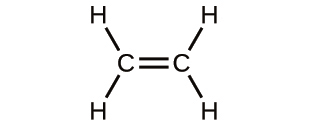
(d)
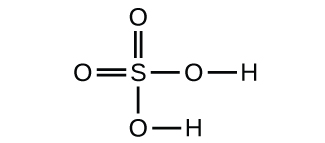
Answer
2-31 §2.4 source ↗
Determine the empirical formulas for the following compounds:
(a) caffeine, C8H10N4O2
(b) sucrose, C12H22O11
(c) hydrogen peroxide, H2O2
(d) glucose, C6H12O6
(e) ascorbic acid (vitamin C), C6H8O6
Answer
2-33 §2.4 source ↗
Write the empirical formulas for the following compounds:
(a)
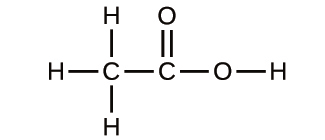
(b)

Answer
2-35 §2.4 source ↗
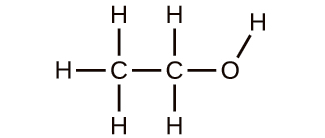
Use the Build a Molecule simulation to repeat Exercise 2.34, but build a molecule with two carbons, six hydrogens, and one oxygen.
(a) Draw the structural formula of this molecule and state its name.
(b) Can you arrange these atoms to make a different molecule? If so, draw its structural formula and state its name.
(c) How are the molecules drawn in (a) and (b) the same? How do they differ? What are they called (the type of relationship between these molecules, not their names).?
Answer
(a) ethanol
(b) methoxymethane, more commonly known as dimethyl ether
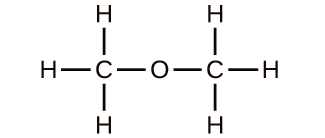
(c) These molecules have the same chemical composition (types and number of atoms) but different chemical structures. They are structural isomers.
2-37 §2.5 source ↗
Using the periodic table, classify each of the following elements as a metal or a nonmetal, and then further classify each as a main-group (representative) element, transition metal, or inner transition metal:
(a) uranium
(b) bromine
(c) strontium
(d) neon
(e) gold
(f) americium
(g) rhodium
(h) sulfur
(i) carbon
(j) potassium
Answer
2-39 §2.5 source ↗
Using the periodic table, identify the lightest member of each of the following groups:
(a) noble gases
(b) alkaline earth metals
(c) alkali metals
(d) chalcogens
Answer
2-41 §2.5 source ↗
Use the periodic table to give the name and symbol for each of the following elements:
(a) the noble gas in the same period as germanium
(b) the alkaline earth metal in the same period as selenium
(c) the halogen in the same period as lithium
(d) the chalcogen in the same period as cadmium
Answer
2-43 §2.5 source ↗
Write a symbol for each of the following neutral isotopes. Include the atomic number and mass number for each.
(a) the alkali metal with 11 protons and a mass number of 23
(b) the noble gas element with 75 neutrons in its nucleus and 54 electrons in the neutral atom
(c) the isotope with 33 protons and 40 neutrons in its nucleus
(d) the alkaline earth metal with 88 electrons and 138 neutrons
Answer
2-45 §2.6 source ↗
Answer
2-47 §2.6 source ↗
For each of the following compounds, state whether it is ionic or covalent. If it is ionic, write the symbols for the ions involved:
(a) NF3
(b) BaO
(c) (NH4)2CO3
(d) Sr(H2PO4)2
(e) IBr
(f) Na2O
Answer
2-49 §2.6 source ↗
For each of the following pairs of ions, write the formula of the compound they will form:
(a) Ca2+, S2−
(b)
(c) Al3+, Br−
(d) Na+,
(e) Mg2+,
Answer
2-51 §2.7 source ↗
Name the following compounds:
(a) CsCl
(b) BaO
(c) K2S
(d) BeCl2
(e) HBr
(f) AlF3
Answer
2-53 §2.7 source ↗
Write the formulas of the following compounds:
(a) rubidium bromide
(b) magnesium selenide
(c) sodium oxide
(d) calcium chloride
(e) hydrogen fluoride
(f) gallium phosphide
(g) aluminum bromide
(h) ammonium sulfate
Answer
2-55 §2.7 source ↗
Write the formulas of the following compounds:
(a) chlorine dioxide
(b) dinitrogen tetraoxide
(c) potassium phosphide
(d) silver sulfide
(e) aluminum fluoride trihydrate
(f) silicon dioxide
Answer
2-57 §2.7 source ↗
Each of the following compounds contains a metal that can exhibit more than one ionic charge. Name these compounds:
(a) Cr2O3
(b) FeCl2
(c) CrO3
(d) TiCl4
(e) CoCl2·6H2O
(f) MoS2
Answer
2-59 §2.7 source ↗
The following ionic compounds are found in common household products. Write the formulas for each compound:
(a) potassium phosphate
(b) copper(II) sulfate
(c) calcium chloride
(d) titanium(IV) oxide
(e) ammonium nitrate
(f) sodium bisulfate (the common name for sodium hydrogen sulfate)
Answer
2-61 §2.7 source ↗
What are the IUPAC names of the following compounds?
(a) manganese dioxide
(b) mercurous chloride (Hg2Cl2)
(c) ferric nitrate [Fe(NO3)3]
(d) titanium tetrachloride
(e) cupric bromide (CuBr2)
Answer
Loading chapter 3…
Problems and answers are adapted from Chemistry 2e by Paul Flowers, Klaus Theopold, Richard Langley and William R. Robinson, OpenStax, and are used under the CC BY-NC-SA 4.0 licence. Access for free at https://openstax.org/books/chemistry-2e/pages/1-introduction. Illustrations: Copyright Rice University, OpenStax, under CC BY-NC-SA 4.0 license. This adaptation is released under the same licence, is non-commercial, and is neither affiliated with nor endorsed by OpenStax or Rice University.