Every problem in the chapter beside the book’s answer, a chapter at a time as you scroll.

Chapter 9: Gases

76 problems · 13 figures

Example 9.1 §9.1 source ↗

A typical barometric pressure in Kansas City is 740 torr. What is this pressure in atmospheres, in millimeters of mercury, in kilopascals, and in bar?

Answer

0.974 atm; 740 mm Hg; 98.7 kPa; 0.987 bar

Example 9.2 §9.1 source ↗

Calculate the height of a column of water at 25 °C that corresponds to normal atmospheric pressure. The density of water at this temperature is 1.0 g/cm3.

Answer

10.3 m

Example 9.3 §9.1 source ↗

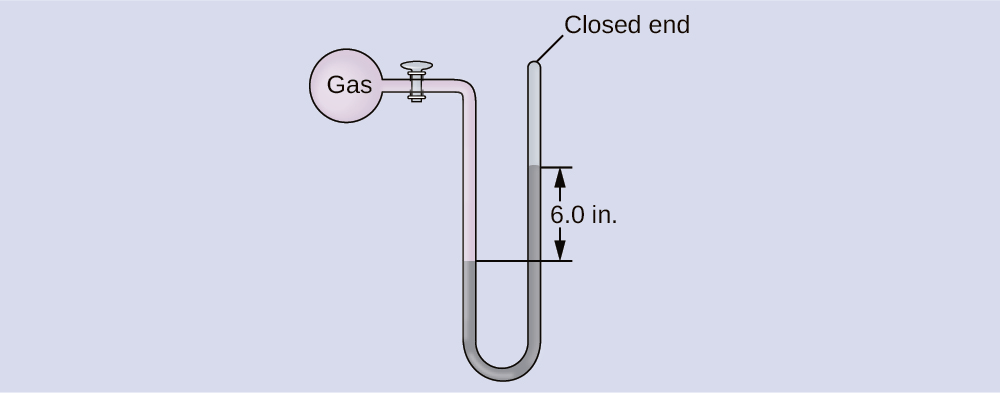
The pressure of a sample of gas is measured with a closed-end manometer. The liquid in the manometer is mercury. Determine the pressure of the gas in:

(a) torr

(b) Pa

(c) bar
A diagram of a closed-end manometer is shown. To the upper left is a spherical container labeled, “gas.” This container is connected by a valve to a U-shaped tube which is labeled “closed end” at the upper right end. The container and a portion of tube that follows are shaded pink. The lower portion of the U-shaped tube is shaded grey with the height of the gray region being greater on the right side than on the left. The difference in height of 6.0 i n is indicated with horizontal line segments and arrows.

Answer

(a) ~150 torr; (b) ~20,000 Pa; (c) ~0.20 bar

Example 9.4 §9.1 source ↗

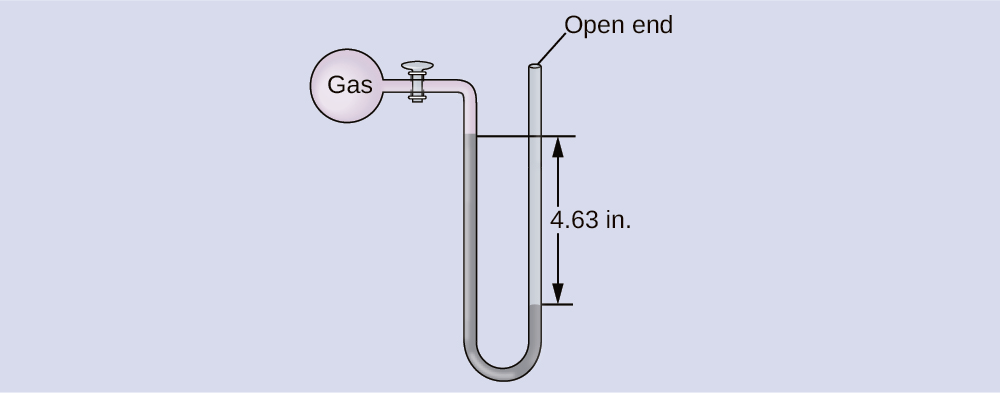
The pressure of a sample of gas is measured at sea level with an open-end Hg manometer, as shown to the right. Determine the pressure of the gas in:

(a) mm Hg

(b) atm

(c) kPa

A diagram of an open-end manometer is shown. To the upper left is a spherical container labeled, “gas.” This container is connected by a valve to a U-shaped tube which is labeled “open end” at the upper right end. The container and a portion of tube that follows are shaded pink. The lower portion of the U-shaped tube is shaded grey with the height of the gray region being greater on the left side than on the right. The difference in height of 4.63 i n is indicated with horizontal line segments and arrows.

Answer

(a) 642 mm Hg; (b) 0.845 atm; (c) 85.6 kPa

Example 9.5 §9.2 source ↗

A sample of nitrogen, N2, occupies 45.0 mL at 27 °C and 600 torr. What pressure will it have if cooled to –73 °C while the volume remains constant?

Answer

400 torr

Example 9.6 §9.2 source ↗

A sample of oxygen, O2, occupies 32.2 mL at 30 °C and 452 torr. What volume will it occupy at –70 °C and the same pressure?

Answer

21.6 mL

Example 9.7 §9.2 source ↗

What is the volume of a sample of ethane at 467 K and 1.1 atm if it occupies 405 mL at 298 K and 1.1 atm?

Answer

635 mL

Example 9.8 §9.2 source ↗

The sample of gas in Figure 9.13 has a volume of 30.0 mL at a pressure of 6.5 psi. Determine the volume of the gas at a pressure of 11.0 psi, using:

(a) the P-V graph in Figure 9.13

(b) the 1P vs. V graph in Figure 9.13

(c) the Boyle’s law equation

Comment on the likely accuracy of each method.

Figure 9.13 in the book ↗
When a gas occupies a smaller volume, it exerts a higher pressure; when it occupies a larger volume, it exerts a lower pressure (assuming the amount of gas and the temperature do not change). Since P and V are inversely proportional, a graph of 1P vs. V is linear.

Answer

(a) about 17–18 mL; (b) ~18 mL; (c) 17.7 mL; it was more difficult to estimate well from the P-V graph, so (a) is likely more inaccurate than (b); the calculation will be as accurate as the equation and measurements allow

Example 9.9 §9.2 source ↗

Calculate the pressure in bar of 2520 moles of hydrogen gas stored at 27 °C in the 180-L storage tank of a modern hydrogen-powered car.

Answer

350 bar

Example 9.10 §9.2 source ↗

A sample of ammonia is found to occupy 0.250 L under laboratory conditions of 27 °C and 0.850 atm. Find the volume of this sample at 0 °C and 1.00 atm.

Answer

0.193 L

Example 9.11 §9.3 source ↗

What is the density of molecular hydrogen gas at 17.0 °C and a pressure of 760 torr?

Answer

d = 0.0847 g/L

Example 9.12 §9.3 source ↗

Acetylene, a fuel used in welding torches, is composed of 92.3% C and 7.7% H by mass. Find the empirical formula. If 1.10 g of acetylene occupies of volume of 1.00 L at 1.15 atm and 59.5 °C, what is the molecular formula for acetylene?

Answer

Empirical formula, CH; Molecular formula, C2H2

Example 9.13 §9.3 source ↗

A sample of phosphorus that weighs 3.243 × 10⁻² g exerts a pressure of 31.89 kPa in a 56.0-mL bulb at 550 °C. What are the molar mass and molecular formula of phosphorus vapor?

Answer

124 g/mol P4

Example 9.14 §9.3 source ↗

A 5.73-L flask at 25 °C contains 0.0388 mol of N2, 0.147 mol of CO, and 0.0803 mol of H2. What is the total pressure in the flask in atmospheres?

Answer

1.137 atm

Example 9.15 §9.3 source ↗

What is the pressure of a mixture of 0.200 g of H2, 1.00 g of N2, and 0.820 g of Ar in a container with a volume of 2.00 L at 20 °C?

Answer

1.87 atm

Example 9.16 §9.3 source ↗

A sample of oxygen collected over water at a temperature of 29.0 °C and a pressure of 764 torr has a volume of 0.560 L. What volume would the dry oxygen from this sample have under the same conditions of temperature and pressure?

Answer

0.537 L

Example 9.17 §9.3 source ↗

An acetylene tank for an oxyacetylene welding torch provides 9340 L of acetylene gas, C2H2, at 0 °C and 1 atm. How many tanks of oxygen, each providing 7.00 × 10³ L of O2 at 0 °C and 1 atm, will be required to burn the acetylene? 2C2H2+5O2⟶4CO2+2H2O

Answer

3.34 tanks (2.34 × 10⁴ L)

Example 9.18 §9.3 source ↗

What volume of O2(g) measured at 25 °C and 760 torr is required to react with 17.0 L of ethylene, C2H4(g), measured under the same conditions of temperature and pressure? The products are CO2 and water vapor.

Answer

51.0 L

Example 9.19 §9.3 source ↗

Sulfur dioxide is an intermediate in the preparation of sulfuric acid. What volume of SO2 at 343 °C and 1.21 atm is produced by burning 1.00 kg of sulfur in excess oxygen?

Answer

1.30 × 10³ L

Example 9.20 §9.4 source ↗

At a particular pressure and temperature, nitrogen gas effuses at the rate of 79 mL/s. Under the same conditions, at what rate will sulfur dioxide effuse?

Answer

52 mL/s

Example 9.21 §9.4 source ↗

A party balloon filled with helium deflates to 23 of its original volume in 8.0 hours. How long will it take an identical balloon filled with the same number of moles of air (ℳ = 28.2 g/mol) to deflate to 12 of its original volume?

Answer

32 h

Example 9.22 §9.4 source ↗

Hydrogen gas effuses through a porous container 8.97-times faster than an unknown gas. Estimate the molar mass of the unknown gas.

Answer

162 g/mol

Example 9.23 §9.5 source ↗

Calculate the root-mean-square speed for a mole of oxygen molecules at –23 °C.

Answer

441 m/s

9-1 §9.1 source ↗

Why are sharp knives more effective than dull knives? (Hint: Think about the definition of pressure.)

Answer

The cutting edge of a knife that has been sharpened has a smaller surface area than a dull knife. Since pressure is force per unit area, a sharp knife will exert a higher pressure with the same amount of force and cut through material more effectively.

9-3 §9.1 source ↗

Why should you roll or belly-crawl rather than walk across a thinly-frozen pond?

Answer

Lying down distributes your weight over a larger surface area, exerting less pressure on the ice compared to standing up. If you exert less pressure, you are less likely to break through thin ice.

9-5 §9.1 source ↗

A typical barometric pressure in Denver, Colorado, is 615 mm Hg. What is this pressure in atmospheres and kilopascals?

Answer

0.809 atm; 82.0 kPa

9-7 §9.1 source ↗

Canadian tire pressure gauges are marked in units of kilopascals. What reading on such a gauge corresponds to 32 psi?

Answer

2.2 × 10² kPa

9-9 §9.1 source ↗

The pressure of the atmosphere on the surface of the planet Venus is about 88.8 atm. Compare that pressure in psi to the normal pressure on earth at sea level in psi.

Answer

Earth: 14.7 lb in–2; Venus: 1.30 × 10³ lb in−2

9-11 §9.1 source ↗

Consider this scenario and answer the following questions: On a mid-August day in the northeastern United States, the following information appeared in the local newspaper: atmospheric pressure at sea level 29.97 in. Hg, 1013.9 mbar.

(a) What was the pressure in kPa?

(b) The pressure near the seacoast in the northeastern United States is usually reported near 30.0 in. Hg. During a hurricane, the pressure may fall to near 28.0 in. Hg. Calculate the drop in pressure in torr.

Answer

(a) 101.5 kPa; (b) 51 torr drop

9-13 §9.1 source ↗

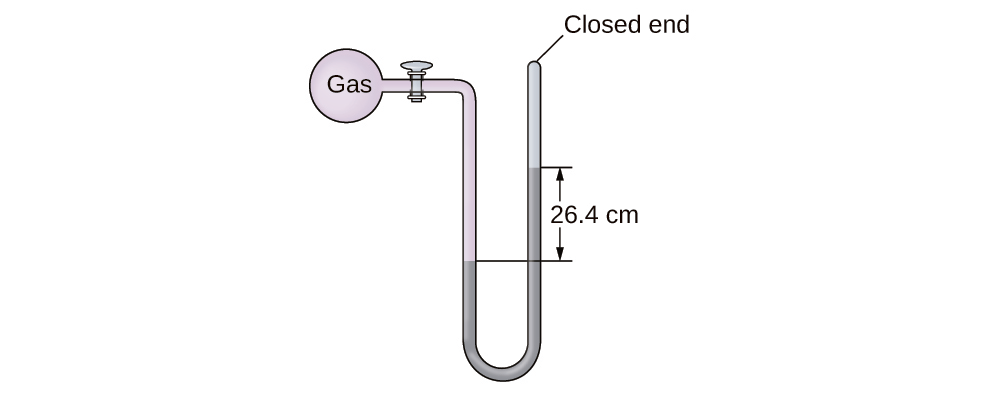
The pressure of a sample of gas is measured at sea level with a closed-end manometer. The liquid in the manometer is mercury. Determine the pressure of the gas in:

(a) torr

(b) Pa

(c) bar

A diagram of a closed-end manometer is shown. To the upper left is a spherical container labeled, “gas.” This container is connected by a valve to a U-shaped tube which is labeled “closed end” at the upper right end. The container and a portion of tube that follows are shaded pink. The lower portion of the U-shaped tube is shaded grey with the height of the gray region being greater on the right side than on the left. The difference in height of 26.4 c m is indicated with horizontal line segments and arrows.

Answer

(a) 264 torr; (b) 35,200 Pa; (c) 0.352 bar

9-15 §9.1 source ↗

The pressure of a sample of gas is measured at sea level with an open-end mercury manometer. Assuming atmospheric pressure is 760.0 mm Hg, determine the pressure of the gas in:

(a) mm Hg

(b) atm

(c) kPa
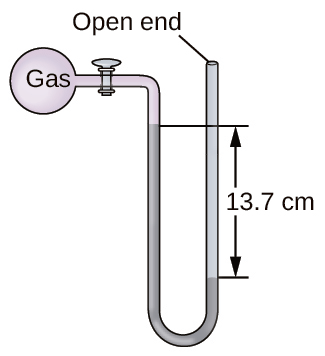
A diagram of an open-end manometer is shown. To the upper left is a spherical container labeled, “gas.” This container is connected by a valve to a U-shaped tube which is labeled “open end” at the upper right end. The container and a portion of tube that follows are shaded pink. The lower portion of the U-shaped tube is shaded grey with the height of the gray region being greater on the left side than on the right. The difference in height of 13.7 c m is indicated with horizontal line segments and arrows.

Answer

(a) 623 mm Hg; (b) 0.820 atm; (c) 83.1 kPa

9-17 §9.1 source ↗

How would the use of a volatile liquid affect the measurement of a gas using open-ended manometers vs. closed-end manometers?

Answer

With a closed-end manometer, no change would be observed, since the vaporized liquid would contribute equal, opposing pressures in both arms of the manometer tube. However, with an open-ended manometer, a higher pressure reading of the gas would be obtained than expected, since Pgas = Patm + Pvol liquid.

9-19 §9.2 source ↗

Explain how the volume of the bubbles exhausted by a scuba diver (Figure 9.16) change as they rise to the surface, assuming that they remain intact.
Figure 9.16 in the book ↗
Scuba divers use compressed air to breathe while underwater. (credit: modification of work by Mark Goodchild)

Answer

As the bubbles rise, the pressure decreases, so their volume increases as suggested by Boyle’s law.

9-21 §9.2 source ↗

An alternate way to state Avogadro’s law is “All other things being equal, the number of molecules in a gas is directly proportional to the volume of the gas.” (a) What is the meaning of the term “directly proportional?” (b) What are the “other things” that must be equal?

Answer

(a) The number of particles in the gas increases as the volume increases. (b) temperature, pressure

9-23 §9.2 source ↗

How would the graph in Figure 9.13 change if the number of moles of gas in the sample used to determine the curve were doubled?
Figure 9.13 in the book ↗
When a gas occupies a smaller volume, it exerts a higher pressure; when it occupies a larger volume, it exerts a lower pressure (assuming the amount of gas and the temperature do not change). Since P and V are inversely proportional, a graph of 1P vs. V is linear.

Answer

The curve would be farther to the right and higher up, but the same basic shape.

9-25 §9.2 source ↗

Determine the volume of 1 mol of CH4 gas at 150 K and 1 atm, using Figure 9.12.
Figure 9.12 in the book ↗
The volume and temperature are linearly related for 1 mole of methane gas at a constant pressure of 1 atm. If the temperature is in kelvin, volume and temperature are directly proportional. The line stops at 111 K because methane liquefies at this temperature; when extrapolated, it intersects the graph’s origin, representing a temperature of absolute zero.

Answer

About 12.5 L

9-27 §9.2 source ↗

A spray can is used until it is empty except for the propellant gas, which has a pressure of 1344 torr at 23 °C. If the can is thrown into a fire (T = 475 °C), what will be the pressure in the hot can?

Answer

3.40 × 10³ torr

9-29 §9.2 source ↗

A 2.50-L volume of hydrogen measured at –196 °C is warmed to 100 °C. Calculate the volume of the gas at the higher temperature, assuming no change in pressure.

Answer

12.1 L

9-31 §9.2 source ↗

A weather balloon contains 8.80 moles of helium at a pressure of 0.992 atm and a temperature of 25 °C at ground level. What is the volume of the balloon under these conditions?
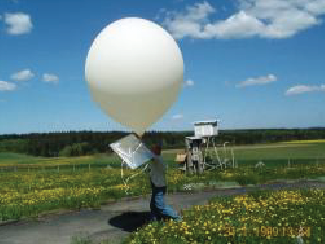
This image shows a white balloon that appears to have an attached white card. The balloon is being held by a person in an outdoor setting.

Answer

217 L

9-33 §9.2 source ↗

How many moles of gaseous boron trifluoride, BF3, are contained in a 4.3410-L bulb at 788.0 K if the pressure is 1.220 atm? How many grams of BF3?

Answer

8.190 × 10⁻² mol; 5.553 g

9-35 §9.2 source ↗

How many grams of gas are present in each of the following cases?

(a) 0.100 L of CO2 at 307 torr and 26 °C

(b) 8.75 L of C2H4, at 378.3 kPa and 483 K

(c) 221 mL of Ar at 0.23 torr and –54 °C

Answer

(a) 7.24 × 10⁻² g; (b) 23.1 g; (c) 1.5 × 10⁻⁴ g

9-37 §9.2 source ↗

A cylinder of medical oxygen has a volume of 35.4 L, and contains O2 at a pressure of 151 atm and a temperature of 25 °C. What volume of O2 does this correspond to at normal body conditions, that is, 1 atm and 37 °C?

Answer

5561 L

9-39 §9.2 source ↗

A 20.0-L cylinder containing 11.34 kg of butane, C4H10, was opened to the atmosphere. Calculate the mass of the gas remaining in the cylinder if it were opened and the gas escaped until the pressure in the cylinder was equal to the atmospheric pressure, 0.983 atm, and a temperature of 27 °C.

Answer

46.4 g

9-41 §9.2 source ↗

For a given amount of gas showing ideal behavior, draw labeled graphs of:

(a) the variation of P with V

(b) the variation of V with T

(c) the variation of P with T

(d) the variation of 1P with V

Answer

For a gas exhibiting ideal behavior:
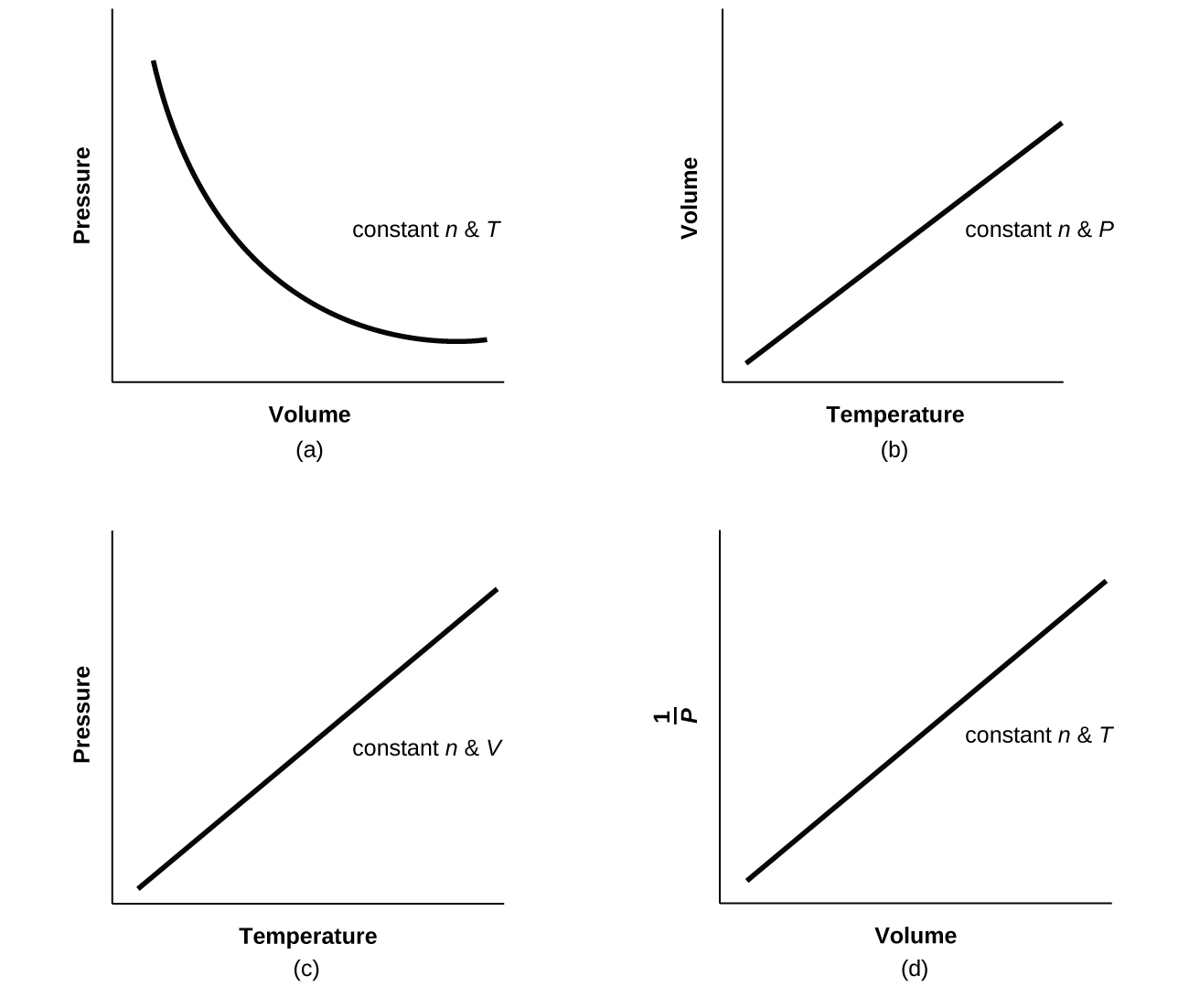
Four graphs are shown. In a, Volume is on the horizontal axis and Pressure is on the vertical axis. A downward trend with a decreasing rate of change is shown by a curved line. The label n, P cons is shown on the graph. In b, Temperature is on the horizontal axis and Volume is on the vertical axis. An increasing linear trend is shown by a straight line segment. The label n, P cons is shown on the graph. In c, Temperature is on the horizontal axis and Pressure is on the vertical axis. An increasing linear trend is shown by a straight line segment. The label n, P cons is shown on the graph. In d, Volume is on the horizontal axis and 1 divided by Pressure is on the vertical axis. An increasing linear trend is shown by a straight line segment on the graph. The label n, P cons is shown on the graph.

9-43 §9.2 source ↗

The effect of chlorofluorocarbons (such as CCl2F2) on the depletion of the ozone layer is well known. The use of substitutes, such as CH3CH2F(g), for the chlorofluorocarbons, has largely corrected the problem. Calculate the volume occupied by 10.0 g of each of these compounds at STP:

(a) CCl2F2(g)

(b) CH3CH2F(g)

Answer

(a) 1.85 L CCl2F2; (b) 4.66 L CH3CH2F

9-45 §9.2 source ↗

A balloon with a volume of 100.21 L at 21 °C and 0.981 atm is released and just barely clears the top of Mount Crumpit in British Columbia. If the final volume of the balloon is 144.53 L at a temperature of 5.24 °C, what is the pressure experienced by the balloon as it clears Mount Crumpit?

Answer

0.644 atm

9-47 §9.2 source ↗

If the volume of a fixed amount of a gas is tripled at constant temperature, what happens to the pressure?

Answer

The pressure decreases by a factor of 3.

9-49 §9.3 source ↗

Calculate the density of Freon 12, CF2Cl2, at 30.0 °C and 0.954 atm.

Answer

4.64 g L−1

9-51 §9.3 source ↗

A cylinder of O2(g) used in breathing by patients with emphysema has a volume of 3.00 L at a pressure of 10.0 atm. If the temperature of the cylinder is 28.0 °C, what mass of oxygen is in the cylinder?

Answer

38.8 g

9-53 §9.3 source ↗

What is the molar mass of a gas if 0.281 g of the gas occupies a volume of 125 mL at a temperature 126 °C and a pressure of 777 torr?

Answer

72.0 g mol−1

9-55 §9.3 source ↗

The density of a certain gaseous fluoride of phosphorus is 3.93 g/L at STP. Calculate the molar mass of this fluoride and determine its molecular formula.

Answer

88.1 g mol−1; PF3

9-57 §9.3 source ↗

A 36.0–L cylinder of a gas used for calibration of blood gas analyzers in medical laboratories contains 350 g CO2, 805 g O2, and 4,880 g N2. At 25 degrees C, what is the pressure in the cylinder in atmospheres?

Answer

141 atm, 107,000 torr, 14,300 kPa

9-59 §9.3 source ↗

A sample of gas isolated from unrefined petroleum contains 90.0% CH4, 8.9% C2H6, and 1.1% C3H8 at a total pressure of 307.2 kPa. What is the partial pressure of each component of this gas? (The percentages given indicate the percent of the total pressure that is due to each component.)

Answer

CH4: 276 kPa; C2H6: 27 kPa; C3H8: 3.4 kPa

9-61 §9.3 source ↗

Most mixtures of hydrogen gas with oxygen gas are explosive. However, a mixture that contains less than 3.0 % O2 is not. If enough O2 is added to a cylinder of H2 at 33.2 atm to bring the total pressure to 34.5 atm, is the mixture explosive?

Answer

Yes

9-63 §9.3 source ↗

A sample of carbon monoxide was collected over water at a total pressure of 756 torr and a temperature of 18 °C. What is the pressure of the carbon monoxide? (See Table 9.2 for the vapor pressure of water.)
Table 9.2 in the book ↗
Temperature (°C) Pressure (torr) Temperature (°C) Pressure (torr) Temperature (°C) Pressure (torr)
–10 1.95 18 15.5 30 31.8
–5 3.0 19 16.5 35 42.2
–2 3.9 20 17.5 40 55.3
0 4.6 21 18.7 50 92.5
2 5.3 22 19.8 60 149.4
4 6.1 23 21.1 70 233.7
6 7.0 24 22.4 80 355.1
8 8.0 25 23.8 90 525.8
10 9.2 26 25.2 95 633.9
12 10.5 27 26.7 99 733.2
14 12.0 28 28.3 100.0 760.0
16 13.6 29 30.0 101.0 787.6

Answer

740 torr

9-65 §9.3 source ↗

Joseph Priestley first prepared pure oxygen by heating mercuric oxide, HgO:
2HgO(s)⟶ 2Hg(l)+ O2(g)

(a) Outline the steps necessary to answer the following question: What volume of O2 at 23 °C and 0.975 atm is produced by the decomposition of 5.36 g of HgO?

(b) Answer the question.

Answer

(a) Determine the moles of HgO that decompose; using the chemical equation, determine the moles of O2 produced by decomposition of this amount of HgO; and determine the volume of O2 from the moles of O2, temperature, and pressure. (b) 0.308 L

9-67 §9.3 source ↗

The chlorofluorocarbon CCl2F2 can be recycled into a different compound by reaction with hydrogen to produce CH2F2(g), a compound useful in chemical manufacturing:
CCl2F2(g)+ 4H2(g)⟶ CH2F2(g)+ 2HCl(g)

(a) Outline the steps necessary to answer the following question: What volume of hydrogen at 225 atm and 35.5 °C would be required to react with 1 ton (1.000 × 10³ kg) of CCl2F2?

(b) Answer the question.

Answer

(a) Determine the molar mass of CCl2F2. From the balanced equation, calculate the moles of H2 needed for the complete reaction. From the ideal gas law, convert moles of H2 into volume. (b) 3.72 × 10³ L

9-69 §9.3 source ↗

Lime, CaO, is produced by heating calcium carbonate, CaCO3; carbon dioxide is the other product.

(a) Outline the steps necessary to answer the following question: What volume of carbon dioxide at 875 K and 0.966 atm is produced by the decomposition of 1 ton (1.000 × 10³ kg) of calcium carbonate?

(b) Answer the question.

Answer

(a) Balance the equation. Determine the grams of CO2 produced and the number of moles. From the ideal gas law, determine the volume of gas. (b) 7.43 × 10⁵ L

9-71 §9.3 source ↗

Calculate the volume of oxygen required to burn 12.00 L of ethane gas, C2H6, to produce carbon dioxide and water, if the volumes of C2H6 and O2 are measured under the same conditions of temperature and pressure.

Answer

42.00 L

9-73 §9.3 source ↗

Consider the following questions:

(a) What is the total volume of the CO2(g) and H2O(g) at 600 °C and 0.888 atm produced by the combustion of 1.00 L of C2H6(g) measured at STP?

(b) What is the partial pressure of H2O in the product gases?

Answer

(a) 18.0 L; (b) 0.533 atm

9-75 §9.3 source ↗

What volume of oxygen at 423.0 K and a pressure of 127.4 kPa is produced by the decomposition of 129.7 g of BaO2 to BaO and O2?

Answer

10.57 L O2

9-77 §9.3 source ↗

Ethanol, C2H5OH, is produced industrially from ethylene, C2H4, by the following sequence of reactions:
3C2H4+ 2H2SO4⟶ C2H5HSO4+ (C2H5)2SO4
C2H5HSO4+ (C2H5)2SO4+ 3H2O⟶ 3C2H5OH+ 2H2SO4

What volume of ethylene at STP is required to produce 1.000 metric ton (1000 kg) of ethanol if the overall yield of ethanol is 90.1%?

Answer

5.40 × 10⁵ L

9-79 §9.3 source ↗

A sample of a compound of xenon and fluorine was confined in a bulb with a pressure of 18 torr. Hydrogen was added to the bulb until the pressure was 72 torr. Passage of an electric spark through the mixture produced Xe and HF. After the HF was removed by reaction with solid KOH, the final pressure of xenon and unreacted hydrogen in the bulb was 36 torr. What is the empirical formula of the xenon fluoride in the original sample? (Note: Xenon fluorides contain only one xenon atom per molecule.)

Answer

XeF4

9-81 §9.4 source ↗

A balloon filled with helium gas takes 6 hours to deflate to 50% of its original volume. How long will it take for an identical balloon filled with the same volume of hydrogen gas (instead of helium) to decrease its volume by 50%?

Answer

4.2 hours

9-83 §9.4 source ↗

Starting with the definition of rate of effusion and Graham’s finding relating rate and molar mass, show how to derive the Graham’s law equation, relating the relative rates of effusion for two gases to their molecular masses.

Answer

Effusion can be defined as the process by which a gas escapes through a pinhole into a vacuum. Graham’s law states that with a mixture of two gases A and B: (rate Arate B)= (molar mass of Bmolar mass of A)1/2. Both A and B are in the same container at the same temperature, and therefore will have the same kinetic energy:
KEA= KEB KE= 12mv2
Therefore, 12mAvA2= 12mBvB2
vA2vB2=mBmA
(vA2vB2)1/2= (mBmA)1/2
vAvB= (mBmA)1/2

9-85 §9.4 source ↗

Which of the following gases diffuse more slowly than oxygen? F2, Ne, N2O, C2H2, NO, Cl2, H2S

Answer

F2, N2O, Cl2, H2S

9-87 §9.4 source ↗

Calculate the relative rate of diffusion of 1H2 (molar mass 2.0 g/mol) compared with 2H2 (molar mass 4.0 g/mol) and the relative rate of diffusion of O2 (molar mass 32 g/mol) compared with O3 (molar mass 48 g/mol).

Answer

1.4; 1.2

9-89 §9.4 source ↗

When two cotton plugs, one moistened with ammonia and the other with hydrochloric acid, are simultaneously inserted into opposite ends of a glass tube that is 87.0 cm long, a white ring of NH4Cl forms where gaseous NH3 and gaseous HCl first come into contact. NH3(g)+ HCl(g)⟶ NH4Cl(s) At approximately what distance from the ammonia moistened plug does this occur? (Hint: Calculate the rates of diffusion for both NH3 and HCl, and find out how much faster NH3 diffuses than HCl.)

Answer

51.7 cm

9-91 §9.5 source ↗

Can the speed of a given molecule in a gas double at constant temperature? Explain your answer.

Answer

Yes. At any given instant, there are a range of values of molecular speeds in a sample of gas. Any single molecule can speed up or slow down as it collides with other molecules. The average speed of all the molecules is constant at constant temperature.

9-93 §9.5 source ↗

The distribution of molecular speeds in a sample of helium is shown in Figure 9.34. If the sample is cooled, will the distribution of speeds look more like that of H2 or of H2O? Explain your answer.
Figure 9.34 in the book ↗
molecular speed is directly related to molecular mass. At a given temperature, lighter molecules move faster on average than heavier molecules.

Answer

H2O. Cooling slows the speeds of the He atoms, causing them to behave as though they were heavier.

9-95 §9.5 source ↗

A 1-L sample of CO initially at STP is heated to 546 K, and its volume is increased to 2 L.

(a) What effect do these changes have on the pressure exerted by the gas?

(b) What is the effect on the average kinetic energy of the molecules?

(c) What is the effect on the root mean square speed of the molecules?

Answer

(a) The pressure of the gas remains constant. (b) The average kinetic energy doubles. (c) The root mean square speed increases to 2 times its initial value; urms is proportional to KEavg.

9-97 §9.5 source ↗

Answer the following questions:

(a) Is the pressure of the gas in the hot-air balloon shown at the opening of this chapter greater than, less than, or equal to that of the atmosphere outside the balloon?

(b) Is the density of the gas in the hot-air balloon shown at the opening of this chapter greater than, less than, or equal to that of the atmosphere outside the balloon?

(c) At a pressure of 1 atm and a temperature of 20 °C, dry air has a density of 1.2256 g/L. What is the (average) molar mass of dry air?

(d) The average temperature of the gas in a hot-air balloon is 1.30 × 10² °F. Calculate its density, assuming the molar mass equals that of dry air.

(e) The lifting capacity of a hot-air balloon is equal to the difference in the mass of the cool air displaced by the balloon and the mass of the gas in the balloon. What is the difference in the mass of 1.00 L of the cool air in part (c) and the hot air in part (d)?

(f) An average balloon has a diameter of 60 feet and a volume of 1.1 × 105 ft3. What is the lifting power of such a balloon? If the weight of the balloon and its rigging is 500 pounds, what is its capacity for carrying passengers and cargo?

(g) A balloon carries 40.0 gallons of liquid propane (density 0.5005 g/L). What volume of CO2 and H2O gas is produced by the combustion of this propane at STP?

(h) A balloon flight can last about 90 minutes. If all of the fuel is burned during this time, what is the approximate rate of heat loss (in kJ/min) from the hot air in the bag during the flight?

Answer

(a) equal; (b) less than; (c) 29.48 g mol−1; (d) 1.0966 g L−1; (e) 0.129 g/L; (f) 4.01 × 10⁵ g; net lifting capacity = 384 lb; (g) 270 L; (h) 39.1 kJ min−1

9-99 §9.6 source ↗

Graphs showing the behavior of several different gases follow. Which of these gases exhibit behavior significantly different from that expected for ideal gases?
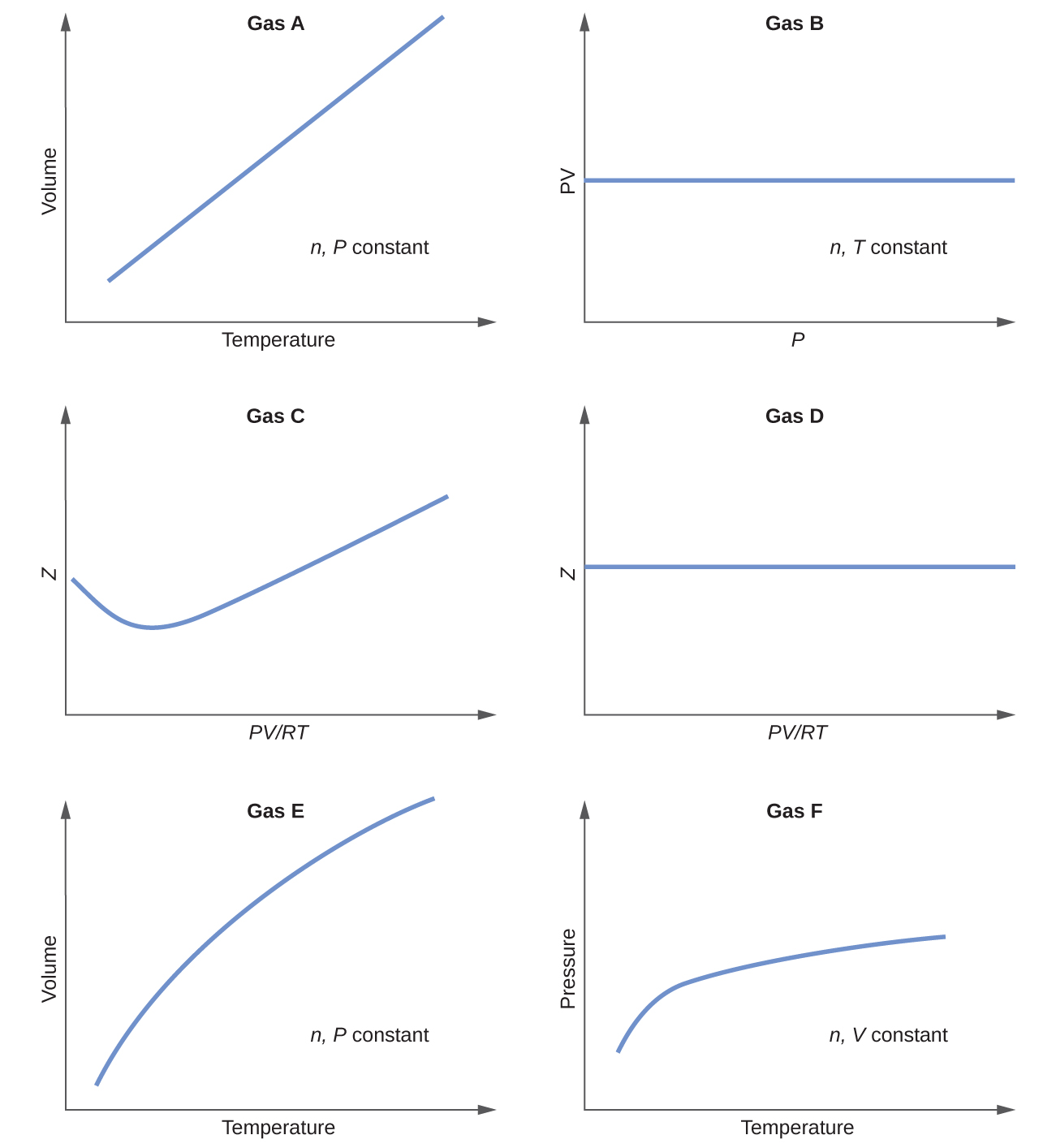
This figure includes 6 graphs. The first, which is labeled, “Gas A,” has a horizontal axis labeled, “Temperature,” and a vertical axis labeled, “Volume.” A straight blue line segment extends from the lower left to the upper right of this graph. The open area in the lower right portion of the graph contains the label, “n, P constant.” The second, which is labeled, “Gas B,” has a horizontal axis labeled, “P,” and a vertical axis labeled, “P V.” A straight blue line segment extends horizontally across the center of this graph. The open area in the lower right portion of the graph contains the label, “n, T constant.” The third, which is labeled, “Gas C,” has a horizontal axis labeled,“P V divided by R T,” and a vertical axis labeled, “Moles.” A blue curve begins about halfway up the vertical axis, dips slightly, then increases steadily to the upper right region of the graph. The fourth, which is labeled, “Gas D,” has a horizontal axis labeled, “P V divided by R T,” and a vertical axis labeled, “Moles.” A straight blue line segment extends horizontally across the center of this graph. The open area in the lower right portion of the graph contains the label “n, P constant.” The fifth, which is labeled, “Gas E,” has a horizontal axis labeled, “Temperature,” and a vertical axis labeled, “Volume.” A blue curve extends from the lower left to the upper right of this graph. The open area in the lower right portion of the graph contains the label “n, P constant.” The sixth graph, which is labeled, “Gas F,” has a horizontal axis labeled, “Temperature,” and a vertical axis labeled, “Pressure.” A blue curve begins toward the lower left region of the graph, increases at a rapid rate, then continues to increase at a relatively slow rate moving left to right across the graph. The open area in the lower right portion of the graph contains the label, “n, V constant.”

Answer

Gases C, E, and F

9-101 §9.6 source ↗

Under which of the following sets of conditions does a real gas behave most like an ideal gas, and for which conditions is a real gas expected to deviate from ideal behavior? Explain.

(a) high pressure, small volume

(b) high temperature, low pressure

(c) low temperature, high pressure

Answer

The gas behavior most like an ideal gas will occur under the conditions that minimize the chances of significant interactions between the gaseous atoms/molecules, namely, low pressures (fewer atoms/molecules per unit volume) and high temperatures (greater kinetic energies of atoms/molecules make them less susceptible to attractive forces). The conditions described in (b), high temperature and low pressure, are therefore most likely to yield ideal gas behavior.

9-103 §9.6 source ↗

For which of the following gases should the correction for the molecular volume be largest:

CO, CO2, H2, He, NH3, SF6?

Answer

SF6

9-105 §9.6 source ↗

Answer the following questions:

(a) If XX behaved as an ideal gas, what would its graph of Z vs. P look like?

(b) For most of this chapter, we performed calculations treating gases as ideal. Was this justified?

(c) What is the effect of the volume of gas molecules on Z? Under what conditions is this effect small? When is it large? Explain using an appropriate diagram.

(d) What is the effect of intermolecular attractions on the value of Z? Under what conditions is this effect small? When is it large? Explain using an appropriate diagram.

(e) In general, under what temperature conditions would you expect Z to have the largest deviations from the Z for an ideal gas?

Answer

(a) A straight horizontal line at 1.0; (b) When real gases are at low pressures and high temperatures, they behave close enough to ideal gases that they are approximated as such; however, in some cases, we see that at a high pressure and temperature, the ideal gas approximation breaks down and is significantly different from the pressure calculated by the ideal gas equation. (c) The greater the compressibility, the more the volume matters. At low pressures, the correction factor for intermolecular attractions is more significant, and the effect of the volume of the gas molecules on Z would be a small lowering compressibility. At higher pressures, the effect of the volume of the gas molecules themselves on Z would increase compressibility (see Figure 9.35). (d) Once again, at low pressures, the effect of intermolecular attractions on Z would be more important than the correction factor for the volume of the gas molecules themselves, though perhaps still small. At higher pressures and low temperatures, the effect of intermolecular attractions would be larger. See Figure 9.35. (e) Low temperatures
Figure 9.35 in the book ↗
A graph of the compressibility factor (Z) vs. pressure shows that gases can exhibit significant deviations from the behavior predicted by the ideal gas law.

Loading chapter 10…

Problems and answers are adapted from Chemistry 2e by Paul Flowers, Klaus Theopold, Richard Langley and William R. Robinson, OpenStax, and are used under the CC BY-NC-SA 4.0 licence. Access for free at https://openstax.org/books/chemistry-2e/pages/1-introduction. Illustrations: Copyright Rice University, OpenStax, under CC BY-NC-SA 4.0 license. This adaptation is released under the same licence, is non-commercial, and is neither affiliated with nor endorsed by OpenStax or Rice University.