Every problem in the chapter beside the book’s answer, a chapter at a time as you scroll.

Chapter 6: Electronic Structure and Periodic Properties of Elements

56 problems · 8 figures

Example 6.1 §6.1 source ↗

One of the frequencies used to transmit and receive cellular telephone signals in the United States is 850 MHz. What is the wavelength in meters of these radio waves?

Answer

0.353 m = 35.3 cm

Example 6.2 §6.1 source ↗

The microwaves in an oven are of a specific frequency that will heat the water molecules contained in food. (This is why most plastics and glass do not become hot in a microwave oven-they do not contain water molecules.) This frequency is about 3 × 10⁹ Hz. What is the energy of one photon in these microwaves?

Answer

2 × 10⁻²⁴ J

Example 6.3 §6.1 source ↗

Calculate the threshold energy in kJ/mol of electrons in aluminum, given that the lowest frequency photon for which the photoelectric effect is observed is 9.87 × 10¹⁴ Hz.

Answer

394 kJ/mol

Example 6.4 §6.2 source ↗

The electron in Figure 6.15 is promoted even further to an orbit with n = 6. What is its new energy?
Figure 6.15 in the book ↗
The horizontal lines show the relative energy of orbits in the Bohr model of the hydrogen atom, and the vertical arrows depict the energy of photons absorbed (left) or emitted (right) as electrons move between these orbits.

Answer

−6.053 × 10⁻²⁰ J

Example 6.5 §6.2 source ↗

What is the energy in joules and the wavelength in meters of the photon produced when an electron falls from the n = 5 to the n = 3 level in a He+ ion (Z = 2 for He+)?

Answer

6.198 × 10⁻¹⁹ J; 3.205 × 10⁻⁷ m

Example 6.6 §6.3 source ↗

Calculate the wavelength of a softball with a mass of 100 g traveling at a velocity of 35 m s–1, assuming that it can be modeled as a single particle.

Answer

1.9 × 10⁻³⁴ m.

We never think of a thrown softball having a wavelength, since this wavelength is so small it is impossible for our senses or any known instrument to detect. Since de Broglie wavelength is inversely proportional to both particle mass and velocity, the particle’s momentum (mathematical product of mass and velocity) must be sufficiently small to yield a detectably large wavelength.

Example 6.7 §6.3 source ↗

Identify the subshell in which electrons with the following quantum numbers are found: (a) n = 3, l = 1; (b) n = 5, l = 3; (c) n = 2, l = 0.

Answer

(a) 3p (b) 5f (c) 2s

Example 6.8 §6.3 source ↗

If a shell contains a maximum of 32 electrons, what is the principal quantum number, n?

Answer

n = 4

Example 6.9 §6.3 source ↗

How many orbitals have l = 2 and n = 3?

Answer

The five degenerate 3d orbitals

Example 6.10 §6.4 source ↗

Identify the atoms from the electron configurations given:

(a) [Ar]4s23d5

(b) [Kr]5s24d105p6

Answer

(a) Mn (b) Xe

Example 6.11 §6.4 source ↗

Which ion with a +2 charge has the electron configuration 1s22s22p63s23p64s23d104p64d5? Which ion with a +3 charge has this configuration?

Answer

Tc2+, Ru3+

Example 6.12 §6.5 source ↗

Give an example of an atom whose size is smaller than fluorine.

Answer

Ne or He

Example 6.13 §6.5 source ↗

Which has the lowest value for IE1: O, Po, Pb, or Ba?

Answer

Ba

6-1 §6.1 source ↗

The light produced by a red neon sign is due to the emission of light by excited neon atoms. Qualitatively describe the spectrum produced by passing light from a neon lamp through a prism.

Answer

The spectrum consists of colored lines, at least one of which (probably the brightest) is red.

6-3 §6.1 source ↗

FM-95, an FM radio station, broadcasts at a frequency of 9.51 × 10⁷ s−1 (95.1 MHz). What is the wavelength of these radio waves in meters?

Answer

3.15 m

6-5 §6.1 source ↗

Light with a wavelength of 614.5 nm looks orange. What is the energy, in joules, per photon of this orange light? What is the energy in eV (1 eV = 1.602 × 10⁻¹⁹ J)?

Answer

3.233 × 10⁻¹⁹ J; 2.018 eV

6-7 §6.1 source ↗

A photon of light produced by a surgical laser has an energy of 3.027 × 10⁻¹⁹ J. Calculate the frequency and wavelength of the photon. What is the total energy in 1 mole of photons? What is the color of the emitted light?

Answer

ν = 4.568 × 10¹⁴ s−1; λ = 656.3 nm; Energy mol−1 = 1.823 × 10⁵ J mol−1; red

6-9 §6.1 source ↗

The emission spectrum of cesium contains two lines whose frequencies are (a) 3.45 × 10¹⁴ Hz and (b) 6.53 × 10¹⁴ Hz. What are the wavelengths and energies per photon of the two lines? What color are the lines?

Answer

(a) λ = 8.69 × 10⁻⁷ m; E = 2.29 × 10⁻¹⁹ J; (b) λ = 4.59 × 10⁻⁷ m; E = 4.33 × 10⁻¹⁹ J; The color of (a) is red; (b) is blue.

6-11 §6.1 source ↗

One of the radiographic devices used in a dentist's office emits an X-ray of wavelength 2.090 × 10⁻¹¹ m. What is the energy, in joules, and frequency of this X-ray?

Answer

E = 9.502 × 10⁻¹⁵ J; ν = 1.434 × 10¹⁹ s−1

6-13 §6.1 source ↗

RGB color television and computer displays use cathode ray tubes that produce colors by mixing red, green, and blue light. If we look at the screen with a magnifying glass, we can see individual dots turn on and off as the colors change. Using a spectrum of visible light, determine the approximate wavelength of each of these colors. What is the frequency and energy of a photon of each of these colors?

Answer

Red: 660 nm; 4.54 × 10¹⁴ Hz; 3.01 × 10⁻¹⁹ J. Green: 520 nm; 5.77 × 10¹⁴ Hz; 3.82 × 10⁻¹⁹ J. Blue: 440 nm; 6.81 × 10¹⁴ Hz; 4.51 × 10⁻¹⁹ J. Somewhat different numbers are also possible.

6-15 §6.1 source ↗

What is the threshold frequency for sodium metal if a photon with frequency 6.66 × 10¹⁴ s−1 ejects an electron with 7.74 × 10⁻²⁰ J kinetic energy? Will the photoelectric effect be observed if sodium is exposed to orange light?

Answer

5.49 × 10¹⁴ s−1; no

6-17 §6.2 source ↗

What does it mean to say that the energy of the electrons in an atom is quantized?

Answer

Quantized energy means that the electrons can possess only certain discrete energy values; values between those quantized values are not permitted.

6-19 §6.2 source ↗

The electron volt (eV) is a convenient unit of energy for expressing atomic-scale energies. It is the amount of energy that an electron gains when subjected to a potential of 1 volt; 1 eV = 1.602 × 10⁻¹⁹ J. Using the Bohr model, determine the energy, in electron volts, of the photon produced when an electron in a hydrogen atom moves from the orbit with n = 5 to the orbit with n = 2. Show your calculations.

Answer

2.856 eV

6-21 §6.2 source ↗

Using the Bohr model, determine the lowest possible energy for the electron in the He+ ion.

Answer

−8.716 × 10⁻¹⁸ J

6-23 §6.2 source ↗

Using the Bohr model, determine the energy of an electron with n = 8 in a hydrogen atom.

Answer

−3.405 × 10⁻²⁰ J

6-25 §6.2 source ↗

What is the radius, in angstroms, of the orbital of an electron with n = 8 in a hydrogen atom?

Answer

33.9 Å

6-27 §6.2 source ↗

Using the Bohr model, determine the energy in joules of the photon produced when an electron in a Li2+ ion moves from the orbit with n = 2 to the orbit with n = 1.

Answer

1.471 × 10⁻¹⁷ J

6-29 §6.2 source ↗

How are the Bohr model and the Rutherford model of the atom similar? How are they different?

Answer

Both involve a relatively heavy nucleus with electrons moving around it, although strictly speaking, the Bohr model works only for one-electron atoms or ions. According to classical mechanics, the Rutherford model predicts a miniature “solar system” with electrons moving about the nucleus in circular or elliptical orbits that are confined to planes. If the requirements of classical electromagnetic theory that electrons in such orbits would emit electromagnetic radiation are ignored, such atoms would be stable, having constant energy and angular momentum, but would not emit any visible light (contrary to observation). If classical electromagnetic theory is applied, then the Rutherford atom would emit electromagnetic radiation of continually increasing frequency (contrary to the observed discrete spectra), thereby losing energy until the atom collapsed in an absurdly short time (contrary to the observed long-term stability of atoms). The Bohr model retains the classical mechanics view of circular orbits confined to planes having constant energy and angular momentum, but restricts these to quantized values dependent on a single quantum number, n. The orbiting electron in Bohr’s model is assumed not to emit any electromagnetic radiation while moving about the nucleus in its stationary orbits, but the atom can emit or absorb electromagnetic radiation when the electron changes from one orbit to another. Because of the quantized orbits, such “quantum jumps” will produce discrete spectra, in agreement with observations.

6-31 §6.3 source ↗

How are the Bohr model and the quantum mechanical model of the hydrogen atom similar? How are they different?

Answer

Both models have a central positively charged nucleus with electrons moving about the nucleus in accordance with the Coulomb electrostatic potential. The Bohr model assumes that the electrons move in circular orbits that have quantized energies, angular momentum, and radii that are specified by a single quantum number, n = 1, 2, 3, …, but this quantization is an ad hoc assumption made by Bohr to incorporate quantization into an essentially classical mechanics description of the atom. Bohr also assumed that electrons orbiting the nucleus normally do not emit or absorb electromagnetic radiation, but do so when the electron switches to a different orbit. In the quantum mechanical model, the electrons do not move in precise orbits (such orbits violate the Heisenberg uncertainty principle) and, instead, a probabilistic interpretation of the electron’s position at any given instant is used, with a mathematical function ψ called a wavefunction that can be used to determine the electron’s spatial probability distribution. These wavefunctions, or orbitals, are three-dimensional stationary waves that can be specified by three quantum numbers that arise naturally from their underlying mathematics (no ad hoc assumptions required): the principal quantum number, n (the same one used by Bohr), which specifies shells such that orbitals having the same n all have the same energy and approximately the same spatial extent; the angular momentum quantum number l, which is a measure of the orbital’s angular momentum and corresponds to the orbitals’ general shapes, as well as specifying subshells such that orbitals having the same l (and n) all have the same energy; and the orientation quantum number m, which is a measure of the z component of the angular momentum and corresponds to the orientations of the orbitals. The Bohr model gives the same expression for the energy as the quantum mechanical expression and, hence, both properly account for hydrogen’s discrete spectrum (an example of getting the right answers for the wrong reasons, something that many chemistry students can sympathize with), but gives the wrong expression for the angular momentum (Bohr orbits necessarily all have non-zero angular momentum, but some quantum orbitals [s orbitals] can have zero angular momentum).

6-33 §6.3 source ↗

Describe the properties of an electron associated with each of the following four quantum numbers: n, l, ml, and ms.

Answer

n determines the general range for the value of energy and the probable distances that the electron can be from the nucleus. l determines the shape of the orbital. m1 determines the orientation of the orbitals of the same l value with respect to one another. ms determines the spin of an electron.

6-35 §6.3 source ↗

Identify the subshell in which electrons with the following quantum numbers are found:

(a) n = 2, l = 1

(b) n = 4, l = 2

(c) n = 6, l = 0

Answer

(a) 2p; (b) 4d; (c) 6s

6-37 §6.3 source ↗

Identify the subshell in which electrons with the following quantum numbers are found:

(a) n = 3, l = 2

(b) n = 1, l = 0

(c) n = 4, l = 3

Answer

(a) 3d; (b) 1s; (c) 4f

6-39 §6.3 source ↗

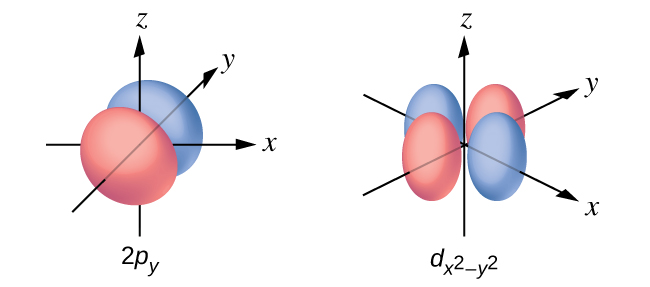
Sketch the boundary surface of a dx2−y2 and a py orbital. Be sure to show and label the axes.

Answer

This figure contains two diagrams. The first is of a 2 p subscript y orbital. The second is of a d subscript x squared minus y squared orbital. The first diagram has two spherical shapes joined at the origin when oriented along the y axis on an x y and z coordinate plane. The second diagram shows four ellipsoid lobes with ends centered around the origin. Two of these ellipsoid lobes are oriented along the x axis and two are oriented along the y axis on the x y and z coordinate plane.

6-41 §6.3 source ↗

Consider the orbitals shown here in outline.
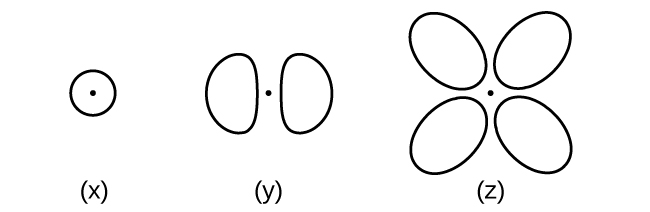
This figure contains three diagrams. In x, a circle is drawn with a dot at the center. In y, two nearly ellipsoid shapes are oriented horizontally with a dot between them. In z, four shapes like those in y are oriented in an x shape with a dot at the center.

(a) What is the maximum number of electrons contained in an orbital of type (x)? Of type (y)? Of type (z)?

(b) How many orbitals of type (x) are found in a shell with n = 2? How many of type (y)? How many of type (z)?

(c) Write a set of quantum numbers for an electron in an orbital of type (x) in a shell with n = 4. Of an orbital of type (y) in a shell with n = 2. Of an orbital of type (z) in a shell with n = 3.

(d) What is the smallest possible n value for an orbital of type (x)? Of type (y)? Of type (z)?

(e) What are the possible l and ml values for an orbital of type (x)? Of type (y)? Of type (z)?

Answer

(a) x. 2, y. 2, z. 2; (b) x. 1, y. 3, z. 0; (c) x. 4 0 0 12, y. 2 1 0 12, z. 3 2 0 12; (d) x. 1, y. 2, z. 3; (e) x. l = 0, ml = 0, y. l = 1, ml = –1, 0, or +1, z. l = 2, ml = –2, –1, 0, +1, +2

6-43 §6.3 source ↗

How many electrons could be held in the second shell of an atom if the spin quantum number ms could have three values instead of just two? (Hint: Consider the Pauli exclusion principle.)

Answer

12

6-45 §6.3 source ↗

Write a set of quantum numbers for each of the electrons with an n of 4 in a Se atom.

Answer

n l ml s
4 0 0 +12
4 0 0 −12
4 1 −1 +12
4 1 0 +12
4 1 +1 +12
4 1 −1 −12

6-47 §6.4 source ↗

Read the labels of several commercial products and identify monatomic ions of at least six main group elements contained in the products. Write the complete electron configurations of these cations and anions.

Answer

For example, Na+: 1s22s22p6; Ca2+: 1s22s22p63s23p6; Sn2+: 1s22s22p63s23p63d104s24p64d105s2; F–: 1s22s22p6; O2–: 1s22s22p6; Cl–: 1s22s22p63s23p6.

6-49 §6.4 source ↗

Using complete subshell notation (1s22s22p6, and so forth), predict the electron configuration of each of the following atoms:

(a) N

(b) Si

(c) Fe

(d) Te

(e) Tb

Answer

(a) 1s22s22p3; (b) 1s22s22p63s23p2; (c) 1s22s22p63s23p64s23d6; (d) 1s22s22p63s23p64s23d104p65s24d105p4; (e) 1s22s22p63s23p64s23d104p65s24d105p66s24f9

6-51 §6.4 source ↗

What additional information do we need to answer the question “Which ion has the electron configuration 1s22s22p63s23p6”?

Answer

The charge on the ion.

6-53 §6.4 source ↗

Use an orbital diagram to describe the electron configuration of the valence shell of each of the following atoms:

(a) N

(b) Si

(c) Fe

(d) Te

(e) Mo

Answer

(a)

This figure includes a square followed by 3 squares all connected in a single row. The first square is labeled below as, “2 s.” The connected squares are labeled below as, “2 p.” The first square has a pair of half arrows: one pointing up, and the other down. Each of the remaining squares contains a single upward pointing arrow.


(b)

This figure includes a square followed by 3 squares all connected in a single row. The first square is labeled below as, “2 s.” The connected squares are labeled below as, “2 p.” The first square has a pair of half arrows: one pointing up and the other down. The first two squares in the row of connected squares contain a single upward pointing arrow. The third square is empty.


(c)

This figure includes a square followed by 5 squares all connected in a single row. The first square is labeled below as, “4 s.” The connected squares are labeled below as, “3 d.” The first square and the left-most square in the row of connected squares each has a pair of half arrows: one pointing up and the other down. Each of the remaining squares contains a single upward pointing arrow.


(d)

This figure includes a square followed by 3 squares all connected in a single row. The first square is labeled below as, “5 s superscript 2.” The connected squares are labeled below as, “5 p. superscript 4.” The first square and the left-most square in the row of connect squares each has a pair of half arrows: one pointing up and the other down. Each of the remaining squares contains a single upward pointing arrow.


(e)

This figure includes a square followed by 5 squares all connected in a single row. The first square is labeled below as, “5 s.” The connected squares are labeled below as, “4 d superscript 5.” Each of the squares contains a single upward pointing arrow.

6-55 §6.4 source ↗

Which atom has the electron configuration 1s22s22p63s23p64s23d104p65s24d2?

Answer

Zr

6-57 §6.4 source ↗

Which ion with a +1 charge has the electron configuration 1s22s22p63s23p63d104s24p6? Which ion with a –2 charge has this configuration?

Answer

Rb+, Se2−

6-59 §6.4 source ↗

Which of the following has two unpaired electrons?

(a) Mg

(b) Si

(c) S

(d) Both Mg and S

(e) Both Si and S.

Answer

Although both (b) and (c) are correct, (e) encompasses both and is the best answer.

6-61 §6.4 source ↗

Which atom would be expected to have a half-filled 4s subshell?

Answer

K

6-63 §6.4 source ↗

Thallium was used as a poison in the Agatha Christie mystery story “The Pale Horse.” Thallium has two possible cationic forms, +1 and +3. The +1 compounds are the more stable. Write the electron structure of the +1 cation of thallium.

Answer

1s22s22p63s23p64s23d104p65s24d105p66s24f145d10

6-65 §6.4 source ↗

Cobalt–60 and iodine–131 are radioactive isotopes commonly used in nuclear medicine. How many protons, neutrons, and electrons are in atoms of these isotopes? Write the complete electron configuration for each isotope.

Answer

Co has 27 protons, 27 electrons, and 33 neutrons: 1s22s22p63s23p64s23d7. I has 53 protons, 53 electrons, and 78 neutrons: 1s22s22p63s23p63d104s24p64d105s25p5.

6-67 §6.5 source ↗

Based on their positions in the periodic table, predict which has the smallest atomic radius: Mg, Sr, Si, Cl, I.

Answer

Cl

6-69 §6.5 source ↗

Based on their positions in the periodic table, predict which has the largest first ionization energy: Mg, Ba, B, O, Te.

Answer

O

6-71 §6.5 source ↗

Based on their positions in the periodic table, rank the following atoms in order of increasing first ionization energy: F, Li, N, Rb

Answer

Rb < Li < N < F

6-73 §6.5 source ↗

Atoms of which group in the periodic table have a valence shell electron configuration of ns2np3?

Answer

15 (5A)

6-75 §6.5 source ↗

Based on their positions in the periodic table, list the following atoms in order of increasing radius: Mg, Ca, Rb, Cs.

Answer

Mg < Ca < Rb < Cs

6-77 §6.5 source ↗

Based on their positions in the periodic table, list the following ions in order of increasing radius: K+, Ca2+, Al3+, Si4+.

Answer

Si4+ < Al3+ < Ca2+ < K+

6-79 §6.5 source ↗

Which atom and/or ion is (are) isoelectronic with Br+: Se2+, Se, As–, Kr, Ga3+, Cl–?

Answer

Se, As−

6-81 §6.5 source ↗

Compare both the numbers of protons and electrons present in each to rank the following ions in order of increasing radius: As3–, Br–, K+, Mg2+.

Answer

Mg2+ < K+ < Br– < As3–

6-83 §6.5 source ↗

Of the five elements Sn, Si, Sb, O, Te, which has the most endothermic reaction? (E represents an atom.) What name is given to the energy for the reaction?
E(g)⟶ E+(g)+ e−

Answer

O, IE1

6-85 §6.5 source ↗

Which main group atom would be expected to have the lowest second ionization energy?

Answer

Ra

Loading chapter 7…

Problems and answers are adapted from Chemistry 2e by Paul Flowers, Klaus Theopold, Richard Langley and William R. Robinson, OpenStax, and are used under the CC BY-NC-SA 4.0 licence. Access for free at https://openstax.org/books/chemistry-2e/pages/1-introduction. Illustrations: Copyright Rice University, OpenStax, under CC BY-NC-SA 4.0 license. This adaptation is released under the same licence, is non-commercial, and is neither affiliated with nor endorsed by OpenStax or Rice University.